
Ionic lattice structures high melting and boiling points
Ionic lattice structures • high melting and boiling points • brittle when hit hard • ions held together by attraction of opposite electrical charges • huge lattice of ions • only conduct electricity when ions can move
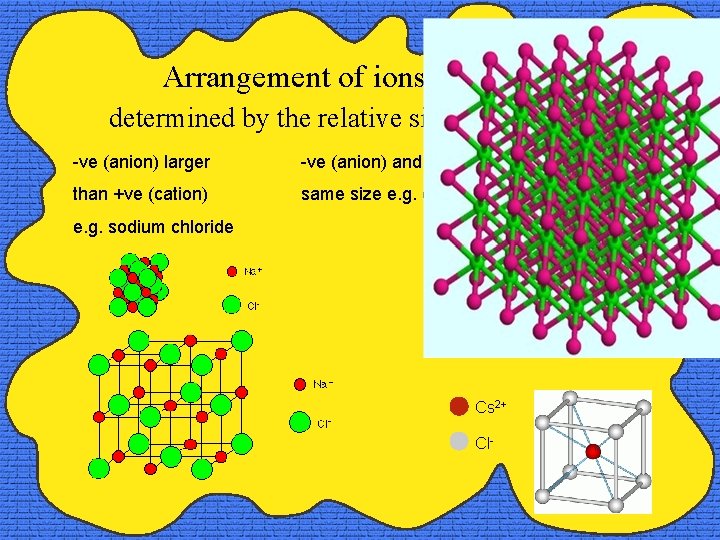
Arrangement of ions in lattices determined by the relative sizes of the 2 ions -ve (anion) larger -ve (anion) and +ve (cation) roughly the than +ve (cation) same size e. g. caesium chloride e. g. sodium chloride Cs 2+ Cl-
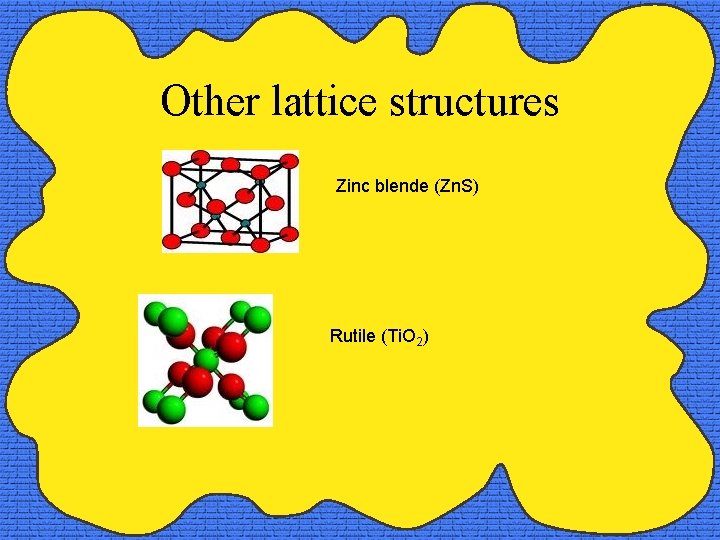
Other lattice structures Zinc blende (Zn. S) Rutile (Ti. O 2)
Ionic lattices Which type of structure, Cs. Cl or Na. Cl, are the following likely to have? 1. Lithium fluoride 2. Calcium sulphide 3. Potassium fluoride 4. Iron (II) oxide
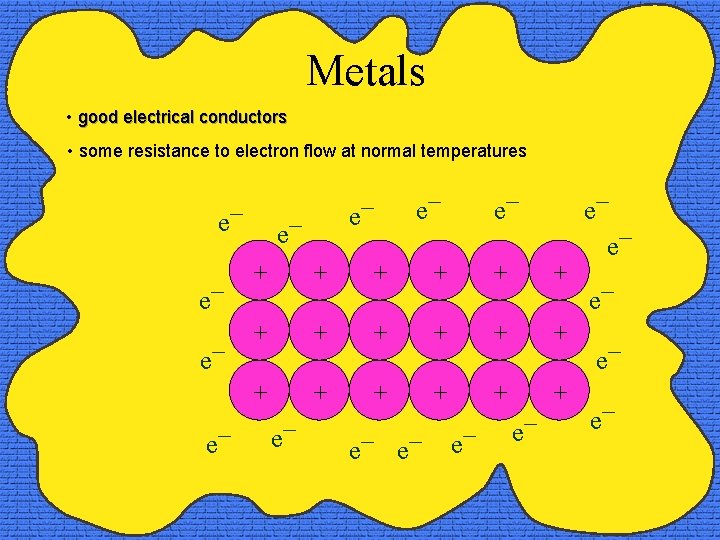
Metals • good electrical conductors • some resistance to electron flow at normal temperatures e e _ e _ e _ + + + e _ e e _ _ _ e + + + _ _ _ e e e
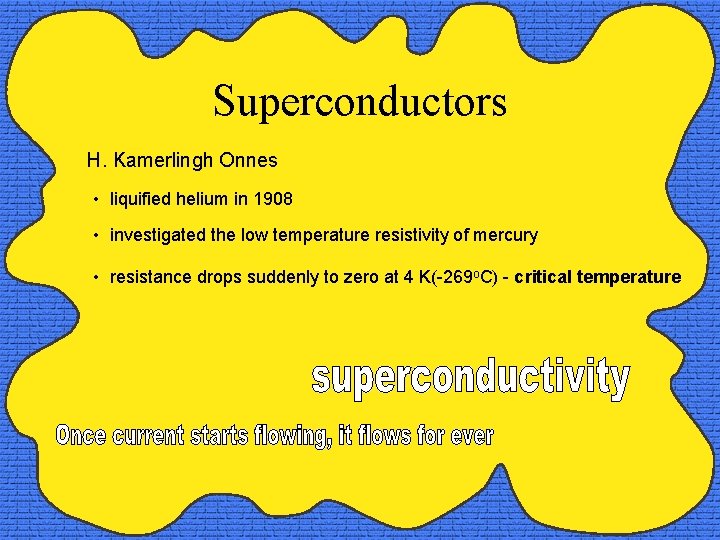
Superconductors H. Kamerlingh Onnes • liquified helium in 1908 • investigated the low temperature resistivity of mercury • resistance drops suddenly to zero at 4 K(-269 o. C) - critical temperature
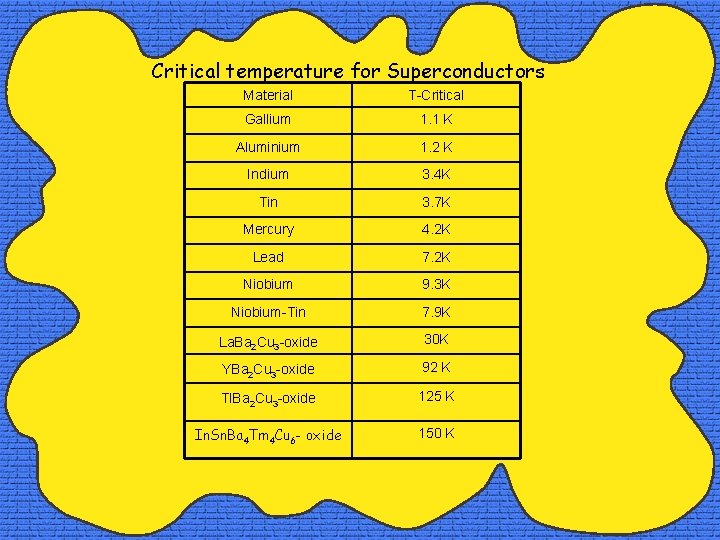
Critical temperature for Superconductors Material T-Critical Gallium 1. 1 K Aluminium 1. 2 K Indium 3. 4 K Tin 3. 7 K Mercury 4. 2 K Lead 7. 2 K Niobium 9. 3 K Niobium-Tin 7. 9 K La. Ba 2 Cu 3 -oxide 30 K YBa 2 Cu 3 -oxide 92 K Tl. Ba 2 Cu 3 -oxide 125 K In. Sn. Ba 4 Tm 4 Cu 6 - oxide 150 K
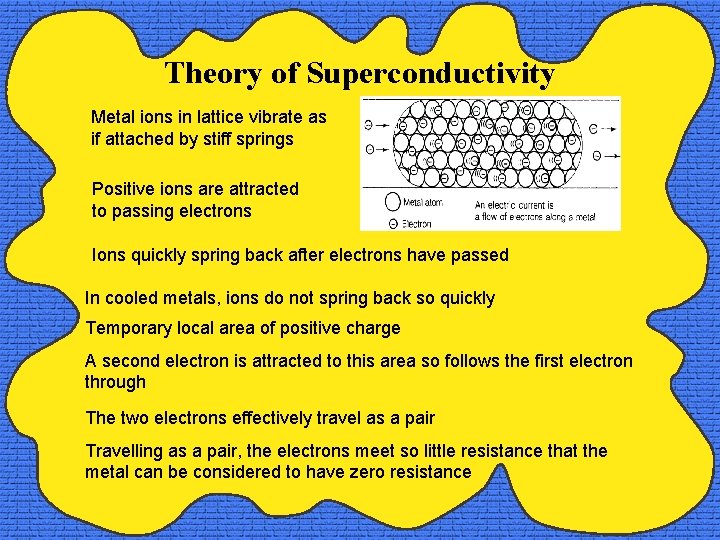
Theory of Superconductivity Metal ions in lattice vibrate as if attached by stiff springs Positive ions are attracted to passing electrons Ions quickly spring back after electrons have passed In cooled metals, ions do not spring back so quickly Temporary local area of positive charge A second electron is attracted to this area so follows the first electron through The two electrons effectively travel as a pair Travelling as a pair, the electrons meet so little resistance that the metal can be considered to have zero resistance
The Meissner Effect Superconductors are perfectly diamagnetic i. e. they repel a magnetic field; this is called the Meissner effect. Magnetic levitation More levitation!
Potential uses of superconductors Transport Å Maglev trains (Paris to Rome in just over 2 hours!) Å Frictionless bearings increasing efficiency of electrical motors and generators in electric-powered transport Å Smaller, lighter gyros in spacecraft and satellites
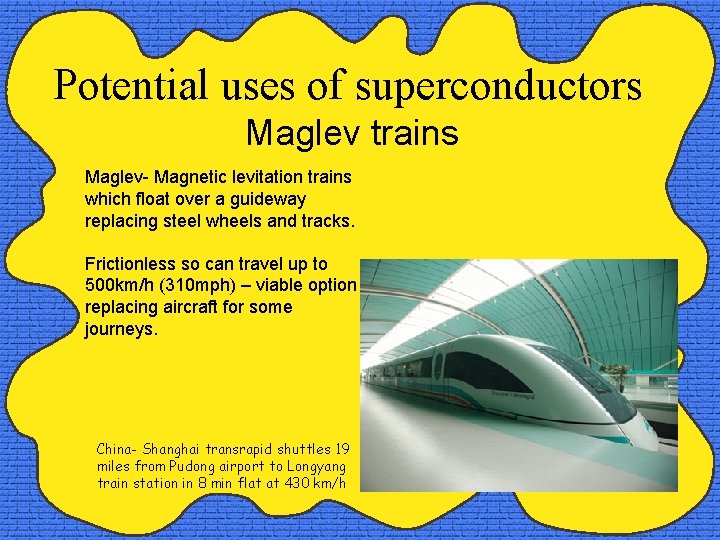
Potential uses of superconductors Maglev trains Maglev- Magnetic levitation trains which float over a guideway replacing steel wheels and tracks. Frictionless so can travel up to 500 km/h (310 mph) – viable option replacing aircraft for some journeys. China- Shanghai transrapid shuttles 19 miles from Pudong airport to Longyang train station in 8 min flat at 430 km/h
Potential uses of superconductors Maglev trains http: //video. google. com/videoplay? docid=6261317600045015385 Main components to the Japanese system are: Å A large electrical power source (a/c current) Å Metal coils lining a guideway or track Å Large guidance magnets attached to the train underside The magnetic field created by the electrified superconducting coils in the guideway walls and the track combine to levitate it 1 -10 cm.
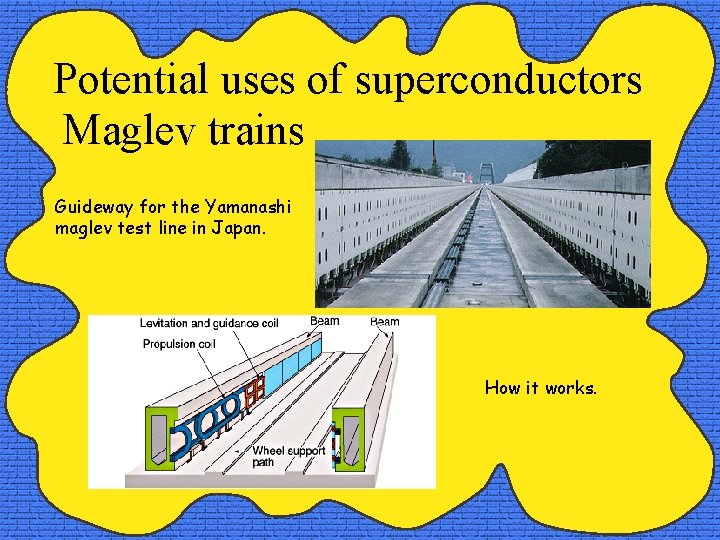
Potential uses of superconductors Maglev trains Guideway for the Yamanashi maglev test line in Japan. How it works.
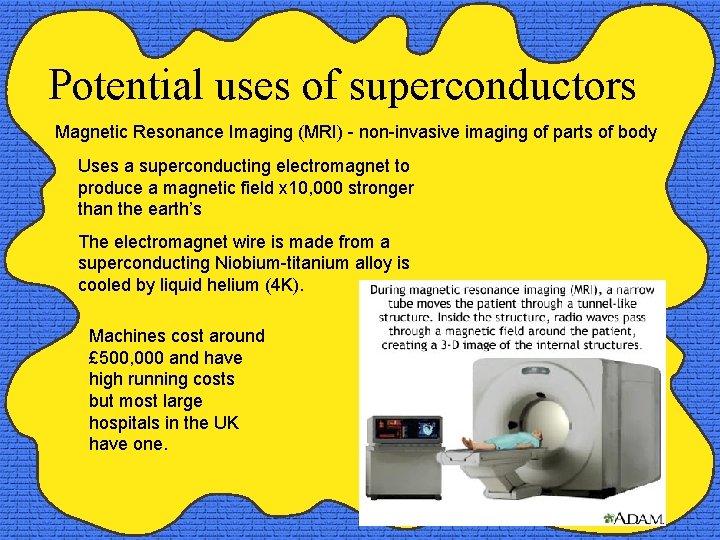
Potential uses of superconductors Magnetic Resonance Imaging (MRI) - non-invasive imaging of parts of body Uses a superconducting electromagnet to produce a magnetic field x 10, 000 stronger than the earth’s The electromagnet wire is made from a superconducting Niobium-titanium alloy is cooled by liquid helium (4 K). Machines cost around £ 500, 000 and have high running costs but most large hospitals in the UK have one.
Potential uses of superconductors Power transmission - reduce energy lost as heat (currently up to 10%)
- Slides: 15