
Ionic Compounds Writing Formulas and Names Formula Units
- Slides: 29
Ionic Compounds: Writing Formulas and Names Formula Units
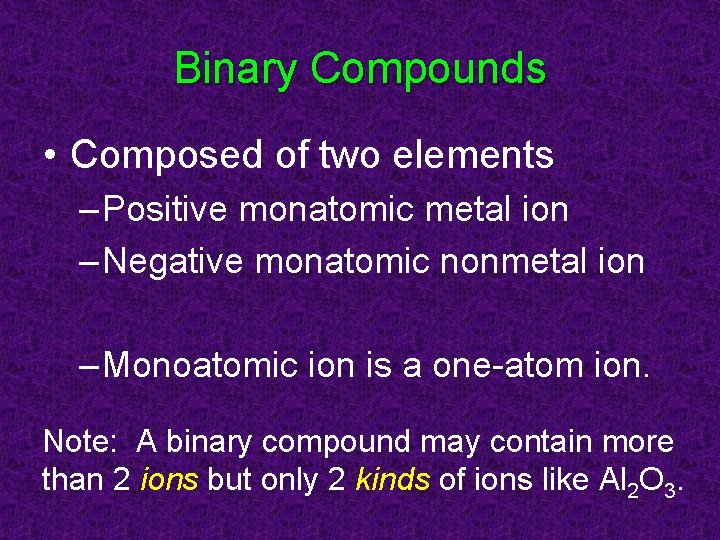
Binary Compounds • Composed of two elements – Positive monatomic metal ion – Negative monatomic nonmetal ion – Monoatomic ion is a one-atom ion. Note: A binary compound may contain more than 2 ions but only 2 kinds of ions like Al 2 O 3.
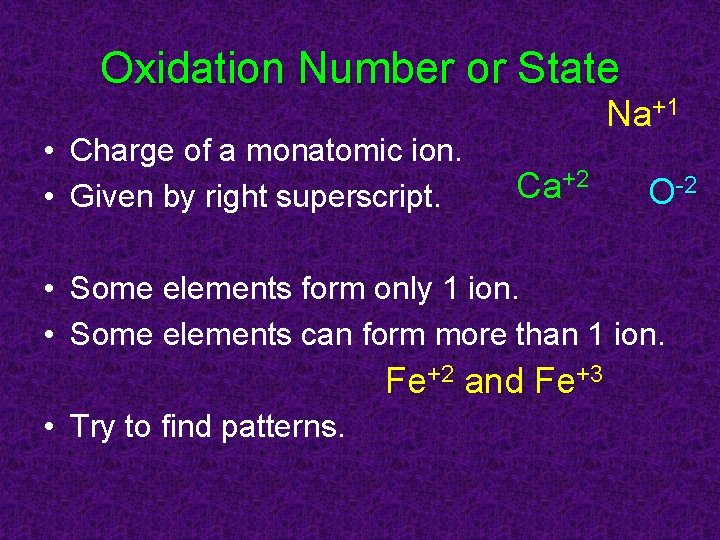
Oxidation Number or State • Charge of a monatomic ion. • Given by right superscript. Na+1 Ca+2 O-2 • Some elements form only 1 ion. • Some elements can form more than 1 ion. Fe+2 and Fe+3 • Try to find patterns.
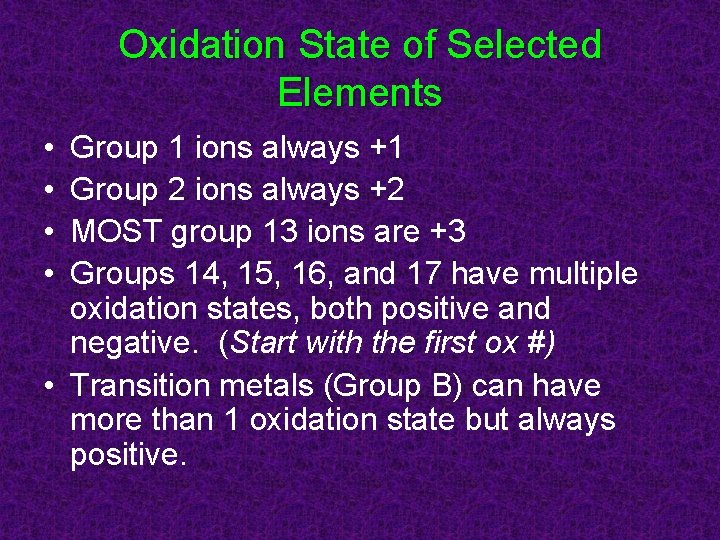
Oxidation State of Selected Elements • • Group 1 ions always +1 Group 2 ions always +2 MOST group 13 ions are +3 Groups 14, 15, 16, and 17 have multiple oxidation states, both positive and negative. (Start with the first ox #) • Transition metals (Group B) can have more than 1 oxidation state but always positive.
Writing Formulas for Binary Cmpds • The first rule in writing formulas for ionic compounds is POSITIVE ION FIRST But how do you get the subscripts? We will start by writing formulas from the ions.
Writing Formulas for Binary Cmpds • Compounds are electrically neutral – no charge. • Take the number of each kind of ion X the charge on the ion. Sum these terms. Should get 0. • Positive and negative charges must balance out.
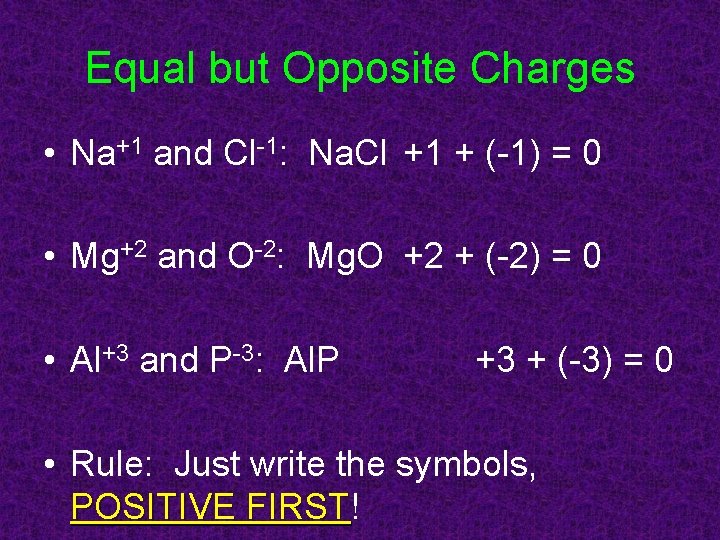
Equal but Opposite Charges • Na+1 and Cl-1: Na. Cl +1 + (-1) = 0 • Mg+2 and O-2: Mg. O +2 + (-2) = 0 • Al+3 and P-3: Al. P +3 + (-3) = 0 • Rule: Just write the symbols, POSITIVE FIRST! FIRST
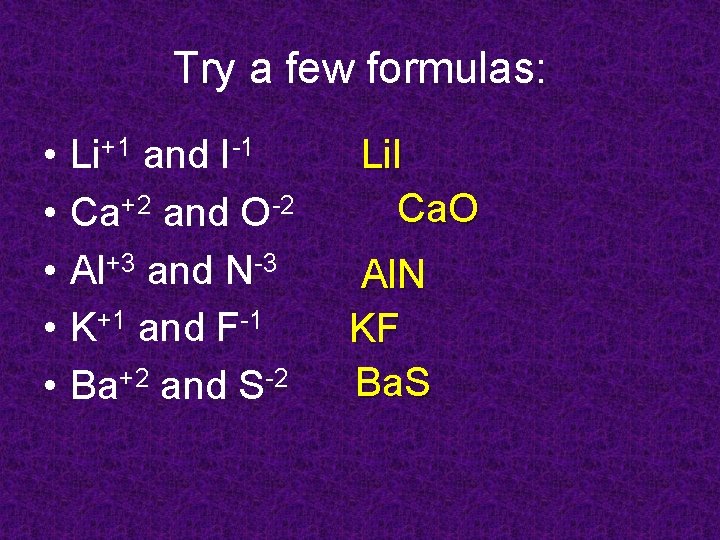
Try a few formulas: • • • Li+1 and I-1 Ca+2 and O-2 Al+3 and N-3 K+1 and F-1 Ba+2 and S-2 Li. I Ca. O Al. N KF Ba. S
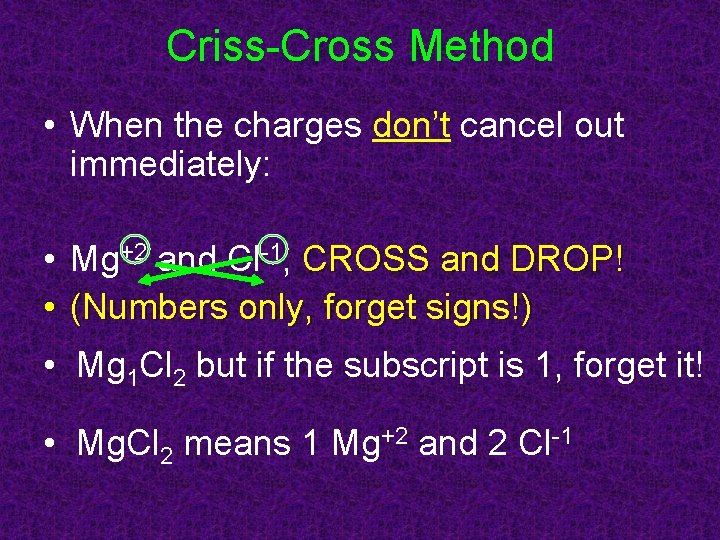
Criss-Cross Method • When the charges don’t cancel out immediately: • Mg+2 and Cl-1, CROSS and DROP! • (Numbers only, forget signs!) • Mg 1 Cl 2 but if the subscript is 1, forget it! • Mg. Cl 2 means 1 Mg+2 and 2 Cl-1
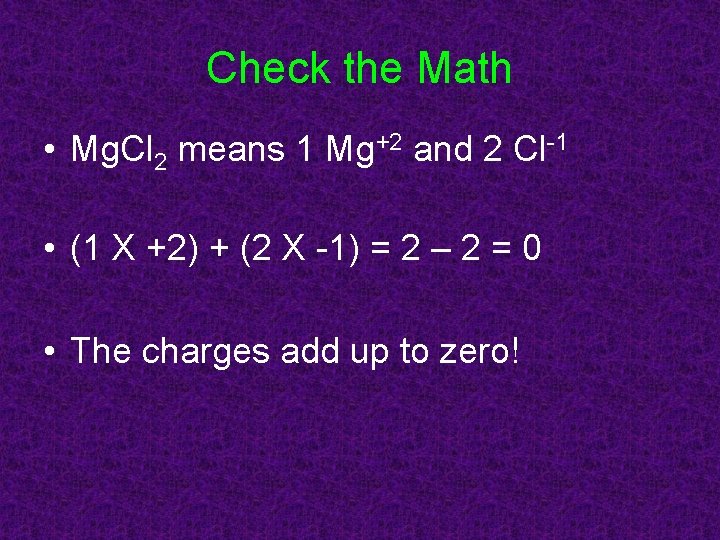
Check the Math • Mg. Cl 2 means 1 Mg+2 and 2 Cl-1 • (1 X +2) + (2 X -1) = 2 – 2 = 0 • The charges add up to zero!
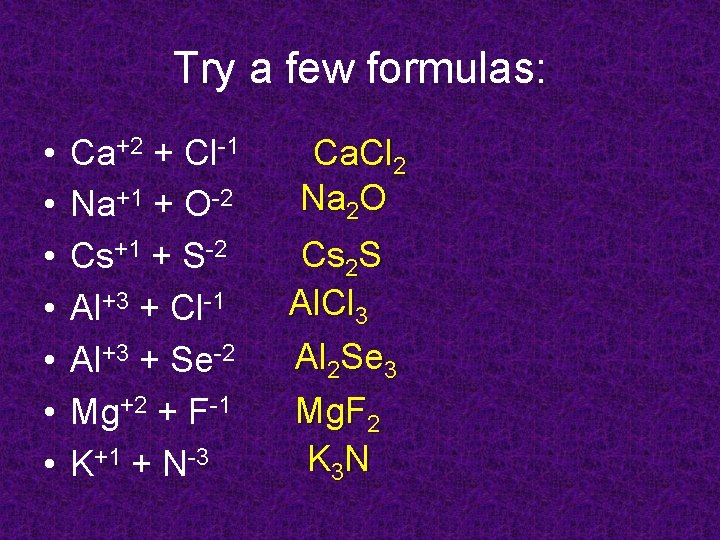
Try a few formulas: • • Ca+2 + Cl-1 Na+1 + O-2 Cs+1 + S-2 Al+3 + Cl-1 Al+3 + Se-2 Mg+2 + F-1 K+1 + N-3 Ca. Cl 2 Na 2 O Cs 2 S Al. Cl 3 Al 2 Se 3 Mg. F 2 K 3 N
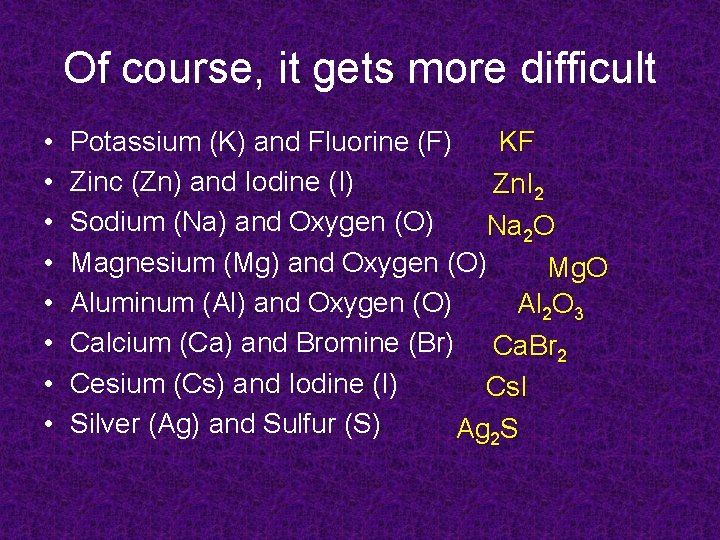
Of course, it gets more difficult • • KF Potassium (K) and Fluorine (F) Zinc (Zn) and Iodine (I) Zn. I 2 Sodium (Na) and Oxygen (O) Na 2 O Magnesium (Mg) and Oxygen (O) Mg. O Aluminum (Al) and Oxygen (O) Al 2 O 3 Calcium (Ca) and Bromine (Br) Ca. Br 2 Cesium (Cs) and Iodine (I) Cs. I Silver (Ag) and Sulfur (S) Ag 2 S
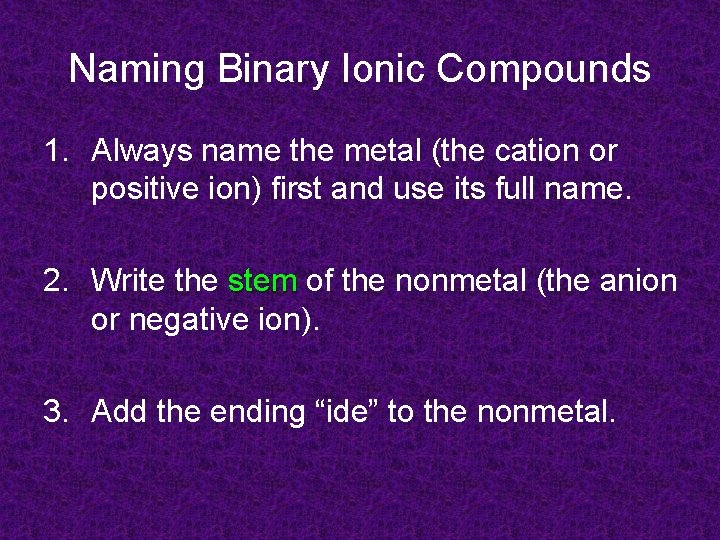
Naming Binary Ionic Compounds 1. Always name the metal (the cation or positive ion) first and use its full name. 2. Write the stem of the nonmetal (the anion or negative ion). 3. Add the ending “ide” to the nonmetal.
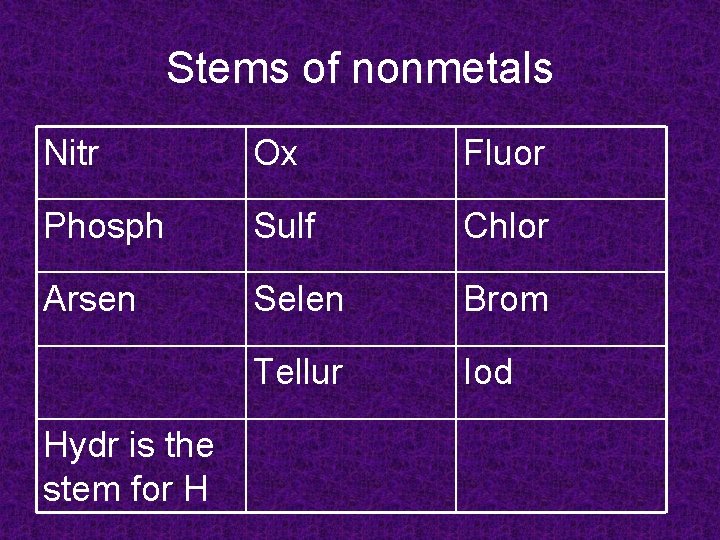
Stems of nonmetals Nitr Ox Fluor Phosph Sulf Chlor Arsen Selen Brom Tellur Iod Hydr is the stem for H
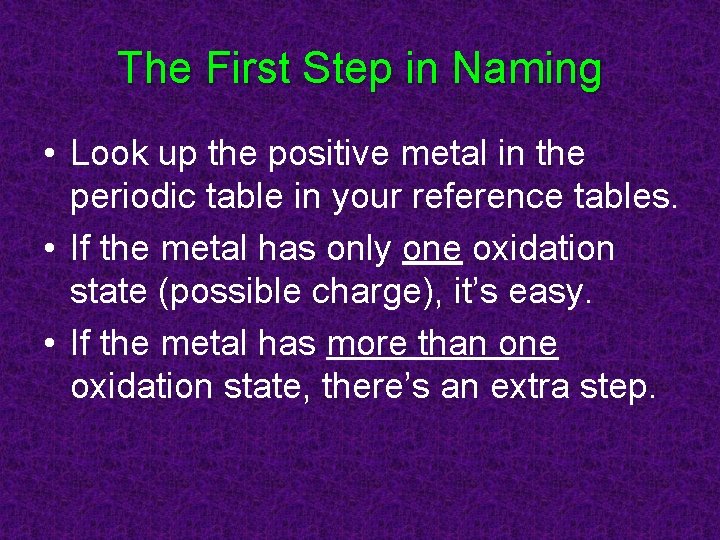
The First Step in Naming • Look up the positive metal in the periodic table in your reference tables. • If the metal has only one oxidation state (possible charge), it’s easy. • If the metal has more than one oxidation state, there’s an extra step.
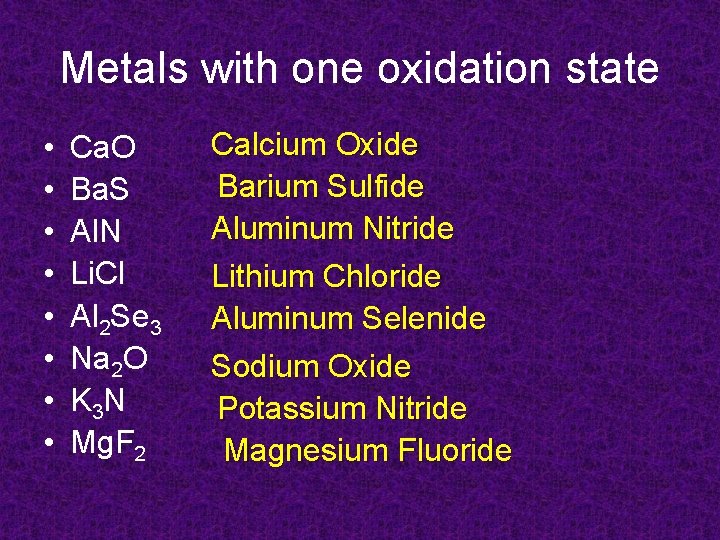
Metals with one oxidation state • • Ca. O Ba. S Al. N Li. Cl Al 2 Se 3 Na 2 O K 3 N Mg. F 2 Calcium Oxide Barium Sulfide Aluminum Nitride Lithium Chloride Aluminum Selenide Sodium Oxide Potassium Nitride Magnesium Fluoride
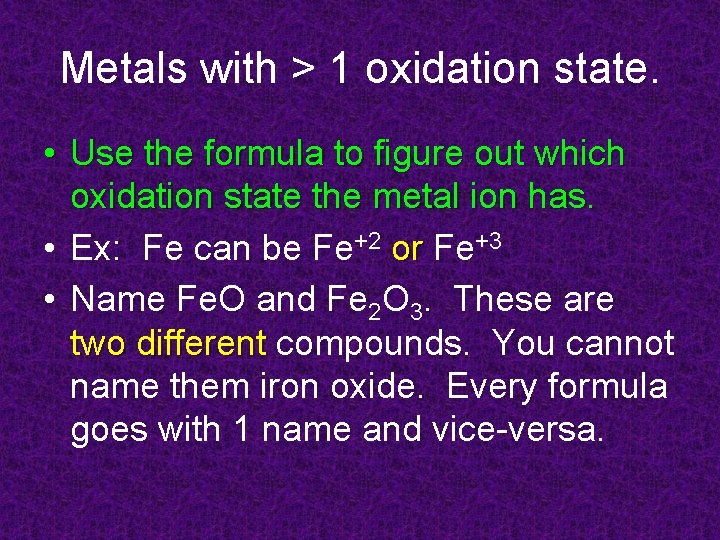
Metals with > 1 oxidation state. • Use the formula to figure out which oxidation state the metal ion has. • Ex: Fe can be Fe+2 or Fe+3 • Name Fe. O and Fe 2 O 3. These are two different compounds. You cannot name them iron oxide. Every formula goes with 1 name and vice-versa.
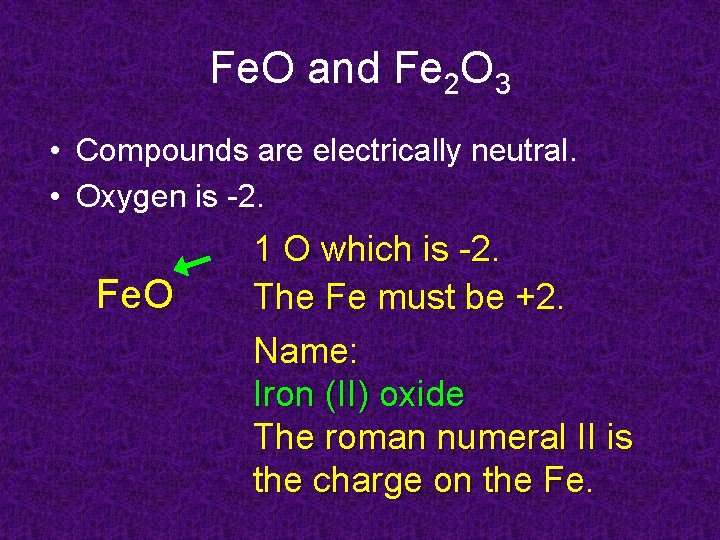
Fe. O and Fe 2 O 3 • Compounds are electrically neutral. • Oxygen is -2. Fe. O 1 O which is -2. The Fe must be +2. Name: Iron (II) oxide The roman numeral II is the charge on the Fe.
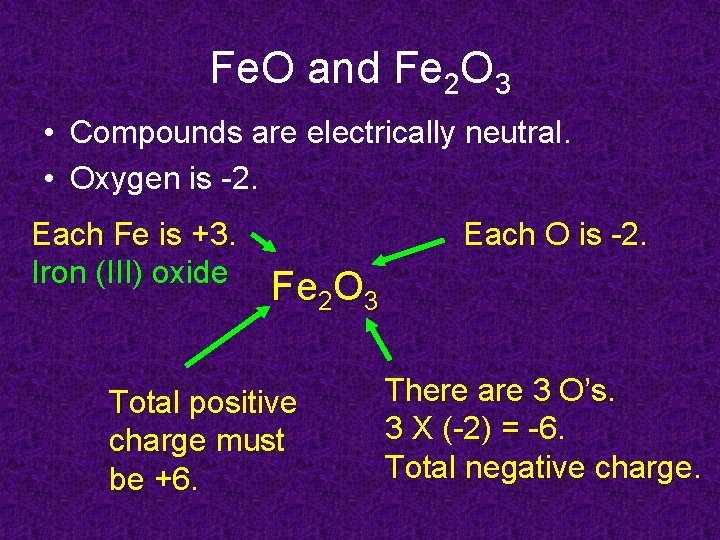
Fe. O and Fe 2 O 3 • Compounds are electrically neutral. • Oxygen is -2. Each Fe is +3. Iron (III) oxide Each O is -2. Fe 2 O 3 Total positive charge must be +6. There are 3 O’s. 3 X (-2) = -6. Total negative charge.
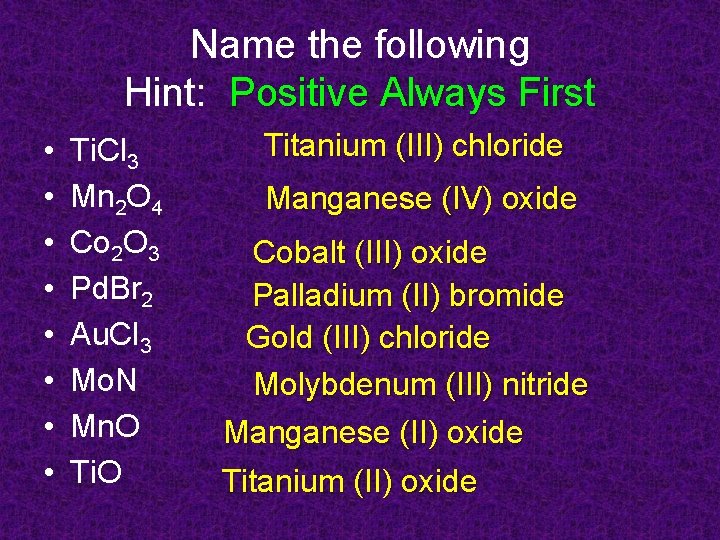
Name the following Hint: Positive Always First • • Ti. Cl 3 Mn 2 O 4 Co 2 O 3 Pd. Br 2 Au. Cl 3 Mo. N Mn. O Titanium (III) chloride Manganese (IV) oxide Cobalt (III) oxide Palladium (II) bromide Gold (III) chloride Molybdenum (III) nitride Manganese (II) oxide Titanium (II) oxide
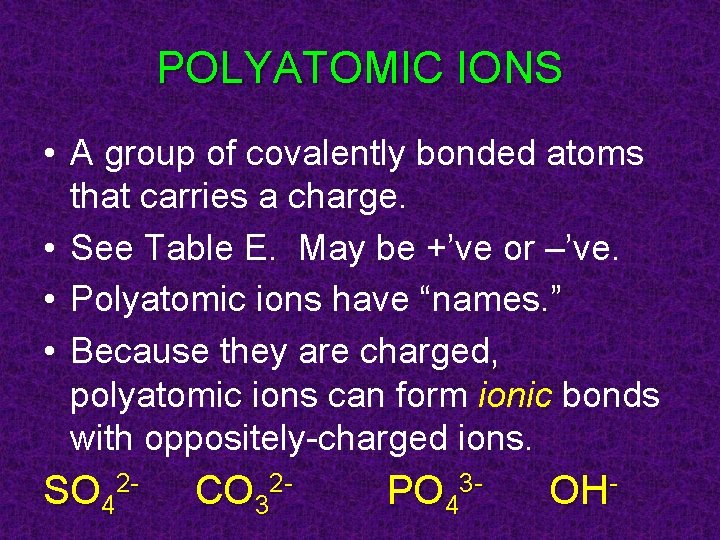
POLYATOMIC IONS • A group of covalently bonded atoms that carries a charge. • See Table E. May be +’ve or –’ve. • Polyatomic ions have “names. ” • Because they are charged, polyatomic ions can form ionic bonds with oppositely-charged ions. SO 42 - CO 32 - PO 43 - OH-
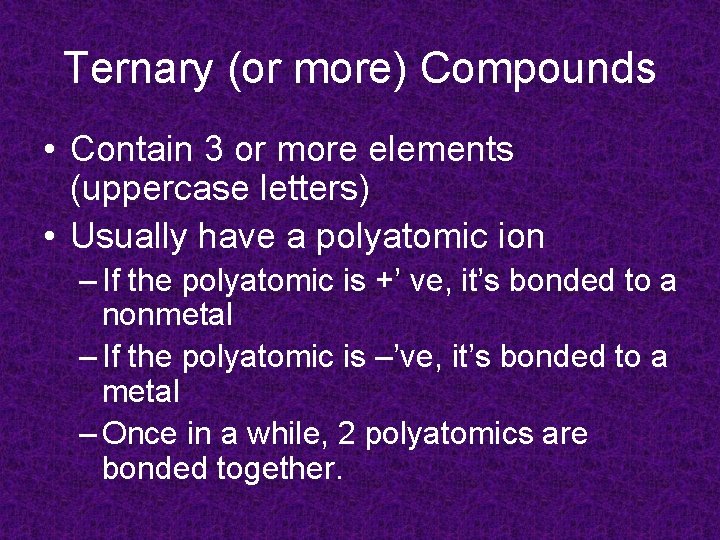
Ternary (or more) Compounds • Contain 3 or more elements (uppercase letters) • Usually have a polyatomic ion – If the polyatomic is +’ ve, it’s bonded to a nonmetal – If the polyatomic is –’ve, it’s bonded to a metal – Once in a while, 2 polyatomics are bonded together.
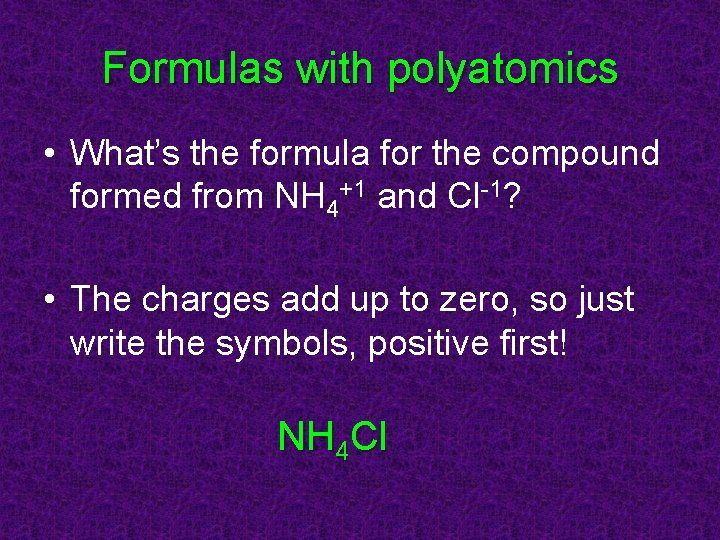
Formulas with polyatomics • What’s the formula for the compound formed from NH 4+1 and Cl-1? • The charges add up to zero, so just write the symbols, positive first! NH 4 Cl
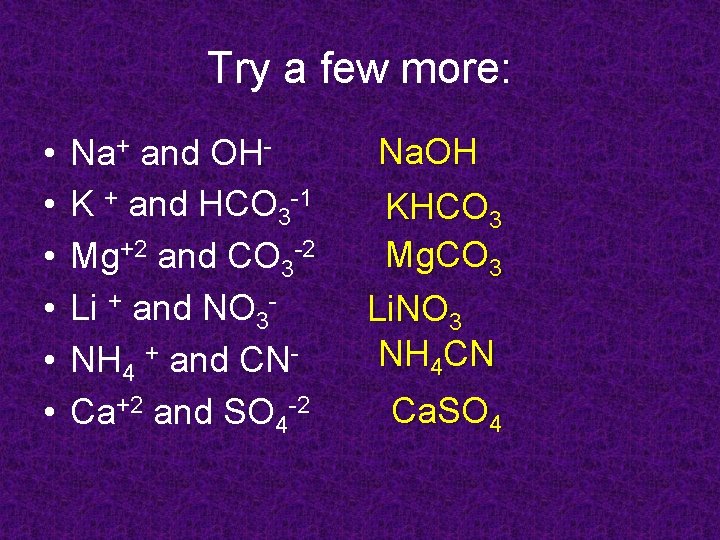
Try a few more: • • • Na+ and OHK + and HCO 3 -1 Mg+2 and CO 3 -2 Li + and NO 3 NH 4 + and CNCa+2 and SO 4 -2 Na. OH KHCO 3 Mg. CO 3 Li. NO 3 NH 4 CN Ca. SO 4
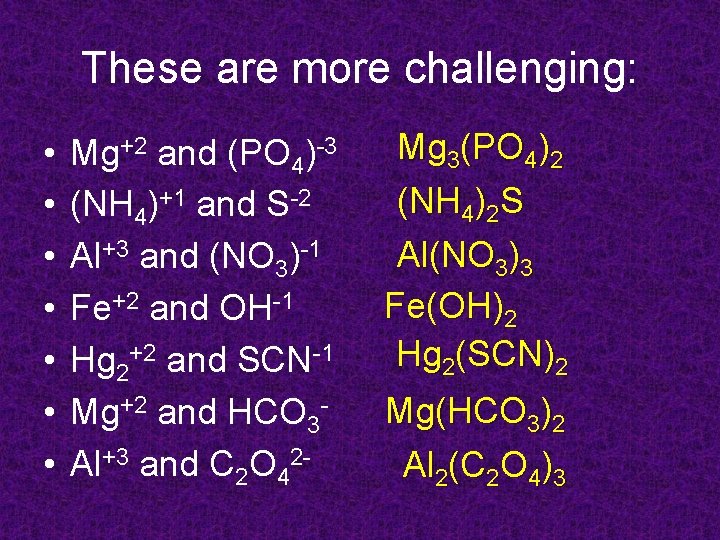
These are more challenging: • • Mg+2 and (PO 4)-3 (NH 4)+1 and S-2 Al+3 and (NO 3)-1 Fe+2 and OH-1 Hg 2+2 and SCN-1 Mg+2 and HCO 3 Al+3 and C 2 O 42 - Mg 3(PO 4)2 (NH 4)2 S Al(NO 3)3 Fe(OH)2 Hg 2(SCN)2 Mg(HCO 3)2 Al 2(C 2 O 4)3
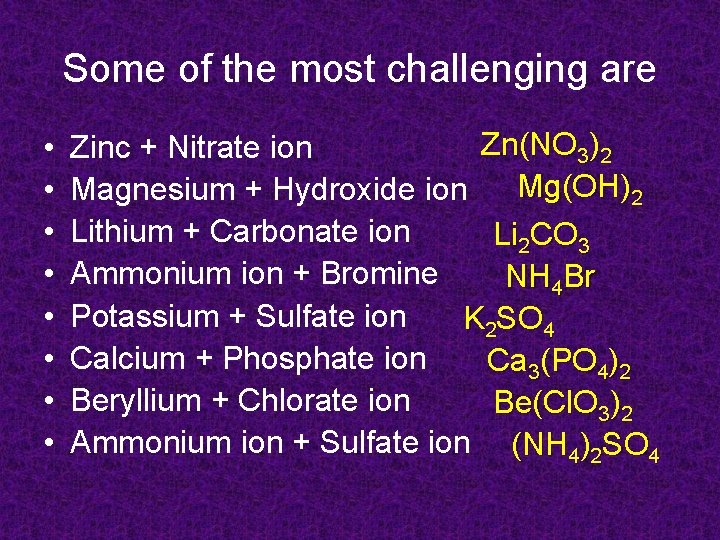
Some of the most challenging are • • Zn(NO 3)2 Zinc + Nitrate ion Mg(OH)2 Magnesium + Hydroxide ion Lithium + Carbonate ion Li 2 CO 3 Ammonium ion + Bromine NH 4 Br Potassium + Sulfate ion K 2 SO 4 Calcium + Phosphate ion Ca 3(PO 4)2 Beryllium + Chlorate ion Be(Cl. O 3)2 Ammonium ion + Sulfate ion (NH 4)2 SO 4
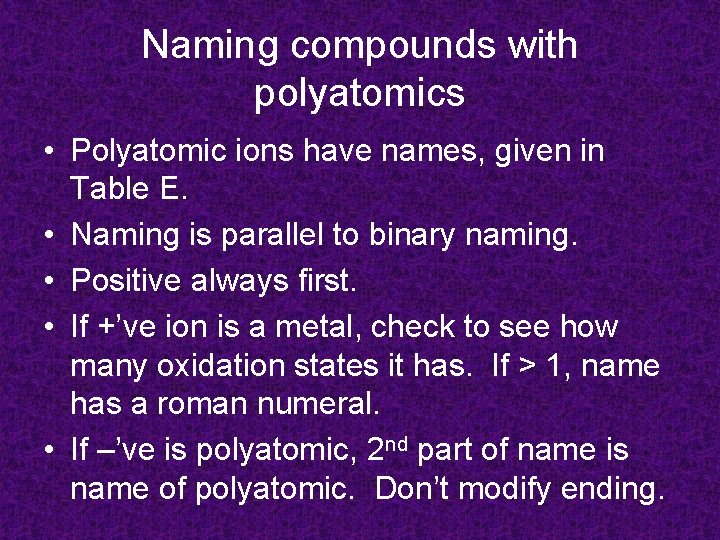
Naming compounds with polyatomics • Polyatomic ions have names, given in Table E. • Naming is parallel to binary naming. • Positive always first. • If +’ve ion is a metal, check to see how many oxidation states it has. If > 1, name has a roman numeral. • If –’ve is polyatomic, 2 nd part of name is name of polyatomic. Don’t modify ending.
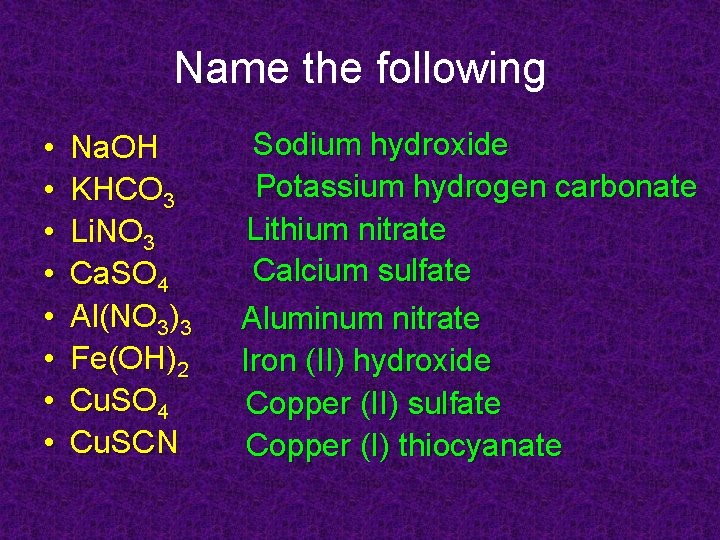
Name the following • • Na. OH KHCO 3 Li. NO 3 Ca. SO 4 Al(NO 3)3 Fe(OH)2 Cu. SO 4 Cu. SCN Sodium hydroxide Potassium hydrogen carbonate Lithium nitrate Calcium sulfate Aluminum nitrate Iron (II) hydroxide Copper (II) sulfate Copper (I) thiocyanate
Summary for Ionic Compounds • Name = metal + stem of nonmetal + ide. • If the metal has more than 1 oxidation state, it has a roman numeral in the name. • Formula: positive first, always. • Compounds are electrically neutral. • Use oxidation states you know, like O, to figure out the oxidation states that have more than 1 possibility.