
Ionic Compounds Why are they formed How do
- Slides: 12
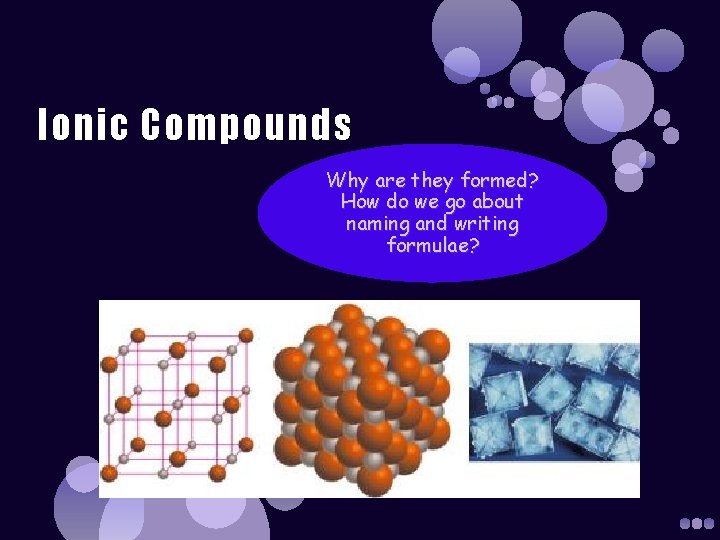
Ionic Compounds Why are they formed? How do we go about naming and writing formulae?
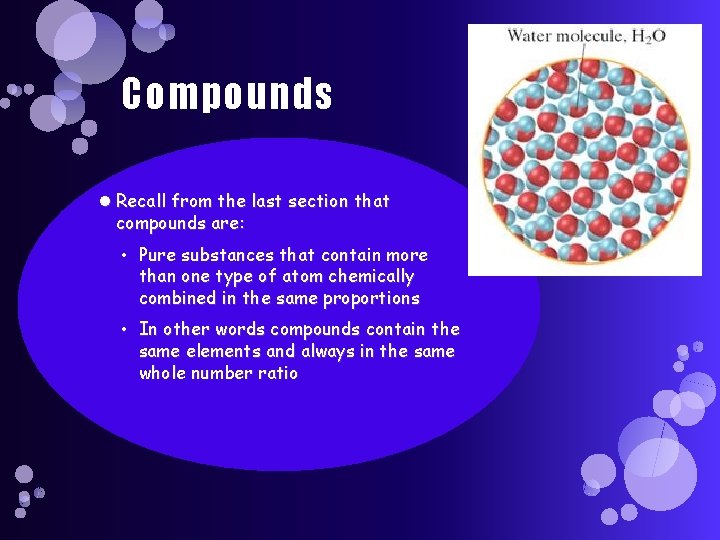
Compounds Recall from the last section that compounds are: • Pure substances that contain more than one type of atom chemically combined in the same proportions • In other words compounds contain the same elements and always in the same whole number ratio
Chemical Formulae Like elemental symbols, scientists use chemical formulae to provide information about compounds: • Describes what elements are present in a chemical compound • Gives the relative proportions of those elements Examples: 1. Ca. Cl 2 - contains one atom of calcium and 2 atoms of chlorine 2. Mg(OH)2 - contains one atom of magnesium, two atoms of oxygen, and two atoms of hydrogen
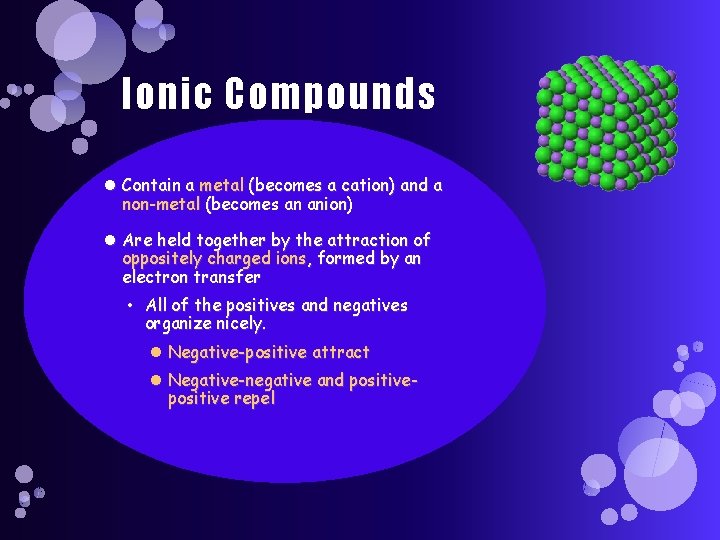
Ionic Compounds Contain a metal (becomes a cation) and a non-metal (becomes an anion) Are held together by the attraction of oppositely charged ions, formed by an electron transfer • All of the positives and negatives organize nicely. Negative-positive attract Negative-negative and positive repel
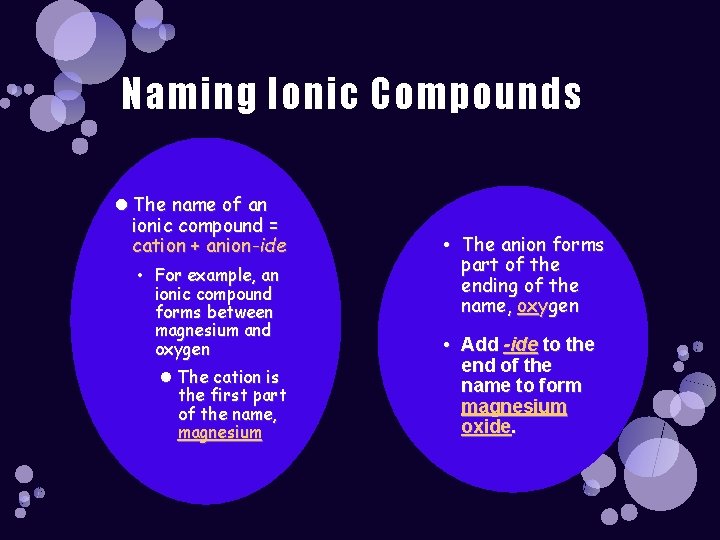
Naming Ionic Compounds The name of an ionic compound = cation + anion-ide • For example, an ionic compound forms between magnesium and oxygen The cation is the first part of the name, magnesium • The anion forms part of the ending of the name, oxygen • Add -ide to the end of the name to form magnesium oxide.
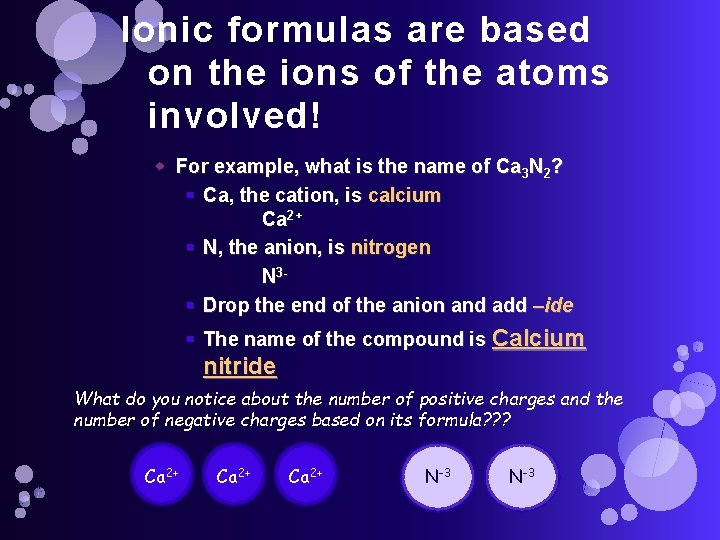
Ionic formulas are based on the ions of the atoms involved! w For example, what is the name of Ca 3 N 2? § Ca, the cation, is calcium Ca 2+ § N, the anion, is nitrogen N 3§ Drop the end of the anion and add –ide § The name of the compound is Calcium nitride What do you notice about the number of positive charges and the number of negative charges based on its formula? ? ? Ca 2+ N-3
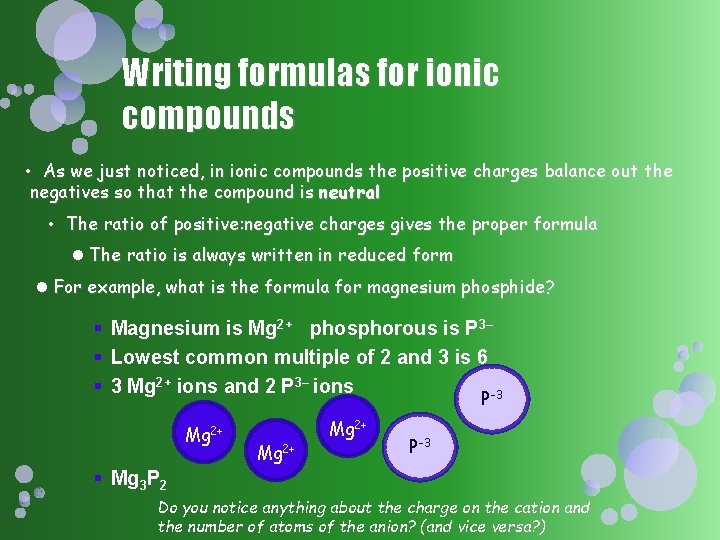
Writing formulas for ionic compounds • As we just noticed, in ionic compounds the positive charges balance out the negatives so that the compound is neutral • The ratio of positive: negative charges gives the proper formula The ratio is always written in reduced form For example, what is the formula for magnesium phosphide? § Magnesium is Mg 2+ phosphorous is P 3– § Lowest common multiple of 2 and 3 is 6 § 3 Mg 2+ ions and 2 P 3– ions -3 P Mg 2+ P-3 § Mg 3 P 2 Do you notice anything about the charge on the cation and the number of atoms of the anion? (and vice versa? )
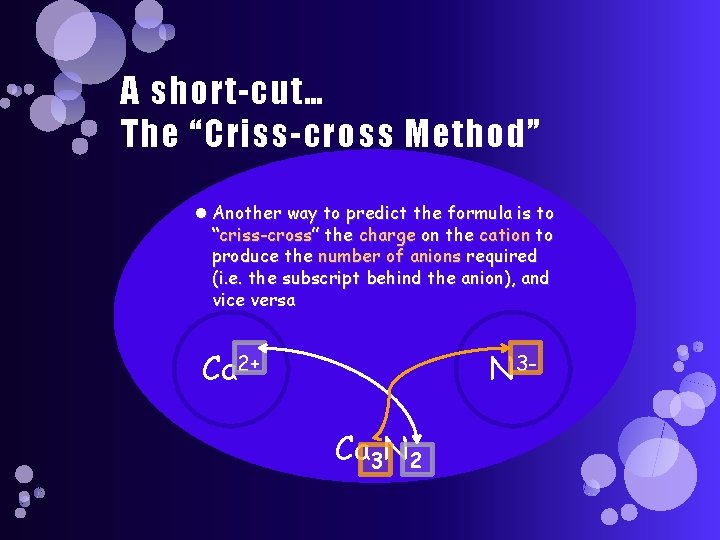
A short-cut… The “Criss-cross Method” Another way to predict the formula is to “criss-cross” the charge on the cation to produce the number of anions required (i. e. the subscript behind the anion), and vice versa Ca 2+ N 3 Ca 3 N 2
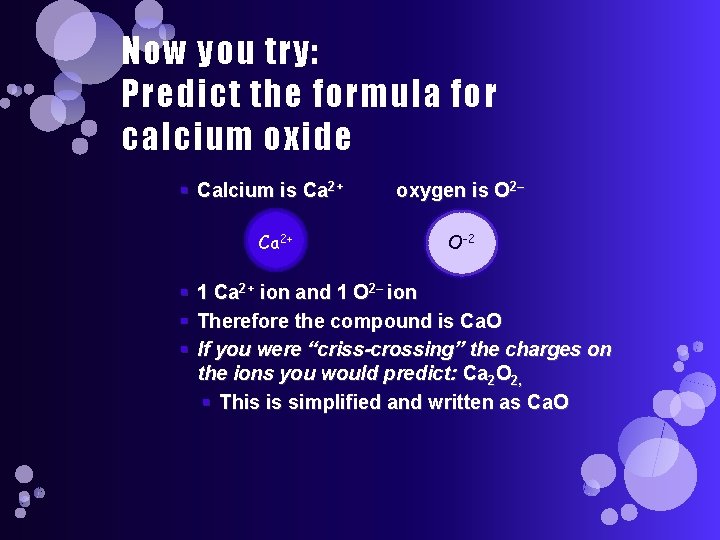
Now you try: Predict the formula for calcium oxide § Calcium is Ca 2+ § § § oxygen is O 2– O-2 1 Ca 2+ ion and 1 O 2– ion Therefore the compound is Ca. O If you were “criss-crossing” the charges on the ions you would predict: Ca 2 O 2, § This is simplified and written as Ca. O
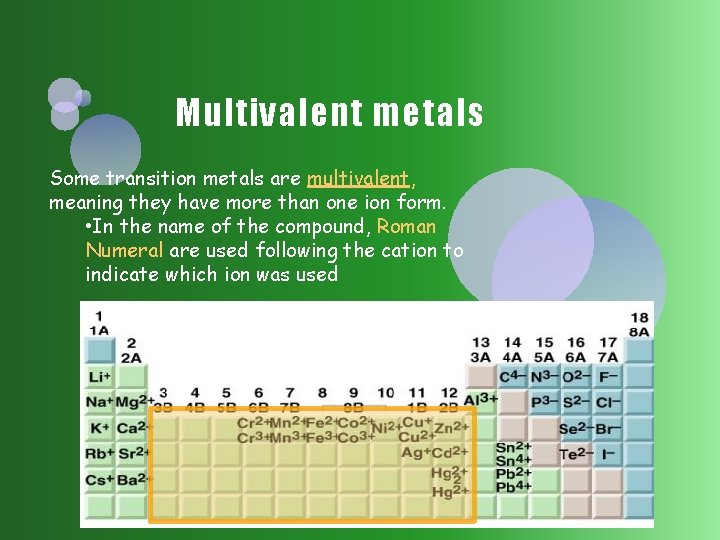
Multivalent metals Some transition metals are multivalent, meaning they have more than one ion form. • In the name of the compound, Roman Numeral are used following the cation to indicate which ion was used
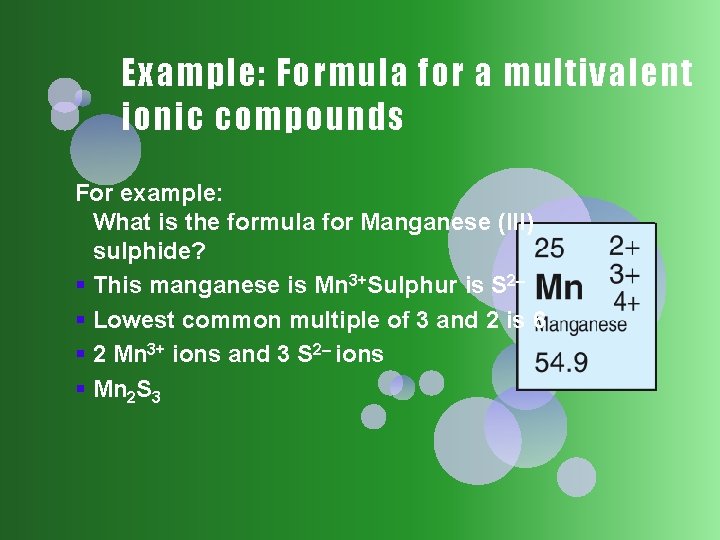
Example: Formula for a multivalent ionic compounds For example: What is the formula for Manganese (III) sulphide? § This manganese is Mn 3+Sulphur is S 2– § Lowest common multiple of 3 and 2 is 6 § 2 Mn 3+ ions and 3 S 2– ions § Mn 2 S 3
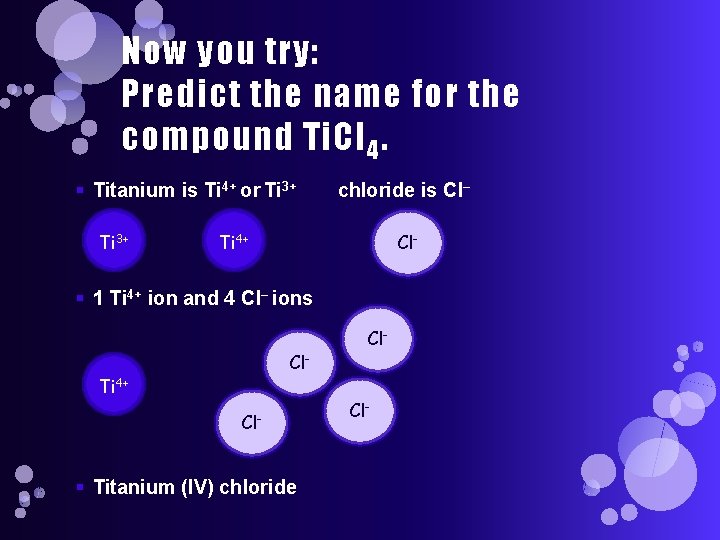
Now you try: Predict the name for the compound Ti. Cl 4. § Titanium is Ti 4+ or Ti 3+ chloride is Cl– Ti 4+ Cl- § 1 Ti 4+ ion and 4 Cl– ions Cl- Ti 4+ Cl- § Titanium (IV) chloride Cl-