
Ionic Compounds Unit 2 Chapter 5 Ionic Compound


- Slides: 12
Ionic Compounds Unit 2 – Chapter 5 Ionic Compound Names
Review (1 of 5) �Ion: charged atoms. �How does this happen? Add or remove electrons…
Review (2 of 5) � CATION-- � ANION— Positive Charge Negative Charge. Lose Electrons Gain Electrons. Usually Metals Usually Nonmetals ▪ Plussycat ▪ Ant-ion
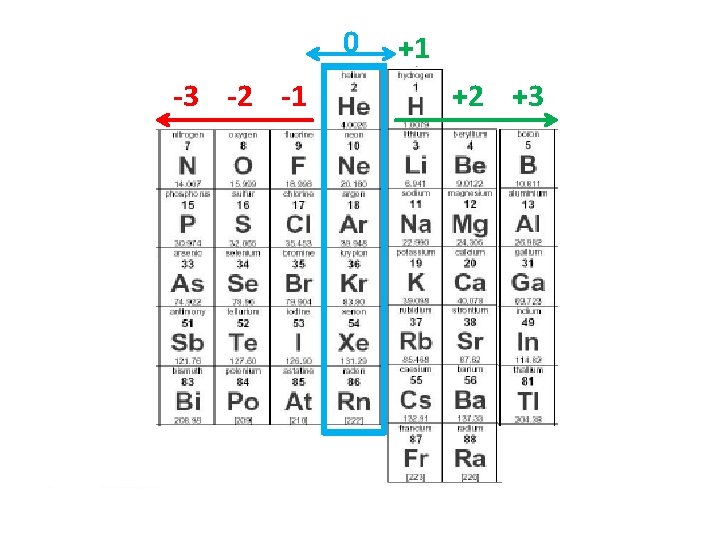
0 -3 -2 -1 +1 +2 +3
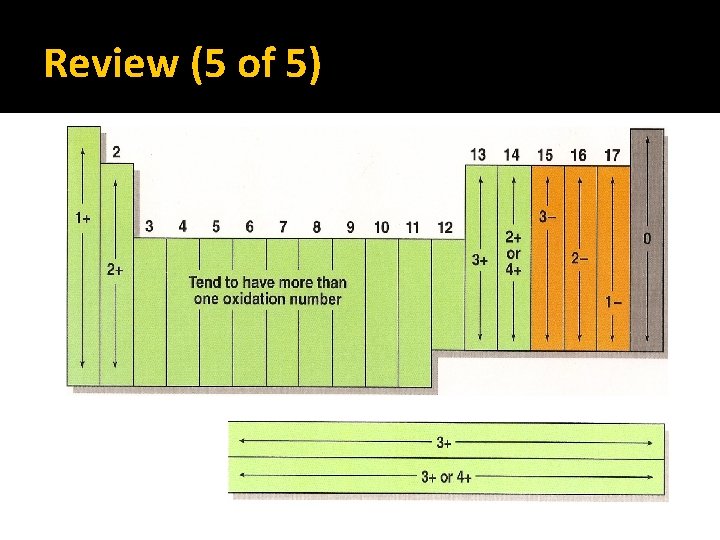
Review (5 of 5)
Electrically Neutral = ZERO �Cation + Anion = Compound �REMEMBER: Compounds are NEUTRAL. Total Cation Charge = Total Anion Charge. �(0) net charge = Electroneutrality.
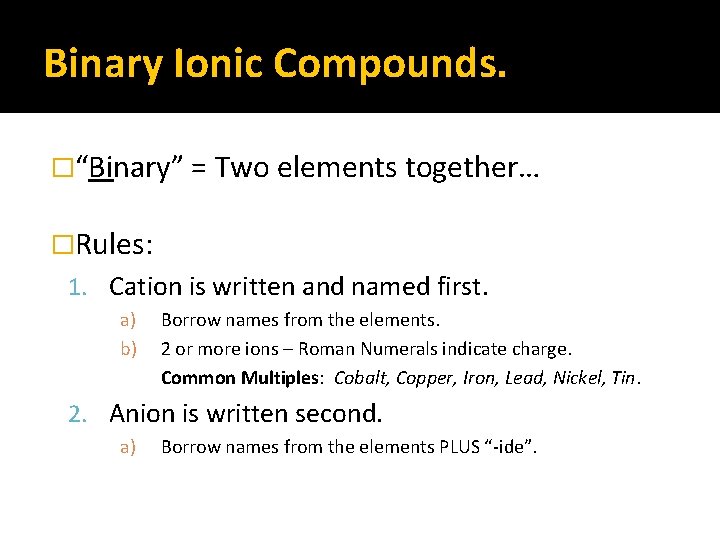
Binary Ionic Compounds. �“Binary” = Two elements together… �Rules: 1. Cation is written and named first. a) b) Borrow names from the elements. 2 or more ions – Roman Numerals indicate charge. Common Multiples: Cobalt, Copper, Iron, Lead, Nickel, Tin. 2. Anion is written second. a) Borrow names from the elements PLUS “-ide”.
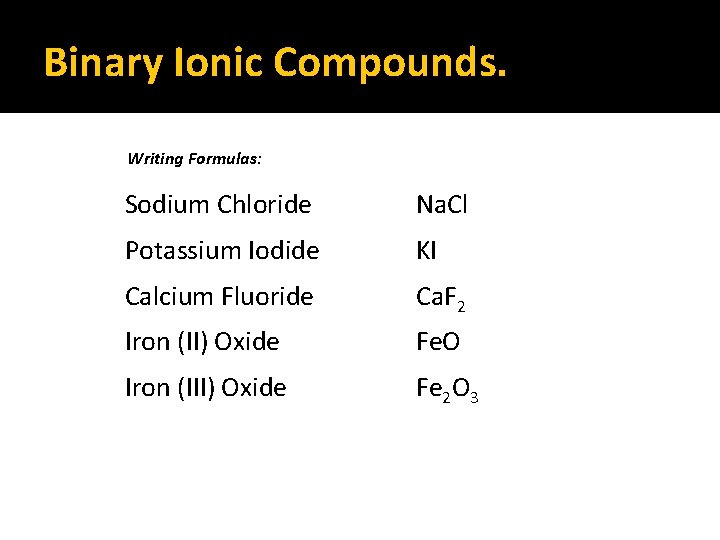
Binary Ionic Compounds. Writing Formulas: Sodium Chloride Na. Cl Potassium Iodide KI Calcium Fluoride Ca. F 2 Iron (II) Oxide Fe. O Iron (III) Oxide Fe 2 O 3
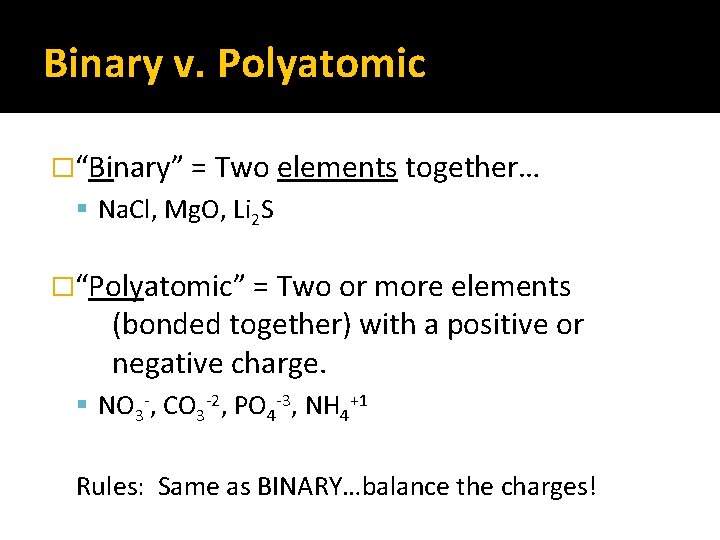
Binary v. Polyatomic �“Binary” = Two elements together… Na. Cl, Mg. O, Li 2 S �“Polyatomic” = Two or more elements (bonded together) with a positive or negative charge. NO 3 -, CO 3 -2, PO 4 -3, NH 4+1 Rules: Same as BINARY…balance the charges!
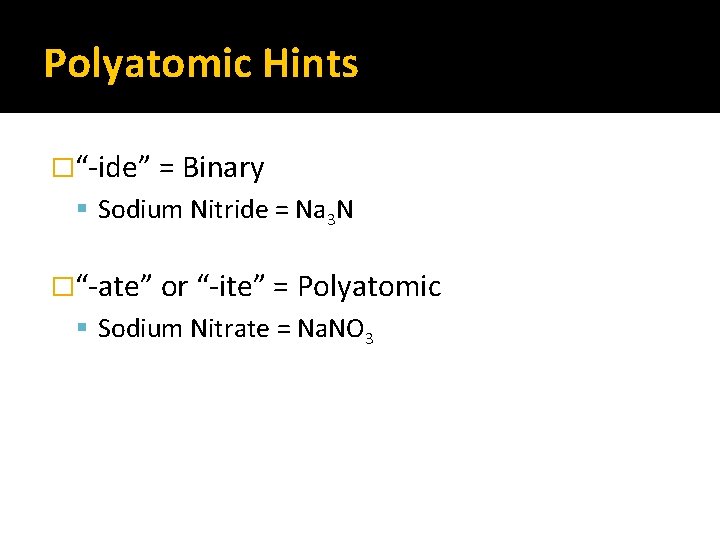
Polyatomic Hints �“-ide” = Binary Sodium Nitride = Na 3 N �“-ate” or “-ite” = Polyatomic Sodium Nitrate = Na. NO 3
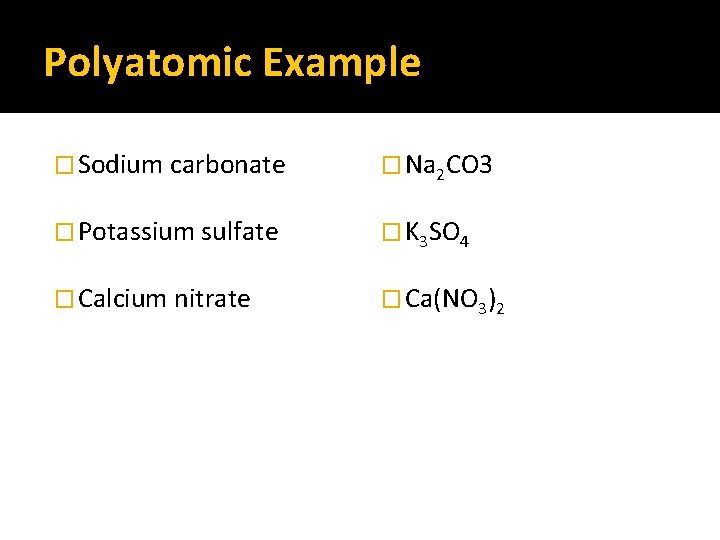
Polyatomic Example � Sodium carbonate � Na 2 CO 3 � Potassium sulfate � K 3 SO 4 � Calcium nitrate � Ca(NO 3)2