
Ionic Compounds Ionic bonds Caused by large Electronegativity
Ionic Compounds (“Ionic bonds”) • Caused by large Electronegativity difference (Δ EN) between two atoms • Using greater than or equal to 1. 7 (Δ EN ≥ 1. 7 ) • Not a True Chemical Bond (Def: sharing valence electrons) Then what is it? ? Answer: • It is actually 2 “things” • • Moving of electrons occurs when atoms become ions Coulombic force holding cations and anions together • Therefore, BASE UNIT IS IONS
6. 3 What are Ions? • An ion is an atom or group of atoms that has a positive or negative charge. • A cation is an ion with a positive charge. • An anion is an ion with a negative charge. • Why do atom form ions? • Δ EN ≥ 1. 7 between the two atoms • Obeying the Rule of Eight (also called Octet Rule) • Rule of Eight After bonding (movement of valence electrons), all “atoms” want eight valence electrons in their highest energy level (“valence shell”) except H (2 ve-), Be (4 ve-), B (6 ve-)) and elements in the 3 rd energy level or greater than can exceed eight.
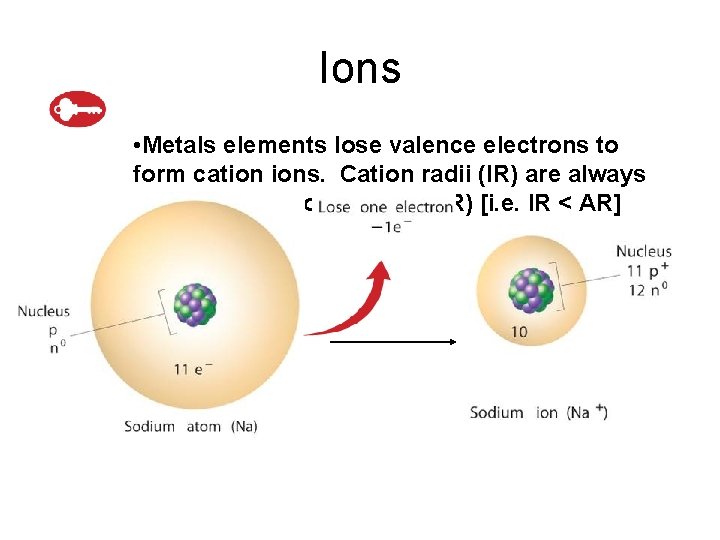
6. 3 Ions • Metals elements lose valence electrons to form cation ions. Cation radii (IR) are always smaller than atomic radii (AR) [i. e. IR < AR]
As the previous slide shows, Why does sodium atom lose only one valence electron to form sodium ion (called cation)? Answer: • It needs to follow Rule of Eight. • Sodium atom electron configuration: Na : 1 s 22 p 63 s 1 • After it lose 1 electron to form the sodium ion (Na 1+), electron configuration is Na 1+ : 1 s 22 p 6 • So, electron configuration of sodium ion has a “full valence energy level or shell” • All metals will do same procedure (lose veto form positive ions or cations)
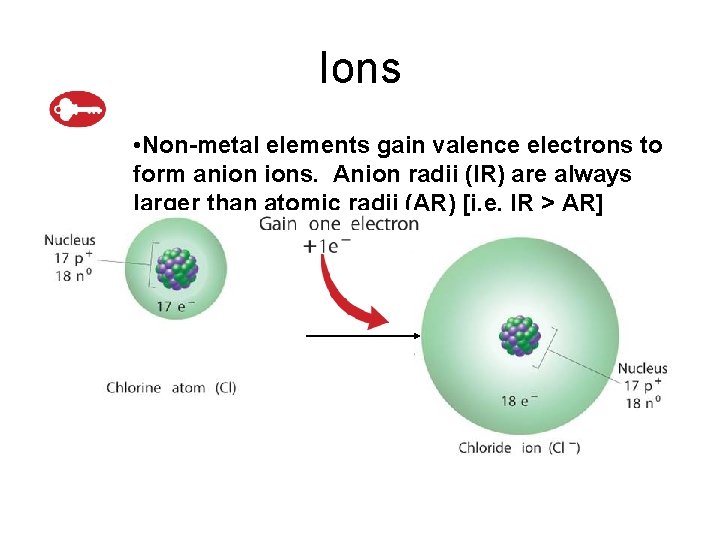
6. 3 Ions • Non-metal elements gain valence electrons to form anion ions. Anion radii (IR) are always larger than atomic radii (AR) [i. e. IR > AR]
As the previous slide shows, Why does chloride atom gain only one valence electron to form chlorine ion called chloride ion (called anion)? Answer: • It needs to follow Rule of Eight. • Chlorine atom electron configuration: Cl 1 s 22 p 63 s 13 p 5 • After it gain 1 electron to form the chloride ion (Cl 1 -), electron configuration is Cl 1 - : 1 s 22 p 63 p 6 • So, electron configuration of chloride ion has a “full valence energy level or shell” • All non-metals will do same procedure (gain ve- to form negative ions or anions)
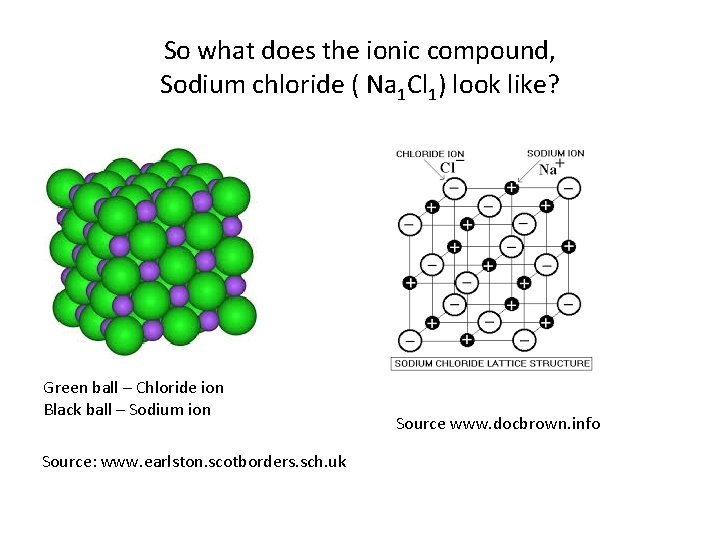
So what does the ionic compound, Sodium chloride ( Na 1 Cl 1) look like? Green ball – Chloride ion Black ball – Sodium ion Source: www. earlston. scotborders. sch. uk Source www. docbrown. info
Summary • When 2 atom (with Δ EN ≥ 1. 7) get near each other, one atom gains ve- to form the anion and other atom loses ve-to form the cation. • “Ionic bond does not really exist, what it is valence electrons moving to form ions and then ions “sticking” together via coulombic force. • How many ve- gained/lost by each atom is governed by the Rule of Eight. • Other Powerpoint Presentation will explain more.
- Slides: 8