
Ionic Compounds and Naming Covalent bonds share electrons
Ionic Compounds and Naming Covalent bonds share electrons Ionic bonds transfer electrons
Ionic Bonds • Ionic compounds - made when two ions join. • Are due to an electrostatic attraction between ions of opposite charge. • Cations are positively charged ions (metals). • Anions are negatively charged ions (non-metals).
Chemical Names, Symbols and Formulas. We must have a uniform way to represent all chemicals. .
Names are often based on a property or a discoverer. • Sodium - Arabic word “suda” means headache. • Hafnium - discovered in Copenhagen. (Latin = Hafnia) • Lithium - Gk “lithos” means rock or stone • Curium - for Marie Curie.
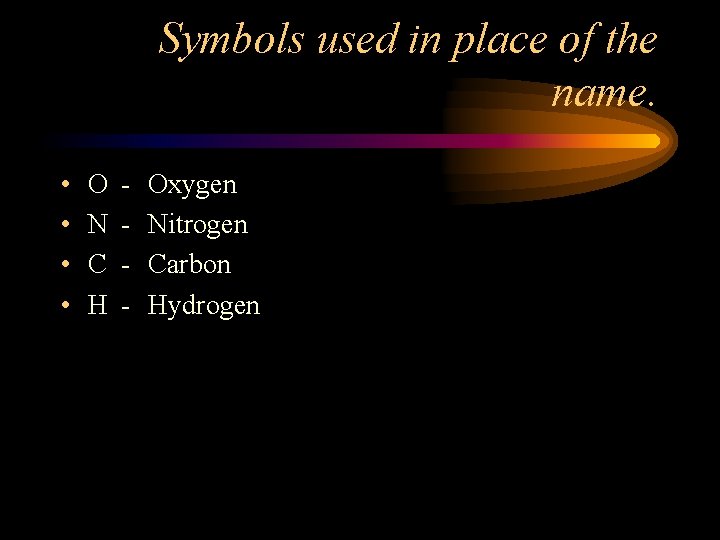
Symbols used in place of the name. • • O N C H - Oxygen Nitrogen Carbon Hydrogen
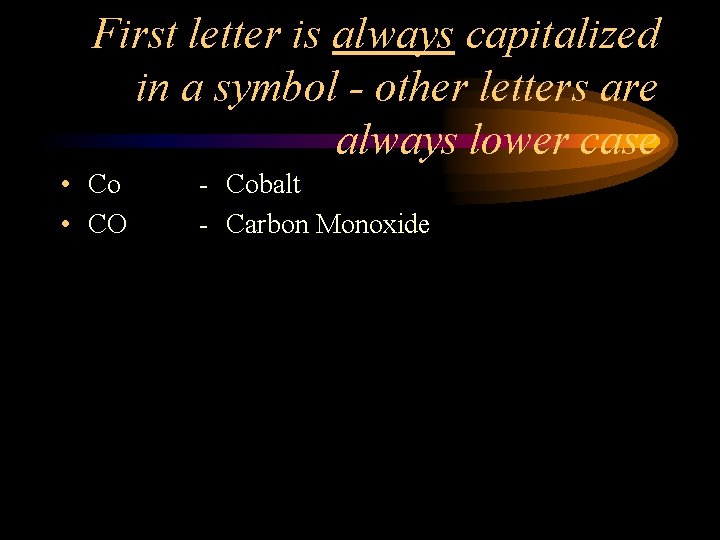
First letter is always capitalized in a symbol - other letters are always lower case • Co • CO - Cobalt - Carbon Monoxide
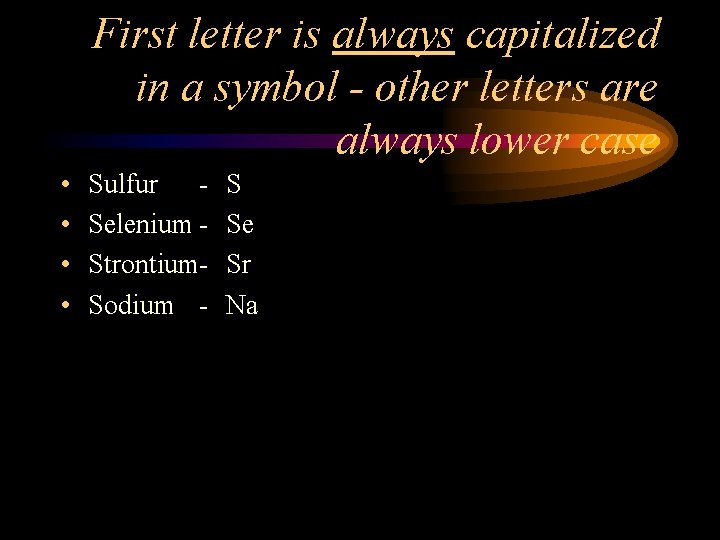
First letter is always capitalized in a symbol - other letters are always lower case • • Sulfur Selenium Strontium. Sodium - S Se Sr Na
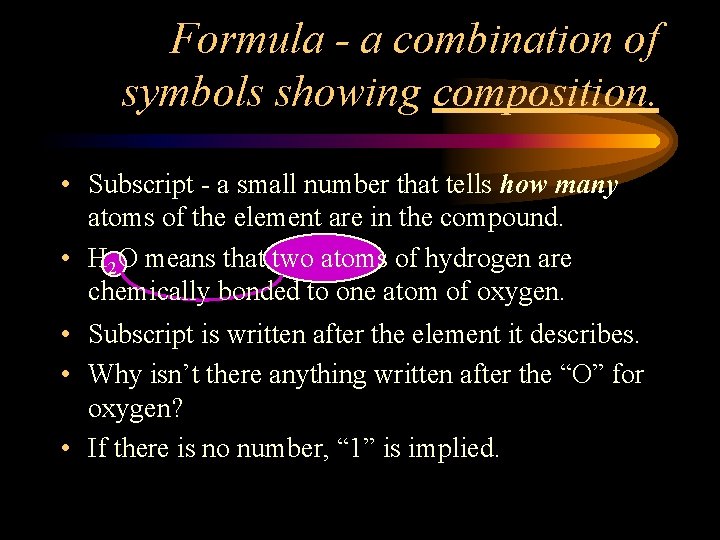
Formula - a combination of symbols showing composition. • Subscript - a small number that tells how many atoms of the element are in the compound. • H 2 O means that two atoms of hydrogen are chemically bonded to one atom of oxygen. • Subscript is written after the element it describes. • Why isn’t there anything written after the “O” for oxygen? • If there is no number, “ 1” is implied.
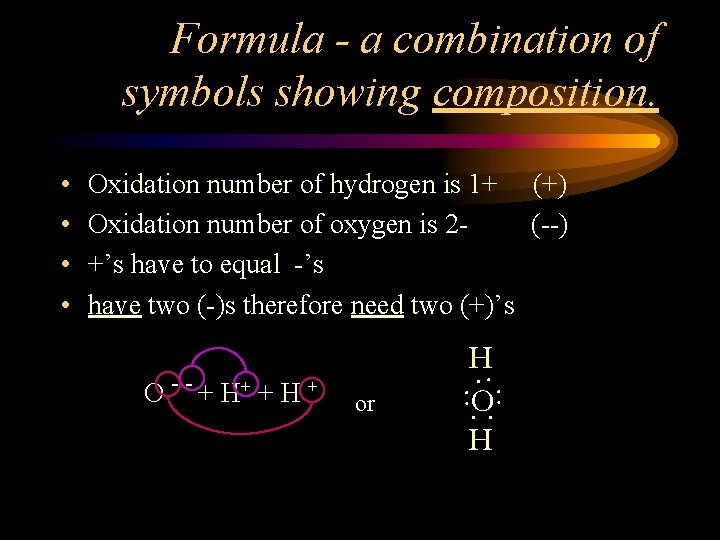
Formula - a combination of symbols showing composition. Oxidation number of hydrogen is 1+ (+) Oxidation number of oxygen is 2(--) +’s have to equal -’s have two (-)s therefore need two (+)’s O - - + H+ + H + or : O. : H • • . . . H
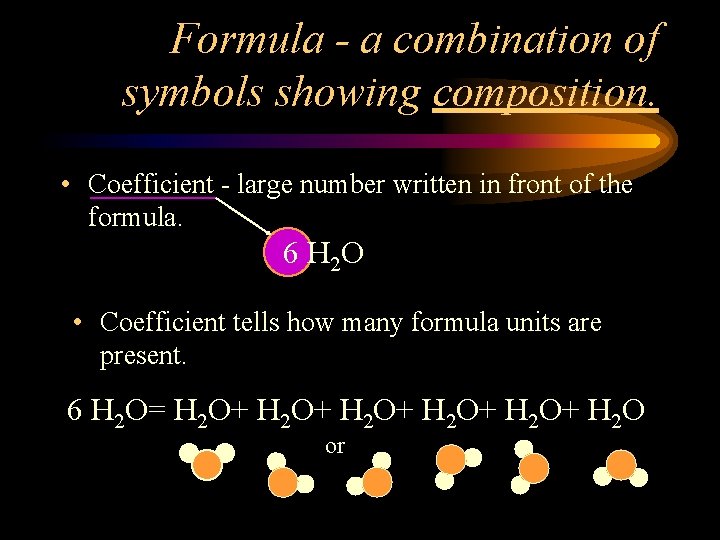
Formula - a combination of symbols showing composition. • Coefficient - large number written in front of the formula. 6 H 2 O • Coefficient tells how many formula units are present. 6 H 2 O= H 2 O+ H 2 O+ H 2 O or
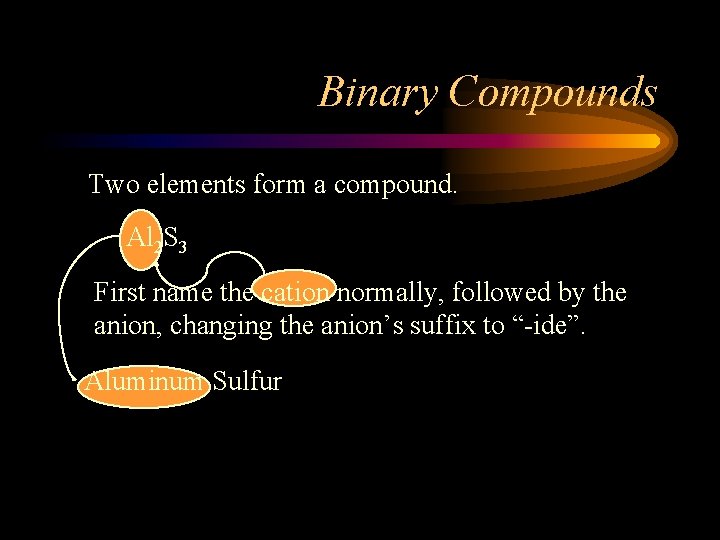
Binary Compounds Two elements form a compound. Al 2 S 3 First name the cation normally, followed by the anion, changing the anion’s suffix to “-ide”. Aluminum Sulfur
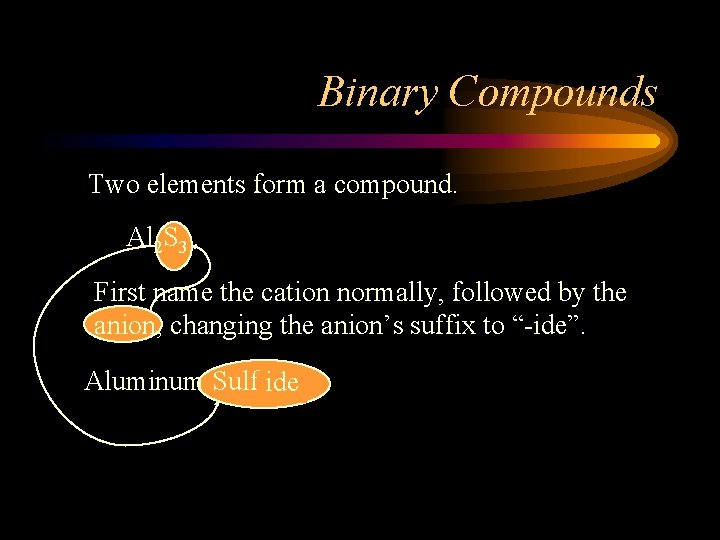
Binary Compounds Two elements form a compound. Al 2 S 3 First name the cation normally, followed by the anion, changing the anion’s suffix to “-ide”. Aluminum Sulfur ide
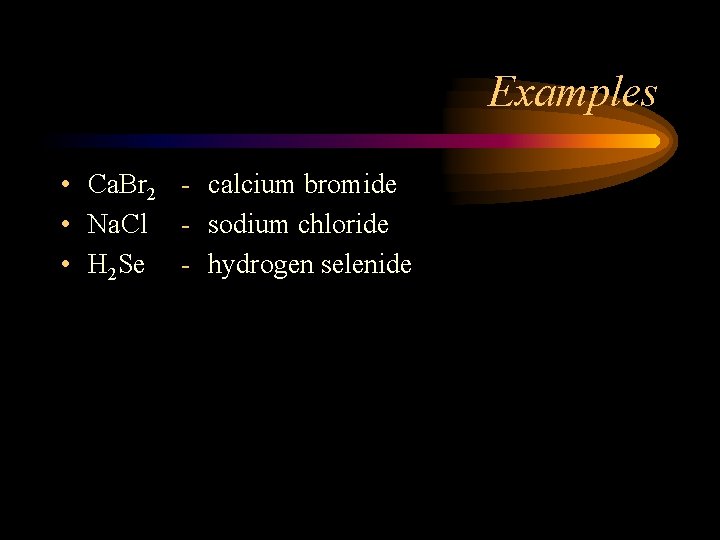
Examples • Ca. Br 2 - calcium bromide • Na. Cl - sodium chloride • H 2 Se - hydrogen selenide
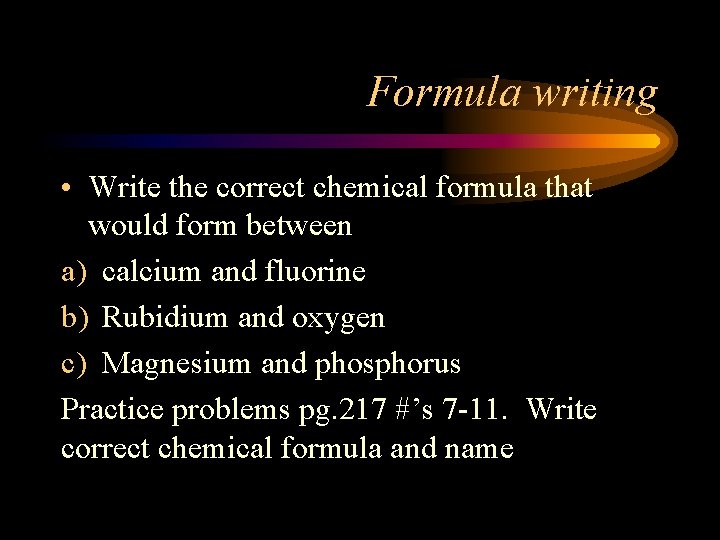
Formula writing • Write the correct chemical formula that would form between a) calcium and fluorine b) Rubidium and oxygen c) Magnesium and phosphorus Practice problems pg. 217 #’s 7 -11. Write correct chemical formula and name
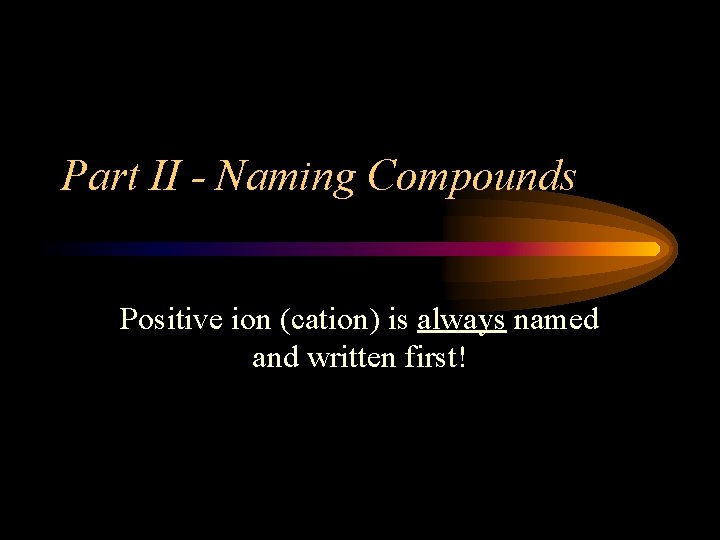
Part II - Naming Compounds Positive ion (cation) is always named and written first!
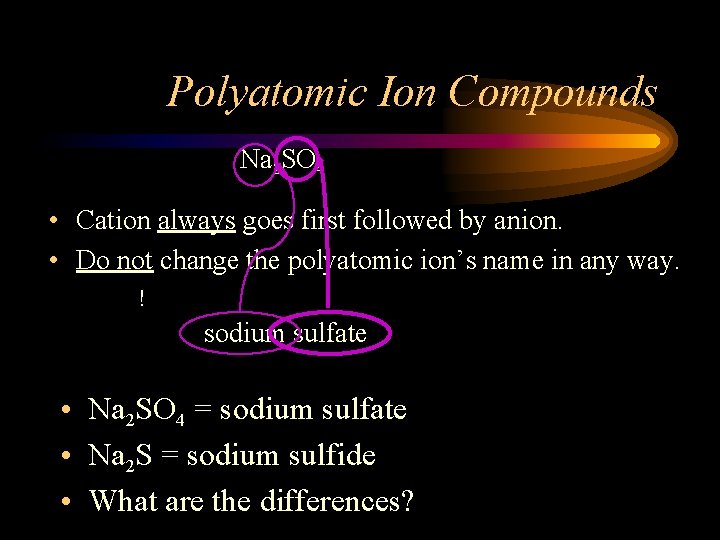
Polyatomic Ion Compounds Na 2 SO 4 • Cation always goes first followed by anion. • Do not change the polyatomic ion’s name in any way. ! sodium sulfate • Na 2 SO 4 = sodium sulfate • Na 2 S = sodium sulfide • What are the differences?
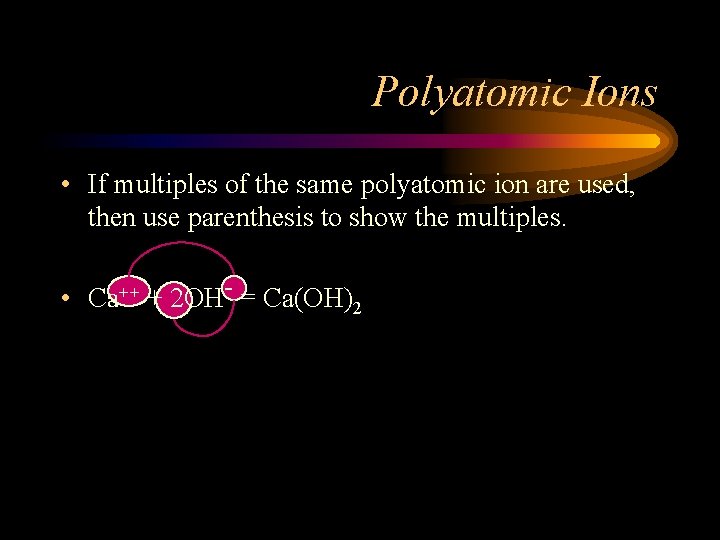
Polyatomic Ions • If multiples of the same polyatomic ion are used, then use parenthesis to show the multiples. • Ca++ + 2 OH- = Ca(OH)2
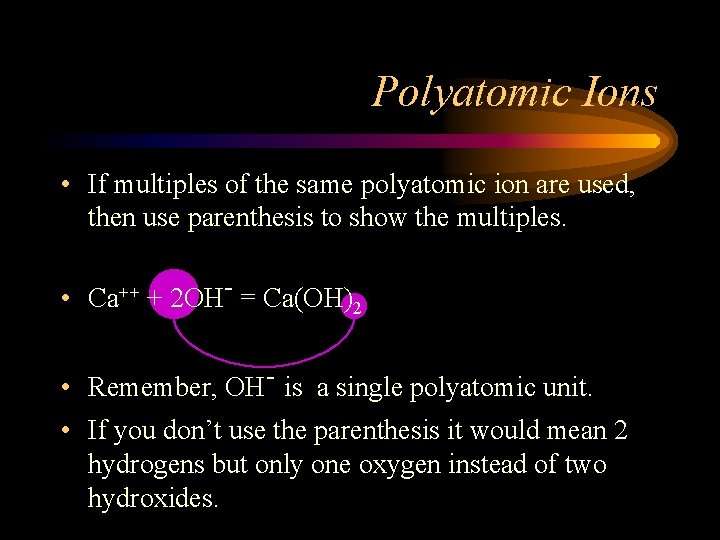
Polyatomic Ions • If multiples of the same polyatomic ion are used, then use parenthesis to show the multiples. • Ca++ + 2 OH- = Ca(OH)2 • Remember, OH- is a single polyatomic unit. • If you don’t use the parenthesis it would mean 2 hydrogens but only one oxygen instead of two hydroxides.
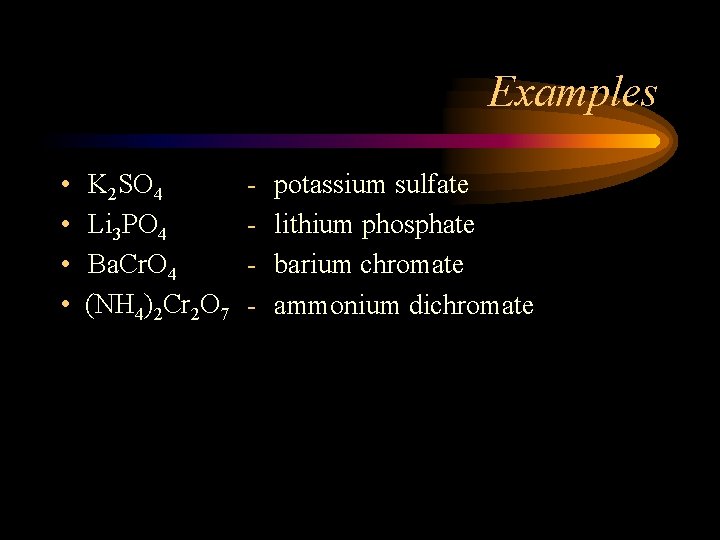
Examples • • K 2 SO 4 Li 3 PO 4 Ba. Cr. O 4 (NH 4)2 Cr 2 O 7 - potassium sulfate lithium phosphate barium chromate ammonium dichromate
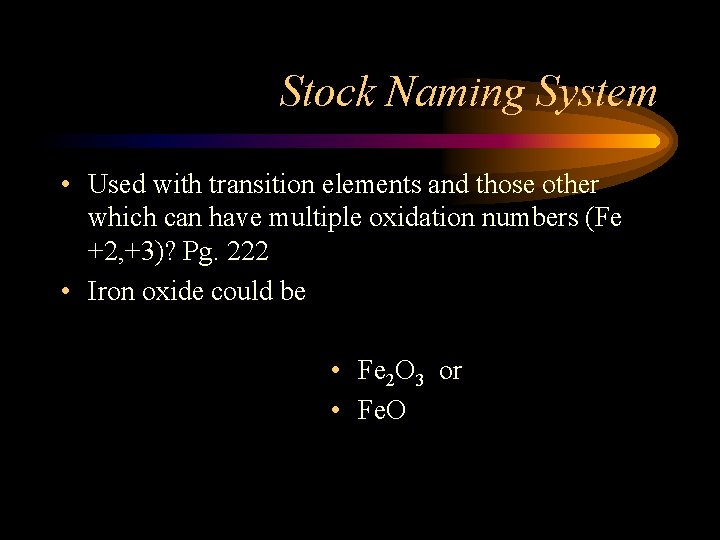
Stock Naming System • Used with transition elements and those other which can have multiple oxidation numbers (Fe +2, +3)? Pg. 222 • Iron oxide could be • Fe 2 O 3 or • Fe. O
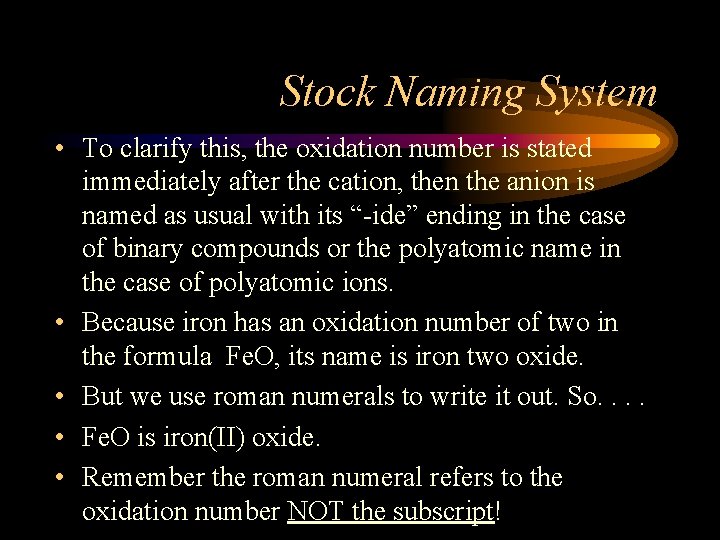
Stock Naming System • To clarify this, the oxidation number is stated immediately after the cation, then the anion is named as usual with its “-ide” ending in the case of binary compounds or the polyatomic name in the case of polyatomic ions. • Because iron has an oxidation number of two in the formula Fe. O, its name is iron two oxide. • But we use roman numerals to write it out. So. . • Fe. O is iron(II) oxide. • Remember the roman numeral refers to the oxidation number NOT the subscript!
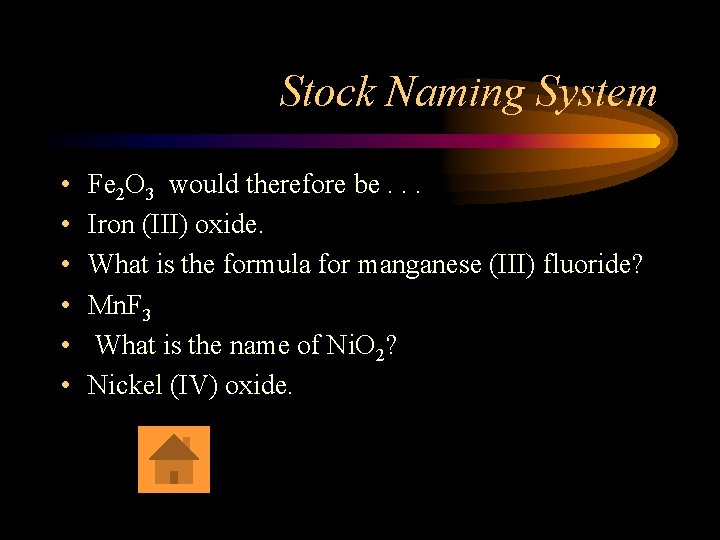
Stock Naming System • • • Fe 2 O 3 would therefore be. . . Iron (III) oxide. What is the formula for manganese (III) fluoride? Mn. F 3 What is the name of Ni. O 2? Nickel (IV) oxide.
Part III Mercury is special!
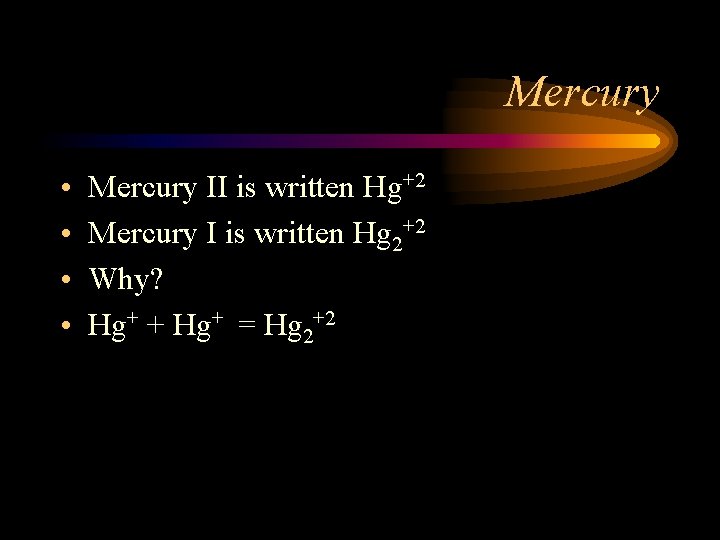
Mercury • • Mercury II is written Hg+2 Mercury I is written Hg 2+2 Why? Hg+ + Hg+ = Hg 2+2
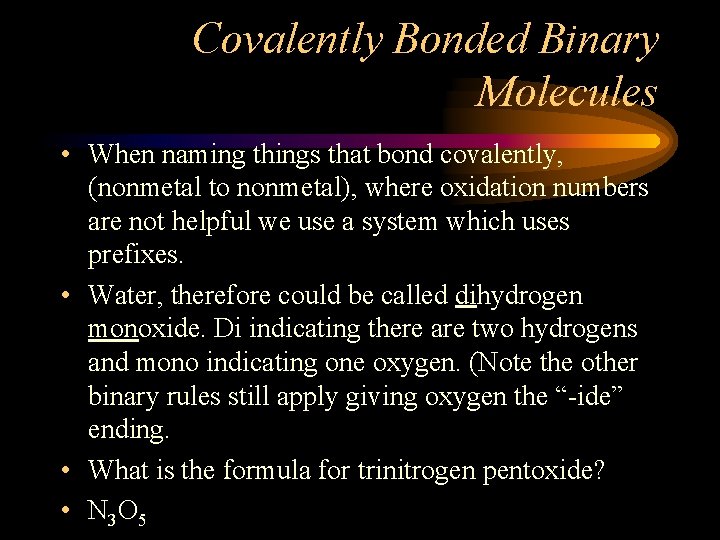
Covalently Bonded Binary Molecules • When naming things that bond covalently, (nonmetal to nonmetal), where oxidation numbers are not helpful we use a system which uses prefixes. • Water, therefore could be called dihydrogen monoxide. Di indicating there are two hydrogens and mono indicating one oxygen. (Note the other binary rules still apply giving oxygen the “-ide” ending. • What is the formula for trinitrogen pentoxide? • N 3 O 5
- Slides: 25