
IONIC BONDS TRANSITION METALS Unit 2 TRANSITION METALS

IONIC BONDS & TRANSITION METALS Unit 2
TRANSITION METALS & IONIC BONDING • Transition metals in ionic compounds are able to lose different numbers of electrons to create their ions. • When writing transition metals in ionic formulas, we must always include a roman numeral after the transition metal, or cation, to indicate its charge.
VARIABLE CHARGE CATIONS • Copper has 2 possible charges, +1 or +2. • Copper (I) • Copper (II) • Manganese has 2 possible charges, +2 or +4. • Manganese (II) • Manganese (IV)

ROMAN NUMERALS
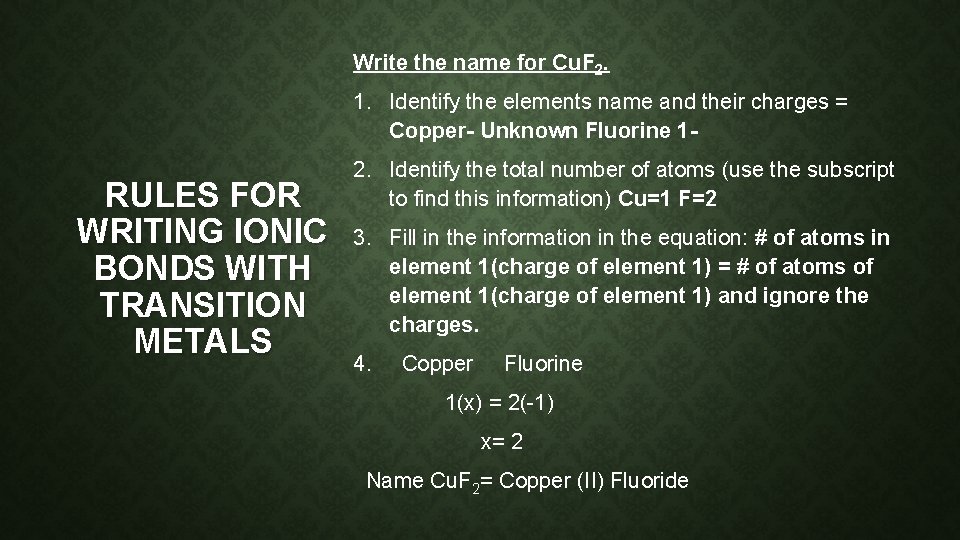
Write the name for Cu. F 2. 1. Identify the elements name and their charges = Copper- Unknown Fluorine 1 - RULES FOR WRITING IONIC BONDS WITH TRANSITION METALS 2. Identify the total number of atoms (use the subscript to find this information) Cu=1 F=2 3. Fill in the information in the equation: # of atoms in element 1(charge of element 1) = # of atoms of element 1(charge of element 1) and ignore the charges. 4. Copper Fluorine 1(x) = 2( 1) x= 2 Name Cu. F 2= Copper (II) Fluoride
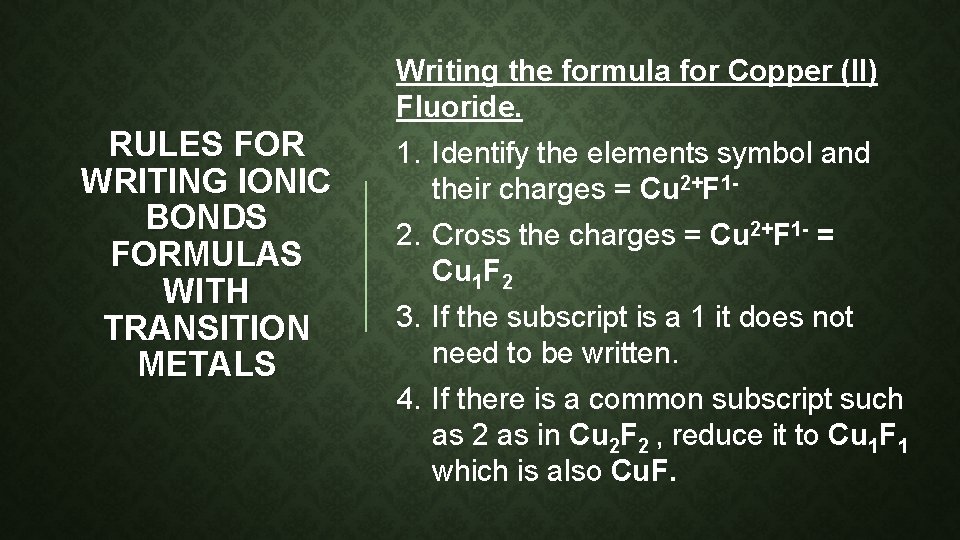
Writing the formula for Copper (II) Fluoride. RULES FOR WRITING IONIC BONDS FORMULAS WITH TRANSITION METALS 1. Identify the elements symbol and their charges = Cu 2+F 12. Cross the charges = Cu 2+F 1 - = Cu 1 F 2 3. If the subscript is a 1 it does not need to be written. 4. If there is a common subscript such as 2 as in Cu 2 F 2 , reduce it to Cu 1 F 1 which is also Cu. F.
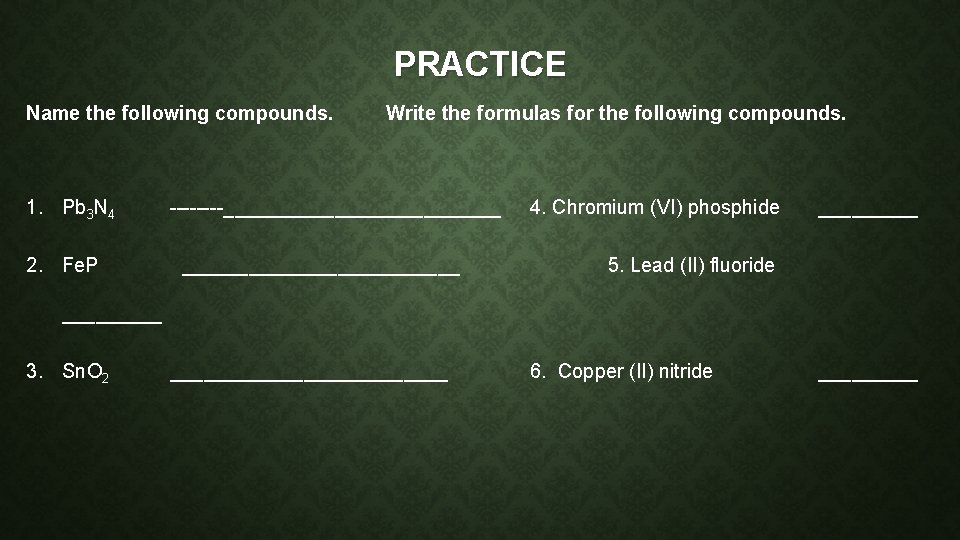
PRACTICE Name the following compounds. 1. Pb 3 N 4 2. Fe. P Write the formulas for the following compounds. _________________________ 4. Chromium (VI) phosphide _____ 5. Lead (II) fluoride _____ 3. Sn. O 2 _____________ 6. Copper (II) nitride _____
- Slides: 7