
Ionic Bonds Naming Writing Intro Questions MODEL Fe

Ionic Bonds: Naming & Writing
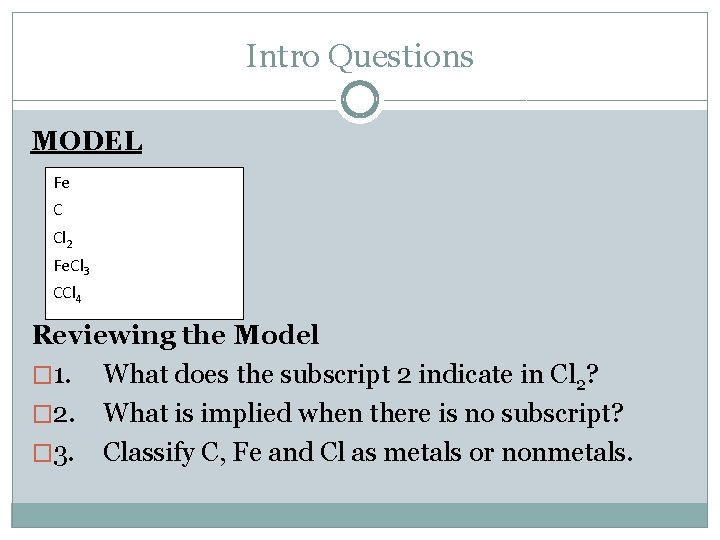
Intro Questions MODEL Fe C Cl 2 Fe. Cl 3 CCl 4 Reviewing the Model � 1. What does the subscript 2 indicate in Cl 2? � 2. What is implied when there is no subscript? � 3. Classify C, Fe and Cl as metals or nonmetals.
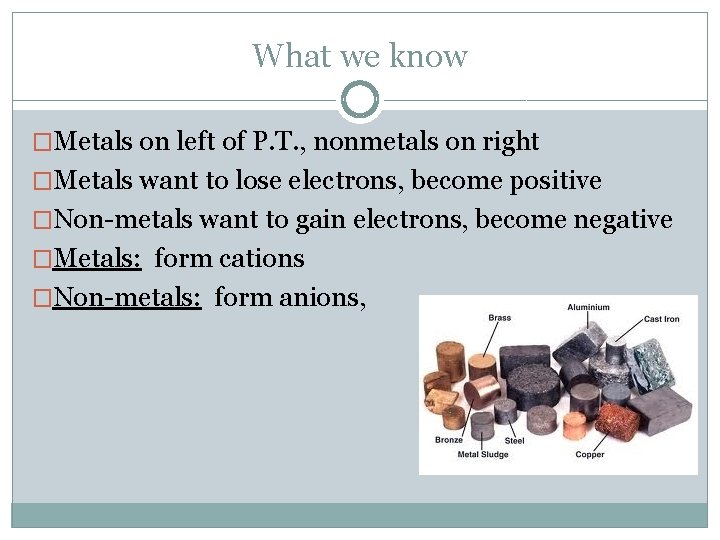
What we know �Metals on left of P. T. , nonmetals on right �Metals want to lose electrons, become positive �Non-metals want to gain electrons, become negative �Metals: form cations �Non-metals: form anions,
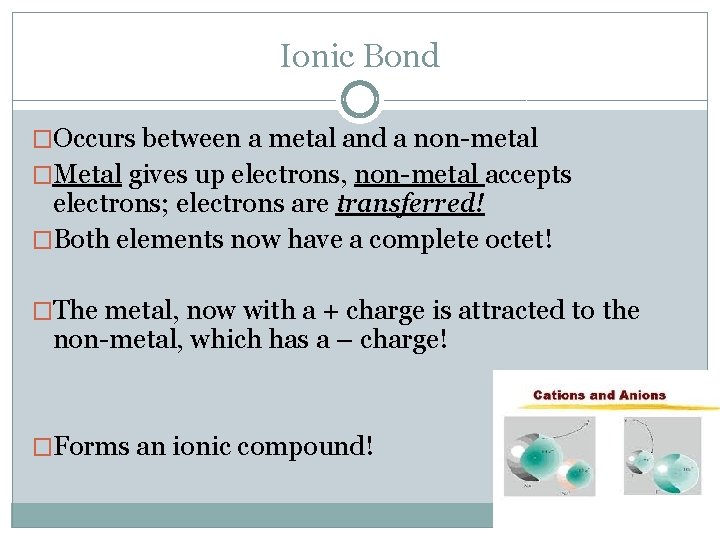
Ionic Bond �Occurs between a metal and a non-metal �Metal gives up electrons, non-metal accepts electrons; electrons are transferred! �Both elements now have a complete octet! �The metal, now with a + charge is attracted to the non-metal, which has a – charge! �Forms an ionic compound!
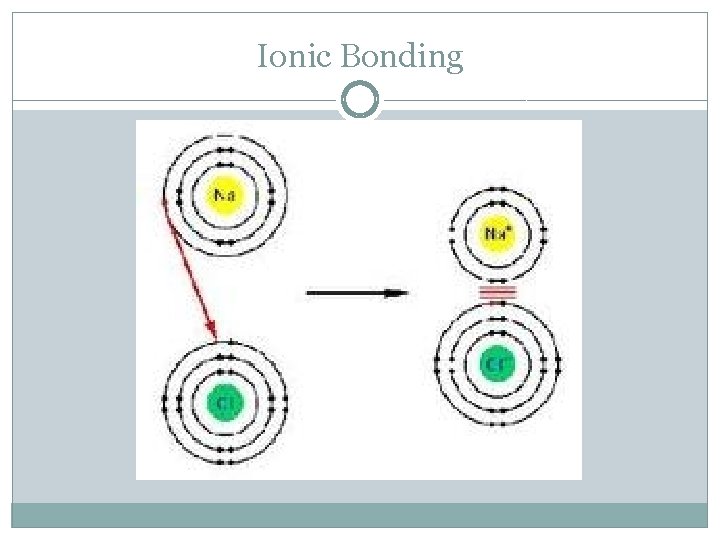
Ionic Bonding
Writing Ionic Formulas: Criss-Cross Method �Note: Charges must add up to ZERO! �Steps: Write symbols for compound out: cation first, then anion Write charges above each element Cross charges below opposite element, removing “+” or “–” Reduce if necessary Check to ensure charges = 0
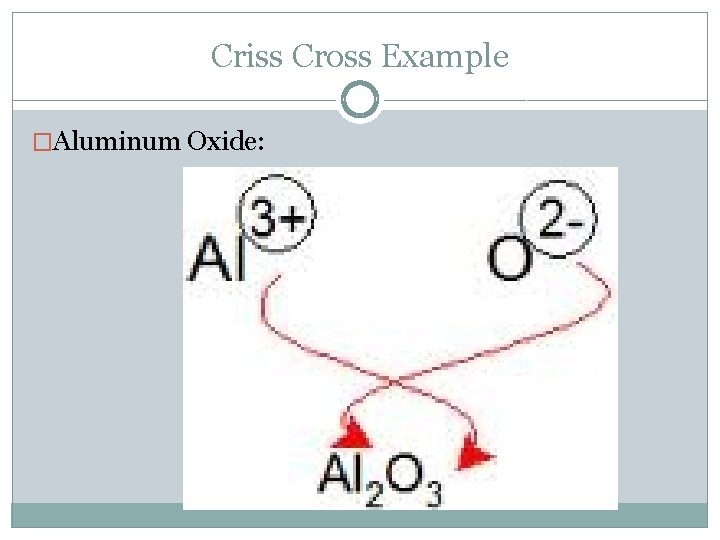
Criss Cross Example �Aluminum Oxide:
Writing Ionic Formulas: Criss Cross �Practice: Sodium Chloride Magnesium Iodide Lithium Sulfide Potassium Nitride Beryllium Oxide Aluminum Nitride
Naming Ionic Compounds �Steps List Cation first, then anion Cation: name does not change Anion: drop the ending (usually last three letters), and add -ide � Ex: Fluorine = fluoride � Ex: oxygen = oxide
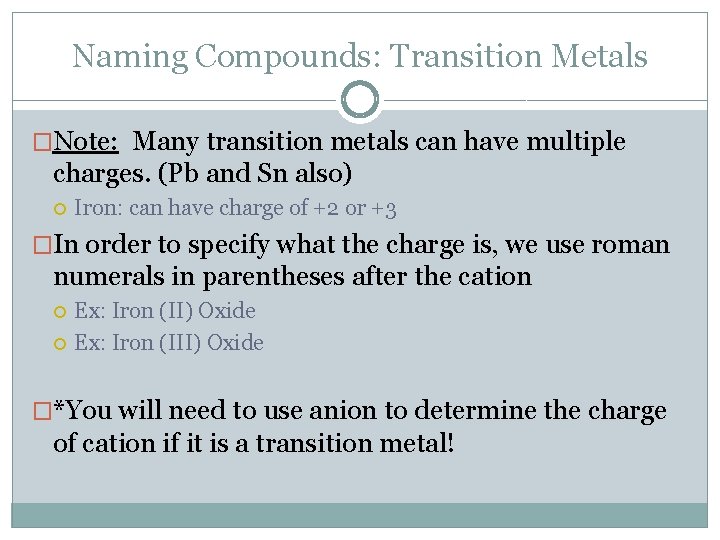
Naming Compounds: Transition Metals �Note: Many transition metals can have multiple charges. (Pb and Sn also) Iron: can have charge of +2 or +3 �In order to specify what the charge is, we use roman numerals in parentheses after the cation Ex: Iron (II) Oxide Ex: Iron (III) Oxide �*You will need to use anion to determine the charge of cation if it is a transition metal!
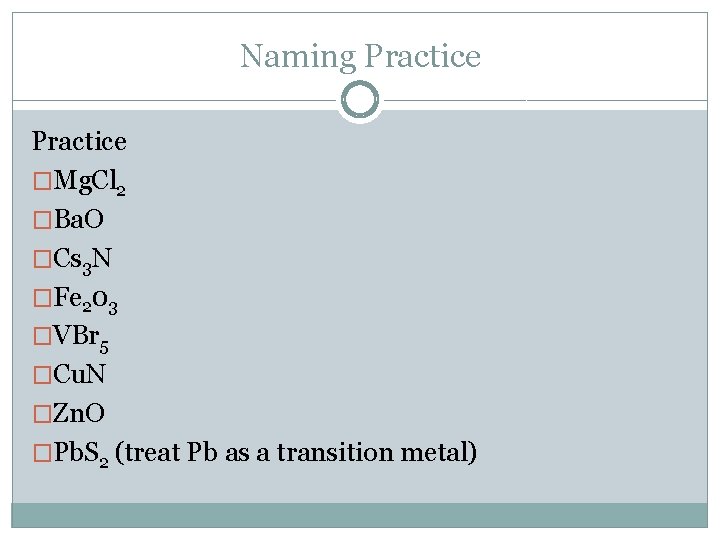
Naming Practice �Mg. Cl 2 �Ba. O �Cs 3 N �Fe 203 �VBr 5 �Cu. N �Zn. O �Pb. S 2 (treat Pb as a transition metal)
- Slides: 11