
Ionic Bonding CONCEPTS q Students know atoms combine
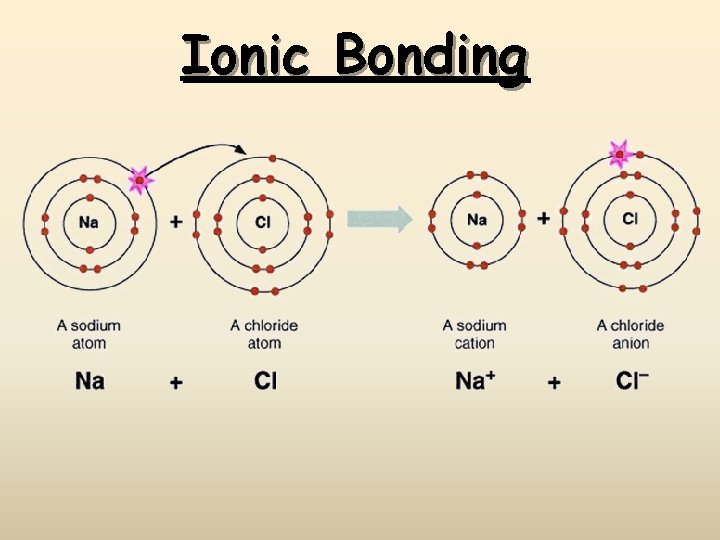
Ionic Bonding
CONCEPTS q Students know atoms combine to form molecules by sharing electrons to form covalent or metallic bonds or by exchanging electrons to form ionic bonds. q Students know salt crystals, such as Na. Cl, are repeating patterns of positive and negative ions held together by electrostatic attraction.
Bonds q Forces that hold groups of atoms together and make them function as a unit. v Ionic bonds – transfer of electrons v Covalent bonds – sharing of electrons
The Octet Rule – Ionic Compounds Ionic compounds form so that each atom, by gaining or losing electrons, has an octet of electrons in its highest occupied energy level. Metals lose electrons to form positively-charged cations Nonmetals gains electrons to form negativelycharged anions
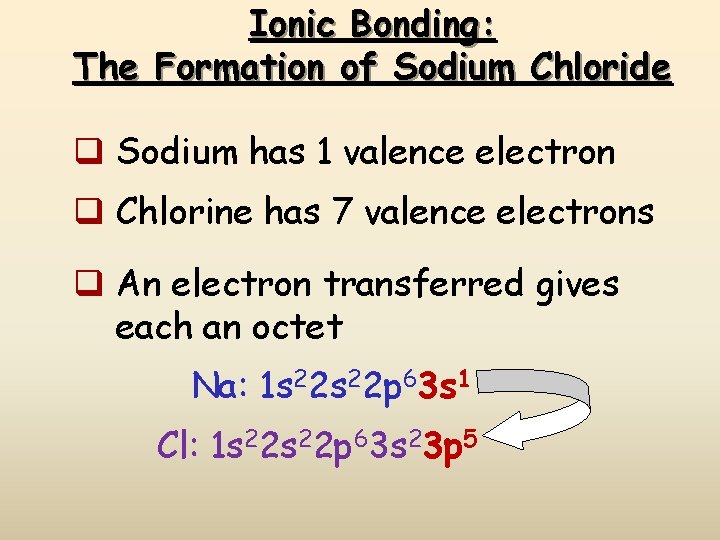
Ionic Bonding: The Formation of Sodium Chloride q Sodium has 1 valence electron q Chlorine has 7 valence electrons q An electron transferred gives each an octet Na: 1 s 22 p 63 s 1 Cl: 1 s 22 p 63 s 23 p 5

Ionic Bonding: The Formation of Sodium Chloride This transfer forms ions, each with an octet: Na+ 1 s 22 p 6 Cl- 1 s 22 p 63 s 23 p 6
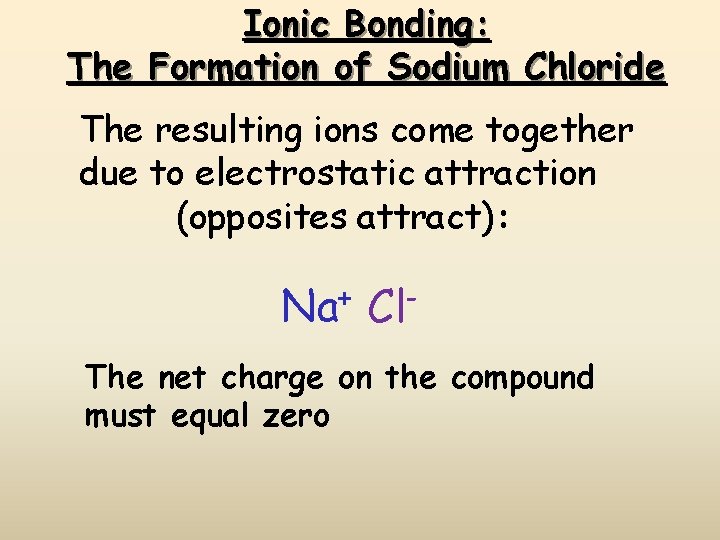
Ionic Bonding: The Formation of Sodium Chloride The resulting ions come together due to electrostatic attraction (opposites attract): Na+ Cl. The net charge on the compound must equal zero
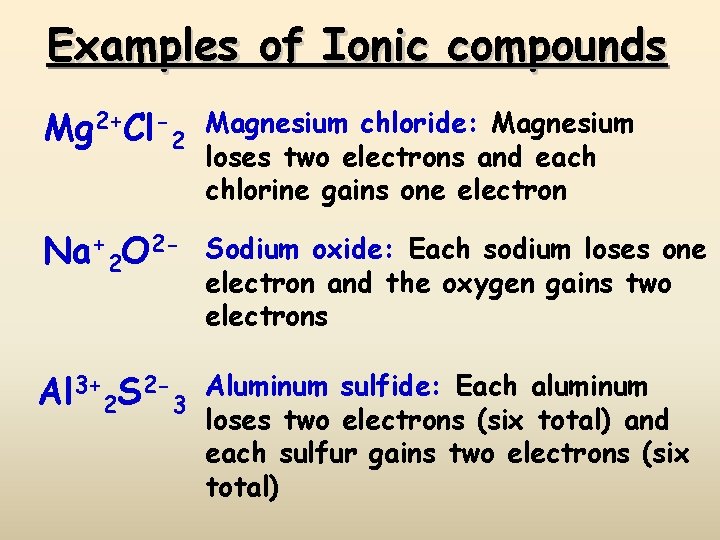
Examples of Ionic compounds Mg 2+Cl-2 Magnesium chloride: Magnesium loses two electrons and each chlorine gains one electron Na+2 O 2 - Sodium oxide: Each sodium loses one electron and the oxygen gains two electrons Al 3+2 S 2 -3 Aluminum sulfide: Each aluminum loses two electrons (six total) and each sulfur gains two electrons (six total)

Metal Lithium Sodium Potassium Magnesium Calcium Barium Aluminum Monatomic Cations Li+ Na+ K+ Mg 2+ Ca 2+ Ba 2+ Al 3+ Ion name Lithium Sodium Potassium Magnesium Calcium Barium Aluminum
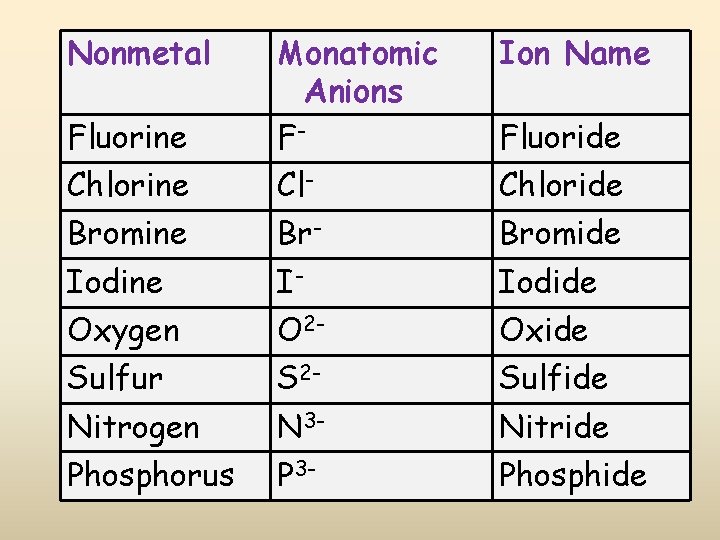
Nonmetal Ion Name Fluorine Monatomic Anions F- Chlorine Cl- Chloride Bromine Br- Bromide Iodine I- Iodide Oxygen O 2 - Oxide Sulfur S 2 - Sulfide Nitrogen N 3 - Nitride Phosphorus P 3 - Phosphide Fluoride
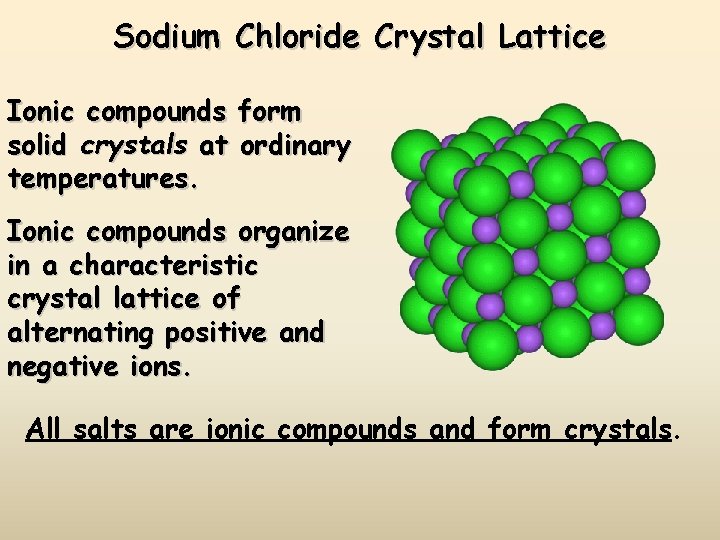
Sodium Chloride Crystal Lattice Ionic compounds form solid crystals at ordinary temperatures. Ionic compounds organize in a characteristic crystal lattice of alternating positive and negative ions. All salts are ionic compounds and form crystals.
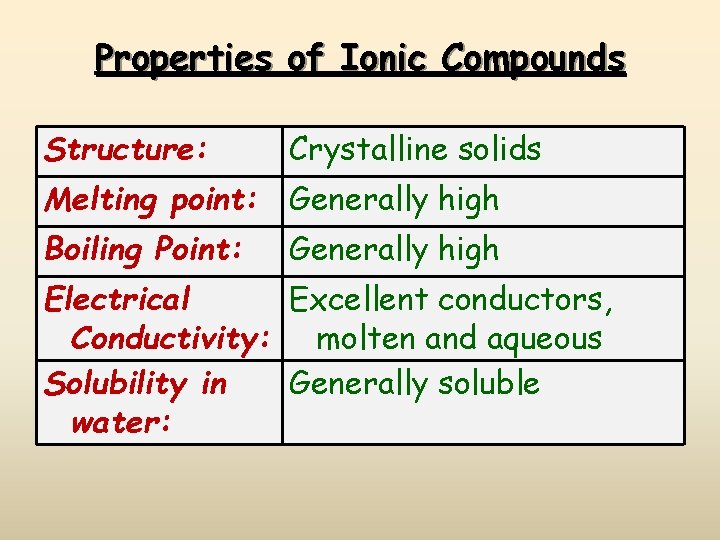
Properties of Ionic Compounds Structure: Crystalline solids Melting point: Generally high Boiling Point: Generally high Electrical Excellent conductors, Conductivity: molten and aqueous Solubility in Generally soluble water:
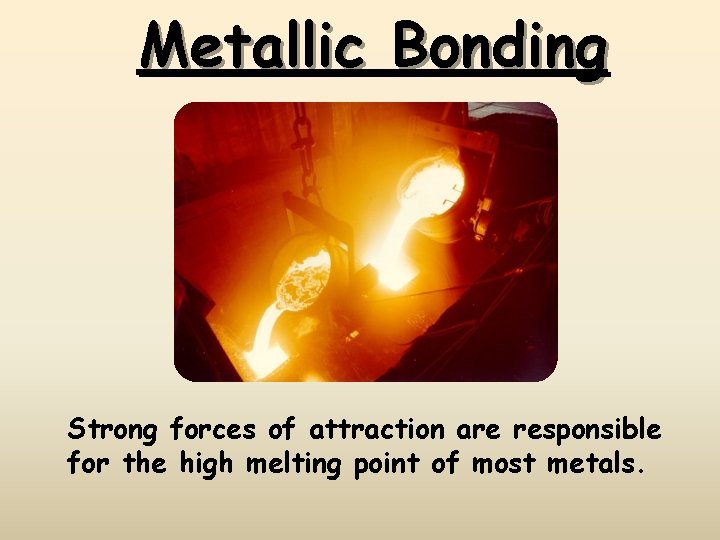
Metallic Bonding Strong forces of attraction are responsible for the high melting point of most metals.
CONCEPT Students know atoms combine to form molecules by sharing electrons to form covalent or metallic bonds or by exchanging electrons to form ionic bonds.
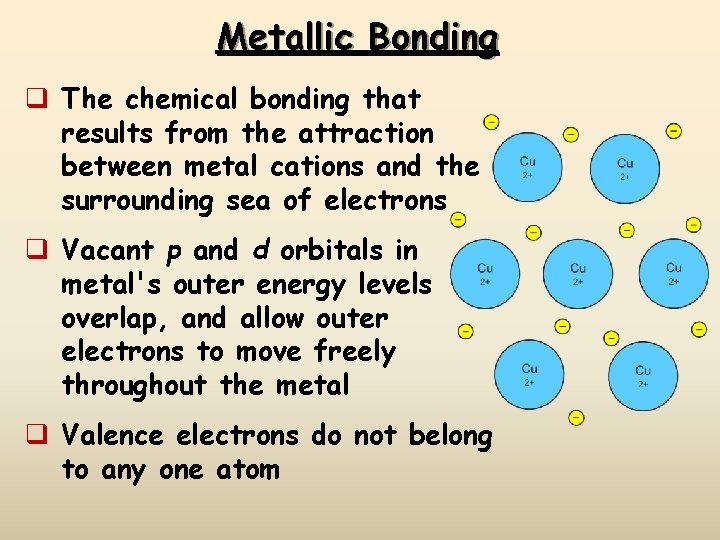
Metallic Bonding q The chemical bonding that results from the attraction between metal cations and the surrounding sea of electrons q Vacant p and d orbitals in metal's outer energy levels overlap, and allow outer electrons to move freely throughout the metal q Valence electrons do not belong to any one atom
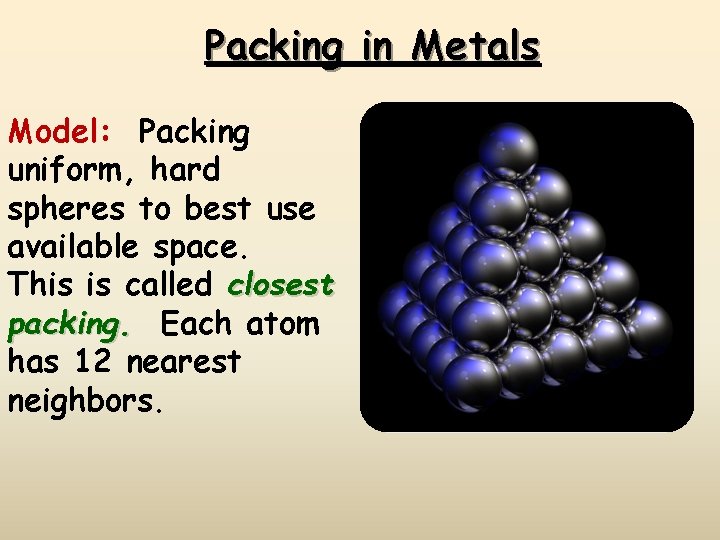
Packing in Metals Model: Packing uniform, hard spheres to best use available space. This is called closest packing. Each atom has 12 nearest neighbors.
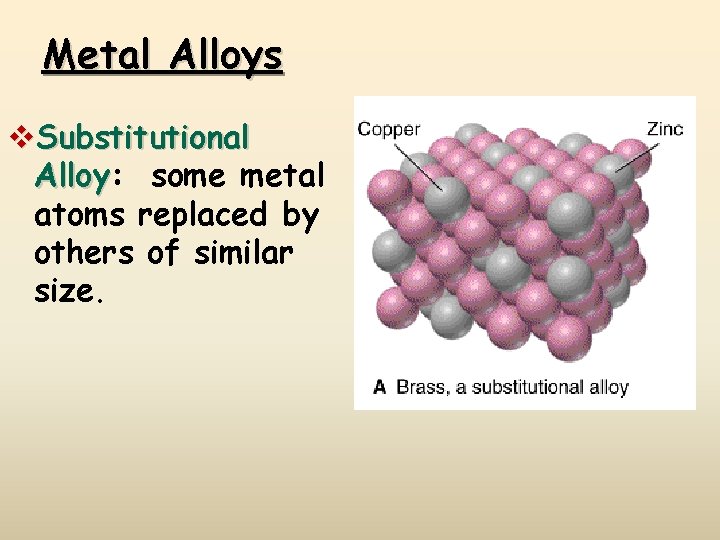
Metal Alloys v. Substitutional Alloy: Alloy some metal atoms replaced by others of similar size.
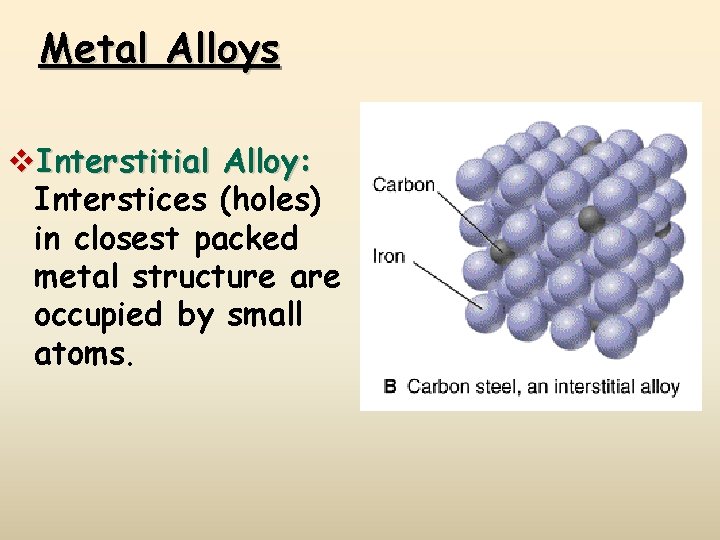
Metal Alloys v. Interstitial Alloy: Interstices (holes) in closest packed metal structure are occupied by small atoms.
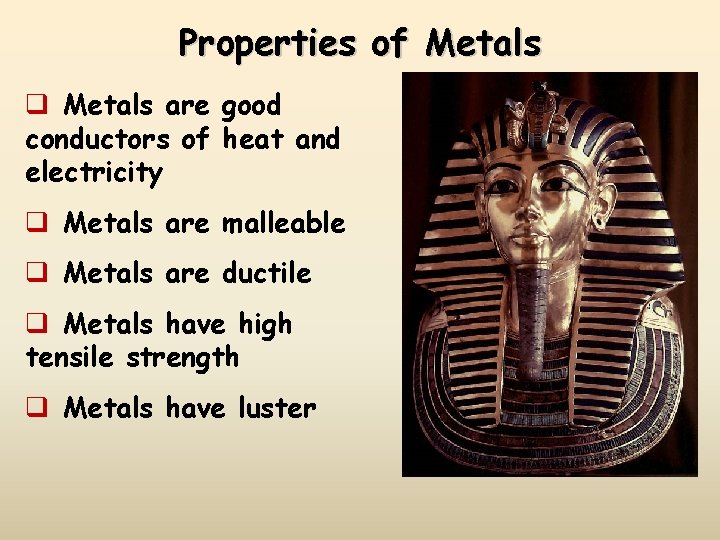
Properties of Metals q Metals are good conductors of heat and electricity q Metals are malleable q Metals are ductile q Metals have high tensile strength q Metals have luster
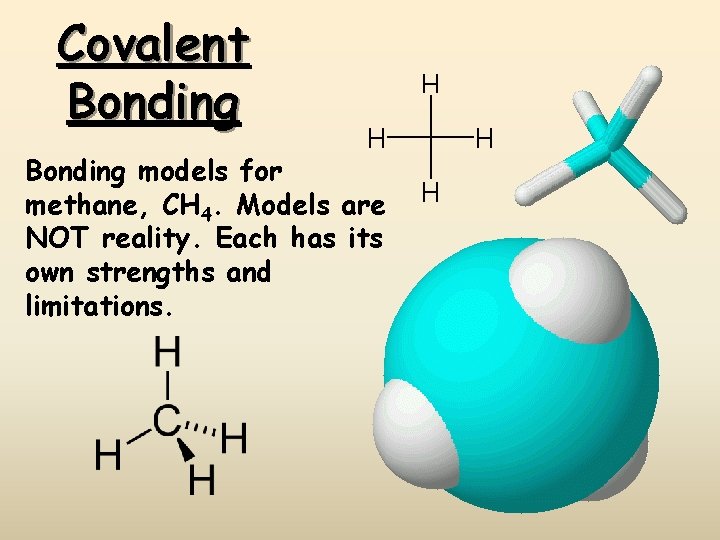
Covalent Bonding models for methane, CH 4. Models are NOT reality. Each has its own strengths and limitations.
CONCEPTS q Students know atoms combine to form molecules by sharing electrons to form covalent or metallic bonds or by exchanging electrons to form ionic bonds. q Students know chemical bonds between atoms in molecules such as H 2, CH 4, NH 3, H 2 CCH 2, N 2, Cl 2, and many large biological molecules are covalent. q Students know how to draw Lewis dot structures.
The Octet Rule and Covalent Compounds v Covalent compounds tend to form so that each atom, by sharing electrons, has an octet of electrons in its highest occupied energy level. v Covalent compounds involve atoms of nonmetals only. v The term “molecule” is used exclusively for covalent bonding
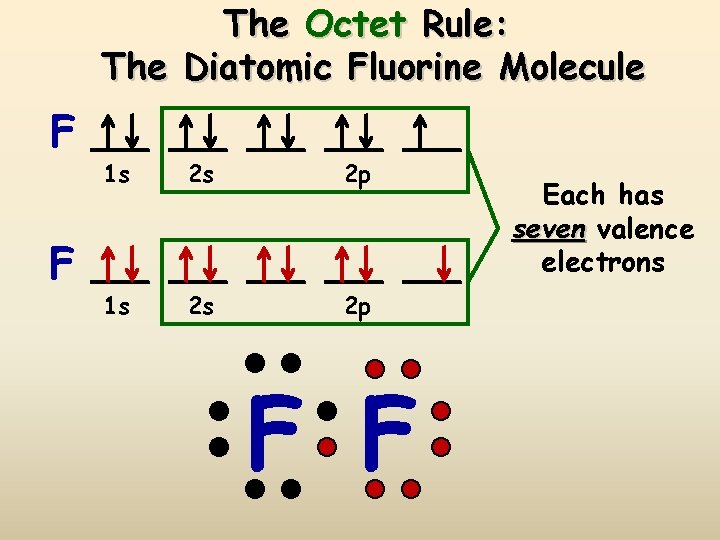
The Octet Rule: The Diatomic Fluorine Molecule F F 1 s 2 s 2 p F F Each has seven valence electrons
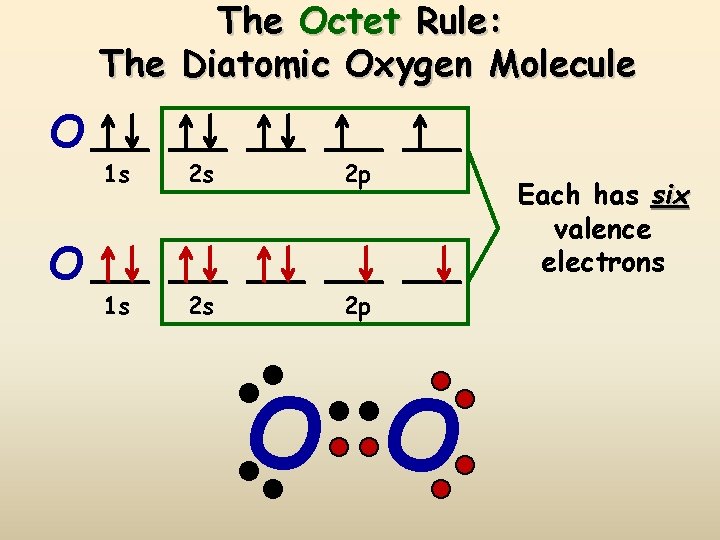
The Octet Rule: The Diatomic Oxygen Molecule O O 1 s 2 s 2 p O O Each has six valence electrons
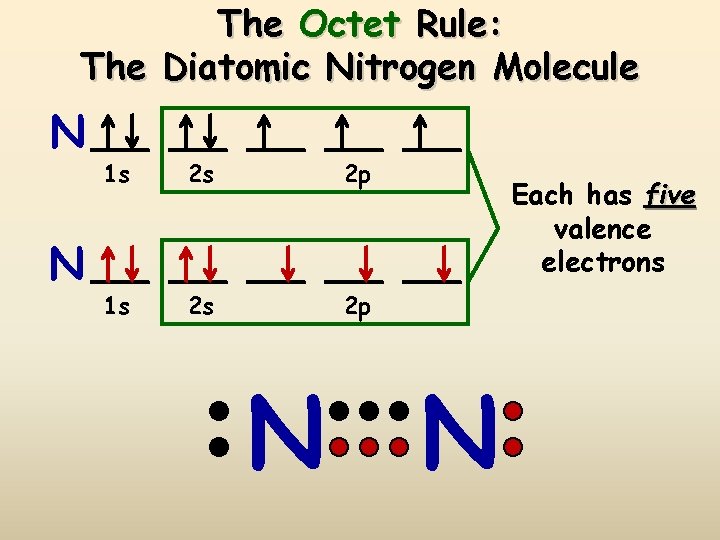
The Octet Rule: The Diatomic Nitrogen Molecule N N 1 s 2 s 2 p N N Each has five valence electrons
Lewis Structures q Lewis structures show valence electrons are arranged among atoms in a molecule. q Lewis structures Reflect the central idea that stability of a compound relates to noble gas electron configuration. q Shared electrons pairs are covalent bonds and can be represented by two dots (: ) or by a single line ( - )
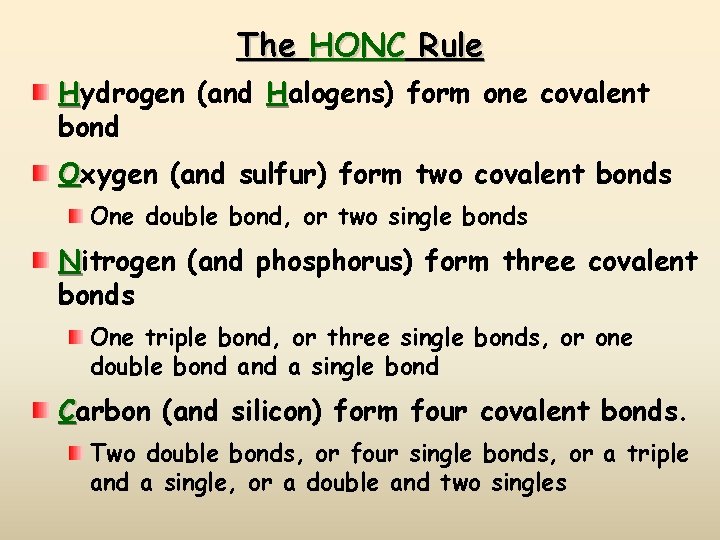
The HONC Rule Hydrogen (and Halogens) form one covalent bond Oxygen (and sulfur) form two covalent bonds One double bond, or two single bonds Nitrogen (and phosphorus) form three covalent bonds One triple bond, or three single bonds, or one double bond a single bond Carbon (and silicon) form four covalent bonds. Two double bonds, or four single bonds, or a triple and a single, or a double and two singles
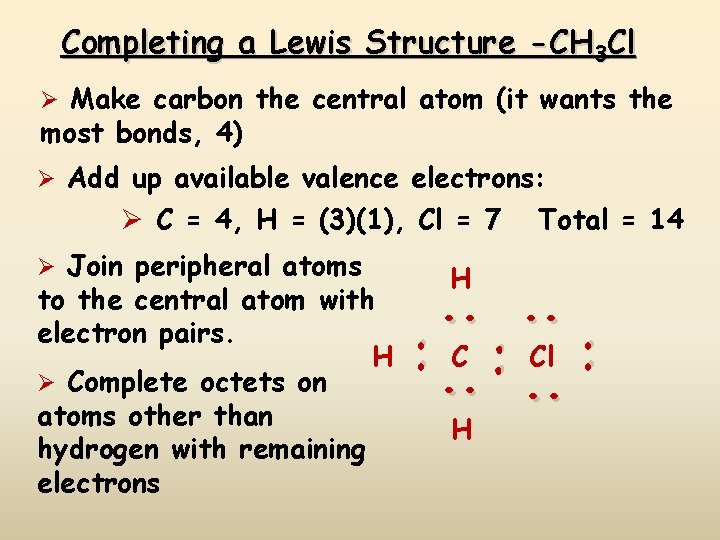
Completing a Lewis Structure -CH 3 Cl Ø Make carbon the central atom (it wants the most bonds, 4) Ø Add up available valence electrons: Ø C = 4, H = (3)(1), Cl = 7 . . C Cl. . H . . to the central atom with electron pairs. H Ø Complete octets on atoms other than hydrogen with remaining electrons H . . Ø Join peripheral atoms Total = 14
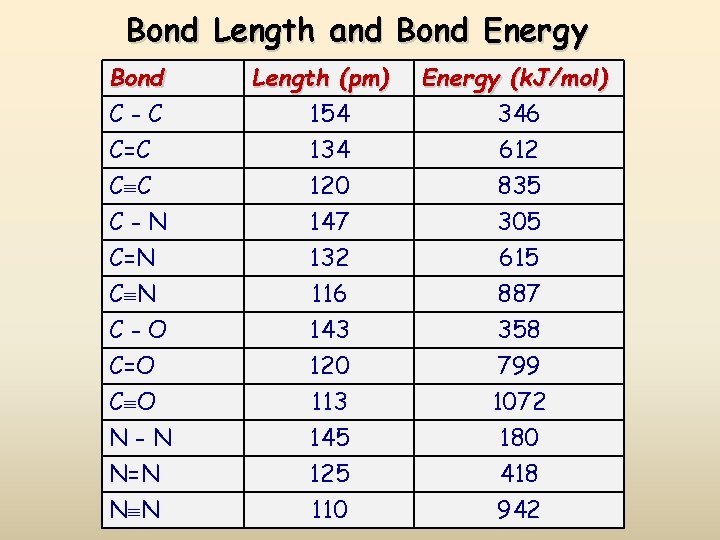
Bond Length and Bond Energy Bond C-C C=C C C Length (pm) 154 134 120 Energy (k. J/mol) 346 612 835 C-N C=N 147 132 305 615 C N C-O C=O C O N-N N=N N N 116 143 120 113 145 125 110 887 358 799 1072 180 418 942
VSEPR and Molecular Geometry Hemoglobin
VSEPR Model (Valence Shell Electron Pair Repulsion) The structure around a given atom is determined principally by minimizing electron pair repulsions.
Predicting a VSEPR Structure Ø Draw Lewis structure. Ø Put pairs as far apart as possible. Ø Determine positions of atoms from the way electron pairs are shared Ø Determine the name of molecular structure from positions of the atoms.
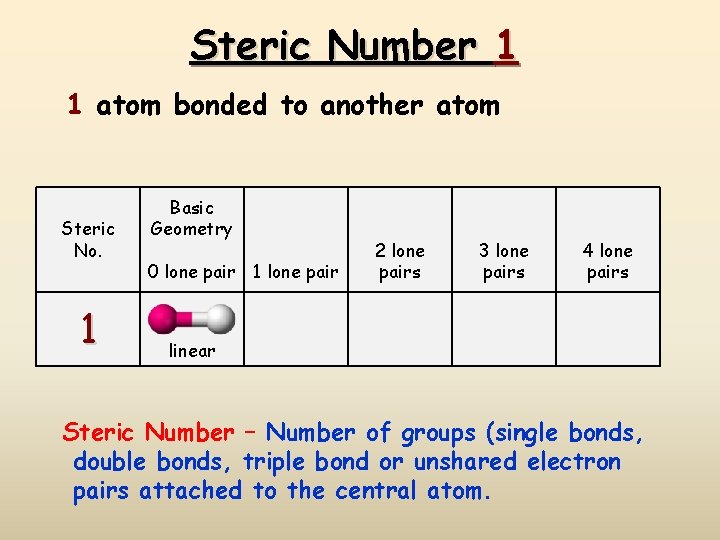
Steric Number 1 1 atom bonded to another atom Steric No. 1 Basic Geometry 0 lone pair 1 lone pair 2 lone pairs 3 lone pairs 4 lone pairs linear Steric Number – Number of groups (single bonds, double bonds, triple bond or unshared electron pairs attached to the central atom.
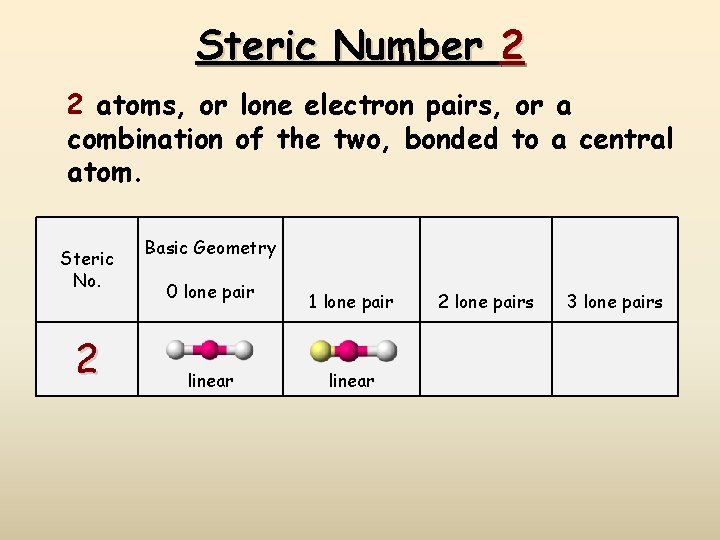
Steric Number 2 2 atoms, or lone electron pairs, or a combination of the two, bonded to a central atom. Steric No. 2 Basic Geometry 0 lone pair linear 1 lone pair linear 2 lone pairs 3 lone pairs
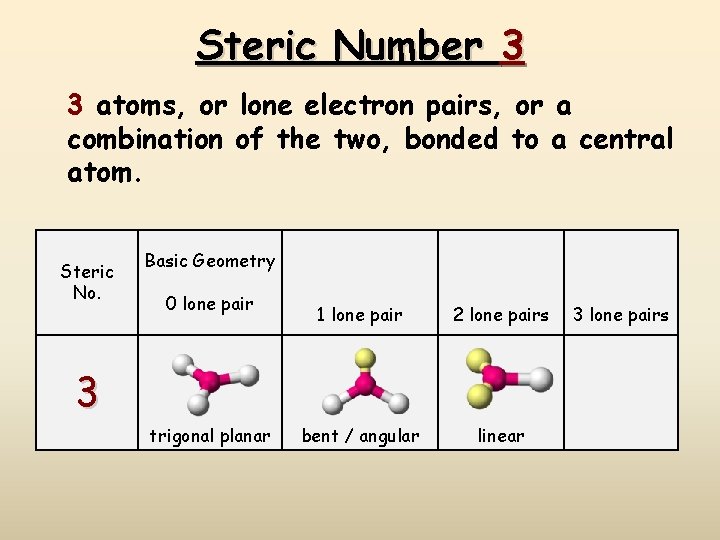
Steric Number 3 3 atoms, or lone electron pairs, or a combination of the two, bonded to a central atom. Steric No. Basic Geometry 0 lone pair 1 lone pair 2 lone pairs bent / angular linear 3 trigonal planar 3 lone pairs
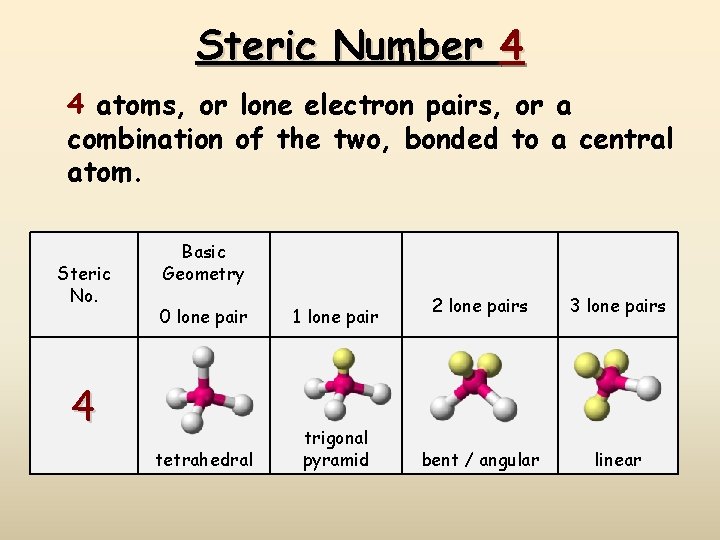
Steric Number 4 4 atoms, or lone electron pairs, or a combination of the two, bonded to a central atom. Steric No. Basic Geometry 0 lone pair 1 lone pair tetrahedral trigonal pyramid 4 2 lone pairs 3 lone pairs bent / angular linear
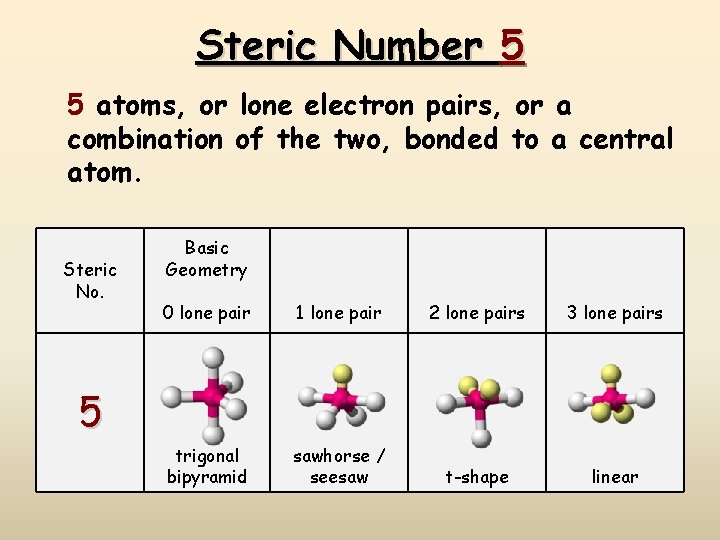
Steric Number 5 5 atoms, or lone electron pairs, or a combination of the two, bonded to a central atom. Steric No. Basic Geometry 0 lone pair 1 lone pair 2 lone pairs 3 lone pairs trigonal bipyramid sawhorse / seesaw t-shape linear 5
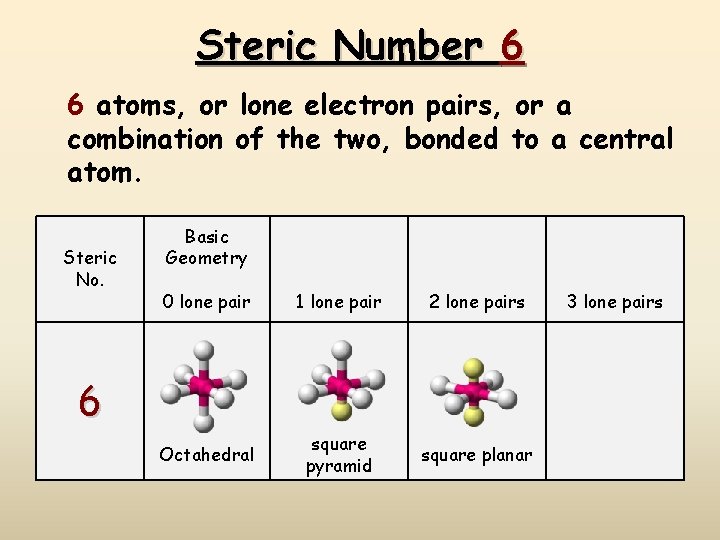
Steric Number 6 6 atoms, or lone electron pairs, or a combination of the two, bonded to a central atom. Steric No. Basic Geometry 0 lone pair 1 lone pair 2 lone pairs Octahedral square pyramid square planar 6 3 lone pairs
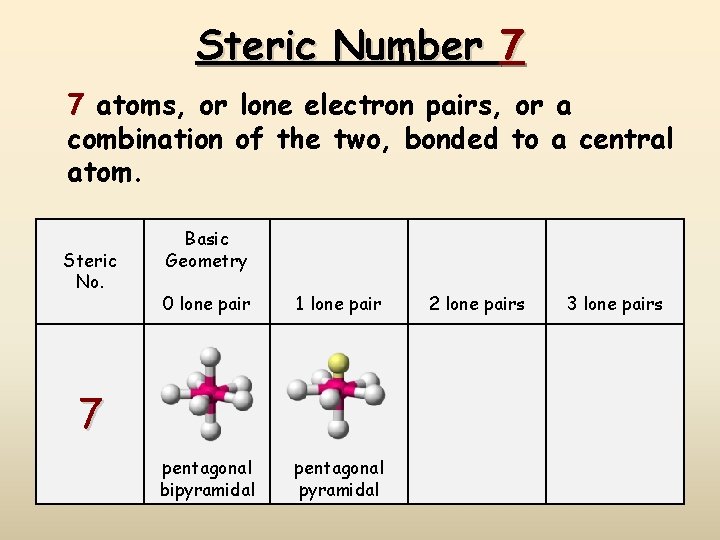
Steric Number 7 7 atoms, or lone electron pairs, or a combination of the two, bonded to a central atom. Steric No. Basic Geometry 0 lone pair 1 lone pair pentagonal bipyramidal pentagonal pyramidal 7 2 lone pairs 3 lone pairs
- Slides: 39