
Ion studies for FCCee A Oeftiger L Mether

- Slides: 23
Ion studies for FCC-ee A. Oeftiger, L. Mether, G. Rumolo FCC Week 2018, Amsterdam April 9 th-13 th 2018
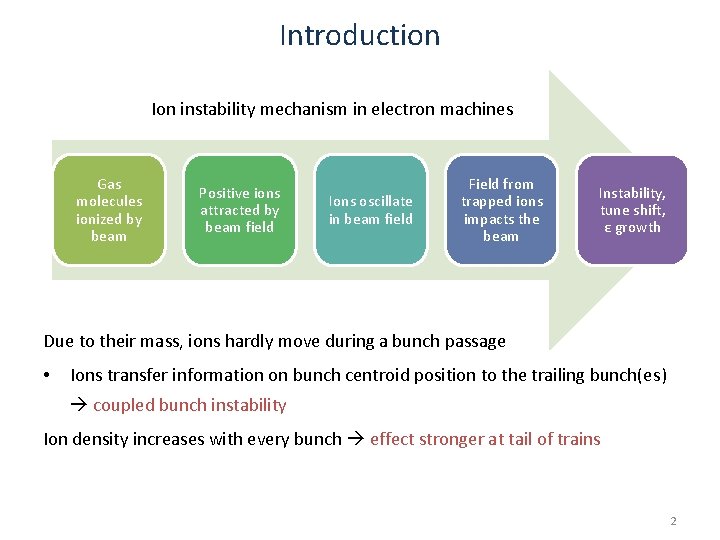
Introduction Ion instability mechanism in electron machines Gas molecules ionized by beam Positive ions attracted by beam field Ions oscillate in beam field Field from trapped ions impacts the beam Instability, tune shift, ε growth Due to their mass, ions hardly move during a bunch passage • Ions transfer information on bunch centroid position to the trailing bunch(es) coupled bunch instability Ion density increases with every bunch effect stronger at tail of trains 2
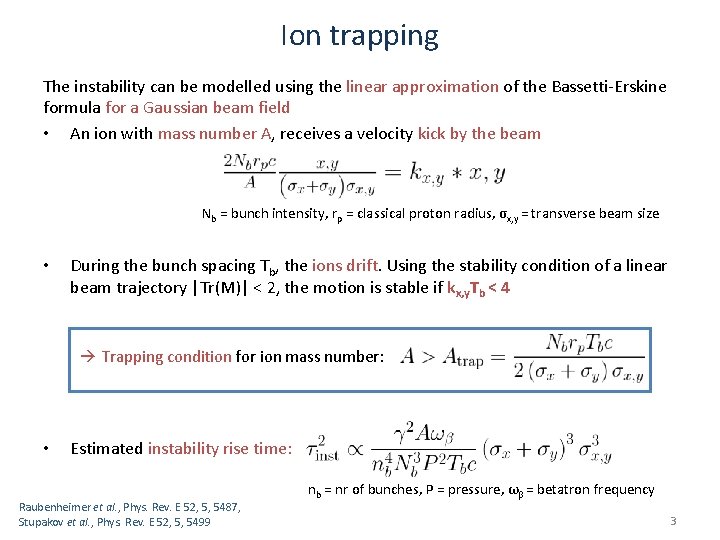
Ion trapping The instability can be modelled using the linear approximation of the Bassetti-Erskine formula for a Gaussian beam field • An ion with mass number A, receives a velocity kick by the beam Nb = bunch intensity, rp = classical proton radius, σx, y = transverse beam size • During the bunch spacing Tb, the ions drift. Using the stability condition of a linear beam trajectory |Tr(M)| < 2, the motion is stable if kx, y. Tb < 4 Trapping condition for ion mass number: • Estimated instability rise time: Raubenheimer et al. , Phys. Rev. E 52, 5, 5487, Stupakov et al. , Phys. Rev. E 52, 5, 5499 nb = nr of bunches, P = pressure, ωβ = betatron frequency 3
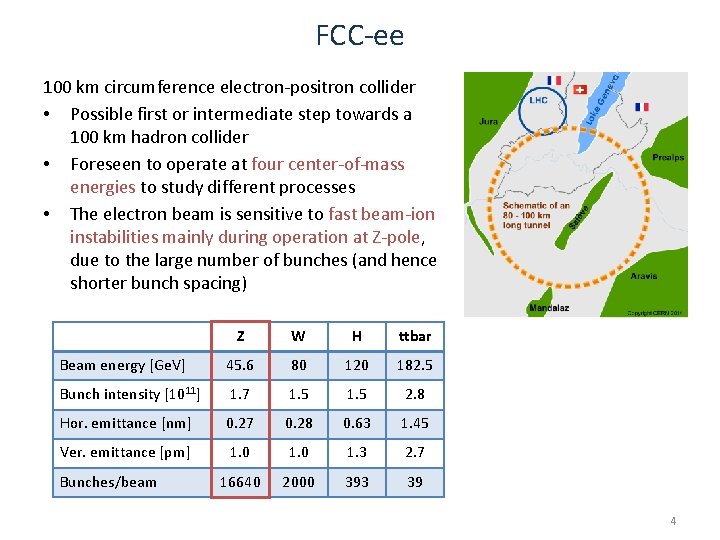
FCC-ee 100 km circumference electron-positron collider • Possible first or intermediate step towards a 100 km hadron collider • Foreseen to operate at four center-of-mass energies to study different processes • The electron beam is sensitive to fast beam-ion instabilities mainly during operation at Z-pole, due to the large number of bunches (and hence shorter bunch spacing) Z W H ttbar Beam energy [Ge. V] 45. 6 80 120 182. 5 Bunch intensity [1011] 1. 7 1. 5 2. 8 Hor. emittance [nm] 0. 27 0. 28 0. 63 1. 45 Ver. emittance [pm] 1. 0 1. 3 2. 7 16640 2000 393 39 Bunches/beam 4
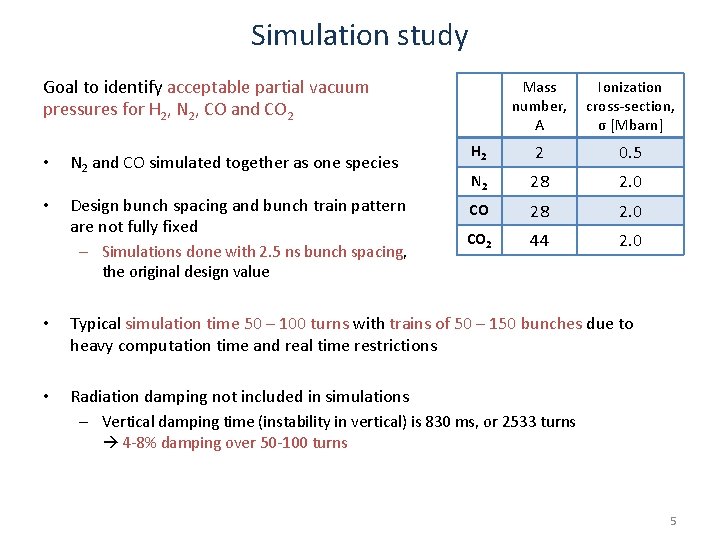
Simulation study Goal to identify acceptable partial vacuum pressures for H 2, N 2, CO and CO 2 • N 2 and CO simulated together as one species • Design bunch spacing and bunch train pattern are not fully fixed – Simulations done with 2. 5 ns bunch spacing, Mass number, A Ionization cross-section, σ [Mbarn] H 2 2 0. 5 N 2 28 2. 0 CO 2 44 2. 0 the original design value • Typical simulation time 50 – 100 turns with trains of 50 – 150 bunches due to heavy computation time and real time restrictions • Radiation damping not included in simulations – Vertical damping time (instability in vertical) is 830 ms, or 2533 turns 4 -8% damping over 50 -100 turns 5
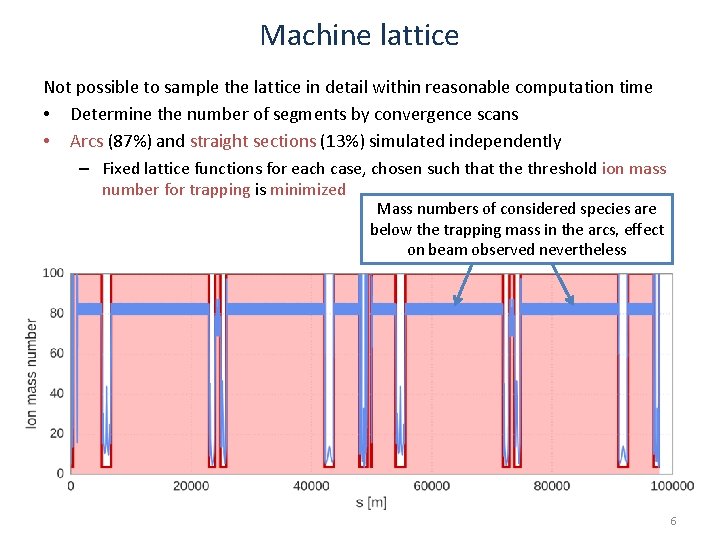
Machine lattice Not possible to sample the lattice in detail within reasonable computation time • Determine the number of segments by convergence scans • Arcs (87%) and straight sections (13%) simulated independently – Fixed lattice functions for each case, chosen such that the threshold ion mass number for trapping is minimized Mass numbers of considered species are below the trapping mass in the arcs, effect on beam observed nevertheless 6
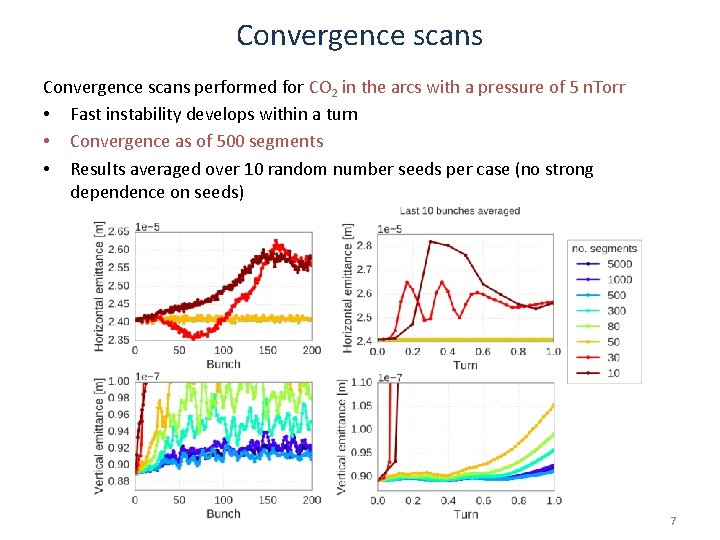
Convergence scans performed for CO 2 in the arcs with a pressure of 5 n. Torr • Fast instability develops within a turn • Convergence as of 500 segments • Results averaged over 10 random number seeds per case (no strong dependence on seeds) 7
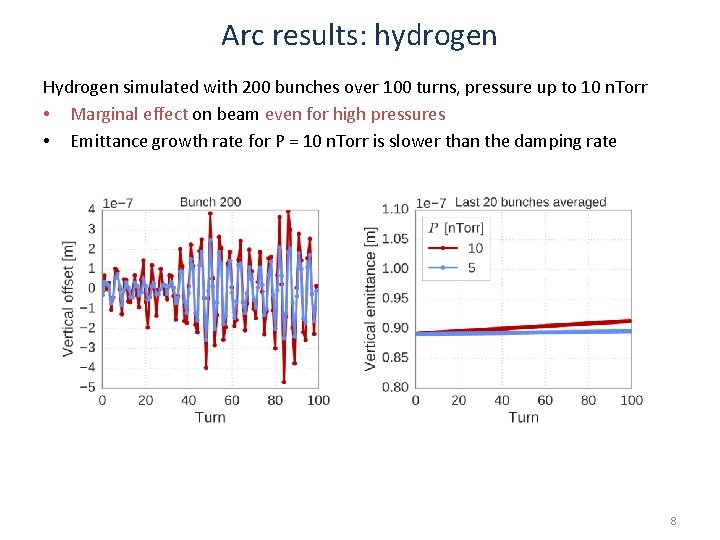
Arc results: hydrogen Hydrogen simulated with 200 bunches over 100 turns, pressure up to 10 n. Torr • Marginal effect on beam even for high pressures • Emittance growth rate for P = 10 n. Torr is slower than the damping rate 8
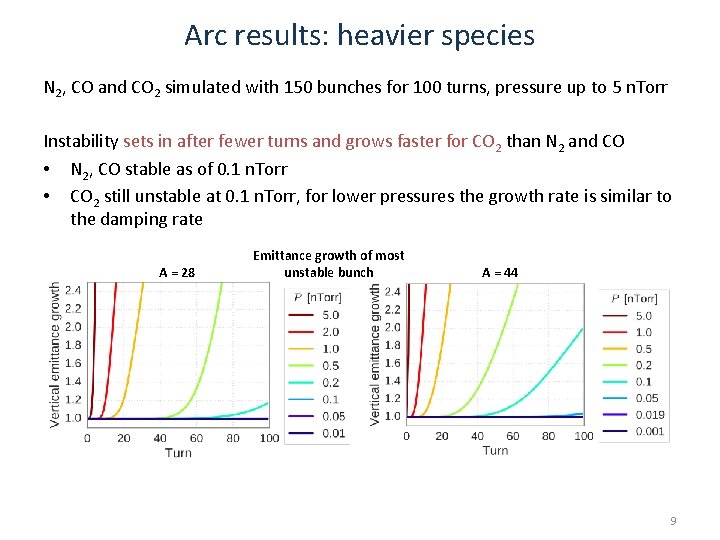
Arc results: heavier species N 2, CO and CO 2 simulated with 150 bunches for 100 turns, pressure up to 5 n. Torr Instability sets in after fewer turns and grows faster for CO 2 than N 2 and CO • N 2, CO stable as of 0. 1 n. Torr • CO 2 still unstable at 0. 1 n. Torr, for lower pressures the growth rate is similar to the damping rate A = 28 Emittance growth of most unstable bunch A = 44 9
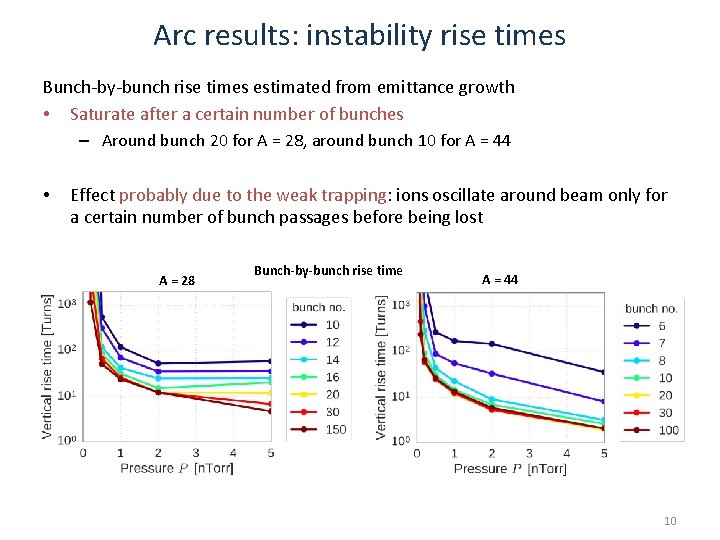
Arc results: instability rise times Bunch-by-bunch rise times estimated from emittance growth • Saturate after a certain number of bunches – Around bunch 20 for A = 28, around bunch 10 for A = 44 • Effect probably due to the weak trapping: ions oscillate around beam only for a certain number of bunch passages before being lost A = 28 Bunch-by-bunch rise time A = 44 10
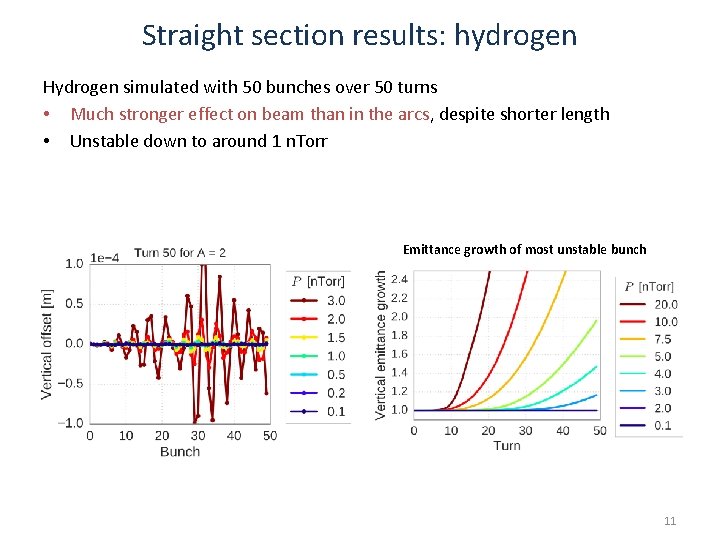
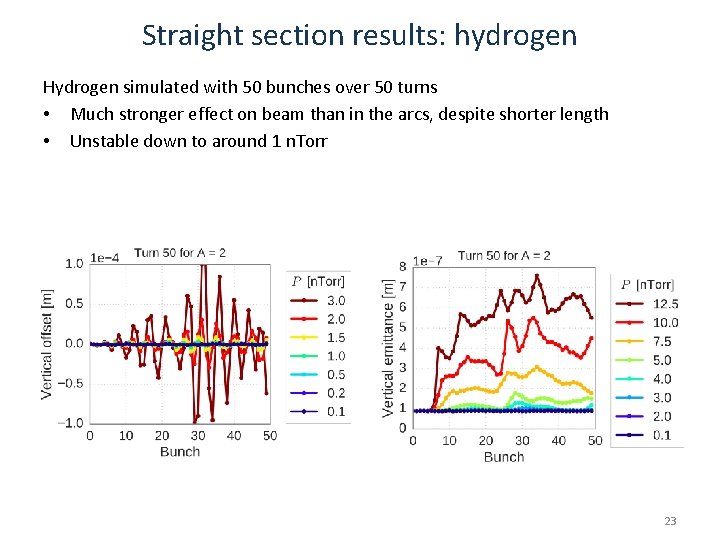
Straight section results: hydrogen Hydrogen simulated with 50 bunches over 50 turns • Much stronger effect on beam than in the arcs, despite shorter length • Unstable down to around 1 n. Torr Emittance growth of most unstable bunch 11
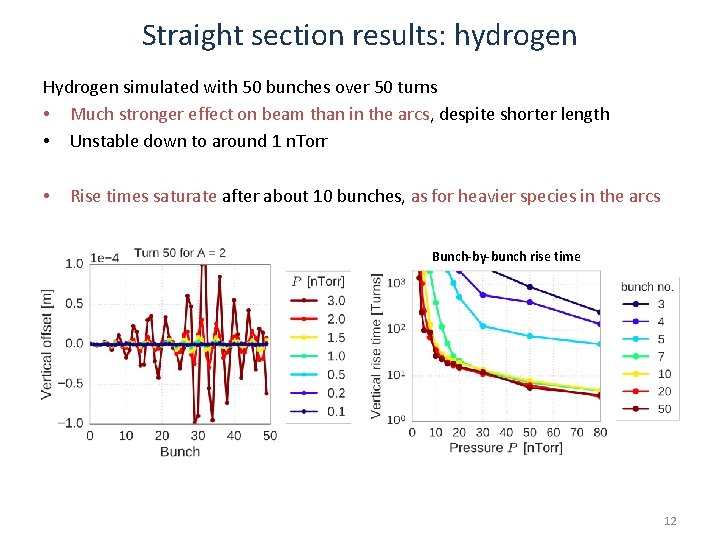
Straight section results: hydrogen Hydrogen simulated with 50 bunches over 50 turns • Much stronger effect on beam than in the arcs, despite shorter length • Unstable down to around 1 n. Torr • Rise times saturate after about 10 bunches, as for heavier species in the arcs Bunch-by-bunch rise time 12
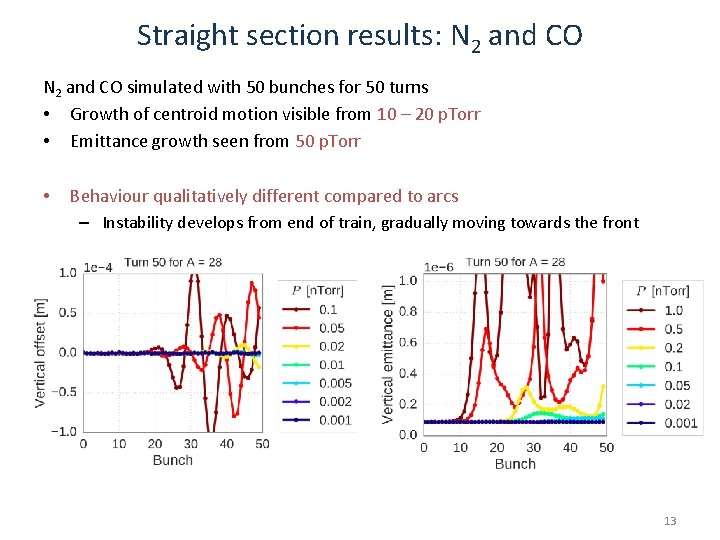
Straight section results: N 2 and CO simulated with 50 bunches for 50 turns • Growth of centroid motion visible from 10 – 20 p. Torr • Emittance growth seen from 50 p. Torr • Behaviour qualitatively different compared to arcs – Instability develops from end of train, gradually moving towards the front 13
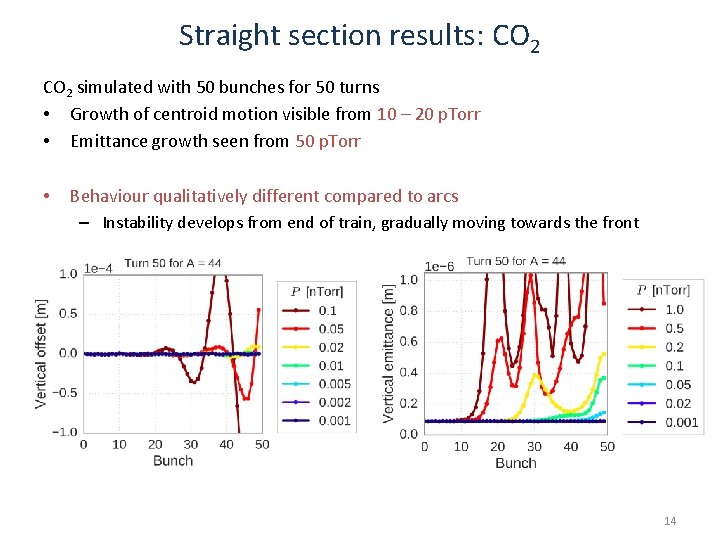
Straight section results: CO 2 simulated with 50 bunches for 50 turns • Growth of centroid motion visible from 10 – 20 p. Torr • Emittance growth seen from 50 p. Torr • Behaviour qualitatively different compared to arcs – Instability develops from end of train, gradually moving towards the front 14
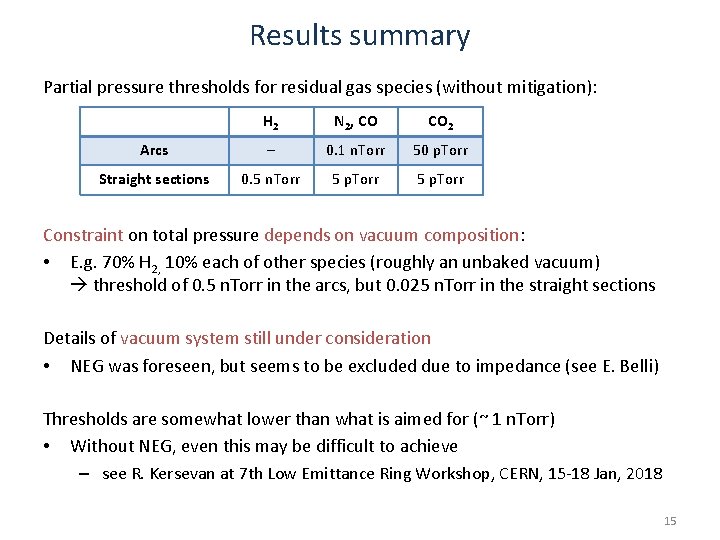
Results summary Partial pressure thresholds for residual gas species (without mitigation): H 2 N 2, CO CO 2 Arcs – 0. 1 n. Torr 50 p. Torr Straight sections 0. 5 n. Torr 5 p. Torr Constraint on total pressure depends on vacuum composition: • E. g. 70% H 2, 10% each of other species (roughly an unbaked vacuum) threshold of 0. 5 n. Torr in the arcs, but 0. 025 n. Torr in the straight sections Details of vacuum system still under consideration • NEG was foreseen, but seems to be excluded due to impedance (see E. Belli) Thresholds are somewhat lower than what is aimed for (~ 1 n. Torr) • Without NEG, even this may be difficult to achieve – see R. Kersevan at 7 th Low Emittance Ring Workshop, CERN, 15 -18 Jan, 2018 15
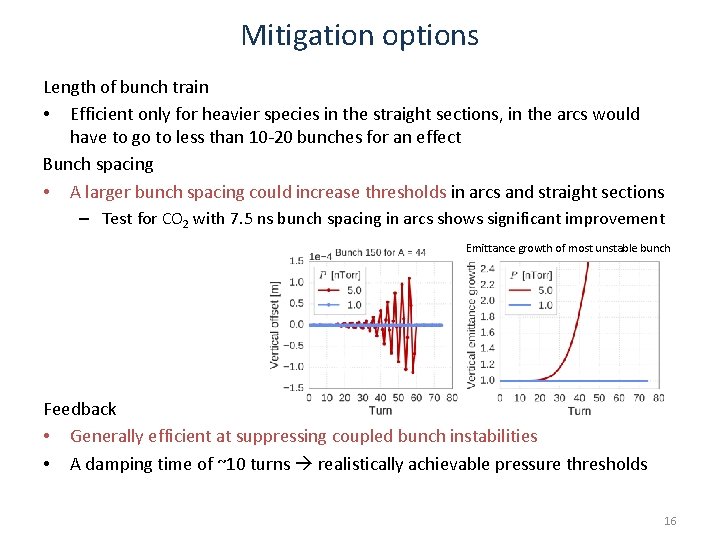
Mitigation options Length of bunch train • Efficient only for heavier species in the straight sections, in the arcs would have to go to less than 10 -20 bunches for an effect Bunch spacing • A larger bunch spacing could increase thresholds in arcs and straight sections – Test for CO 2 with 7. 5 ns bunch spacing in arcs shows significant improvement Emittance growth of most unstable bunch Feedback • Generally efficient at suppressing coupled bunch instabilities • A damping time of ~10 turns realistically achievable pressure thresholds 16
Conclusion and outlook Partial pressure thresholds in FCC-ee have been determined for H 2, N 2, CO and CO 2 • With 2. 5 ns bunch spacing, instabilities develop faster than the damping time for partial pressures as low as 10 p. Torr • Adjusting the bunch train length can only give partial mitigation, due to the limited trapping in the arcs • The constraints can be relaxed considerably by using a longer bunch spacing • Also a transverse feedback is expected to effectively mitigate the instability, although simulation studies are yet to be done • A report of the results was delivered to the FCC study (an EPFL deliverable) in December (EDMS 1895017 v. 1. 0 | FCC-ACC-RPT-0025 v. 1. 0) 17
Thank you 18
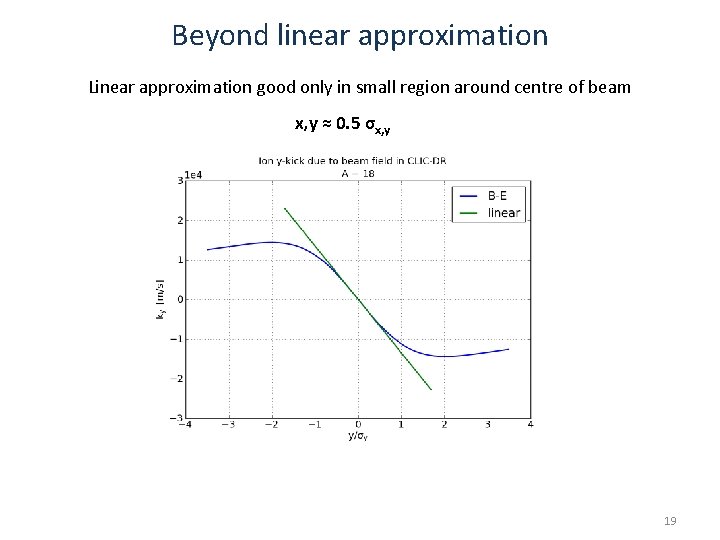
Beyond linear approximation Linear approximation good only in small region around centre of beam x, y ≈ 0. 5 σx, y 19
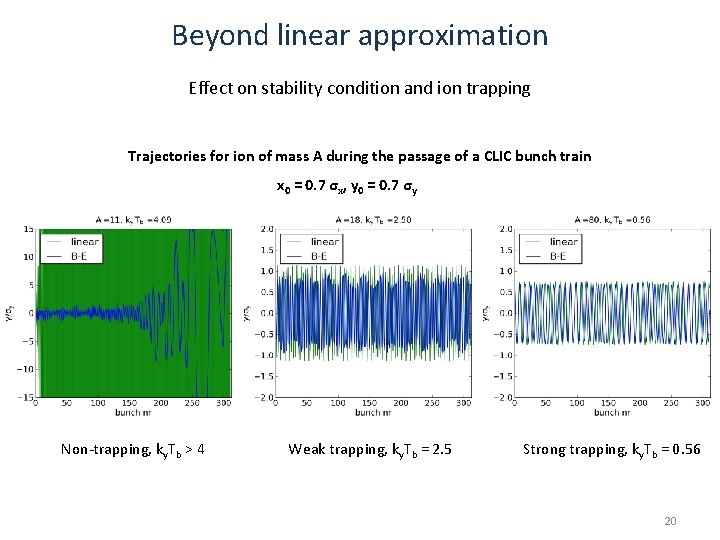
Beyond linear approximation Effect on stability condition and ion trapping Trajectories for ion of mass A during the passage of a CLIC bunch train x 0 = 0. 7 σx, y 0 = 0. 7 σy Non-trapping, ky. Tb > 4 Weak trapping, ky. Tb = 2. 5 Strong trapping, ky. Tb = 0. 56 20
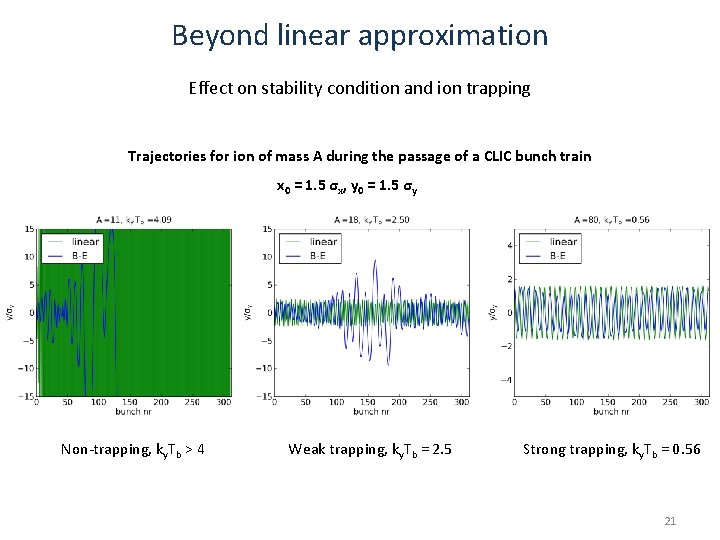
Beyond linear approximation Effect on stability condition and ion trapping Trajectories for ion of mass A during the passage of a CLIC bunch train x 0 = 1. 5 σx, y 0 = 1. 5 σy Non-trapping, ky. Tb > 4 Weak trapping, ky. Tb = 2. 5 Strong trapping, ky. Tb = 0. 56 21
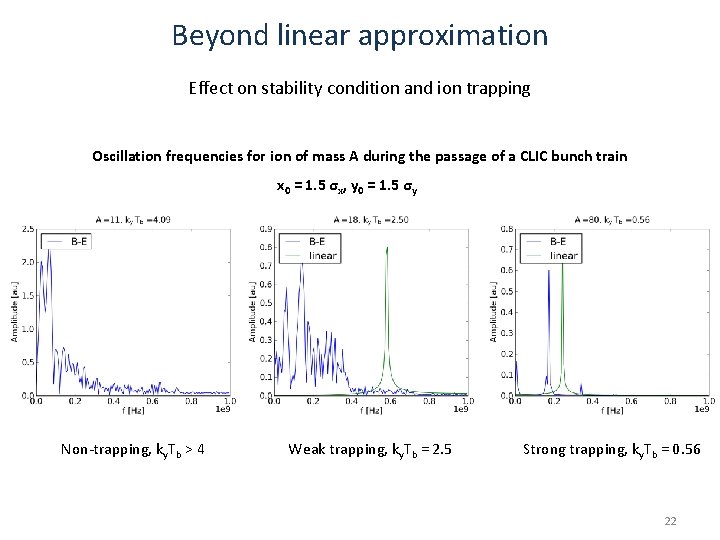
Beyond linear approximation Effect on stability condition and ion trapping Oscillation frequencies for ion of mass A during the passage of a CLIC bunch train x 0 = 1. 5 σx, y 0 = 1. 5 σy Non-trapping, ky. Tb > 4 Weak trapping, ky. Tb = 2. 5 Strong trapping, ky. Tb = 0. 56 22
Straight section results: hydrogen Hydrogen simulated with 50 bunches over 50 turns • Much stronger effect on beam than in the arcs, despite shorter length • Unstable down to around 1 n. Torr 23