
Ion Source and LEBT Ion Sources Producing large
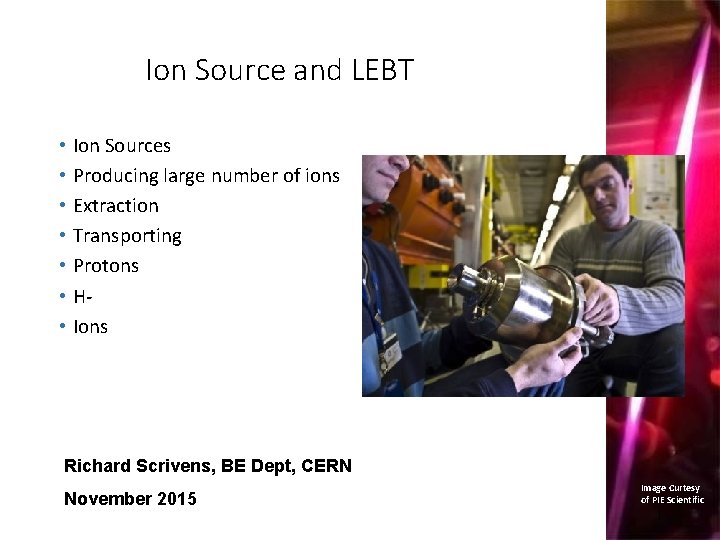
Ion Source and LEBT • Ion Sources • Producing large number of ions • Extraction • Transporting • Protons • H • Ions Richard Scrivens, BE Dept, CERN November 2015 Image Curtesy of PIE Scientific 1
• Ion Sources • Producing large number of ions • Extraction • Transporting • Protons • H • Ions 2

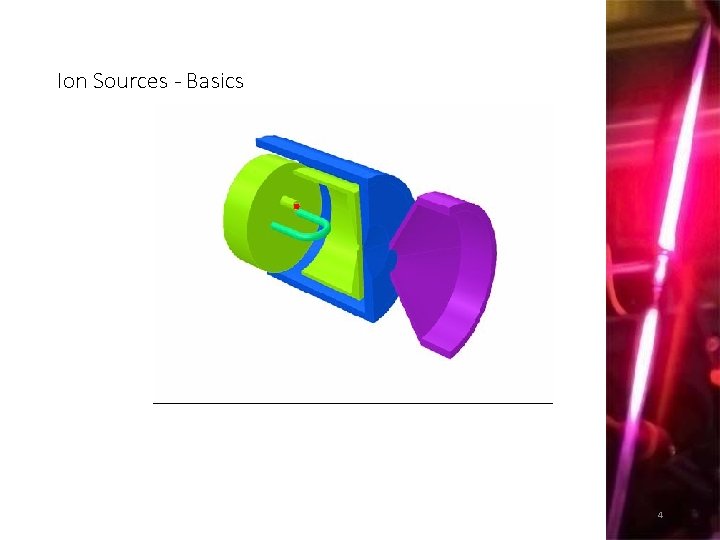
Ion Sources - Basics • An Ion Source requires an “ion production” region and an “ion extraction” system. • In most (but not all) cases, ion production occurs in a plasma. A plasma or discharge chamber A hole to let the ions out! Material input Power to create a plasma / discharge An extraction system 3
Ion Sources - Basics 4

Ion Sources - Basics o Hydrogen plasma (for protons or H-) from an RF source. o Hydrogen plasma emits a pink light from an atomic transition. 5
• Ion Sources • Producing large number of ions • Extraction • Transporting • Protons • H • Ions 6
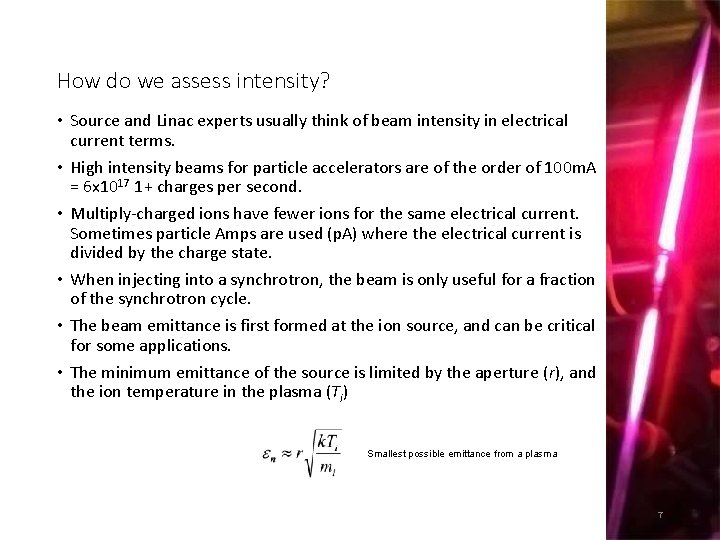
How do we assess intensity? • Source and Linac experts usually think of beam intensity in electrical current terms. • High intensity beams for particle accelerators are of the order of 100 m. A = 6 x 10¹⁷ 1+ charges per second. • Multiply-charged ions have fewer ions for the same electrical current. Sometimes particle Amps are used (p. A) where the electrical current is divided by the charge state. • When injecting into a synchrotron, the beam is only useful for a fraction of the synchrotron cycle. • The beam emittance is first formed at the ion source, and can be critical for some applications. • The minimum emittance of the source is limited by the aperture (r), and the ion temperature in the plasma (Ti) Smallest possible emittance from a plasma 7
Plasma Density Limitations • Particle accelerators must work under vacuum, whereas ion sources need a gas (or a vapour). • For protons (or H-) we have to start with H 2 gas. • It is not very feasible to operate on ion source above 1 mbar gas pressure and keep the following accelerator under vacuum. • Nmolecules @1 mbar = 2. 7 x 10¹⁶ /cm 3 • The plasma density is limited by many processes: • Increased plasma density leads to higher ion losses. • Increase plasma heating raises plasma temperature, increasing losses. • Increased plasma heating (electrons) can eventually reduce cross section for ion production. 8
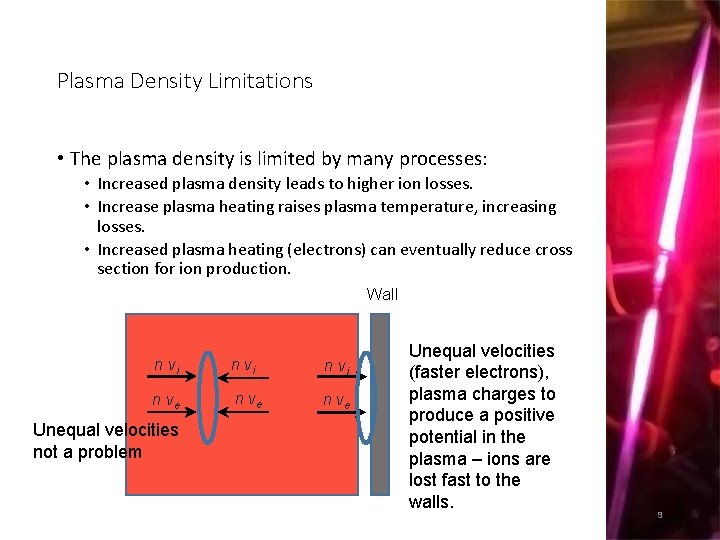
Plasma Density Limitations • The plasma density is limited by many processes: • Increased plasma density leads to higher ion losses. • Increase plasma heating raises plasma temperature, increasing losses. • Increased plasma heating (electrons) can eventually reduce cross section for ion production. Wall n vi n ve Unequal velocities not a problem Unequal velocities (faster electrons), plasma charges to produce a positive potential in the plasma – ions are lost fast to the walls. 9

Ion Sources – Electron Impact Ionization • • In many ion sources we use electron impact ionization. We need to create electrons, accelerate them to a few times the ionization potential of the material, and get them to interact with atoms. Ionization Cross Section by Electron Impact Alternative methods for ion generation are: • Photo-ionization • Surface interactions. R. Rejoub, B. G. Lindsay, and R. F. Stebbings, Phys. Rev. A 65, 042713 (2002) Except H: Y. -K. Kim and M. E. Rudd, Phys. Rev. A 50, 3954 (1994) The plot shows the cross section for ionization by electron impact on a selection of neutral atoms, as a function of the impacting electron energy. There is a minimum required electron energy (the ionization energy of the ion) and the cross section peaks at approximately 3 x this energy. 10
• Ion Sources • Producing large number of ions • Extraction • Transporting • Protons • H- • Ions 11
Extraction – Child Langmuir • Child-Langmuir law (3/2 power law) gives the limit of current density that can be removed from a surface. • Well adapted to electrons extracted from a cathode, but also relevant for the extraction of ions. • Need electric field to remove electrons from surface. • Electrons set up their own space charge field.
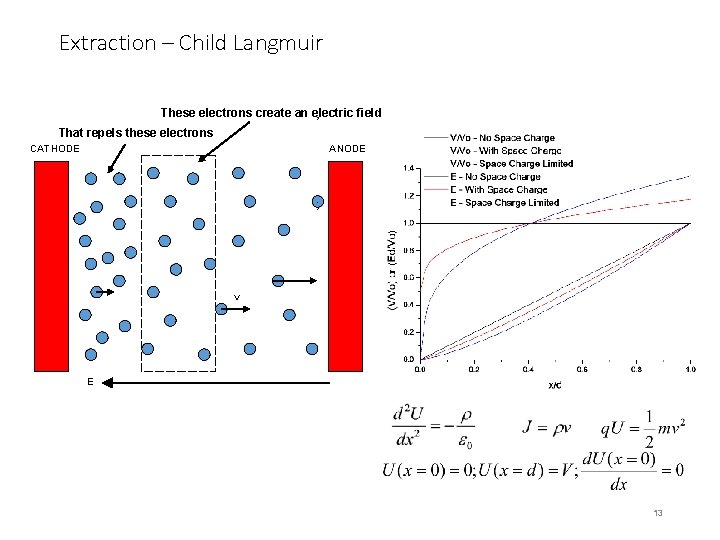
Extraction – Child Langmuir These electrons create an electric field ; That repels these electrons CATHODE ANODE ; v E 13
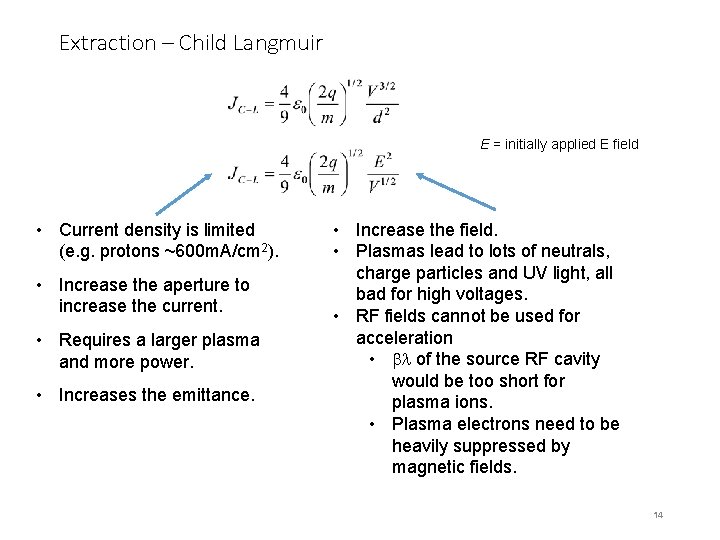
Extraction – Child Langmuir E = initially applied E field • Current density is limited (e. g. protons ~600 m. A/cm 2). • Increase the aperture to increase the current. • Requires a larger plasma and more power. • Increases the emittance. • Increase the field. • Plasmas lead to lots of neutrals, charge particles and UV light, all bad for high voltages. • RF fields cannot be used for acceleration • bl of the source RF cavity would be too short for plasma ions. • Plasma electrons need to be heavily suppressed by magnetic fields. 14
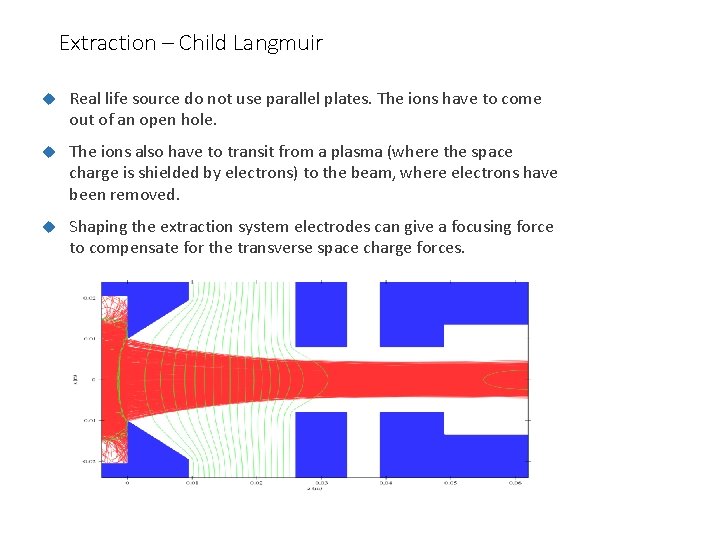
Extraction – Child Langmuir Real life source do not use parallel plates. The ions have to come out of an open hole. The ions also have to transit from a plasma (where the space charge is shielded by electrons) to the beam, where electrons have been removed. Shaping the extraction system electrodes can give a focusing force to compensate for the transverse space charge forces.
• Ion Sources • Producing large number of ions • Extraction • Transporting • Protons • H- • Ions 16
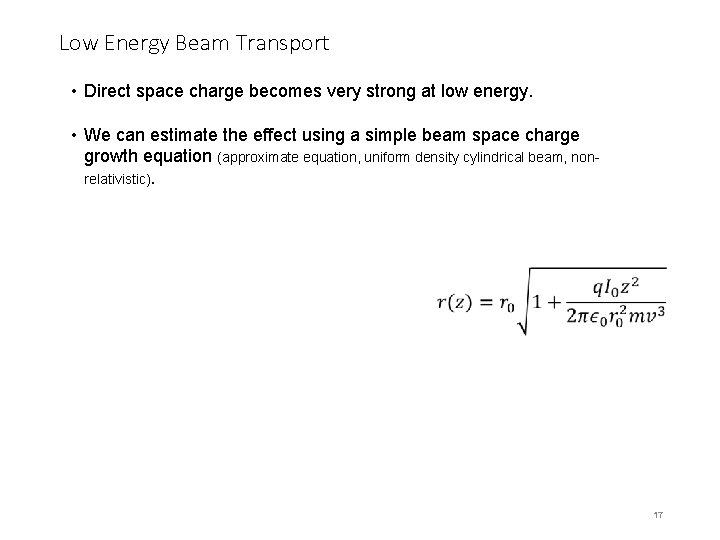
Low Energy Beam Transport • Direct space charge becomes very strong at low energy. • We can estimate the effect using a simple beam space charge growth equation (approximate equation, uniform density cylindrical beam, nonrelativistic). 17
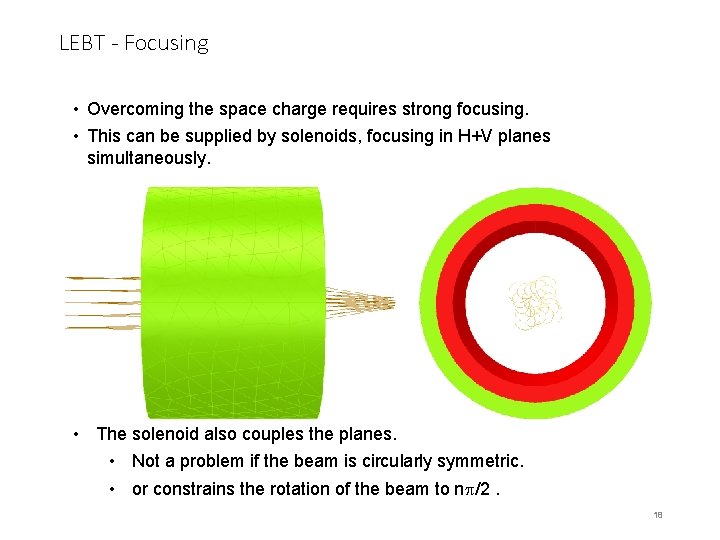
LEBT - Focusing • Overcoming the space charge requires strong focusing. • This can be supplied by solenoids, focusing in H+V planes simultaneously. • The solenoid also couples the planes. • Not a problem if the beam is circularly symmetric. • or constrains the rotation of the beam to np/2. 18
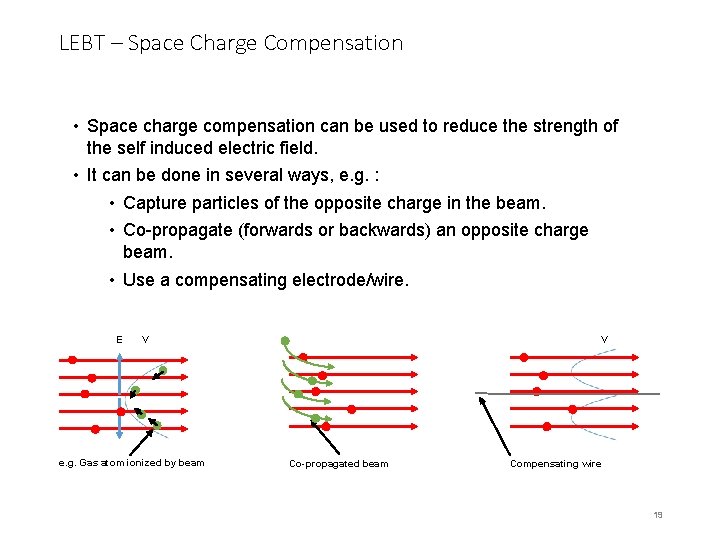
LEBT – Space Charge Compensation • Space charge compensation can be used to reduce the strength of the self induced electric field. • It can be done in several ways, e. g. : • Capture particles of the opposite charge in the beam. • Co-propagate (forwards or backwards) an opposite charge beam. • Use a compensating electrode/wire. E V V e. g. Gas atom ionized by beam Co-propagated beam Compensating wire 19
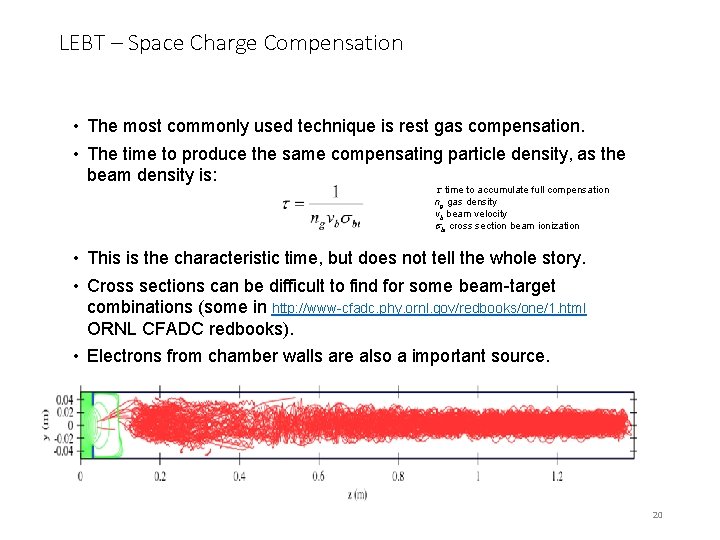
LEBT – Space Charge Compensation • The most commonly used technique is rest gas compensation. • The time to produce the same compensating particle density, as the beam density is: t time to accumulate full compensation ng gas density vb beam velocity sbi cross section beam ionization • This is the characteristic time, but does not tell the whole story. • Cross sections can be difficult to find for some beam-target combinations (some in http: //www-cfadc. phy. ornl. gov/redbooks/one/1. html ORNL CFADC redbooks). • Electrons from chamber walls are also a important source. 20
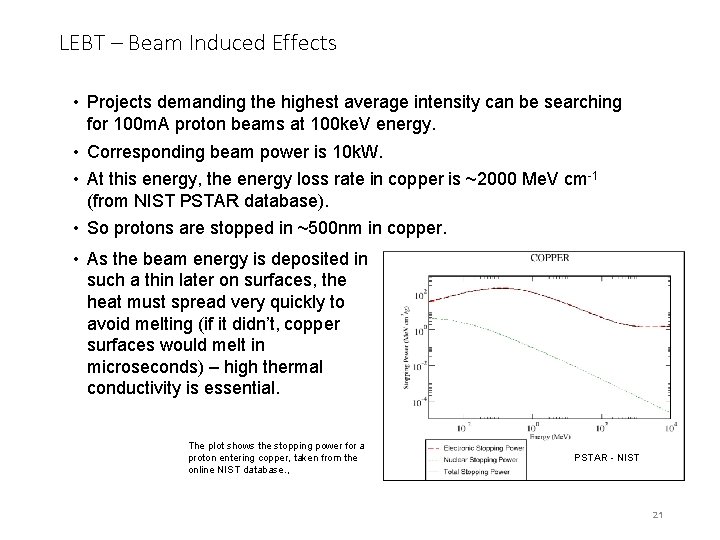
LEBT – Beam Induced Effects • Projects demanding the highest average intensity can be searching for 100 m. A proton beams at 100 ke. V energy. • Corresponding beam power is 10 k. W. • At this energy, the energy loss rate in copper is ~2000 Me. V cm-1 (from NIST PSTAR database). • So protons are stopped in ~500 nm in copper. • As the beam energy is deposited in such a thin later on surfaces, the heat must spread very quickly to avoid melting (if it didn’t, copper surfaces would melt in microseconds) – high thermal conductivity is essential. The plot shows the stopping power for a proton entering copper, taken from the online NIST database. , PSTAR - NIST 21
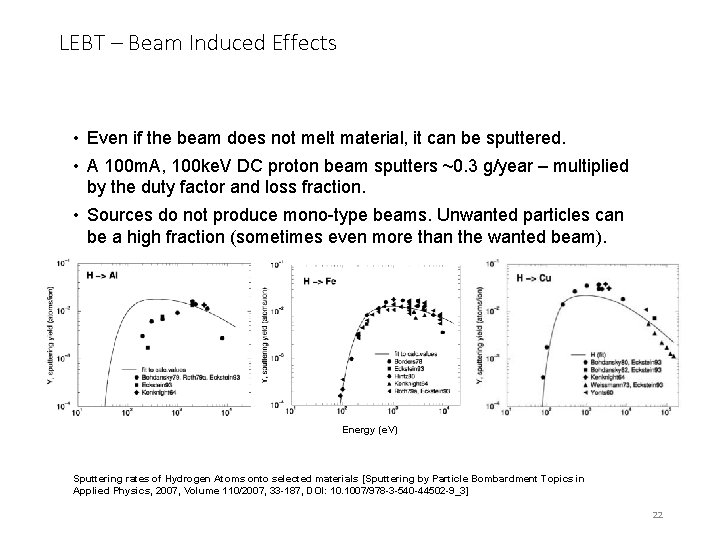
LEBT – Beam Induced Effects • Even if the beam does not melt material, it can be sputtered. • A 100 m. A, 100 ke. V DC proton beam sputters ~0. 3 g/year – multiplied by the duty factor and loss fraction. • Sources do not produce mono-type beams. Unwanted particles can be a high fraction (sometimes even more than the wanted beam). Energy (e. V) Sputtering rates of Hydrogen Atoms onto selected materials [Sputtering by Particle Bombardment Topics in Applied Physics, 2007, Volume 110/2007, 33 -187, DOI: 10. 1007/978 -3 -540 -44502 -9_3] 22
• Ion Sources • Producing large number of ions • Extraction • Transporting • Protons • H • Ions 23

The Cathode Problem Many ion sources work on the gas discharge model (cathode and anode separated by a gas). For high intensities, the density of the gas is high, and ions created can return to the cathode, causing sputtering. In order to run ion sources in DC mode, with high reliability, cathode/anode discharges have to be avoided (cathodes are strongly sputtered by ions formed in dense gas discharges). Hence, high intensity sources often require to move to RF/Microwave discharges in order to remove the cathode. Failed cathode of the CERN duoplasmatron 24
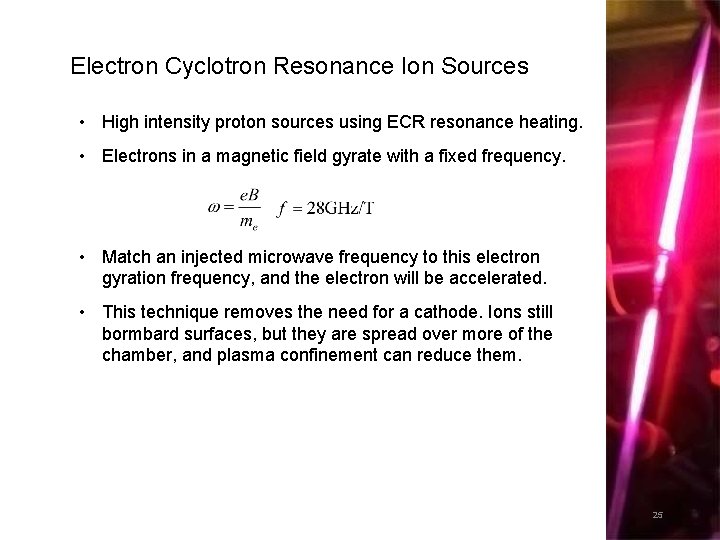
Electron Cyclotron Resonance Ion Sources • High intensity proton sources using ECR resonance heating. • Electrons in a magnetic field gyrate with a fixed frequency. • Match an injected microwave frequency to this electron gyration frequency, and the electron will be accelerated. • This technique removes the need for a cathode. Ions still bormbard surfaces, but they are spread over more of the chamber, and plasma confinement can reduce them. 25
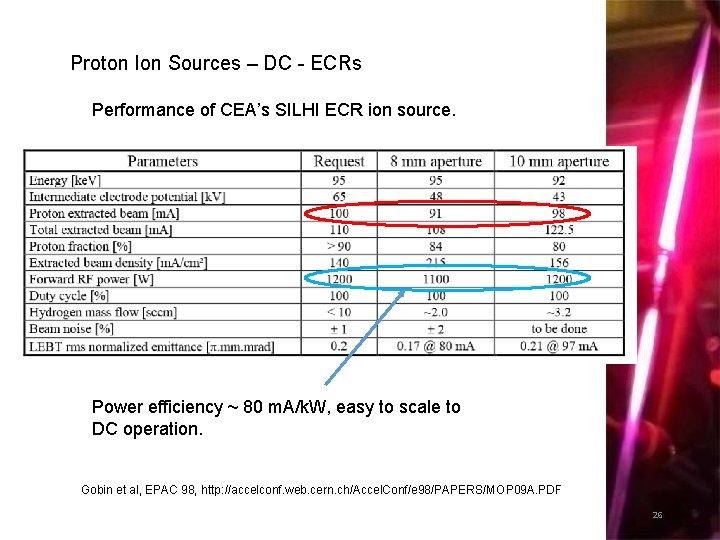
Proton Ion Sources – DC - ECRs Performance of CEA’s SILHI ECR ion source. Power efficiency ~ 80 m. A/k. W, easy to scale to DC operation. Gobin et al, EPAC 98, http: //accelconf. web. cern. ch/Accel. Conf/e 98/PAPERS/MOP 09 A. PDF 26
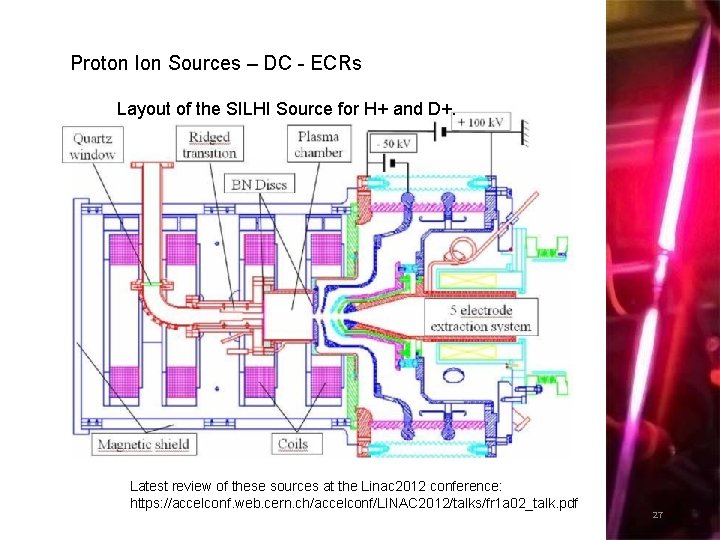
Proton Ion Sources – DC - ECRs Layout of the SILHI Source for H+ and D+. Latest review of these sources at the Linac 2012 conference: https: //accelconf. web. cern. ch/accelconf/LINAC 2012/talks/fr 1 a 02_talk. pdf 27
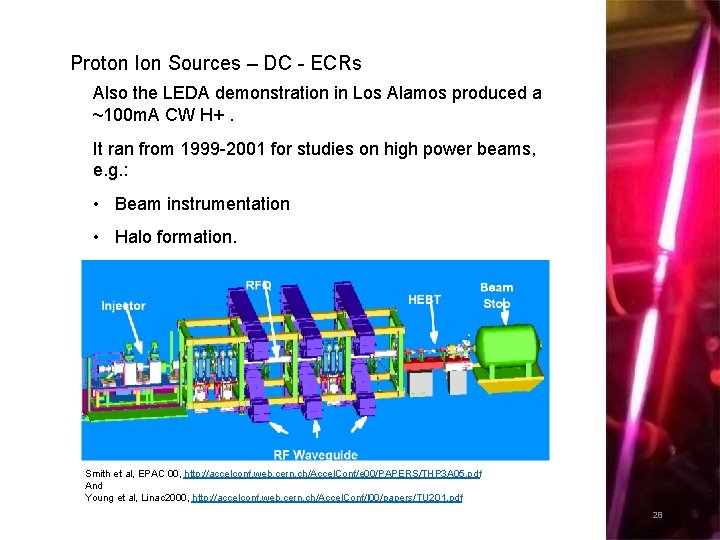
Proton Ion Sources – DC - ECRs Also the LEDA demonstration in Los Alamos produced a ~100 m. A CW H+. It ran from 1999 -2001 for studies on high power beams, e. g. : • Beam instrumentation • Halo formation. Smith et al, EPAC 00, http: //accelconf. web. cern. ch/Accel. Conf/e 00/PAPERS/THP 3 A 05. pdf And Young et al, Linac 2000, http: //accelconf. web. cern. ch/Accel. Conf/l 00/papers/TU 201. pdf 28
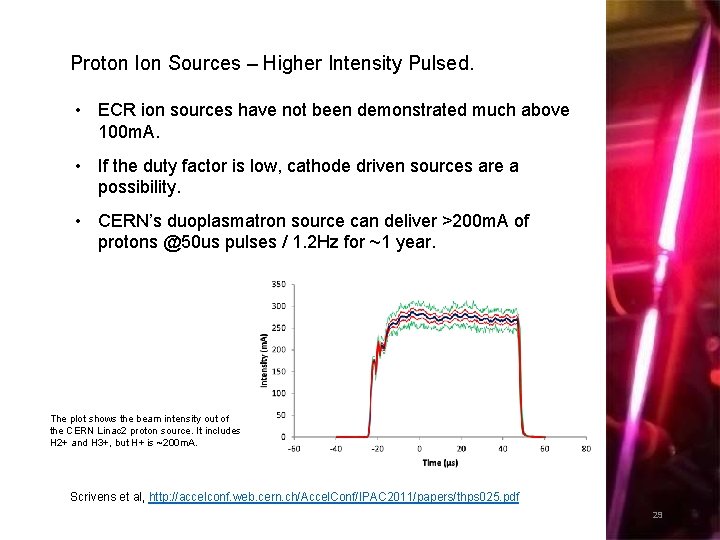
Proton Ion Sources – Higher Intensity Pulsed. • ECR ion sources have not been demonstrated much above 100 m. A. • If the duty factor is low, cathode driven sources are a possibility. • CERN’s duoplasmatron source can deliver >200 m. A of protons @50 us pulses / 1. 2 Hz for ~1 year. The plot shows the beam intensity out of the CERN Linac 2 proton source. It includes H 2+ and H 3+, but H+ is ~200 m. A. Scrivens et al, http: //accelconf. web. cern. ch/Accel. Conf/IPAC 2011/papers/thps 025. pdf 29
• Ion Sources • Producing large number of ions • Extraction • Transporting • Protons • H • Ions 30

Negative Ion Sources – Sources • Negative ions have an additional electron attached. • Ions that have a positive electron affinity are stable. H Electron Affinity (e. V) 0. 7542 He <0 Li 0. 6182 Be <0 B 0. 277 C 1. 2629 N <0 O 1. 462 F 3. 399 31
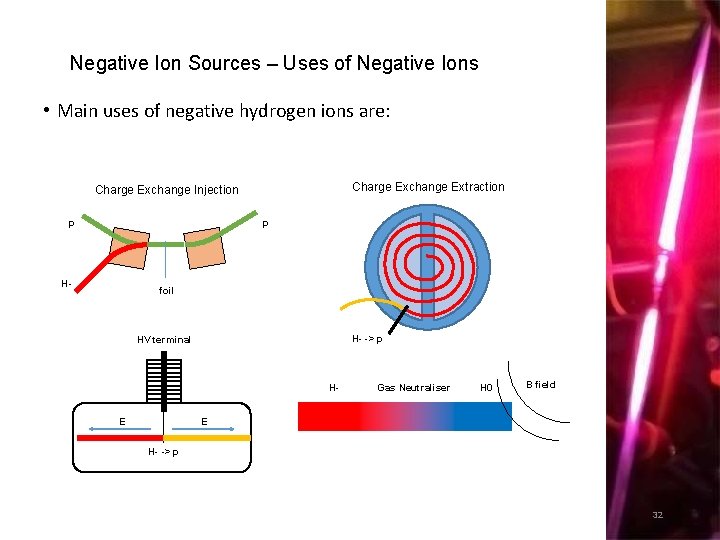
Negative Ion Sources – Uses of Negative Ions • Main uses of negative hydrogen ions are: Charge Exchange Extraction Charge Exchange Injection p p H- foil H- -> p HV terminal HE Gas Neutraliser H 0 B field E H- -> p 32
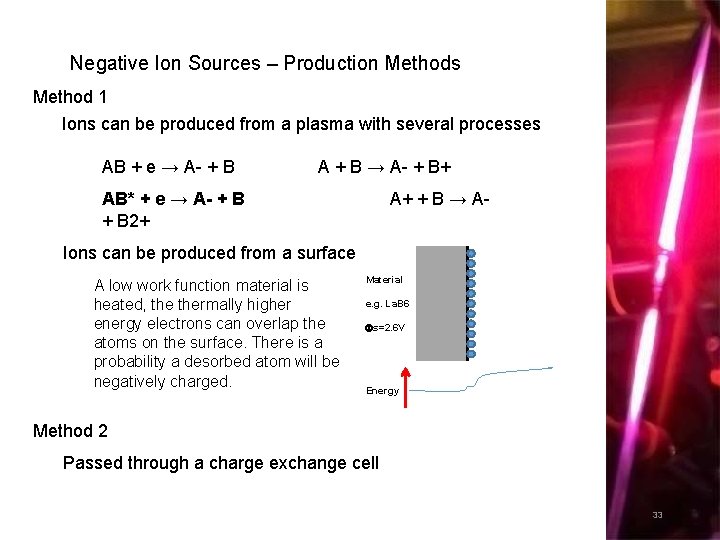
Negative Ion Sources – Production Methods Method 1 Ions can be produced from a plasma with several processes AB + e → A- + B A + B → A- + B+ AB* + e → A- + B 2+ A+ + B → A- Ions can be produced from a surface A low work function material is heated, thermally higher energy electrons can overlap the atoms on the surface. There is a probability a desorbed atom will be negatively charged. Material e. g. La. B 6 Fs=2. 6 V Energy Method 2 Passed through a charge exchange cell 33
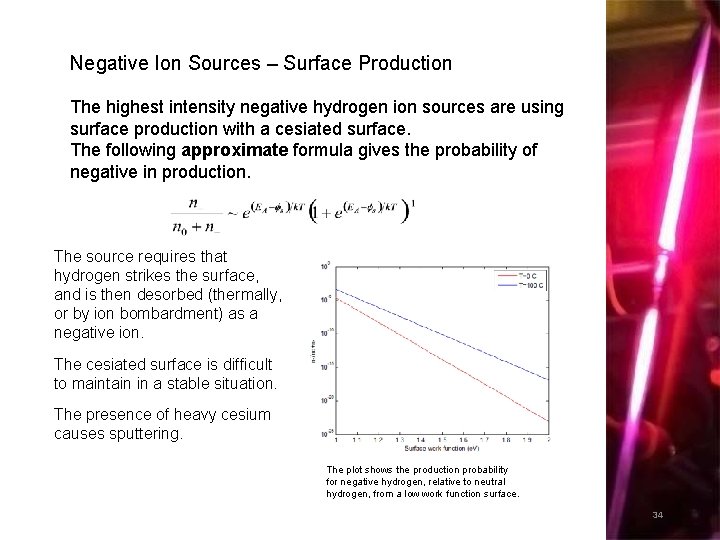
Negative Ion Sources – Surface Production The highest intensity negative hydrogen ion sources are using surface production with a cesiated surface. The following approximate formula gives the probability of negative in production. The source requires that hydrogen strikes the surface, and is then desorbed (thermally, or by ion bombardment) as a negative ion. The cesiated surface is difficult to maintain in a stable situation. The presence of heavy cesium causes sputtering. The plot shows the production probability for negative hydrogen, relative to neutral hydrogen, from a low work function surface. 34
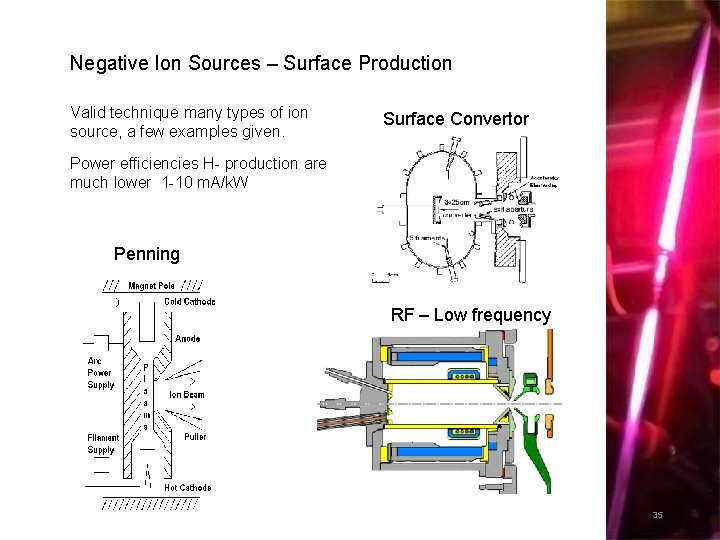
Negative Ion Sources – Surface Production Valid technique many types of ion source, a few examples given. Surface Convertor Power efficiencies H- production are much lower 1 -10 m. A/k. W Penning RF – Low frequency 35
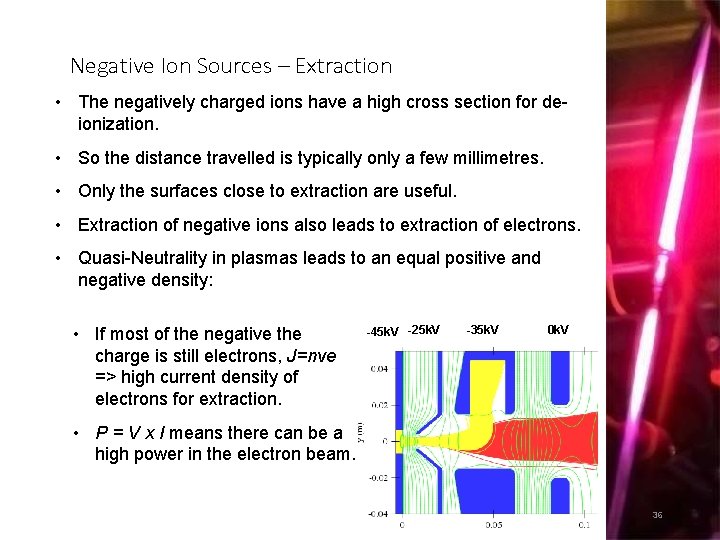
Negative Ion Sources – Extraction • The negatively charged ions have a high cross section for deionization. • So the distance travelled is typically only a few millimetres. • Only the surfaces close to extraction are useful. • Extraction of negative ions also leads to extraction of electrons. • Quasi-Neutrality in plasmas leads to an equal positive and negative density: • If most of the negative the charge is still electrons, J=nve => high current density of electrons for extraction. -45 k. V -25 k. V -35 k. V 0 k. V • P = V x I means there can be a high power in the electron beam. 36
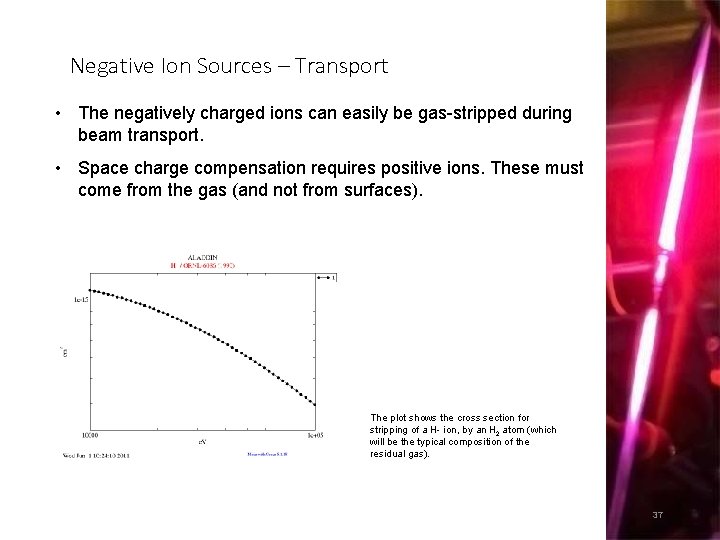
Negative Ion Sources – Transport • The negatively charged ions can easily be gas-stripped during beam transport. • Space charge compensation requires positive ions. These must come from the gas (and not from surfaces). The plot shows the cross section for stripping of a H- ion, by an H 2 atom (which will be the typical composition of the residual gas). 37
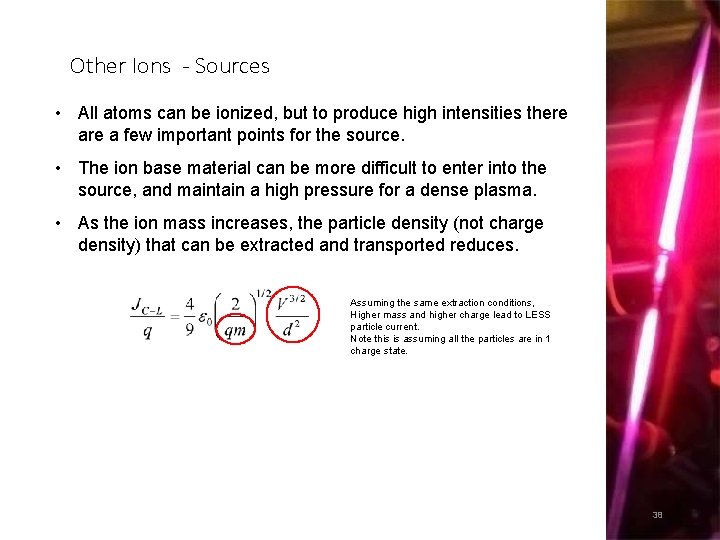
Other Ions - Sources • All atoms can be ionized, but to produce high intensities there a few important points for the source. • The ion base material can be more difficult to enter into the source, and maintain a high pressure for a dense plasma. • As the ion mass increases, the particle density (not charge density) that can be extracted and transported reduces. Assuming the same extraction conditions, Higher mass and higher charge lead to LESS particle current. Note this is assuming all the particles are in 1 charge state. 38
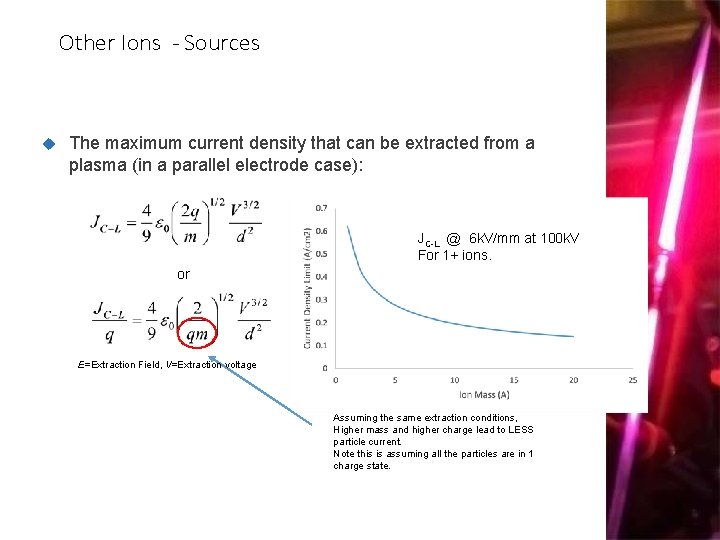
Other Ions - Sources The maximum current density that can be extracted from a plasma (in a parallel electrode case): JC-L @ 6 k. V/mm at 100 k. V For 1+ ions. or E=Extraction Field, V=Extraction voltage Assuming the same extraction conditions, Higher mass and higher charge lead to LESS particle current. Note this is assuming all the particles are in 1 charge state.
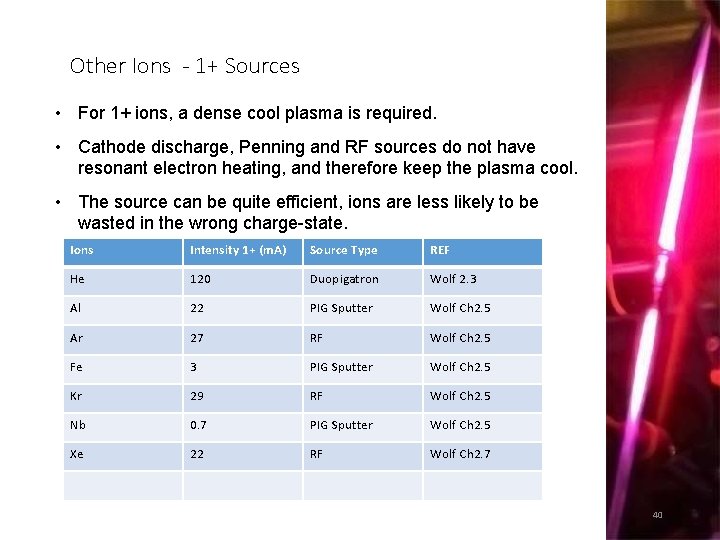
Other Ions - 1+ Sources • For 1+ ions, a dense cool plasma is required. • Cathode discharge, Penning and RF sources do not have resonant electron heating, and therefore keep the plasma cool. • The source can be quite efficient, ions are less likely to be wasted in the wrong charge-state. Ions Intensity 1+ (m. A) Source Type REF He 120 Duopigatron Wolf 2. 3 Al 22 PIG Sputter Wolf Ch 2. 5 Ar 27 RF Wolf Ch 2. 5 Fe 3 PIG Sputter Wolf Ch 2. 5 Kr 29 RF Wolf Ch 2. 5 Nb 0. 7 PIG Sputter Wolf Ch 2. 5 Xe 22 RF Wolf Ch 2. 7 40
Other Ions - 1+ Acceleration • Low q ions are harder to accelerate and bend/focus, and therefore expensive to build. (E = q x V ; r = p / q. B). • Converting them to high q (stripping) is: • Inefficient (usually produces many ions of the wrong state). • Requires thin foils at low energy (high powers deposited), or gas stripping (inefficient conversion rate). 41
Other Ions - q+ Sources • So for cost and acceleration efficiency reasons => use more highly charged ions. • For low charge state ions (ionization potential <100 e. V) the same sources as 1+ are often used. • For highly charged ion, must move to high temperature plasma sources. • ECR: Resonant electron heating with good confinement leads to high electron temperatures. • EBIS (Electron Beam Ion Source): Ion trapped in a few ke. V high density electron beam, ionization up to electron beam energy. • Laser Plasma: High power focused laser pulses (short in length) creates a dense hot plasma on a target surface, containing high charge states. 42
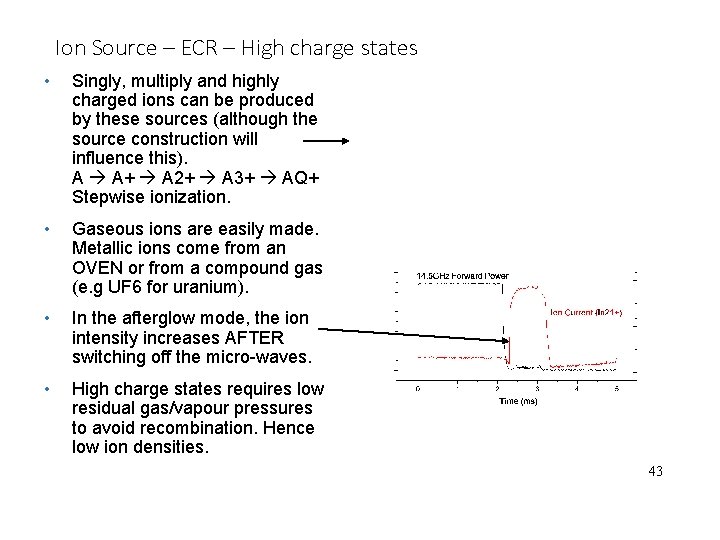
Ion Source – ECR – High charge states • Singly, multiply and highly charged ions can be produced by these sources (although the source construction will influence this). A A+ A 2+ A 3+ AQ+ Stepwise ionization. • Gaseous ions are easily made. Metallic ions come from an OVEN or from a compound gas (e. g UF 6 for uranium). • In the afterglow mode, the ion intensity increases AFTER switching off the micro-waves. • High charge states requires low residual gas/vapour pressures to avoid recombination. Hence low ion densities. 43
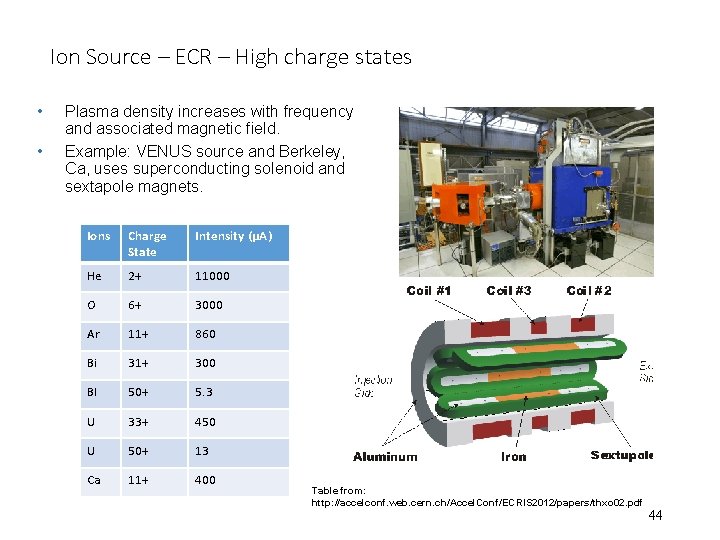
Ion Source – ECR – High charge states • • Plasma density increases with frequency and associated magnetic field. Example: VENUS source and Berkeley, Ca, uses superconducting solenoid and sextapole magnets. Ions Charge State Intensity (µA) He 2+ 11000 O 6+ 3000 Ar 11+ 860 Bi 31+ 300 BI 50+ 5. 3 U 33+ 450 U 50+ 13 Ca 11+ 400 Table from: http: //accelconf. web. cern. ch/Accel. Conf/ECRIS 2012/papers/thxo 02. pdf 44
Summary • The limitations of ion sources are varied. • Protons are limited by the current density that can be extracted. • Several limitations come together for H- • • High power density required into the plasma. • H- ions do not easily survive in dense plasmas. • Electron extraction perturbs beam. For other ions, low charge state sources offer the best route to high ion intensities, but the acceleration is costly. 45
Further Reading • Handbook of Ion Source, B. Wolf, Boca Raton, FL: CRC Press, 1995 • Ion Sources, Zhang Hua Shun, Berlin: Springer, 1999. • The Physics and Technology of Ion Source, I. G. Brown, New York, NY: Wiley, 1989 • Large Ion Beams: Fundamentals of Generation and Propagation, T. A. Forrester, New York, NY: Wiley, 1988 • CAS – 5 th General School (CERN 94 -01 ) and Cyclotrons, Linacs… (CERN-96 -02 ) 46

Thank you for your attention. 47
A: Richardson-Dushman constant B: Magnetic field D: Diffusion rate E: Particle Kinetic Energy E: Electric field J: Current density m: Particle Mass n: Particle density q: Charge Q: Charge State r: Radius T: Temperature U, V: Voltage v: Particle velocity vdrift: Particle drift velocity Z: Distance along z-axis b: Relativistic beta g: Relativistic gamma e 0: Electrical Permittivity fs: Work Function (Voltage) n: Collision Frequency rc: Cyclotron Radius wc: Cyclotron Frequency 48
- Slides: 48