
Ion Pair Chromatography Principle Ionic compounds can be
Ion Pair Chromatography
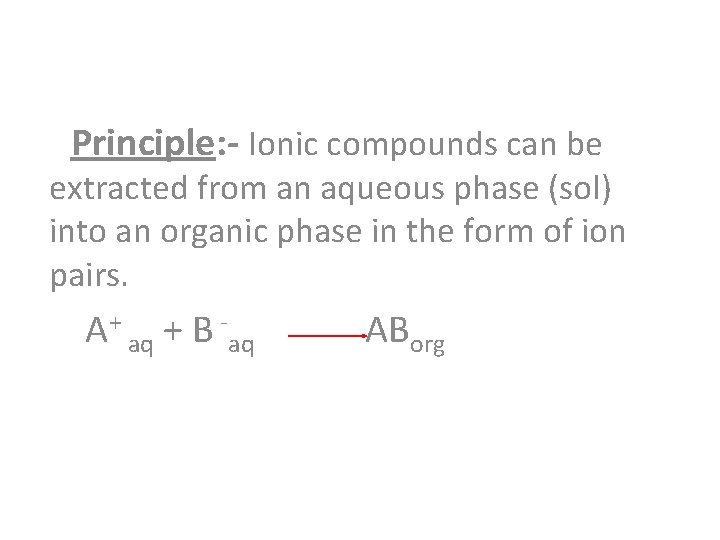
Principle: - Ionic compounds can be extracted from an aqueous phase (sol) into an organic phase in the form of ion pairs. A+ aq + B -aq ABorg
What is Ion Pair Chromatography? ● Ion Pair Chromatography (IPC) is used to separate ionic analytes on a reversed phase column. ● An Ion Pair reagent is added to modulate retention of the ionic analytes. ● Typical IP reagents are: alkylsulphonates, alkylsulphates, tetra-alkylammonium ions etc.
Ion-pair chromatography uses a reversed-phase HPLC column instead of an ion-exchange column. To separate a mixture of cations (e. g. protonated organic bases) an ionic surfactant is added to the mobile phase.

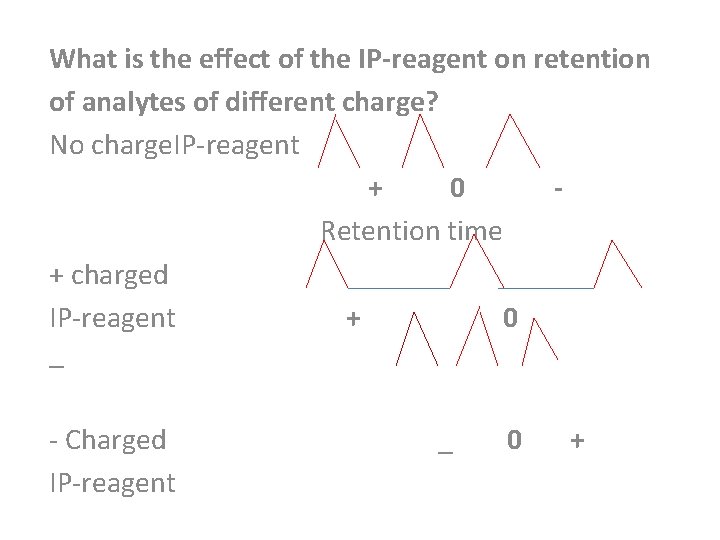
What is the effect of the IP-reagent on retention of analytes of different charge? No charge. IP-reagent + 0 Retention time + charged IP-reagent + 0 _ - Charged IP-reagent _ 0 +
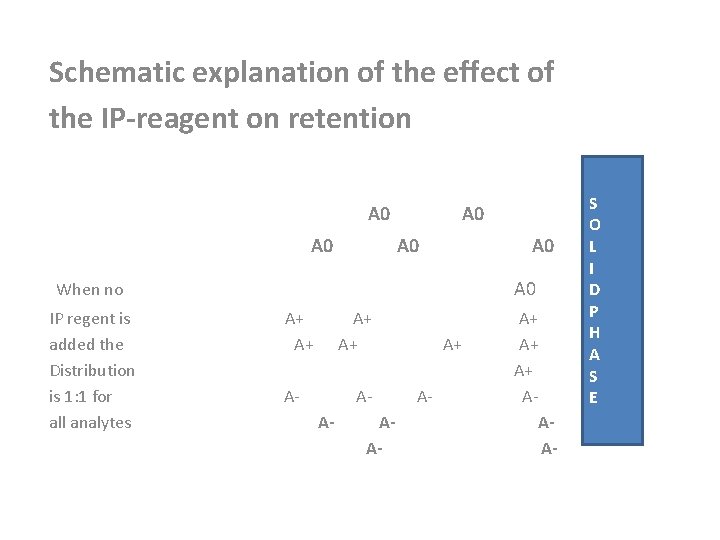
Schematic explanation of the effect of the IP-reagent on retention A 0 A 0 A 0 When no IP regent is added the Distribution is 1: 1 for all analytes A+ A+ A- AA- A+ A+ A+ AAA- S A 0 O L I D P H A S E

MECHANISM OF ION PAIR CHOMATOGRAPHIC RETENTION : The extract mechanism of ion pair chromatography is not clear. Three models have been proposed. 1) Ion pair formation: - This model states that the analyte and ion pair reagent form a neutral ion pair and then partition between mobile and stationary phase 2) Dynamic ion exchange: - This model states that the ion 3) pair reagent partition stationary phase and its hydrophobic portion adsorbs to the hydrophobic stationary phase & analyte will form reversible ion pair. Ion interaction model : - This does not require ion pair formation to occur in either phase nor is it based on classical ion exchange phenomenon. This model presumes that electrical double layer is formed at stationary phase surface as a result of dynamic adsorption of ion pair reagent. .
Factors affecting ion pair chromatography Ø Ph ØTemperature ØConcentration ØOrganic modifier ØIon pair reagent

Advantages : Applications : -
How theory meet practice in IPchromatography. ● A theory for IP-chromatography shall quantitatively describe how retention is affected by: ● The charge of the analytes. ● The type and concentration of IP-reagent ● The type and concentration of organic modifier ● The ionic strength. ● The theory shall be physically acceptable.
- Slides: 11