
Ion irradiation for nuclear materials research at University
- Slides: 23
Ion irradiation for nuclear materials research at University of Wisconsin. Madison Li He, Gabriel Meric De Bellefon, Kim Kriewaldt, Kumar Sridharan, Adrien Couet, Todd Allen University of Wisconsin – Madison SNEAP 2018 conference Madison, WI September 24 th, 2018 1
Overview • Ion Beam Lab and post-irradiation examination facility • Upgrades • Materials study examples • Access IBL 2
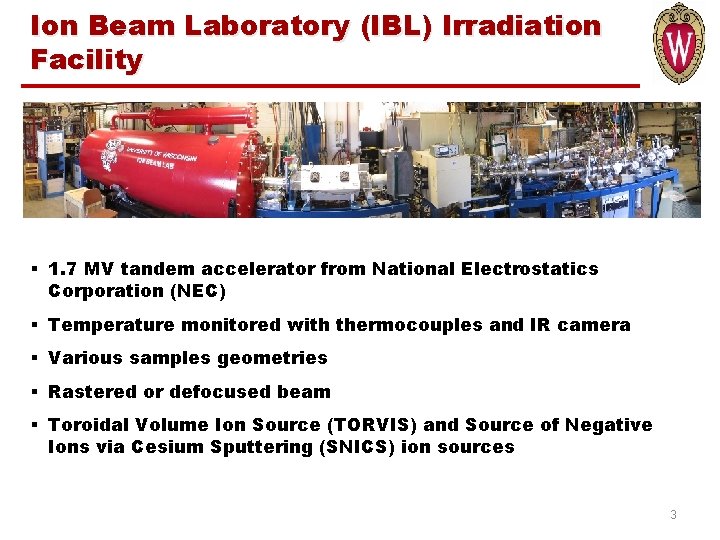
Ion Beam Laboratory (IBL) Irradiation Facility § 1. 7 MV tandem accelerator from National Electrostatics Corporation (NEC) § Temperature monitored with thermocouples and IR camera § Various samples geometries § Rastered or defocused beam § Toroidal Volume Ion Source (TORVIS) and Source of Negative Ions via Cesium Sputtering (SNICS) ion sources 3
Ion sources TORVIS q q High current hydrogen, deuterium, and helium ion source, from < 1 μA to 100 μA for protons (H+ ions). Emulate neutron irradiation effect with proton irradiation. Damage rate ~ 10 -6 dpa/s (displacements per atoms/s) Flat damage/depth profile. SNICS q q Wide range of heavy ions, Fe, Si, C, V, Nd, and more. Fast to achieve high damage, e. g. , 250 dpa peak damage of stainless steels in 9 hours. Damage rate 10 -4 -10 -2 dpa/s No radiation-induced radioactivity. 4
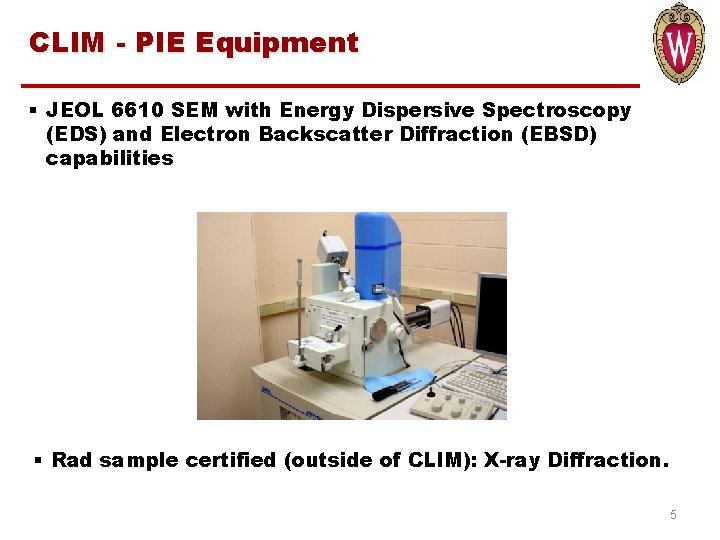
CLIM - PIE Equipment § JEOL 6610 SEM with Energy Dispersive Spectroscopy (EDS) and Electron Backscatter Diffraction (EBSD) capabilities § Rad sample certified (outside of CLIM): X-ray Diffraction. 5
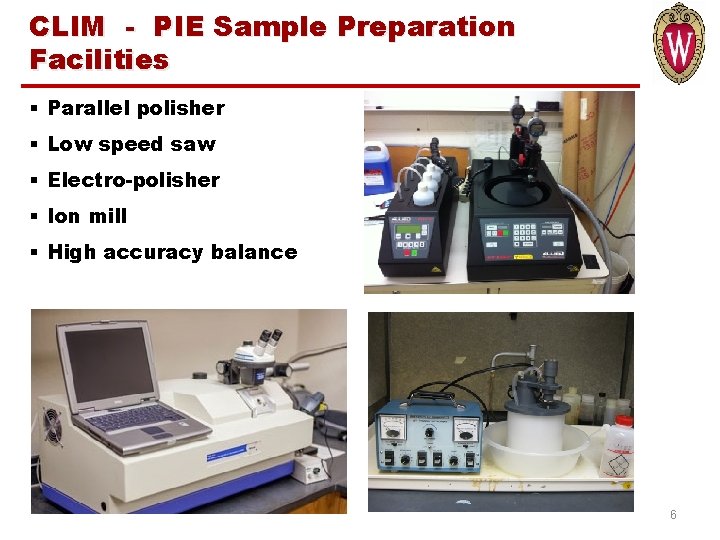
CLIM - PIE Sample Preparation Facilities § Parallel polisher § Low speed saw § Electro-polisher § Ion mill § High accuracy balance 6
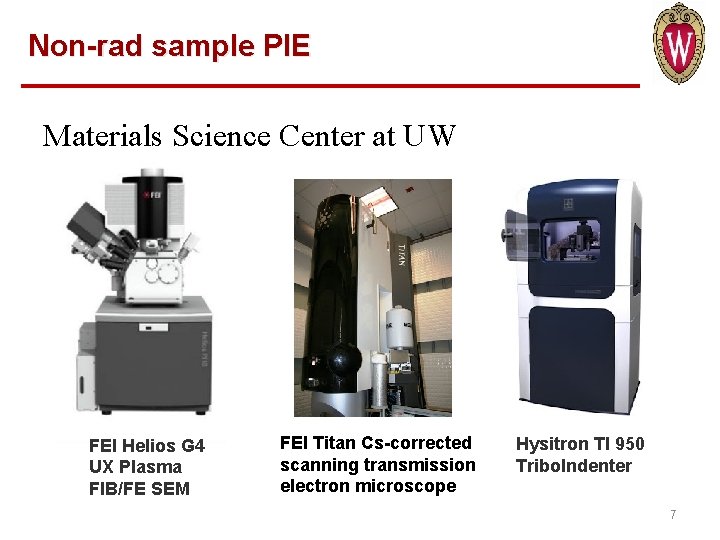
Non-rad sample PIE Materials Science Center at UW FEI Helios G 4 UX Plasma FIB/FE SEM FEI Titan Cs-corrected scanning transmission electron microscope Hysitron TI 950 Tribo. Indenter 7
Lab upgrade timeline • 2009: Nuclear Science User Facility partner. • 2011: TORVIS ion source (high beam current for H and He). • 2014: CLIM laboratory (consolidation of sample preparation tools and SEM). • 2015: Chamber upgrade (control of irradiation area, preloading chamber). • 2016: Sample activity screening (count integration over time, better accuracy). • 2017: Sample stage upgrade (liquid metal contact to ensure proper cooling). • 2018: two-dimensional moving sample stage. 8
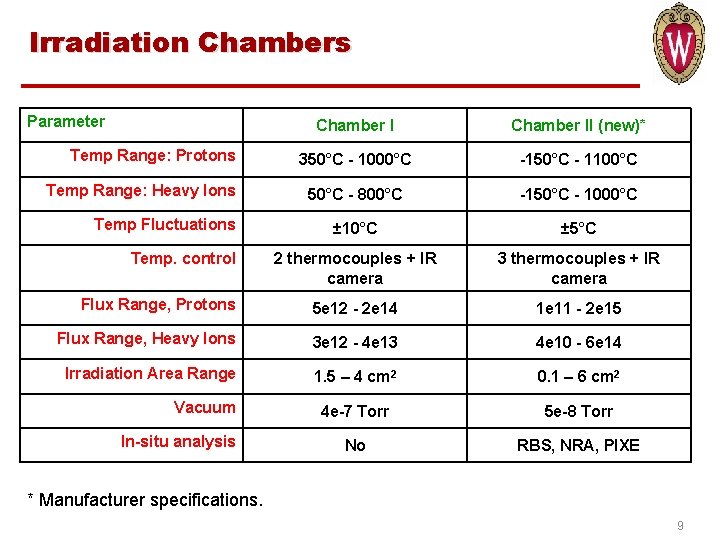
Irradiation Chambers Parameter Chamber II (new)* 350°C - 1000°C -150°C - 1100°C 50°C - 800°C -150°C - 1000°C ± 10°C ± 5°C 2 thermocouples + IR camera 3 thermocouples + IR camera Flux Range, Protons 5 e 12 - 2 e 14 1 e 11 - 2 e 15 Flux Range, Heavy Ions 3 e 12 - 4 e 13 4 e 10 - 6 e 14 Irradiation Area Range 1. 5 – 4 cm 2 0. 1 – 6 cm 2 4 e-7 Torr 5 e-8 Torr No RBS, NRA, PIXE Temp Range: Protons Temp Range: Heavy Ions Temp Fluctuations Temp. control Vacuum In-situ analysis * Manufacturer specifications. 9
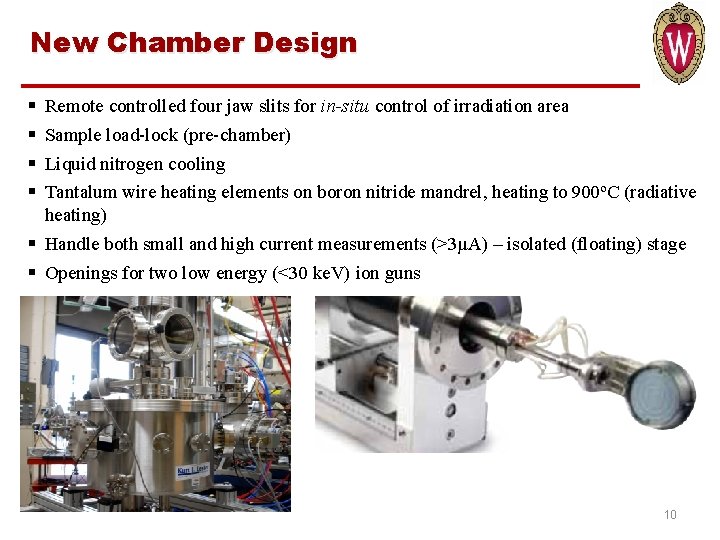
New Chamber Design § § Remote controlled four jaw slits for in-situ control of irradiation area Sample load-lock (pre-chamber) Liquid nitrogen cooling Tantalum wire heating elements on boron nitride mandrel, heating to 900ºC (radiative heating) § Handle both small and high current measurements (>3μA) – isolated (floating) stage § Openings for two low energy (<30 ke. V) ion guns 10
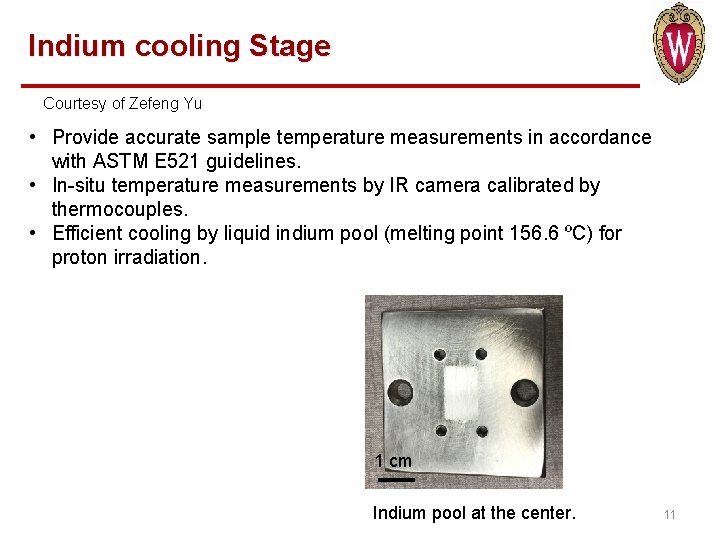
Indium cooling Stage Courtesy of Zefeng Yu • Provide accurate sample temperature measurements in accordance with ASTM E 521 guidelines. • In-situ temperature measurements by IR camera calibrated by thermocouples. • Efficient cooling by liquid indium pool (melting point 156. 6 ºC) for proton irradiation. 1 cm Indium pool at the center. 11
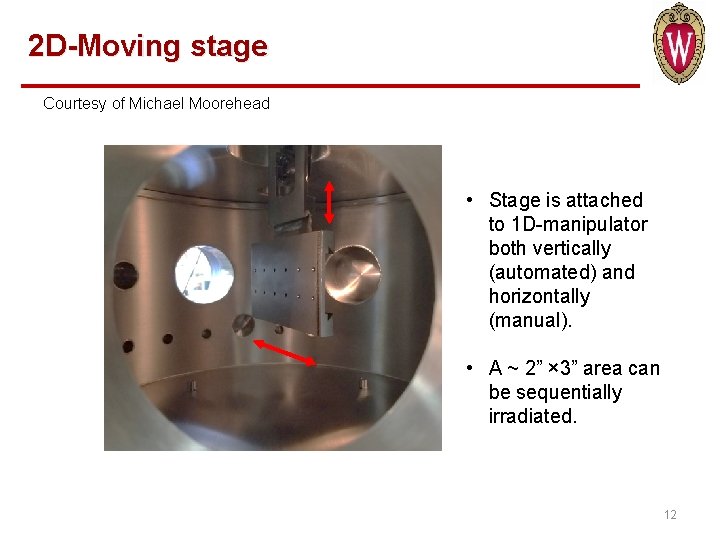
2 D-Moving stage Courtesy of Michael Moorehead • Stage is attached to 1 D-manipulator both vertically (automated) and horizontally (manual). • A ~ 2” × 3” area can be sequentially irradiated. 12
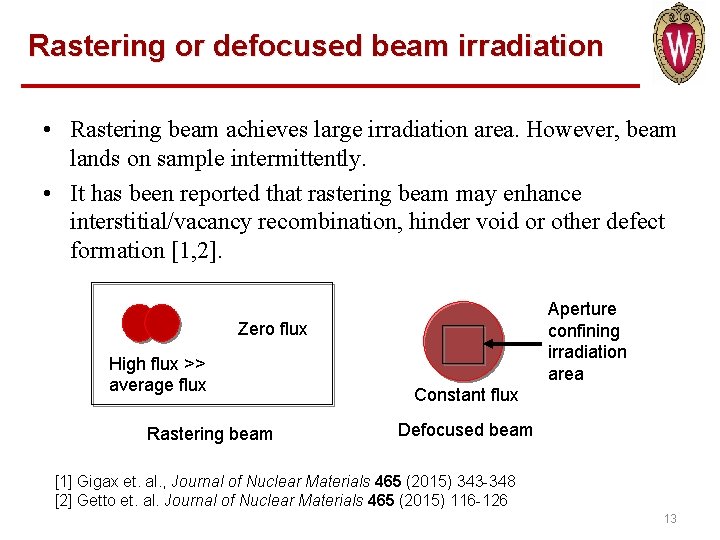
Rastering or defocused beam irradiation • Rastering beam achieves large irradiation area. However, beam lands on sample intermittently. • It has been reported that rastering beam may enhance interstitial/vacancy recombination, hinder void or other defect formation [1, 2]. Aperture confining irradiation area Zero flux High flux >> average flux Rastering beam Constant flux Defocused beam [1] Gigax et. al. , Journal of Nuclear Materials 465 (2015) 343 -348 [2] Getto et. al. Journal of Nuclear Materials 465 (2015) 116 -126 13
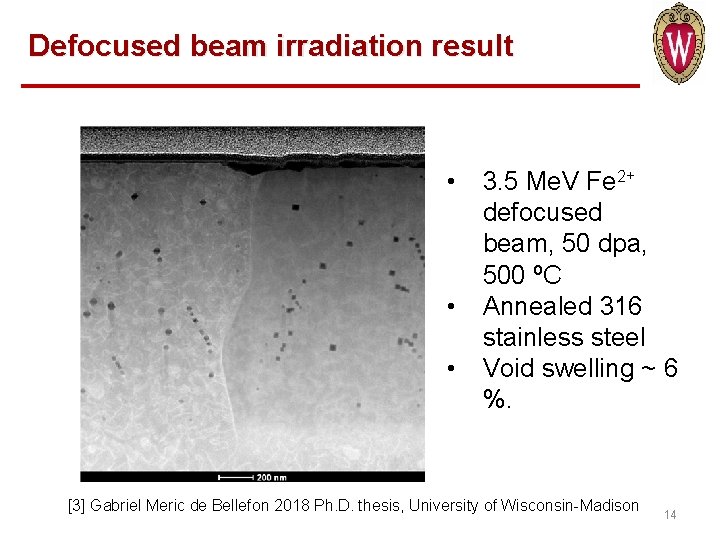
Defocused beam irradiation result • • • 3. 5 Me. V Fe 2+ defocused beam, 50 dpa, 500 ºC Annealed 316 stainless steel Void swelling ~ 6 %. [3] Gabriel Meric de Bellefon 2018 Ph. D. thesis, University of Wisconsin-Madison 14
IBL Usage in 2017 -2018 § 22% UW-Madison committed non-NSUF projects § 50% NSUF, Nuclear Energy Enabling Technologies (NEET), Nuclear Energy University Program (NEUP) projects • Oak Ridge National Laboratory “Mechanical Properties and Radiation Resistance of Nanoprecipitates-Strengthened Advanced Ferritic Alloys” NEET 2015 • University of Wisconsin-Madison “Radiation Damage in High Entropy Alloys” NSUF RTE 2018 § 28% others • Naval Nuclear Laboratory “Proton Irradiation and TEM Analysis of Zr -4” § Total 350 hours/year § Still able to accommodate considerably more hours. 15
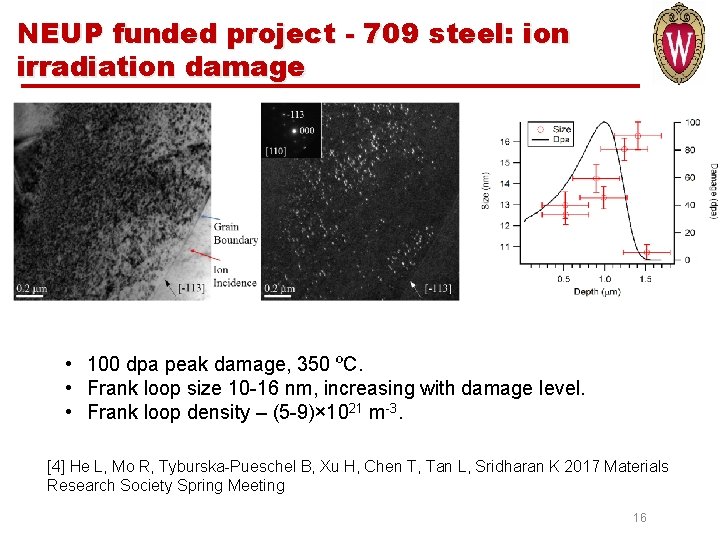
NEUP funded project - 709 steel: ion irradiation damage • 100 dpa peak damage, 350 ºC. • Frank loop size 10 -16 nm, increasing with damage level. • Frank loop density – (5 -9)× 1021 m-3. [4] He L, Mo R, Tyburska-Pueschel B, Xu H, Chen T, Tan L, Sridharan K 2017 Materials Research Society Spring Meeting 16
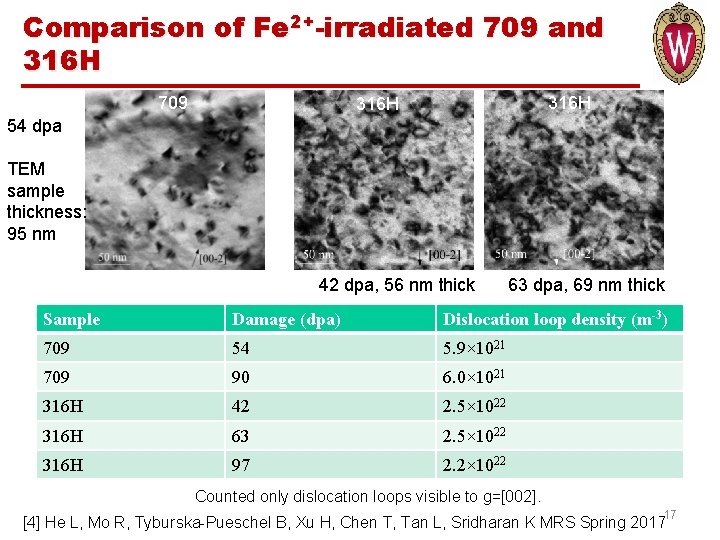
Comparison of Fe 2+-irradiated 709 and 316 H 709 316 H 54 dpa TEM sample thickness: 95 nm 42 dpa, 56 nm thick 63 dpa, 69 nm thick Sample Damage (dpa) Dislocation loop density (m-3) 709 54 5. 9× 10²¹ 709 90 6. 0× 1021 316 H 42 2. 5× 10²² 316 H 63 2. 5× 10²² 316 H 97 2. 2× 10²² Counted only dislocation loops visible to g=[002]. 17 [4] He L, Mo R, Tyburska-Pueschel B, Xu H, Chen T, Tan L, Sridharan K MRS Spring 2017
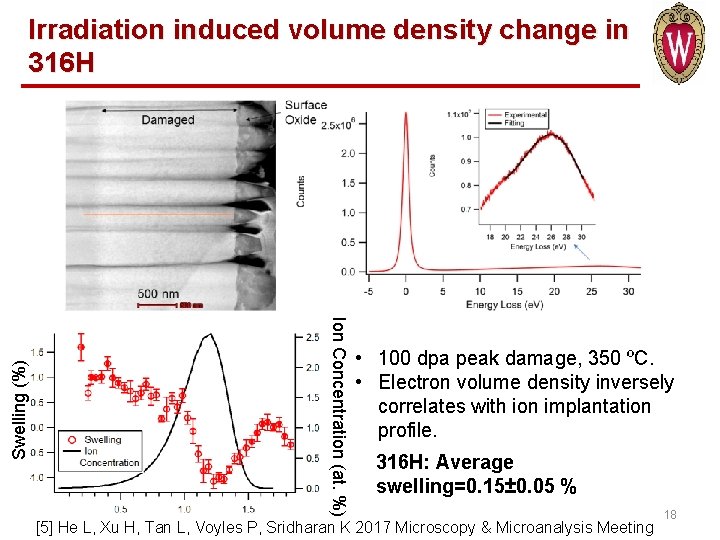
Ion Concentration (at. %) Swelling (%) Irradiation induced volume density change in 316 H • 100 dpa peak damage, 350 ºC. • Electron volume density inversely correlates with ion implantation profile. 316 H: Average swelling=0. 15± 0. 05 % [5] He L, Xu H, Tan L, Voyles P, Sridharan K 2017 Microscopy & Microanalysis Meeting 18
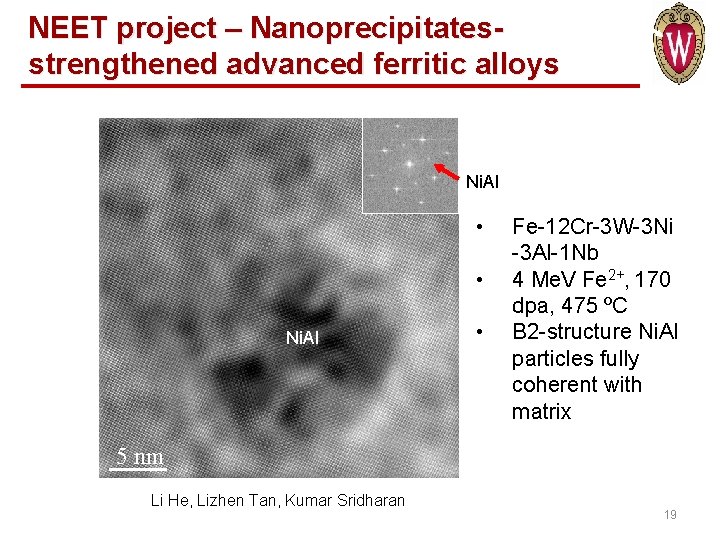
NEET project – Nanoprecipitatesstrengthened advanced ferritic alloys Ni. Al • • Ni. Al • Fe-12 Cr-3 W-3 Ni -3 Al-1 Nb 4 Me. V Fe 2+, 170 dpa, 475 ºC B 2 -structure Ni. Al particles fully coherent with matrix 5 nm Li He, Lizhen Tan, Kumar Sridharan 19
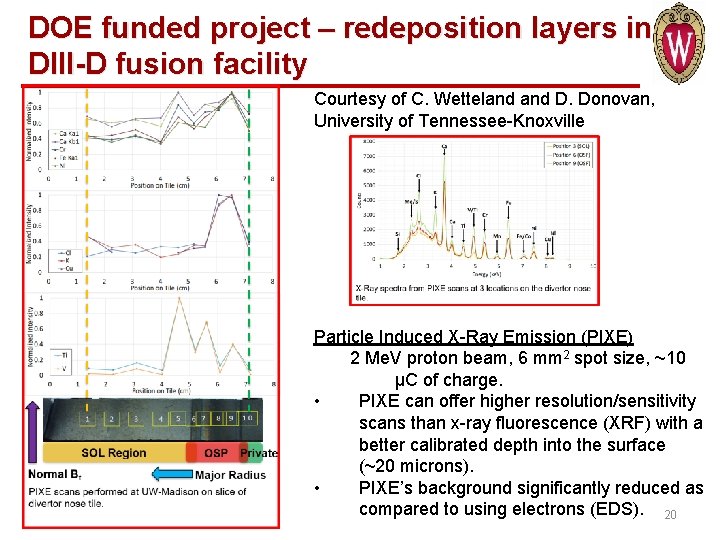
DOE funded project – redeposition layers in DIII-D fusion facility Courtesy of C. Wetteland D. Donovan, University of Tennessee-Knoxville Particle Induced X-Ray Emission (PIXE) 2 Me. V proton beam, 6 mm 2 spot size, ~10 μC of charge. • PIXE can offer higher resolution/sensitivity scans than x-ray fluorescence (XRF) with a better calibrated depth into the surface (~20 microns). • PIXE’s background significantly reduced as compared to using electrons (EDS). 20
Access UW-IBL • UW-IBL is continually improved to meet the research needs involving ion irradiation. • Access IBL through NSUF proposal: – DOE Consolidated Innovative Nuclear Research (CINR), annual submission. – Rapid Turnaround Experiments, three calls a year. – https: //nsuf. inl. gov/ 21
Contact Details, rates, and application forms: § http: //ibl. ep. wisc. edu § https: //nsuf. inl. gov/ Contacts: § Li He - (li. he@wisc. edu) – NSUF POC § Kumar Sridharan (kumar. sridharan@wisc. edu) § Adrien Couet (couet@wisc. edu) § Todd Allen (todd. allen@wisc. edu) § Kim Kriewaldt – lab manager, technical questions only (kriewald@engr. wisc. edu) 22
Acknowledgements § Iron irradiation of 709 and G 92 § US Department of Energy Nuclear Engineering University Program (NEUP) under project Number 14 -6346 § Iron irradiation of ferritic alloys § Nuclear Energy Enabling Technologies (NEET): Reactor Materials FY 2015 Award § Analysis of redeposition layers in DIII-D § US Department of Energy under DE-AC 05 -00 OR 22725 (ORNL), DE-FG 0207 ER 54917 (UCSD), and DE-FC 02 -04 ER 54698 (General Atomics). 23