
Ion Exchange Ion exchange is an adsorption phenomenon
![Neglecting activity corrections we can write: Where: [A+], [B+]= moles A+, B+ per liter](https://slidetodoc.com/presentation_image_h2/5c4f76ecb0618c6f8a07c4a862a899e7/image-15.jpg "Neglecting activity corrections we can write: Where: [A+], [B+]= moles A+, B+ per liter")
![The influent has the following characteristics: [Cl-] = 3 meq/L [NO-3] = 1. 5](https://slidetodoc.com/presentation_image_h2/5c4f76ecb0618c6f8a07c4a862a899e7/image-32.jpg "The influent has the following characteristics: [Cl-] = 3 meq/L [NO-3] = 1. 5")
- Slides: 43
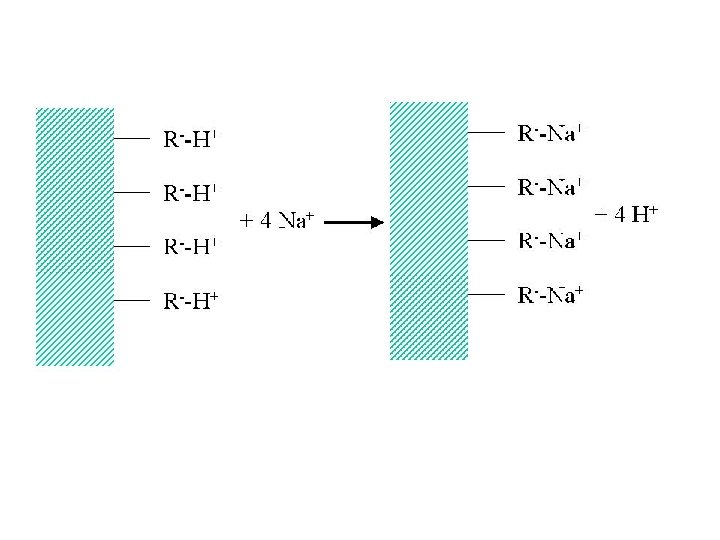
Ion Exchange Ion exchange is an adsorption phenomenon where the mechanism of adsorption is electrostatic. Electrostatic forces hold ions to charged functional groups on the surface of the ion exchange resin. The adsorbed ions replace ions that are on the resin surface on a 1: 1 charge basis. For example:
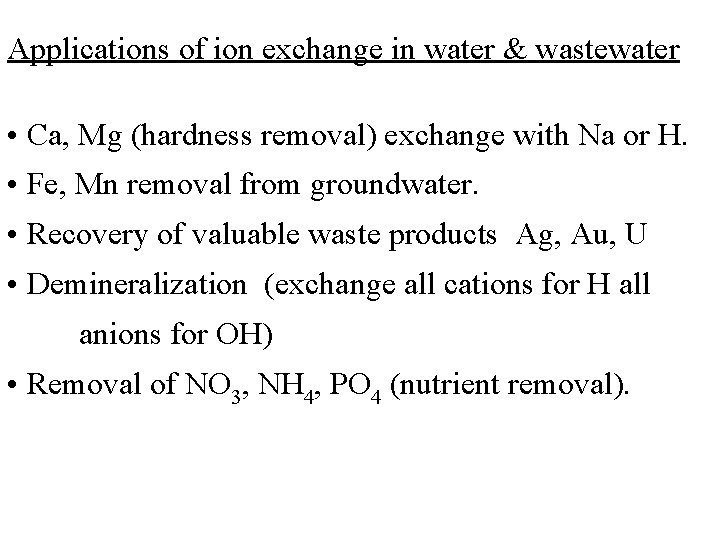
Applications of ion exchange in water & wastewater • Ca, Mg (hardness removal) exchange with Na or H. • Fe, Mn removal from groundwater. • Recovery of valuable waste products Ag, Au, U • Demineralization (exchange all cations for H all anions for OH) • Removal of NO 3, NH 4, PO 4 (nutrient removal).
Ion Exchangers (types) • Natural: Proteins, Soils, Lignin, Coal, Metal oxides, Aluminosilicates (zeolites) (Na. OAl 2 O 3. 4 Si. O 2). • Synthetic zeolite gels and most common polymeric resins (macroreticular, large pores).
Polymeric resins are made in 3 -D networks by cross-linking hydrocarbon chains. The resulting resin is insoluble, inert and relatively rigid. Ionic functional groups are attached to this framework.
These resins are generally manufactured by polymerizing neutral organic molecules such as sytrene (to form polystrene) and then cross-linked with divinyl benzene (DVB). Functional groups are then added according to the intended use. For example the resin can be sulfonated by adding sulfuric acid to get the structure shown above.
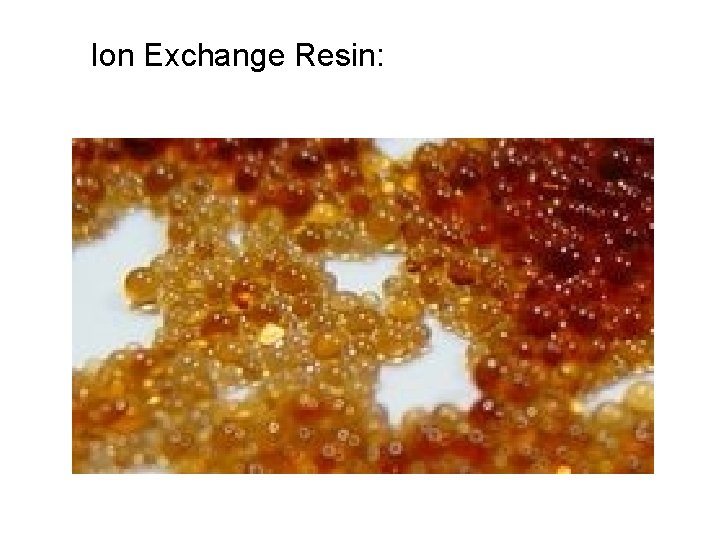
Ion Exchange Resin:
Resin classification: Resins are classified based on the type of functional group they contain and their % of crosslinkages Cationic Exchangers: - Strongly acidic – functional groups derived from strong acids e. g. , R-SO 3 H (sulfonic). - Weakly acidic – functional groups derived from weak acids, e. g. , R-COOH (carboxylic).
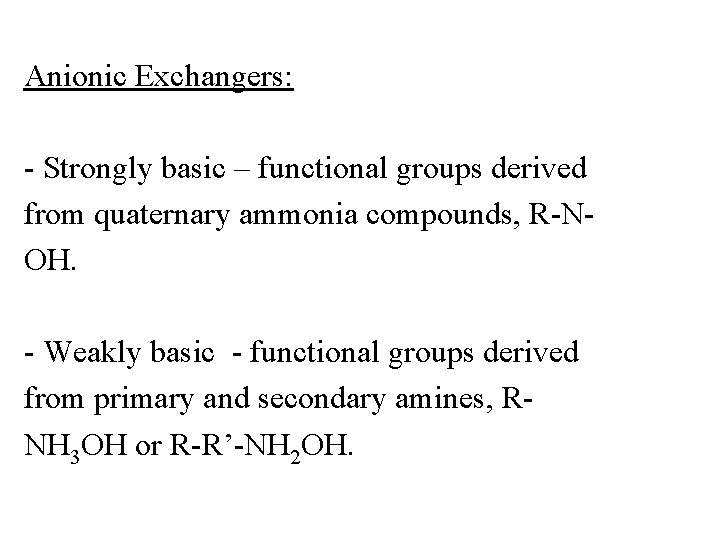
Anionic Exchangers: - Strongly basic – functional groups derived from quaternary ammonia compounds, R-NOH. - Weakly basic - functional groups derived from primary and secondary amines, RNH 3 OH or R-R’-NH 2 OH.
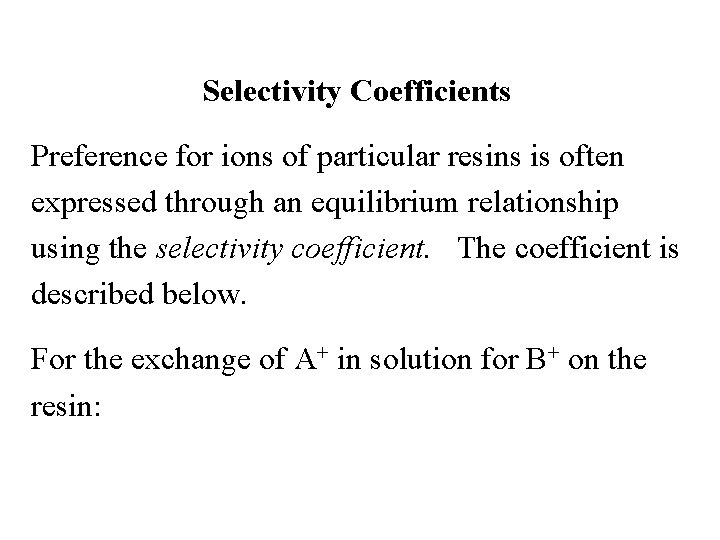
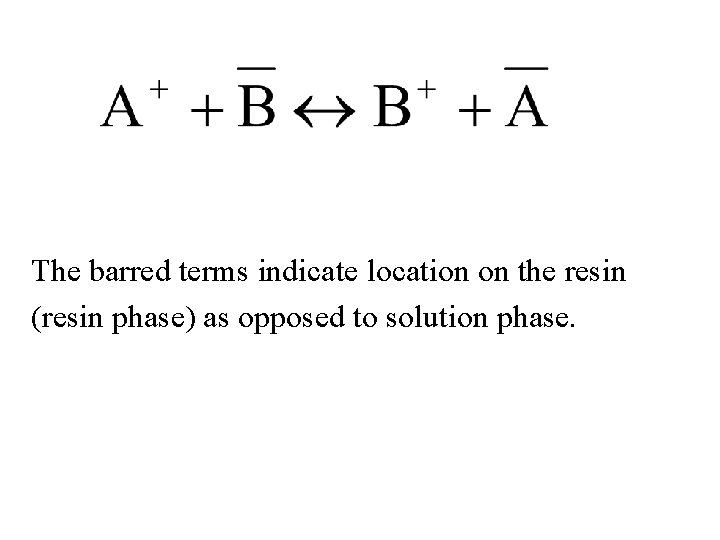
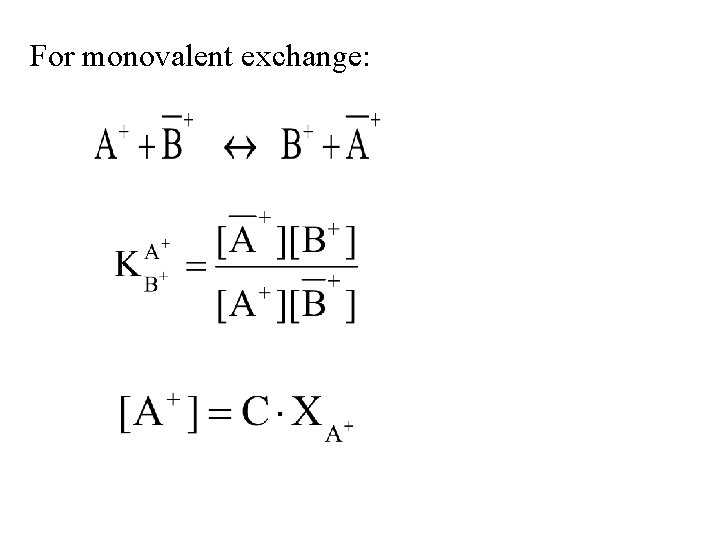
Selectivity Coefficients Preference for ions of particular resins is often expressed through an equilibrium relationship using the selectivity coefficient. The coefficient is described below. For the exchange of A+ in solution for B+ on the resin:
The barred terms indicate location on the resin (resin phase) as opposed to solution phase.
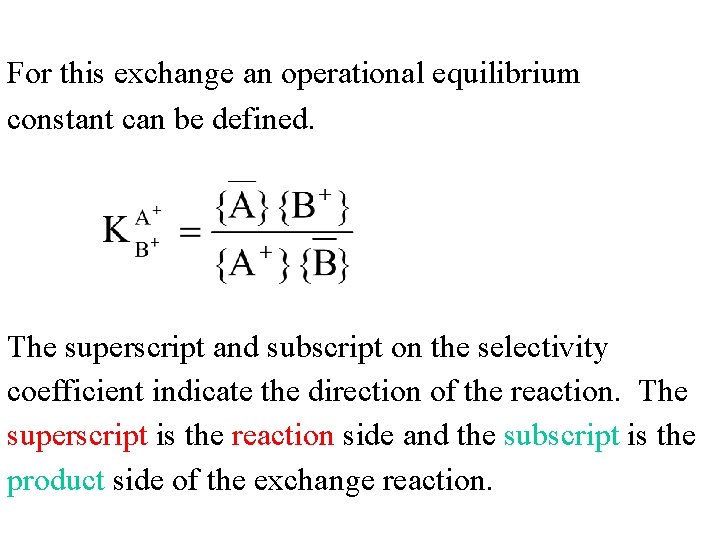
For this exchange an operational equilibrium constant can be defined. The superscript and subscript on the selectivity coefficient indicate the direction of the reaction. The superscript is the reaction side and the subscript is the product side of the exchange reaction.
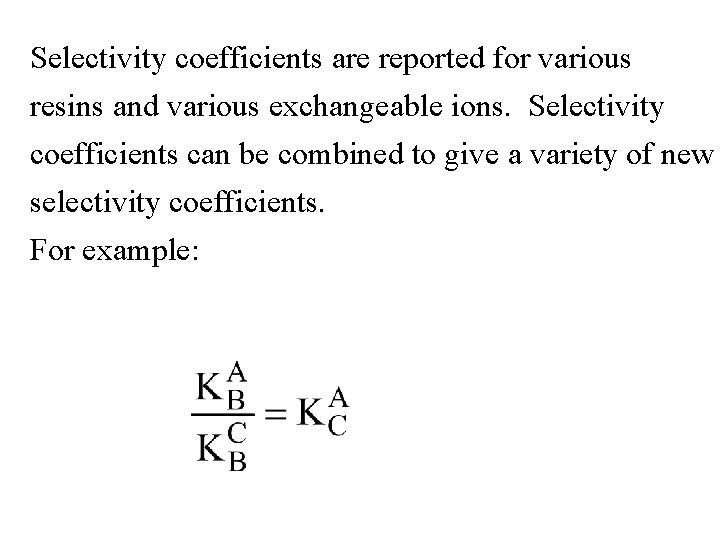
Selectivity coefficients are reported for various resins and various exchangeable ions. Selectivity coefficients can be combined to give a variety of new selectivity coefficients. For example:
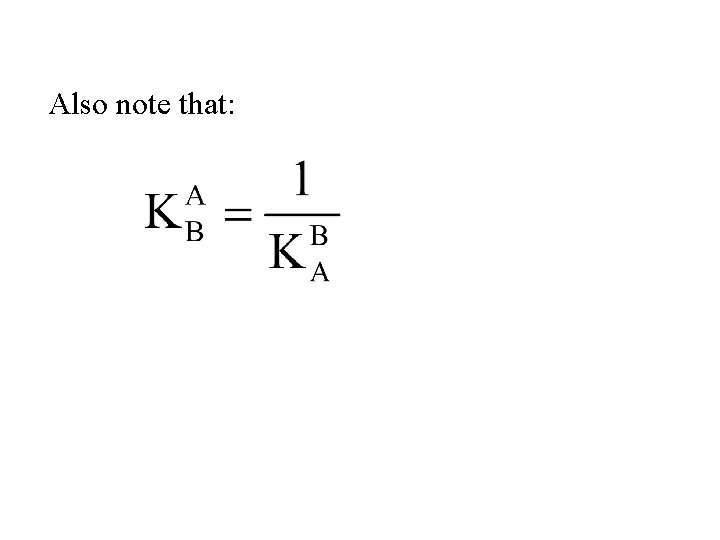
Also note that:
Neglecting activity corrections we can write: Where: [A+], [B+]= moles A+, B+ per liter of liquid = moles of A+, B+on resin per liter of resin (bulk volume basis).
This selectivity coefficient is not quite a thermodynamically defined equilibrium constant because of the strange choice of concentration units and the lack of activity corrections. So it is clearly an operational equilibrium constant.
Factors which affect the selectivity coefficient: For a given resin type ion selectivity is a function of ionic charge and hydrated radius and functional group-ion chemical interactions. In most cases the higher the ionic charge the higher the affinity for a site.
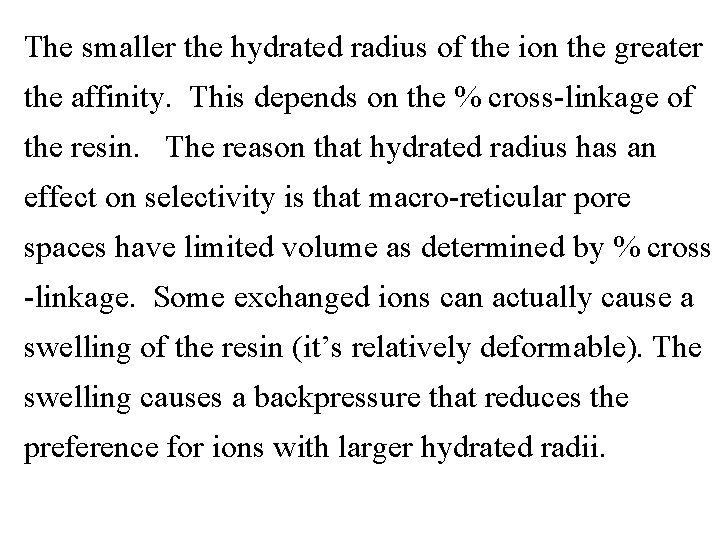
The smaller the hydrated radius of the ion the greater the affinity. This depends on the % cross-linkage of the resin. The reason that hydrated radius has an effect on selectivity is that macro-reticular pore spaces have limited volume as determined by % cross -linkage. Some exchanged ions can actually cause a swelling of the resin (it’s relatively deformable). The swelling causes a backpressure that reduces the preference for ions with larger hydrated radii.
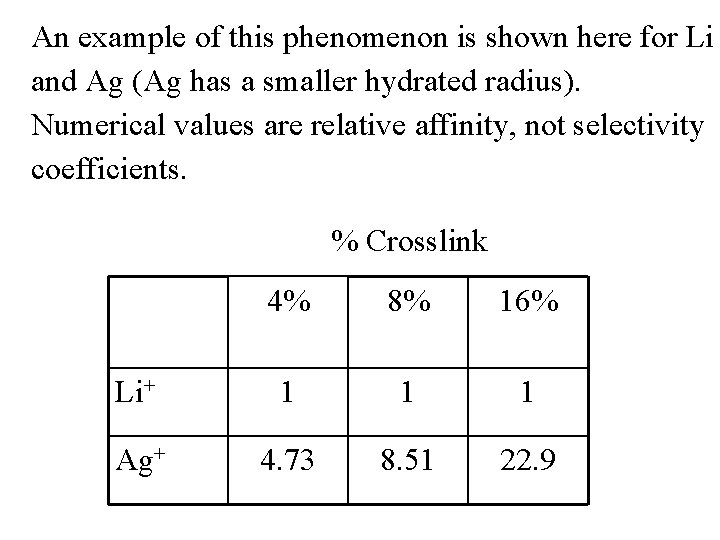
An example of this phenomenon is shown here for Li and Ag (Ag has a smaller hydrated radius). Numerical values are relative affinity, not selectivity coefficients. % Crosslink 4% 8% 16% Li+ 1 1 1 Ag+ 4. 73 8. 51 22. 9
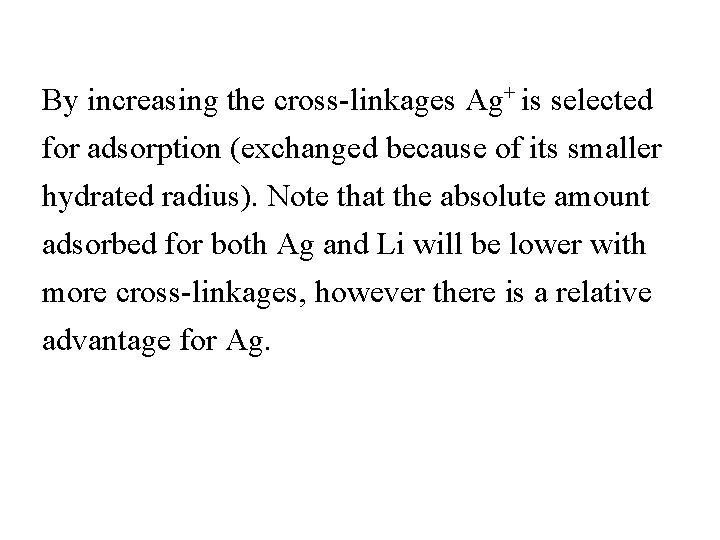
By increasing the cross-linkages Ag+ is selected for adsorption (exchanged because of its smaller hydrated radius). Note that the absolute amount adsorbed for both Ag and Li will be lower with more cross-linkages, however there is a relative advantage for Ag.
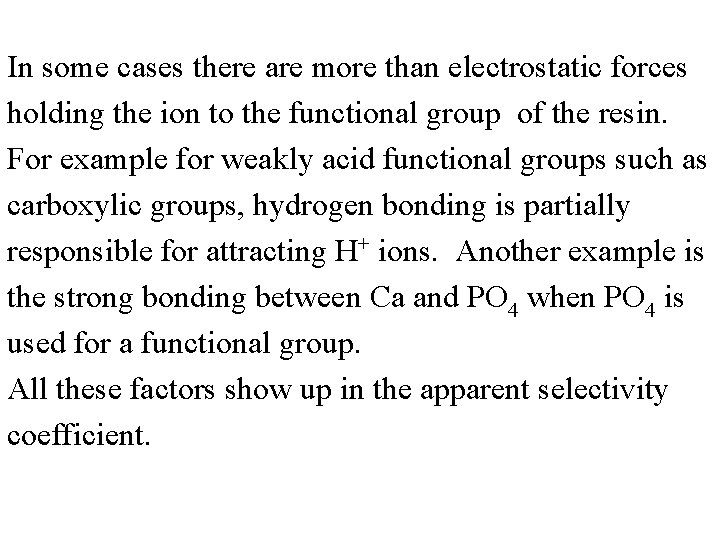
In some cases there are more than electrostatic forces holding the ion to the functional group of the resin. For example for weakly acid functional groups such as carboxylic groups, hydrogen bonding is partially responsible for attracting H+ ions. Another example is the strong bonding between Ca and PO 4 when PO 4 is used for a functional group. All these factors show up in the apparent selectivity coefficient.
The selectivity coefficient is only applicable over a narrow range of concentrations because the activity coefficients vary with concentration.
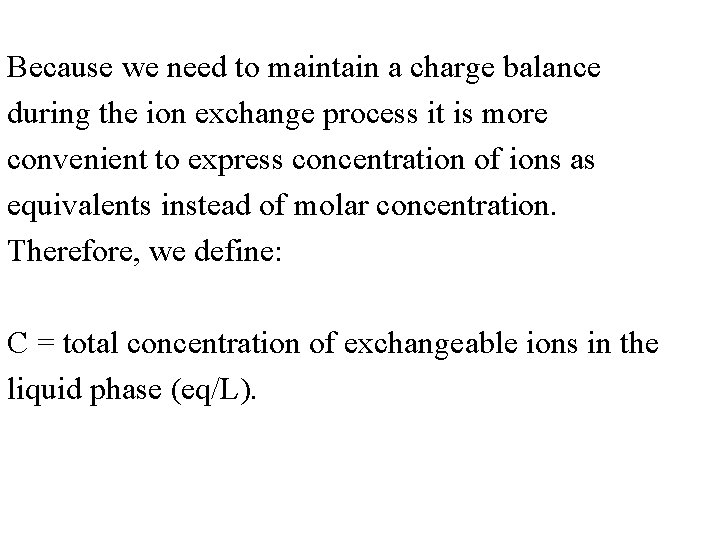
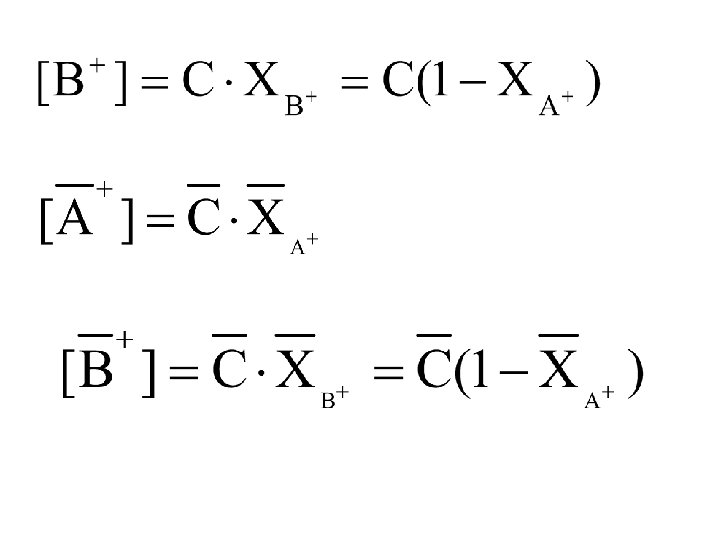
Because we need to maintain a charge balance during the ion exchange process it is more convenient to express concentration of ions as equivalents instead of molar concentration. Therefore, we define: C = total concentration of exchangeable ions in the liquid phase (eq/L).
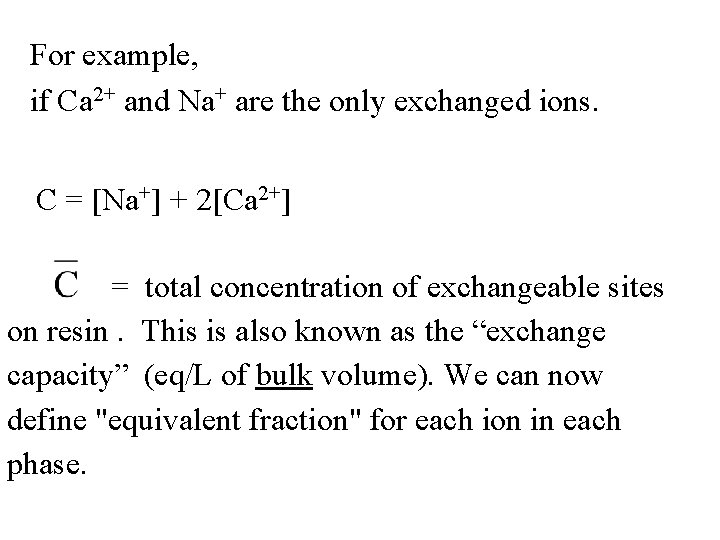
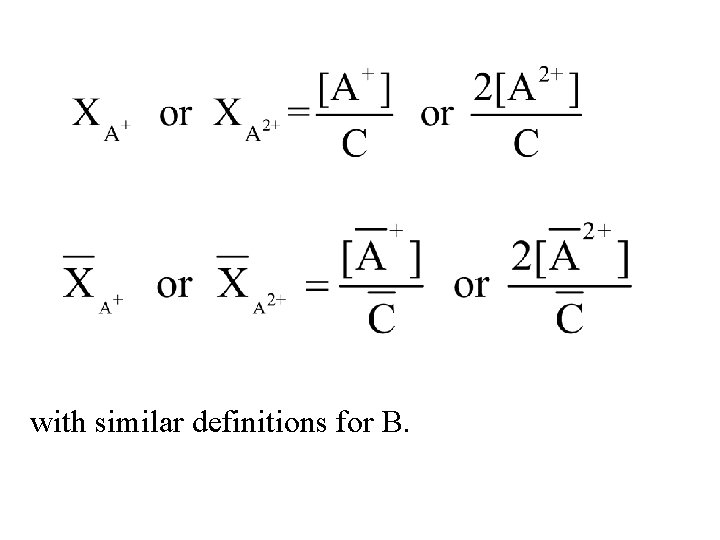
For example, if Ca 2+ and Na+ are the only exchanged ions. C = [Na+] + 2[Ca 2+] = total concentration of exchangeable sites on resin. This is also known as the “exchange capacity” (eq/L of bulk volume). We can now define "equivalent fraction" for each ion in each phase.
with similar definitions for B.
For monovalent exchange:
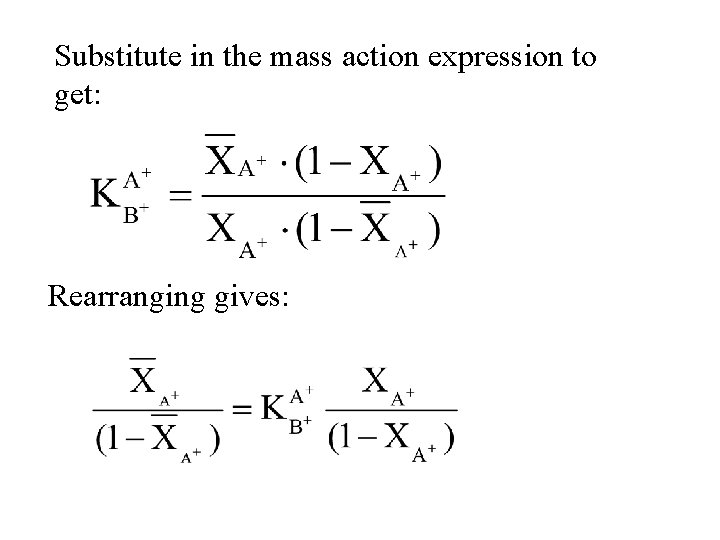
Substitute in the mass action expression to get: Rearranging gives:
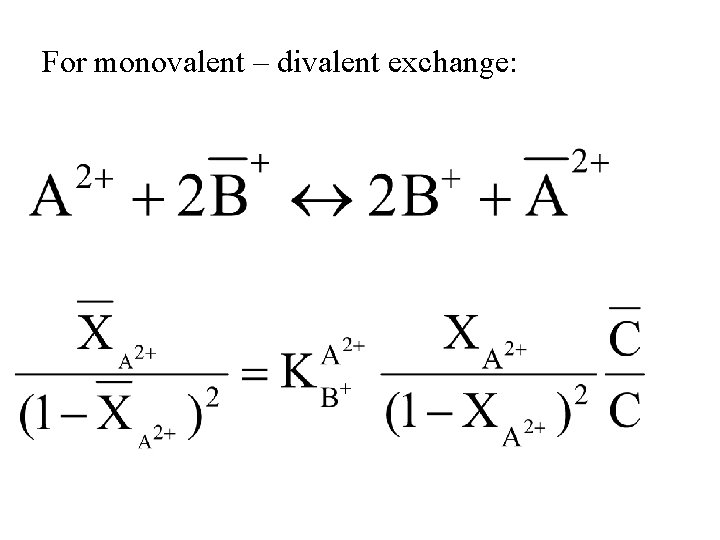
For monovalent – divalent exchange:
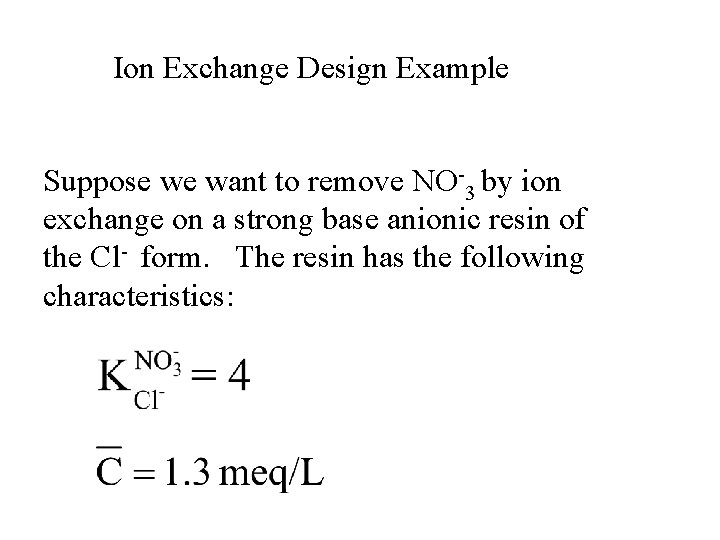
In this form the equation gives the amount exchanged as a function of the amount in solution. It is very useful for process design as demonstrated below.
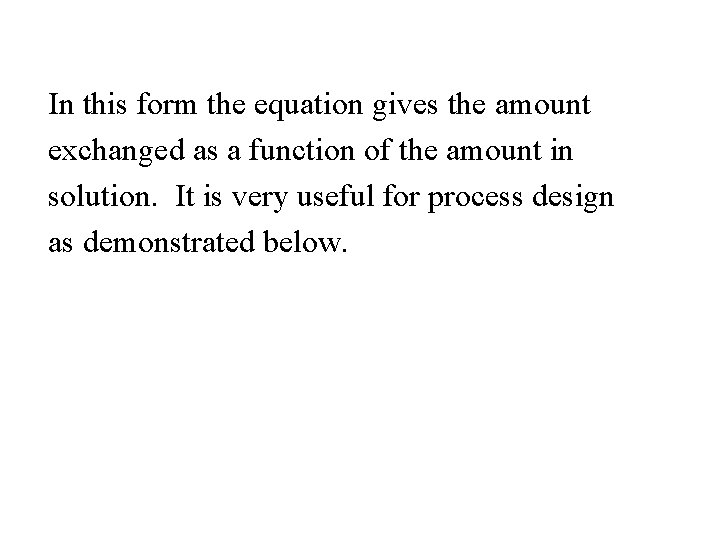
Ion Exchange Design Example Suppose we want to remove NO-3 by ion exchange on a strong base anionic resin of the Cl- form. The resin has the following characteristics:
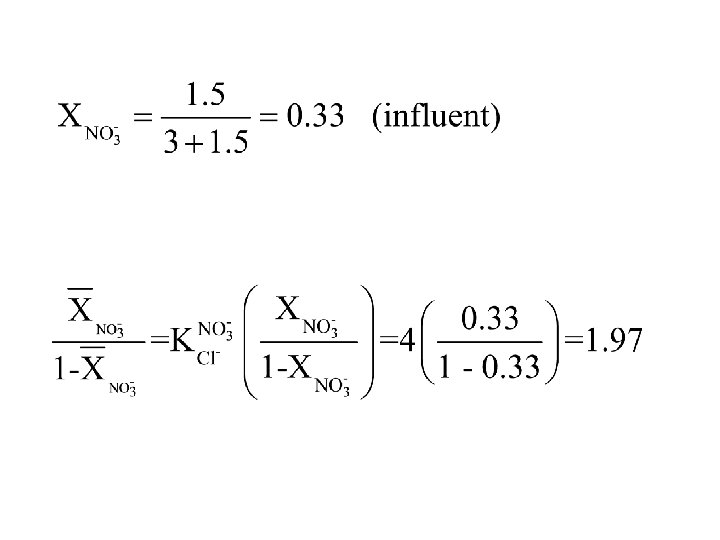
The influent has the following characteristics: [Cl-] = 3 meq/L [NO-3] = 1. 5 meq/L
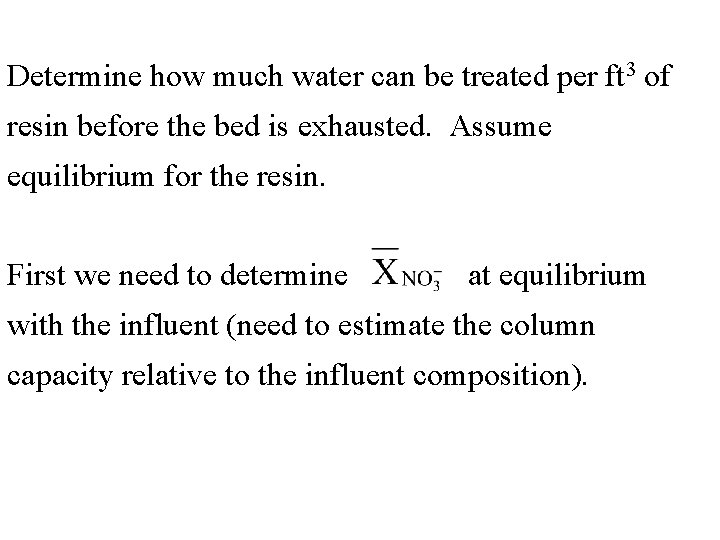
Determine how much water can be treated per ft 3 of resin before the bed is exhausted. Assume equilibrium for the resin. First we need to determine at equilibrium with the influent (need to estimate the column capacity relative to the influent composition).
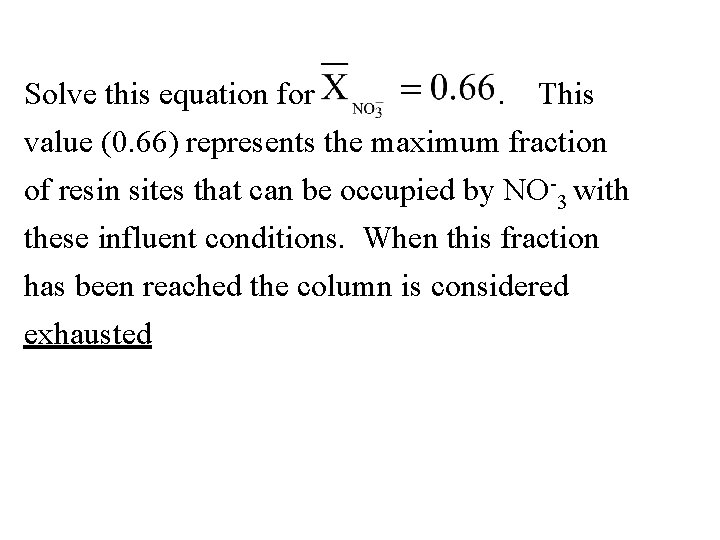
Solve this equation for. This value (0. 66) represents the maximum fraction of resin sites that can be occupied by NO-3 with these influent conditions. When this fraction has been reached the column is considered exhausted
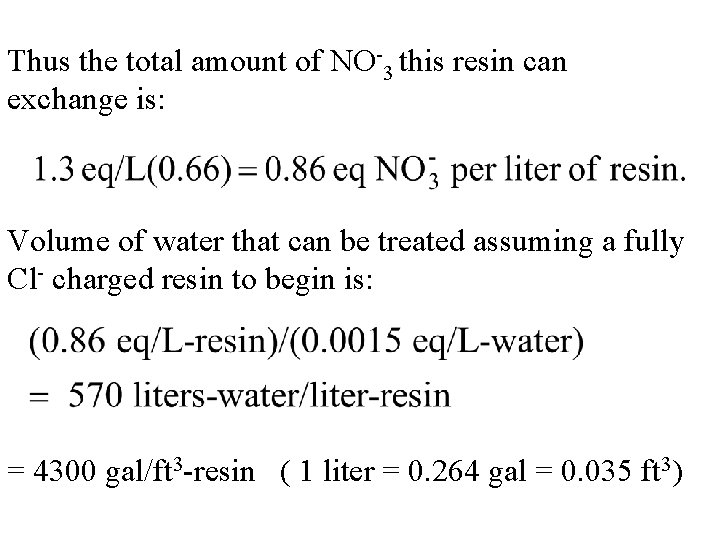
Thus the total amount of NO-3 this resin can exchange is: Volume of water that can be treated assuming a fully Cl- charged resin to begin is: = 4300 gal/ft 3 -resin ( 1 liter = 0. 264 gal = 0. 035 ft 3)
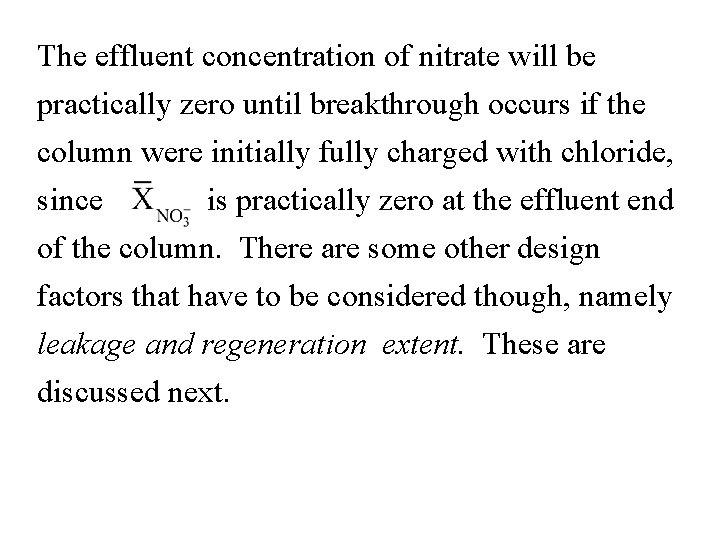
The effluent concentration of nitrate will be practically zero until breakthrough occurs if the column were initially fully charged with chloride, since is practically zero at the effluent end of the column. There are some other design factors that have to be considered though, namely leakage and regeneration extent. These are discussed next.
Regeneration Spent or exhausted columns must be regenerated because of the cost of the resin would make onetime use prohibitive. Since ion exchange is a very reversible process regeneration can be accomplished by manipulation of solution composition.
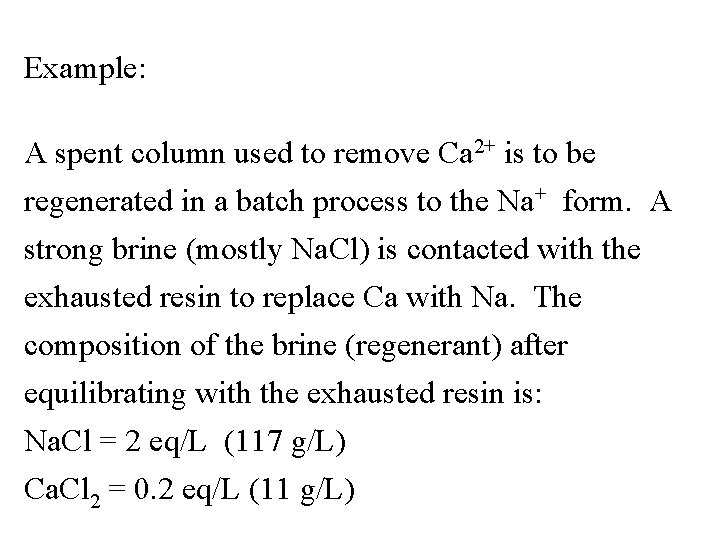
Example: A spent column used to remove Ca 2+ is to be regenerated in a batch process to the Na+ form. A strong brine (mostly Na. Cl) is contacted with the exhausted resin to replace Ca with Na. The composition of the brine (regenerant) after equilibrating with the exhausted resin is: Na. Cl = 2 eq/L (117 g/L) Ca. Cl 2 = 0. 2 eq/L (11 g/L)
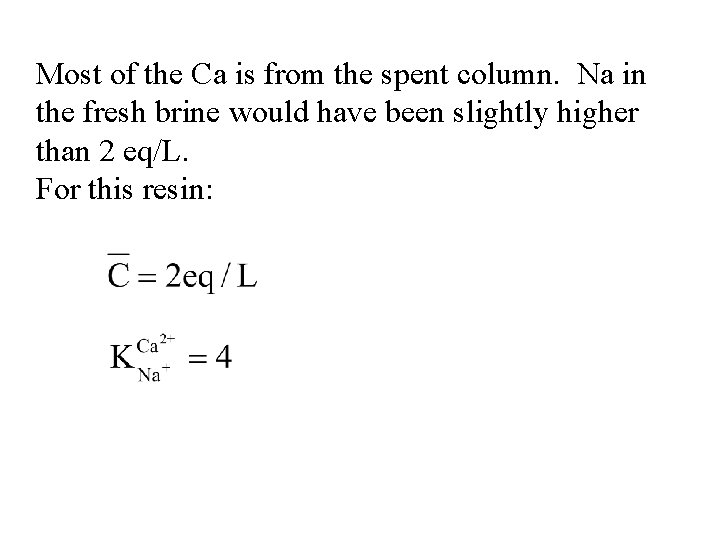
Most of the Ca is from the spent column. Na in the fresh brine would have been slightly higher than 2 eq/L. For this resin:
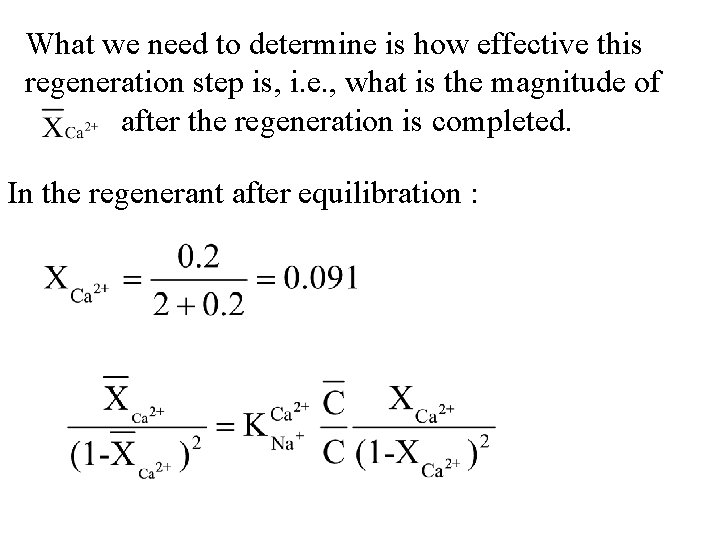
What we need to determine is how effective this regeneration step is, i. e. , what is the magnitude of after the regeneration is completed. In the regenerant after equilibration :
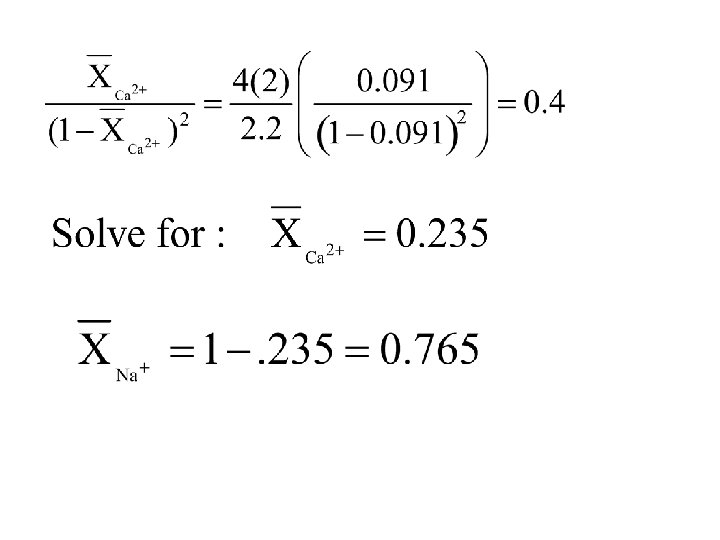
Only 76. 5% regeneration can be accomplished with this regenerant because even small amounts of Ca can have a significant effect because of the high selectivity coefficient in favor of Ca. To get higher regeneration need to make the Na. Cl concentration higher or make the total volume of regenerant higher to dilute the Ca that comes off the exhausted column. Both options cost money and there needs to be a tradeoff evaluated between higher column utilization and more costly regeneration. To formalize this trade-off problem define the following.