
ION EXCHANGE CHROMATOGRAPHY CHROMATOGRAPHY The process or technique

- Slides: 16
ION EXCHANGE CHROMATOGRAPHY
CHROMATOGRAPHY Ø Ø The process or technique of separating molecules or components in a mixture solution (gas or liquid) according to the differential absorption and elution Invented in 1906 by the Russian botanist Mikhail Tsvet Chromatography is the physical separation of a mixture into its individual components. Used in qualitative and quantitative analysis of biological and chemical substances
Ø This technique employs two immiscible substances- mobile phase and stationary phase Ø Mobile phase -solution of gas or liquid components, works as transporter, moves in a definite direction Ø Stationary phase -liquid or solid, absorbs or impedes different components of the solution to different degrees
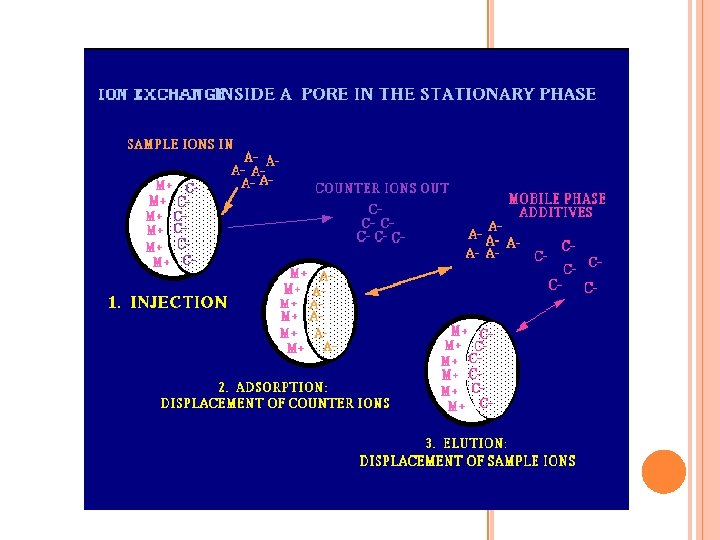
ION EXCHANGE CHROMATOGRAPHY üIon exchange chromatography -- is a separation based on charge üUsed for almost any kind of charged molecules --large proteins, small nucleotides and amino acids üIon-exchange chromatography preserves analyte molecules on the column based on ionic interactions üMobile phage – buffer, p. H and salt concentration--opposite charged solute ions attracted to the stationary phage by electrostatic force üStationary phage– resin is used to covalently attach anions or cations onto it
PRINCIPLE………. ØIon Exchange Chromatography relies on charge-charge interactions between the proteins
TYPES OF IEC…. Øanion Øcation exchangers
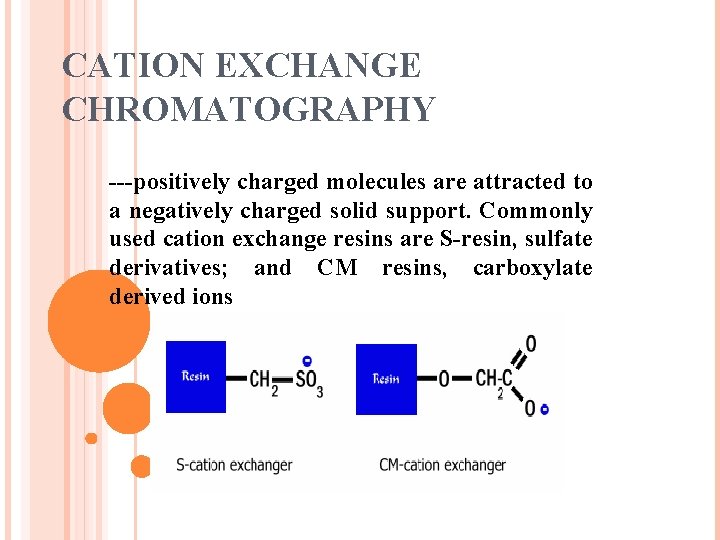
CATION EXCHANGE CHROMATOGRAPHY ---positively charged molecules are attracted to a negatively charged solid support. Commonly used cation exchange resins are S-resin, sulfate derivatives; and CM resins, carboxylate derived ions
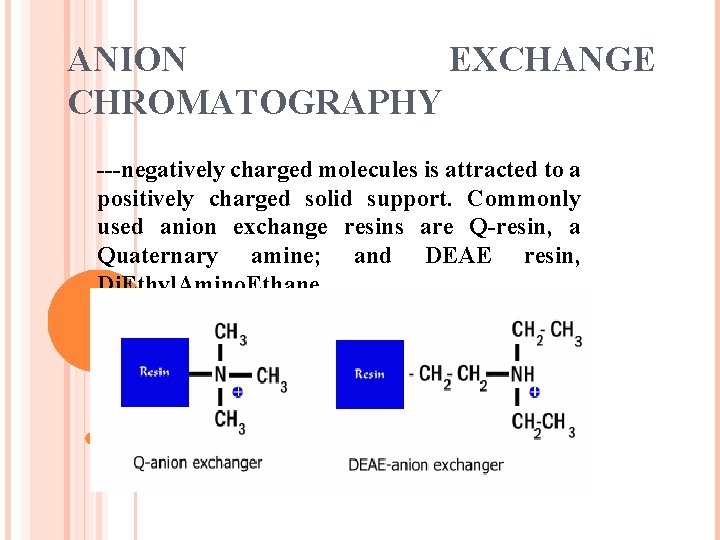
ANION EXCHANGE CHROMATOGRAPHY ---negatively charged molecules is attracted to a positively charged solid support. Commonly used anion exchange resins are Q-resin, a Quaternary amine; and DEAE resin, Di. Ethyl. Amino. Ethane
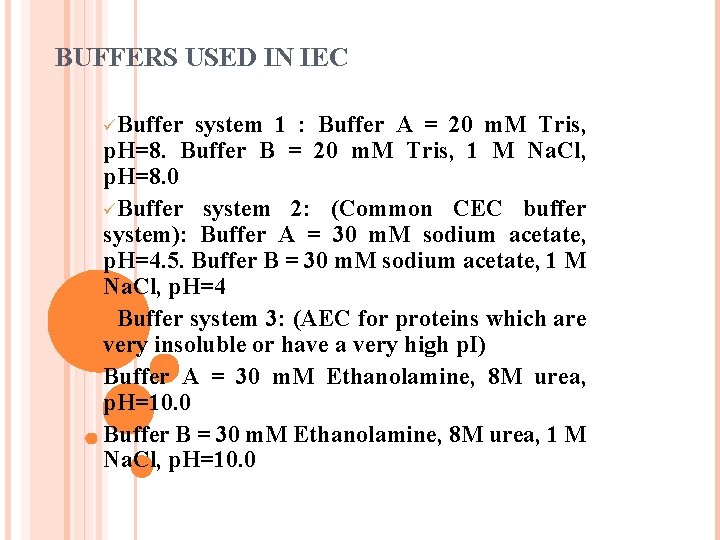
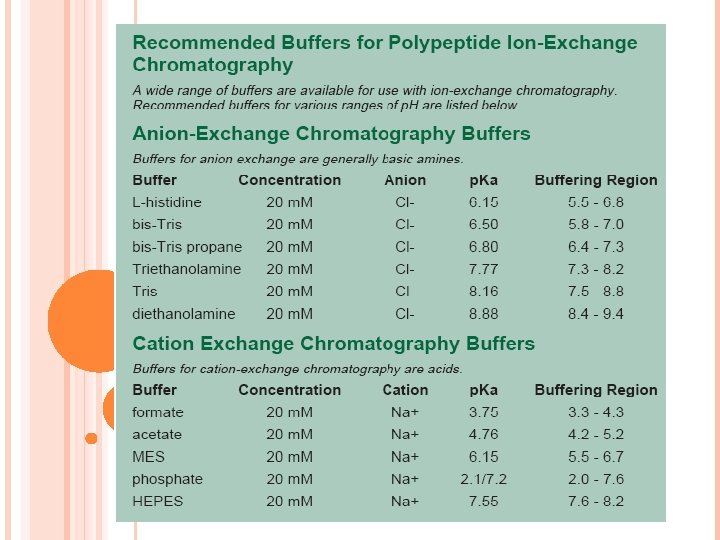
BUFFERS USED IN IEC üBuffer system 1 : Buffer A = 20 m. M Tris, p. H=8. Buffer B = 20 m. M Tris, 1 M Na. Cl, p. H=8. 0 üBuffer system 2: (Common CEC buffer system): Buffer A = 30 m. M sodium acetate, p. H=4. 5. Buffer B = 30 m. M sodium acetate, 1 M Na. Cl, p. H=4 üBuffer system 3: (AEC for proteins which are very insoluble or have a very high p. I) Buffer A = 30 m. M Ethanolamine, 8 M urea, p. H=10. 0 Buffer B = 30 m. M Ethanolamine, 8 M urea, 1 M Na. Cl, p. H=10. 0
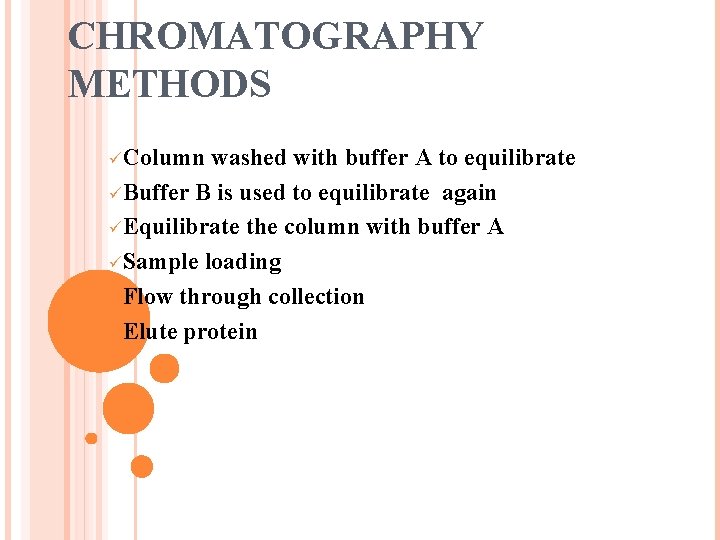
CHROMATOGRAPHY METHODS üColumn washed with buffer A to equilibrate üBuffer B is used to equilibrate again üEquilibrate the column with buffer A üSample loading üFlow through collection üElute protein
ADVANTAGES üIt is a non-denaturing technique. It can be used at all stages and scales of purification üAn IEX separation can be controlled by changing p. H, salt concentration and/or the ion exchange media üIt can serve as a concentrating step. A large volume of dilute sample can be applied to a media, and the adsorbed protein subsequently eluted in a smaller volume üIt offers high selectivity; it can resolve molecules with small differences in charge.
DISADVANTAGES ücostly equipment and more expensive chemicals üturbidity should be below 10 ppm.
CONCLUSION Ion exchange chromatography is more efficient than other chromatography. It could be widely used for commercial purposes.
THANKS