
Ion diagnostics for laser plasma experiments Thomson Parabola
Ion diagnostics for laser plasma experiments Thomson Parabola arrangements for ion spectroscopy Sargis Ter-Avetisyan ELI - Extreme Light Infrastructure, Institute of Physics, Prague, Czech Republic Matthias Schnürer Max-Born-Institute, Berlin, Germany Peter V. Nickles GIST, Gwangju South Korea 18 -19 October 2012
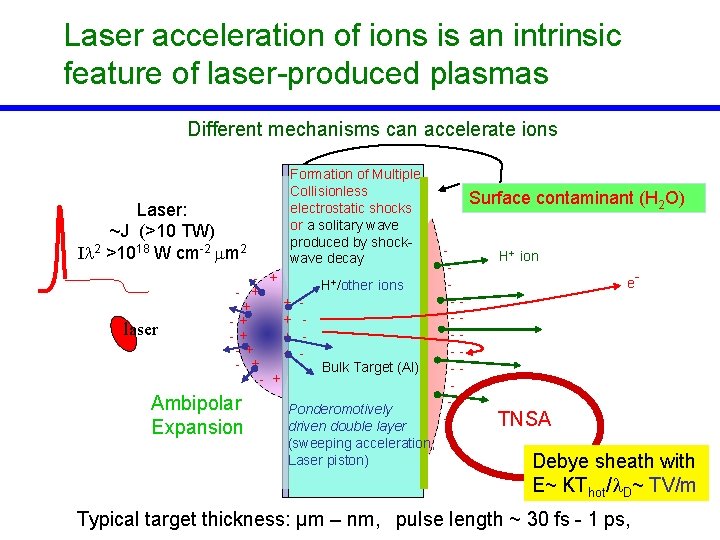
Laser acceleration of ions is an intrinsic feature of laser-produced plasmas Different mechanisms can accelerate ions Formation of Multiple Collisionless electrostatic shocks or a solitary wave produced by shockwave decay Laser: ~J (>10 TW) I 2 >1018 W cm-2 mm 2 - + + laser - + - + - + Ambipolar Expansion H+/other ions + + - Bulk Target (Al) Ponderomotively driven double layer (sweeping acceleration, Laser piston) Surface contaminant (H 2 O) ------ H+ ion e - TNSA Debye sheath with E~ KThot/ D~ TV/m Typical target thickness: µm – nm, pulse length ~ 30 fs - 1 ps,
outline - Čerenkov diagnostic - Thomson spectrometer - charged particle analyser - Thomson spectrometer with high spatial resolution - Time-resolving Thomson spectrometer - Thomson parabola – XUV spectrometer -Thomson spectrometer for ion source tomographgy
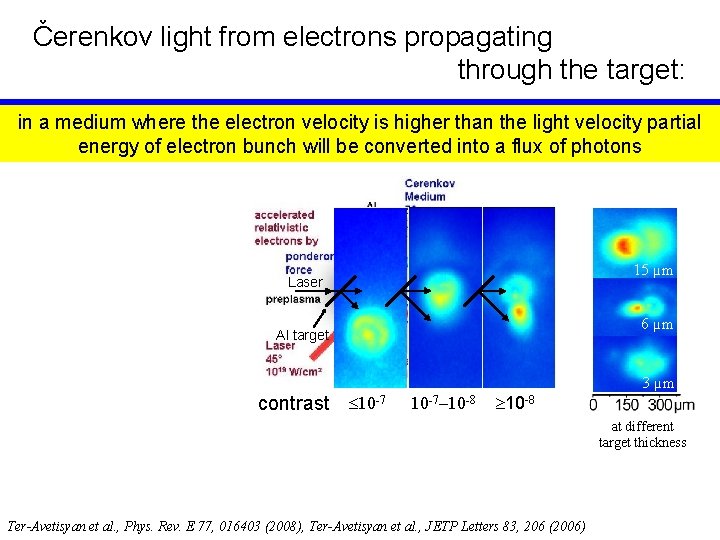
Čerenkov light from electrons propagating through the target: in a medium where the electron velocity is higher than the light velocity partial energy of electron bunch will be converted into a flux of photons 15 µm Laser 6 µm Al target contrast 10 -7– 10 -8 3 µm at different target thickness Ter-Avetisyan et al. , Phys. Rev. E 77, 016403 (2008), Ter-Avetisyan et al. , JETP Letters 83, 206 (2006)

Thomson spectrometer Absolute calibrated MCP is capable for 100µm pinhole B ~ 0. 8 T, E ~ 12 k. V/cm C+ target H+ electric deflection single particle detection 10 nm C, laser energy E~ 7 J, 50 fs magnetic deflection Ion spectra (Thomson parabola)
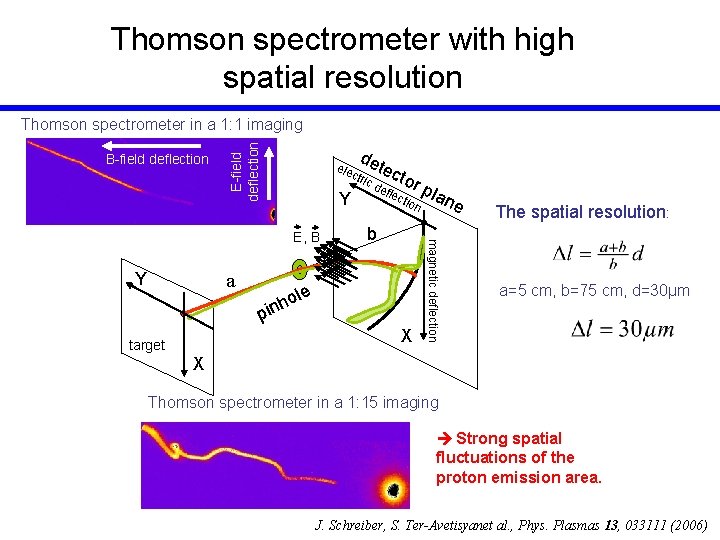
Thomson spectrometer with high spatial resolution B-field deflection E-field deflection Thomson spectrometer in a 1: 1 imaging ele Y a tric de tor flec tion b le ho pin X target pla ne magnetic deflection E, B Y de tec c The spatial resolution: a=5 cm, b=75 cm, d=30µm X Thomson spectrometer in a 1: 15 imaging Strong spatial fluctuations of the proton emission area. J. Schreiber, S. Ter-Avetisyanet al. , Phys. Plasmas 13, 033111 (2006)
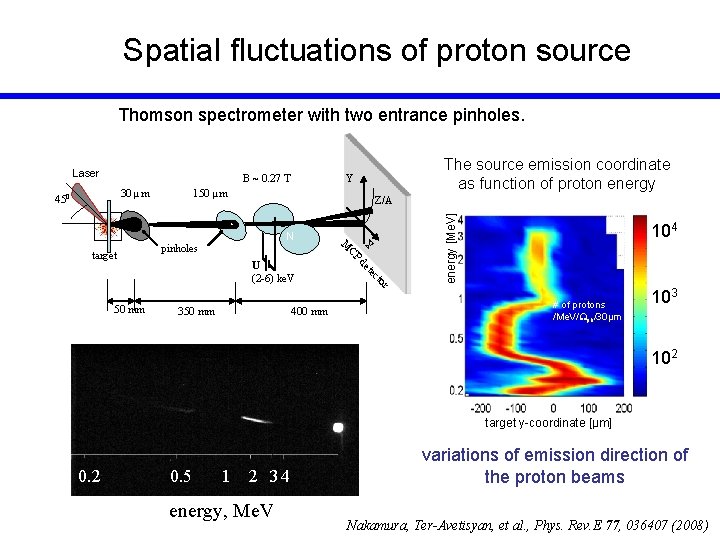
Spatial fluctuations of proton source Thomson spectrometer with two entrance pinholes. B ~ 0. 27 T 30 µm 450 150 µm The source emission coordinate as function of proton energy Y Z/A S N X or ct 400 mm te 350 mm de U (2 -6) ke. V CP 50 mm pinholes M target energy [Me. V] Laser 104 # of protons /Me. V/Wph/30µm 103 102 target y-coordinate [µm] 0. 2 0. 5 1 2 34 energy, Me. V variations of emission direction of the proton beams Nakamura, Ter-Avetisyan, et al. , Phys. Rev. E 77, 036407 (2008)

Time-resolving Thomson spectrometer measurement of arrival time and velocity - not loosing the spectral information TOF: T = t + l/v MCP detector T - time delay Z/mv t - departure (acceleration) time B=0. 33 T l/v - TOF of the ions V Ion source X=0 Z/A S N Z/mv 2 X=l J. Phys. D: Appl. Phys. 38, 863 (2005)
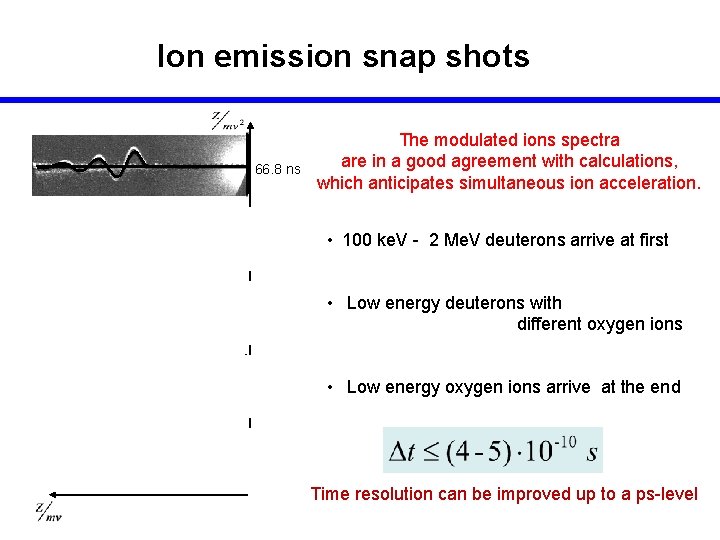
Ion emission snap shots 66. 8 ns The modulated ions spectra are in a good agreement with calculations, which anticipates simultaneous ion acceleration. 107 ns • 100 ke. V - 2 Me. V deuterons arrive at first 139 ns • Low energy deuterons with different oxygen ions 145 ns • Low energy oxygen ions arrive at the end 182 ns Time resolution can be improved up to a ps-level
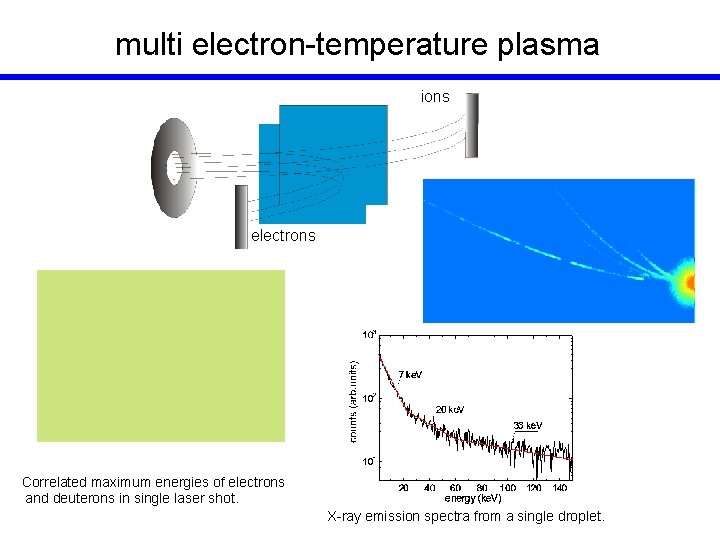
multi electron-temperature plasma ions electrons Correlated maximum energies of electrons and deuterons in single laser shot. X-ray emission spectra from a single droplet.
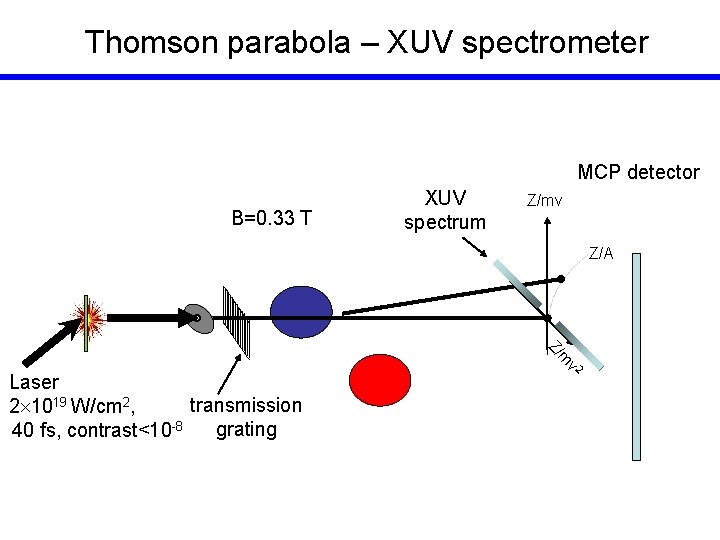
Thomson parabola – XUV spectrometer MCP detector XUV spectrum B=0. 33 T Z/mv S Z/A 2 v m Laser transmission 2 1019 W/cm 2, grating 40 fs, contrast<10 -8 Z/ N
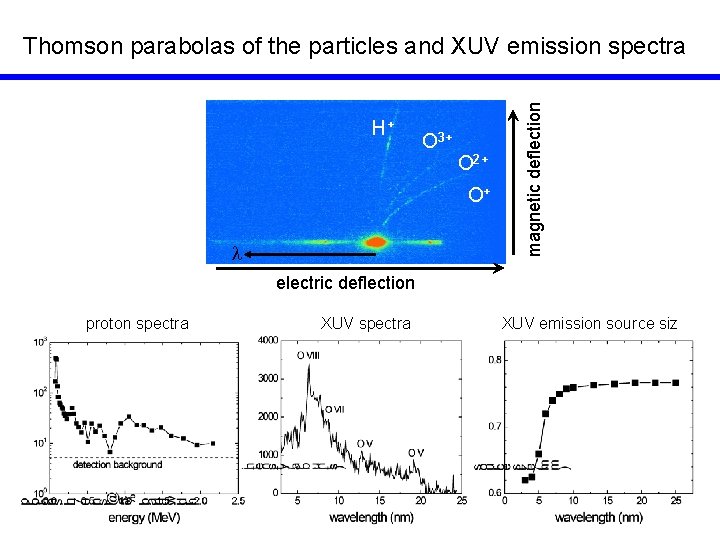
H+ O 3+ O 2+ O+ magnetic deflection Thomson parabolas of the particles and XUV emission spectra electric deflection proton spectra XUV emission source siz
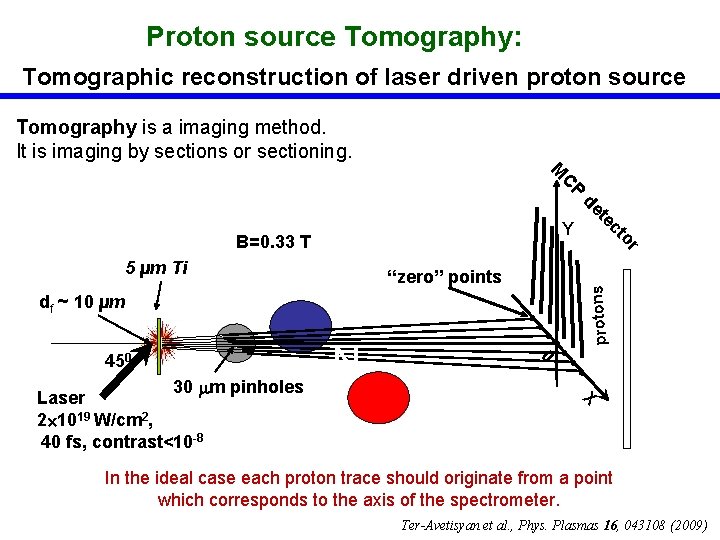
Proton source Tomography: Tomographic reconstruction of laser driven proton source Tomography is a imaging method. It is imaging by sections or sectioning. P C M “zero” points S 30 m pinholes Laser 2 1019 W/cm 2, 40 fs, contrast<10 -8 N 0 450 protons df ~ 10 µm or 5 µm Ti ct B=0. 33 T te de Y X In the ideal case each proton trace should originate from a point which corresponds to the axis of the spectrometer. Ter-Avetisyan et al. , Phys. Plasmas 16, 043108 (2009)
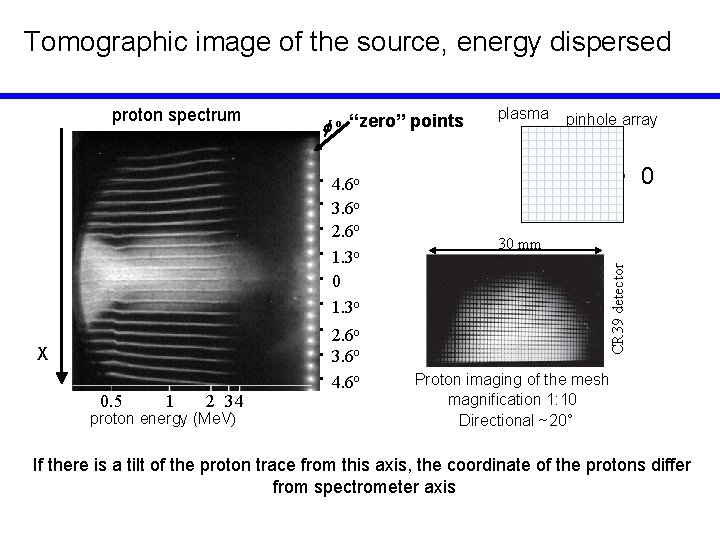
Tomographic image of the source, energy dispersed o “zero” points 4. 6 o 3. 6 o 2. 6 o 1. 3 o 0 1. 3 o X 0. 5 1 2 34 proton energy (Me. V) 2. 6 o 3. 6 o 4. 6 o plasma pinhole array 0 30 mm CR 39 detector proton spectrum Proton imaging of the mesh magnification 1: 10 Directional ~20° If there is a tilt of the proton trace from this axis, the coordinate of the protons differ from spectrometer axis
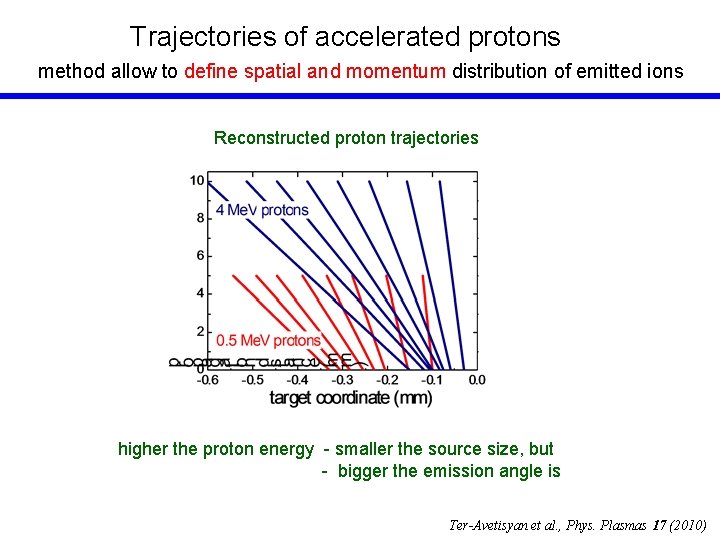
Trajectories of accelerated protons method allow to define spatial and momentum distribution of emitted ions Reconstructed proton trajectories higher the proton energy - smaller the source size, but - bigger the emission angle is Ter-Avetisyan et al. , Phys. Plasmas 17 (2010)
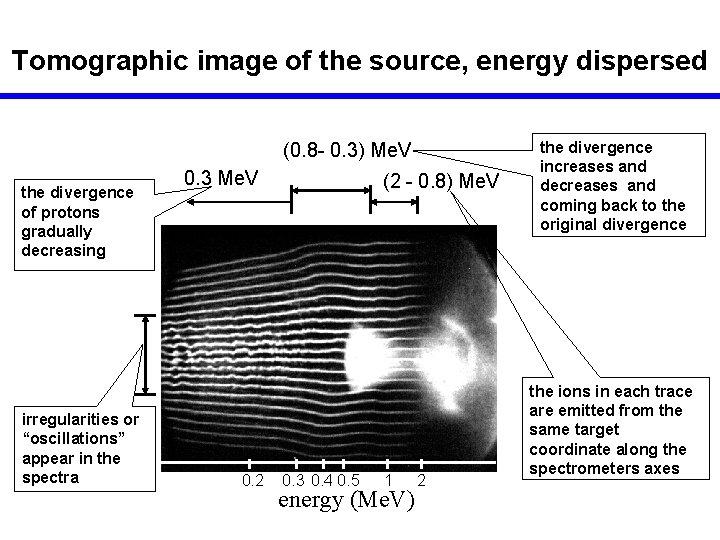
Tomographic image of the source, energy dispersed (0. 8 - 0. 3) Me. V the divergence of protons gradually decreasing irregularities or “oscillations” appear in the spectra 0. 3 Me. V 0. 2 (2 - 0. 8) Me. V 0. 3 0. 4 0. 5 1 energy (Me. V) 2 the divergence increases and decreases and coming back to the original divergence the ions in each trace are emitted from the same target coordinate along the spectrometers axes
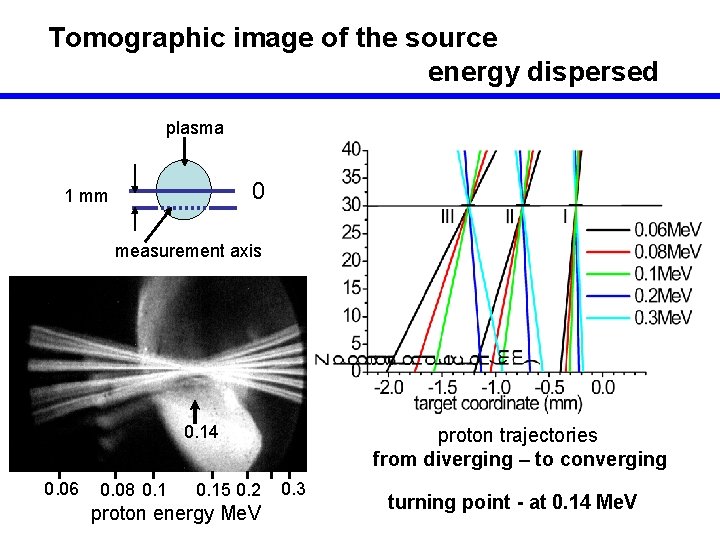
Tomographic image of the source energy dispersed plasma 0 1 mm measurement axis 0. 14 0. 06 0. 08 0. 15 0. 2 proton energy Me. V proton trajectories from diverging – to converging 0. 3 turning point - at 0. 14 Me. V
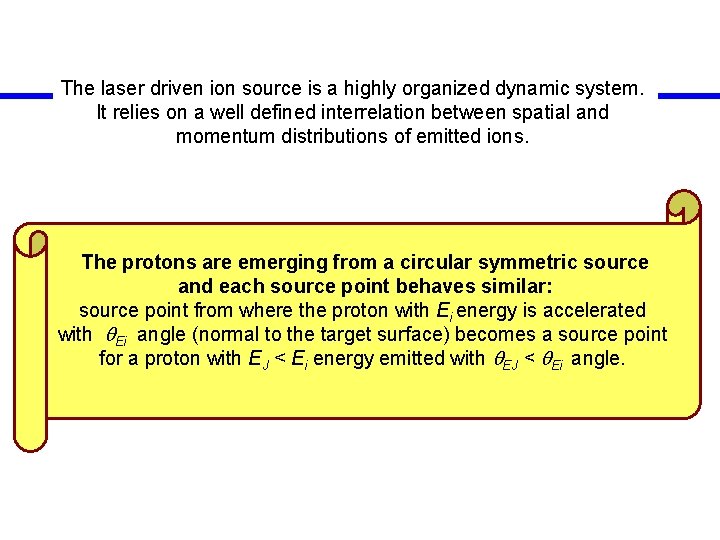
The laser driven ion source is a highly organized dynamic system. It relies on a well defined interrelation between spatial and momentum distributions of emitted ions. The protons are emerging from a circular symmetric source and each source point behaves similar: source point from where the proton with Ei energy is accelerated with Ei angle (normal to the target surface) becomes a source point for a proton with EJ < Ei energy emitted with EJ < Ei angle.
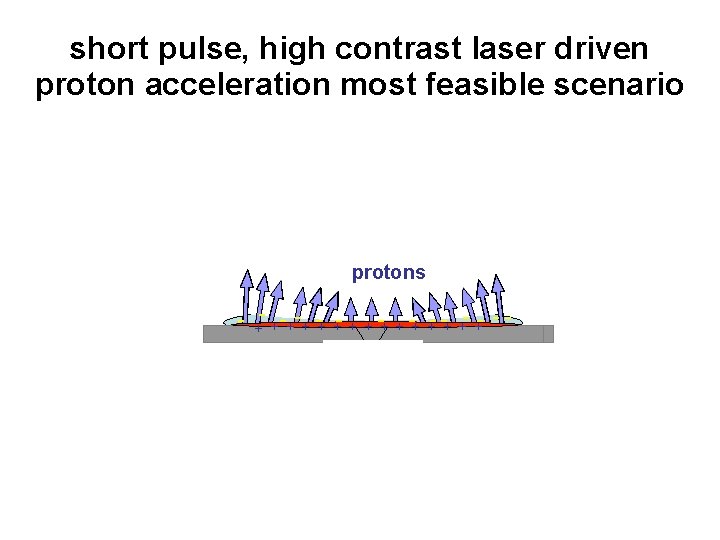
short pulse, high contrast laser driven proton acceleration most feasible scenario protons high energy photons e- e- e- protons - - -- +--- -+- -- +- +-+--+---++-+++--+-++++++-+++++-+--+-+-+--+- +- +- - Laser
- Slides: 19