
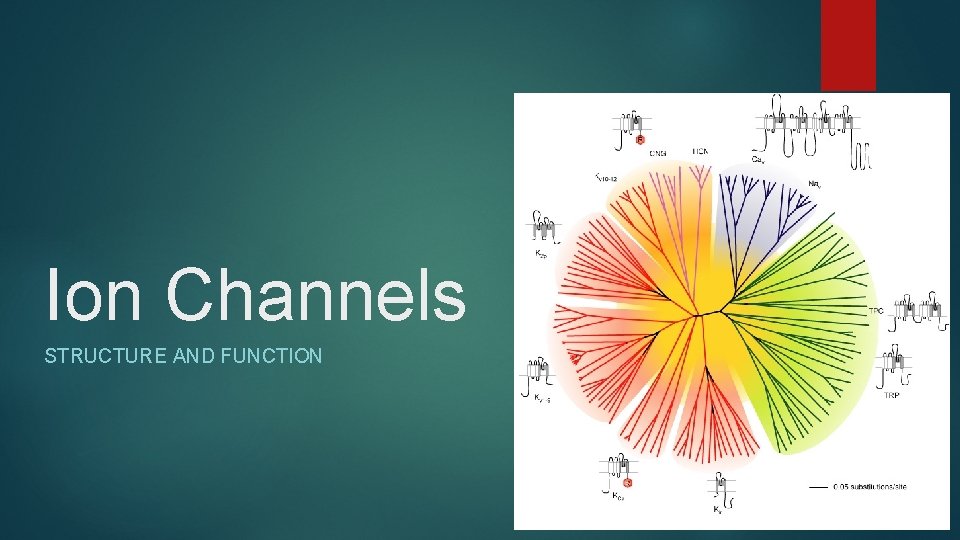
Ion Channels STRUCTURE AND FUNCTION Mechanically gated ion
- Slides: 8
Ion Channels STRUCTURE AND FUNCTION
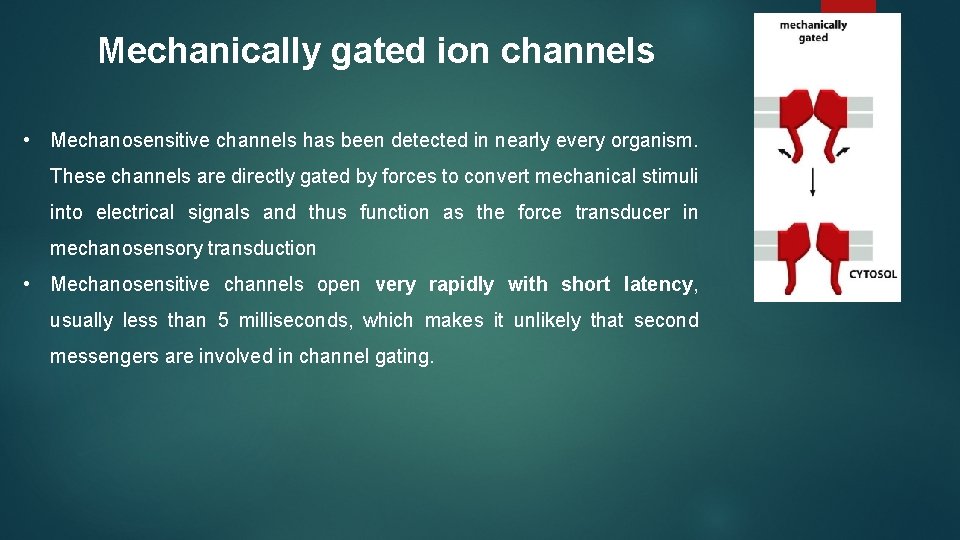
Mechanically gated ion channels • Mechanosensitive channels has been detected in nearly every organism. These channels are directly gated by forces to convert mechanical stimuli into electrical signals and thus function as the force transducer in mechanosensory transduction • Mechanosensitive channels open very rapidly with short latency, usually less than 5 milliseconds, which makes it unlikely that second messengers are involved in channel gating.
Mechanically gated ion channels It is generally believed that the three common mechanical sensory modalities — touch, hearing and proprioception — are mediated by mechanosensitive channels that are directly gated by forces. The molecular identities of these channels, however, remain largely elusive, particularly in mammals. A new study by Coste et al. , published recently in Science, has now shed light on this enigma.
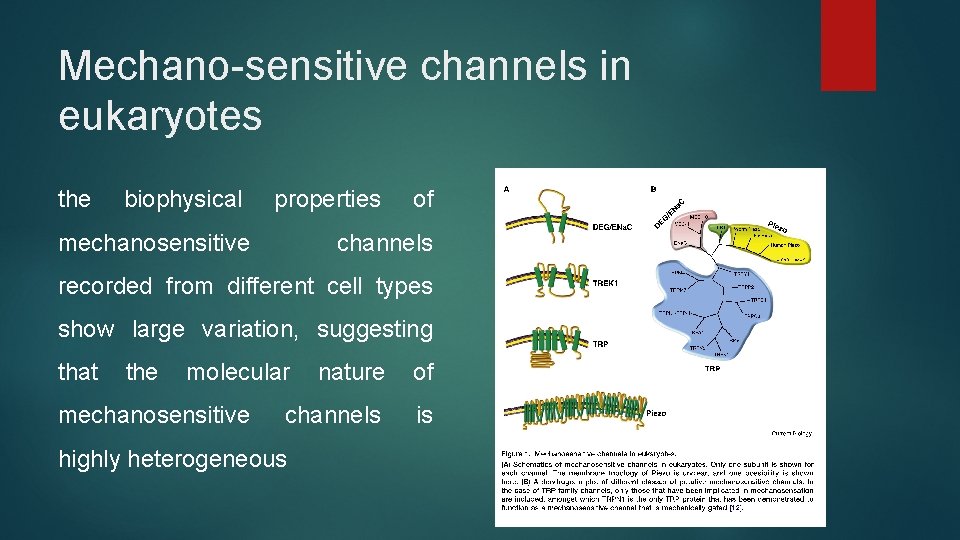
Mechano-sensitive channels in eukaryotes the biophysical properties mechanosensitive of channels recorded from different cell types show large variation, suggesting that the molecular mechanosensitive nature of channels is highly heterogeneous
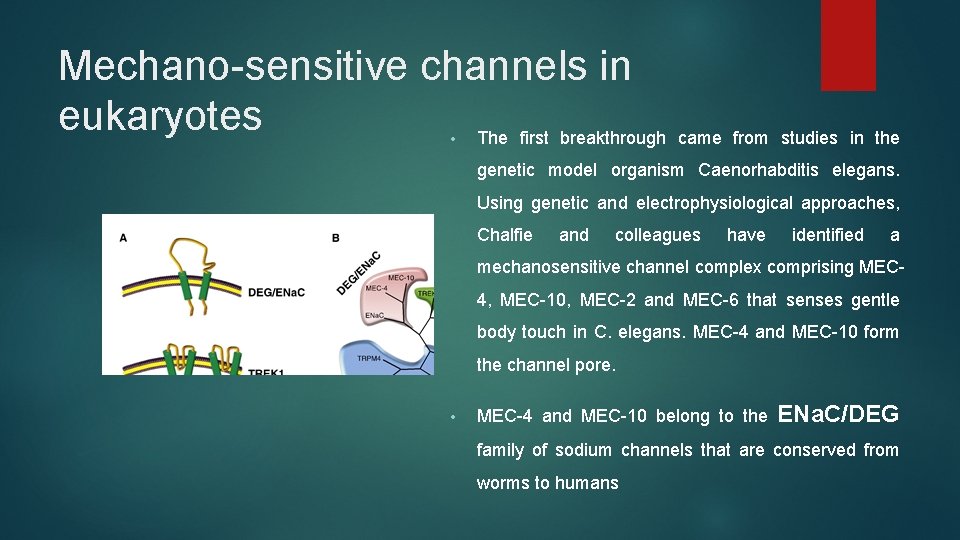
Mechano-sensitive channels in eukaryotes The first breakthrough came from studies in the • genetic model organism Caenorhabditis elegans. Using genetic and electrophysiological approaches, Chalfie and colleagues have identified a mechanosensitive channel complex comprising MEC 4, MEC-10, MEC-2 and MEC-6 that senses gentle body touch in C. elegans. MEC-4 and MEC-10 form the channel pore. • MEC-4 and MEC-10 belong to the ENa. C/DEG family of sodium channels that are conserved from worms to humans
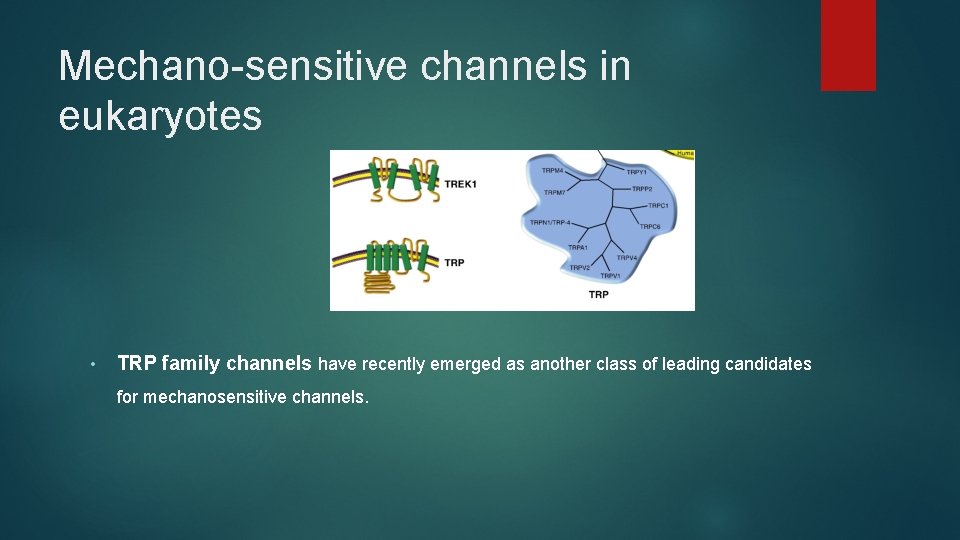
Mechano-sensitive channels in eukaryotes • TRP family channels have recently emerged as another class of leading candidates for mechanosensitive channels.
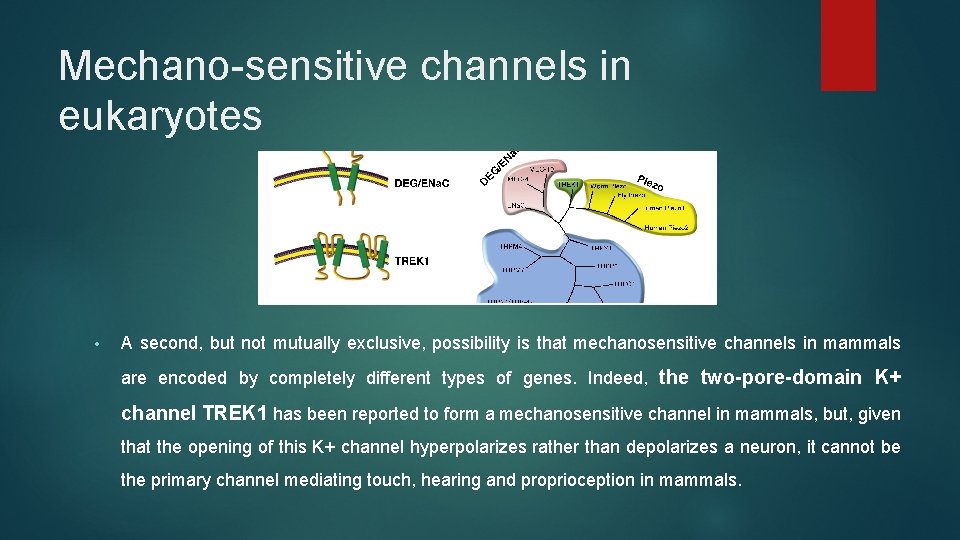
Mechano-sensitive channels in eukaryotes • A second, but not mutually exclusive, possibility is that mechanosensitive channels in mammals are encoded by completely different types of genes. Indeed, the two-pore-domain K+ channel TREK 1 has been reported to form a mechanosensitive channel in mammals, but, given that the opening of this K+ channel hyperpolarizes rather than depolarizes a neuron, it cannot be the primary channel mediating touch, hearing and proprioception in mammals.
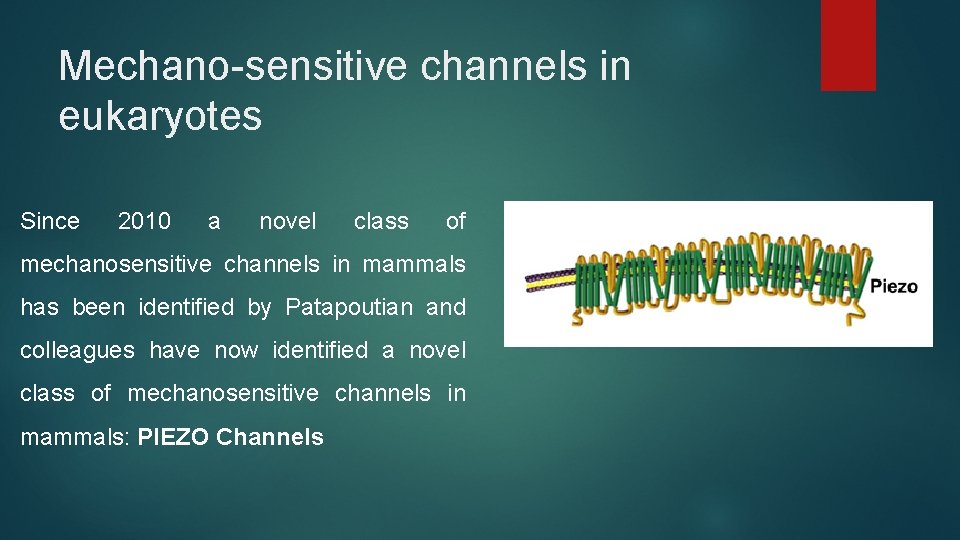
Mechano-sensitive channels in eukaryotes Since 2010 a novel class of mechanosensitive channels in mammals has been identified by Patapoutian and colleagues have now identified a novel class of mechanosensitive channels in mammals: PIEZO Channels