
ION BEAM ANALYSIS Mdlina BADEA 1 Daniela Adriana
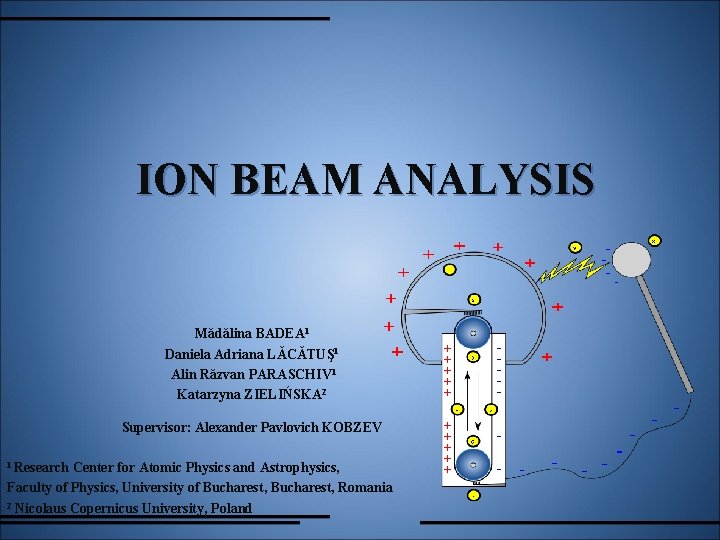
ION BEAM ANALYSIS Mădălina BADEA 1 Daniela Adriana LĂCĂTUŞ 1 Alin Răzvan PARASCHIV 1 Katarzyna ZIELIŃSKA 2 Supervisor: Alexander Pavlovich KOBZEV 1 Research Center for Atomic Physics and Astrophysics, Faculty of Physics, University of Bucharest, Romania 2 Nicolaus Copernicus University, Poland
ION BEAM ANALYSIS – FRANK LABORATORY OF NEUTRON PHYSICS Overview Ion Beam Analysis (IBA) is based on the interaction, at both the atomic and the nuclear level, between accelerated charged particles and the bombarded material. When a charged particle moving at high speed strikes a material, it interacts with the electrons and nuclei of the material atoms, slows down and possibly deviates from its initial trajectory. This can lead to the emission of particles or radiation whose energy is characteristic of the elements which constitute the sample material. 2010 STUDENT PRACTICE IN JINR FIELDS OF RESEARCH – 5– 25 July 2010 2
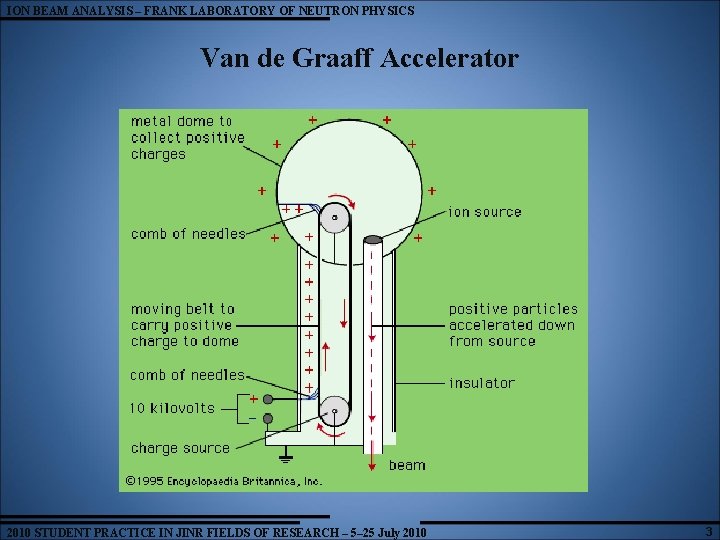
ION BEAM ANALYSIS – FRANK LABORATORY OF NEUTRON PHYSICS Van de Graaff Accelerator 2010 STUDENT PRACTICE IN JINR FIELDS OF RESEARCH – 5– 25 July 2010 3
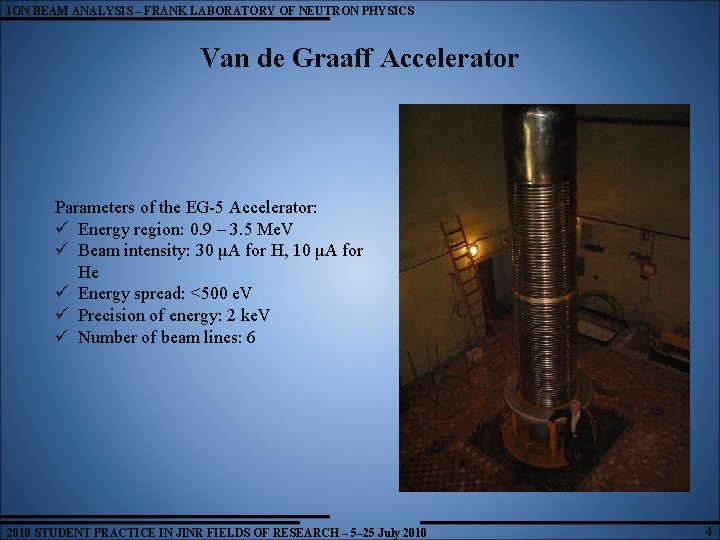
ION BEAM ANALYSIS – FRANK LABORATORY OF NEUTRON PHYSICS Van de Graaff Accelerator Parameters of the EG-5 Accelerator: ü Energy region: 0. 9 – 3. 5 Me. V ü Beam intensity: 30 μA for H, 10 μA for He ü Energy spread: <500 e. V ü Precision of energy: 2 ke. V ü Number of beam lines: 6 2010 STUDENT PRACTICE IN JINR FIELDS OF RESEARCH – 5– 25 July 2010 4
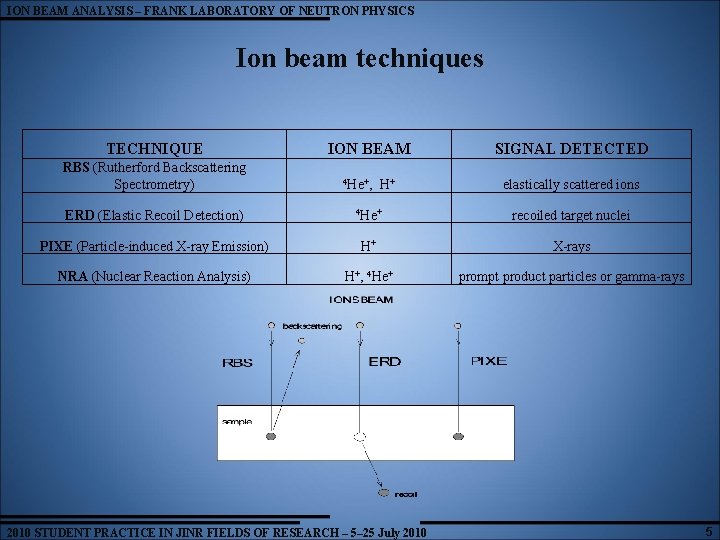
ION BEAM ANALYSIS – FRANK LABORATORY OF NEUTRON PHYSICS Ion beam techniques TECHNIQUE RBS (Rutherford Backscattering Spectrometry) ION BEAM 4 He+, H+ SIGNAL DETECTED elastically scattered ions ERD (Elastic Recoil Detection) 4 He+ recoiled target nuclei PIXE (Particle-induced X-ray Emission) H+ X-rays NRA (Nuclear Reaction Analysis) H+, 4 He+ prompt product particles or gamma-rays 2010 STUDENT PRACTICE IN JINR FIELDS OF RESEARCH – 5– 25 July 2010 5
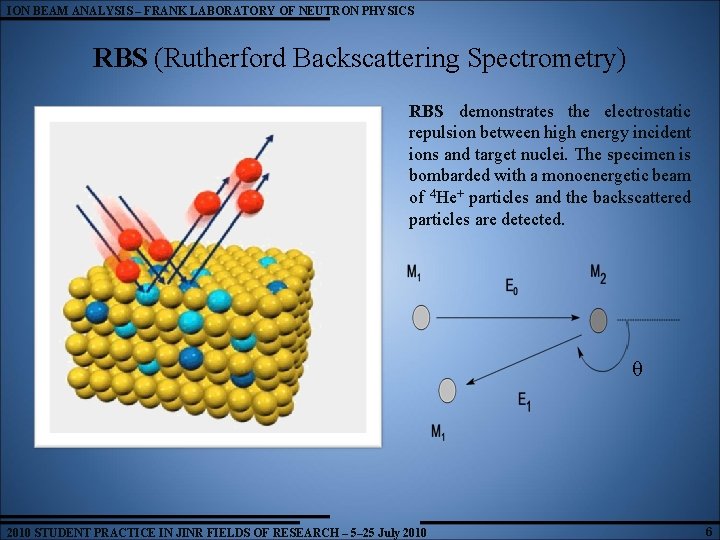
ION BEAM ANALYSIS – FRANK LABORATORY OF NEUTRON PHYSICS RBS (Rutherford Backscattering Spectrometry) RBS demonstrates the electrostatic repulsion between high energy incident ions and target nuclei. The specimen is bombarded with a monoenergetic beam of 4 He+ particles and the backscattered particles are detected. θ 2010 STUDENT PRACTICE IN JINR FIELDS OF RESEARCH – 5– 25 July 2010 6
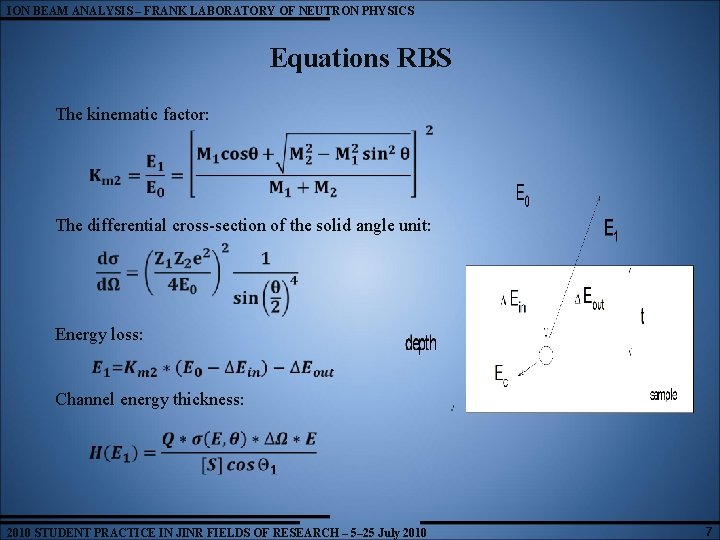
ION BEAM ANALYSIS – FRANK LABORATORY OF NEUTRON PHYSICS Equations RBS The kinematic factor: The differential cross-section of the solid angle unit: Energy loss: Channel energy thickness: 2010 STUDENT PRACTICE IN JINR FIELDS OF RESEARCH – 5– 25 July 2010 7
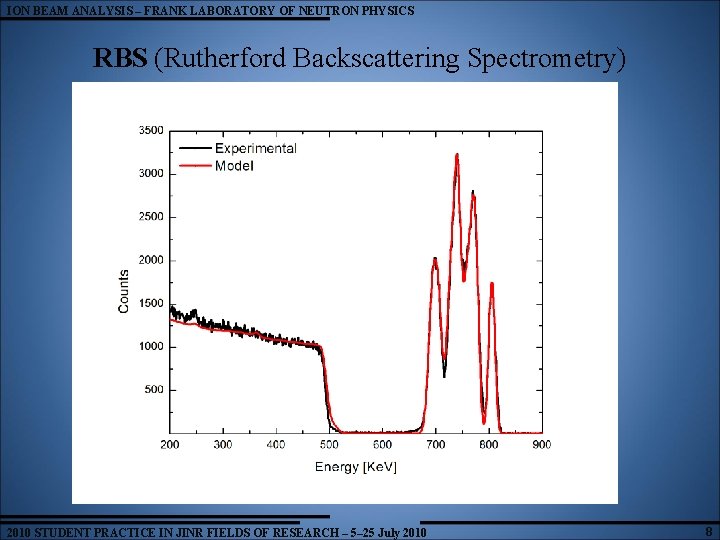
ION BEAM ANALYSIS – FRANK LABORATORY OF NEUTRON PHYSICS RBS (Rutherford Backscattering Spectrometry) 2010 STUDENT PRACTICE IN JINR FIELDS OF RESEARCH – 5– 25 July 2010 8
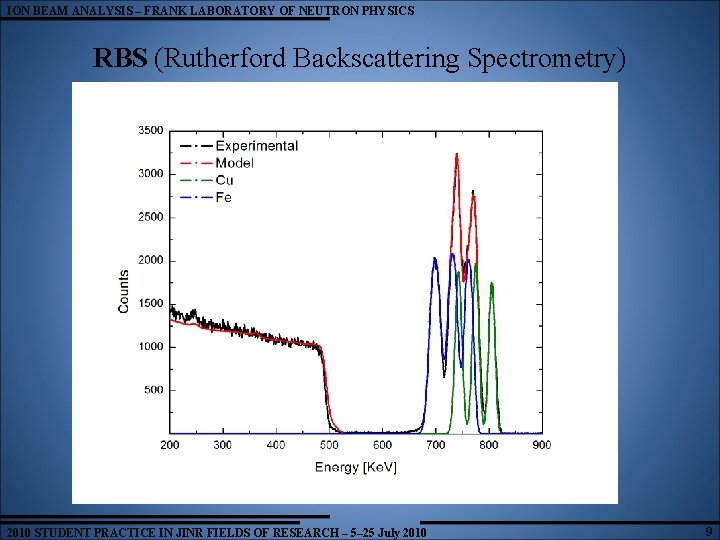
ION BEAM ANALYSIS – FRANK LABORATORY OF NEUTRON PHYSICS RBS (Rutherford Backscattering Spectrometry) 2010 STUDENT PRACTICE IN JINR FIELDS OF RESEARCH – 5– 25 July 2010 9
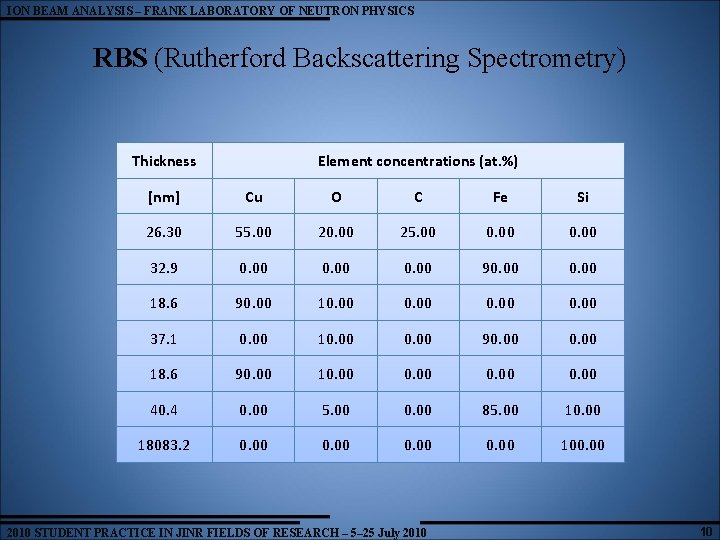
ION BEAM ANALYSIS – FRANK LABORATORY OF NEUTRON PHYSICS RBS (Rutherford Backscattering Spectrometry) Thickness Element concentrations (at. %) [nm] Cu O C Fe Si 26. 30 55. 00 20. 00 25. 00 0. 00 32. 9 0. 00 90. 00 18. 6 90. 00 10. 00 37. 1 0. 00 10. 00 90. 00 18. 6 90. 00 10. 00 40. 4 0. 00 5. 00 0. 00 85. 00 10. 00 18083. 2 0. 00 100. 00 2010 STUDENT PRACTICE IN JINR FIELDS OF RESEARCH – 5– 25 July 2010 10
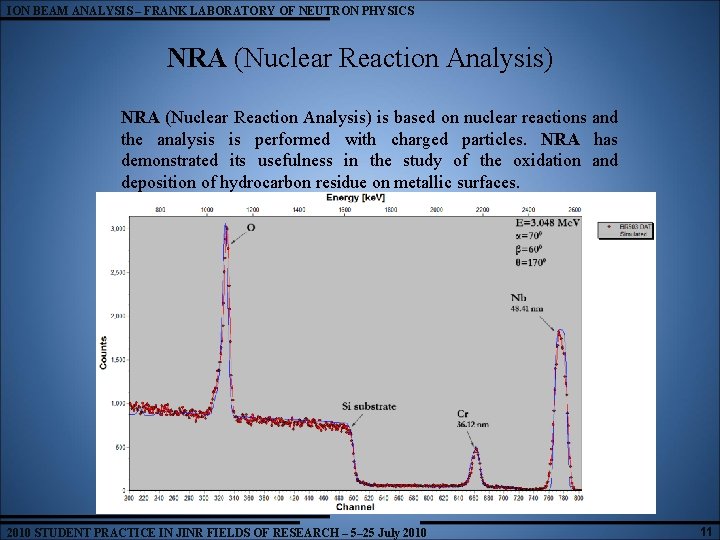
ION BEAM ANALYSIS – FRANK LABORATORY OF NEUTRON PHYSICS NRA (Nuclear Reaction Analysis) is based on nuclear reactions and the analysis is performed with charged particles. NRA has demonstrated its usefulness in the study of the oxidation and deposition of hydrocarbon residue on metallic surfaces. 2010 STUDENT PRACTICE IN JINR FIELDS OF RESEARCH – 5– 25 July 2010 11
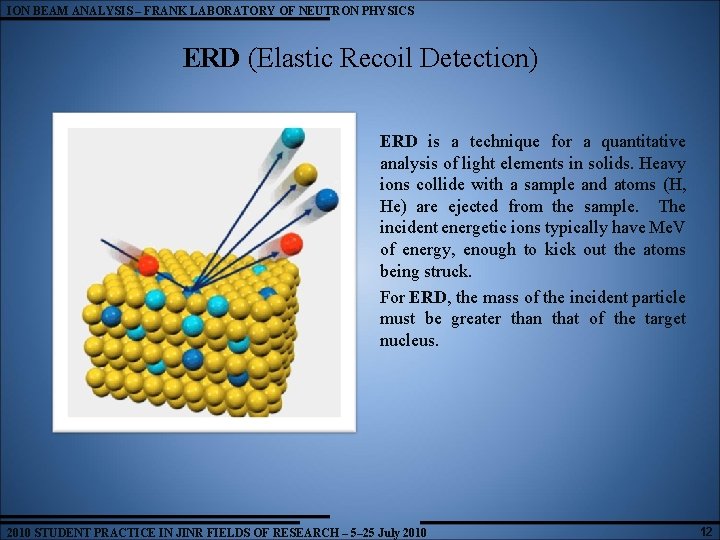
ION BEAM ANALYSIS – FRANK LABORATORY OF NEUTRON PHYSICS ERD (Elastic Recoil Detection) ERD is a technique for a quantitative analysis of light elements in solids. Heavy ions collide with a sample and atoms (H, He) are ejected from the sample. The incident energetic ions typically have Me. V of energy, enough to kick out the atoms being struck. For ERD, the mass of the incident particle must be greater than that of the target nucleus. 2010 STUDENT PRACTICE IN JINR FIELDS OF RESEARCH – 5– 25 July 2010 12
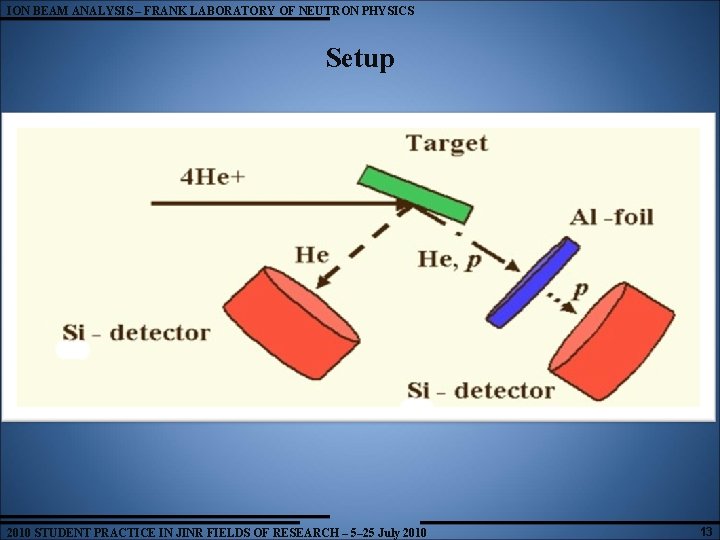
ION BEAM ANALYSIS – FRANK LABORATORY OF NEUTRON PHYSICS Setup 2010 STUDENT PRACTICE IN JINR FIELDS OF RESEARCH – 5– 25 July 2010 13
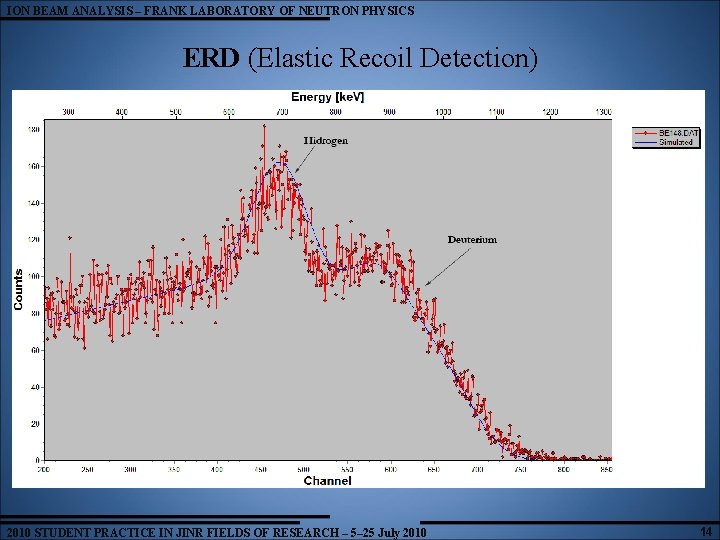
ION BEAM ANALYSIS – FRANK LABORATORY OF NEUTRON PHYSICS ERD (Elastic Recoil Detection) 2010 STUDENT PRACTICE IN JINR FIELDS OF RESEARCH – 5– 25 July 2010 14
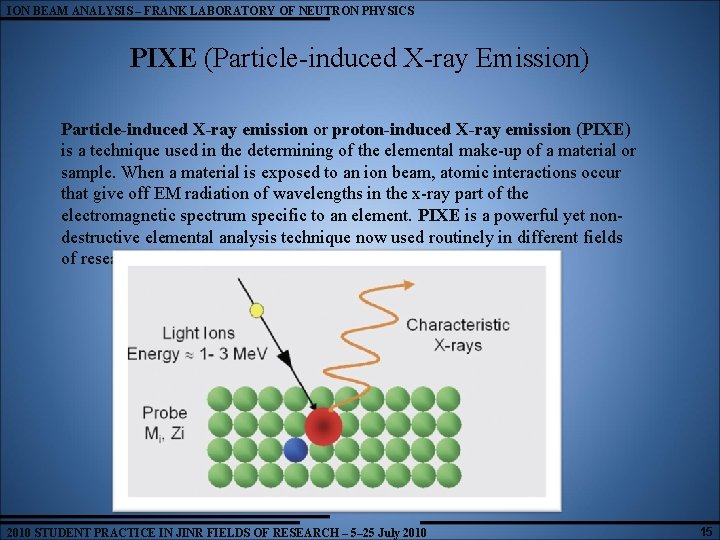
ION BEAM ANALYSIS – FRANK LABORATORY OF NEUTRON PHYSICS PIXE (Particle-induced X-ray Emission) Particle-induced X-ray emission or proton-induced X-ray emission (PIXE) is a technique used in the determining of the elemental make-up of a material or sample. When a material is exposed to an ion beam, atomic interactions occur that give off EM radiation of wavelengths in the x-ray part of the electromagnetic spectrum specific to an element. PIXE is a powerful yet nondestructive elemental analysis technique now used routinely in different fields of research. 2010 STUDENT PRACTICE IN JINR FIELDS OF RESEARCH – 5– 25 July 2010 15
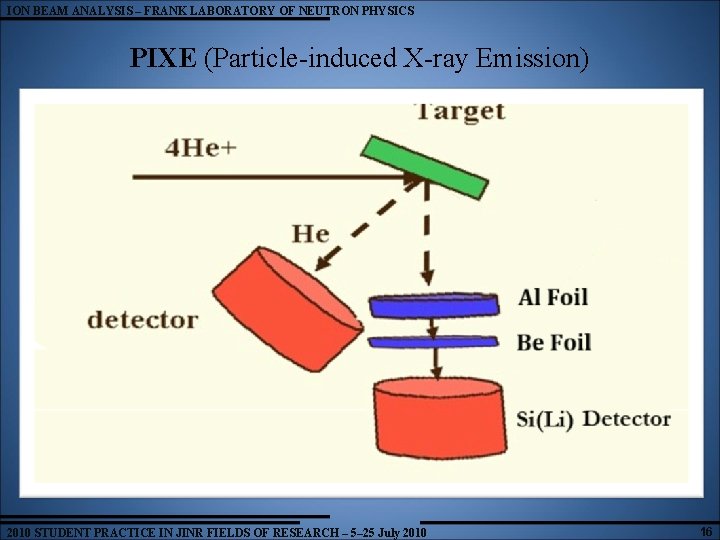
ION BEAM ANALYSIS – FRANK LABORATORY OF NEUTRON PHYSICS PIXE (Particle-induced X-ray Emission) 2010 STUDENT PRACTICE IN JINR FIELDS OF RESEARCH – 5– 25 July 2010 16
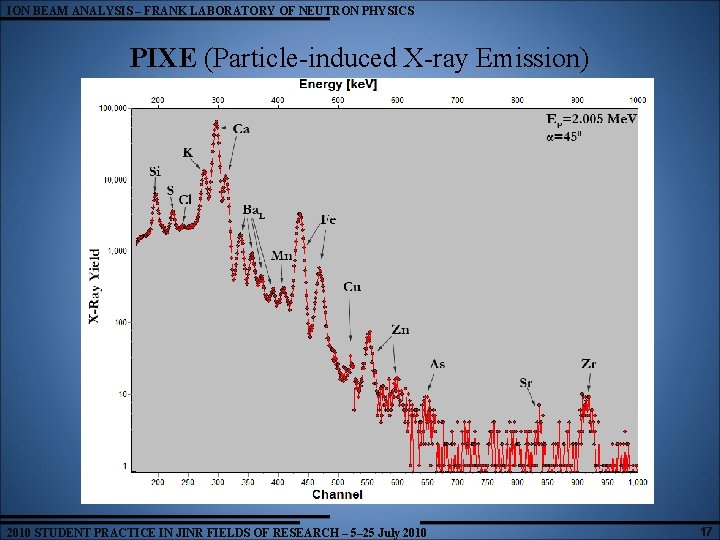
ION BEAM ANALYSIS – FRANK LABORATORY OF NEUTRON PHYSICS PIXE (Particle-induced X-ray Emission) 2010 STUDENT PRACTICE IN JINR FIELDS OF RESEARCH – 5– 25 July 2010 17
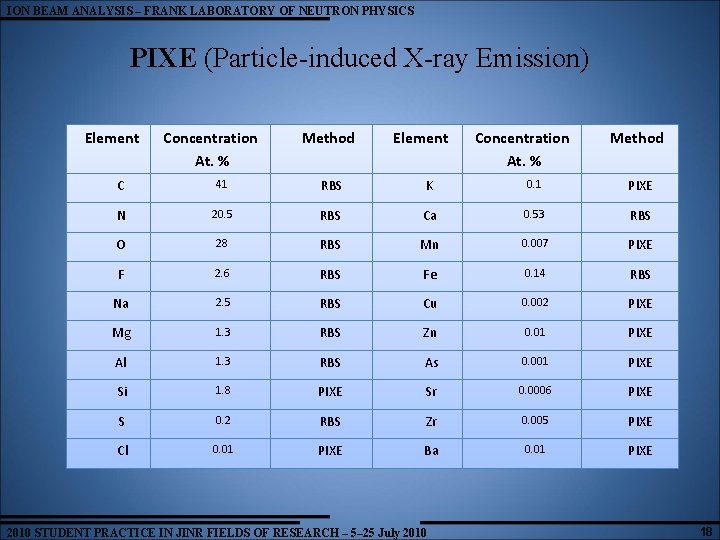
ION BEAM ANALYSIS – FRANK LABORATORY OF NEUTRON PHYSICS PIXE (Particle-induced X-ray Emission) Element C N Concentration At. % Method Element Concentration At. % Method 41 RBS K 0. 1 PIXE RBS Ca 0. 53 RBS 20. 5 O 28 RBS Mn 0. 007 PIXE F 2. 6 RBS Fe 0. 14 RBS Na 2. 5 RBS Cu 0. 002 PIXE Mg 1. 3 RBS Zn 0. 01 PIXE Al 1. 3 RBS As 0. 001 PIXE Si 1. 8 PIXE Sr 0. 0006 PIXE S 0. 2 RBS Zr 0. 005 PIXE Cl 0. 01 PIXE Ba 0. 01 PIXE 2010 STUDENT PRACTICE IN JINR FIELDS OF RESEARCH – 5– 25 July 2010 18
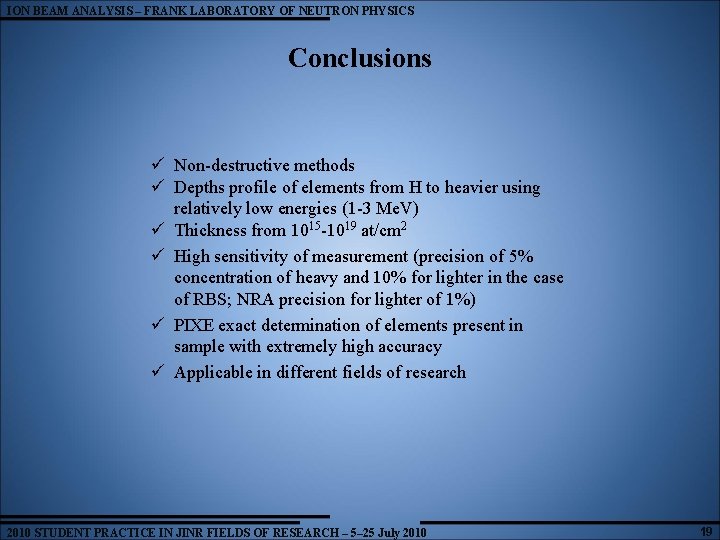
ION BEAM ANALYSIS – FRANK LABORATORY OF NEUTRON PHYSICS Conclusions ü Non-destructive methods ü Depths profile of elements from H to heavier using relatively low energies (1 -3 Me. V) ü Thickness from 1015 -1019 at/cm 2 ü High sensitivity of measurement (precision of 5% concentration of heavy and 10% for lighter in the case of RBS; NRA precision for lighter of 1%) ü PIXE exact determination of elements present in sample with extremely high accuracy ü Applicable in different fields of research 2010 STUDENT PRACTICE IN JINR FIELDS OF RESEARCH – 5– 25 July 2010 19
ION BEAM ANALYSIS – FRANK LABORATORY OF NEUTRON PHYSICS THANK YOU FOR YOUR ATTENTION ! 2010 STUDENT PRACTICE IN JINR FIELDS OF RESEARCH – 5– 25 July 2010 20
- Slides: 20