
Ion Beam Analysis Dolly Langa Physics Department University
Ion Beam Analysis Dolly Langa Physics Department, University of Pretoria, South Africa Blane Lomberg Physics Department, University of the Western Cape, South Africa Project Supervisor: Prof A. P. Kobzev Frank Laboratory of Neutron Physics, Joint Institute for Nuclear Research, Dubna, Russia
AIM OF PROJECT Analysis of contents and depth distribution of different elements in the near surface layers of solids using • Rutherford Backscattering Spectrometry (RBS) • Elastic Recoil Detection (ERD) • Particle Induced X-ray Emission (PIXE)
OUTLINE 1. AIM OF PROJECT 2. VAN DER GRAAFF ACCELERATOR 3. PRINCIPLE OF ION BEAM ANALYSIS USED 4. RESULTS AND DISCUSSION 5. CONCLUSION
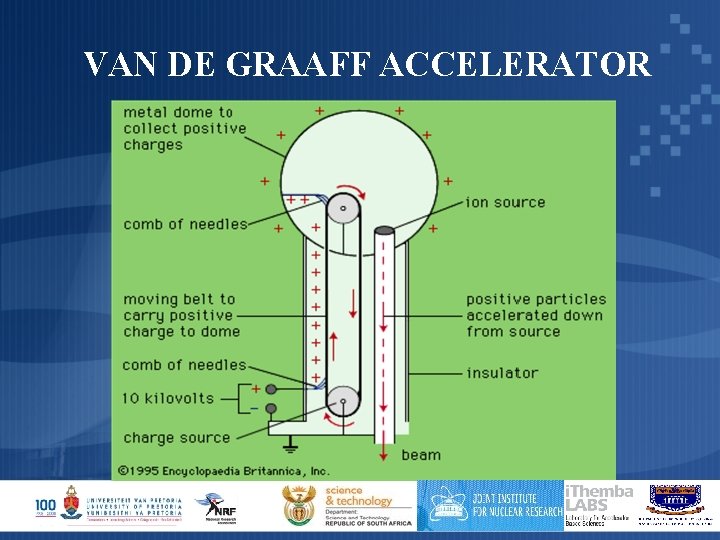
VAN DE GRAAFF ACCELERATOR
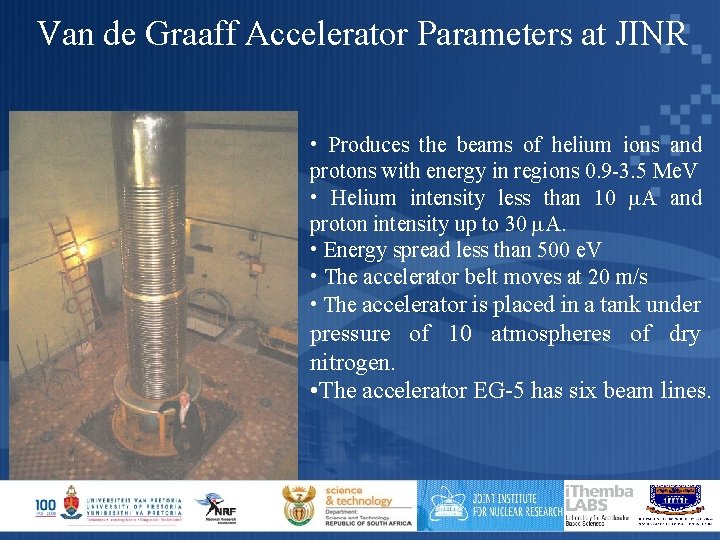
Van de Graaff Accelerator Parameters at JINR • Produces the beams of helium ions and protons with energy in regions 0. 9 -3. 5 Me. V • Helium intensity less than 10 A and proton intensity up to 30 A. • Energy spread less than 500 e. V • The accelerator belt moves at 20 m/s • The accelerator is placed in a tank under pressure of 10 atmospheres of dry nitrogen. • The accelerator EG-5 has six beam lines.

PRINCIPLE OF ION BEAM ANALYSIS USED Conti. . Rutherford Backscattering Spectrometry (RBS)
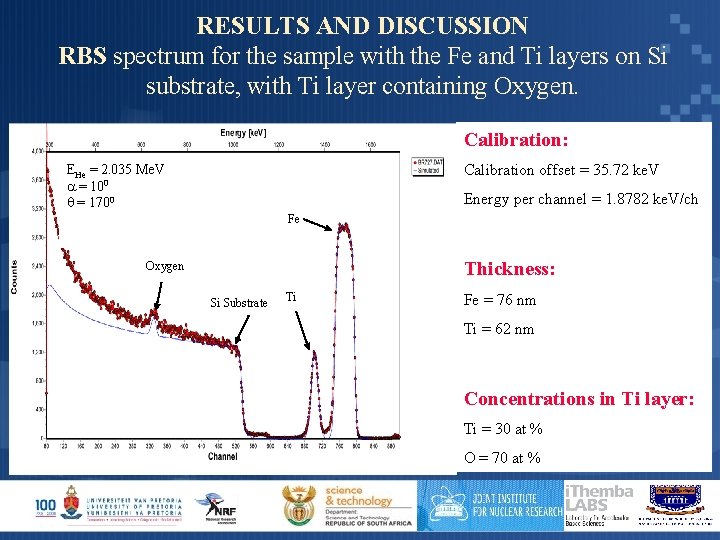
RESULTS AND DISCUSSION RBS spectrum for the sample with the Fe and Ti layers on Si substrate, with Ti layer containing Oxygen. Calibration: Calibration offset = 35. 72 ke. V EHe = 2. 035 Me. V = 100 = 1700 Energy per channel = 1. 8782 ke. V/ch Fe Thickness: Oxygen Si Substrate Ti Fe = 76 nm Ti = 62 nm Concentrations in Ti layer: Ti = 30 at % O = 70 at %
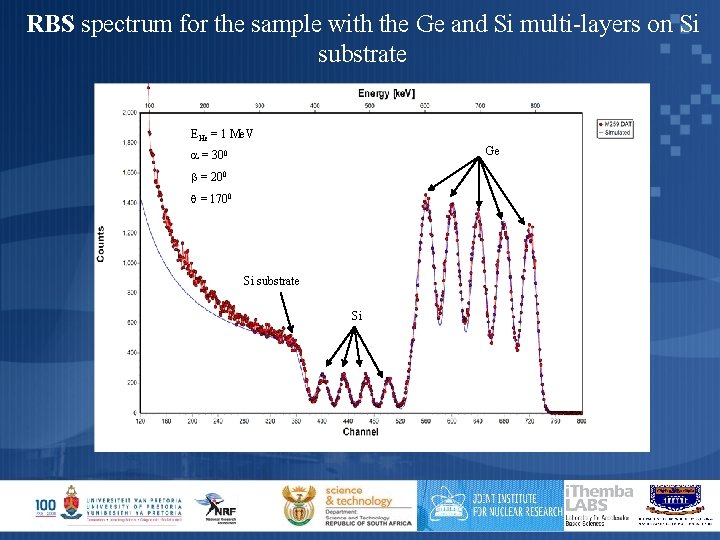
RBS spectrum for the sample with the Ge and Si multi-layers on Si substrate EHe = 1 Me. V Ge = 300 = 200 = 1700 Si substrate Si
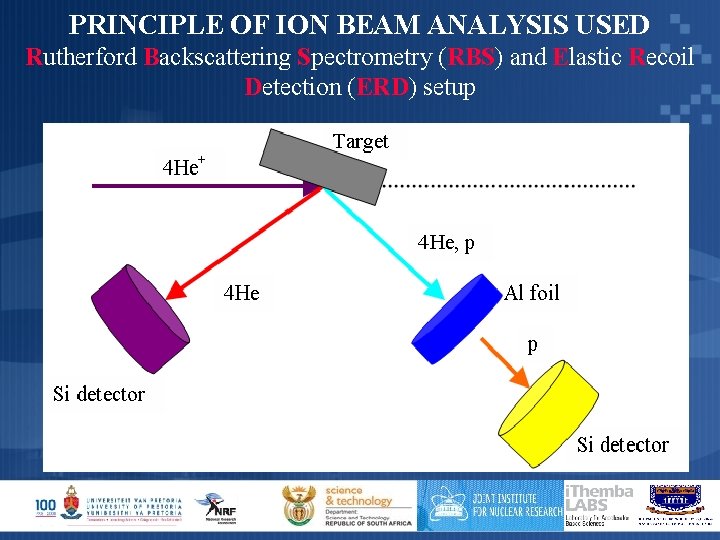
PRINCIPLE OF ION BEAM ANALYSIS USED Rutherford Backscattering Spectrometry (RBS) and Elastic Recoil Detection (ERD) setup
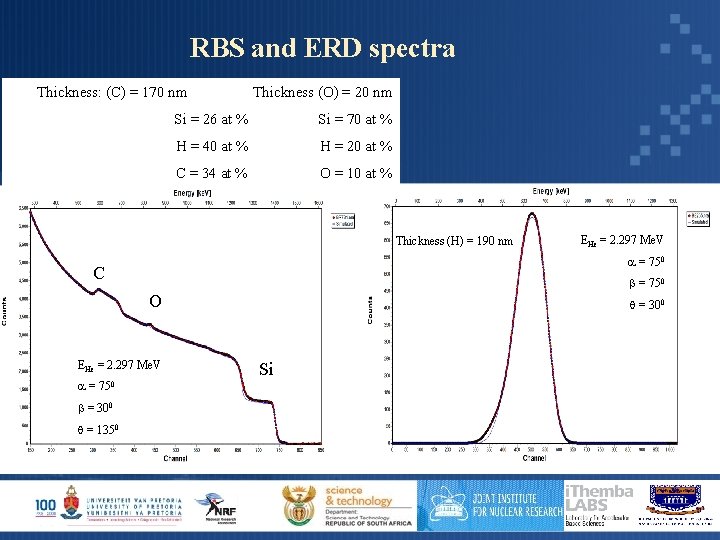
RBS and ERD spectra Thickness: (C) = 170 nm Thickness (O) = 20 nm Si = 26 at % Si = 70 at % H = 40 at % H = 20 at % C = 34 at % O = 10 at % Thickness (H) = 190 nm = 750 C = 750 O EHe = 2. 297 Me. V = 750 = 300 = 1350 EHe = 2. 297 Me. V = 300 Si
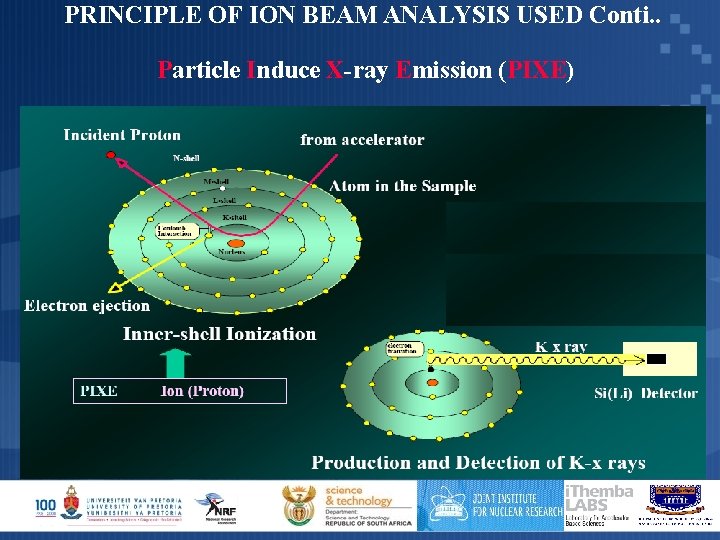
PRINCIPLE OF ION BEAM ANALYSIS USED Conti. . Particle Induce X-ray Emission (PIXE)
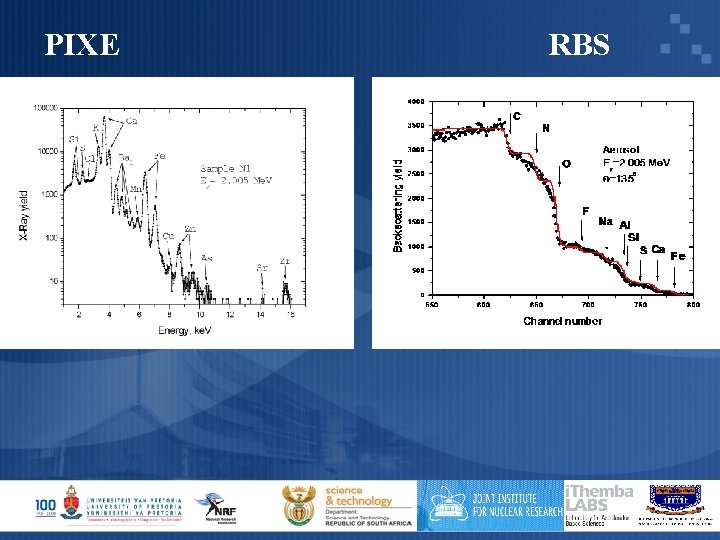
PIXE RBS
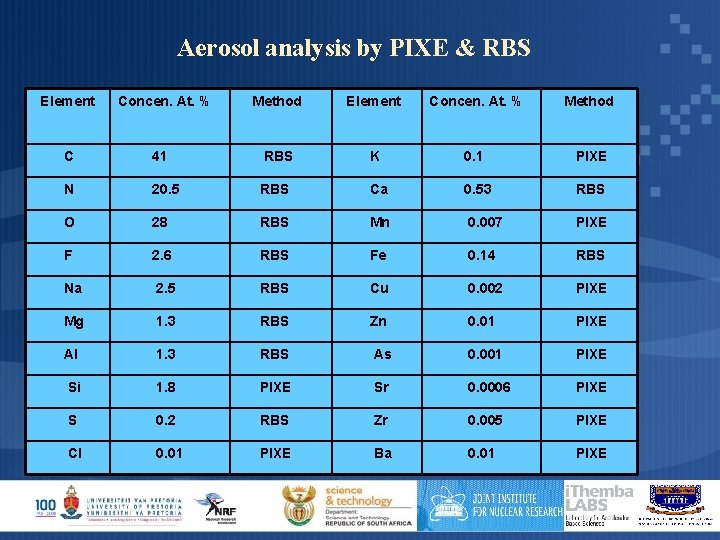
Aerosol analysis by PIXE & RBS Element Concen. At. % Method C 41 RBS K 0. 1 PIXE N 20. 5 RBS Ca 0. 53 RBS O 28 RBS Mn 0. 007 PIXE F 2. 6 RBS Fe 0. 14 RBS Na 2. 5 RBS Cu 0. 002 PIXE Mg 1. 3 RBS Zn 0. 01 PIXE Al 1. 3 RBS As 0. 001 PIXE Si 1. 8 PIXE Sr 0. 0006 PIXE S 0. 2 RBS Zr 0. 005 PIXE Cl 0. 01 PIXE Ba 0. 01 PIXE
CONCLUSION • These methods are non-destructive techniques to study materials • The used methods allow the determination of depth distribution and concentration from hydrogen to heavy elements. • The spectra calculations and model comparisons was executed in SIMNRA software tool, in which good agreement was achieved for RBS and ERD experiments. • Furthermore, the depth resolution is done near to few nm range for these methods. • The sensitivity for heavy elements is of the order 1014 atoms/cm 2
THANK YOU
- Slides: 15