
Ion Activation and Dissociation Vicki Wysocki University of
![Energetic Information – Biochemistry Glycosidic bond cleavage of nucleosides and deoxynucleosides Protonated deoxyadenosine [Ado+H+]](https://slidetodoc.com/presentation_image_h2/fe05ca30397926afed7d51130885272a/image-7.jpg "Energetic Information – Biochemistry Glycosidic bond cleavage of nucleosides and deoxynucleosides Protonated deoxyadenosine [Ado+H+]")
- Slides: 8
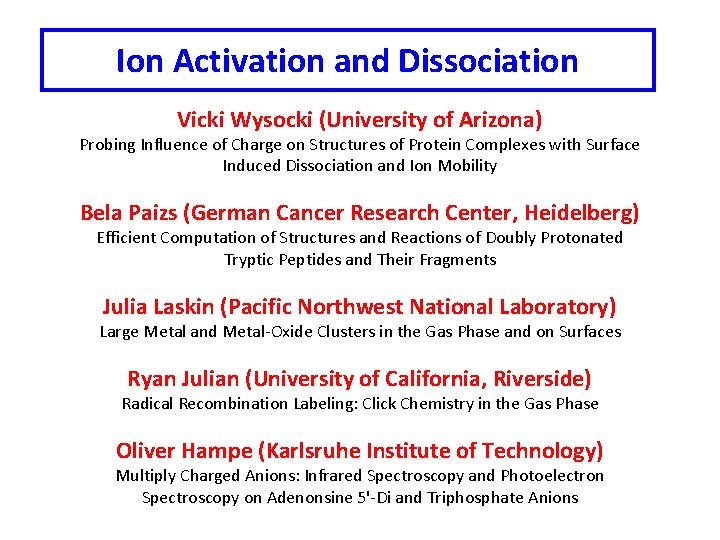
Ion Activation and Dissociation Vicki Wysocki (University of Arizona) Probing Influence of Charge on Structures of Protein Complexes with Surface Induced Dissociation and Ion Mobility Bela Paizs (German Cancer Research Center, Heidelberg) Efficient Computation of Structures and Reactions of Doubly Protonated Tryptic Peptides and Their Fragments Julia Laskin (Pacific Northwest National Laboratory) Large Metal and Metal-Oxide Clusters in the Gas Phase and on Surfaces Ryan Julian (University of California, Riverside) Radical Recombination Labeling: Click Chemistry in the Gas Phase Oliver Hampe (Karlsruhe Institute of Technology) Multiply Charged Anions: Infrared Spectroscopy and Photoelectron Spectroscopy on Adenonsine 5'-Di and Triphosphate Anions
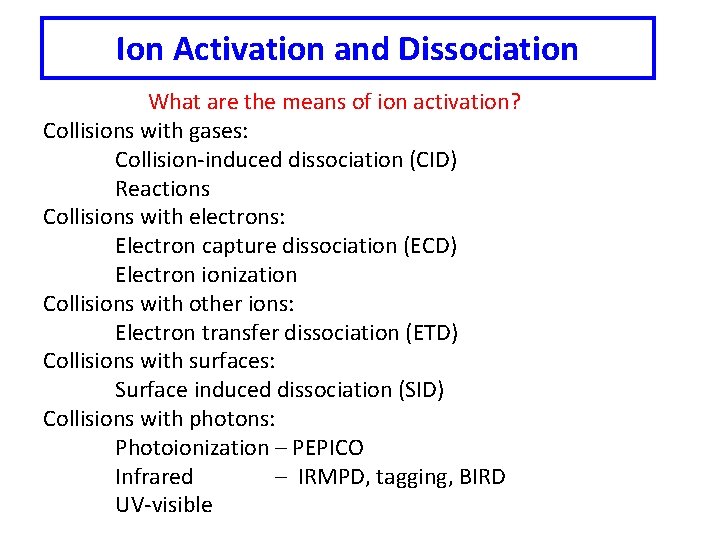
Ion Activation and Dissociation What are the means of ion activation? Collisions with gases: Collision-induced dissociation (CID) Reactions Collisions with electrons: Electron capture dissociation (ECD) Electron ionization Collisions with other ions: Electron transfer dissociation (ETD) Collisions with surfaces: Surface induced dissociation (SID) Collisions with photons: Photoionization – PEPICO Infrared – IRMPD, tagging, BIRD UV-visible
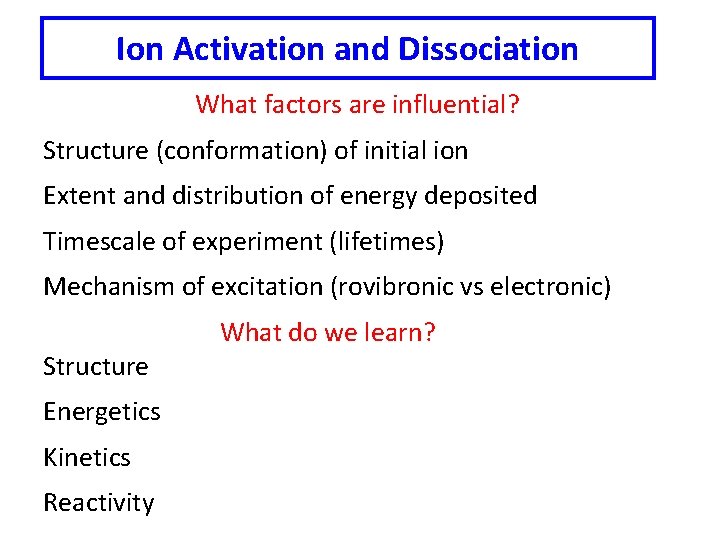
Ion Activation and Dissociation What factors are influential? Structure (conformation) of initial ion Extent and distribution of energy deposited Timescale of experiment (lifetimes) Mechanism of excitation (rovibronic vs electronic) Structure Energetics Kinetics Reactivity What do we learn?
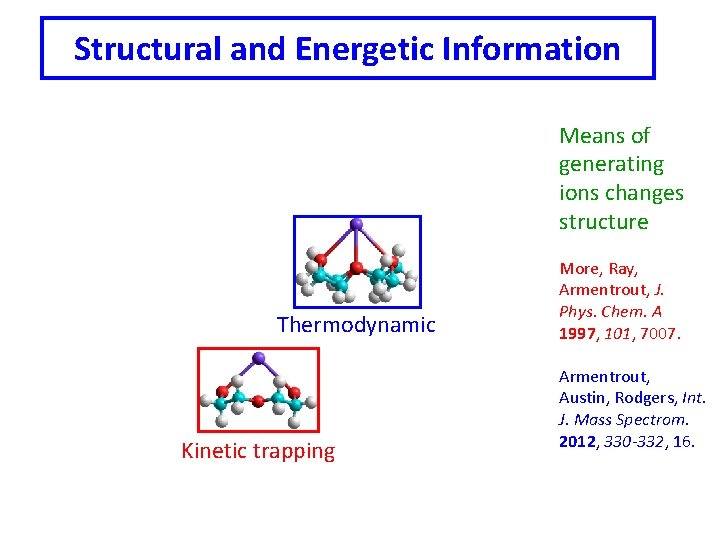
Structural and Energetic Information Means of generating ions changes structure Thermodynamic Kinetic trapping More, Ray, Armentrout, J. Phys. Chem. A 1997, 101, 7007. Armentrout, Austin, Rodgers, Int. J. Mass Spectrom. 2012, 330 -332, 16.
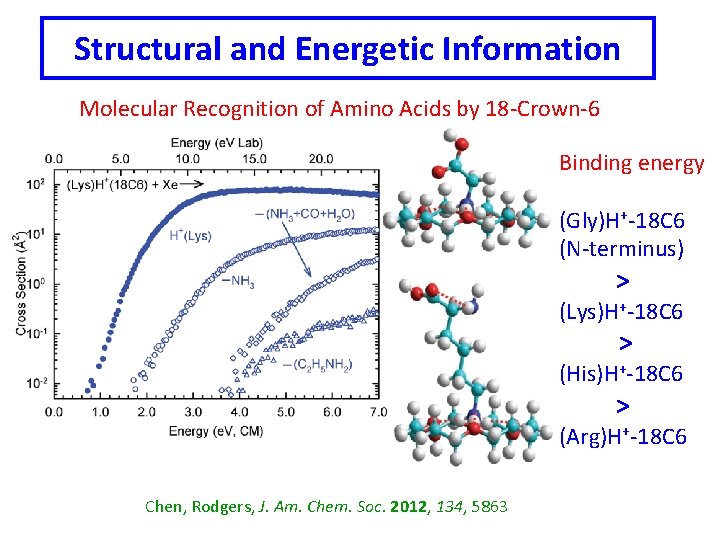
Structural and Energetic Information Molecular Recognition of Amino Acids by 18 -Crown-6 Binding energy (Gly)H+-18 C 6 (N-terminus) > (Lys)H+-18 C 6 > (His)H+-18 C 6 > (Arg)H+-18 C 6 Chen, Rodgers, J. Am. Chem. Soc. 2012, 134, 5863
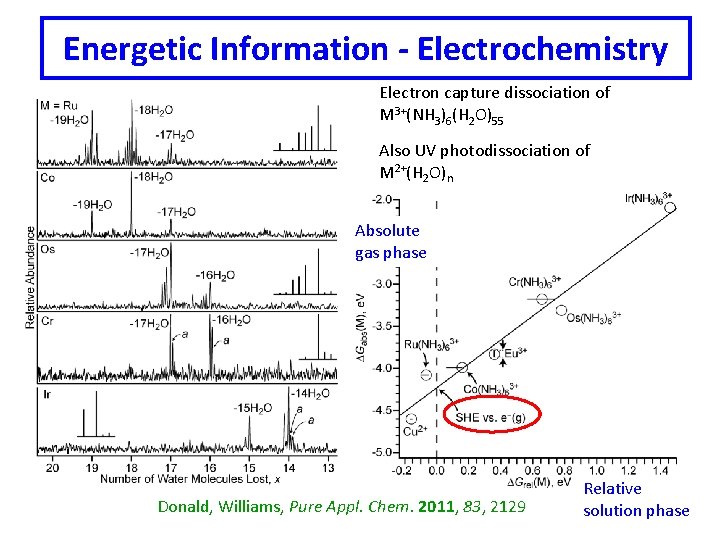
Energetic Information - Electrochemistry Electron capture dissociation of M 3+(NH 3)6(H 2 O)55 Also UV photodissociation of M 2+(H 2 O)n Absolute gas phase Donald, Williams, Pure Appl. Chem. 2011, 83, 2129 Relative solution phase
Energetic Information – Biochemistry Glycosidic bond cleavage of nucleosides and deoxynucleosides Protonated deoxyadenosine [Ado+H+] N 3, syn, C 2'-endo Energy required for glycosidic bond cleavage: DNA < RNA Wu and Rodgers, work in progress MAD ± SD DNA 4. 1 ± 4. 3 RNA 6. 5 ± 8. 6
Ion Activation and Dissociation Vicki Wysocki (University of Arizona) Probing Influence of Charge on Structures of Protein Complexes with Surface Induced Dissociation and Ion Mobility Bela Paizs (German Cancer Research Center, Heidelberg) Efficient Computation of Structures and Reactions of Doubly Protonated Tryptic Peptides and Their Fragments Julia Laskin (Pacific Northwest National Laboratory) Large Metal and Metal-Oxide Clusters in the Gas Phase and on Surfaces Ryan Julian (University of California, Riverside) Radical Recombination Labeling: Click Chemistry in the Gas Phase Oliver Hampe (Karlsruhe Institute of Technology) Multiply Charged Anions: Infrared Spectroscopy and Photoelectron Spectroscopy on Adenonsine 5'-Di and Triphosphate Anions