
Io T The Sleeping Giant Medical Devices Kristopher


- Slides: 30
Io. T: The Sleeping Giant – Medical Devices Kristopher Kusche, M. Eng. , CISSP, CPHIMS, FHIMSS, HCISPP Vice President and CISO, Albany Medical Center
Disclaimer The presenter has no real or apparent conflicts and affirms that no remuneration or other compensation is being received for this presentation. In no way does the mention of specific vendors or products imply any endorsement of that vendor or product. 2
Why are we here? With the rapid growth of medical devices in the interconnected healthcare landscape, CISOs face the challenge of providing security for devices which look and act differently from traditional IT devices. The need to extend an IT security management program to medical devices is paramount to secure the HIT computing environment. 3
Why am I here? Healthcare Information Technology executive with 25+ years of academic medical center experience Master’s degreed biomedical engineer with 25+ years of biomedical engineering management experience 15+ year academic medical center Chief Information Security Officer experience CISSP, CPHIMS and HCISPP certified cybersecurity professional 4
Objectives This presentation will help the IT Executive understand: – the basics of Io. T – what a medical device is – the differences between a medical device and traditional IT device that requires special consideration of tactics, toolsets and people – a framework for what a practical medical device security program might look like –characteristics of toolsets that can help manage medical device security via a scenario demonstration 5
Io. T Primer Io. T stands for “The Internet of Things” Io. T is a loose definition for a class of technology that helps connect the physical world to the digital world Io. T devices have the following basic characteristics: - a physical device that is uniquely identifiable (i. e. , has a digital identity) - has a sensor(s) to collect data about its environment - is able to send that data to other devices or computers utilizing a digital network 6
Io. T Primer Io. T devices may or may not communicate using standard communication protocols Io. T devices do not have to use the Internet – they can be connected via Bluetooth, wireless, CAN, etc. Examples of Io. T devices are: - Automobiles, Boats, Trains, Planes - Clocks - Light Bulbs - Medical Devices - Wearable exercise technologies 7
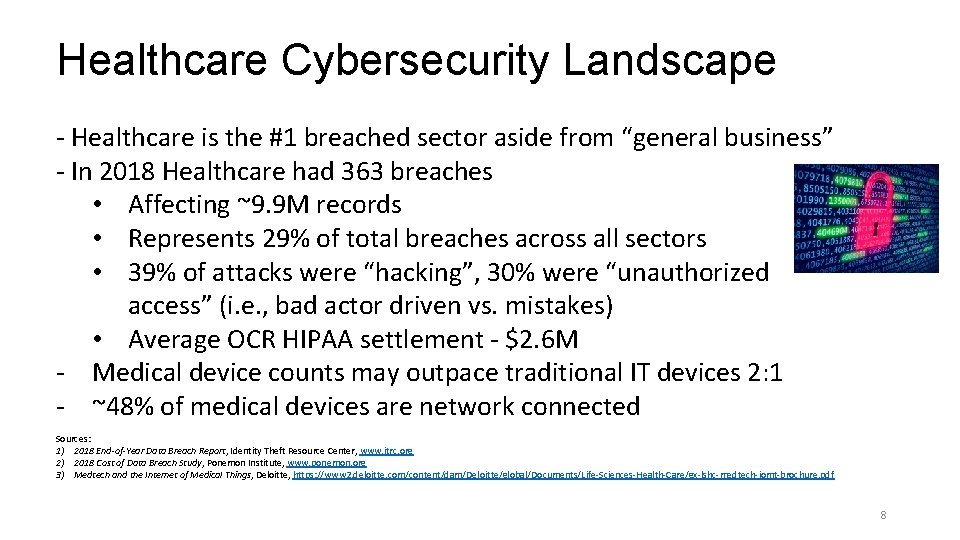
Healthcare Cybersecurity Landscape - Healthcare is the #1 breached sector aside from “general business” - In 2018 Healthcare had 363 breaches • Affecting ~9. 9 M records • Represents 29% of total breaches across all sectors • 39% of attacks were “hacking”, 30% were “unauthorized access” (i. e. , bad actor driven vs. mistakes) • Average OCR HIPAA settlement - $2. 6 M - Medical device counts may outpace traditional IT devices 2: 1 - ~48% of medical devices are network connected Sources: 1) 2018 End-of-Year Data Breach Report, Identity Theft Resource Center, www. itrc. org 2) 2018 Cost of Data Breach Study, Ponemon Institute, www. ponemon. org 3) Medtech and the Internet of Medical Things, Deloitte, https: //www 2. deloitte. com/content/dam/Deloitte/global/Documents/Life-Sciences-Health-Care/gx-lshc-medtech-iomt-brochure. pdf 8
Medical Device Cybersecurity Landscape The FDA says that with regards to mitigating cybersecurity risks - “Medical device manufacturers (MDMs) are responsible for remaining vigilant about identifying risks and hazards associated with their medical devices, including risks related to cybersecurity. - Health care delivery organizations (HDOs) should evaluate their network security and protect their hospital systems. - Both MDMs and HDOs are responsible for putting appropriate mitigations in place to address patient safety risks and ensure proper device performance. ” Source: 1) Cybersecurity, Food and Drug Administration, https: //www. fda. gov/medical-devices/digital-health/cybersecurity 9
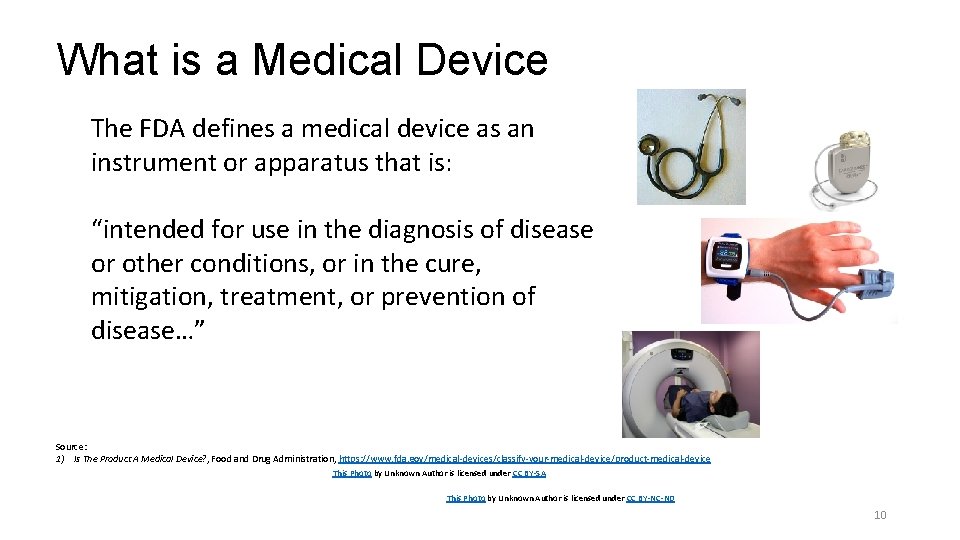
What is a Medical Device The FDA defines a medical device as an instrument or apparatus that is: “intended for use in the diagnosis of disease or other conditions, or in the cure, mitigation, treatment, or prevention of disease…” Source: 1) Is The Product A Medical Device? , Food and Drug Administration, https: //www. fda. gov/medical-devices/classify-your-medical-device/product-medical-device This Photo by Unknown Author is licensed under CC BY-SA This Photo by Unknown Author is licensed under CC BY-NC-ND 10
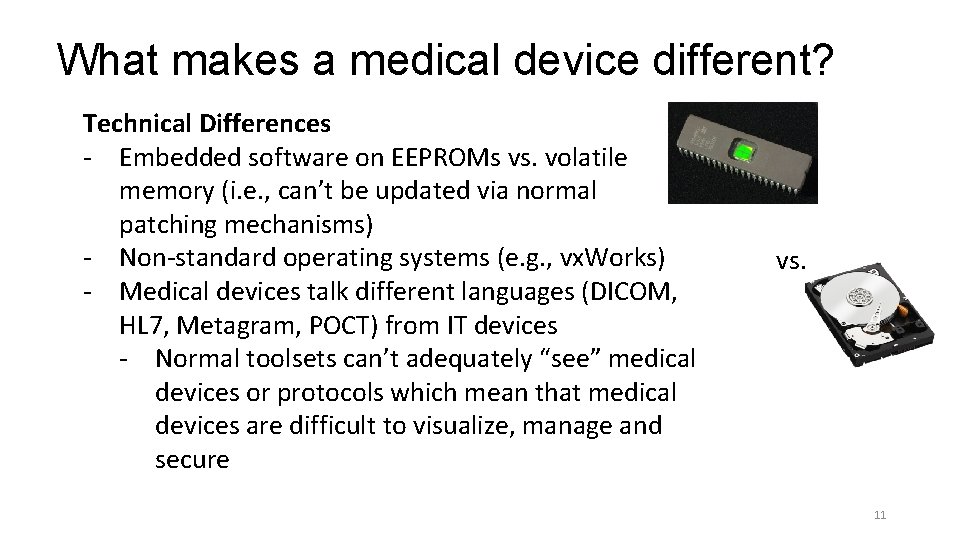
What makes a medical device different? Technical Differences - Embedded software on EEPROMs vs. volatile memory (i. e. , can’t be updated via normal patching mechanisms) - Non-standard operating systems (e. g. , vx. Works) - Medical devices talk different languages (DICOM, HL 7, Metagram, POCT) from IT devices - Normal toolsets can’t adequately “see” medical devices or protocols which mean that medical devices are difficult to visualize, manage and secure vs. 11
What makes a medical device different? People and Process Differences - CE and IT are not typically leadership-aligned - CE and IT personnel have different skillsets - Inventory intentions and uses are inherently different - CE inventories are “cradle to grave” focused on device risk and safety (i. e. , regulatory safety inspection completion, recalls, failure incident and modal analysis) - IT inventories are asset tracking mechanisms used to better manage devices through characteristic detail (i. e. , CPU, OS, software revision, patch levels) 12
What makes a medical device different? Industry and Market Differences - Medical devices are regulated by many agencies (e. g. , FDA, CDRH, AABB, Do. H, ACR, and others) - Technology Refresh Cycle - Medical device replacement average 7 -10 years - IT device replacement average 3 -5 years - Cost/Total Cost of Ownership - Desktop=$350, laptop=$1, 500 - IV pump=$6, 000, Defibrillator=$15, 000, Bedside Patient Monitor=$40, 000, Anesthesia Machine=$75, 000, Ultrasound=$250, 000, MRI=$3 M 13
Problem Restated IT Executives need to find a way to provide a cybersecurity program for networked devices that: 1) don’t behave like normal IT devices 2) can’t be monitored like normal IT devices 3) can’t be protected like normal IT devices 4) are supported by professionals with mismatched skillsets 5) have regulatory restrictions 6) have an extremely high TCO causing lags in technology currency 14
What We Need…People & Process Technology leadership to reinvent medical device management - Operational transformation of CE/IT relationship - Application of IT security fundamentals to medical device management while maintaining CE rigor and safety focus - Security-focused product selection and contracting - Risk-assessed inventory inclusive of security related data (OS, firmware rev. , model options) - Cross-training of CE/IT staff for security harmonization 15
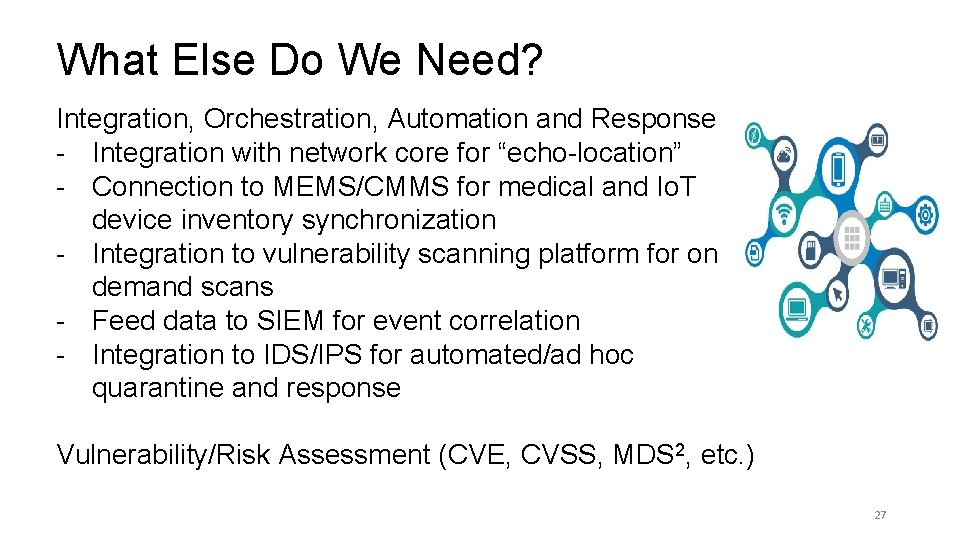
What We Need…Technology New technology toolsets that “speak” medical device to prevent and detect breaches in the absence of the ability to apply typical IT preventive measures (i. e. , anti-malware, encryption) - Logical segmentation - Real-time network visibility - Device parameter discovery - Vulnerability identification - Behavior profiling and anomaly detection - SIEM, Prevention and Alerting 16
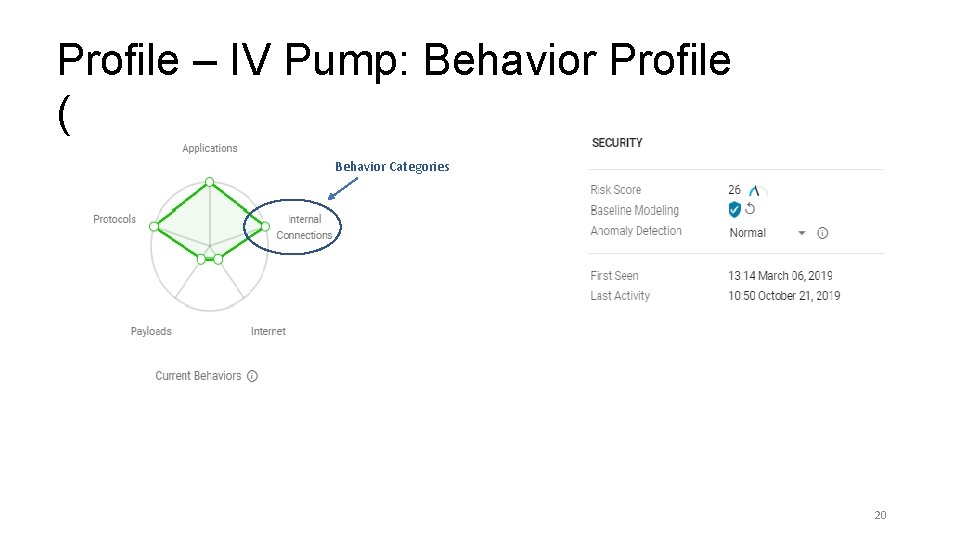
Profiling Defined as “the act or process of extrapolating information … based on known traits or tendencies” To profile a networked medical device we look at its normal behaviors: - network connection pairs - communication protocols used - resident applications - traffic volumes and network payloads Profiling can be used to identify anomalous behavior or increases in risk level which could indicate a compromise Sources: 1) Definition of Profiling, Meriam-Webster Dictionary, https: //www. merriam-webster. com/dictionary/profiling 17
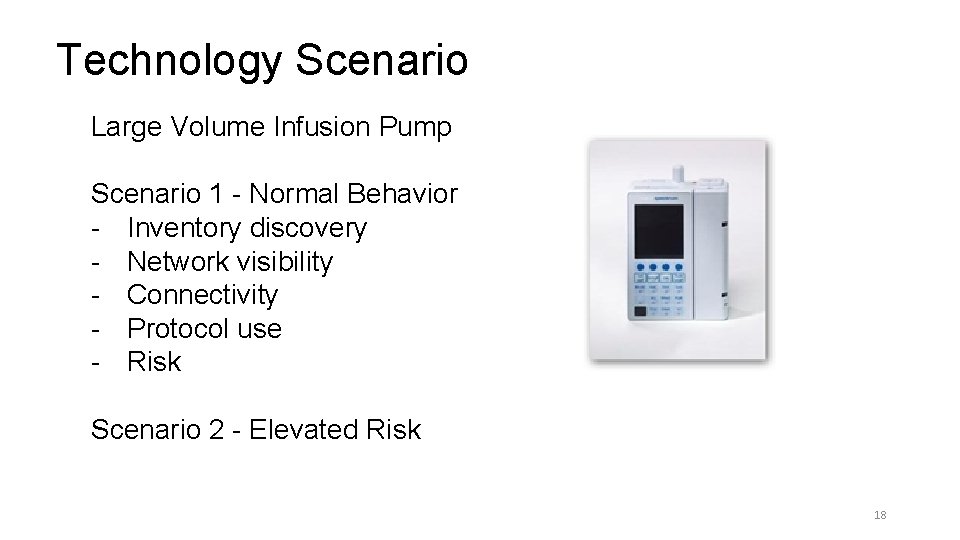
Technology Scenario Large Volume Infusion Pump Scenario 1 - Normal Behavior - Inventory discovery - Network visibility - Connectivity - Protocol use - Risk Scenario 2 - Elevated Risk 18
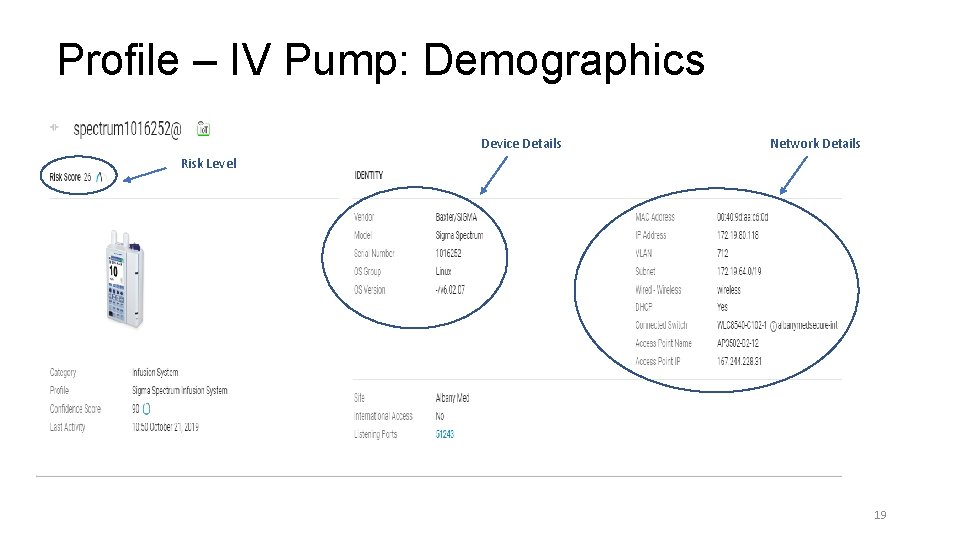
Profile – IV Pump: Demographics Device Details Network Details Risk Level 19
Profile – IV Pump: Behavior Profile (Normal) Behavior Categories 20
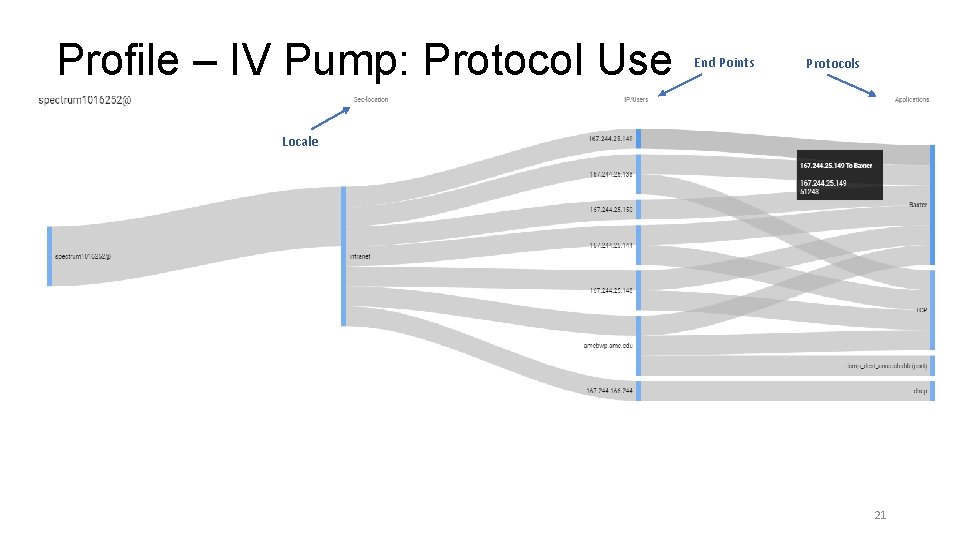
Profile – IV Pump: Protocol Use End Points Protocols Locale 21
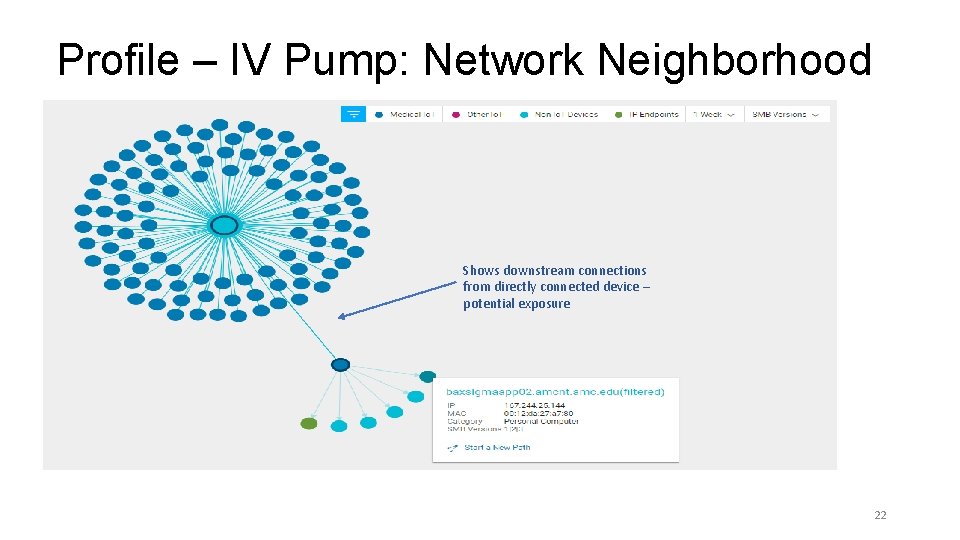
Profile – IV Pump: Network Neighborhood Shows downstream connections from directly connected device – potential exposure 22
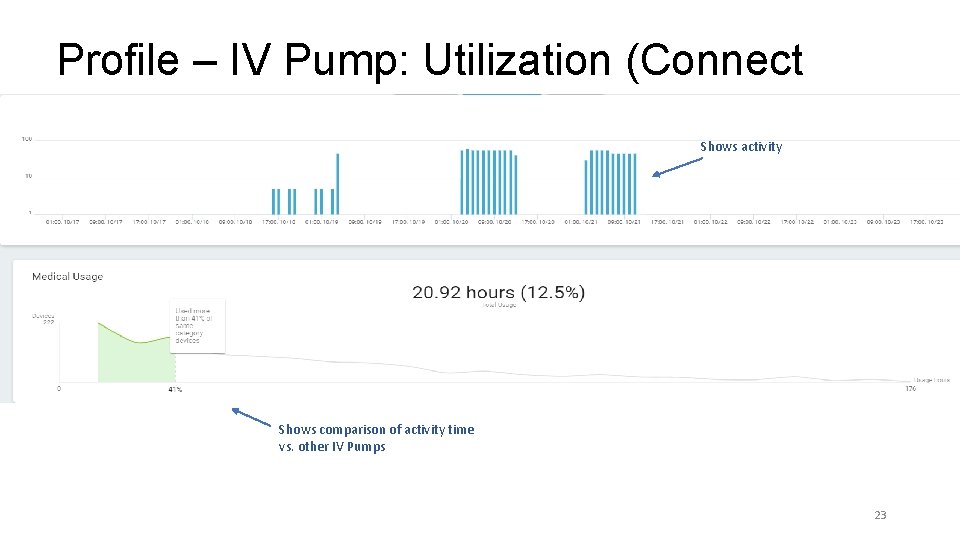
Profile – IV Pump: Utilization (Connect Time) Shows activity Shows comparison of activity time vs. other IV Pumps 23
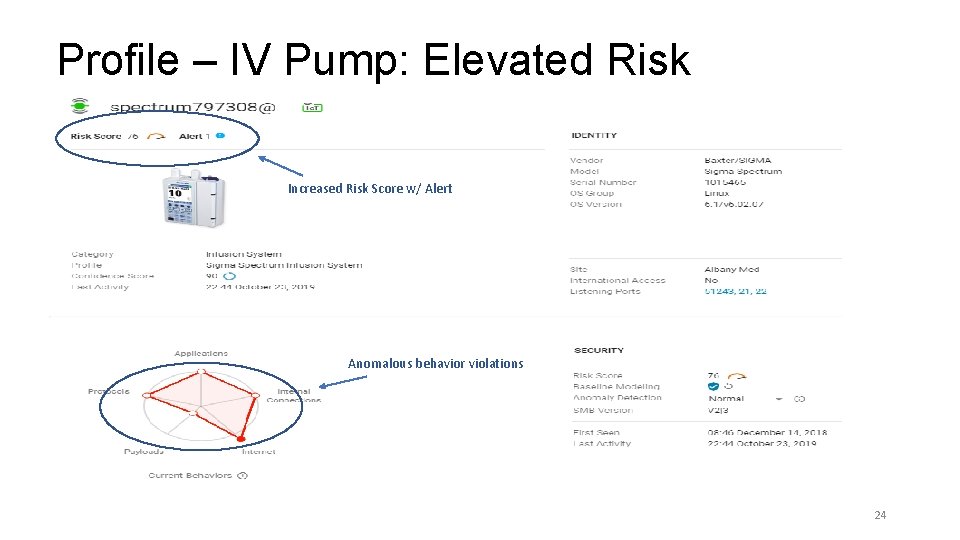
Profile – IV Pump: Elevated Risk (simulated) Increased Risk Score w/ Alert Anomalous behavior violations 24
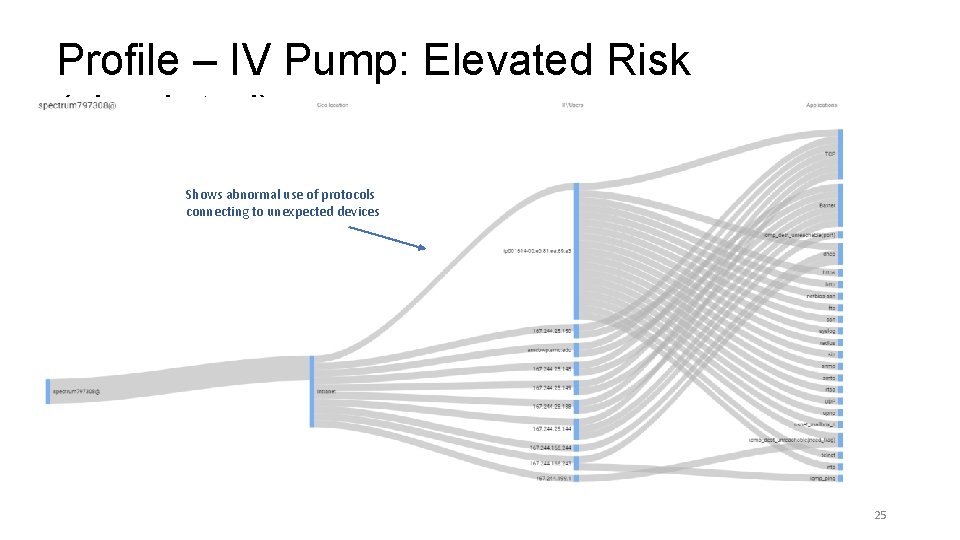
Profile – IV Pump: Elevated Risk (simulated) Shows abnormal use of protocols connecting to unexpected devices 25
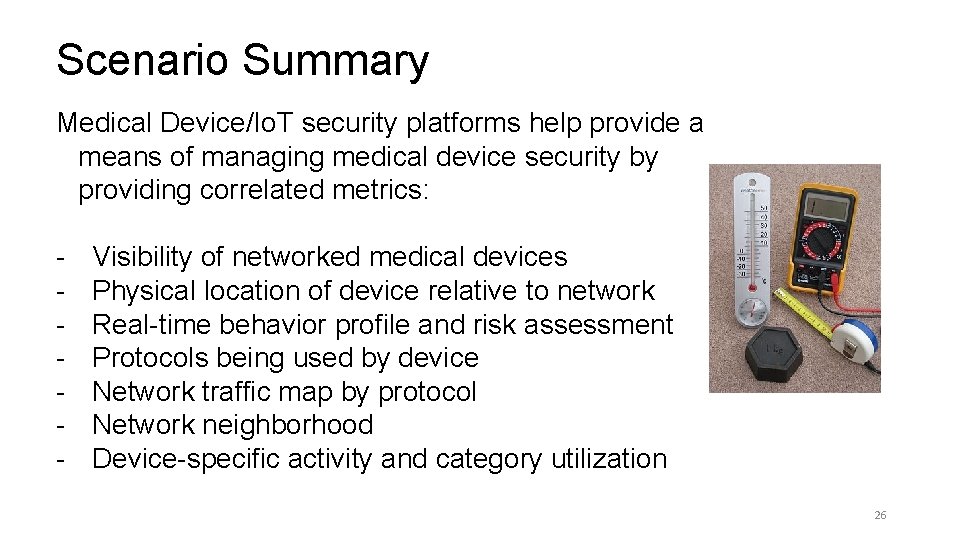
Scenario Summary Medical Device/Io. T security platforms help provide a means of managing medical device security by providing correlated metrics: - Visibility of networked medical devices Physical location of device relative to network Real-time behavior profile and risk assessment Protocols being used by device Network traffic map by protocol Network neighborhood Device-specific activity and category utilization 26
What Else Do We Need? Integration, Orchestration, Automation and Response - Integration with network core for “echo-location” - Connection to MEMS/CMMS for medical and Io. T device inventory synchronization - Integration to vulnerability scanning platform for on demand scans - Feed data to SIEM for event correlation - Integration to IDS/IPS for automated/ad hoc quarantine and response Vulnerability/Risk Assessment (CVE, CVSS, MDS 2, etc. ) 27
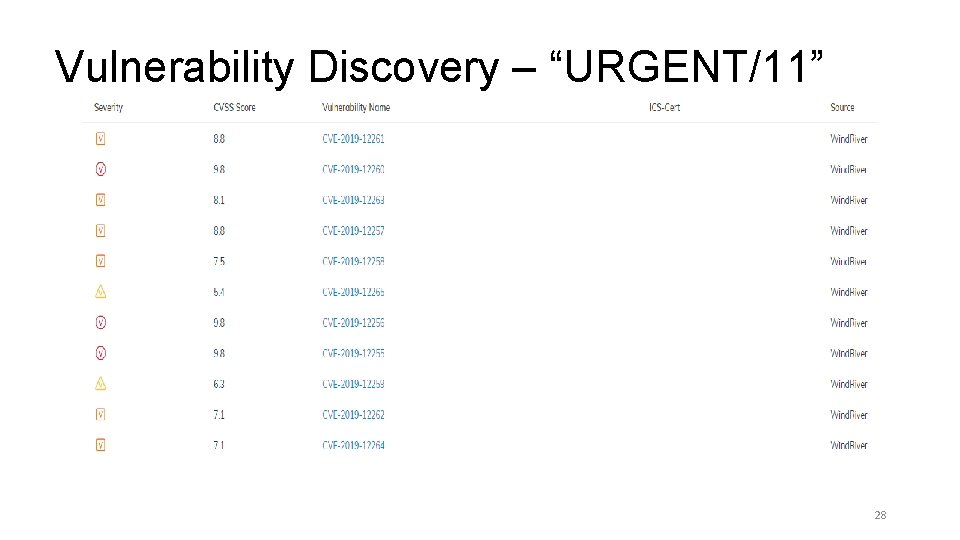
Vulnerability Discovery – “URGENT/11” 28
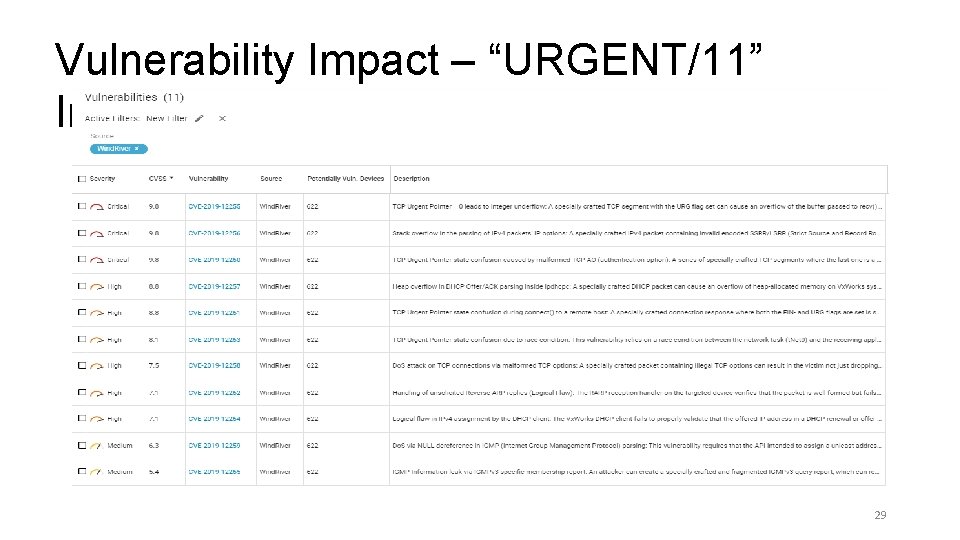
Vulnerability Impact – “URGENT/11” Impact 29
Questions? Contact Information: Kristopher Kusche, M. Eng. , CISSP, CPHIMS, FHIMSS, HCISPP Vice President & CISO Albany Medical Center kuschek@amc. edu (518) 262 -4690 30