
Involving Persons with Lived Experience in Homelessness Research

- Slides: 23
Involving Persons with Lived Experience in Homelessness Research A COMMUNITY-BASED RESEARCH PROJECT TO PROMOTE THE RIGHTS OF HOMELESS INDIVIDUALS Presented by: Cam Stewart, Kaylee Ramage, Darren Mycroft, Michael Firingstoney A PARTNERSHIP BETWEEN: FUNDING PROVIDED BY:
Context • Partnership between the Alberta Human Rights Commission and the Calgary Homeless Foundation • Funded by the Human Rights Education and Multiculturalism Fund • Aim to recognize and promote the rights of the homeless community and their ability to access and exercise those rights, and to reduce discrimination based on housing status • First project of its kind in Canada
Context • Recognition of the challenges that people experiencing homelessness face when trying to exercise their rights, especially around the logistical barriers of not having a fixed address: • No identification • No reliable means of communication • Not having anywhere to go and therefore always “loitering” • Introduction of public behavioral bylaws that criminalize many of the survival activities related to homelessness
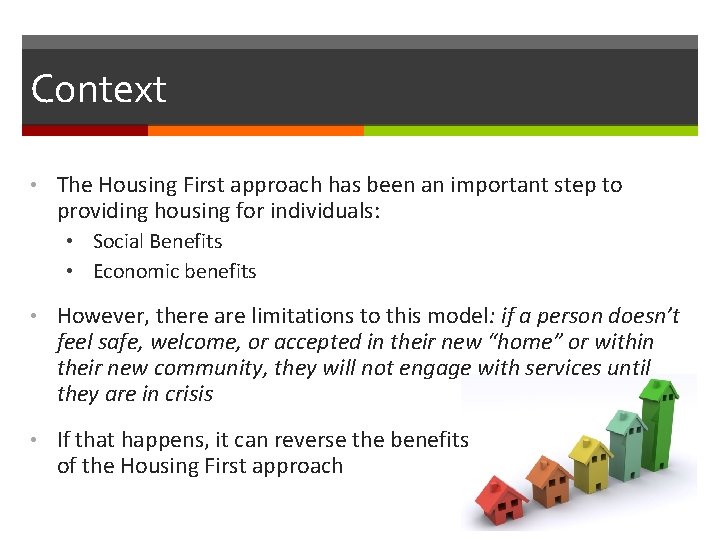
Context • The Housing First approach has been an important step to providing housing for individuals: • Social Benefits • Economic benefits • However, there are limitations to this model: if a person doesn’t feel safe, welcome, or accepted in their new “home” or within their new community, they will not engage with services until they are in crisis • If that happens, it can reverse the benefits of the Housing First approach
Equity for Homeless Populations • What are the inequities experienced by the homeless population?
Project Methods • Review of existing literature, policies, municipal bylaws, legislation • Primary data collection and analysis • Focus groups with people with lived experience of homelessness • Key informant interviews • Community collaboration – with members of the legal/justice system, the health sector, the housing sector, the mental health/addictions sector, and with people with lived experience of homelessness
Project Outputs • Final Report, with a compilation of some of the areas of need and the areas of progress • Recommendations for the future • Production of educational and awareness materials • Homeless Charter of Rights
Project Outcomes Agencies working with homeless populations will ensure the human rights of their clientele are fully protected, through: Community capacity building Civic Participation Public education and awareness Institutional and organizational change
Importance of Participatory Action Approach • Relationship building • Finding common issues • Realizing every perspective • Engagement of multiple stakeholders • Empowering those with lived experience to let their voices be heard
Involvement of the CHF Client Action Committee (CAC) • The CAC is a group of individuals with lived experience of homelessness who meet biweekly to discuss issues important to the homeless community and to give feedback and guidance for research projects • Helped with recruitment, data collection, project direction, and will continue to help with implementation
“It’s a bridge between us and them, bridging a major gap. Publicly, there seems to be more publicity of homelessness and not in a negative way. It feels good to do this, it’s part of my life to know [my rights] now. ” (Member of the Client Action Committee) “I’m grateful for the experience, what it has done for me, my knowledge, self-esteem, and resumé. It feels good to be part of the change. It is in increments, but eventually the snowflakes will break the branch. ” (Member of the Client Action Committee) “It’s an honour to be a part of this project. I can see with my own eyes that we are making a difference. I like being part of the change, a positive change. ” (Member of the Client Action Committee)
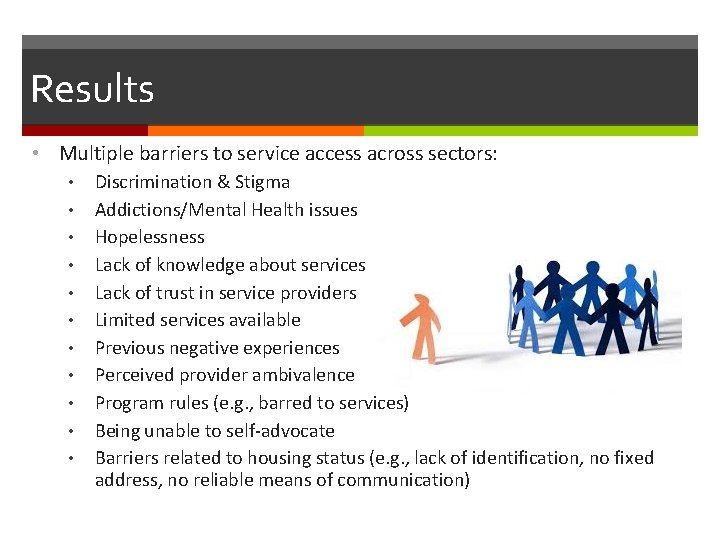
Results • Multiple barriers to service access across sectors: • Discrimination & Stigma • Addictions/Mental Health issues • Hopelessness • Lack of knowledge about services • Lack of trust in service providers • Limited services available • Previous negative experiences • Perceived provider ambivalence • Program rules (e. g. , barred to services) • Being unable to self-advocate • Barriers related to housing status (e. g. , lack of identification, no fixed address, no reliable means of communication)
“A lot of clients have difficulty advocating for their rights because they don’t have the power or the resources… they feel less empowered to speak up for themselves. So even if they feel that they’re being discriminated against… they feel even less able to speak for themselves [because] they are also homeless. ” (Justice System Provider)
“I know how to survive on the streets, picking bottles, pushing a cart. But there’s so many laws in place now that you can’t survive on the streets without breaking the law. ” (Client)
Results • Positive principles that are already working to combat these barriers in Calgary: • Use of discretion/flexibility in rules • Communication and collaboration between service providers/agencies • Informing homeless individuals of their rights and helping them advocate • Building relationships and trust through outreach • Bringing services to the individuals in a way that works for them (rather than waiting for them to try to access services)
Promising Practices in Calgary: Health • AHS’s ID Clinic and ID Repository • Street Outreach & Stabilization (SOS) Team • Safeworks Harm Reduction Strategy
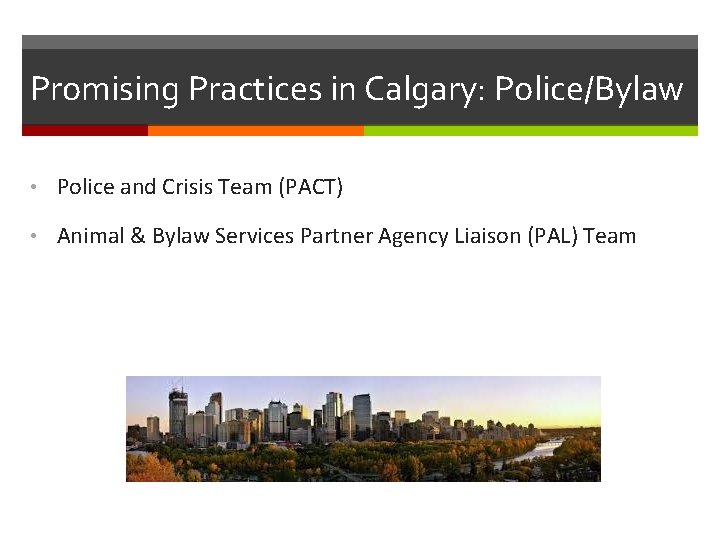
Promising Practices in Calgary: Police/Bylaw • Police and Crisis Team (PACT) • Animal & Bylaw Services Partner Agency Liaison (PAL) Team
Promising Practices in Calgary: Housing • CHF’s Coordinated Access and Assessment • CHF’s Case Management Standards • Downtown Outreach Addictions Partnership (DOAP) Team • The Calgary Drop-In & Rehab Centre’s Victim Peer Support Group
Promising Practices in Calgary: Community • Safe Communities Opportunity & Resource Centre • Pure North S’Energy Foundation’s Optimizing Health Program
Audience Participation • At your table, take 5 -10 minutes to discuss the following questions: • What are some initiatives that you are using in your organization that help to increase service access and overcome barriers for homeless individuals? • How can positive changes be made to promote the rights of homeless individuals in your organization/sector?
Impact • Project involved stakeholders from the health, housing/homelessness, mental health, police and bylaw, and justice sectors • Relationships between different sectors have been built and strengthened, resulting in a strong collaboration to reach our common goal • Change is happening!
Call to Action • Official Launch of the Homeless Charter of Rights will be in June 2015 • Training, education, and informational materials will be available • What can you do to help shine a light on inequities?
Questions?