
Invisible Ink with Lemon Juice Introduction Making invisible
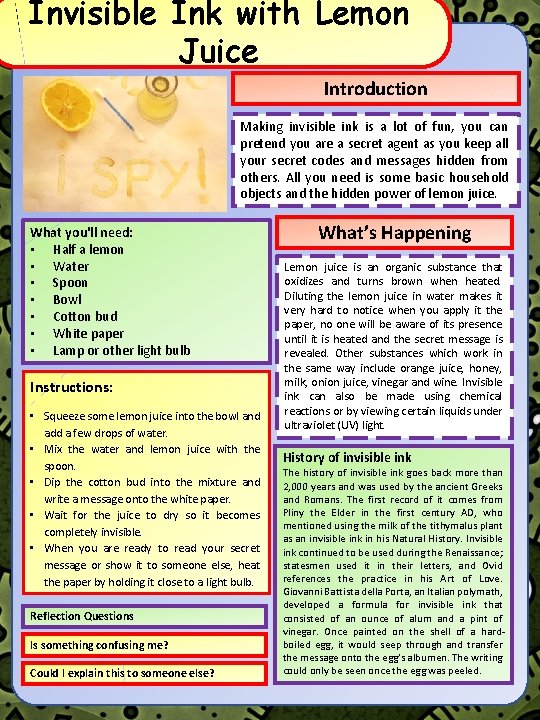
Invisible Ink with Lemon Juice Introduction Making invisible ink is a lot of fun, you can pretend you are a secret agent as you keep all your secret codes and messages hidden from others. All you need is some basic household objects and the hidden power of lemon juice. What you'll need: • Half a lemon • Water • Spoon • Bowl • Cotton bud • White paper • Lamp or other light bulb Instructions: • Squeeze some lemon juice into the bowl and add a few drops of water. • Mix the water and lemon juice with the spoon. • Dip the cotton bud into the mixture and write a message onto the white paper. • Wait for the juice to dry so it becomes completely invisible. • When you are ready to read your secret message or show it to someone else, heat the paper by holding it close to a light bulb. Reflection Questions Is something confusing me? Could I explain this to someone else? What’s Happening Lemon juice is an organic substance that oxidizes and turns brown when heated. Diluting the lemon juice in water makes it very hard to notice when you apply it the paper, no one will be aware of its presence until it is heated and the secret message is revealed. Other substances which work in the same way include orange juice, honey, milk, onion juice, vinegar and wine. Invisible ink can also be made using chemical reactions or by viewing certain liquids under ultraviolet (UV) light. History of invisible ink The history of invisible ink goes back more than 2, 000 years and was used by the ancient Greeks and Romans. The first record of it comes from Pliny the Elder in the first century AD, who mentioned using the milk of the tithymalus plant as an invisible ink in his Natural History. Invisible ink continued to be used during the Renaissance; statesmen used it in their letters, and Ovid references the practice in his Art of Love. Giovanni Battista della Porta, an Italian polymath, developed a formula for invisible ink that consisted of an ounce of alum and a pint of vinegar. Once painted on the shell of a hardboiled egg, it would seep through and transfer the message onto the egg’s albumen. The writing could only be seen once the egg was peeled.
- Slides: 1