
Invisi Spec Making Speculative Execution Invisible in the
Invisi. Spec: Making Speculative Execution Invisible in the Cache Hierarchy Mengjia Yan† , Jiho Choi† , Dimitrios Skarlatos, Adam Morrison∗, Christopher W. Fletcher, and Josep Torrellas University of Illinois at Urbana-Champaign ∗Tel Aviv University †Authors contributed equally to this work.
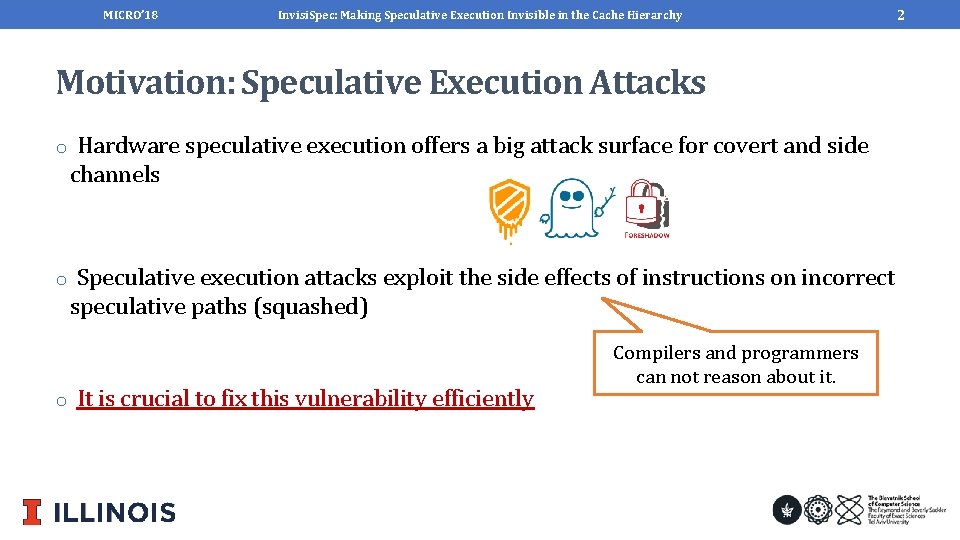
MICRO’ 18 Invisi. Spec: Making Speculative Execution Invisible in the Cache Hierarchy Motivation: Speculative Execution Attacks o Hardware speculative execution offers a big attack surface for covert and side channels o Speculative execution attacks exploit the side effects of instructions on incorrect speculative paths (squashed) o It is crucial to fix this vulnerability efficiently Compilers and programmers can not reason about it. 2
MICRO’ 18 Invisi. Spec: Making Speculative Execution Invisible in the Cache Hierarchy Outline o Background o A comprehensive threat model o Invisible Speculation (Invisi. Spec): the first holistic defense mechanism o Evaluation results and current work 3
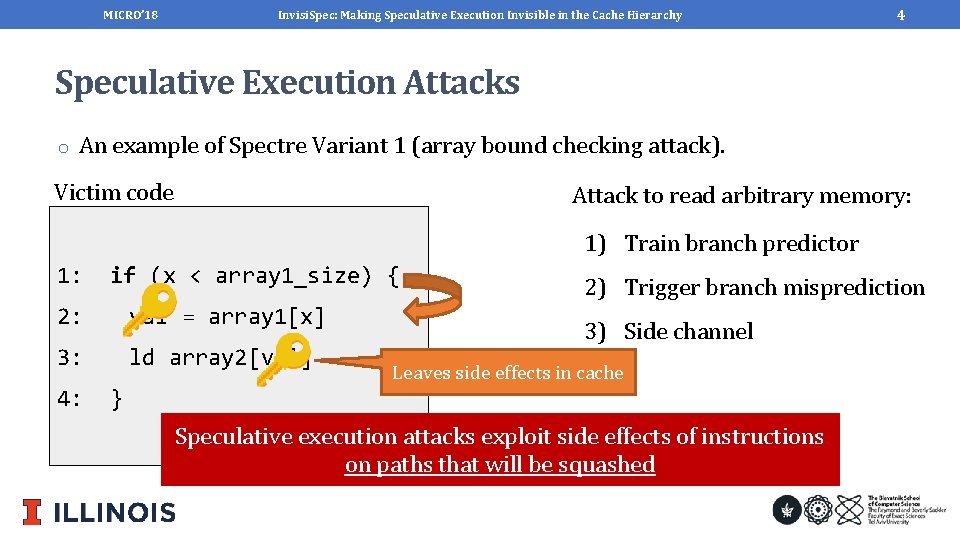
MICRO’ 18 Invisi. Spec: Making Speculative Execution Invisible in the Cache Hierarchy 4 Speculative Execution Attacks o An example of Spectre Variant 1 (array bound checking attack). Victim code Attack to read arbitrary memory: 1) Train branch predictor 1: if (x < array 1_size) { 2: val = array 1[x] 3: ld array 2[val] 4: } 2) Trigger branch misprediction 3) Side channel Leaves side effects in cache Speculative execution attacks exploit side effects of instructions on paths that will be squashed
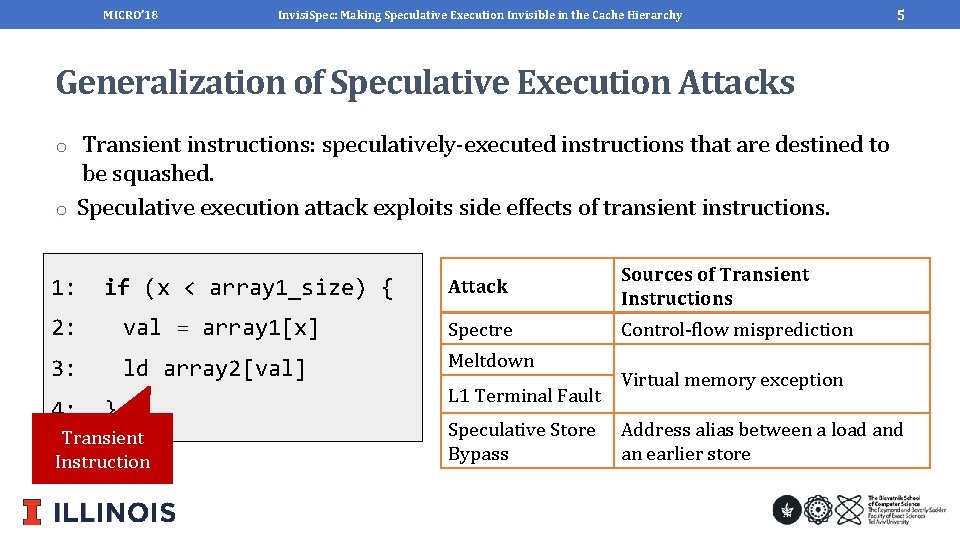
MICRO’ 18 Invisi. Spec: Making Speculative Execution Invisible in the Cache Hierarchy 5 Generalization of Speculative Execution Attacks o Transient instructions: speculatively-executed instructions that are destined to be squashed. o Speculative execution attack exploits side effects of transient instructions. 1: if (x < array 1_size) { Attack Sources of Transient Instructions Control-flow misprediction 2: val = array 1[x] Spectre 3: ld array 2[val] Meltdown 4: } Transient Instruction L 1 Terminal Fault Speculative Store Bypass Virtual memory exception Address alias between a load an earlier store
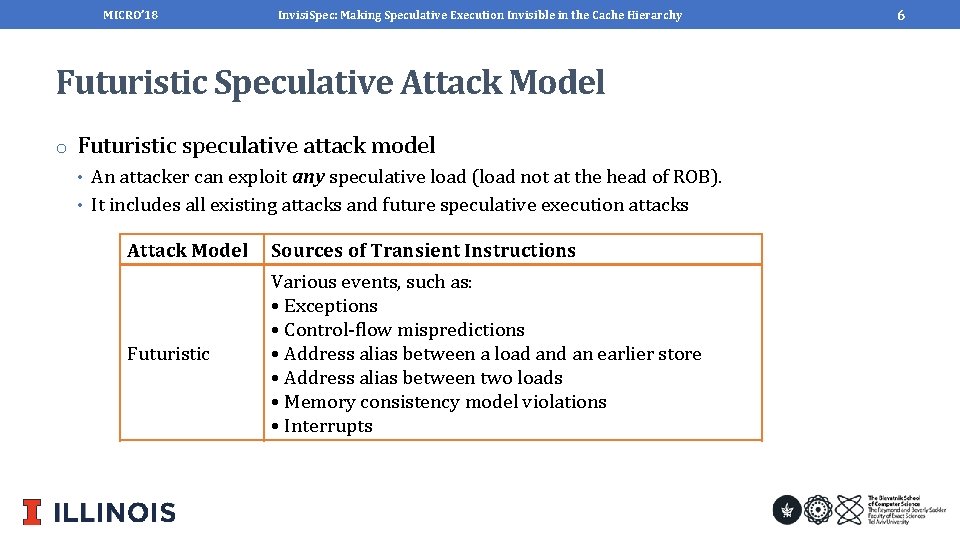
MICRO’ 18 Invisi. Spec: Making Speculative Execution Invisible in the Cache Hierarchy Futuristic Speculative Attack Model o Futuristic speculative attack model • An attacker can exploit any speculative load (load not at the head of ROB). • It includes all existing attacks and future speculative execution attacks Attack Model Sources of Transient Instructions Futuristic Various events, such as: • Exceptions • Control-flow mispredictions • Address alias between a load an earlier store • Address alias between two loads • Memory consistency model violations • Interrupts Spectre Control-flow misprediction 6
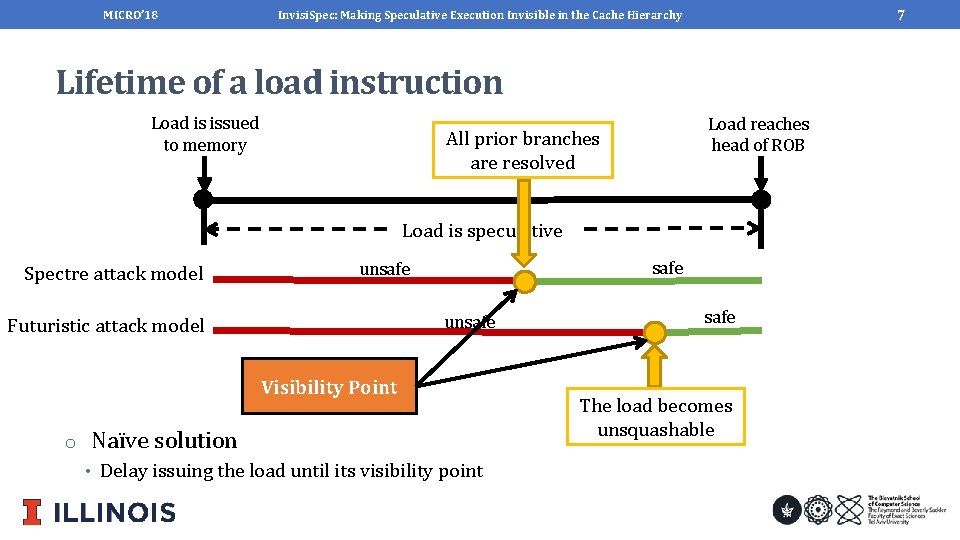
MICRO’ 18 7 Invisi. Spec: Making Speculative Execution Invisible in the Cache Hierarchy Lifetime of a load instruction Load is issued to memory Load reaches head of ROB All prior branches are resolved Load is speculative Spectre attack model safe unsafe Futuristic attack model Visibility Point o Naïve solution • Delay issuing the load until its visibility point safe The load becomes unsquashable
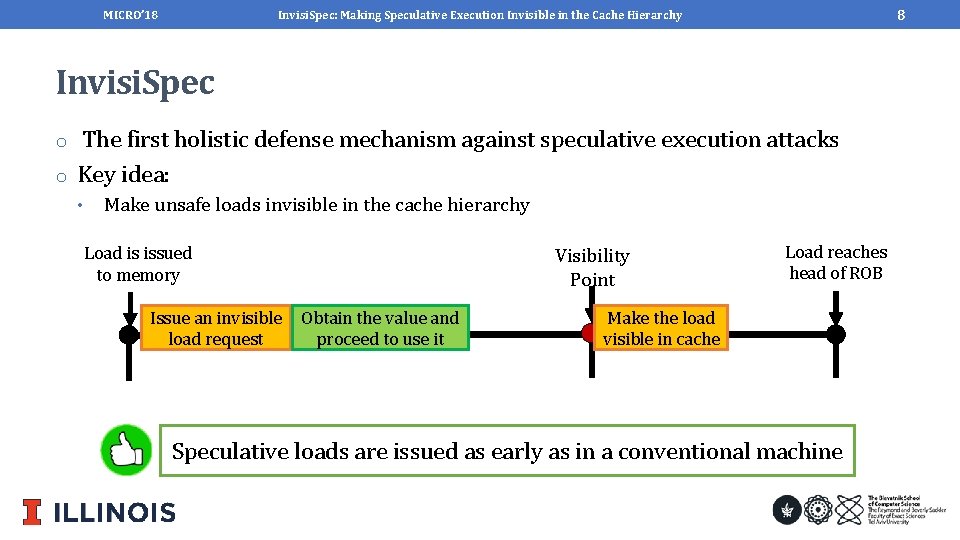
MICRO’ 18 8 Invisi. Spec: Making Speculative Execution Invisible in the Cache Hierarchy Invisi. Spec o The first holistic defense mechanism against speculative execution attacks o Key idea: • Make unsafe loads invisible in the cache hierarchy Load is issued to memory Issue an invisible load request Visibility Point Obtain the value and proceed to use it Load reaches head of ROB Make the load visible in cache Speculative loads are issued as early as in a conventional machine
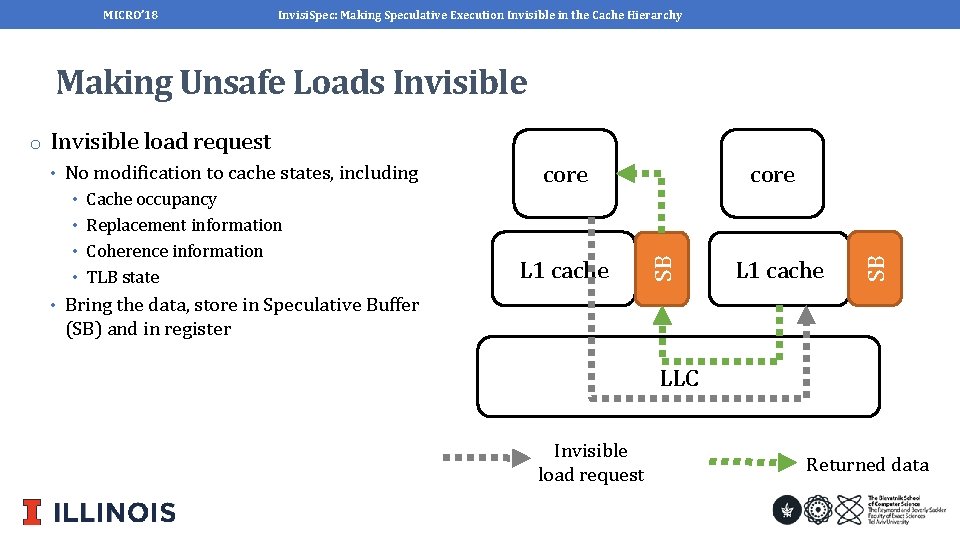
MICRO’ 18 Invisi. Spec: Making Speculative Execution Invisible in the Cache Hierarchy 9 Making Unsafe Loads Invisible o Invisible load request • No modification to cache states, including core L 1 cache • Cache occupancy • TLB state SB • Coherence information SB • Replacement information • Bring the data, store in Speculative Buffer (SB) and in register LLC Invisible load request Returned data
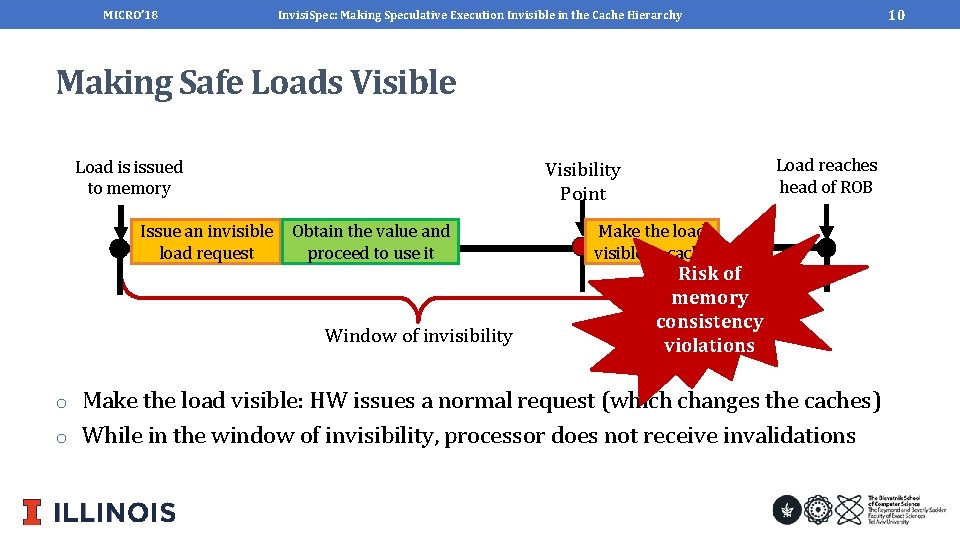
MICRO’ 18 10 Invisi. Spec: Making Speculative Execution Invisible in the Cache Hierarchy Making Safe Loads Visible Load is issued to memory Issue an invisible load request Load reaches head of ROB Visibility Point Obtain the value and proceed to use it Window of invisibility Make the load visible in cache Risk of memory consistency violations o Make the load visible: HW issues a normal request (which changes the caches) o While in the window of invisibility, processor does not receive invalidations
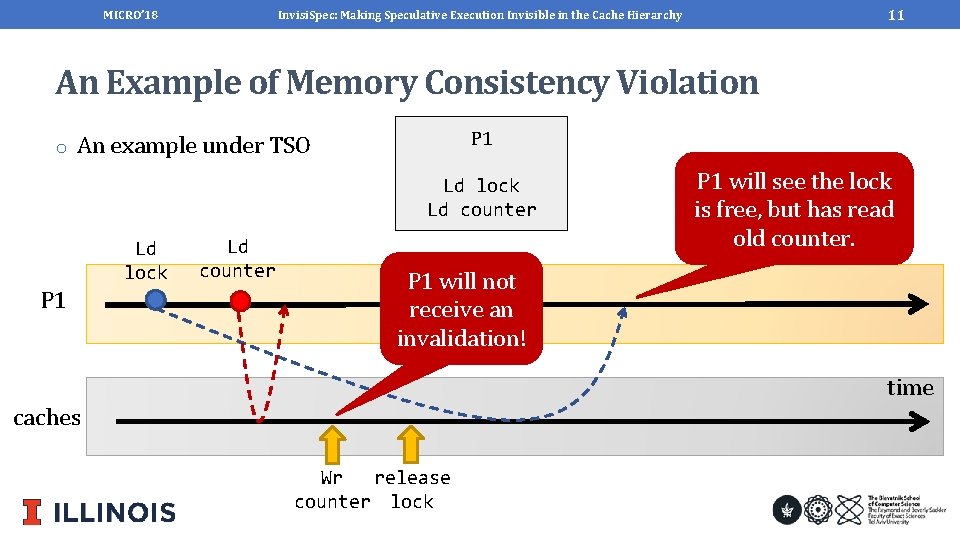
MICRO’ 18 11 Invisi. Spec: Making Speculative Execution Invisible in the Cache Hierarchy An Example of Memory Consistency Violation P 1 o An example under TSO Ld lock Ld counter Ld lock P 1 Ld counter P 1 will see the lock is free, but has read old counter. P 1 will not receive an invalidation! time caches Wr release counter lock
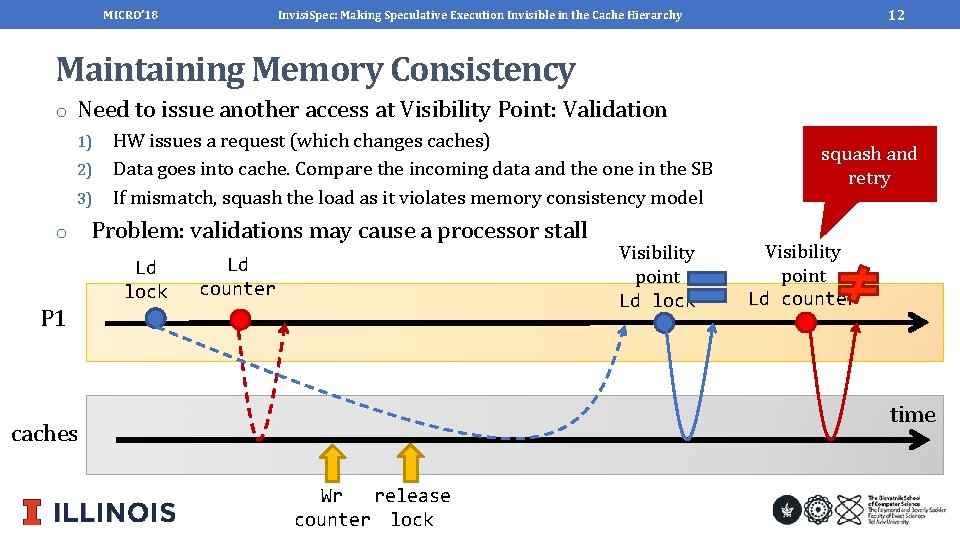
MICRO’ 18 12 Invisi. Spec: Making Speculative Execution Invisible in the Cache Hierarchy Maintaining Memory Consistency o Need to issue another access at Visibility Point: Validation 1) HW issues a request (which changes caches) 2) Data goes into cache. Compare the incoming data and the one in the SB 3) If mismatch, squash the load as it violates memory consistency model o Problem: validations may cause a processor stall Ld lock Ld counter P 1 Visibility point Ld lock squash and retry Visibility point Ld counter time caches Wr release counter lock
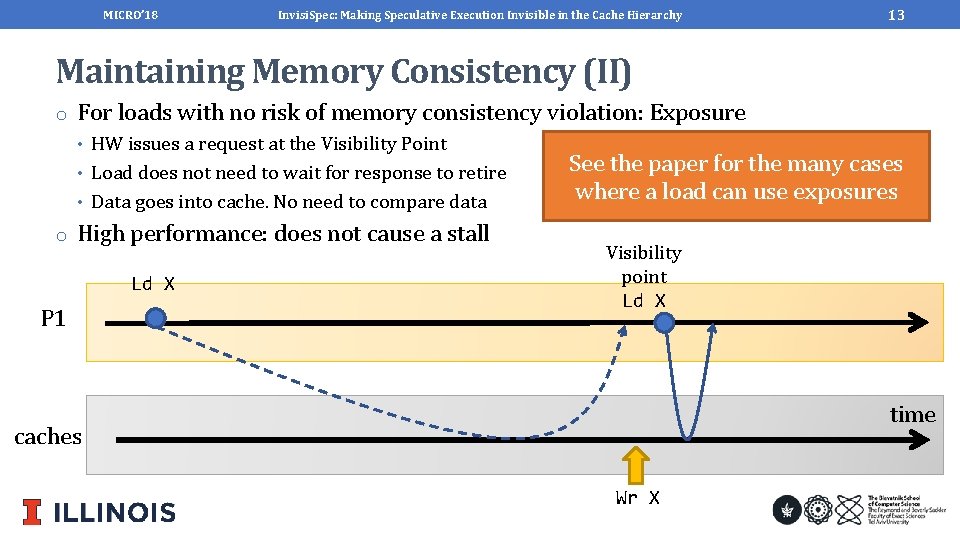
MICRO’ 18 Invisi. Spec: Making Speculative Execution Invisible in the Cache Hierarchy 13 Maintaining Memory Consistency (II) o For loads with no risk of memory consistency violation: Exposure • HW issues a request at the Visibility Point See the paper for the many cases • Load does not need to wait for response to retire where a load can use exposures • Data goes into cache. No need to compare data o High performance: does not cause a stall Ld X P 1 Visibility point Ld X time caches Wr X
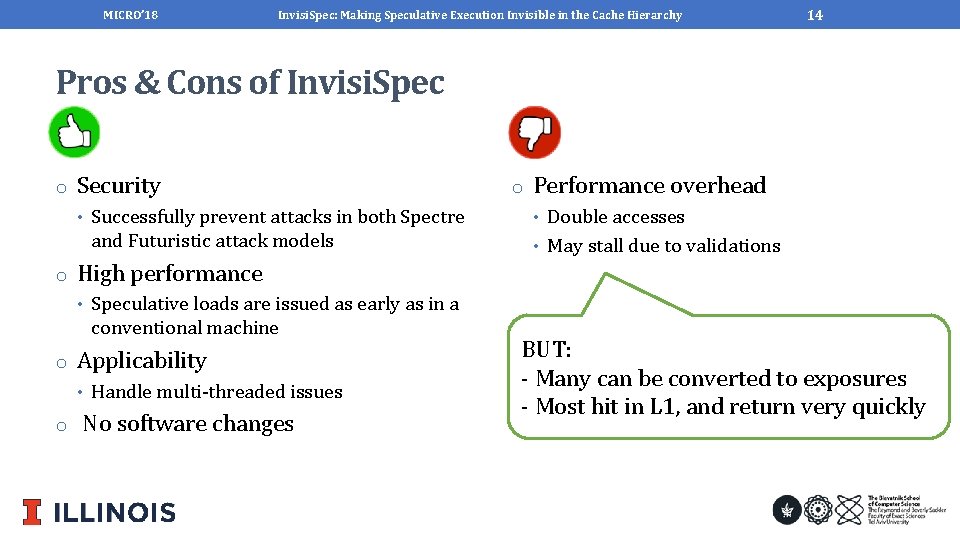
MICRO’ 18 Invisi. Spec: Making Speculative Execution Invisible in the Cache Hierarchy 14 Pros & Cons of Invisi. Spec o Security • Successfully prevent attacks in both Spectre and Futuristic attack models o High performance • Speculative loads are issued as early as in a conventional machine o Applicability • Handle multi-threaded issues o No software changes o Performance overhead • Double accesses • May stall due to validations BUT: - Many can be converted to exposures - Most hit in L 1, and return very quickly
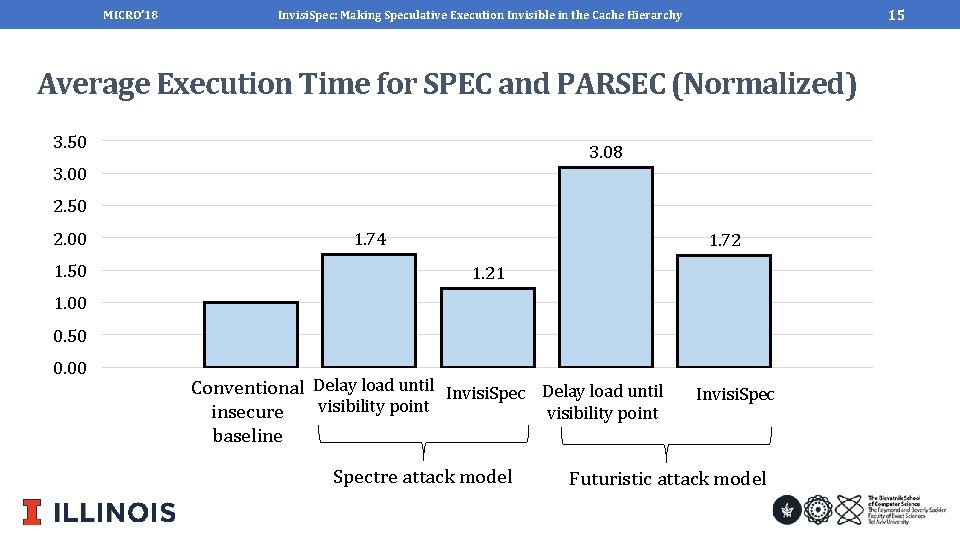
MICRO’ 18 15 Invisi. Spec: Making Speculative Execution Invisible in the Cache Hierarchy Average Execution Time for SPEC and PARSEC (Normalized) 3. 50 3. 08 3. 00 2. 50 2. 00 1. 50 1. 74 1. 72 1. 21 1. 00 0. 50 0. 00 Conventional Delay load until Invisi. Spec Delay load until visibility point insecure visibility point baseline Spectre attack model Invisi. Spec Futuristic attack model
MICRO’ 18 Invisi. Spec: Making Speculative Execution Invisible in the Cache Hierarchy Current Work o Reduce performance overhead: selectively enable Invisi. Spec 16
MICRO’ 18 Invisi. Spec: Making Speculative Execution Invisible in the Cache Hierarchy More in the paper o Security analysis o Details of when to use validations and exposures, and overlapping of them o Details of implementation o Detailed performance and area overhead evaluation results 17
MICRO’ 18 Invisi. Spec: Making Speculative Execution Invisible in the Cache Hierarchy Conclusion o Invisi. Spec is the first comprehensive defense mechanism against speculative execution attacks in the cache hierarchy o We published the code of our architecture simulator: https: //github. com/mjyan 0720/Invisi. Spec-1. 0 18
- Slides: 18