
Investments Analysis and Behavior Chapter 7 Market Anomalies

Investments: Analysis and Behavior Chapter 7 - Market Anomalies © 2008 Mc. Graw-Hill/Irwin
Learning Objectives n n Understand the joint test problem of testing market efficiency. · Identify return anomalies associated with the calendar. · Be able to compute abnormal returns around news announcements. · Identify fundamental and news event anomalies. 7 -2
Testing the EMH n The Efficient Market Hypothesis states that stock prices are fairly valued. ¨ No under- or over- valued firms. ¨ Therefore, what return is expected? n n n Expected return depends on the risk premium How do we estimate risk and predict the risk premium? Asset Pricing Models show the relation between risk and return. ¨ CAPM, APT, Multi-factor models ¨ Do these models express the right relationship? 7 -3
Joint Test Problem • If a portfolio of stocks seems to earn higher returns than it should given its level of risk, is this evidence of: • Market inefficiency? • stocks were undervalued • A miss-specified asset pricing model? • Risk premium not estimated correctly • Practical Relevance • Implications for indexing, active management, diversification, etc. 7 -4
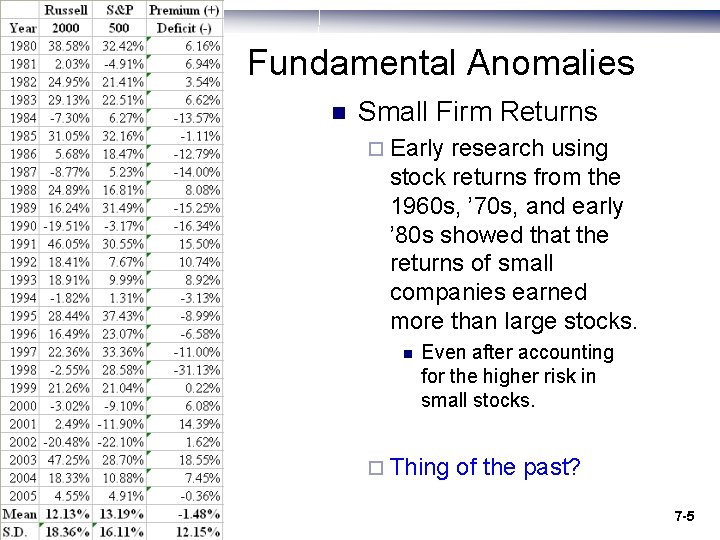
Fundamental Anomalies n Small Firm Returns ¨ Early research using stock returns from the 1960 s, ’ 70 s, and early ’ 80 s showed that the returns of small companies earned more than large stocks. n Even after accounting for the higher risk in small stocks. ¨ Thing of the past? 7 -5
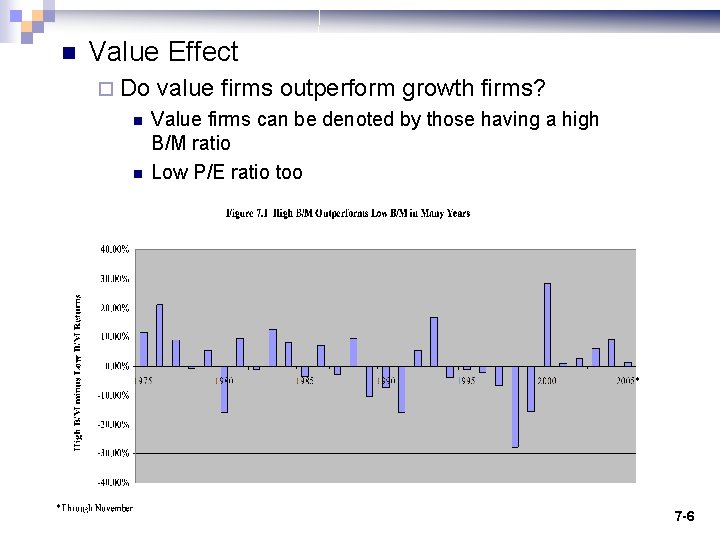
n Value Effect ¨ Do n n value firms outperform growth firms? Value firms can be denoted by those having a high B/M ratio Low P/E ratio too 7 -6
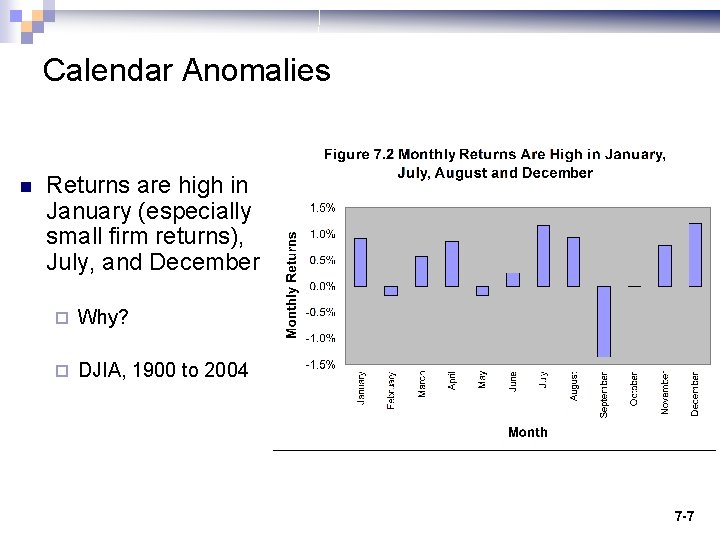
Calendar Anomalies n Returns are high in January (especially small firm returns), July, and December ¨ Why? ¨ DJIA, 1900 to 2004 7 -7
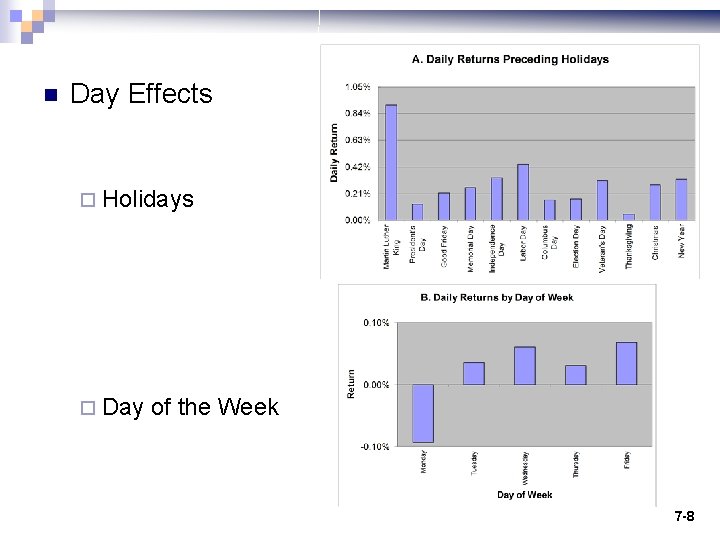
n Day Effects ¨ Holidays ¨ Day of the Week 7 -8
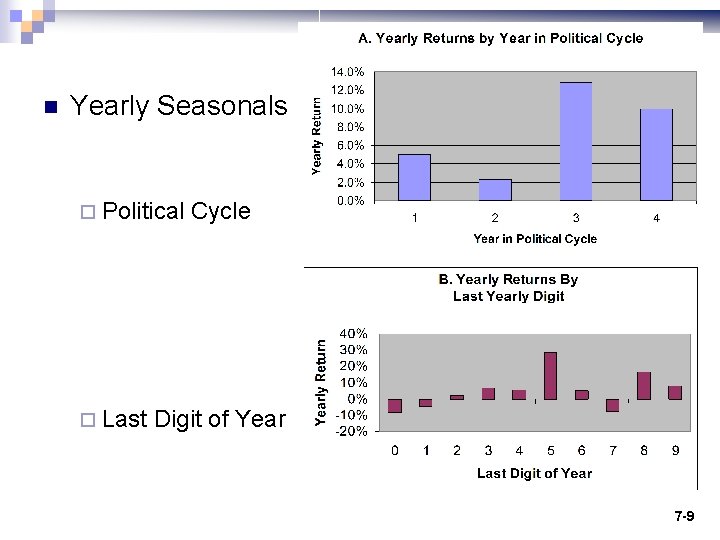
n Yearly Seasonals ¨ Political ¨ Last Cycle Digit of Year 7 -9
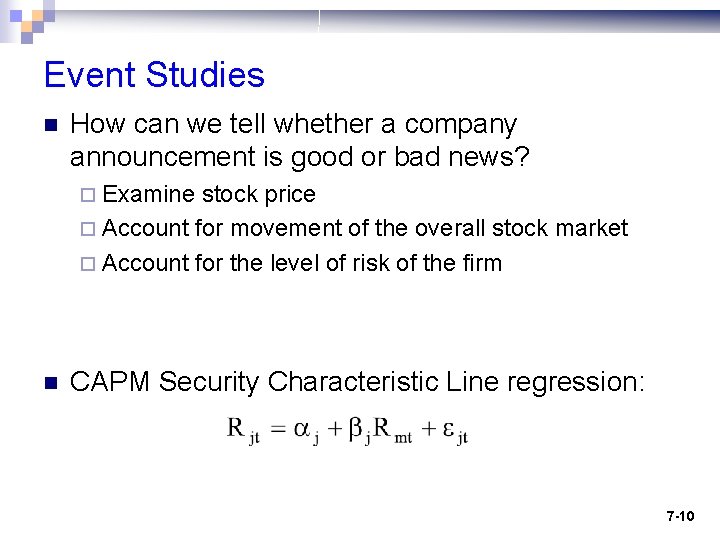
Event Studies n How can we tell whether a company announcement is good or bad news? ¨ Examine stock price ¨ Account for movement of the overall stock market ¨ Account for the level of risk of the firm n CAPM Security Characteristic Line regression: 7 -10
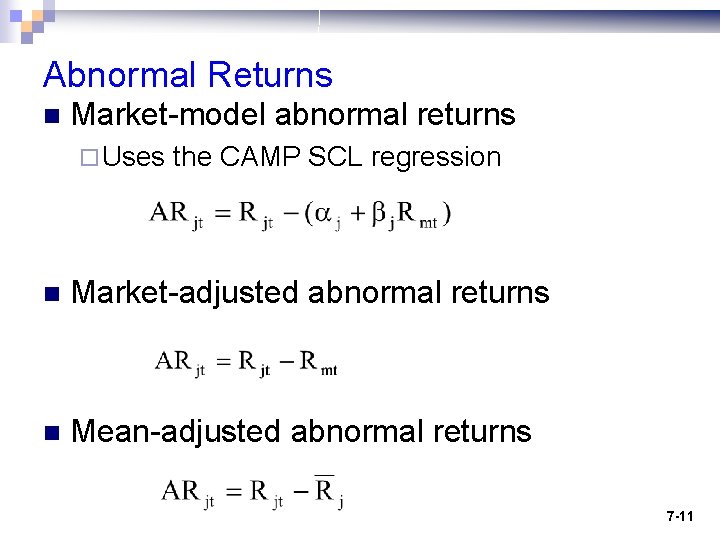
Abnormal Returns n Market-model abnormal returns ¨ Uses the CAMP SCL regression n Market-adjusted abnormal returns n Mean-adjusted abnormal returns 7 -11
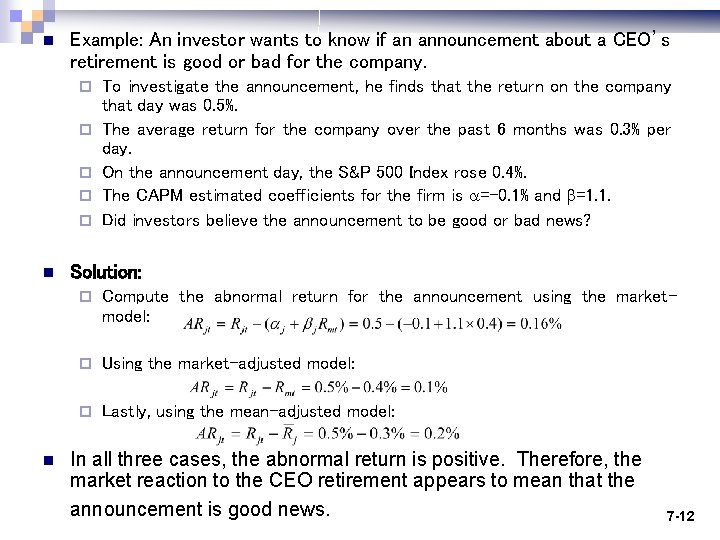
n Example: An investor wants to know if an announcement about a CEO’s retirement is good or bad for the company. ¨ ¨ ¨ n n To investigate the announcement, he finds that the return on the company that day was 0. 5%. The average return for the company over the past 6 months was 0. 3% per day. On the announcement day, the S&P 500 Index rose 0. 4%. The CAPM estimated coefficients for the firm is =-0. 1% and =1. 1. Did investors believe the announcement to be good or bad news? Solution: ¨ Compute the abnormal return for the announcement using the marketmodel: ¨ Using the market-adjusted model: ¨ Lastly, using the mean-adjusted model: In all three cases, the abnormal return is positive. Therefore, the market reaction to the CEO retirement appears to mean that the announcement is good news. 7 -12
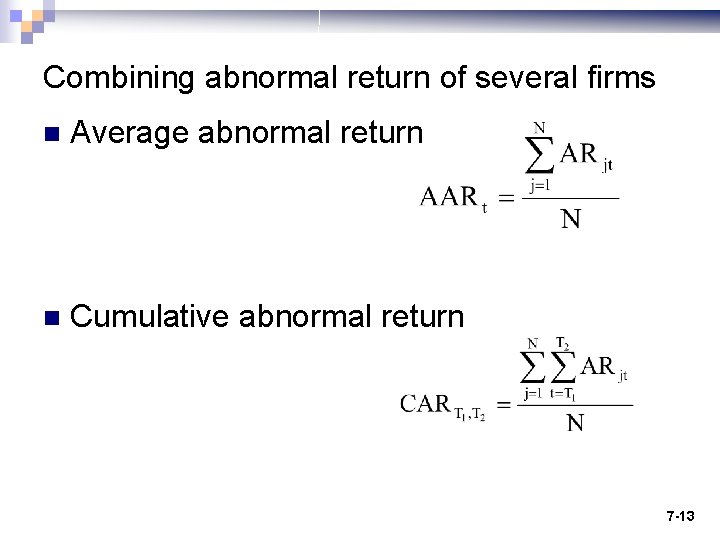
Combining abnormal return of several firms n Average abnormal return n Cumulative abnormal return 7 -13
Earnings Surprise n When firms announce their earnings numbers (quarterly and annually), they often surprise the street by earning more (or less) than expected. ¨ Can you make money after hearing the news? ¨ Post-earnings announcement drift 7 -14
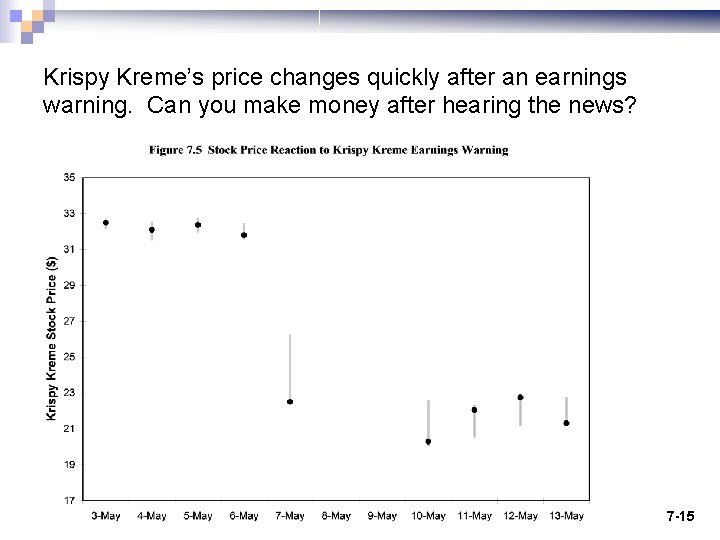
Krispy Kreme’s price changes quickly after an earnings warning. Can you make money after hearing the news? 7 -15
Common Announcements n Stock splits (2: 1, 3: 1, 1: 2) ¨ Changes the number of shares and thus, the stock price n n Announcement date Record date Pay date Ex-split date ¨ Common belief that stock prices go up after a split. n Prices already went up, that is the cause of the split! 7 -16
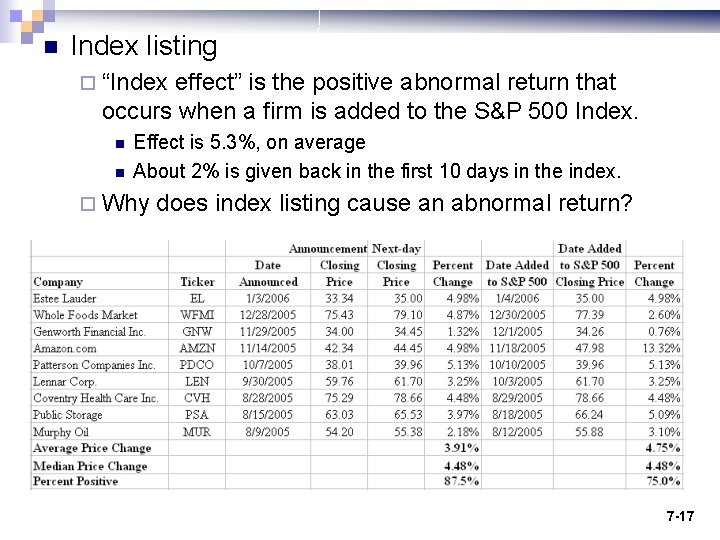
n Index listing ¨ “Index effect” is the positive abnormal return that occurs when a firm is added to the S&P 500 Index. n n Effect is 5. 3%, on average About 2% is given back in the first 10 days in the index. ¨ Why does index listing cause an abnormal return? 7 -17
3 Com’s spin-off of Palm n n One of the innovative products developed by 3 com was the Palm Pilot. In 2000, 3 Com decided to spin-off its Palm subsidiary as an independent operating company. The plan was to issue 5% of the shares of Palm in an IPO and distribute the remaining 95% of the Palm shares to 3 Com stockholders. ¨ On March 2, 2000, 3 Com conducted the Palm IPO. ¨ The other 95% of the Palm stock was to be distributed later in the year as 1. 5 shares of Palm for every 1 share of 3 Com stock owned. ¨ n By the end of the Palm IPO day, newly issued shares of Palm traded at $95. 06 per share. Since holders of one share of 3 Com could expect to receive 1. 5 shares of Palm in a few months, 3 Com stock should have then been worth $142. 59 (=1. 5 x $95. 06) plus the value of 3 com’s other operations. ¨ 3 Com’s stock price should have been substantially higher than $142. 59. ¨ 3 Com stock closed at only $81. 81 per share, or at roughly 57. 3% of the value of the company’s shareholdings in Palm alone, not to mention the value of 3 Com’s other operations! ¨ 7 -18
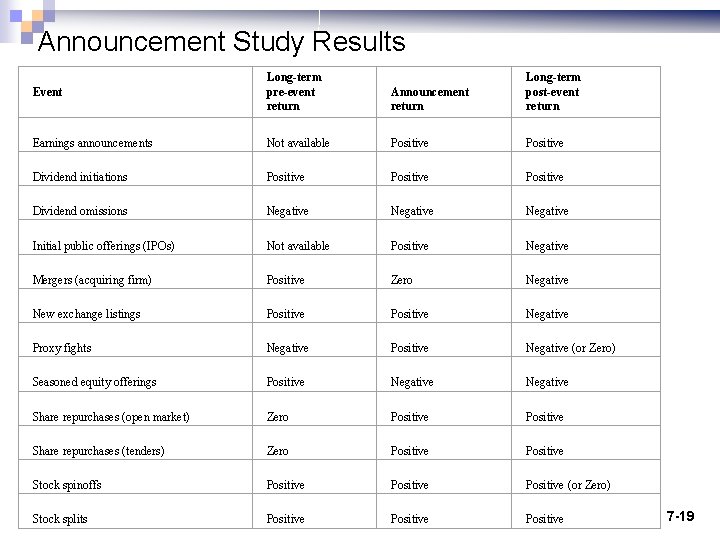
Announcement Study Results Event Long-term pre-event return Announcement return Long-term post-event return Earnings announcements Not available Positive Dividend initiations Positive Dividend omissions Negative Initial public offerings (IPOs) Not available Positive Negative Mergers (acquiring firm) Positive Zero Negative New exchange listings Positive Negative Proxy fights Negative Positive Negative (or Zero) Seasoned equity offerings Positive Negative Share repurchases (open market) Zero Positive Share repurchases (tenders) Zero Positive Stock spinoffs Positive (or Zero) Stock splits Positive 7 -19
Summary n Some patterns appear from time to time, but they are not always dependable. It is difficult to know whether abnormal returns are due to market inefficiency or a missspecified model of risk premium. n Are markets efficient? n 7 -20
- Slides: 20