
Investments Analysis and Behavior Chapter 13 Technical Analysis
Investments: Analysis and Behavior Chapter 13 - Technical Analysis © 2008 Mc. Graw-Hill/Irwin
Learning Objectives n n n Learn the graphing tools of technical analysis. Identify stock price patterns. Know how trading volume relates to price patterns. Learn technical indicators for measuring market activity. Understand how investor sentiment is measured and used. 13 -2
Inefficient Markets Chapter 6 argues that markets are efficient. n Chapter 7 illustrates EMH anomalies. n Chapter 8 argues that if investors are not always rational, then markets may not be fully efficient. n If markets are nearly efficient, what tools may be useful for investors to make money? These tools are detailed in Technical Analysis. 13 -3
Supply and Demand n n Fundamental Analysis: stocks prices are related to the value of the business. Technical Analysis: stock prices are the result of supply and demand forces for the stock. Priced more like a commodity. ¨ Technicians try to understand measure the changing supply and demand. ¨ Market Technicians Association (www. mta. org) ¨ 13 -4

Plotting the Market – measuring trends Price charts: ¨ Resistance lines and Support lines ¨ Channels and Breakouts 13 -5
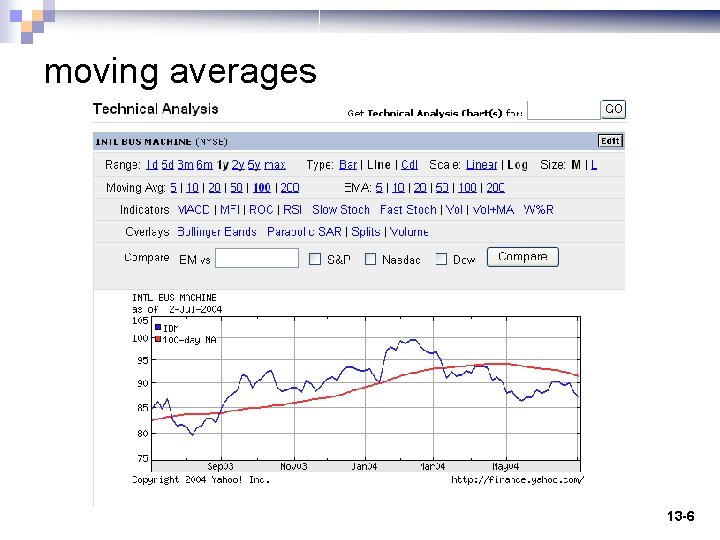
moving averages 13 -6
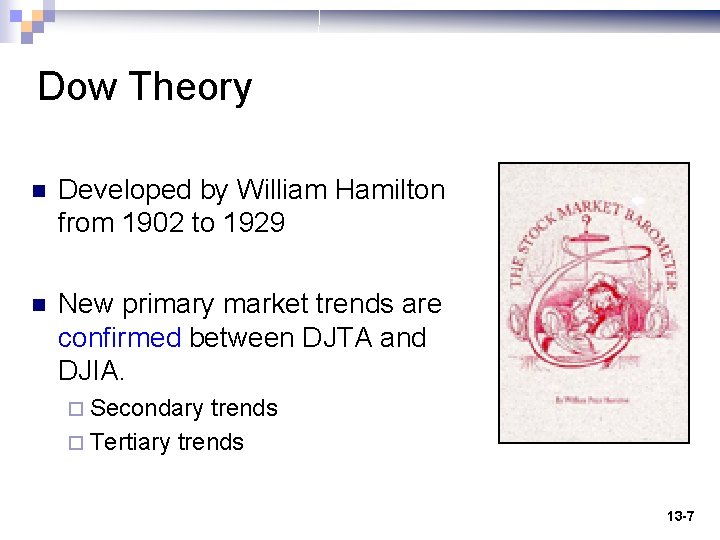
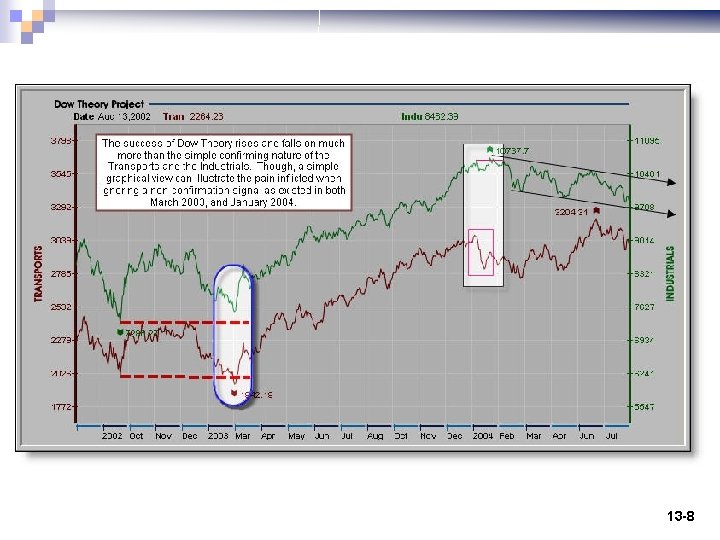
Dow Theory n Developed by William Hamilton from 1902 to 1929 n New primary market trends are confirmed between DJTA and DJIA. ¨ Secondary trends ¨ Tertiary trends 13 -7
13 -8
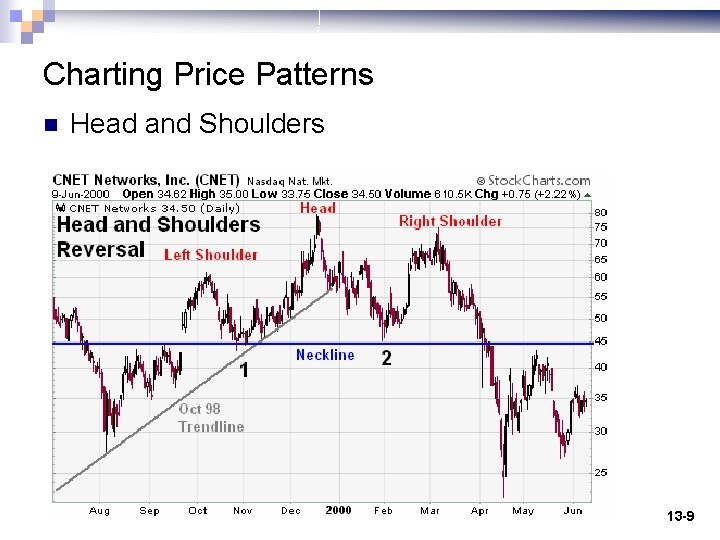
Charting Price Patterns n Head and Shoulders 13 -9
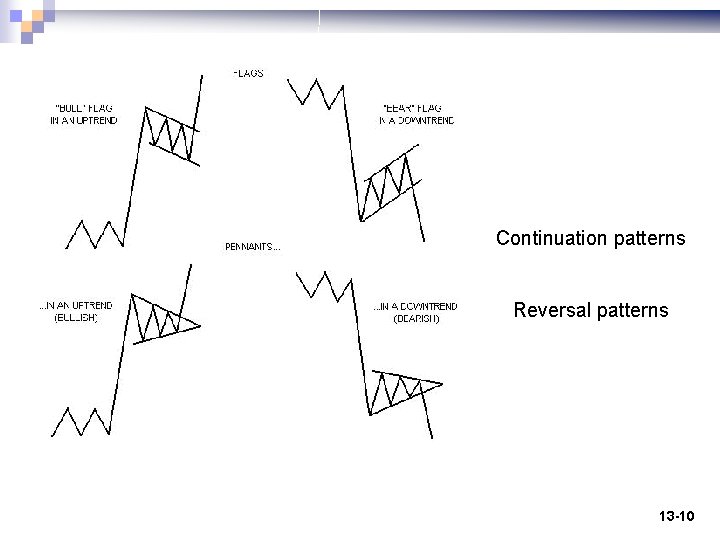
Continuation patterns Reversal patterns 13 -10
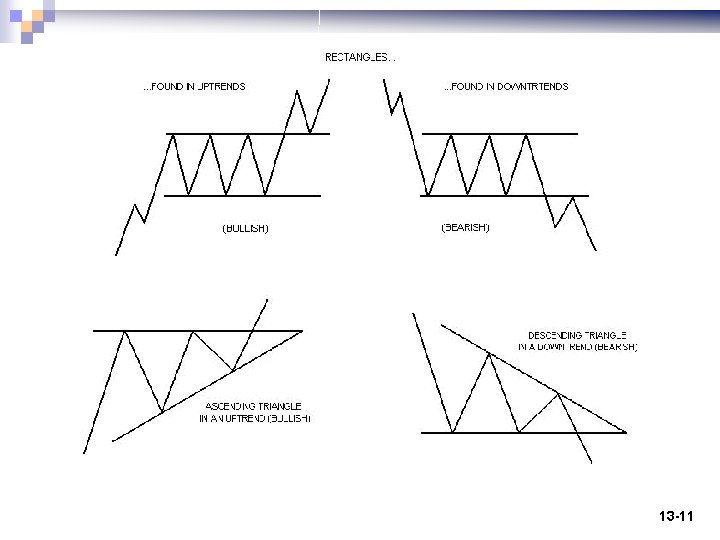
13 -11
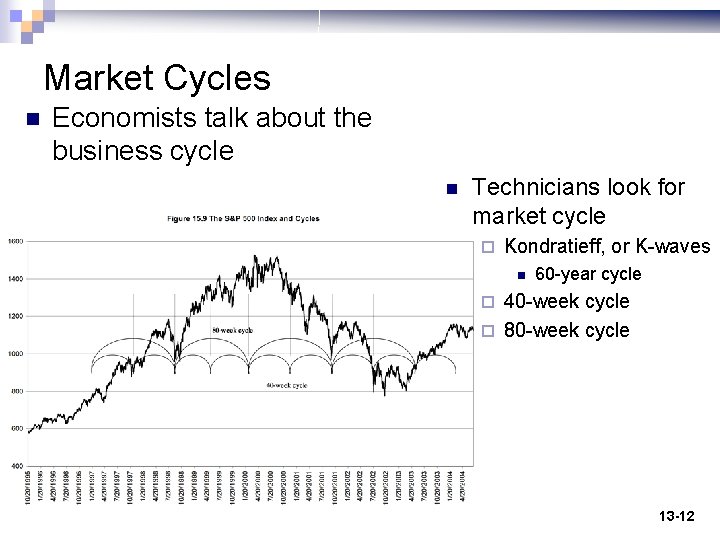
Market Cycles n Economists talk about the business cycle n Technicians look for market cycle ¨ Kondratieff, or K-waves n 60 -year cycle 40 -week cycle ¨ 80 -week cycle ¨ 13 -12
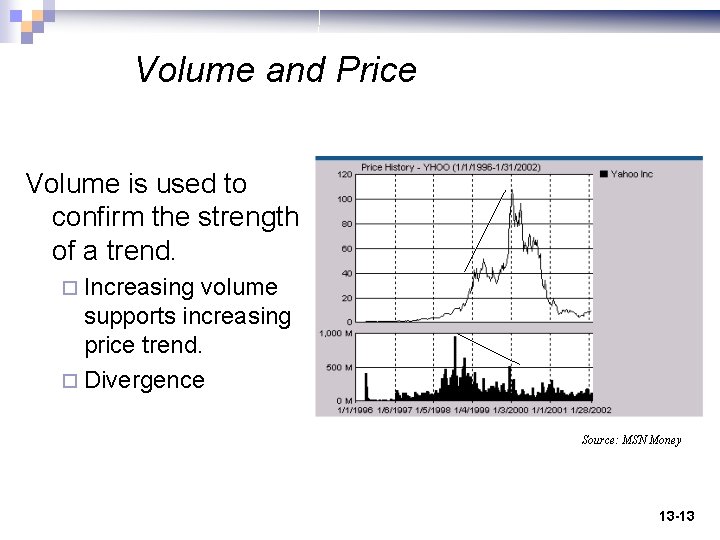
Volume and Price Volume is used to confirm the strength of a trend. ¨ Increasing volume supports increasing price trend. ¨ Divergence Source: MSN Money 13 -13
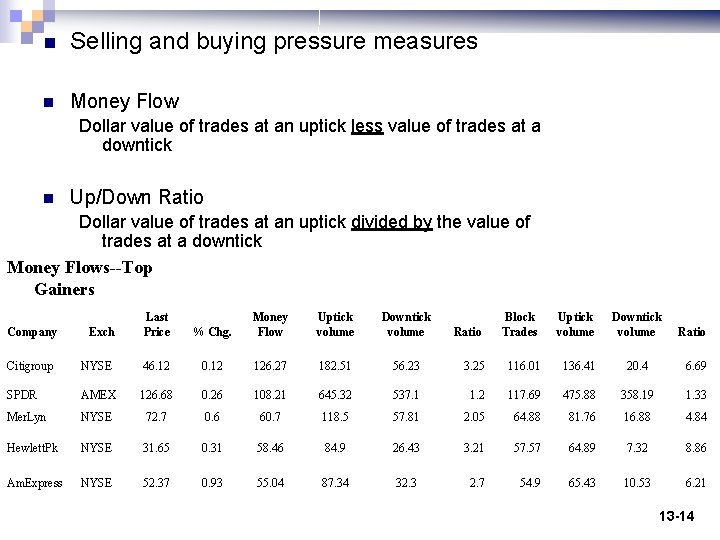
n Selling and buying pressure measures n Money Flow Dollar value of trades at an uptick less value of trades at a downtick n Up/Down Ratio Dollar value of trades at an uptick divided by the value of trades at a downtick Money Flows--Top Gainers Exch Last Price % Chg. Money Flow Uptick volume Downtick volume Citigroup NYSE 46. 12 0. 12 126. 27 182. 51 SPDR AMEX 126. 68 0. 26 108. 21 Mer. Lyn NYSE 72. 7 0. 6 Hewlett. Pk NYSE 31. 65 Am. Express NYSE 52. 37 Company Ratio Block Trades Uptick volume Downtick volume 56. 23 3. 25 116. 01 136. 41 20. 4 6. 69 645. 32 537. 1 1. 2 117. 69 475. 88 358. 19 1. 33 60. 7 118. 5 57. 81 2. 05 64. 88 81. 76 16. 88 4. 84 0. 31 58. 46 84. 9 26. 43 3. 21 57. 57 64. 89 7. 32 8. 86 0. 93 55. 04 87. 34 32. 3 2. 7 54. 9 65. 43 10. 53 6. 21 Ratio 13 -14
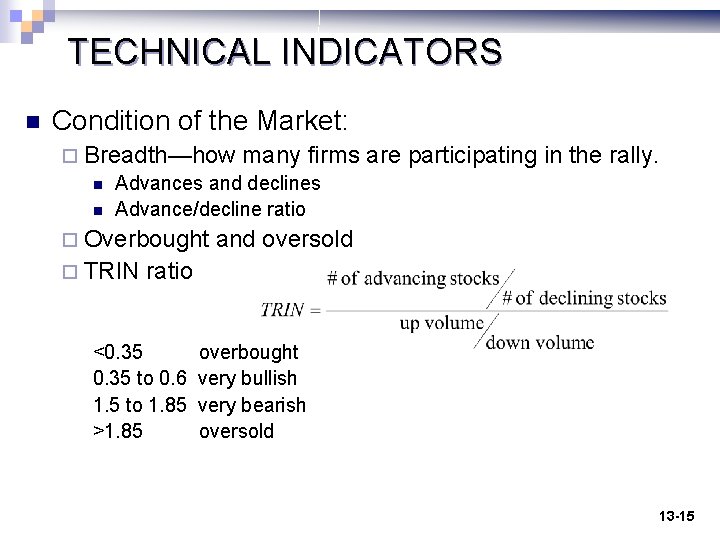
TECHNICAL INDICATORS n Condition of the Market: ¨ Breadth—how many firms are participating in the rally. n Advances and declines n Advance/decline ratio ¨ Overbought and oversold ¨ TRIN ratio <0. 35 overbought 0. 35 to 0. 6 very bullish 1. 5 to 1. 85 very bearish >1. 85 oversold 13 -15
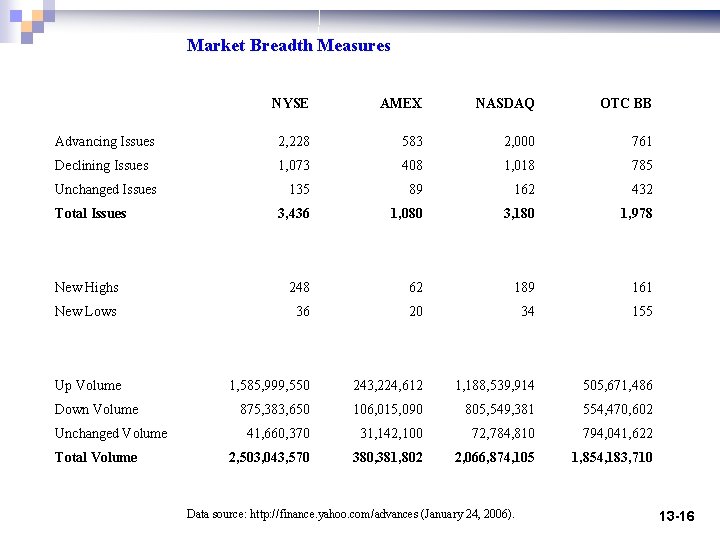
Market Breadth Measures NYSE AMEX NASDAQ OTC BB Advancing Issues 2, 228 583 2, 000 761 Declining Issues 1, 073 408 1, 018 785 135 89 162 432 3, 436 1, 080 3, 180 1, 978 New Highs 248 62 189 161 New Lows 36 20 34 155 1, 585, 999, 550 243, 224, 612 1, 188, 539, 914 505, 671, 486 875, 383, 650 106, 015, 090 805, 549, 381 554, 470, 602 41, 660, 370 31, 142, 100 72, 784, 810 794, 041, 622 2, 503, 043, 570 380, 381, 802 2, 066, 874, 105 1, 854, 183, 710 Unchanged Issues Total Issues Up Volume Down Volume Unchanged Volume Total Volume Data source: http: //finance. yahoo. com/advances (January 24, 2006). 13 -16
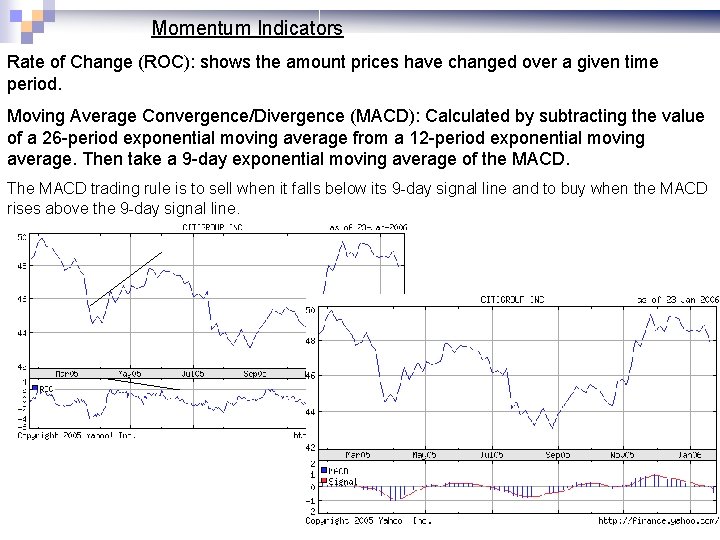
Momentum Indicators Rate of Change (ROC): shows the amount prices have changed over a given time period. Moving Average Convergence/Divergence (MACD): Calculated by subtracting the value of a 26 -period exponential moving average from a 12 -period exponential moving average. Then take a 9 -day exponential moving average of the MACD. The MACD trading rule is to sell when it falls below its 9 -day signal line and to buy when the MACD rises above the 9 -day signal line. 13 -17
Sentiment Indicators Sentiment: The mood of investors drive markets. ¨ Investor actions n n n Odd lot trades (contrary indicator) Mutual fund flow Broker account credit and debit balances Short interest Put/call ratio ¨ Surveys 13 -18
AAII Investor Sentiment Survey Measures the percentage of individual investors who are bullish, bearish, and neutral on the stock market in the short term: weekly. Consumer Confidence Survey The survey of 5, 000 households is conducted for the Conference Board by NFO World. Group: monthly. University of Michigan Consumer Sentiment The Index of Consumer Sentiment (ICS) is based upon consumer responses to each of five survey questions on spending plans. ABC News/Money Magazine Consumer Comfort Index The index is based on ratings of the economy, buying climate, and personal finances: rolling 4 -week sample of 1, 000 adults. Investor’s Intelligence Newsletter reviews other investment newsletters and reports the percentage that is bullish on a weekly basis. (www. investorsintelligence. com) Merrill Lynch Sell Side Indicator This indicator is based on a survey of Wall Street Strategist asset allocation recommendations: monthly. Robert Shiller’s Stock Market Confidence Indices Yale Professor Rober Shiller compiles four different indices based upon surveys of individual and institutional investors: One-Year Confidence Index, Buy-on Dips Confidence Index, Crash Confidence Index, and Valuation Confidence Index. (icf. som. yale. edu/confidence. index) 13 -19
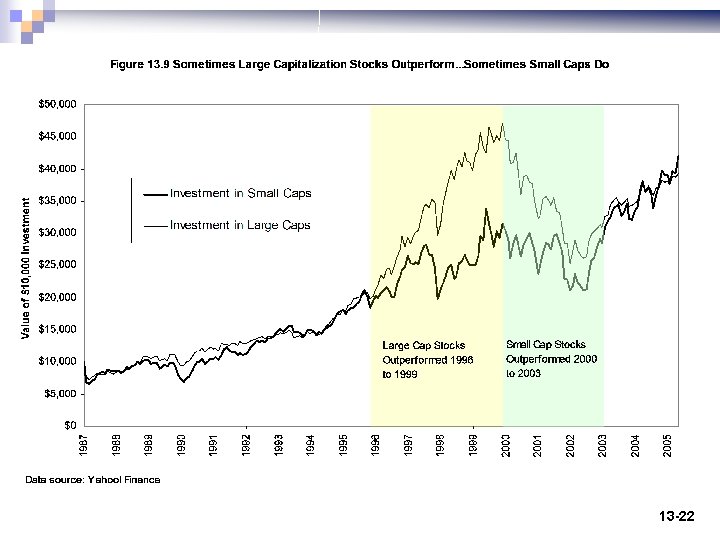
Stock Rotations n Sector Rotation ¨ Sometimes investors like, technology, other times they like energy… n Value/Growth Rotation n Capitalization Rotation ¨ Small versus large companies 13 -20
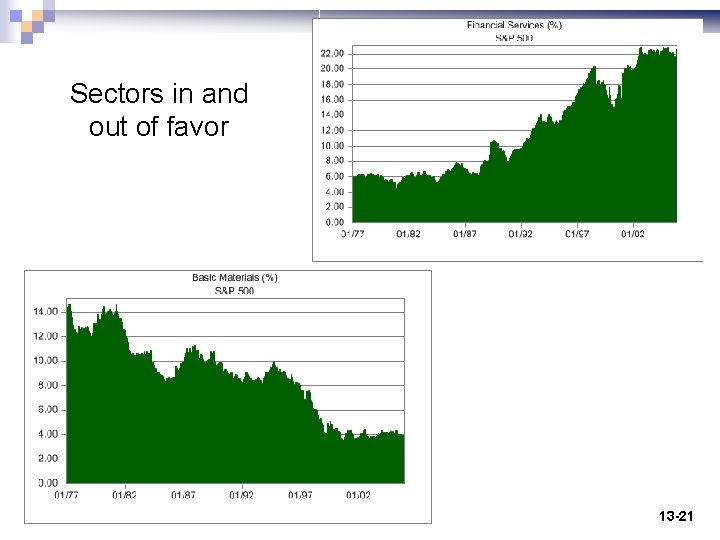
Sectors in and out of favor 13 -21
13 -22
Criticisms of TA n n n Not much statistical analysis support for technical trading rules. Subjective judgment is part of the decision making. The brain sees patterns in random data 13 -23
- Slides: 23