
Investment trends in the global hedge fund business
Investment trends in the global hedge fund business Antoine Massad – CEO, Man Investments Middle East Limited May 2006 A member of the Man Group
Important notes This document is not an invitation to make an investment in any product to which Man Investments Limited (or any other member of Man Group plc’s group of companies) provides investment advisory or any other services, nor does it constitute an offer for the sale or purchase of bonds (or any other instruments) issued by any entity. Information contained herein is provided from the Man database except where otherwise stated. Potential investors should note that alternative investments can involve significant risks and the value of an investment may go down as well as up. There is no guarantee of trading performance and past or projected performance is not necessarily a guide to future results. This material is communicated by Man Investments Limited, which is authorised and regulated by the Financial Services Authority. This material is only to be communicated to investment professionals, market counterparties or intermediate customers and must not be relied upon by any other person. www. maninvestments. com 2
Three broad themes • Growth and consolidation of the hedge fund industry • Shifting client need • New styles, strategies and sources of alpha 3
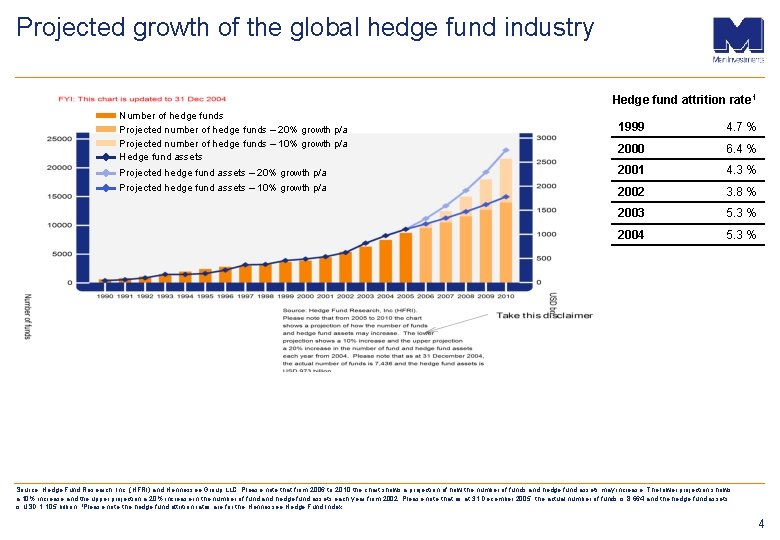
Projected growth of the global hedge fund industry Hedge fund attrition rate 1 Number of hedge funds Projected number of hedge funds – 20% growth p/a Projected number of hedge funds – 10% growth p/a Hedge fund assets 1999 4. 7 % 2000 6. 4 % Projected hedge fund assets – 20% growth p/a 2001 4. 3 % Projected hedge fund assets – 10% growth p/a 2002 3. 8 % 2003 5. 3 % 2004 5. 3 % Source: Hedge Fund Research, Inc. (HFRI) and Hennessee Group LLC. Please note that from 2006 to 2010 the chart shows a projection of how the number of funds and hedge fund assets may increase. The lower projection shows a 10% increase and the upper projection a 20% increase in the number of fund and hedge fund assets each year from 2002. Please note that as at 31 December 2005, the actual number of funds is 8, 664 and the hedge fund assets is USD 1, 105 billion. 1 Please note the hedge fund attrition rates are for the Hennessee Hedge Fund Index. 4
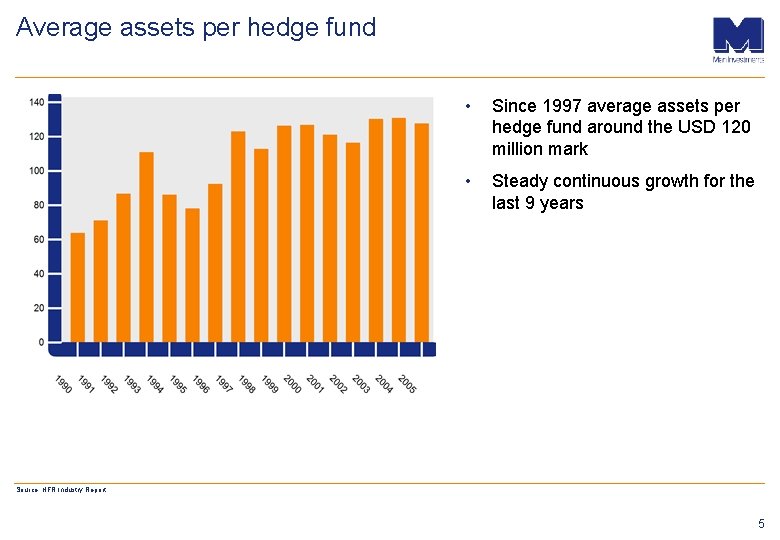
Average assets per hedge fund • Since 1997 average assets per hedge fund around the USD 120 million mark • Steady continuous growth for the last 9 years Source: HFR Industry Report. 5
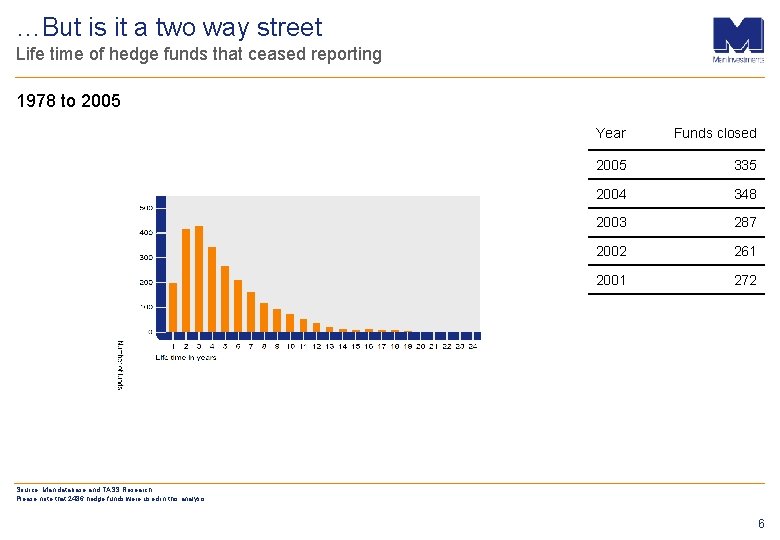
…But is it a two way street Life time of hedge funds that ceased reporting 1978 to 2005 Year Funds closed 2005 335 2004 348 2003 287 2002 261 2001 272 Source: Man database and TASS Research. Please note that 2486 hedge funds were used in this analysis. 6
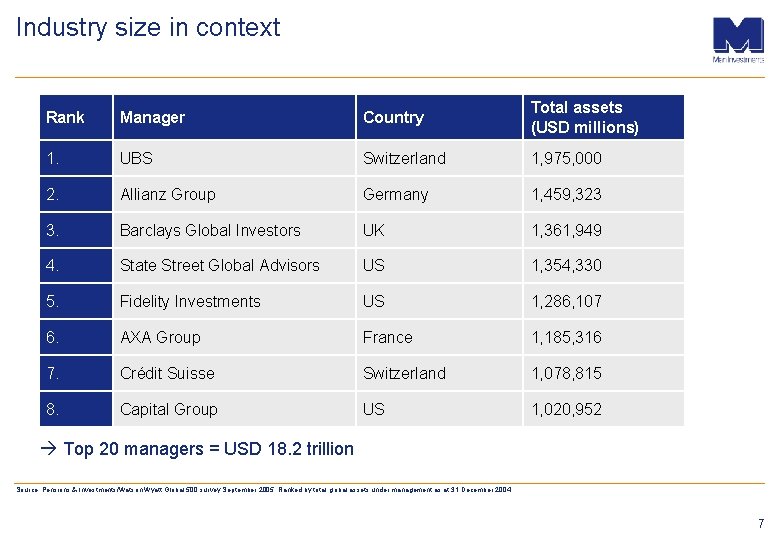
Industry size in context Rank Manager Country Total assets (USD millions) 1. UBS Switzerland 1, 975, 000 2. Allianz Group Germany 1, 459, 323 3. Barclays Global Investors UK 1, 361, 949 4. State Street Global Advisors US 1, 354, 330 5. Fidelity Investments US 1, 286, 107 6. AXA Group France 1, 185, 316 7. Crédit Suisse Switzerland 1, 078, 815 8. Capital Group US 1, 020, 952 Top 20 managers = USD 18. 2 trillion Source: Pensions & Investments/Watson Wyatt Global 500 survey September 2005. Ranked by total global assets under management as at 31 December 2004. 7
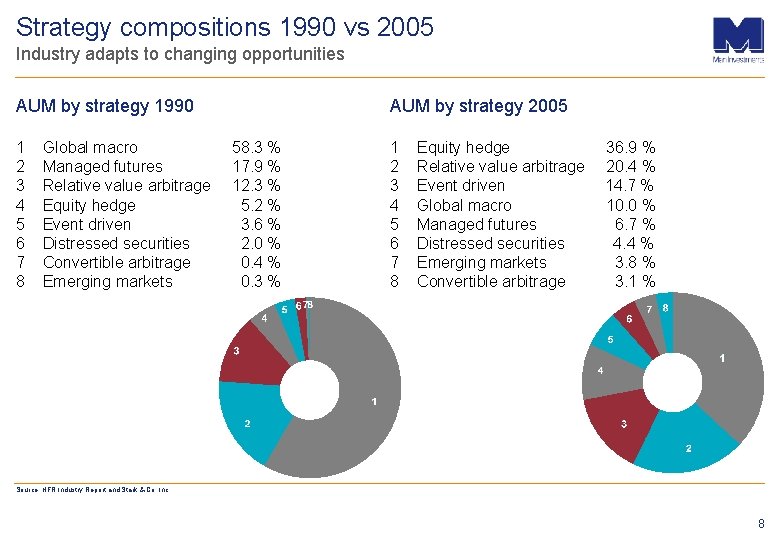
Strategy compositions 1990 vs 2005 Industry adapts to changing opportunities AUM by strategy 1990 1 2 3 4 5 6 7 8 Global macro Managed futures Relative value arbitrage Equity hedge Event driven Distressed securities Convertible arbitrage Emerging markets AUM by strategy 2005 58. 3 % 17. 9 % 12. 3 % 5. 2 % 3. 6 % 2. 0 % 0. 4 % 0. 3 % 1 2 3 4 5 6 7 8 Equity hedge Relative value arbitrage Event driven Global macro Managed futures Distressed securities Emerging markets Convertible arbitrage 36. 9 % 20. 4 % 14. 7 % 10. 0 % 6. 7 % 4. 4 % 3. 8 % 3. 1 % Source: HFR Industry Report and Stark & Co, Inc. 8
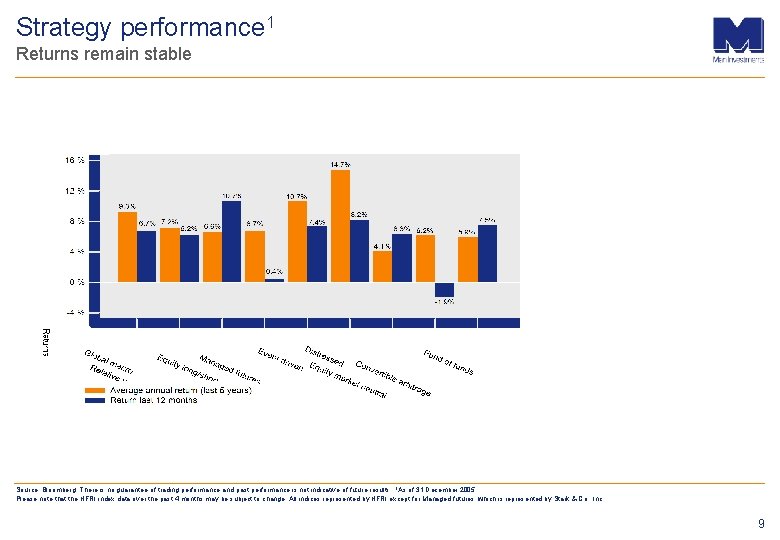
Strategy performance 1 Returns remain stable Source: Bloomberg. There is no guarantee of trading performance and past performance is not indicative of future results. 1 As of 31 December 2005. Please note that the HFRI index data over the past 4 months may be subject to change. All indices represented by HFRI except for Managed futures, which is represented by Stark & Co. , Inc. 9
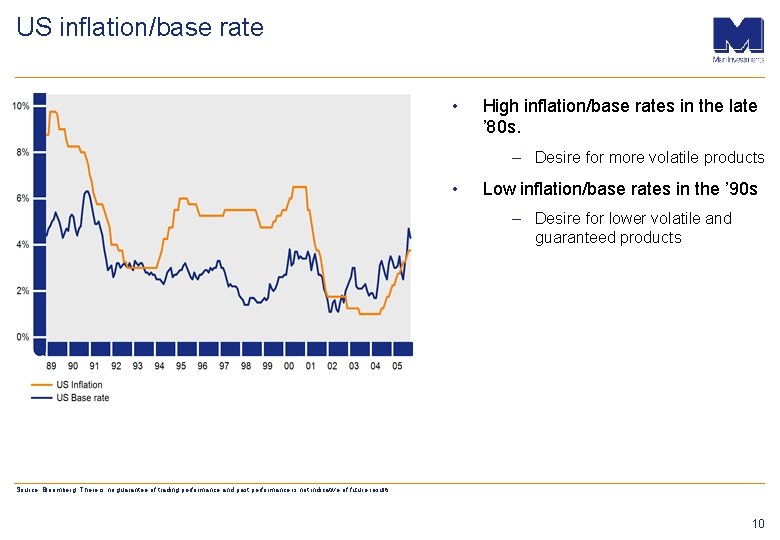
US inflation/base rate • High inflation/base rates in the late ’ 80 s. – Desire for more volatile products • Low inflation/base rates in the ’ 90 s – Desire for lower volatile and guaranteed products Source: Bloomberg. There is no guarantee of trading performance and past performance is not indicative of future results. 10
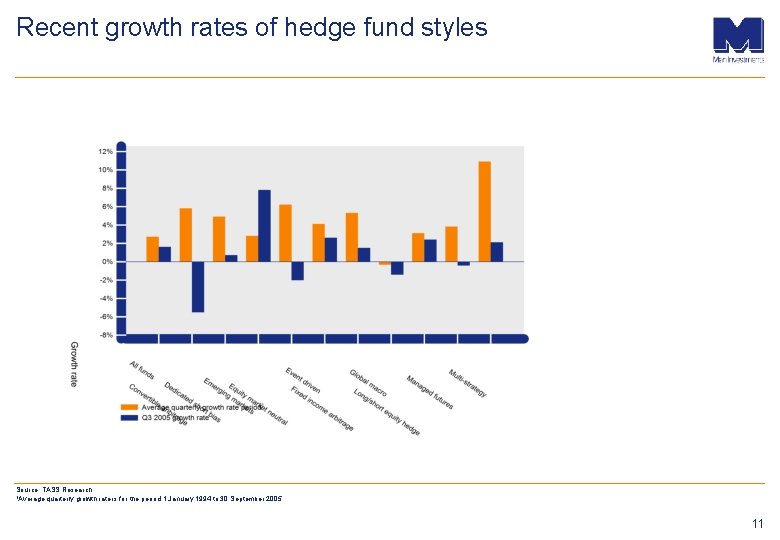
Recent growth rates of hedge fund styles Source: TASS Research. 1 Average quarterly growth rate is for the period 1 January 1994 to 30 September 2005. 11
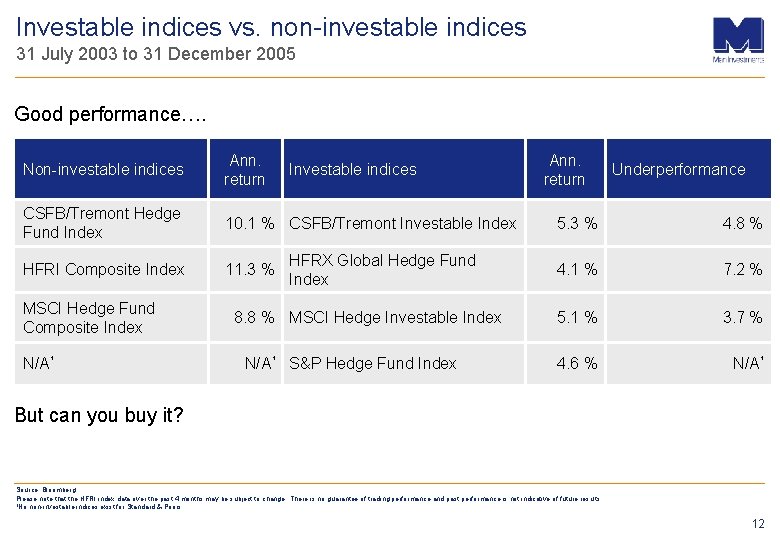
Investable indices vs. non-investable indices 31 July 2003 to 31 December 2005 Good performance…. Non-investable indices Ann. return CSFB/Tremont Hedge Fund Index 10. 1 % CSFB/Tremont Investable Index HFRI Composite Index 11. 3 % MSCI Hedge Fund Composite Index N/A¹ Investable indices HFRX Global Hedge Fund Index 8. 8 % MSCI Hedge Investable Index N/A¹ S&P Hedge Fund Index Ann. return Underperformance 5. 3 % 4. 8 % 4. 1 % 7. 2 % 5. 1 % 3. 7 % 4. 6 % N/A¹ But can you buy it? Source: Bloomberg. Please note that the HFRI index data over the past 4 months may be subject to change. There is no guarantee of trading performance and past performance is not indicative of future results. ¹No non-investable indices exist for Standard & Poors. 12
New styles/strategies • New styles – Commodities – Credit – Insurance – Longer term alpha – Emerging local market debt • New strategies – Asian opportunities – Healthcare – Special situations 13
Conclusion • Is the industry too big? • There are new sources of alpha • Investable indices are not what they appear • Well managed fund of funds can deliver better returns • Structured products offering guaranteed return of capital are another safe way into hedge funds 14
- Slides: 14