
Investment Analysis and Portfolio Management Sixth Edition by
Investment Analysis and Portfolio Management Sixth Edition by Frank K. Reilly & Keith C. Brown The Portfolio Management Process (From Ch. 2) Copyright © 2000 by Harcourt, Inc. All rights reserved.
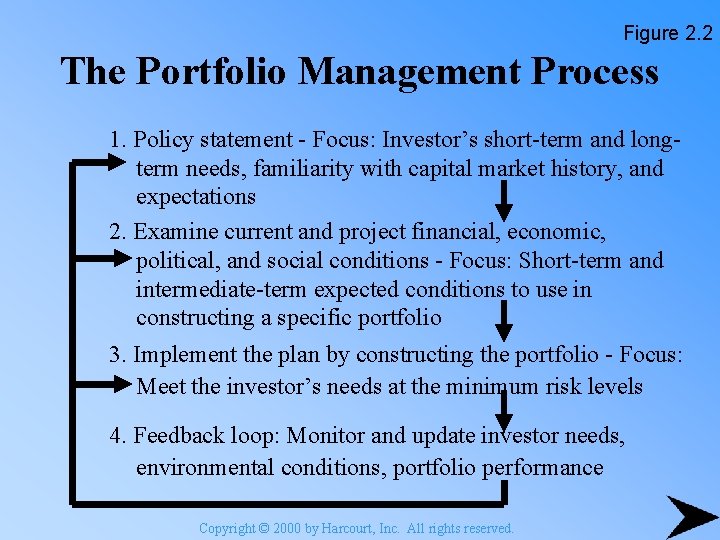
Figure 2. 2 The Portfolio Management Process 1. Policy statement - Focus: Investor’s short-term and longterm needs, familiarity with capital market history, and expectations 2. Examine current and project financial, economic, political, and social conditions - Focus: Short-term and intermediate-term expected conditions to use in constructing a specific portfolio 3. Implement the plan by constructing the portfolio - Focus: Meet the investor’s needs at the minimum risk levels 4. Feedback loop: Monitor and update investor needs, environmental conditions, portfolio performance Copyright © 2000 by Harcourt, Inc. All rights reserved.
The Portfolio Management Process 1. Policy statement – specifies investment goals and acceptable risk levels – should be reviewed periodically – guides all investment decisions Copyright © 2000 by Harcourt, Inc. All rights reserved.
The Portfolio Management Process 2. Study current financial and economic conditions and forecast future trends – determine strategies to meet goals – requires monitoring and updates Copyright © 2000 by Harcourt, Inc. All rights reserved.
The Portfolio Management Process 3. Construct the portfolio – allocate available funds to meet goals and minimize investor’s risks Copyright © 2000 by Harcourt, Inc. All rights reserved.
The Portfolio Management Process 4. Monitor and update – revise policy statement as needed – modify investment strategy accordingly – evaluate portfolio performance Copyright © 2000 by Harcourt, Inc. All rights reserved.
The Need For A Policy Statement • Understand articulate realistic investor goals – needs, objectives, and constraints – financial markets and risks of investing Copyright © 2000 by Harcourt, Inc. All rights reserved.
Constructing A Policy Statement • What are the real risks of an adverse financial outcome, especially in the short run? • What probable emotional reactions will I have to an adverse financial outcome? • How knowledgeable am I about investments and markets? Copyright © 2000 by Harcourt, Inc. All rights reserved.
Constructing A Policy Statement • What other capital or income sources do I have? How important is this particular portfolio to my overall financial position? • What, if any, legal restrictions may affect my investment needs? • What, if any, unanticipated consequences of interim fluctuations in portfolio value might affect my investment policy? Copyright © 2000 by Harcourt, Inc. All rights reserved.
Standards For Evaluating Portfolio Performance • Benchmark portfolio – risk and return • Matches risk preferences and investment needs – analysis of risk tolerance – return objective goals Copyright © 2000 by Harcourt, Inc. All rights reserved.
Realistic Investor Goals • Capital preservation – minimize risk of real loss – strongly risk-averse or funds needed soon • Capital appreciation – capital gains to provide real growth over time for future need – aggressive strategy with accepted risk • Current income – generate spendable funds Copyright © 2000 by Harcourt, Inc. All rights reserved.
Realistic Investor Goals • Total return – capital gains and income reinvestment – moderate risk exposure Copyright © 2000 by Harcourt, Inc. All rights reserved.
Investment Constraints • Liquidity needs – near-term goals • Time horizon – longer time horizon favors risk acceptability – short time horizon favors less risky investments because losses are harder to overcome in a short time frame Copyright © 2000 by Harcourt, Inc. All rights reserved.
Investment Constraints • Tax concerns – interest and dividends taxed at investor’s marginal tax rate – capital gains may be unrealized – basis and gain or loss realized – revisions to capital gains tax rates – tradeoff with diversification needs for employer’s stock holdings Copyright © 2000 by Harcourt, Inc. All rights reserved.
Legal and Regulatory Factors • Limitations or penalties on withdrawals • Fiduciary responsibilities “prudent man” rule • Investment laws prohibit insider trading Copyright © 2000 by Harcourt, Inc. All rights reserved.
Unique Needs and Preferences • Personal preferences - socially conscious investments • Time constraints or expertise for managing the portfolio may require professional management • Large investment in employer may require consideration of diversification needs and realistic liquidity • Institutional investors needs Copyright © 2000 by Harcourt, Inc. All rights reserved.
Constructing the Policy Statement • Objectives - risk and return • Constraints - liquidity, time horizon, tax factors, legal and regulatory constraints, and unique needs and preferences • Developing a plan depends on understanding the relationship between risk and return and the importance of diversification Copyright © 2000 by Harcourt, Inc. All rights reserved.
- Slides: 17