
Investing under uncertainty Real options analysis Contents Objectives
Investing under uncertainty Real options analysis
Contents Objectives of workshop Introduction to real options Applying real options analysis throughout the investment lifecycle Exercises Wrap up 1

Objectives of the workshop • Provide an introduction to real options analysis • Explain how real options analysis can be applied throughout the investment life cycle • Desired outcomes – an understanding of uncertainties (as distinct from risks) and the impact they may have on an investment – an understanding of how flexibility can add value to an investment – an understanding of how real options analysis should be applied to all investments at a high level – an understanding of the investments for which a more detailed application of real options analysis is justified 2
1 Introduction to real options analysis
Why consider real options analysis? • Traditional investment decision-making based on cost-benefit analysis (CBA) • Traditional CBA and NPV analyses commonly make some fundamental assumptions – investment now or never – objective to deliver approved scope, even as circumstances changes – project risks accounted for upfront, rather than providing managerial flexibility to respond to changing circumstances • Government may not have sufficient flexibility to adapt investment strategy to effectively deal with changing circumstances (uncertainties) • May regret investment decision – Investment options that are preferred and would be successful under one set of circumstances can become unviable under a different set of circumstances • For example, a road expanded based on historical growth in demand may be unviable if the take up of driverless cars is greater than forecast 4
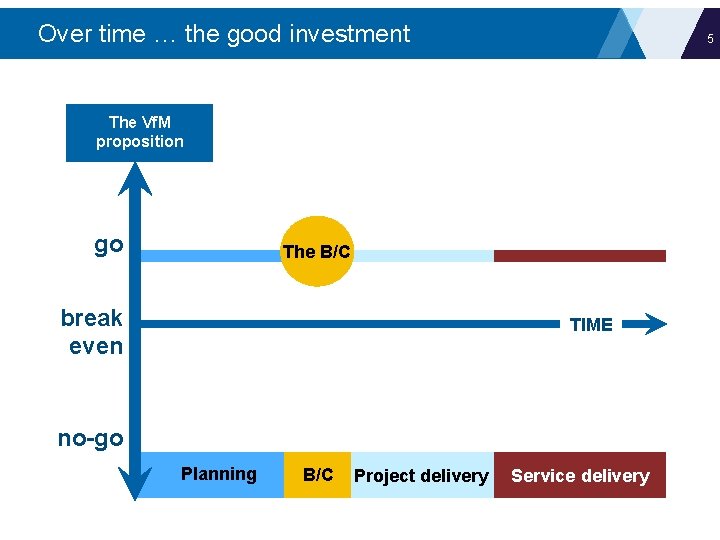
Over time … the good investment 5 The Vf. M proposition go The B/C break even TIME no-go Planning B/C Project delivery Service delivery
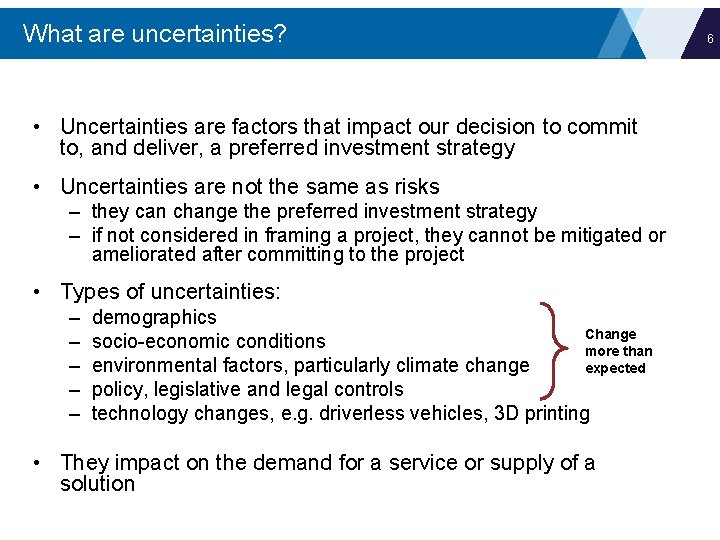
What are uncertainties? • Uncertainties are factors that impact our decision to commit to, and deliver, a preferred investment strategy • Uncertainties are not the same as risks – they can change the preferred investment strategy – if not considered in framing a project, they cannot be mitigated or ameliorated after committing to the project • Types of uncertainties: – – – demographics Change socio-economic conditions more than environmental factors, particularly climate change expected policy, legislative and legal controls technology changes, e. g. driverless vehicles, 3 D printing • They impact on the demand for a service or supply of a solution 6
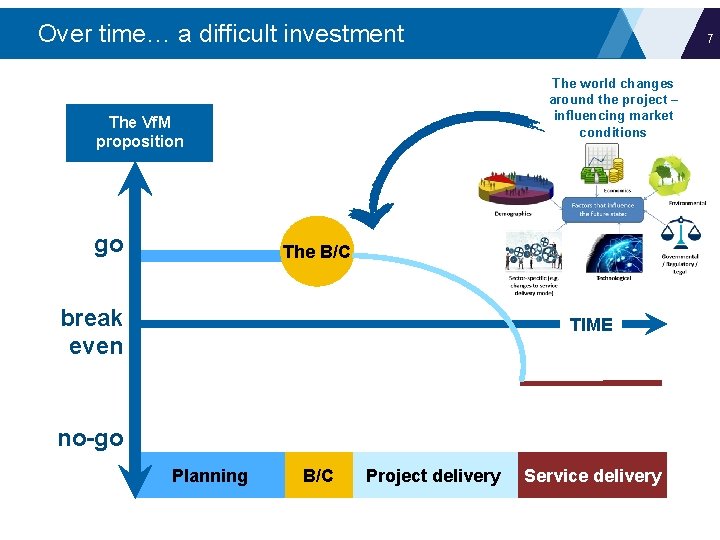
Over time… a difficult investment The world changes around the project – influencing market conditions The Vf. M proposition go 7 The B/C break even TIME no-go Planning B/C Project delivery Service delivery
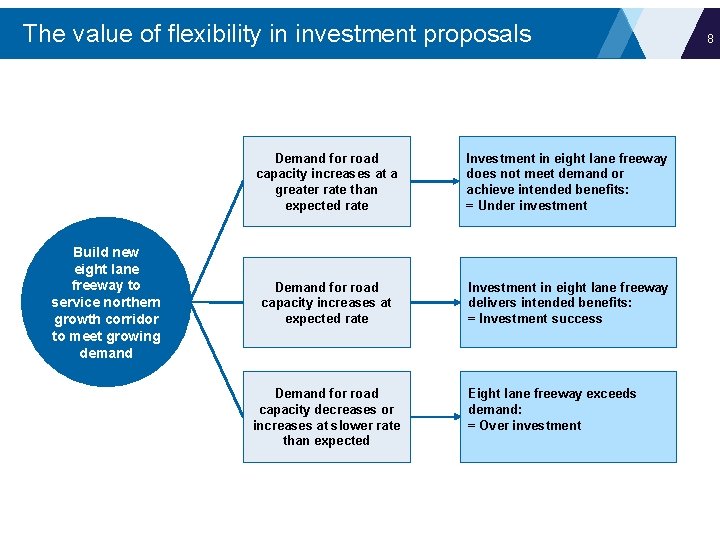
The value of flexibility in investment proposals Build new eight lane freeway to service northern growth corridor to meet growing demand Demand for road capacity increases at a greater rate than expected rate Investment in eight lane freeway does not meet demand or achieve intended benefits: = Under investment Demand for road capacity increases at expected rate Investment in eight lane freeway delivers intended benefits: = Investment success Demand for road capacity decreases or increases at slower rate than expected Eight lane freeway exceeds demand: = Over investment 8

Risks vs uncertainties 9 RISKS UNCERTAINTIES Forecasts (e. g. population) within expected range Forecasts outside expected range Design risks relating to project scope Technological advancements or market disruptions Due diligence risks (e. g. soil contamination) within expectations Future economic conditions, such as strength of Australian dollar, outside expectations Stakeholder management issues Future legislative, legal or policy changes at a State or Commonwealth level Loss of key project staff Conditional outcomes in inter-dependent investment projects • • • Risks can be managed while striving to deliver intended outcomes; uncertainties can’t be managed unless they were considered in framing the investment strategy A successful strategy to deal with uncertainty will usually be flexible so that a decision can be made to cost effectively change the investment strategy’s course Real options analysis is an investment planning, evaluation and decision-making framework that incorporates flexible, qualitative and quantitative approaches to better plan and manage projects that are significantly impacted by uncertainty

What is real options analysis? • Real options analysis extends the traditional CBA framework • A real option comprises – Option costs – costs associated with creating flexibility to change investment strategy and maintain effective access to the option • For example, a hospital may be built in a way that it is readily upgradeable if demand increases more quickly than expected – Exercise cost – the cost to exercise the option • For example, the cost to upgrade the hospital – Life of an option – the time until the option is no longer valid or available • For example, some time before the end of the life of the hospital – Exercise trigger – the conditions that define when a real option should be exercised • For example, when the demand for services exceeds a particular threshold 10
What is real options analysis? • Real options analysis can add value to an investment – when identifying the problem to be addressed – prior to committing to an investment – during project delivery – during the asset’s operational life 11
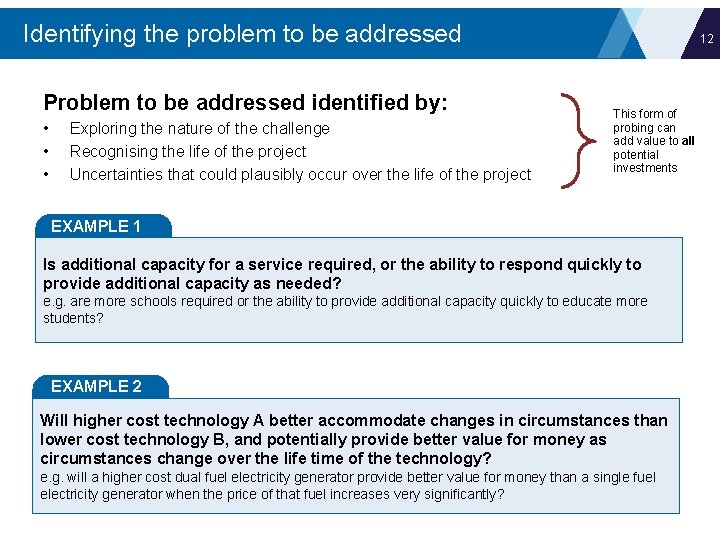
Identifying the problem to be addressed Problem to be addressed identified by: • • • Exploring the nature of the challenge Recognising the life of the project Uncertainties that could plausibly occur over the life of the project 12 This form of probing can add value to all potential investments EXAMPLE 1 Is additional capacity for a service required, or the ability to respond quickly to provide additional capacity as needed? e. g. are more schools required or the ability to provide additional capacity quickly to educate more students? EXAMPLE 2 Will higher cost technology A better accommodate changes in circumstances than lower cost technology B, and potentially provide better value for money as circumstances change over the life time of the technology? e. g. will a higher cost dual fuel electricity generator provide better value for money than a single fuel electricity generator when the price of that fuel increases very significantly?
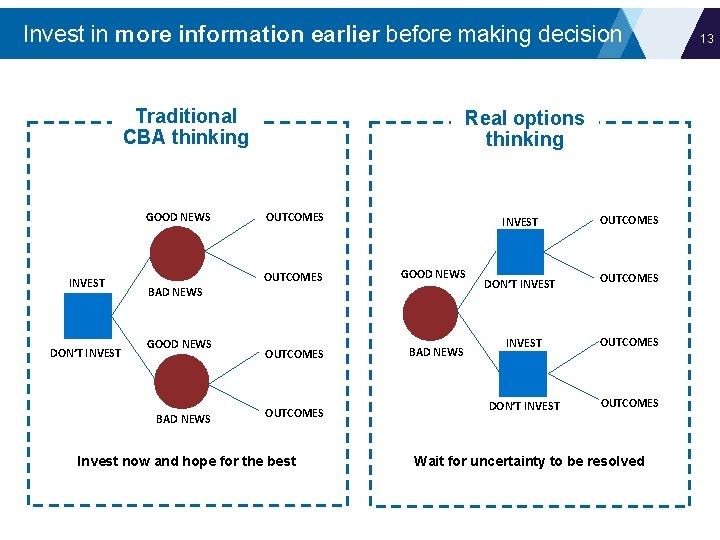
Invest in more information earlier before making decision Traditional CBA thinking GOOD NEWS Real options thinking OUTCOMES INVEST GOOD NEWS BAD NEWS DON’T INVEST GOOD NEWS 13 DON’T INVEST OUTCOMES BAD NEWS OUTCOMES INVEST BAD NEWS OUTCOMES Invest now and hope for the best DON’T INVEST OUTCOMES Wait for uncertainty to be resolved
Examples of information options
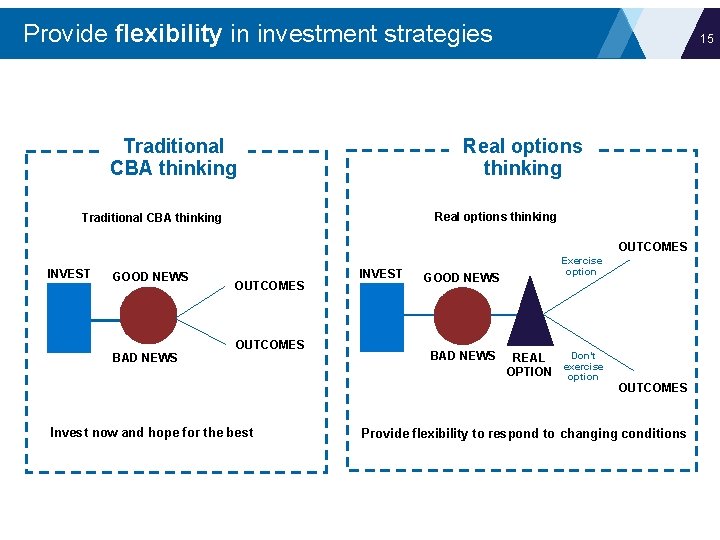
Provide flexibility in investment strategies Traditional CBA thinking 15 Real options thinking Traditional CBA thinking OUTCOMES INVEST GOOD NEWS Exercise option BAD NEWS OUTCOMES Invest now and hope for the best BAD NEWS REAL Don’t exercise OPTION option OUTCOMES Provide flexibility to respond to changing conditions
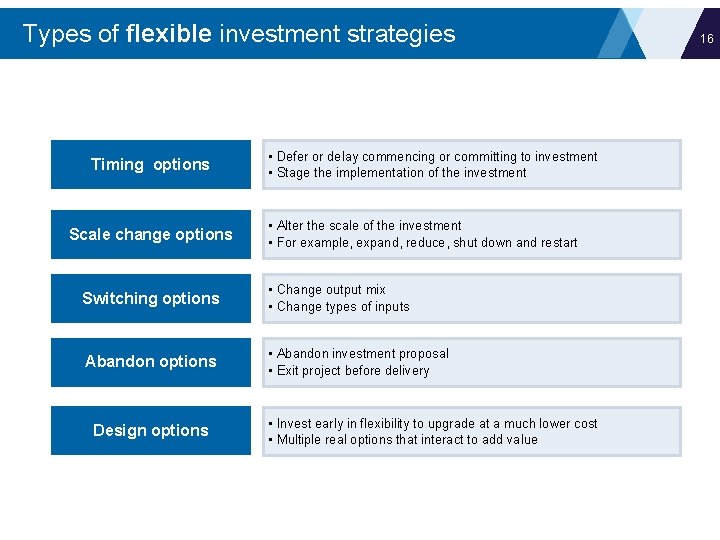
Types of flexible investment strategies Timing options Scale change options • Defer or delay commencing or committing to investment • Stage the implementation of the investment • Alter the scale of the investment • For example, expand, reduce, shut down and restart Switching options • Change output mix • Change types of inputs Abandon options • Abandon investment proposal • Exit project before delivery Design options • Invest early in flexibility to upgrade at a much lower cost • Multiple real options that interact to add value 16
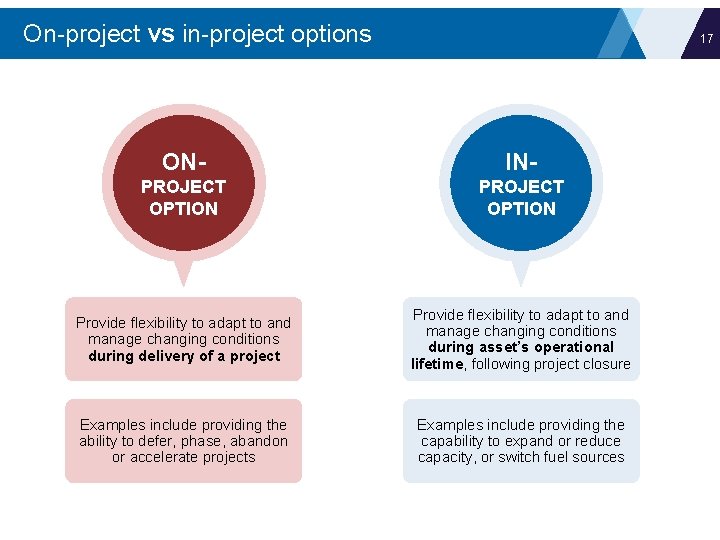
On-project vs in-project options 17 ON- IN- PROJECT OPTION Provide flexibility to adapt to and manage changing conditions during delivery of a project Provide flexibility to adapt to and manage changing conditions during asset’s operational lifetime, following project closure Examples include providing the ability to defer, phase, abandon or accelerate projects Examples include providing the capability to expand or reduce capacity, or switch fuel sources
Examples of flexibility options
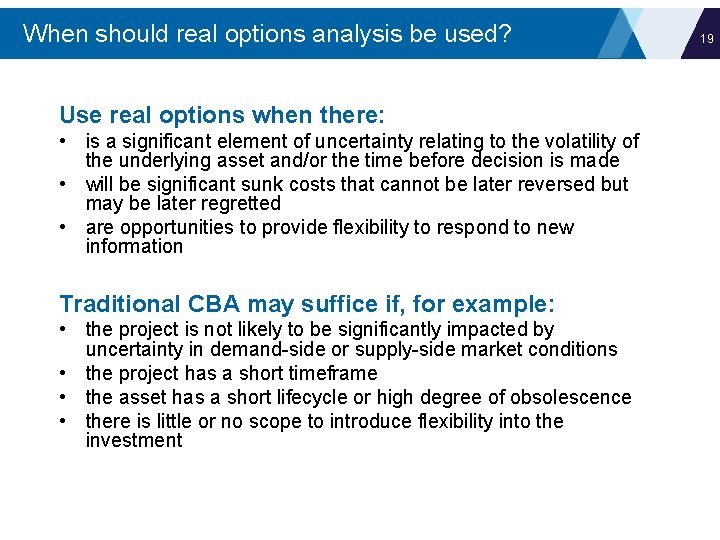
When should real options analysis be used? Use real options when there: • is a significant element of uncertainty relating to the volatility of the underlying asset and/or the time before decision is made • will be significant sunk costs that cannot be later reversed but may be later regretted • are opportunities to provide flexibility to respond to new information Traditional CBA may suffice if, for example: • the project is not likely to be significantly impacted by uncertainty in demand-side or supply-side market conditions • the project has a short timeframe • the asset has a short lifecycle or high degree of obsolescence • there is little or no scope to introduce flexibility into the investment 19
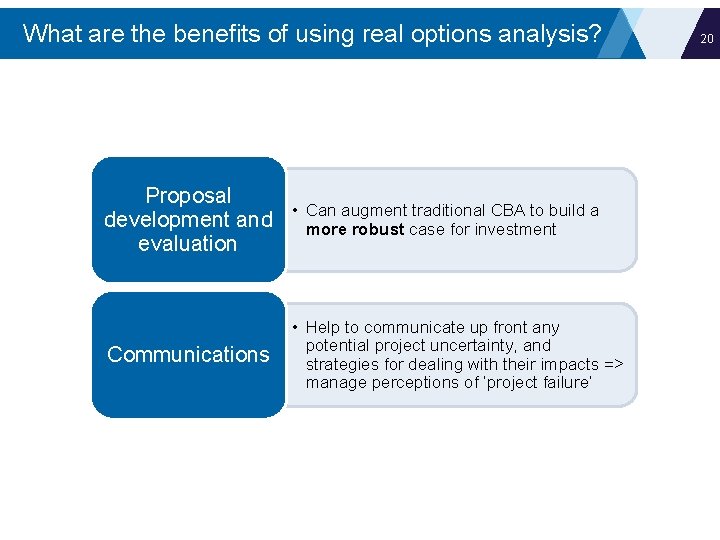
What are the benefits of using real options analysis? Proposal development and evaluation • Can augment traditional CBA to build a more robust case for investment Communications • Help to communicate up front any potential project uncertainty, and strategies for dealing with their impacts => manage perceptions of ‘project failure’ 20
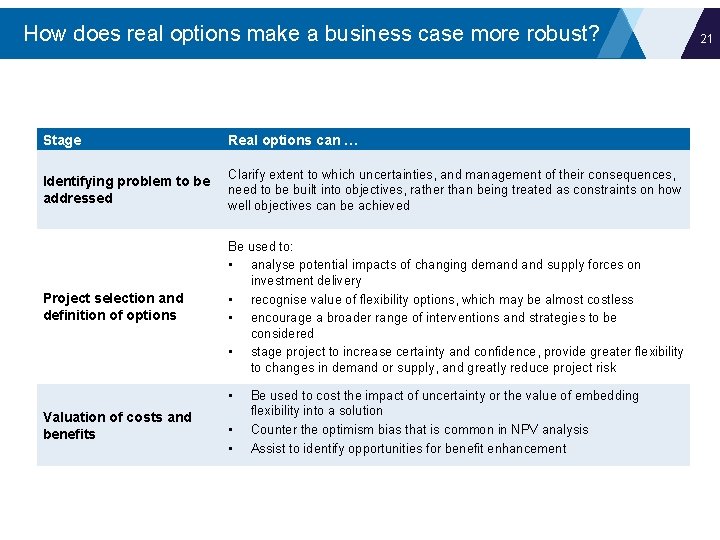
How does real options make a business case more robust? Stage Real options can … Identifying problem to be addressed Clarify extent to which uncertainties, and management of their consequences, need to be built into objectives, rather than being treated as constraints on how well objectives can be achieved Project selection and definition of options Be used to: • analyse potential impacts of changing demand supply forces on investment delivery • recognise value of flexibility options, which may be almost costless • encourage a broader range of interventions and strategies to be considered • stage project to increase certainty and confidence, provide greater flexibility to changes in demand or supply, and greatly reduce project risk • Valuation of costs and benefits • • Be used to cost the impact of uncertainty or the value of embedding flexibility into a solution Counter the optimism bias that is common in NPV analysis Assist to identify opportunities for benefit enhancement 21
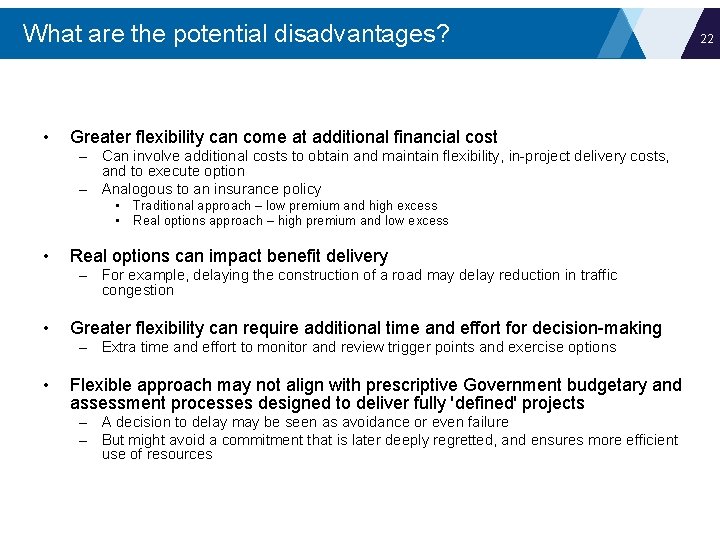
What are the potential disadvantages? • Greater flexibility can come at additional financial cost – Can involve additional costs to obtain and maintain flexibility, in-project delivery costs, and to execute option – Analogous to an insurance policy • Traditional approach – low premium and high excess • Real options approach – high premium and low excess • Real options can impact benefit delivery – For example, delaying the construction of a road may delay reduction in traffic congestion • Greater flexibility can require additional time and effort for decision-making – Extra time and effort to monitor and review trigger points and exercise options • Flexible approach may not align with prescriptive Government budgetary and assessment processes designed to deliver fully 'defined' projects – A decision to delay may be seen as avoidance or even failure – But might avoid a commitment that is later deeply regretted, and ensures more efficient use of resources 22
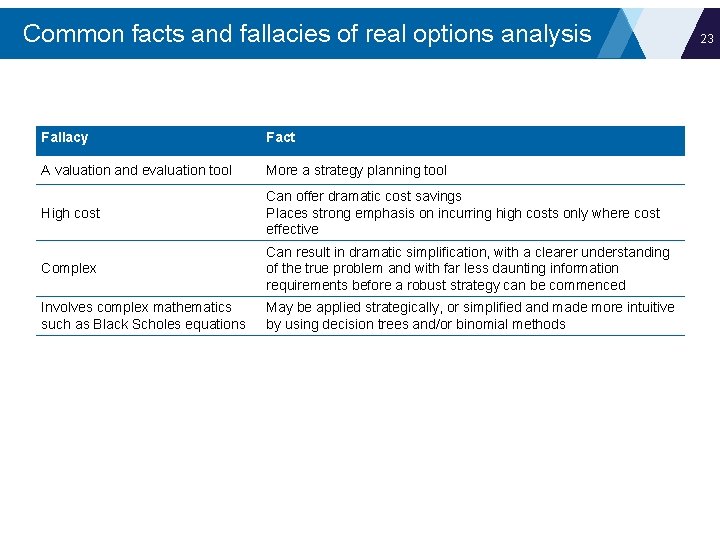
Common facts and fallacies of real options analysis Fallacy Fact A valuation and evaluation tool More a strategy planning tool High cost Can offer dramatic cost savings Places strong emphasis on incurring high costs only where cost effective Complex Can result in dramatic simplification, with a clearer understanding of the true problem and with far less daunting information requirements before a robust strategy can be commenced Involves complex mathematics such as Black Scholes equations May be applied strategically, or simplified and made more intuitive by using decision trees and/or binomial methods 23
2 Applying real options analysis throughout the investment lifecycle
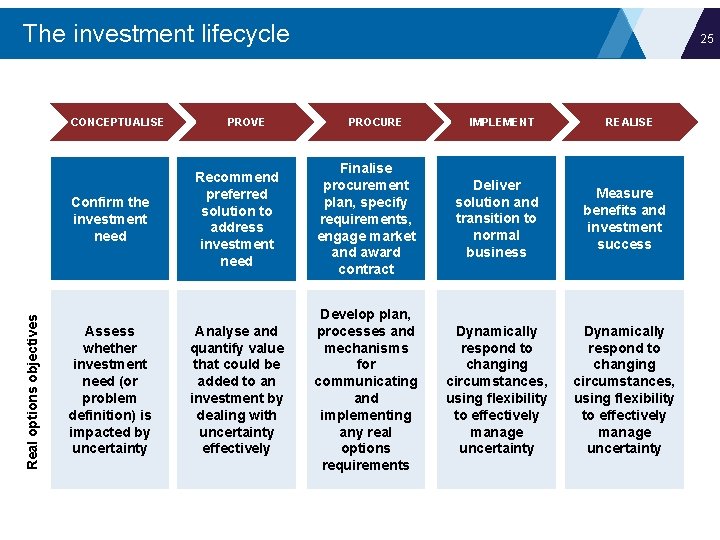
The investment lifecycle CONCEPTUALISE Real options objectives Confirm the investment need Assess whether investment need (or problem definition) is impacted by uncertainty PROVE 25 PROCURE IMPLEMENT REALISE Recommend preferred solution to address investment need Finalise procurement plan, specify requirements, engage market and award contract Deliver solution and transition to normal business Measure benefits and investment success Analyse and quantify value that could be added to an investment by dealing with uncertainty effectively Develop plan, processes and mechanisms for communicating and implementing any real options requirements Dynamically respond to changing circumstances, using flexibility to effectively manage uncertainty
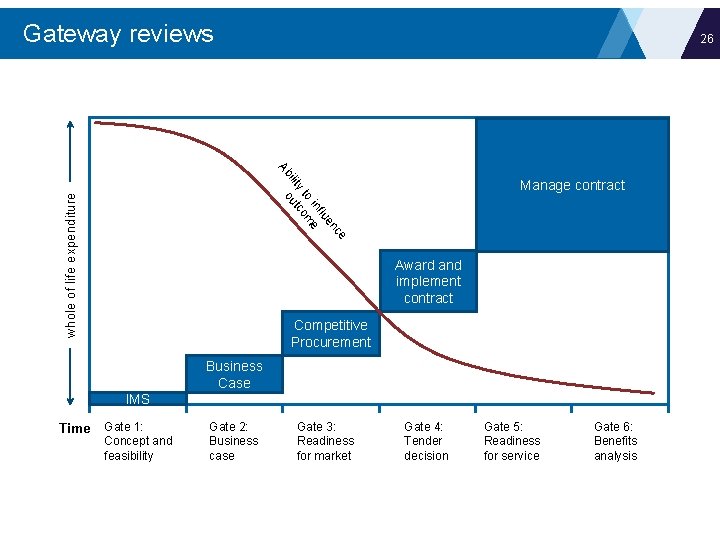
Gateway reviews 26 Ab ce whole of life expenditure en flu in e to m y co ilit out Manage contract Award and implement contract Competitive Procurement Business Case IMS Time Gate 1: Concept and feasibility Gate 2: Business case Gate 3: Readiness for market Gate 4: Tender decision Gate 5: Readiness for service Gate 6: Benefits analysis
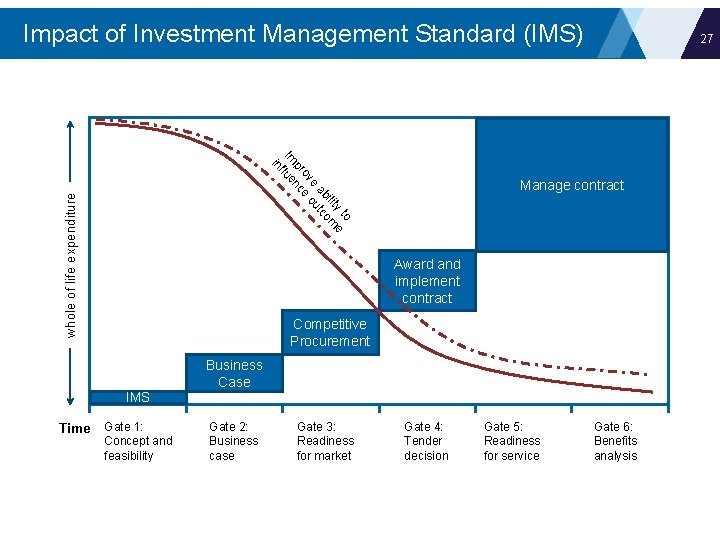
Impact of Investment Management Standard (IMS) to y e ilit om ab tc e ou ov e pr nc Im lue f in whole of life expenditure 27 Manage contract Award and implement contract Competitive Procurement Business Case IMS Time Gate 1: Concept and feasibility Gate 2: Business case Gate 3: Readiness for market Gate 4: Tender decision Gate 5: Readiness for service Gate 6: Benefits analysis
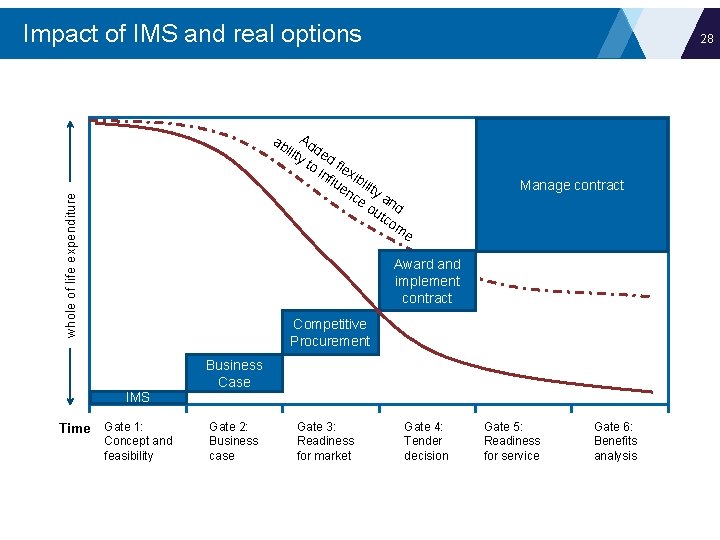
Impact of IMS and real options 28 whole of life expenditure ab Ad ilit de y t d o i fle nfl xib ue ilit nc y a e o nd utc om e Manage contract Award and implement contract Competitive Procurement Business Case IMS Time Gate 1: Concept and feasibility Gate 2: Business case Gate 3: Readiness for market Gate 4: Tender decision Gate 5: Readiness for service Gate 6: Benefits analysis
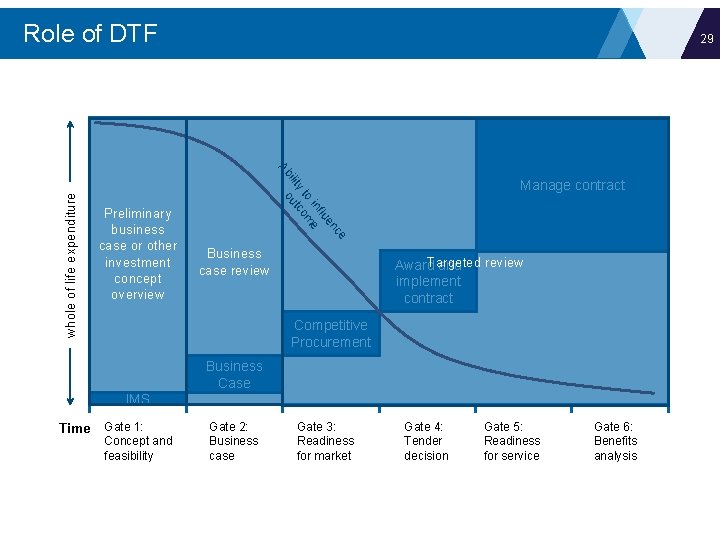
Role of DTF 29 ce en flu in e to m y co ilit out whole of life expenditure Ab Preliminary business case or other investment concept overview Manage contract Business case review Targeted review Award and implement contract Competitive Procurement Business Case IMS Time Gate 1: Concept and feasibility Gate 2: Business case Gate 3: Readiness for market Gate 4: Tender decision Gate 5: Readiness for service Gate 6: Benefits analysis
STAGE 1: CONCEPTUALISE
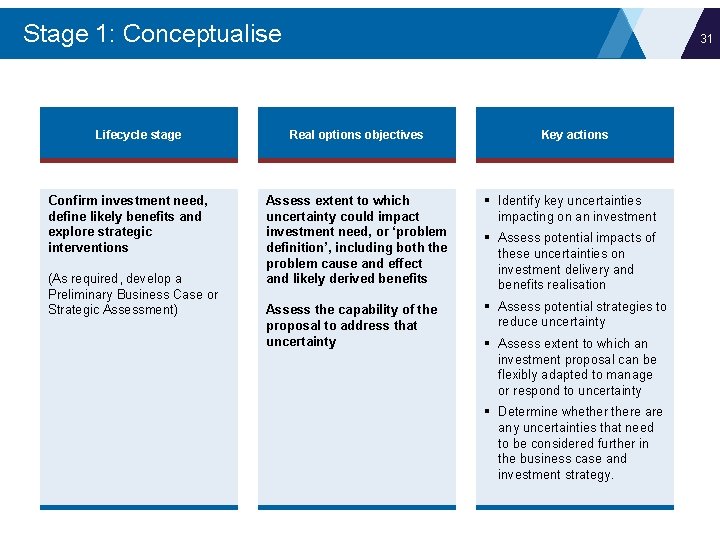
Stage 1: Conceptualise Lifecycle stage Confirm investment need, define likely benefits and explore strategic interventions (As required, develop a Preliminary Business Case or Strategic Assessment) 31 Real options objectives Key actions Assess extent to which uncertainty could impact investment need, or ‘problem definition’, including both the problem cause and effect and likely derived benefits § Identify key uncertainties impacting on an investment Assess the capability of the proposal to address that uncertainty § Assess potential strategies to reduce uncertainty § Assess potential impacts of these uncertainties on investment delivery and benefits realisation § Assess extent to which an investment proposal can be flexibly adapted to manage or respond to uncertainty § Determine whethere any uncertainties that need to be considered further in the business case and investment strategy.
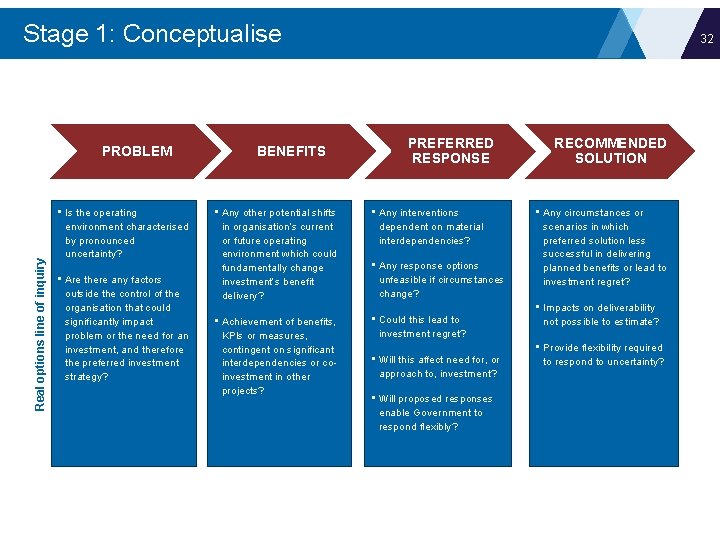
Stage 1: Conceptualise Real options line of inquiry PROBLEM • Is the operating environment characterised by pronounced uncertainty? • Are there any factors outside the control of the organisation that could significantly impact problem or the need for an investment, and therefore the preferred investment strategy? BENEFITS 32 PREFERRED RESPONSE • Any other potential shifts in organisation’s current or future operating environment which could fundamentally change investment’s benefit delivery? • Any interventions dependent on material interdependencies? • Achievement of benefits, KPIs or measures, contingent on significant interdependencies or coinvestment in other projects? • Could this lead to investment regret? • Any response options unfeasible if circumstances change? • Will this affect need for, or approach to, investment? • Will proposed responses enable Government to respond flexibly? RECOMMENDED SOLUTION • Any circumstances or scenarios in which preferred solution less successful in delivering planned benefits or lead to investment regret? • Impacts on deliverability not possible to estimate? • Provide flexibility required to respond to uncertainty?
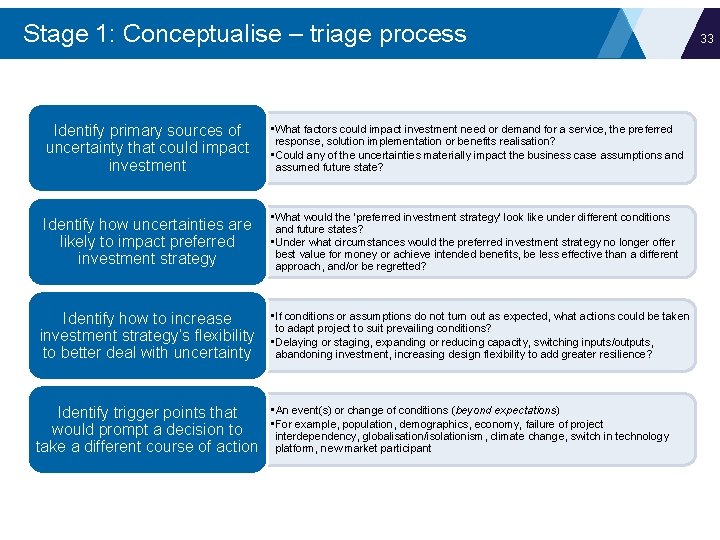
Stage 1: Conceptualise – triage process Identify primary sources of uncertainty that could impact investment • What factors could impact investment need or demand for a service, the preferred response, solution implementation or benefits realisation? • Could any of the uncertainties materially impact the business case assumptions and assumed future state? Identify how uncertainties are likely to impact preferred investment strategy • What would the 'preferred investment strategy' look like under different conditions and future states? • Under what circumstances would the preferred investment strategy no longer offer best value for money or achieve intended benefits, be less effective than a different approach, and/or be regretted? Identify how to increase investment strategy’s flexibility to better deal with uncertainty Identify trigger points that would prompt a decision to take a different course of action • If conditions or assumptions do not turn out as expected, what actions could be taken to adapt project to suit prevailing conditions? • Delaying or staging, expanding or reducing capacity, switching inputs/outputs, abandoning investment, increasing design flexibility to add greater resilience? • An event(s) or change of conditions (beyond expectations) • For example, population, demographics, economy, failure of project interdependency, globalisation/isolationism, climate change, switch in technology platform, new market participant 33
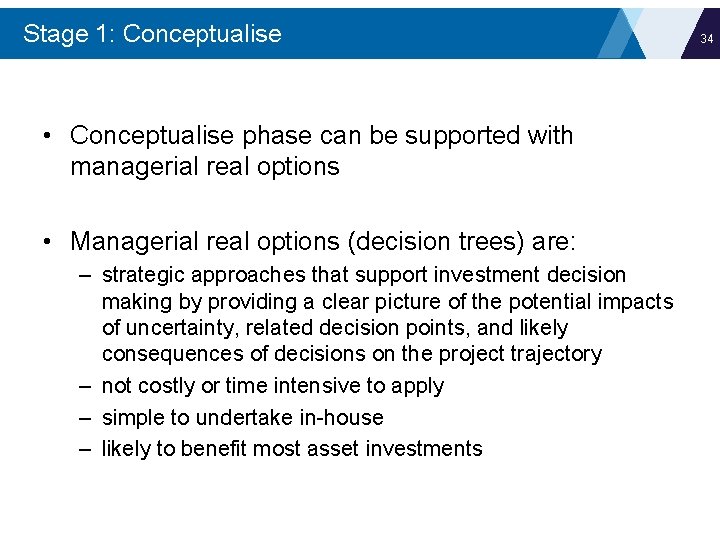
Stage 1: Conceptualise • Conceptualise phase can be supported with managerial real options • Managerial real options (decision trees) are: – strategic approaches that support investment decision making by providing a clear picture of the potential impacts of uncertainty, related decision points, and likely consequences of decisions on the project trajectory – not costly or time intensive to apply – simple to undertake in-house – likely to benefit most asset investments 34
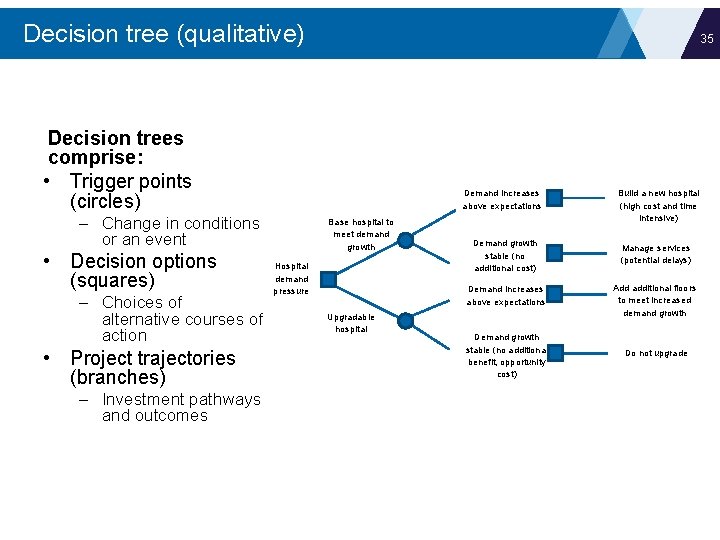
Decision tree (qualitative) 35 Decision trees comprise: • Trigger points (circles) Demand increases above expectations – Change in conditions or an event • Decision options (squares) – Choices of alternative courses of action • Project trajectories (branches) – Investment pathways and outcomes Base hospital to meet demand growth Hospital demand pressure Upgradable hospital Build a new hospital (high cost and time intensive) Demand growth stable (no additional cost) Manage services (potential delays) Demand increases above expectations Add additional floors to meet increased demand growth Demand growth stable (no additional benefit, opportunity cost) Do not upgrade
STAGE 2: PROVE
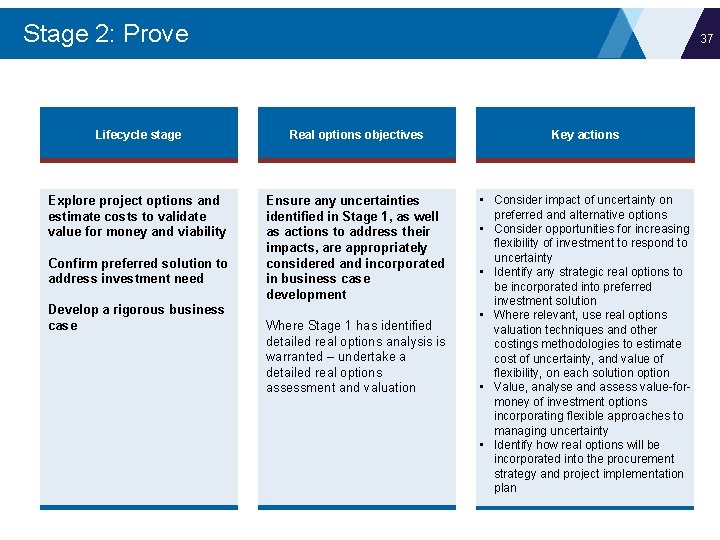
Stage 2: Prove 37 Lifecycle stage Real options objectives Key actions Explore project options and estimate costs to validate value for money and viability Ensure any uncertainties identified in Stage 1, as well as actions to address their impacts, are appropriately considered and incorporated in business case development • Consider impact of uncertainty on preferred and alternative options • Consider opportunities for increasing flexibility of investment to respond to uncertainty • Identify any strategic real options to be incorporated into preferred investment solution • Where relevant, use real options valuation techniques and other costings methodologies to estimate cost of uncertainty, and value of flexibility, on each solution option • Value, analyse and assess value-formoney of investment options incorporating flexible approaches to managing uncertainty • Identify how real options will be incorporated into the procurement strategy and project implementation plan Confirm preferred solution to address investment need Develop a rigorous business case Where Stage 1 has identified detailed real options analysis is warranted – undertake a detailed real options assessment and valuation
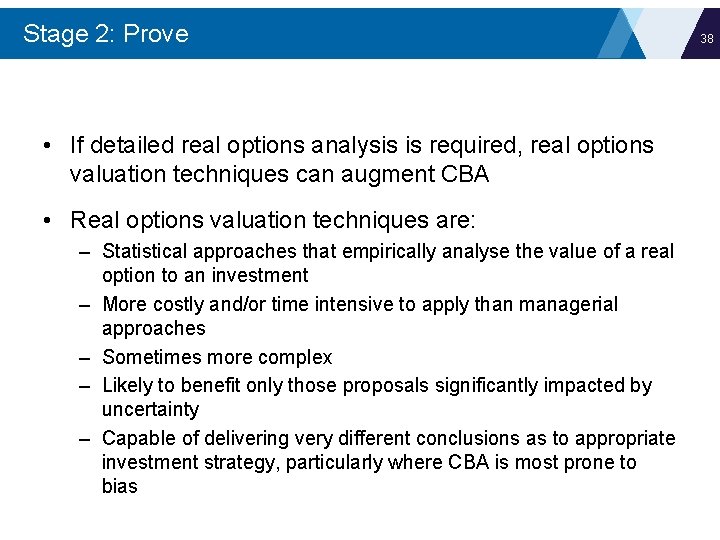
Stage 2: Prove • If detailed real options analysis is required, real options valuation techniques can augment CBA • Real options valuation techniques are: – Statistical approaches that empirically analyse the value of a real option to an investment – More costly and/or time intensive to apply than managerial approaches – Sometimes more complex – Likely to benefit only those proposals significantly impacted by uncertainty – Capable of delivering very different conclusions as to appropriate investment strategy, particularly where CBA is most prone to bias 38
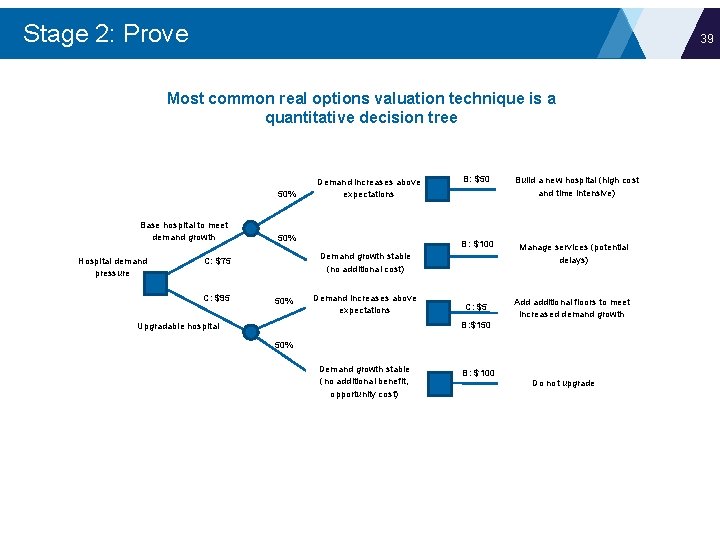
Stage 2: Prove 39 Most common real options valuation technique is a quantitative decision tree 50% Base hospital to meet demand growth Hospital demand pressure Upgradable hospital B: $50 Build a new hospital (high cost and time intensive) 50% B: $100 Demand growth stable (no additional cost) C: $75 C: $95 Demand increases above expectations 50% Demand increases above expectations C: $5 Manage services (potential delays) Add additional floors to meet increased demand growth B: $150 50% Demand growth stable (no additional benefit, opportunity cost) B: $100 Do not upgrade
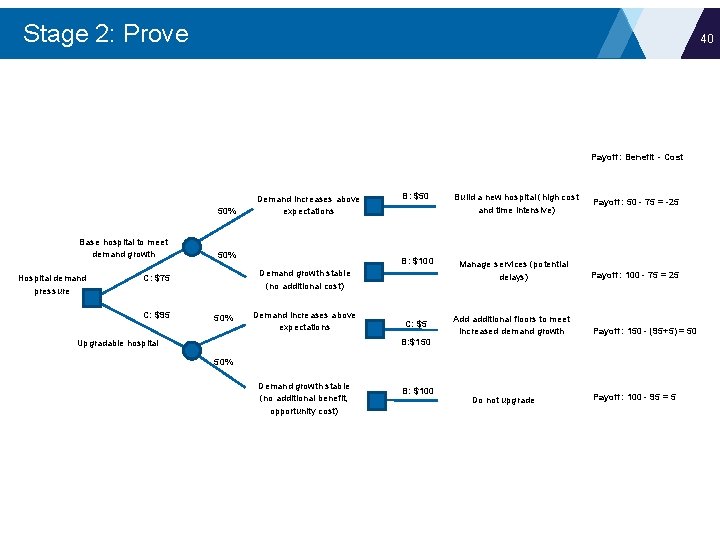
Stage 2: Prove 40 Payoff: Benefit - Cost 50% Base hospital to meet demand growth Hospital demand pressure Upgradable hospital B: $50 Build a new hospital (high cost and time intensive) Payoff: 50 - 75 = -25 50% B: $100 Demand growth stable (no additional cost) C: $75 C: $95 Demand increases above expectations 50% Demand increases above expectations C: $5 Manage services (potential delays) Add additional floors to meet increased demand growth Payoff: 100 - 75 = 25 Payoff: 150 - (95+5) = 50 B: $150 50% Demand growth stable (no additional benefit, opportunity cost) B: $100 Do not upgrade Payoff: 100 - 95 = 5
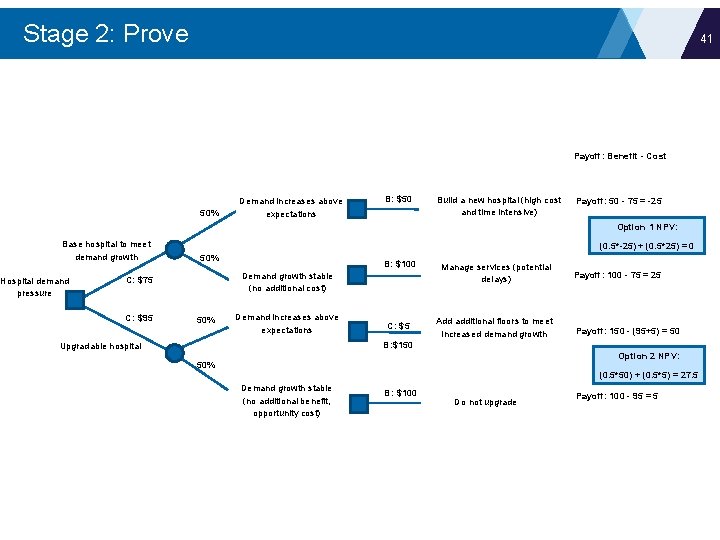
Stage 2: Prove 41 Payoff: Benefit - Cost 50% Base hospital to meet demand growth Hospital demand pressure Upgradable hospital B: $50 Build a new hospital (high cost and time intensive) (0. 5*-25) + (0. 5*25) = 0 50% B: $100 Demand growth stable (no additional cost) 50% Payoff: 50 - 75 = -25 Option 1 NPV: C: $75 C: $95 Demand increases above expectations C: $5 Manage services (potential delays) Add additional floors to meet increased demand growth Payoff: 100 - 75 = 25 Payoff: 150 - (95+5) = 50 B: $150 Option 2 NPV: 50% (0. 5*50) + (0. 5*5) = 27. 5 Demand growth stable (no additional benefit, opportunity cost) B: $100 Do not upgrade Payoff: 100 - 95 = 5
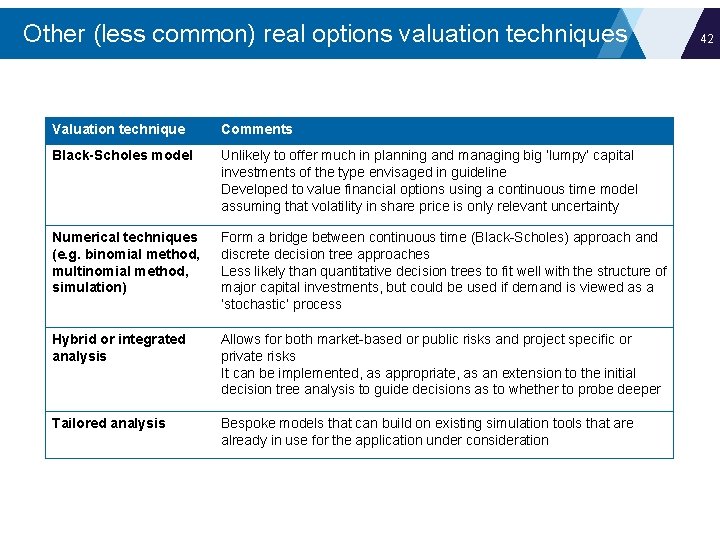
Other (less common) real options valuation techniques Valuation technique Comments Black-Scholes model Unlikely to offer much in planning and managing big ‘lumpy’ capital investments of the type envisaged in guideline Developed to value financial options using a continuous time model assuming that volatility in share price is only relevant uncertainty Numerical techniques (e. g. binomial method, multinomial method, simulation) Form a bridge between continuous time (Black-Scholes) approach and discrete decision tree approaches Less likely than quantitative decision trees to fit well with the structure of major capital investments, but could be used if demand is viewed as a ‘stochastic’ process Hybrid or integrated analysis Allows for both market-based or public risks and project specific or private risks It can be implemented, as appropriate, as an extension to the initial decision tree analysis to guide decisions as to whether to probe deeper Tailored analysis Bespoke models that can build on existing simulation tools that are already in use for the application under consideration 42
Stage 2: Prove Other considerations • Procurement analysis and strategy – Should demonstrate that the procurement approach can appropriately accommodate real options approach • Governance and approvals – should clearly indicate – – • Conditions or triggers for exercising an option Who is responsible for monitoring these conditions Who has the authority to exercise an option Any requirements that should attach to the exercising of an option Project management – Detailed costing and economic evaluation – how will real options or strategies for dealing with uncertainty be considered in the project budget? Is funding required upfront to establish an option or create flexibility? – Timelines and milestones – need to be developed for each project trajectory – Performance measures and benefits realisation – how may optionality impact expected benefits? – Stakeholder management and communications 43
STAGE 3: PROCURE
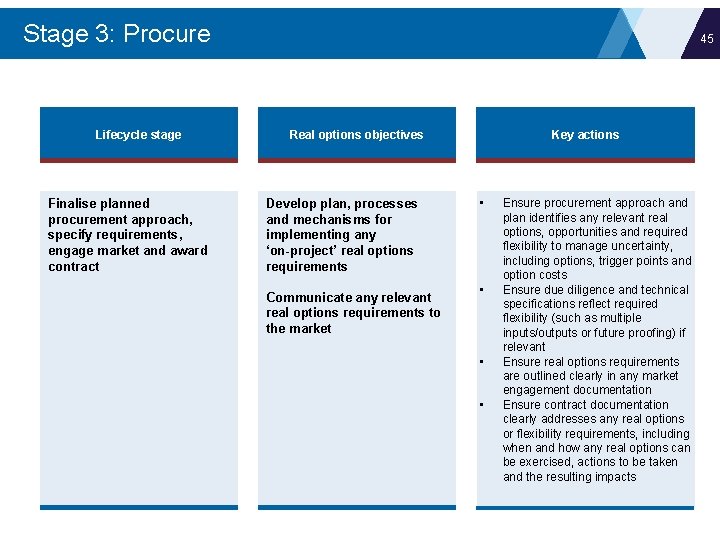
Stage 3: Procure Lifecycle stage Finalise planned procurement approach, specify requirements, engage market and award contract 45 Real options objectives Develop plan, processes and mechanisms for implementing any ‘on-project’ real options requirements Communicate any relevant real options requirements to the market Key actions • • Ensure procurement approach and plan identifies any relevant real options, opportunities and required flexibility to manage uncertainty, including options, trigger points and option costs Ensure due diligence and technical specifications reflect required flexibility (such as multiple inputs/outputs or future proofing) if relevant Ensure real options requirements are outlined clearly in any market engagement documentation Ensure contract documentation clearly addresses any real options or flexibility requirements, including when and how any real options can be exercised, actions to be taken and the resulting impacts
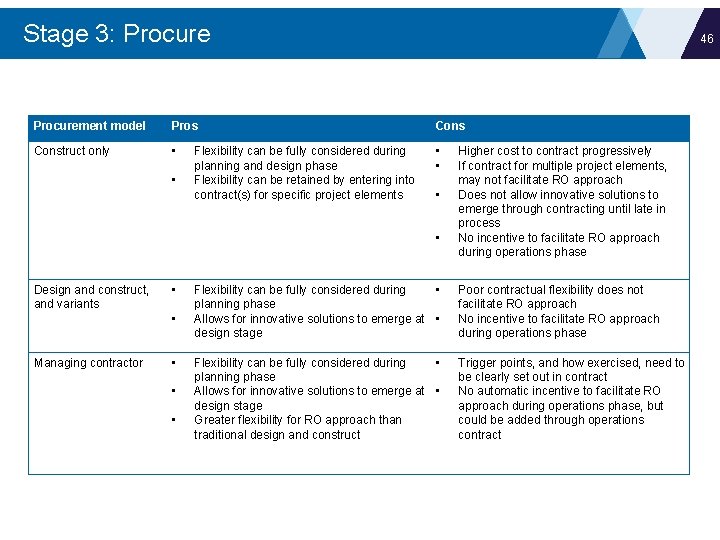
Stage 3: Procure 46 Procurement model Pros Construct only • • Flexibility can be fully considered during planning and design phase Flexibility can be retained by entering into contract(s) for specific project elements • • Design and construct, and variants • • Managing contractor • • • Higher cost to contract progressively If contract for multiple project elements, may not facilitate RO approach Does not allow innovative solutions to emerge through contracting until late in process No incentive to facilitate RO approach during operations phase Flexibility can be fully considered during • planning phase Allows for innovative solutions to emerge at • design stage Poor contractual flexibility does not facilitate RO approach No incentive to facilitate RO approach during operations phase Flexibility can be fully considered during • planning phase Allows for innovative solutions to emerge at • design stage Greater flexibility for RO approach than traditional design and construct Trigger points, and how exercised, need to be clearly set out in contract No automatic incentive to facilitate RO approach during operations phase, but could be added through operations contract
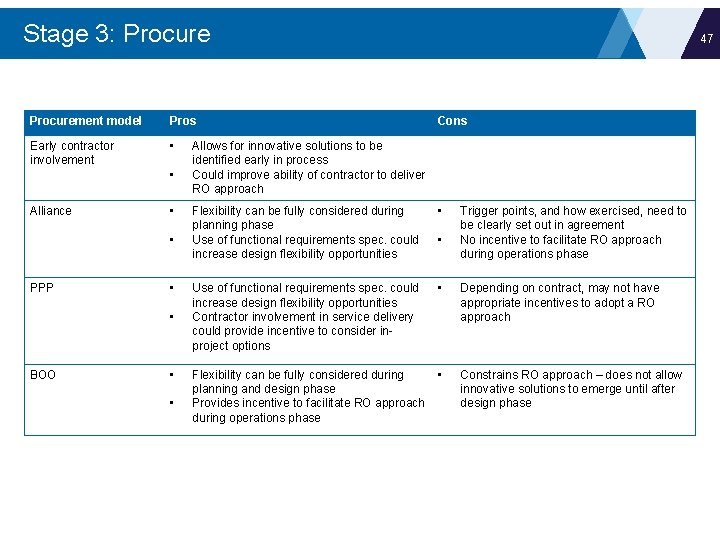
Stage 3: Procurement model Pros Early contractor involvement • • Alliance • • PPP • • BOO • • 47 Cons Allows for innovative solutions to be identified early in process Could improve ability of contractor to deliver RO approach Flexibility can be fully considered during planning phase Use of functional requirements spec. could increase design flexibility opportunities • Use of functional requirements spec. could increase design flexibility opportunities Contractor involvement in service delivery could provide incentive to consider inproject options • • Flexibility can be fully considered during • planning and design phase Provides incentive to facilitate RO approach during operations phase Trigger points, and how exercised, need to be clearly set out in agreement No incentive to facilitate RO approach during operations phase Depending on contract, may not have appropriate incentives to adopt a RO approach Constrains RO approach – does not allow innovative solutions to emerge until after design phase
STAGE 4: IMPLEMENT
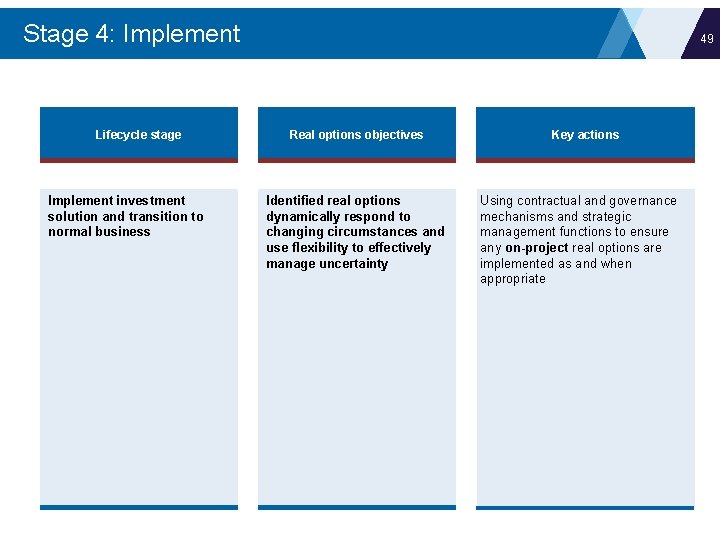
Stage 4: Implement Lifecycle stage Implement investment solution and transition to normal business 49 Real options objectives Identified real options dynamically respond to changing circumstances and use flexibility to effectively manage uncertainty Key actions Using contractual and governance mechanisms and strategic management functions to ensure any on-project real options are implemented as and when appropriate
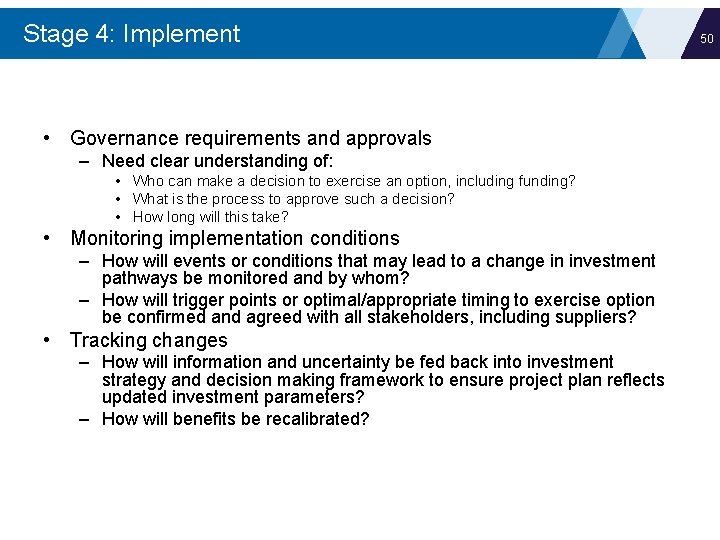
Stage 4: Implement • Governance requirements and approvals – Need clear understanding of: • Who can make a decision to exercise an option, including funding? • What is the process to approve such a decision? • How long will this take? • Monitoring implementation conditions – How will events or conditions that may lead to a change in investment pathways be monitored and by whom? – How will trigger points or optimal/appropriate timing to exercise option be confirmed and agreed with all stakeholders, including suppliers? • Tracking changes – How will information and uncertainty be fed back into investment strategy and decision making framework to ensure project plan reflects updated investment parameters? – How will benefits be recalibrated? 50
STAGE 5: REALISE
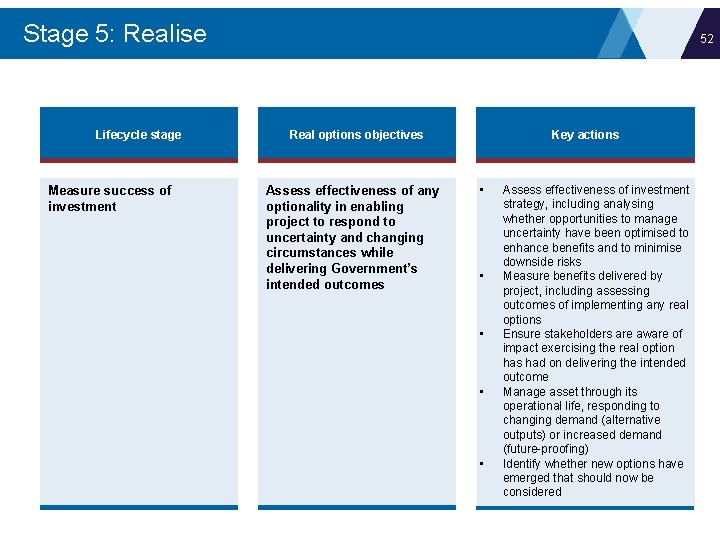
Stage 5: Realise Lifecycle stage Measure success of investment 52 Real options objectives Assess effectiveness of any optionality in enabling project to respond to uncertainty and changing circumstances while delivering Government’s intended outcomes Key actions • • • Assess effectiveness of investment strategy, including analysing whether opportunities to manage uncertainty have been optimised to enhance benefits and to minimise downside risks Measure benefits delivered by project, including assessing outcomes of implementing any real options Ensure stakeholders are aware of impact exercising the real option has had on delivering the intended outcome Manage asset through its operational life, responding to changing demand (alternative outputs) or increased demand (future-proofing) Identify whether new options have emerged that should now be considered
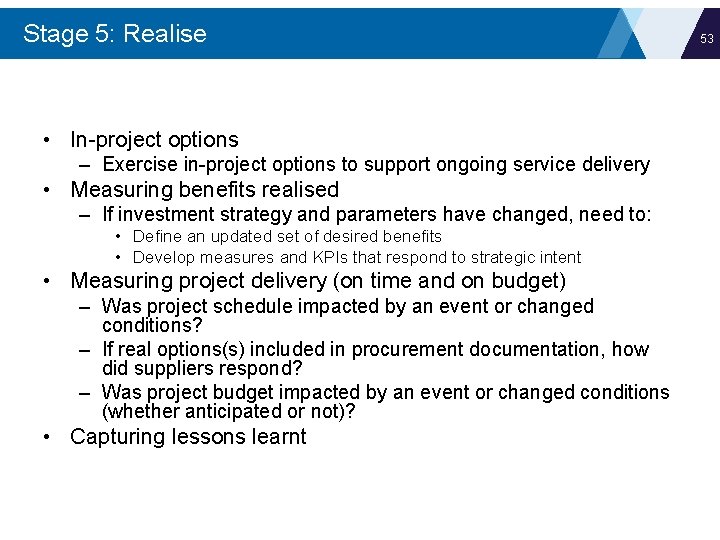
Stage 5: Realise • In-project options – Exercise in-project options to support ongoing service delivery • Measuring benefits realised – If investment strategy and parameters have changed, need to: • Define an updated set of desired benefits • Develop measures and KPIs that respond to strategic intent • Measuring project delivery (on time and on budget) – Was project schedule impacted by an event or changed conditions? – If real options(s) included in procurement documentation, how did suppliers respond? – Was project budget impacted by an event or changed conditions (whether anticipated or not)? • Capturing lessons learnt 53
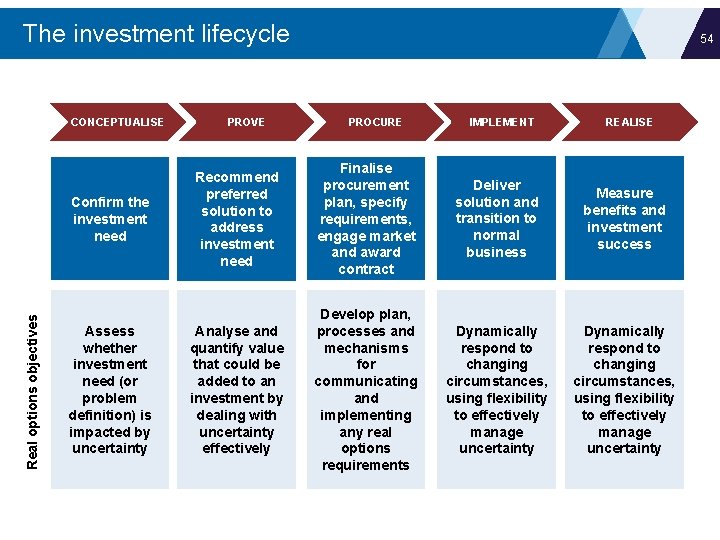
The investment lifecycle CONCEPTUALISE Real options objectives Confirm the investment need Assess whether investment need (or problem definition) is impacted by uncertainty PROVE 54 PROCURE IMPLEMENT REALISE Recommend preferred solution to address investment need Finalise procurement plan, specify requirements, engage market and award contract Deliver solution and transition to normal business Measure benefits and investment success Analyse and quantify value that could be added to an investment by dealing with uncertainty effectively Develop plan, processes and mechanisms for communicating and implementing any real options requirements Dynamically respond to changing circumstances, using flexibility to effectively manage uncertainty
3 Exercises
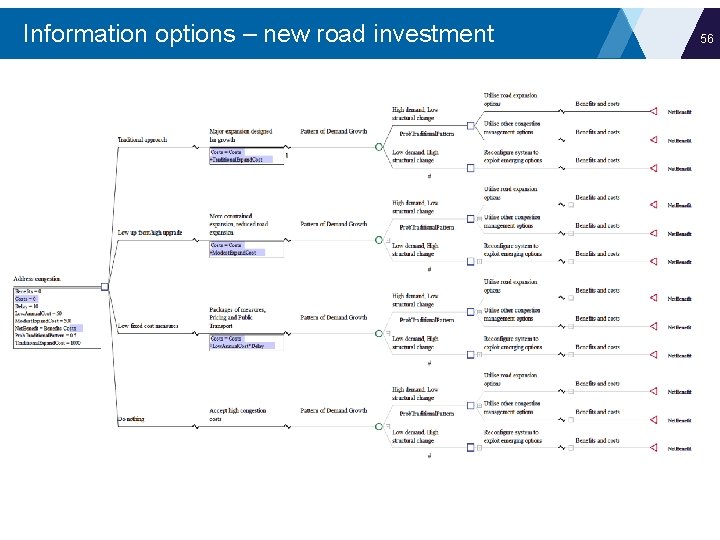
Information options – new road investment 56
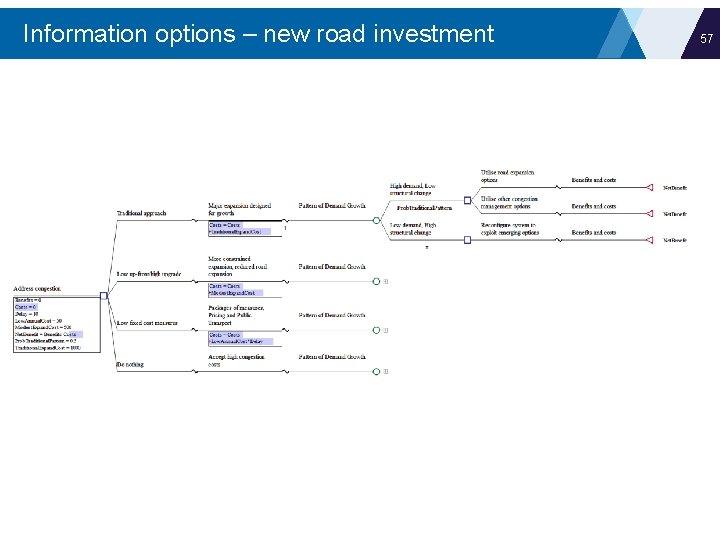
Information options – new road investment 57
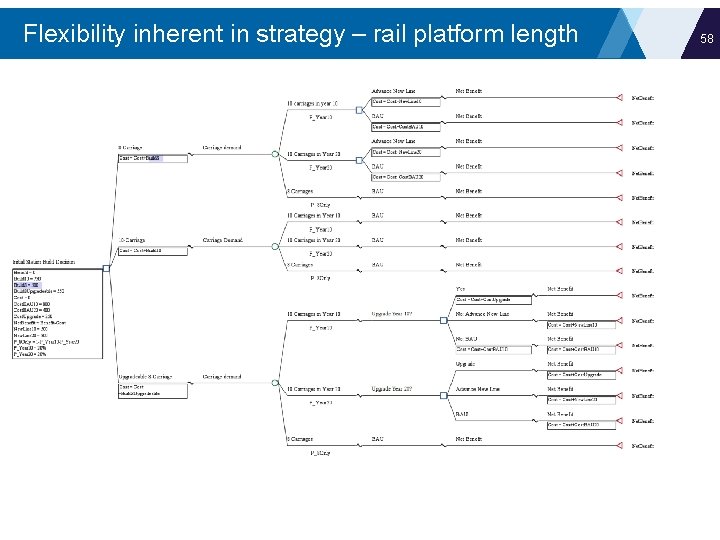
Flexibility inherent in strategy – rail platform length 58
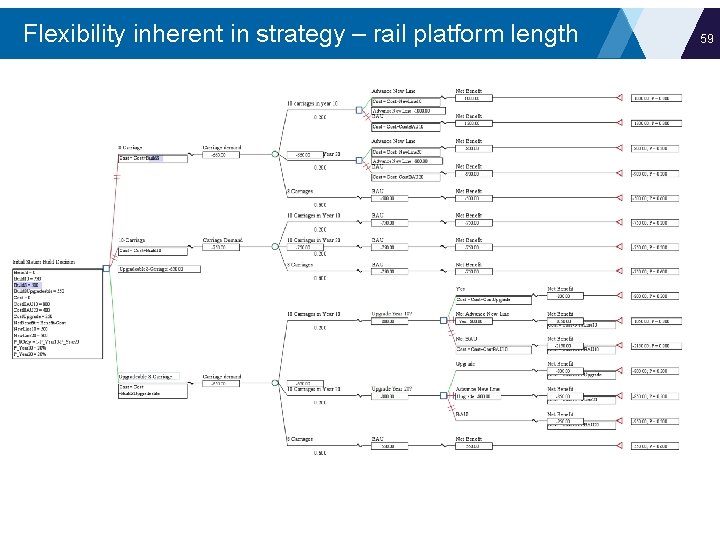
Flexibility inherent in strategy – rail platform length 59
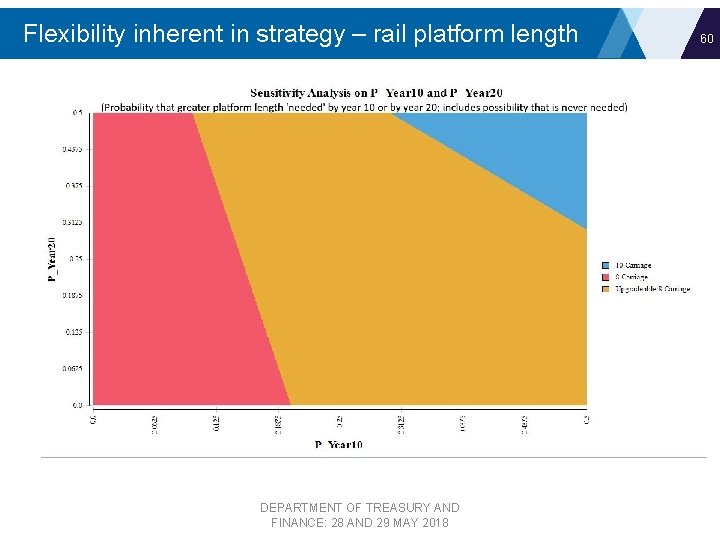
Flexibility inherent in strategy – rail platform length DEPARTMENT OF TREASURY AND FINANCE: 28 AND 29 MAY 2018 60

61 4 Wrap up
Wrap up – key messages • Real options analysis is not ‘new’; simply a formal framework to better encourage and support existing practices • Evolution, not revolution • Not mandated policy, but strong expectation that uncertainty is considered and flexible decision-making is incorporated into projects where possible • There will be implementation hurdles Further information and contacts • • Investing under uncertainty – New technical supplement to the Investment Lifecycle Guidance published this week, https: //www. dtf. vic. gov. au/investment-lifecycle-and-highvalue-high-risk-guidelines/technical-guides Lara Morton-Cox: 9651 2478, lara. mortoncox@dtf. vic. gov. au Karen Hew: 03 9651 1486; karen. hew@dtf. vic. gov. au General Infrastructure Policy Team: Investmentmanagement@dtf. vic. gov. au
- Slides: 63