
Investing in Financial Assets Lecture No 14 Chapter
- Slides: 13
Investing in Financial Assets Lecture No. 14 Chapter 4 Contemporary Engineering Economics Copyright © 2010 Contemporary Engineering Economics, 5 th edition, © 2010
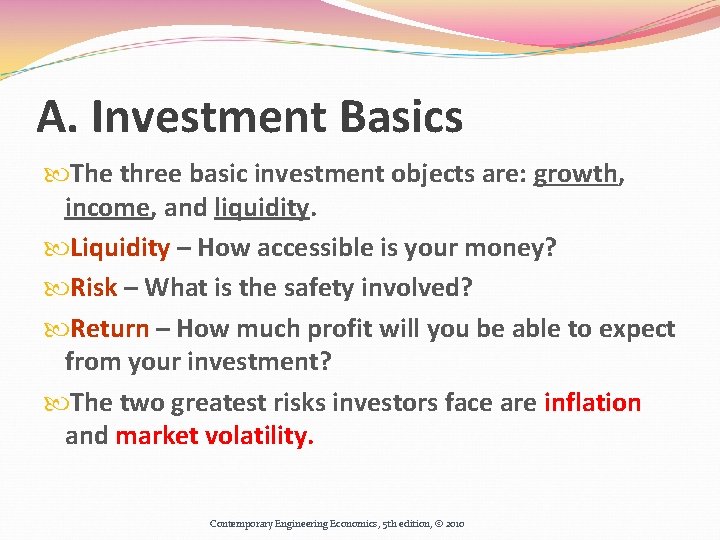
A. Investment Basics The three basic investment objects are: growth, income, and liquidity. Liquidity – How accessible is your money? Risk – What is the safety involved? Return – How much profit will you be able to expect from your investment? The two greatest risks investors face are inflation and market volatility. Contemporary Engineering Economics, 5 th edition, © 2010
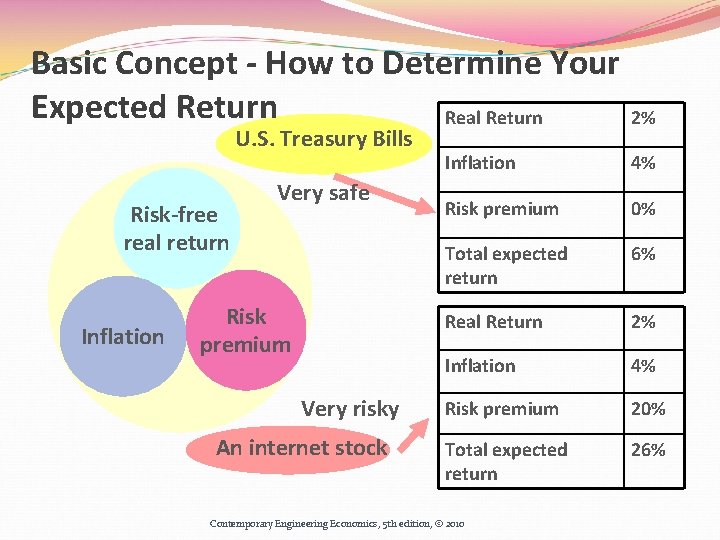
Basic Concept - How to Determine Your Expected Return Real Return U. S. Treasury Bills Risk-free real return Inflation Very safe Risk premium Very risky An internet stock 2% Inflation 4% Risk premium 0% Total expected return 6% Real Return 2% Inflation 4% Risk premium 20% Total expected return 26% Contemporary Engineering Economics, 5 th edition, © 2010
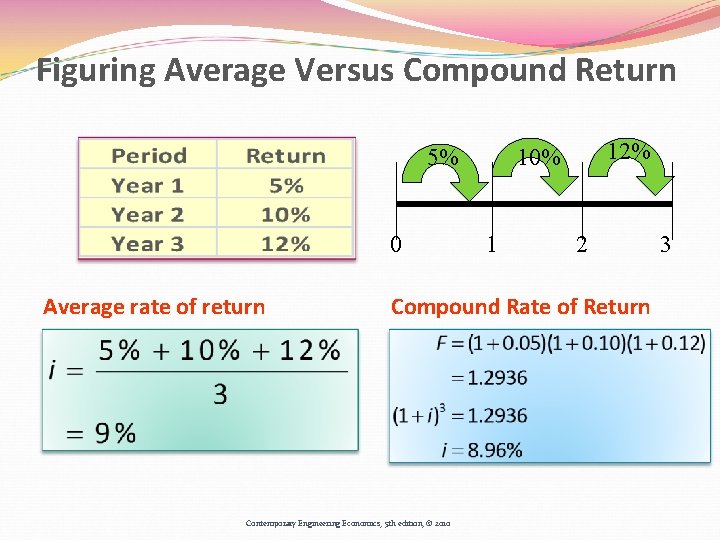
Figuring Average Versus Compound Return 5% 0 Average rate of return 12% 10% 1 2 Compound Rate of Return Contemporary Engineering Economics, 5 th edition, © 2010 3
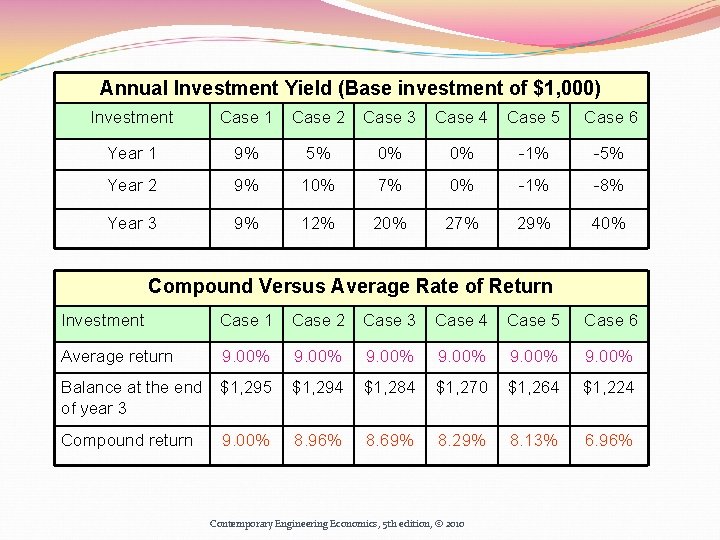
Annual Investment Yield (Base investment of $1, 000) Investment Case 1 Case 2 Case 3 Case 4 Case 5 Case 6 Year 1 9% 5% 0% 0% -1% -5% Year 2 9% 10% 7% 0% -1% -8% Year 3 9% 12% 20% 27% 29% 40% Compound Versus Average Rate of Return Investment Case 1 Case 2 Case 3 Case 4 Case 5 Case 6 Average return 9. 00% Balance at the end of year 3 $1, 295 $1, 294 $1, 284 $1, 270 $1, 264 $1, 224 Compound return 9. 00% 8. 96% 8. 69% 8. 29% 8. 13% 6. 96% Contemporary Engineering Economics, 5 th edition, © 2010
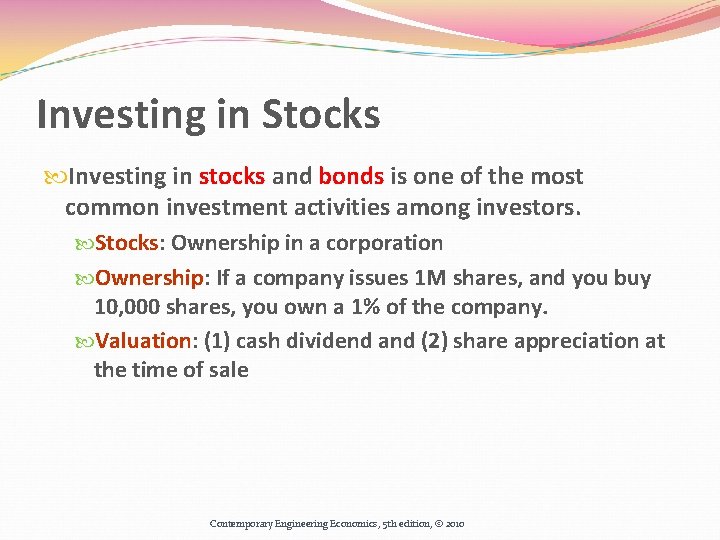
Investing in Stocks Investing in stocks and bonds is one of the most common investment activities among investors. Stocks: Ownership in a corporation Ownership: If a company issues 1 M shares, and you buy 10, 000 shares, you own a 1% of the company. Valuation: (1) cash dividend and (2) share appreciation at the time of sale Contemporary Engineering Economics, 5 th edition, © 2010
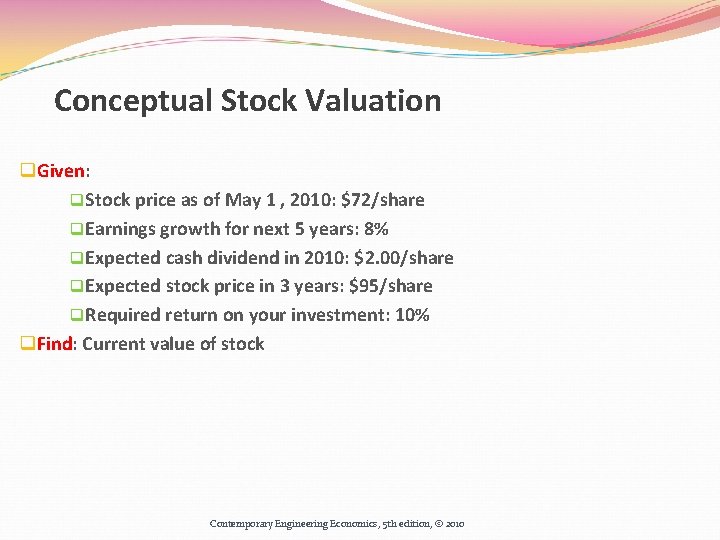
Conceptual Stock Valuation q. Given: q. Stock price as of May 1 , 2010: $72/share q. Earnings growth for next 5 years: 8% q. Expected cash dividend in 2010: $2. 00/share q. Expected stock price in 3 years: $95/share q. Required return on your investment: 10% q. Find: Current value of stock Contemporary Engineering Economics, 5 th edition, © 2010
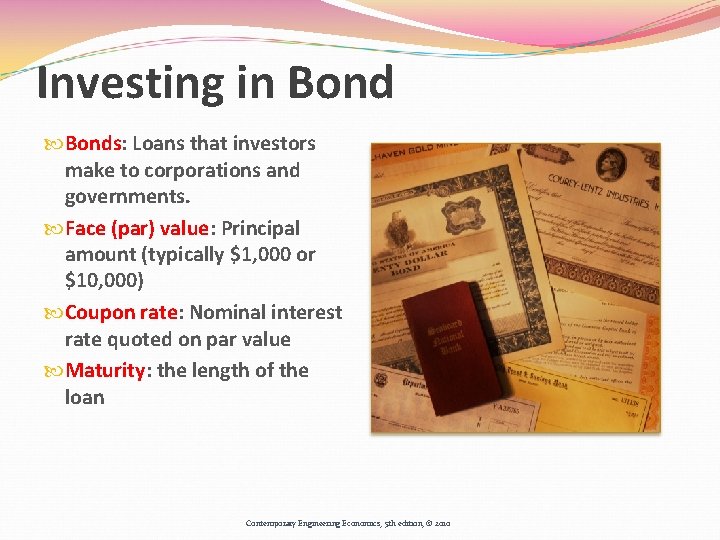
Investing in Bonds: Loans that investors make to corporations and governments. Face (par) value: Principal amount (typically $1, 000 or $10, 000) Coupon rate: Nominal interest rate quoted on par value Maturity: the length of the loan Contemporary Engineering Economics, 5 th edition, © 2010
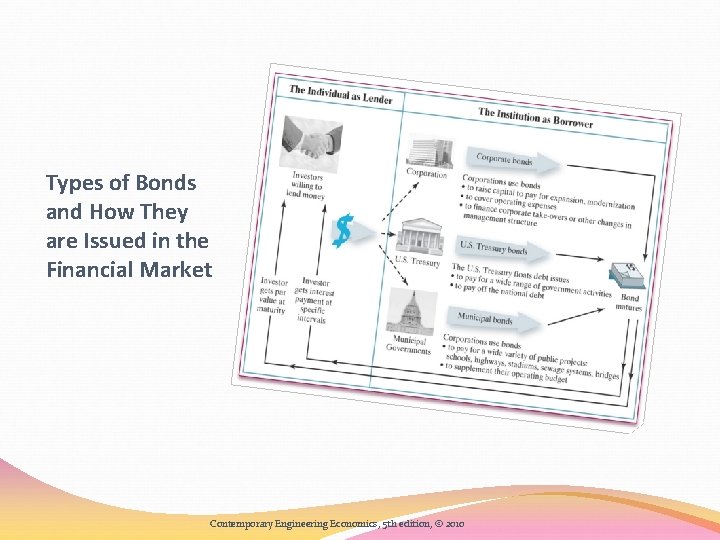
Types of Bonds and How They are Issued in the Financial Market Contemporary Engineering Economics, 5 th edition, © 2010
How Do Prices and Yields Work? Yield to Maturity: The actual interest earned from a bond over the holding period Current Yield: The annual interest earned as a percentage of the current market price Contemporary Engineering Economics, 5 th edition, © 2010
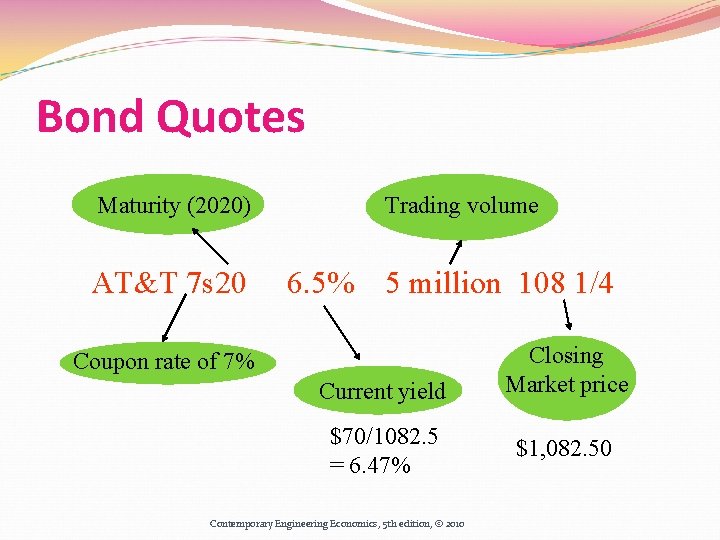
Bond Quotes Maturity (2020) AT&T 7 s 20 Trading volume 6. 5% 5 million 108 1/4 Coupon rate of 7% Current yield $70/1082. 5 = 6. 47% Contemporary Engineering Economics, 5 th edition, © 2010 Closing Market price $1, 082. 50
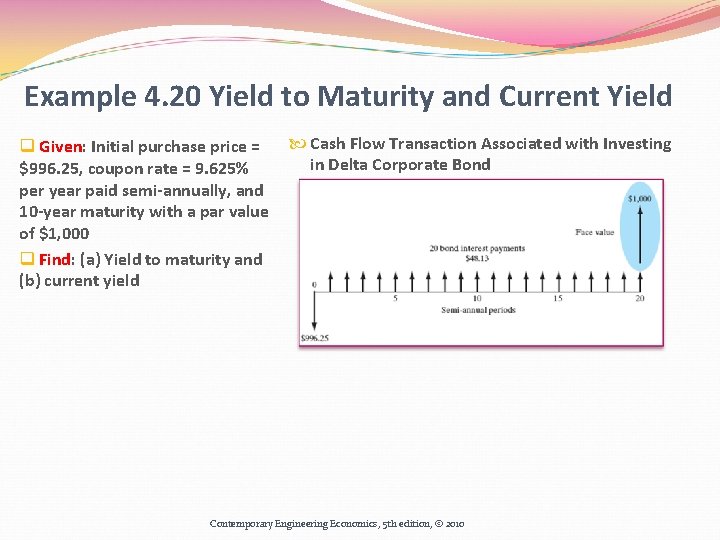
Example 4. 20 Yield to Maturity and Current Yield q Given: Initial purchase price = $996. 25, coupon rate = 9. 625% per year paid semi-annually, and 10 -year maturity with a par value of $1, 000 q Find: (a) Yield to maturity and (b) current yield Cash Flow Transaction Associated with Investing in Delta Corporate Bond Contemporary Engineering Economics, 5 th edition, © 2010
Bond Value Over Time q. Mr. Gonzalez wishes to sell a bond that has a face value of $1, 000. The bond bears an interest rate of 8% with bond interests payable semiannually. q. Four years ago, $920 was paid for the bond. At least a 9% return (yield) in investment is desired. q. What must be the minimum selling price? Contemporary Engineering Economics, 5 th edition, © 2010