
Investing in Canadas Future By Martha Crago Ph
Investing in Canada’s Future By Martha Crago, Ph. D Vice-Principal (Research and Innovation) Mc. Gill University March 12, 2018 1
Investing in Canada’s Future “Our government must ensure its support for fundamental research is coherent, effective, and agile enough to keep pace with the dynamic nature of contemporary science. ” – The Honourable Kirsty Duncan, Minister of Science Panelists C. David Naylor Robert J. Birgeneau Martha Crago Mike Lazaridis Claudia Malacrida Arthur B. Mc. Donald Martha C. Piper Rémi Quirion Anne Wilson 2
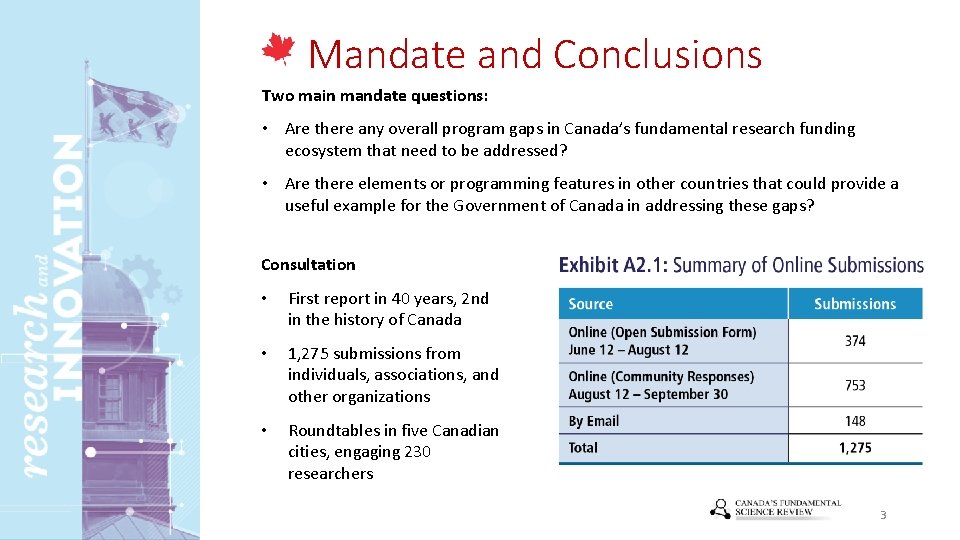
Mandate and Conclusions Two main mandate questions: • Are there any overall program gaps in Canada’s fundamental research funding ecosystem that need to be addressed? • Are there elements or programming features in other countries that could provide a useful example for the Government of Canada in addressing these gaps? Consultation • First report in 40 years, 2 nd in the history of Canada • 1, 275 submissions from individuals, associations, and other organizations • Roundtables in five Canadian cities, engaging 230 researchers 3
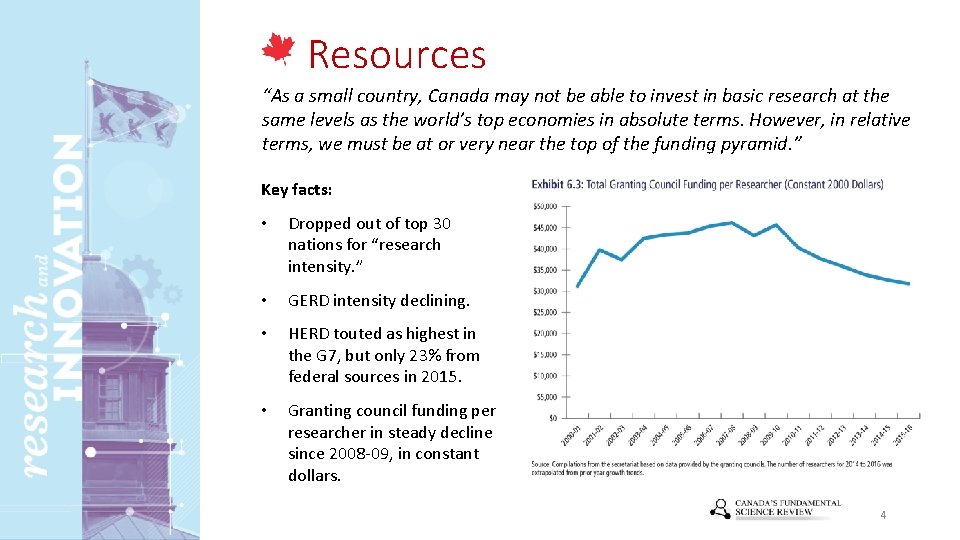
Resources “As a small country, Canada may not be able to invest in basic research at the same levels as the world’s top economies in absolute terms. However, in relative terms, we must be at or very near the top of the funding pyramid. ” Key facts: • Dropped out of top 30 nations for “research intensity. ” • GERD intensity declining. • HERD touted as highest in the G 7, but only 23% from federal sources in 2015. • Granting council funding per researcher in steady decline since 2008 -09, in constant dollars. 4
Performance “The bar we set for our investment in research should be the quality of its output. ” Key findings: • Canada remains above-average in citations, helped by below-average impact of massive volume of publications from China. • Declining outputs highlighted in report could be arguably offset if Canadian research showed rising impact as measured by citation analysis. • Canada is a strong performer in certain fields, but citation ranking fell in 13 of 22 fields assessed. • Canada lags behind many other nations in winning international prizes, not least Australia. 5
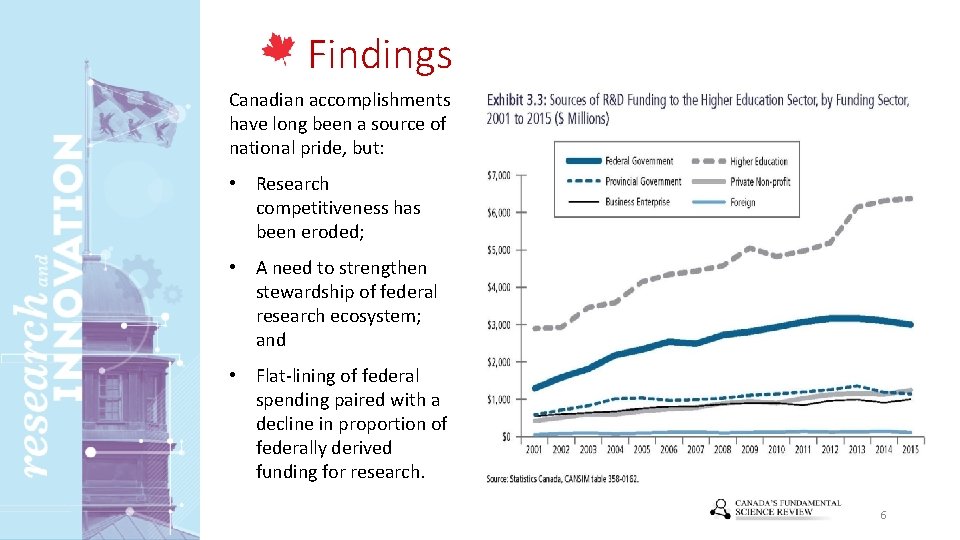
Findings Canadian accomplishments have long been a source of national pride, but: • Research competitiveness has been eroded; • A need to strengthen stewardship of federal research ecosystem; and • Flat-lining of federal spending paired with a decline in proportion of federally derived funding for research. 6
Governance – Why the Focus? Clear evidence of weak system-level oversight: • Suboptimal coordination across the pillar agencies • Puzzling inconsistencies in program architecture • Uneven decision-making on investments in national science facilities • Discrepant success rates and blurred accountabilities • Proliferation of disconnected entities arising from opportunistic decisions, some inspired and some not • Importance of coordination of university and federal government science Urgency: • Urgent given weakening competitive position, critical societal and economic challenges, and major opportunities created by global political trends • Strategic advice on both research and innovation is necessary in short term as innovation ecosystem to undergo review and possible overhaul. 7
Stewardship and Governance “Canada’s federal research ecosystem, despite many strengths, is weakly coordinated and inconsistently evaluated, and has not had consistent oversight. ” Related recommendations: • National Advisory Council on Research and Innovation (NACRI) • Advice, coordination and strategic alignment, evaluation • Chief Science Advisor – Vice Chair of NACRI, integrated Secretariat • Four Agency Coordinating Board Rationale: • Canada, for a long time, has needed high-level overview and coordination of research efforts – concerns date back to the 1910 s. • Current advisory systems have not had the stability and support to make a lasting contribution. • Further machinery changes may be needed if major improvements do not occur rapidly. 8
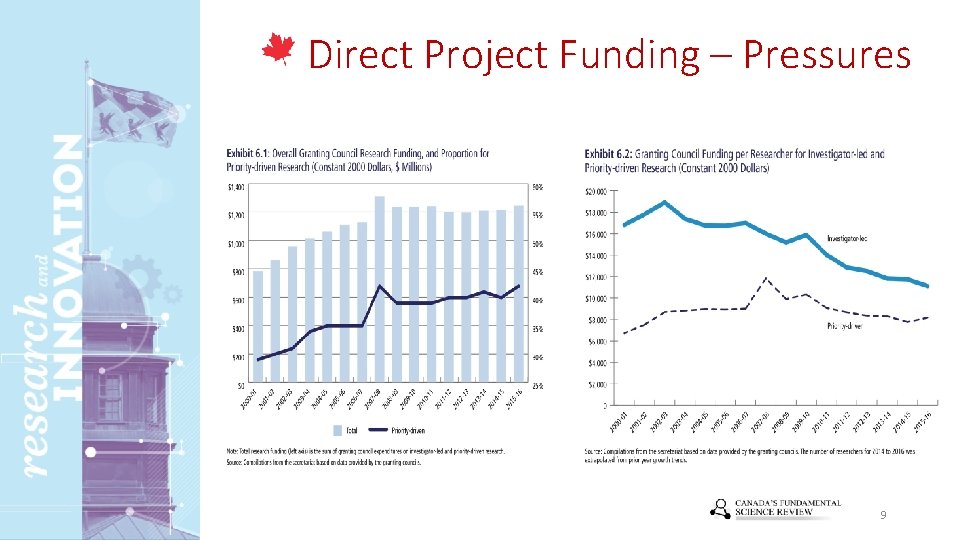
Direct Project Funding – Pressures 9
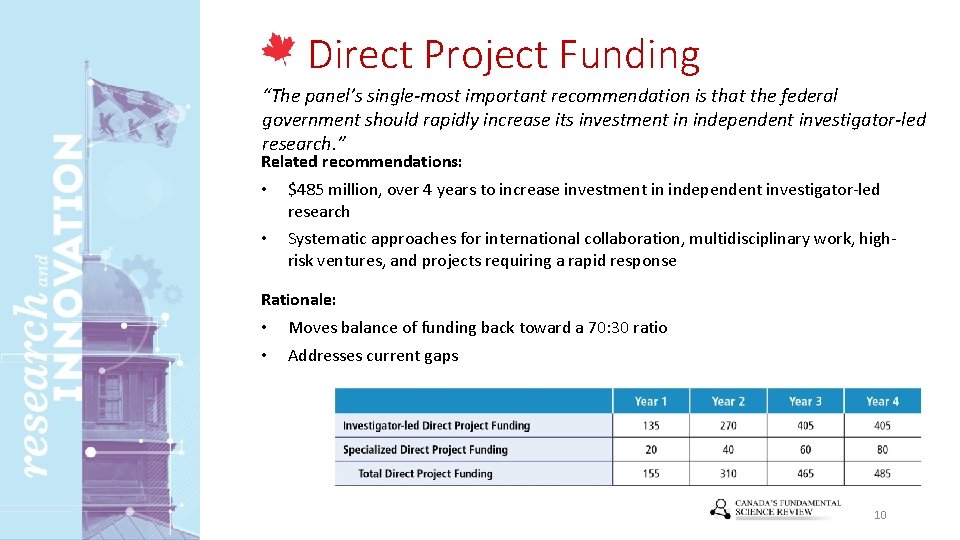
Direct Project Funding “The panel’s single-most important recommendation is that the federal government should rapidly increase its investment in independent investigator-led research. ” Related recommendations: • $485 million, over 4 years to increase investment in independent investigator-led research • Systematic approaches for international collaboration, multidisciplinary work, highrisk ventures, and projects requiring a rapid response Rationale: • • Moves balance of funding back toward a 70: 30 ratio Addresses current gaps 10
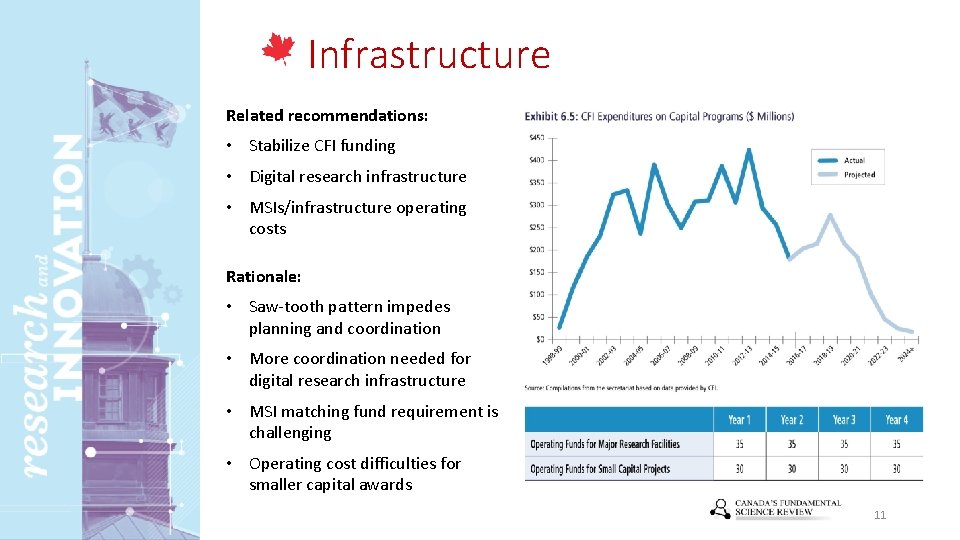
Infrastructure Related recommendations: • Stabilize CFI funding • Digital research infrastructure • MSIs/infrastructure operating costs Rationale: • Saw-tooth pattern impedes planning and coordination • More coordination needed for digital research infrastructure • MSI matching fund requirement is challenging • Operating cost difficulties for smaller capital awards 11
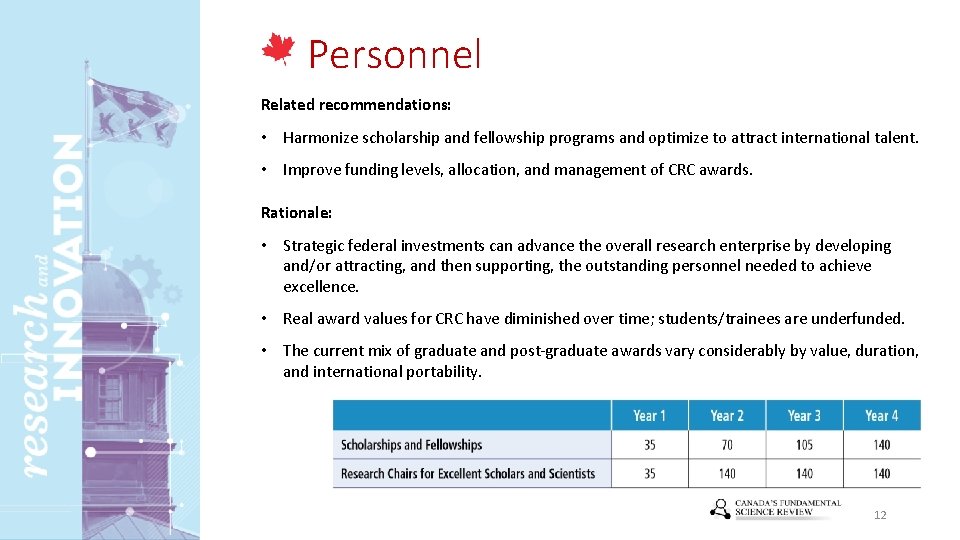
Personnel Related recommendations: • Harmonize scholarship and fellowship programs and optimize to attract international talent. • Improve funding levels, allocation, and management of CRC awards. Rationale: • Strategic federal investments can advance the overall research enterprise by developing and/or attracting, and then supporting, the outstanding personnel needed to achieve excellence. • Real award values for CRC have diminished over time; students/trainees are underfunded. • The current mix of graduate and post-graduate awards vary considerably by value, duration, and international portability. 12
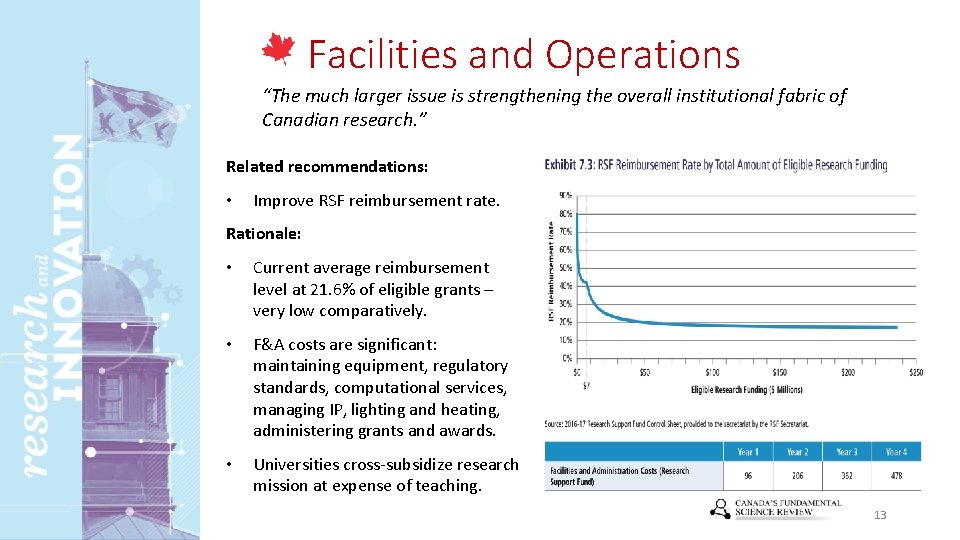
Facilities and Operations “The much larger issue is strengthening the overall institutional fabric of Canadian research. ” Related recommendations: • Improve RSF reimbursement rate. Rationale: • Current average reimbursement level at 21. 6% of eligible grants – very low comparatively. • F&A costs are significant: maintaining equipment, regulatory standards, computational services, managing IP, lighting and heating, administering grants and awards. • Universities cross-subsidize research mission at expense of teaching. 13
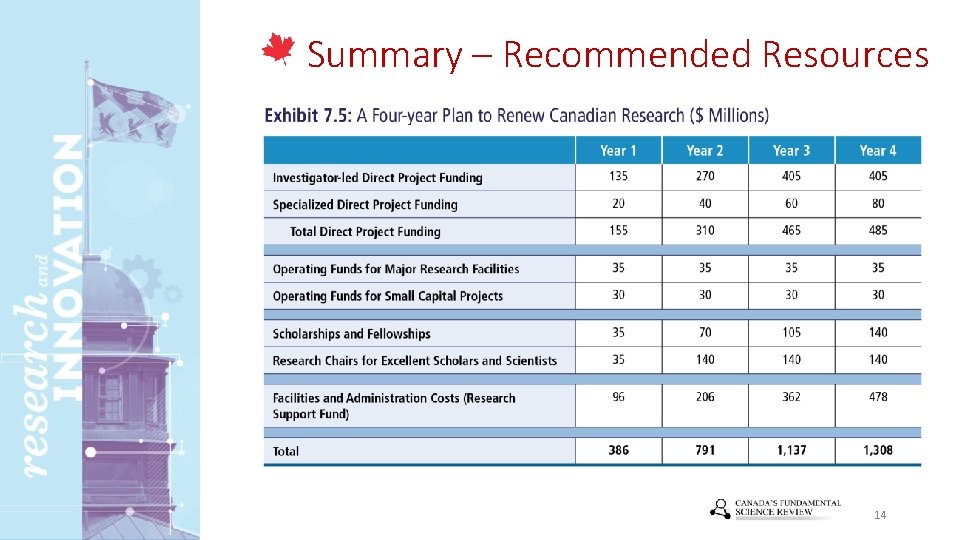
Summary – Recommended Resources 14
Following the Report… • Uniform acceptance of recommendations across Canada • Cross-sectoral lobbying • Some key issues: • Emerging researchers emphasis • Recognition that 50 -60% of health/natural science and engineering funding goes to graduate students. = Important for a youth-focused government 15
Budget 2018 Response “Budget 2018 proposes an investment of nearly $4 billion in Canada’s research system to support the work of researchers and to provide them access to the state-of-the-art tools and facilities they need. ” • $1. 22 B in new funding to the Tri-Council • $275 M in a new fund aimed at research that is international, multidisciplinary, and/or fast-breaking • $21 M to increase diversity in science • $763 M in stable funding for research infrastructure via the CFI • $231 M for the Research Support Fund (indirect costs of research) • $572. 5 M to support digital research infrastructure • $210 M for the Canada Research Chair program • $540 M for the National Research Council 16
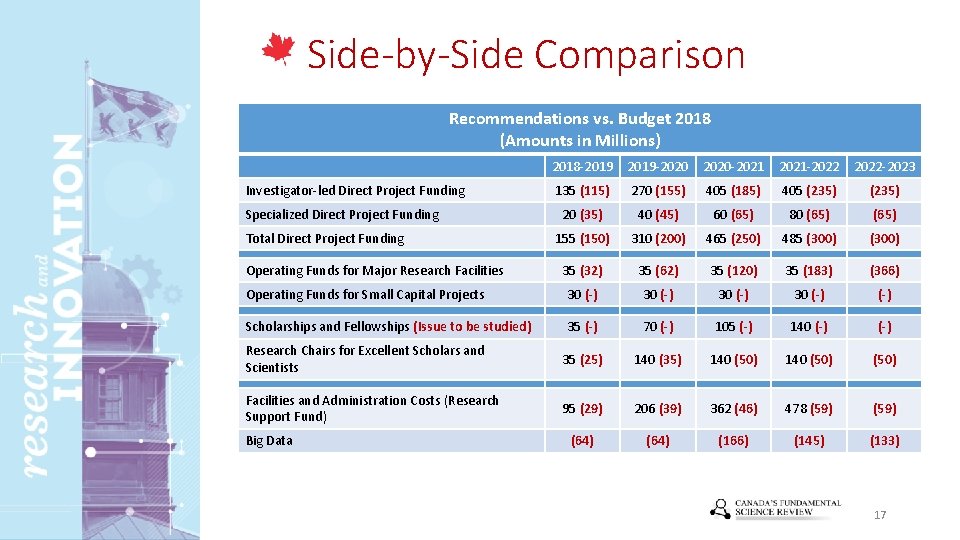
Side-by-Side Comparison Recommendations vs. Budget 2018 (Amounts in Millions) 2018 -2019 -2020 -2021 -2022 -2023 135 (115) 270 (155) 405 (185) 405 (235) 20 (35) 40 (45) 60 (65) 80 (65) 155 (150) 310 (200) 465 (250) 485 (300) 35 (32) 35 (62) 35 (120) 35 (183) (366) Operating Funds for Small Capital Projects 30 (-) (-) Scholarships and Fellowships (Issue to be studied) 35 (-) 70 (-) 105 (-) 140 (-) Research Chairs for Excellent Scholars and Scientists 35 (25) 140 (35) 140 (50) Facilities and Administration Costs (Research Support Fund) 95 (29) 206 (39) 362 (46) 478 (59) (64) (166) (145) (133) Investigator-led Direct Project Funding Specialized Direct Project Funding Total Direct Project Funding Operating Funds for Major Research Facilities Big Data 17

Questions? Thank you. 18
- Slides: 18