
INVESTING FOR SOCIAL IMPACT IN AFRICA IDA Global
INVESTING FOR SOCIAL IMPACT IN AFRICA IDA Global Development 24 January 2018.
AGENDA • Nordic Impact Funds – who we are and what we want to achieve? • The opportunity – growth and market perspectives • The solutions – trends and challenges • The cases – examples from East Africa • Discussion
NORDIC IMPACT FUNDS IN BRIEF Creating a positive impact for more than a million lives in East Africa by leveraging the best of the Nordics - governance, capital, technology, and expertise and combining it with African presence, deal experience and local network
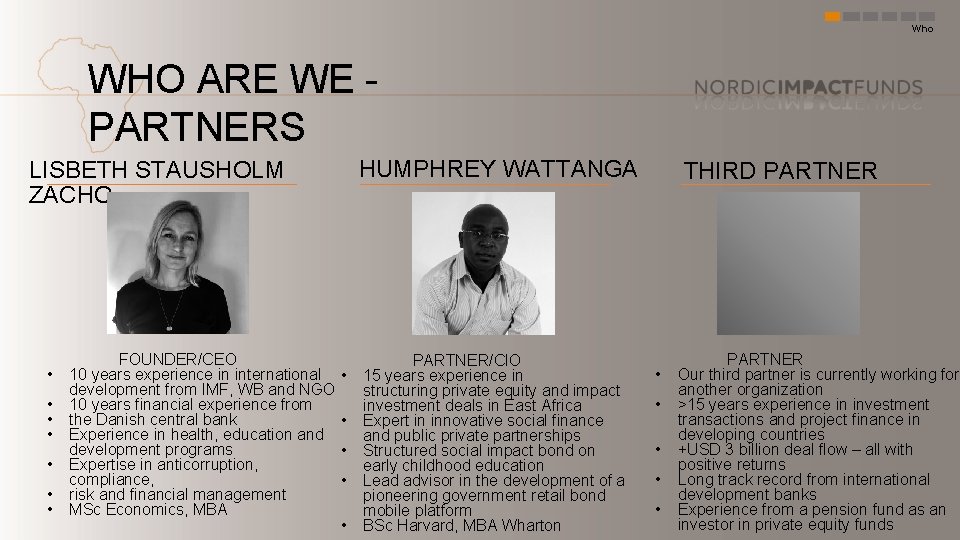
Who WHO ARE WE - PARTNERS HUMPHREY WATTANGA LISBETH STAUSHOLM ZACHO • • FOUNDER/CEO 10 years experience in international development from IMF, WB and NGO 10 years financial experience from the Danish central bank Experience in health, education and development programs Expertise in anticorruption, compliance, risk and financial management MSc Economics, MBA • • • PARTNER/CIO 15 years experience in structuring private equity and impact investment deals in East Africa Expert in innovative social finance and public private partnerships Structured social impact bond on early childhood education Lead advisor in the development of a pioneering government retail bond mobile platform BSc Harvard, MBA Wharton THIRD PARTNER • • • PARTNER Our third partner is currently working for another organization >15 years experience in investment transactions and project finance in developing countries +USD 3 billion deal flow – all with positive returns Long track record from international development banks Experience from a pension fund as an investor in private equity funds
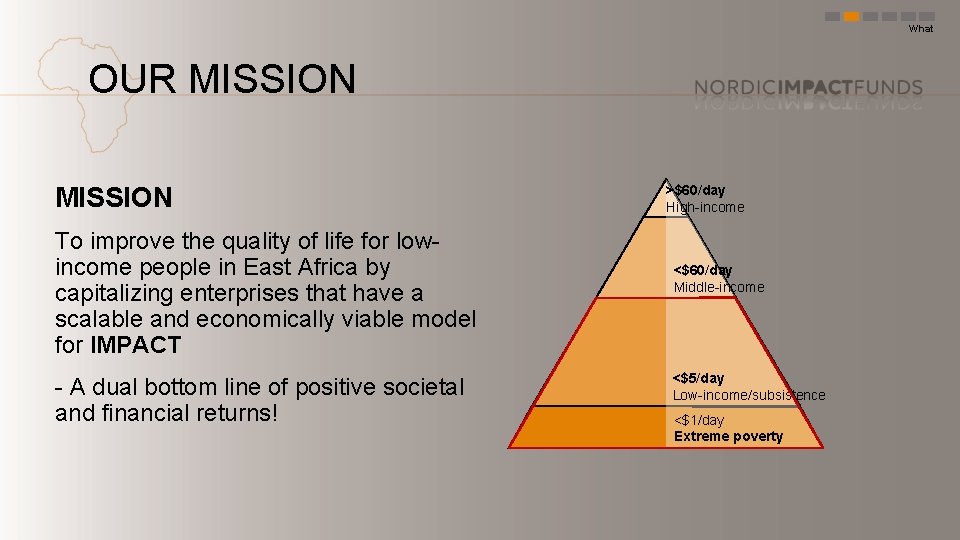
What OUR MISSION To improve the quality of life for lowincome people in East Africa by capitalizing enterprises that have a scalable and economically viable model for IMPACT - A dual bottom line of positive societal and financial returns! >$60/day High-income <$60/day Middle-income <$5/day Low-income/subsistence <$1/day Extreme poverty
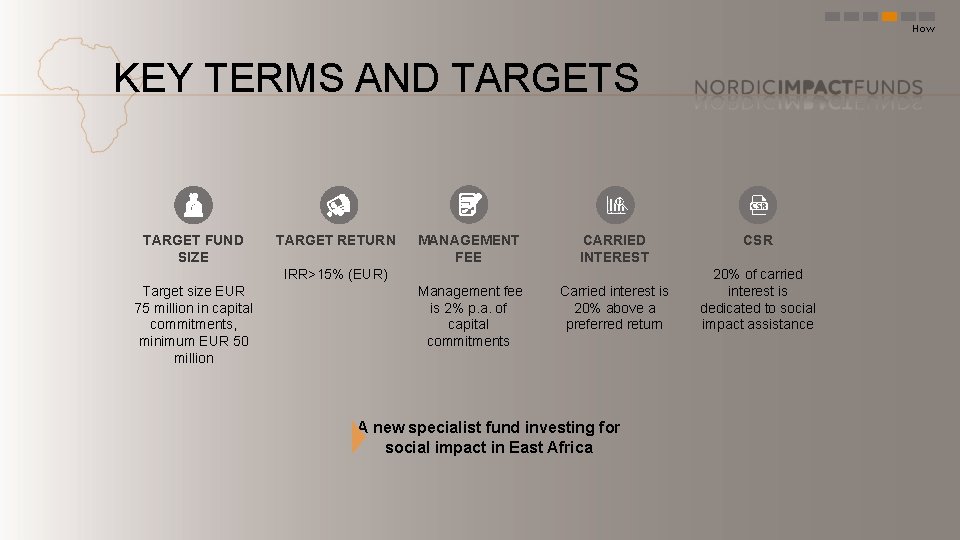
How KEY TERMS AND TARGETS TARGET FUND SIZE TARGET RETURN MANAGEMENT FEE CARRIED INTEREST IRR>15% (EUR) Target size EUR 75 million in capital commitments, minimum EUR 50 million Management fee is 2% p. a. of capital commitments Carried interest is 20% above a preferred return A new specialist fund investing for social impact in East Africa CSR 20% of carried interest is dedicated to social impact assistance
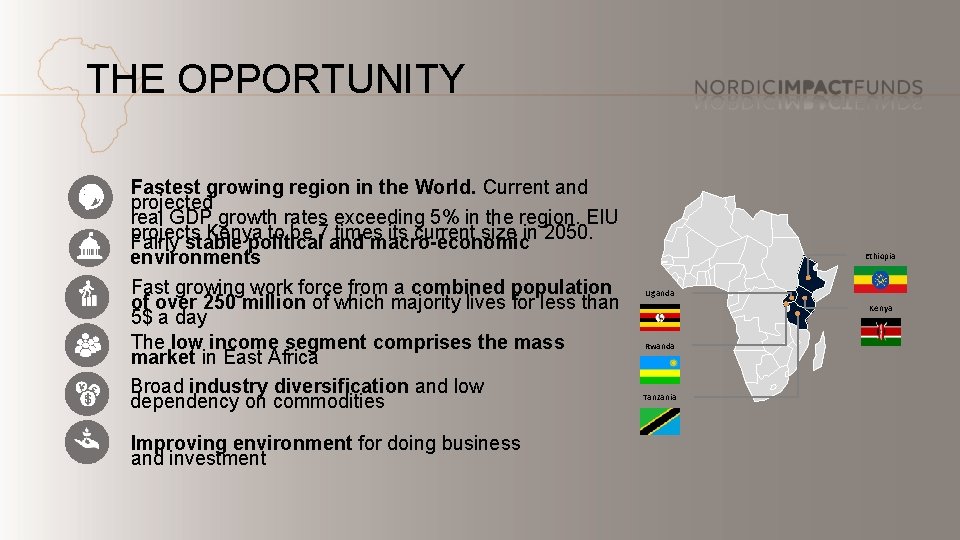
THE OPPORTUNITY Fastest growing region in the World. Current and projected real GDP growth rates exceeding 5% in the region. EIU projects Kenya to be 7 times its current size in 2050. Fairly stable political and macro-economic environments Fast growing work force from a combined population of over 250 million of which majority lives for less than 5$ a day The low income segment comprises the mass market in East Africa Broad industry diversification and low dependency on commodities Improving environment for doing business and investment Ethiopia Uganda Kenya Rwanda Tanzania
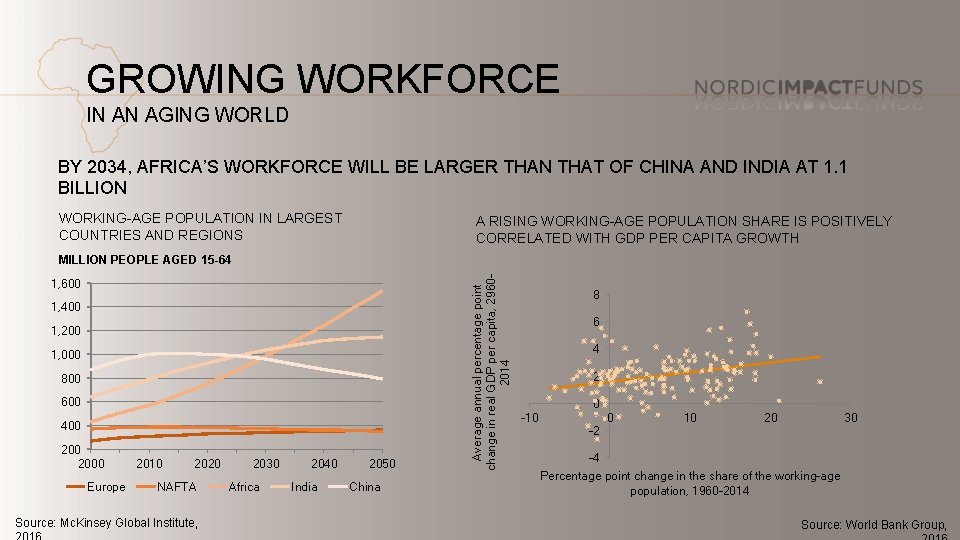
GROWING WORKFORCE IN AN AGING WORLD BY 2034, AFRICA’S WORKFORCE WILL BE LARGER THAN THAT OF CHINA AND INDIA AT 1. 1 BILLION WORKING-AGE POPULATION IN LARGEST COUNTRIES AND REGIONS A RISING WORKING-AGE POPULATION SHARE IS POSITIVELY CORRELATED WITH GDP PER CAPITA GROWTH 1, 600 1, 400 1, 200 1, 000 800 600 400 2000 Europe 2010 2020 NAFTA Source: Mc. Kinsey Global Institute, 2030 Africa 2040 India 2050 China Average annual percentage point change in real GDP per capita, 29602014 MILLION PEOPLE AGED 15 -64 8 6 4 2 0 -10 -2 0 10 20 30 -4 Percentage point change in the share of the working-age population, 1960 -2014 Source: World Bank Group,
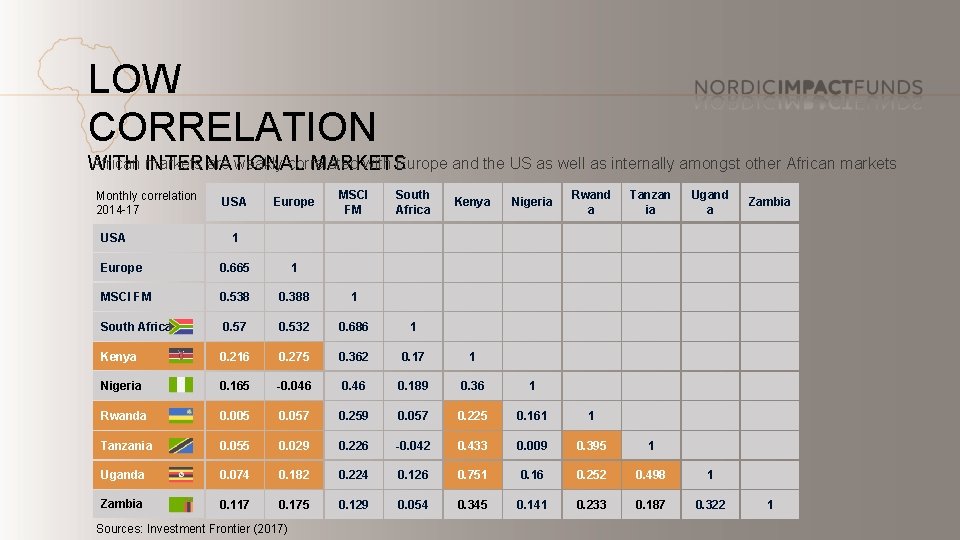
LOW CORRELATION African markets are weakly correlated with Europe and the US as well as internally amongst other African markets WITH INTERNATIONAL MARKETS Monthly correlation 2014 -17 USA Europe MSCI FM South Africa Kenya Nigeria Rwand a Tanzan ia Ugand a Zambia 1 Europe 0. 665 1 MSCI FM 0. 538 0. 388 1 South Africa 0. 57 0. 532 0. 686 1 Kenya 0. 216 0. 275 0. 362 0. 17 1 Nigeria 0. 165 -0. 046 0. 189 0. 36 1 Rwanda 0. 005 0. 057 0. 259 0. 057 0. 225 0. 161 1 Tanzania 0. 055 0. 029 0. 226 -0. 042 0. 433 0. 009 0. 395 1 Uganda 0. 074 0. 182 0. 224 0. 126 0. 751 0. 16 0. 252 0. 498 1 Zambia 0. 117 0. 175 0. 129 0. 054 0. 345 0. 141 0. 233 0. 187 0. 322 Sources: Investment Frontier (2017) 1
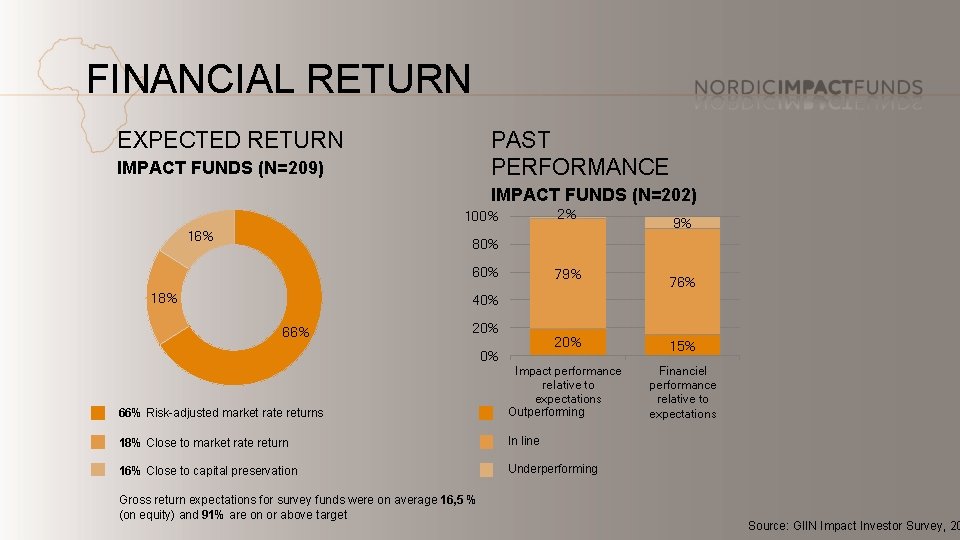
FINANCIAL RETURN EXPECTED RETURN PAST PERFORMANCE IMPACT FUNDS (N=209) IMPACT FUNDS (N=202) 2% 100% 16% 9% 80% 60% 18% 79% 76% 40% 66% 20% 0% 20% 66% Risk-adjusted market rate returns Impact performance relative to expectations Outperforming 18% Close to market rate return In line 16% Close to capital preservation Underperforming Gross return expectations for survey funds were on average 16, 5 % (on equity) and 91% are on or above target 15% Financiel performance relative to expectations Source: GIIN Impact Investor Survey, 20
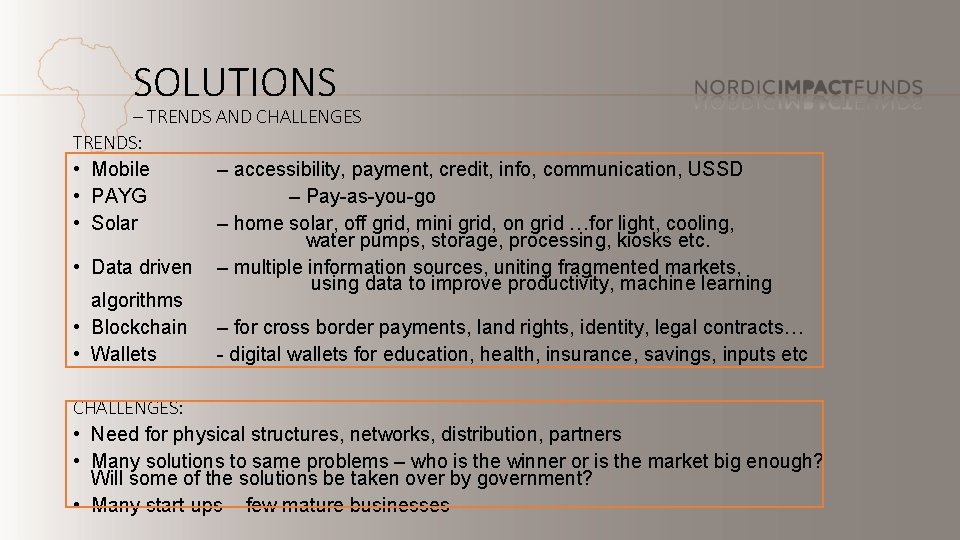
SOLUTIONS – TRENDS AND CHALLENGES TRENDS: • Mobile – accessibility, payment, credit, info, communication, USSD • PAYG – Pay-as-you-go • Solar – home solar, off grid, mini grid, on grid …for light, cooling, water pumps, storage, processing, kiosks etc. • Data driven – multiple information sources, uniting fragmented markets, using data to improve productivity, machine learning algorithms • Blockchain – for cross border payments, land rights, identity, legal contracts… • Wallets - digital wallets for education, health, insurance, savings, inputs etc CHALLENGES: • Need for physical structures, networks, distribution, partners • Many solutions to same problems – who is the winner or is the market big enough? Will some of the solutions be taken over by government? • Many start-ups – few mature businesses
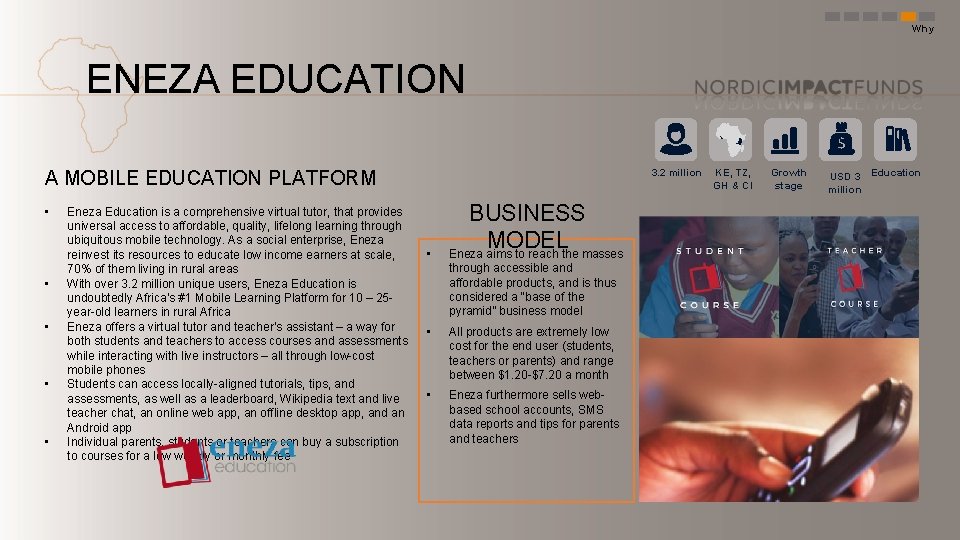
Why ENEZA EDUCATION 3. 2 million A MOBILE EDUCATION PLATFORM • • • Eneza Education is a comprehensive virtual tutor, that provides universal access to affordable, quality, lifelong learning through ubiquitous mobile technology. As a social enterprise, Eneza reinvest its resources to educate low income earners at scale, 70% of them living in rural areas With over 3. 2 million unique users, Eneza Education is undoubtedly Africa’s #1 Mobile Learning Platform for 10 – 25 year-old learners in rural Africa Eneza offers a virtual tutor and teacher’s assistant – a way for both students and teachers to access courses and assessments while interacting with live instructors – all through low-cost mobile phones Students can access locally-aligned tutorials, tips, and assessments, as well as a leaderboard, Wikipedia text and live teacher chat, an online web app, an offline desktop app, and an Android app Individual parents, students or teachers can buy a subscription to courses for a low weekly or monthly fee • BUSINESS MODEL Eneza aims to reach the masses through accessible and affordable products, and is thus considered a “base of the pyramid” business model • All products are extremely low cost for the end user (students, teachers or parents) and range between $1. 20 -$7. 20 a month • Eneza furthermore sells webbased school accounts, SMS data reports and tips for parents and teachers KE, TZ, GH & CI Growth stage USD 3 Education million
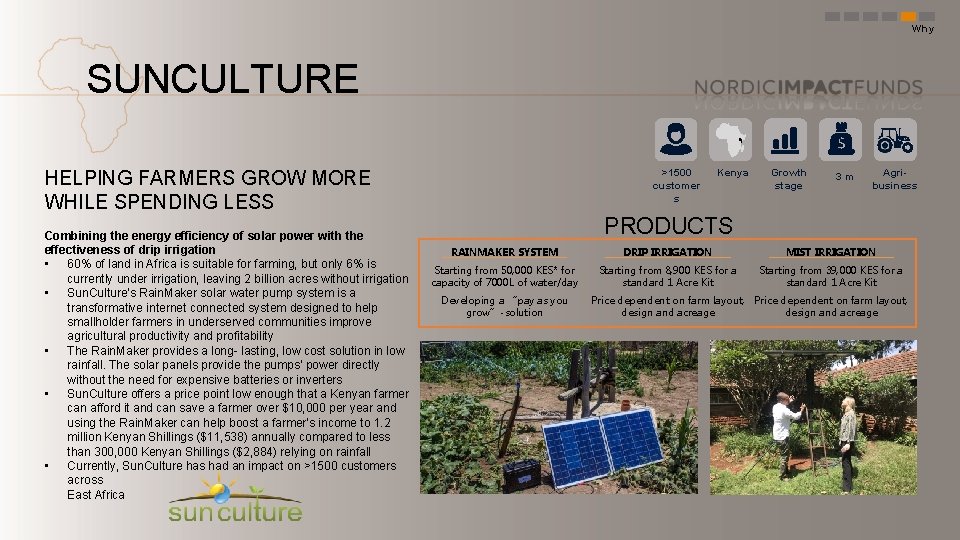
Why SUNCULTURE >1500 customer s HELPING FARMERS GROW MORE WHILE SPENDING LESS Combining the energy efficiency of solar power with the effectiveness of drip irrigation • 60% of land in Africa is suitable for farming, but only 6% is currently under irrigation, leaving 2 billion acres without irrigation • Sun. Culture’s Rain. Maker solar water pump system is a transformative internet connected system designed to help smallholder farmers in underserved communities improve agricultural productivity and profitability • The Rain. Maker provides a long- lasting, low cost solution in low rainfall. The solar panels provide the pumps’ power directly without the need for expensive batteries or inverters • Sun. Culture offers a price point low enough that a Kenyan farmer can afford it and can save a farmer over $10, 000 per year and using the Rain. Maker can help boost a farmer’s income to 1. 2 million Kenyan Shillings ($11, 538) annually compared to less than 300, 000 Kenyan Shillings ($2, 884) relying on rainfall • Currently, Sun. Culture has had an impact on >1500 customers across East Africa Kenya Growth stage 3 m Agribusiness PRODUCTS RAINMAKER SYSTEM DRIP IRRIGATION MIST IRRIGATION Starting from 50, 000 KES* for capacity of 7000 L of water/day Starting from 8, 900 KES for a standard 1 Acre Kit Starting from 39, 000 KES for a standard 1 Acre Kit Developing a “pay as you grow”-solution Price dependent on farm layout, design and acreage
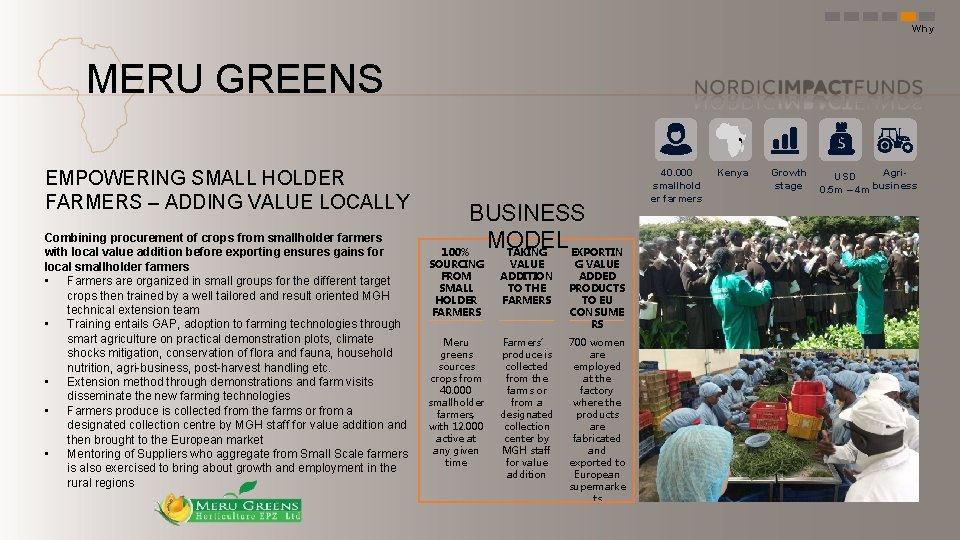
Why MERU GREENS EMPOWERING SMALL HOLDER FARMERS – ADDING VALUE LOCALLY Combining procurement of crops from smallholder farmers with local value addition before exporting ensures gains for local smallholder farmers • Farmers are organized in small groups for the different target crops then trained by a well tailored and result oriented MGH technical extension team • Training entails GAP, adoption to farming technologies through smart agriculture on practical demonstration plots, climate shocks mitigation, conservation of flora and fauna, household nutrition, agri-business, post-harvest handling etc. • Extension method through demonstrations and farm visits disseminate the new farming technologies • Farmers produce is collected from the farms or from a designated collection centre by MGH staff for value addition and then brought to the European market • Mentoring of Suppliers who aggregate from Small Scale farmers is also exercised to bring about growth and employment in the rural regions BUSINESS MODEL EXPORTIN TAKING 100% SOURCING FROM SMALL HOLDER FARMERS VALUE ADDITION TO THE FARMERS G VALUE ADDED PRODUCTS TO EU CONSUME RS Meru greens sources crops from 40. 000 smallholder farmers, with 12. 000 active at any given time Farmers’ produce is collected from the farms or from a designated collection center by MGH staff for value addition 700 women are employed at the factory where the products are fabricated and exported to European supermarke ts 40. 000 smallhold er farmers Kenya Growth stage Agri. USD business 0. 5 m – 4 m
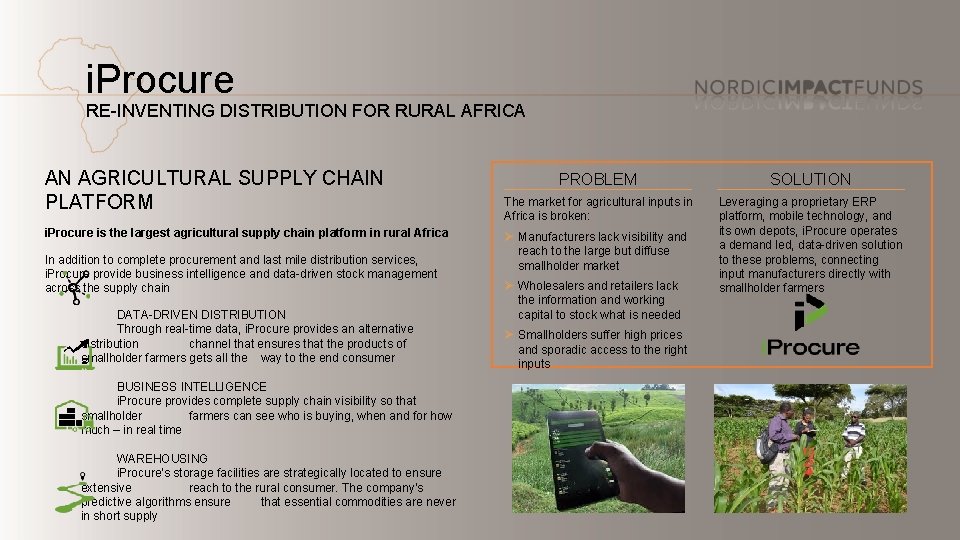
i. Procure RE-INVENTING DISTRIBUTION FOR RURAL AFRICA AN AGRICULTURAL SUPPLY CHAIN PLATFORM i. Procure is the largest agricultural supply chain platform in rural Africa In addition to complete procurement and last mile distribution services, i. Procure provide business intelligence and data-driven stock management across the supply chain DATA-DRIVEN DISTRIBUTION Through real-time data, i. Procure provides an alternative distribution channel that ensures that the products of smallholder farmers gets all the way to the end consumer BUSINESS INTELLIGENCE i. Procure provides complete supply chain visibility so that smallholder farmers can see who is buying, when and for how much – in real time WAREHOUSING i. Procure’s storage facilities are strategically located to ensure extensive reach to the rural consumer. The company’s predictive algorithms ensure that essential commodities are never in short supply PROBLEM SOLUTION The market for agricultural inputs in Africa is broken: Leveraging a proprietary ERP platform, mobile technology, and its own depots, i. Procure operates a demand led, data-driven solution to these problems, connecting input manufacturers directly with smallholder farmers Ø Manufacturers lack visibility and reach to the large but diffuse smallholder market Ø Wholesalers and retailers lack the information and working capital to stock what is needed Ø Smallholders suffer high prices and sporadic access to the right inputs
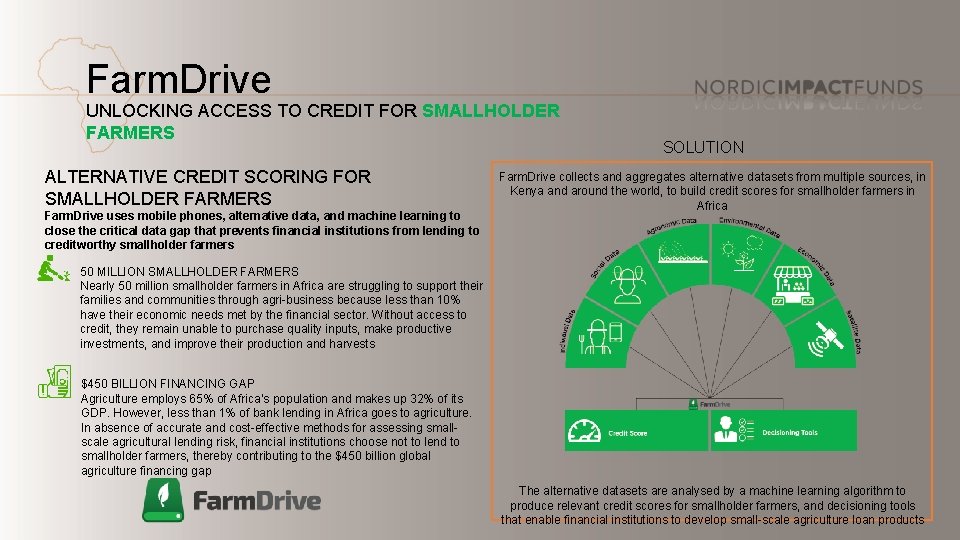
Farm. Drive UNLOCKING ACCESS TO CREDIT FOR SMALLHOLDER FARMERS ALTERNATIVE CREDIT SCORING FOR SMALLHOLDER FARMERS Farm. Drive uses mobile phones, alternative data, and machine learning to close the critical data gap that prevents financial institutions from lending to creditworthy smallholder farmers SOLUTION Farm. Drive collects and aggregates alternative datasets from multiple sources, in Kenya and around the world, to build credit scores for smallholder farmers in Africa 50 MILLION SMALLHOLDER FARMERS Nearly 50 million smallholder farmers in Africa are struggling to support their families and communities through agri-business because less than 10% have their economic needs met by the financial sector. Without access to credit, they remain unable to purchase quality inputs, make productive investments, and improve their production and harvests $450 BILLION FINANCING GAP Agriculture employs 65% of Africa’s population and makes up 32% of its GDP. However, less than 1% of bank lending in Africa goes to agriculture. In absence of accurate and cost-effective methods for assessing smallscale agricultural lending risk, financial institutions choose not to lend to smallholder farmers, thereby contributing to the $450 billion global agriculture financing gap The alternative datasets are analysed by a machine learning algorithm to produce relevant credit scores for smallholder farmers, and decisioning tools that enable financial institutions to develop small-scale agriculture loan products
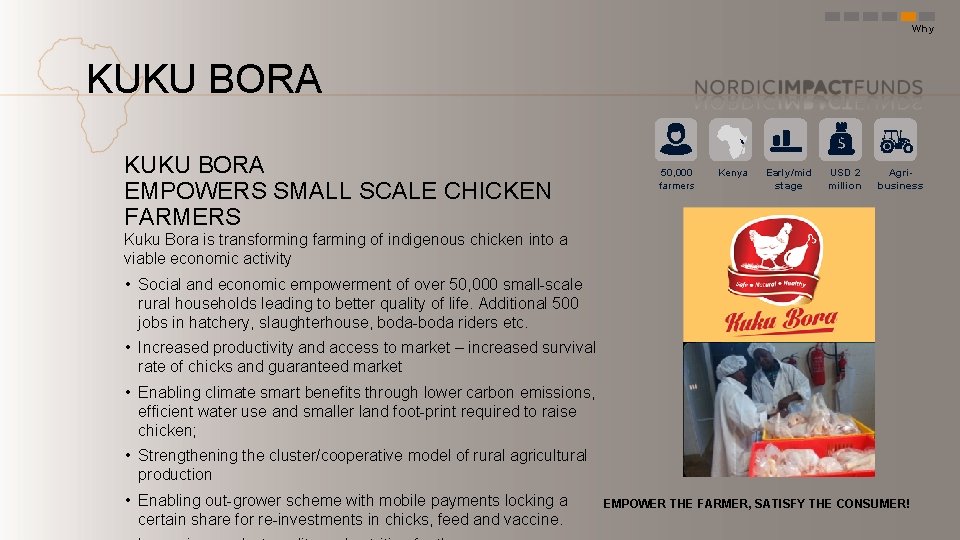
Why KUKU BORA EMPOWERS SMALL SCALE CHICKEN FARMERS 50, 000 farmers Kenya Early/mid stage USD 2 million Agribusiness Kuku Bora is transforming farming of indigenous chicken into a viable economic activity • Social and economic empowerment of over 50, 000 small-scale rural households leading to better quality of life. Additional 500 jobs in hatchery, slaughterhouse, boda-boda riders etc. • Increased productivity and access to market – increased survival rate of chicks and guaranteed market • Enabling climate smart benefits through lower carbon emissions, efficient water use and smaller land foot-print required to raise chicken; • Strengthening the cluster/cooperative model of rural agricultural production • Enabling out-grower scheme with mobile payments locking a certain share for re-investments in chicks, feed and vaccine. EMPOWER THE FARMER, SATISFY THE CONSUMER!
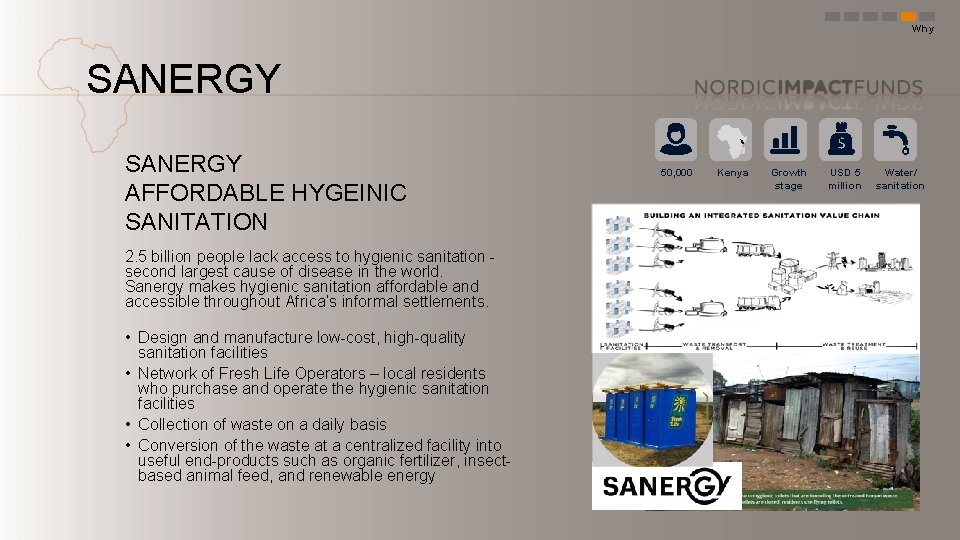
Why SANERGY AFFORDABLE HYGEINIC SANITATION 2. 5 billion people lack access to hygienic sanitation - second largest cause of disease in the world. Sanergy makes hygienic sanitation affordable and accessible throughout Africa’s informal settlements. • Design and manufacture low-cost, high-quality sanitation facilities • Network of Fresh Life Operators – local residents who purchase and operate the hygienic sanitation facilities • Collection of waste on a daily basis • Conversion of the waste at a centralized facility into useful end-products such as organic fertilizer, insectbased animal feed, and renewable energy 50, 000 Kenya Growth stage USD 5 million Water/ sanitation
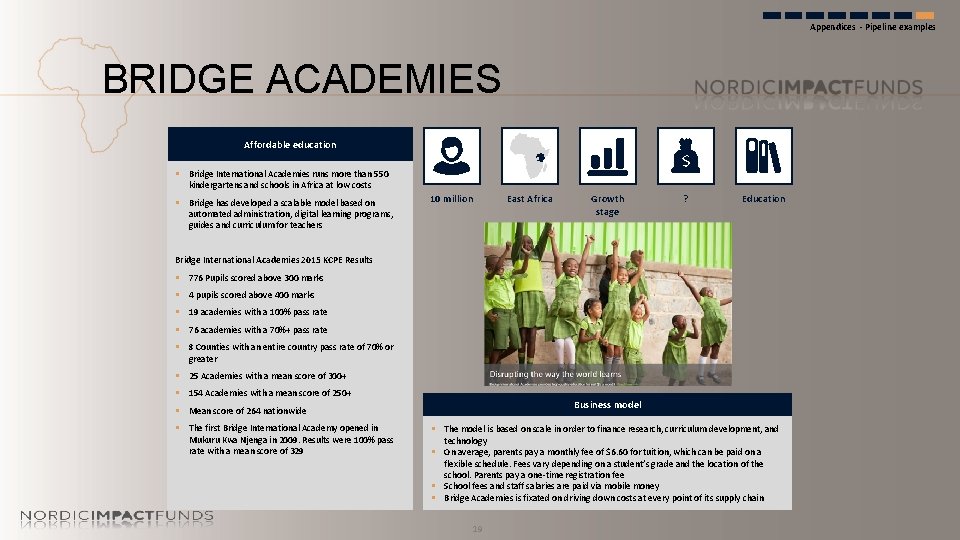
Appendices - Pipeline examples BRIDGE ACADEMIES Affordable education § Bridge International Academies runs more than 550 kindergartens and schools in Africa at low costs § Bridge has developed a scalable model based on 10 million automated administration, digital learning programs, guides and curriculum for teachers East Africa Growth stage ? Education Bridge International Academies 2015 KCPE Results § 776 Pupils scored above 300 marks § 4 pupils scored above 400 marks § 19 academies with a 100% pass rate § 76 academies with a 70%+ pass rate § 8 Counties with an entire country pass rate of 70% or greater § 25 Academies with a mean score of 300+ § 154 Academies with a mean score of 250+ Business model § Mean score of 264 nationwide § The first Bridge International Academy opened in Mukuru Kwa Njenga in 2009. Results were 100% pass rate with a mean score of 329 § The model is based on scale in order to finance research, curriculum development, and technology § On average, parents pay a monthly fee of $6. 60 for tuition, which can be paid on a flexible schedule. Fees vary depending on a student’s grade and the location of the school. Parents pay a one-time registration fee § School fees and staff salaries are paid via mobile money § Bridge Academies is fixated on driving down costs at every point of its supply chain 19
- Slides: 19