
Investigative Mathematics Objectives At the end of the
Investigative Mathematics Objectives At the end of the lesson, you will be able to : 1. Know the difference between a linear series pattern, non-linear series pattern and triangular series pattern. 2. Recognise three different types of pattern question. 3. Solve all the three different types of number pattern questions.
Investigative Mathematics The three different types of pattern questions are : 1. Linear series pattern 2. Non – Linear series pattern 3. Triangular series pattern

Investigative Mathematics Linear Series Pattern Example 1 Look at the number pattern below 4, 10, 16, 22, 28 a) Find the 10 th term. b) Find the 55 th term. How do I solve this?
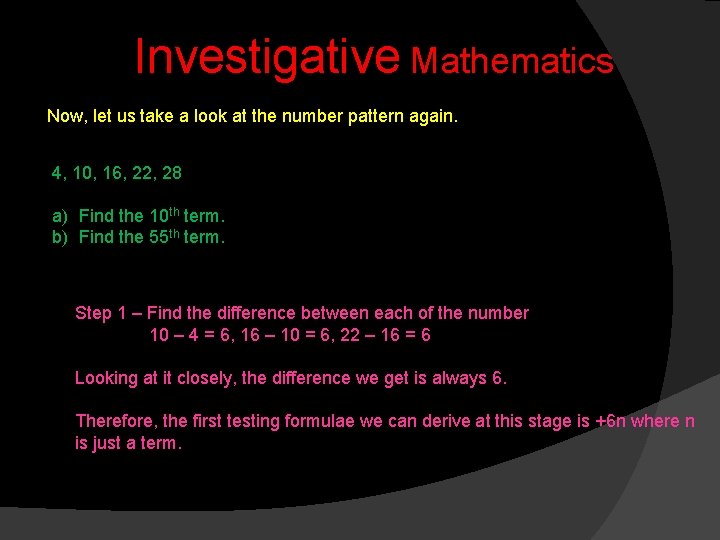
Investigative Mathematics Now, let us take a look at the number pattern again. 4, 10, 16, 22, 28 a) Find the 10 th term. b) Find the 55 th term. Step 1 – Find the difference between each of the number 10 – 4 = 6, 16 – 10 = 6, 22 – 16 = 6 Looking at it closely, the difference we get is always 6. Therefore, the first testing formulae we can derive at this stage is +6 n where n is just a term.
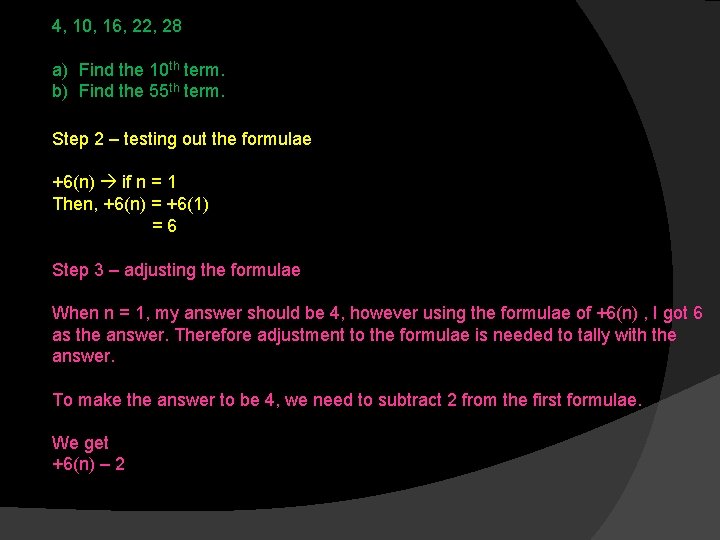
4, 10, 16, 22, 28 a) Find the 10 th term. b) Find the 55 th term. Step 2 – testing out the formulae +6(n) if n = 1 Then, +6(n) = +6(1) =6 Step 3 – adjusting the formulae When n = 1, my answer should be 4, however using the formulae of +6(n) , I got 6 as the answer. Therefore adjustment to the formulae is needed to tally with the answer. To make the answer to be 4, we need to subtract 2 from the first formulae. We get +6(n) – 2
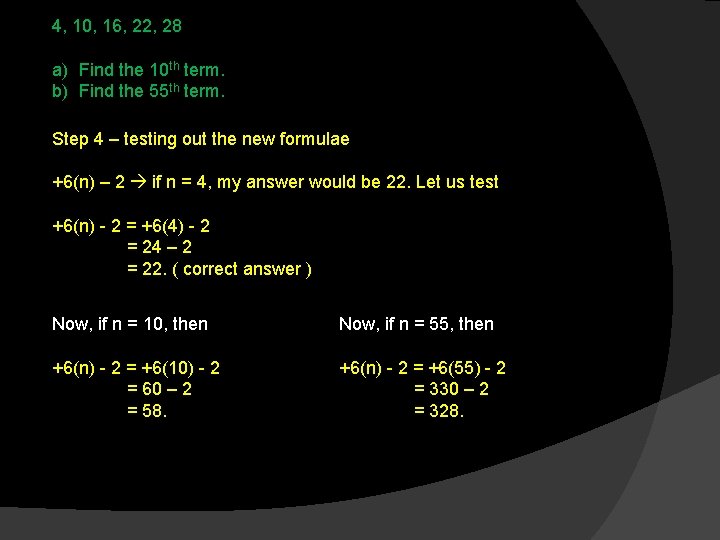
4, 10, 16, 22, 28 a) Find the 10 th term. b) Find the 55 th term. Step 4 – testing out the new formulae +6(n) – 2 if n = 4, my answer would be 22. Let us test +6(n) - 2 = +6(4) - 2 = 24 – 2 = 22. ( correct answer ) Now, if n = 10, then Now, if n = 55, then +6(n) - 2 = +6(10) - 2 = 60 – 2 = 58. +6(n) - 2 = +6(55) - 2 = 330 – 2 = 328.
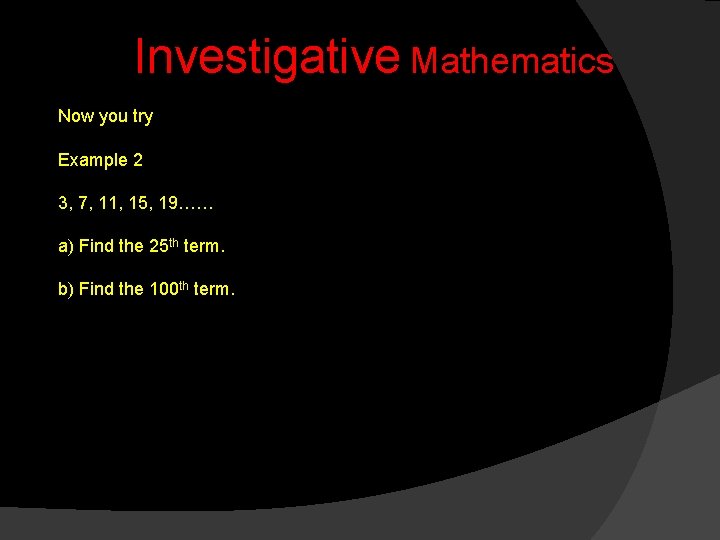
Investigative Mathematics Now you try Example 2 3, 7, 11, 15, 19…… a) Find the 25 th term. b) Find the 100 th term.
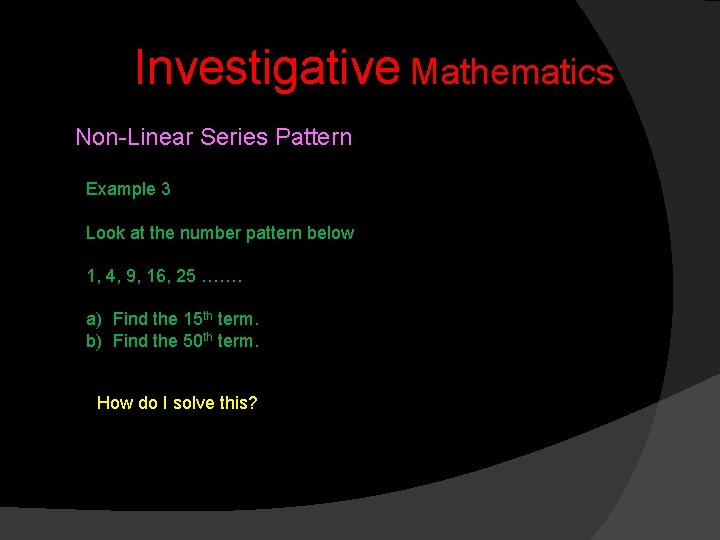
Investigative Mathematics Non-Linear Series Pattern Example 3 Look at the number pattern below 1, 4, 9, 16, 25 ……. a) Find the 15 th term. b) Find the 50 th term. How do I solve this?
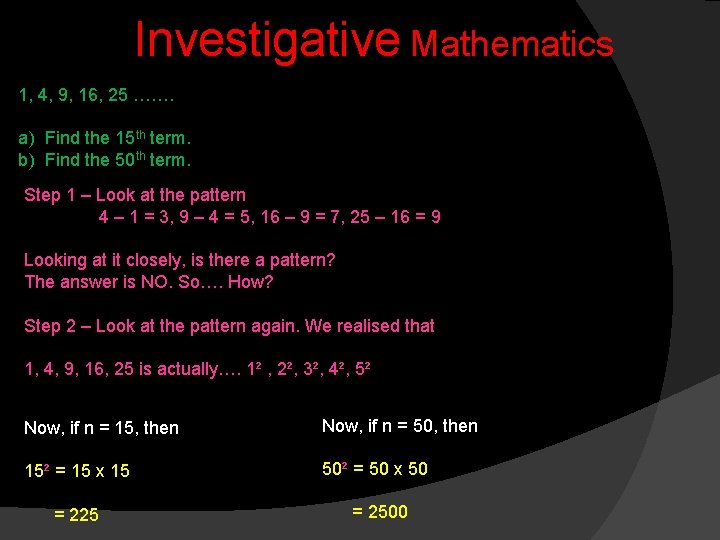
Investigative Mathematics 1, 4, 9, 16, 25 ……. a) Find the 15 th term. b) Find the 50 th term. Step 1 – Look at the pattern 4 – 1 = 3, 9 – 4 = 5, 16 – 9 = 7, 25 – 16 = 9 Looking at it closely, is there a pattern? The answer is NO. So…. How? Step 2 – Look at the pattern again. We realised that 1, 4, 9, 16, 25 is actually…. 1² , 2², 3², 4², 5² Now, if n = 15, then Now, if n = 50, then 15² = 15 x 15 50² = 50 x 50 = 225 = 2500
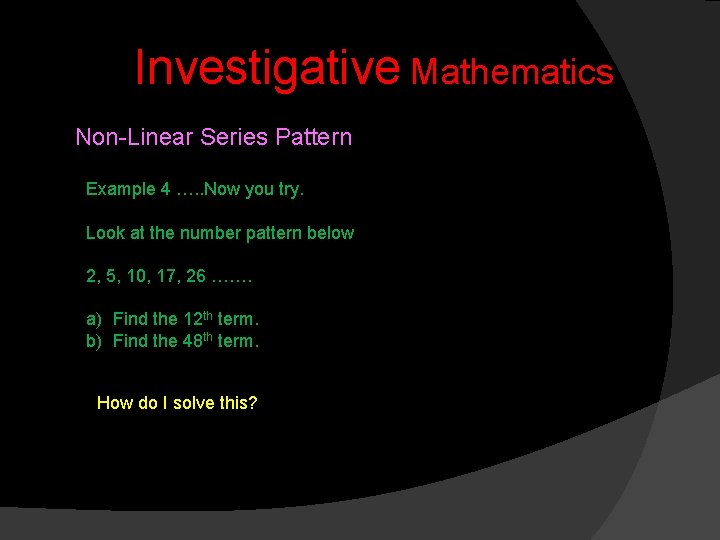
Investigative Mathematics Non-Linear Series Pattern Example 4 …. . Now you try. Look at the number pattern below 2, 5, 10, 17, 26 ……. a) Find the 12 th term. b) Find the 48 th term. How do I solve this?
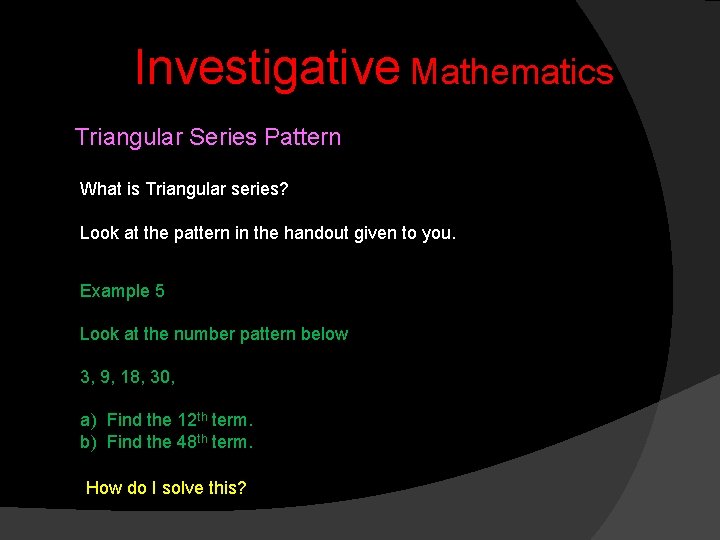
Investigative Mathematics Triangular Series Pattern What is Triangular series? Look at the pattern in the handout given to you. Example 5 Look at the number pattern below 3, 9, 18, 30, a) Find the 12 th term. b) Find the 48 th term. How do I solve this?
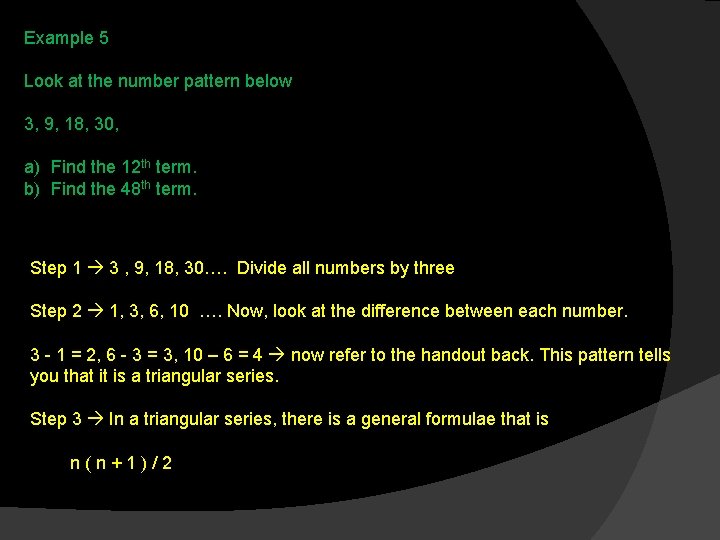
Example 5 Look at the number pattern below 3, 9, 18, 30, a) Find the 12 th term. b) Find the 48 th term. Step 1 3 , 9, 18, 30…. Divide all numbers by three Step 2 1, 3, 6, 10 …. Now, look at the difference between each number. 3 - 1 = 2, 6 - 3 = 3, 10 – 6 = 4 now refer to the handout back. This pattern tells you that it is a triangular series. Step 3 In a triangular series, there is a general formulae that is n(n+1)/2
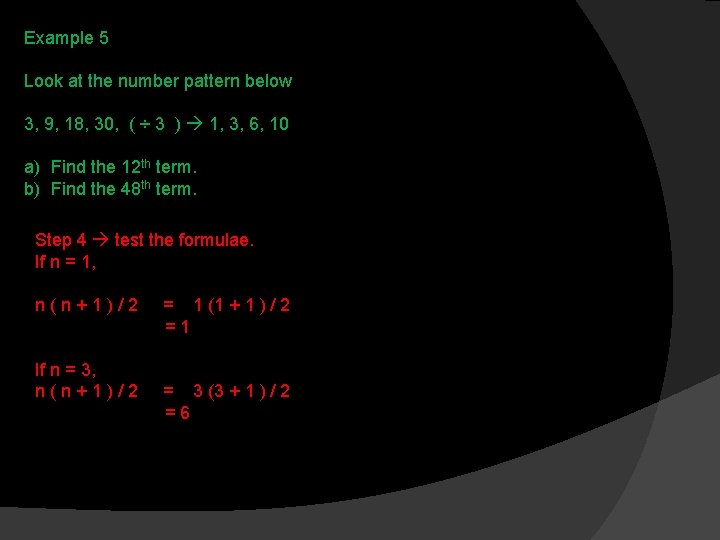
Example 5 Look at the number pattern below 3, 9, 18, 30, ( ÷ 3 ) 1, 3, 6, 10 a) Find the 12 th term. b) Find the 48 th term. Step 4 test the formulae. If n = 1, n(n+1)/2 If n = 3, n(n+1)/2 = 1 (1 + 1 ) / 2 =1 = 3 (3 + 1 ) / 2 =6
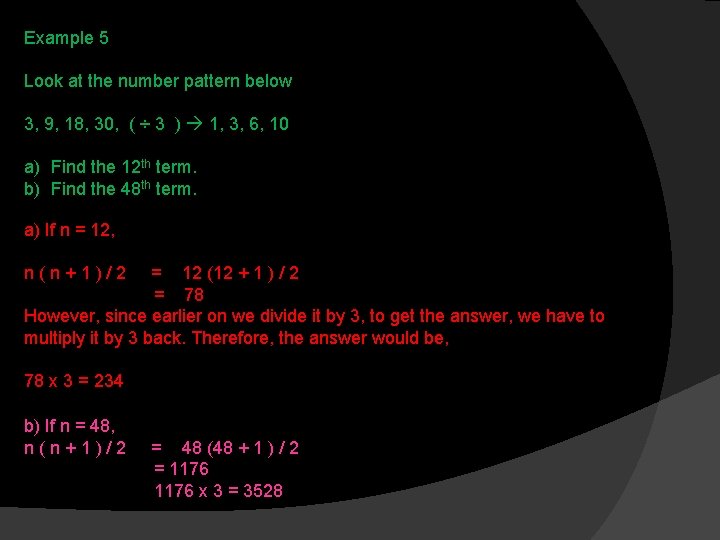
Example 5 Look at the number pattern below 3, 9, 18, 30, ( ÷ 3 ) 1, 3, 6, 10 a) Find the 12 th term. b) Find the 48 th term. a) If n = 12, n(n+1)/2 = 12 (12 + 1 ) / 2 = 78 However, since earlier on we divide it by 3, to get the answer, we have to multiply it by 3 back. Therefore, the answer would be, 78 x 3 = 234 b) If n = 48, n(n+1)/2 = 48 (48 + 1 ) / 2 = 1176 x 3 = 3528
Investigative Mathematics Now take a look at the question that you have in the remediation paper
Conclusion You have learnt 1. the difference between a linear series pattern, non-linear series pattern and triangular series pattern. 2. to recognise three different types of pattern question. 3. how to solve all the three different types of number pattern questions.
- Slides: 16