
Investigations on the performance of lidar measurements with
![Observations with different pulse durations [2] V. Banakh and I. Smalikho, Coherent Doppler wind](https://slidetodoc.com/presentation_image_h2/c08954ec05d39e387bb70b80af9cc545/image-8.jpg "Observations with different pulse durations [2] V. Banakh and I. Smalikho, Coherent Doppler wind")
![Observations with different pulse shapes [2] V. Banakh and I. Smalikho, Coherent Doppler wind](https://slidetodoc.com/presentation_image_h2/c08954ec05d39e387bb70b80af9cc545/image-12.jpg "Observations with different pulse shapes [2] V. Banakh and I. Smalikho, Coherent Doppler wind")
- Slides: 15
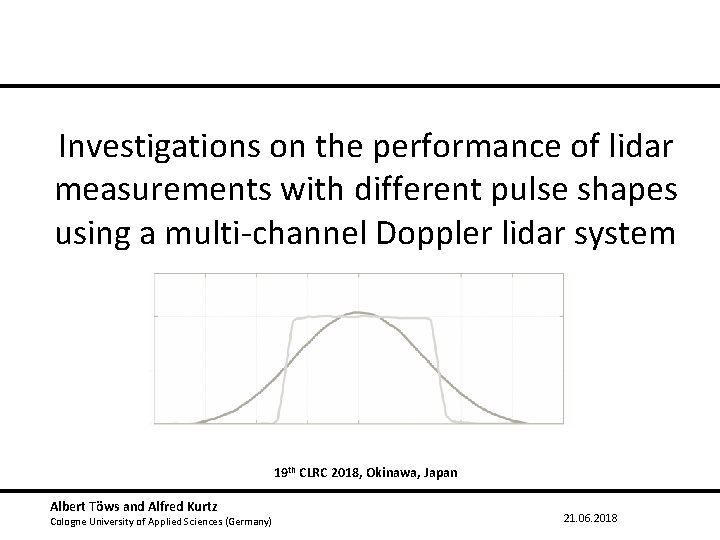
Investigations on the performance of lidar measurements with different pulse shapes using a multi-channel Doppler lidar system 19 th CLRC 2018, Okinawa, Japan Albert Töws and Alfred Kurtz Cologne University of Applied Sciences (Germany) 21. 06. 2018
Outline Multi-channel system setup Feedback controlled pulse-shaping technique Method for comparing measurements with different pulses Measurement results with different pulse length and shapes
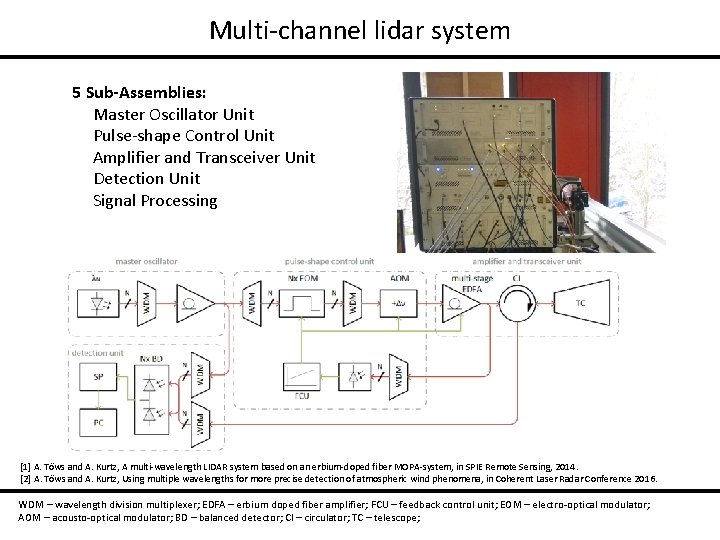
Multi-channel lidar system 5 Sub-Assemblies: Master Oscillator Unit Pulse-shape Control Unit Amplifier and Transceiver Unit Detection Unit Signal Processing [1] A. Töws and A. Kurtz, A multi-wavelength LIDAR system based on an erbium-doped fiber MOPA-system, in SPIE Remote Sensing, 2014. [2] A. Töws and A. Kurtz, Using multiple wavelengths for more precise detection of atmospheric wind phenomena, in Coherent Laser Radar Conference 2016. WDM – wavelength division multiplexer; EDFA – erbium doped fiber amplifier; FCU – feedback control unit; EOM – electro-optical modulator; AOM – acousto-optical modulator; BD – balanced detector; CI – circulator; TC – telescope;
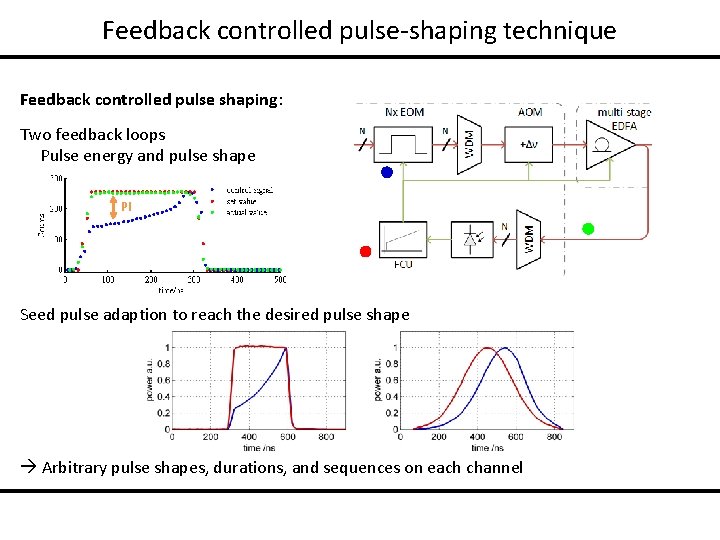
Feedback controlled pulse-shaping technique Feedback controlled pulse shaping: Two feedback loops Pulse energy and pulse shape PI Seed pulse adaption to reach the desired pulse shape Arbitrary pulse shapes, durations, and sequences on each channel
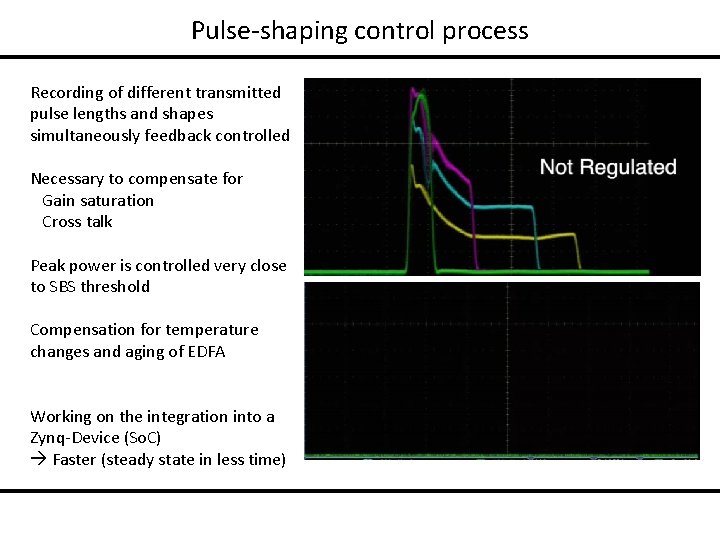
Pulse-shaping control process Recording of different transmitted pulse lengths and shapes simultaneously feedback controlled Necessary to compensate for Gain saturation Cross talk Peak power is controlled very close to SBS threshold Compensation for temperature changes and aging of EDFA Working on the integration into a Zynq-Device (So. C) Faster (steady state in less time)
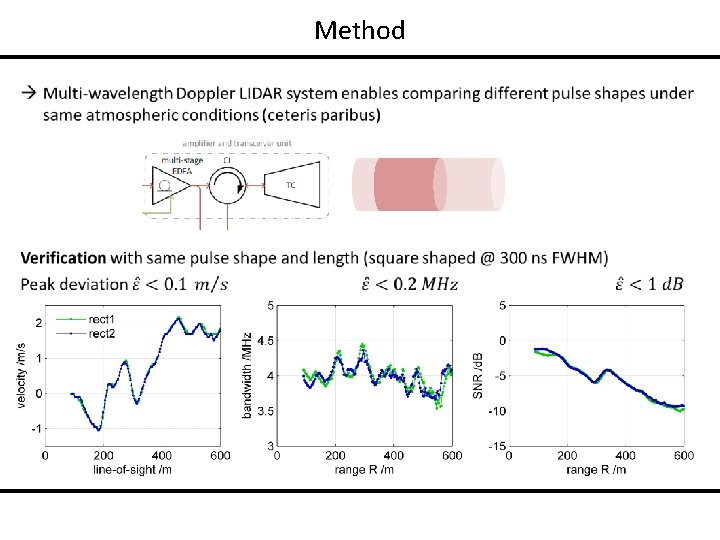
Method
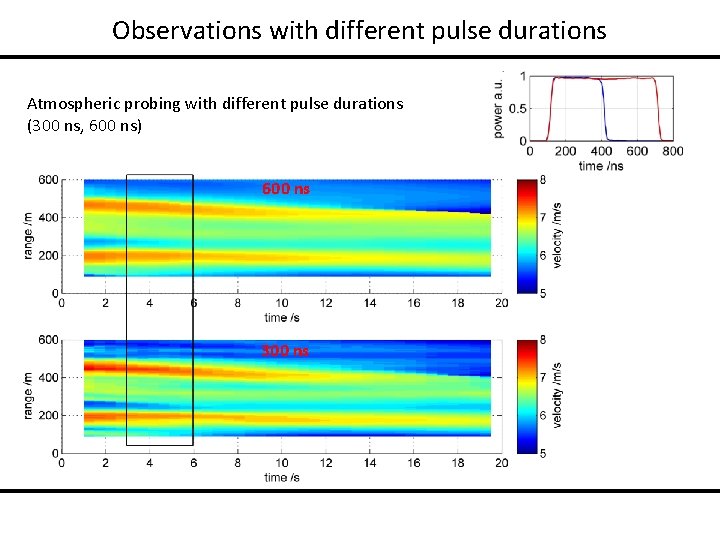
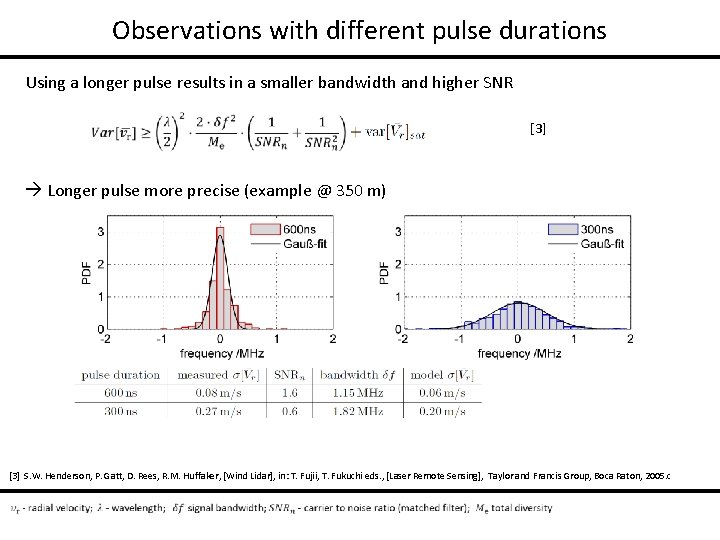
Observations with different pulse durations Atmospheric probing with different pulse durations (300 ns, 600 ns) 600 ns 300 ns
Observations with different pulse durations [2] V. Banakh and I. Smalikho, Coherent Doppler wind lidars in a turbulent atmosphere (Artech House, 2013).
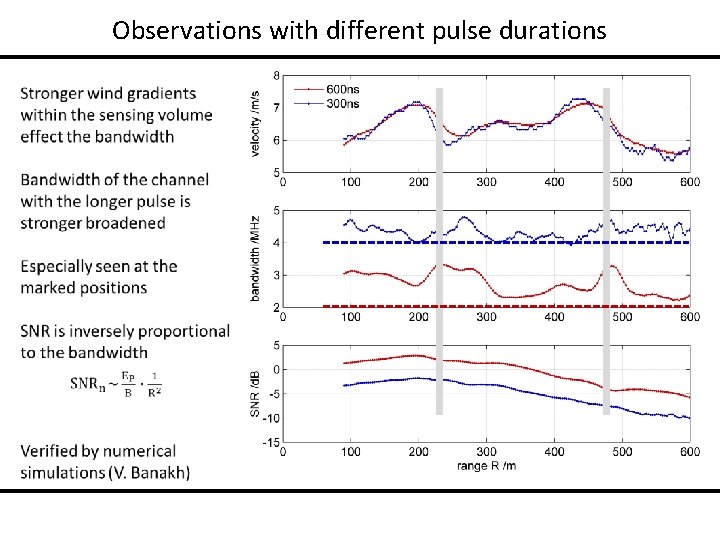
Observations with different pulse durations
Observations with different pulse durations Using a longer pulse results in a smaller bandwidth and higher SNR [3] Longer pulse more precise (example @ 350 m) [3] S. W. Henderson, P. Gatt, D. Rees, R. M. Huffaker, [Wind Lidar], in: T. Fujii, T. Fukuchi eds. , [Laser Remote Sensing], Taylor and Francis Group, Boca Raton, 2005. c
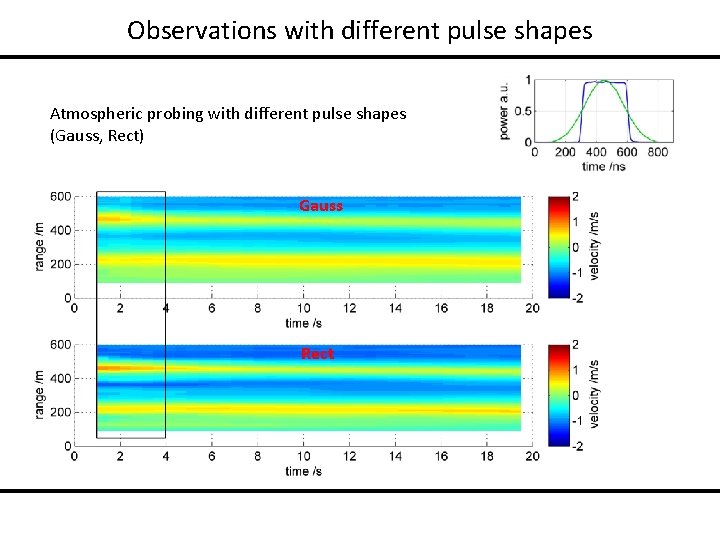
Observations with different pulse shapes Atmospheric probing with different pulse shapes (Gauss, Rect) Gauss Rect
Observations with different pulse shapes [2] V. Banakh and I. Smalikho, Coherent Doppler wind lidars in a turbulent atmosphere (Artech House, 2013).
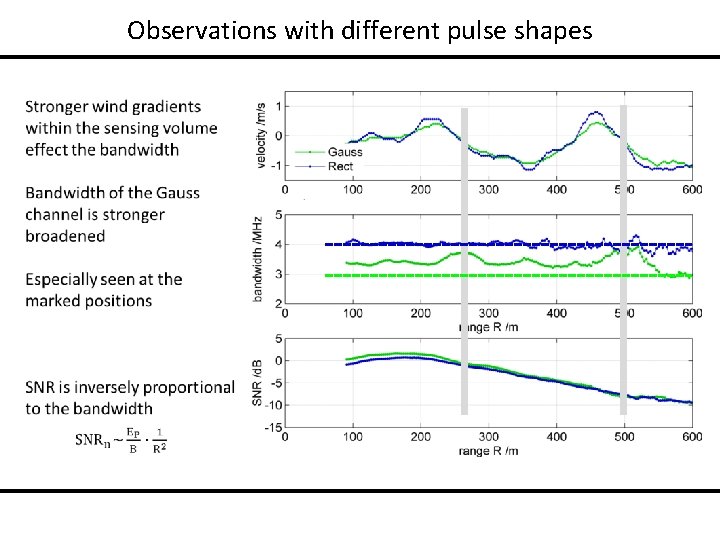
Observations with different pulse shapes
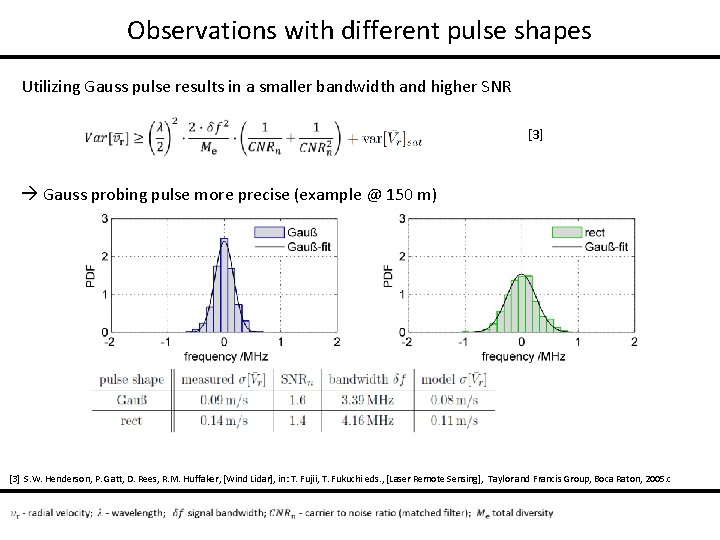
Observations with different pulse shapes Utilizing Gauss pulse results in a smaller bandwidth and higher SNR [3] Gauss probing pulse more precise (example @ 150 m) [3] S. W. Henderson, P. Gatt, D. Rees, R. M. Huffaker, [Wind Lidar], in: T. Fujii, T. Fukuchi eds. , [Laser Remote Sensing], Taylor and Francis Group, Boca Raton, 2005. c
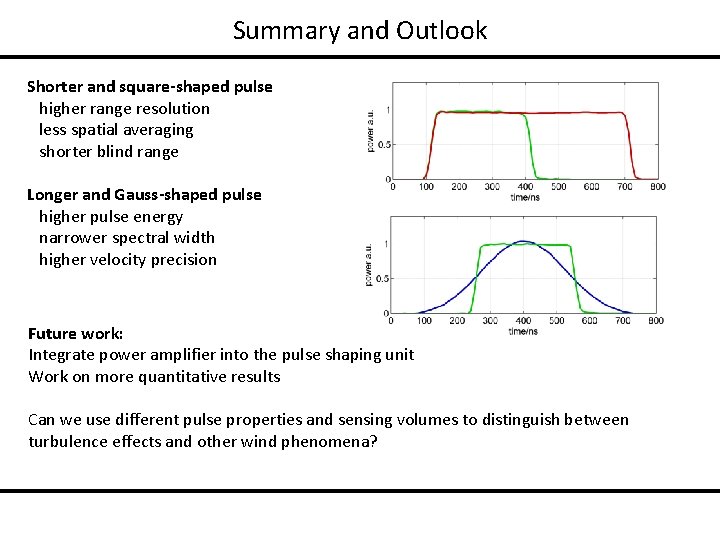
Summary and Outlook Shorter and square-shaped pulse higher range resolution less spatial averaging shorter blind range Longer and Gauss-shaped pulse higher pulse energy narrower spectral width higher velocity precision Future work: Integrate power amplifier into the pulse shaping unit Work on more quantitative results Can we use different pulse properties and sensing volumes to distinguish between turbulence effects and other wind phenomena?