
Investigational Device Exemption IDE Overview for IRBs Marian

Investigational Device Exemption (IDE) Overview for IRBs Marian Serge, RN Division of Bioresearch Monitoring Office of Compliance Center for Devices and Radiological Health FDA 1
Topics • Provision of IDE regulations • Medical device definition • When is an IDE not needed • When is an IDE required • Significant risk (SR) device • Non-significant risk (NSR) device • Non compliance 2
Provisions of the IDE Regulation - 21 CFR 812 • • • Submission process of an IDE application to FDA for significant risk device studies Process for obtaining IDE for non-significant risk device studies Assigns responsibilities: sponsor and clinical investigator – Investigator agreement – Device accountability – Reporting and records – IRB review and informed consent 3
IRBs must know three basic things 1. 2. 3. Does the study involve a device? Does it need an IDE? Is the device SR or NSR? 4
Question # 1 What is a device? 5

What is a medical device? • An instrument, apparatus, implement, machine, contrivance, implant, in vitro reagent. . . or component, part, or accessory. . . intended to diagnose a disease or condition or to cure, mitigate, treat, or for prevention of disease or it affects the structure or function of the body…. . and does not achieve its primary purpose through chemical action. . . or by being metabolized 6
Question 2 Does the device study require an Investigational Device Exemption (IDE)? 7
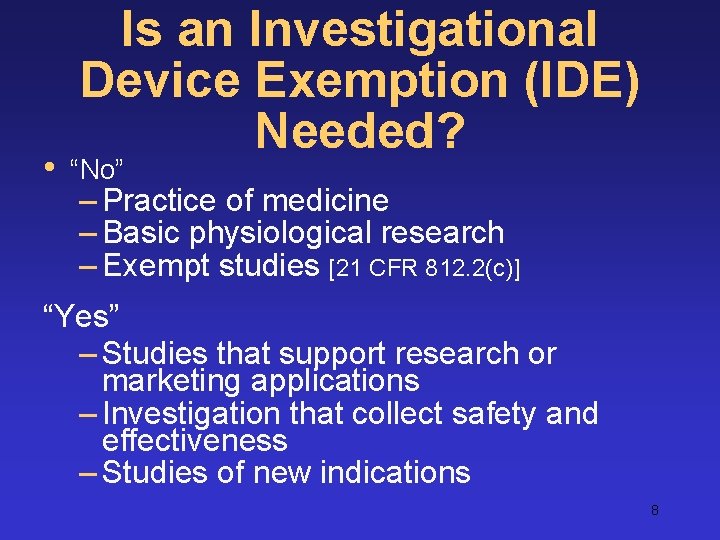
• Is an Investigational Device Exemption (IDE) Needed? “No” – Practice of medicine – Basic physiological research – Exempt studies [21 CFR 812. 2(c)] “Yes” – Studies that support research or marketing applications – Investigation that collect safety and effectiveness – Studies of new indications 8

IDE not needed 9
Practice of Medicine (no IDE) • Physician should – Be well informed about the product – Use firm scientific rationale and sound medical evidence – Maintain records on use and effects • Not research but check Institutional policy: it may require IRB review and Informed Consent 10
Basic Physiological Research (no IDE) • Investigating a physiological principle • No intent to develop the device for marketing • Only using the device to address the research question – not safety and effectiveness 11
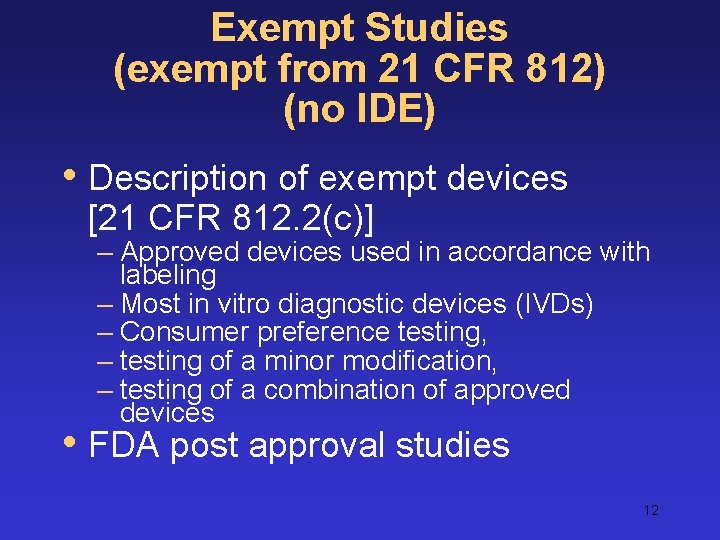
Exempt Studies (exempt from 21 CFR 812) (no IDE) • Description of exempt devices [21 CFR 812. 2(c)] – Approved devices used in accordance with labeling – Most in vitro diagnostic devices (IVDs) – Consumer preference testing, – testing of a minor modification, – testing of a combination of approved devices • FDA post approval studies 12

IDE required 13
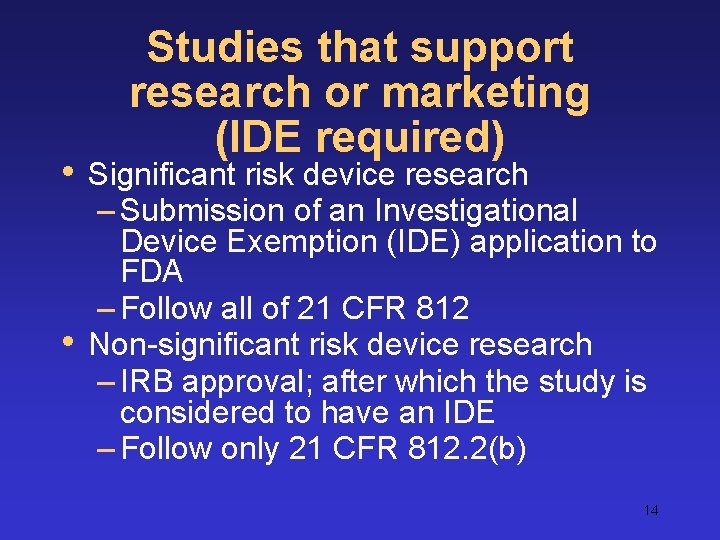
• • Studies that support research or marketing (IDE required) Significant risk device research – Submission of an Investigational Device Exemption (IDE) application to FDA – Follow all of 21 CFR 812 Non-significant risk device research – IRB approval; after which the study is considered to have an IDE – Follow only 21 CFR 812. 2(b) 14
Results of an investigation to FDA (IDE needed) • Clinical investigations of devices where safety and effectiveness data are collected will require an IDE 15
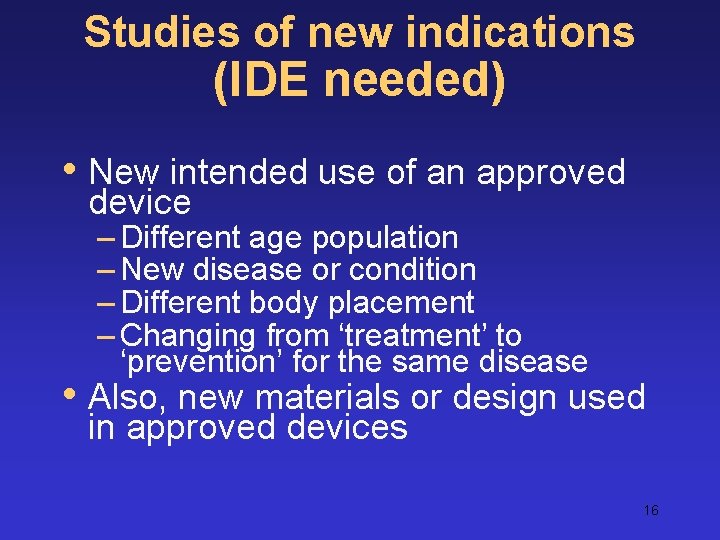
Studies of new indications (IDE needed) • New intended use of an approved device – Different age population – New disease or condition – Different body placement – Changing from ‘treatment’ to ‘prevention’ for the same disease • Also, new materials or design used in approved devices 16
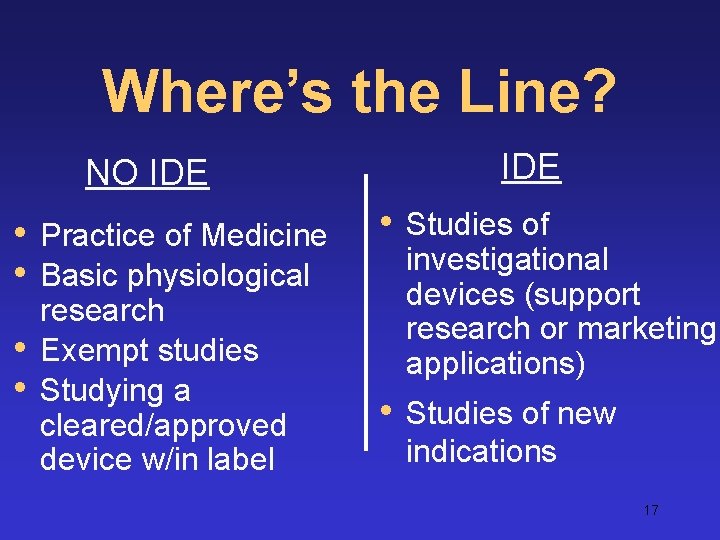
Where’s the Line? IDE NO IDE • • Practice of Medicine Basic physiological research Exempt studies Studying a cleared/approved device w/in label • Studies of investigational devices (support research or marketing applications) • Studies of new indications 17
Question 3 Is the device SR or NSR? 18
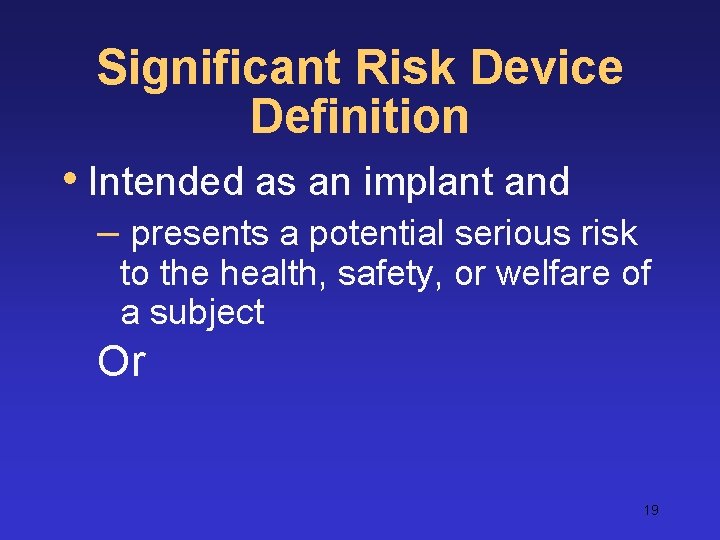
Significant Risk Device Definition • Intended as an implant and – presents a potential serious risk to the health, safety, or welfare of a subject Or 19
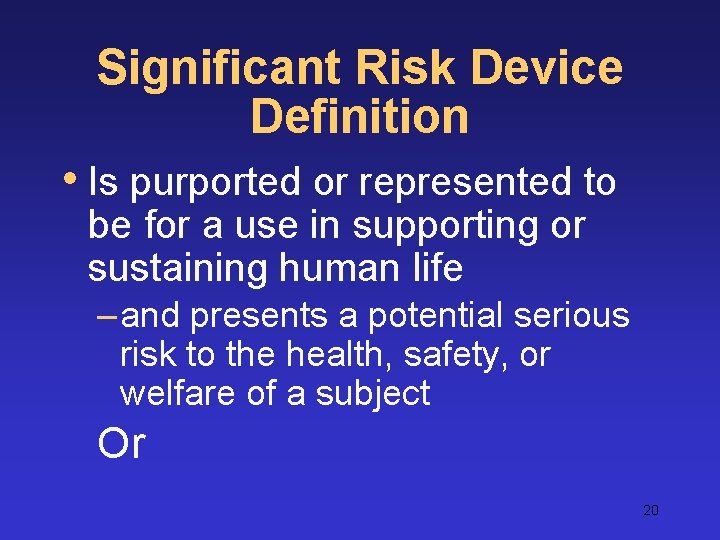
Significant Risk Device Definition • Is purported or represented to be for a use in supporting or sustaining human life – and presents a potential serious risk to the health, safety, or welfare of a subject Or 20
Significant Risk Device Definition • Is for a use of substantial importance in diagnosing, curing, mitigating, or treating disease, or otherwise preventing impairment of human health – and presents a potential serious risk to the health, safety, or welfare of a subject Or 21
Significant Risk Device Definition • Otherwise presents a potential for serious risk to the health safety or welfare of the subject • Examples of SR devices: stents, respirators, dialysis machines, sutures, organ storage units, dental lasers for hard tissue, deep brain stimulators, female condoms, etc 22
Significant Risk Device • • IDEs Sponsor submits IDE application to FDA approves or disapproves or FDA conditionally approves which means there are no safety concerns and the study can begin while deficiencies are being addressed After FDA approval and IRB approval the SR device study can begin 23
Non-significant risk device • Any device that is not significant risk Examples: – caries removal solution – contact lens, daily wear – gastroenterology and urology endoscopes and/or accessories – externally worn monitors for insulin reactions 24
Non-significant risk device • • • IDEs Sponsor presents the IRB with – protocol & a brief explanation why the device is not a significant risk device IRB also determines whether the device is SR or NSR If IRB determination agrees with sponsor’s NSR determination the IRB can review and approve the study using the criterial at 21 CFR 56. 111 – it is considered to have approved application for IDE • No formal IDE submission to FDA 25
Quick summary SR and NSR device studies • Significant risk device study • • – Requires FDA and IRB approval Non-significant risk device study – Requires IRB approval Need help deciding? – CDRH has procedures: see handout. • Want to see FDA’s decision letter? – Ask the sponsor. 26
IRB Non-compliance • • Inadequate initial or continuing review – Frequency of review – Expedited review – SR determination Inadequate records – SOPs – Minutes, including the vote – Membership roster – Study documentation 27
Clinical Investigator Non-compliance • Failed to – Follow investigational plan, investigator agreement, or protocol – Document case history and device exposure – Obtain adequate informed consent 28
Clinical Investigator Non-compliance • Failed to – Control of investigational device – Report Unanticipated ADEs – Obtain FDA or IRB approval to conduct study 29
Summary • Medical device definition • Significant risk (SR) device • Non-significant risk (NSR) device • IDE not required • IDE required • IRB and investigator noncompliance 30
Contact Information and Websites • IDE Staff –Sheila. Brown@fda. hhs. gov –Stephen Rhodes, Director • Websites: – www. fda. gov and click on Medical Devices – www. fda. gov/oc/ohrt/irbs/ 31
Marian Serge, RN DBM, OC, CDRH, FDA Marian, Serge@FDA. HHS. GOV (301) 796 -5644 32
- Slides: 32