
Investigation of Hot QCD Matter with Relativistic Heavy
![Holographic argument General argument [Kovtun, Son & Starinets, PRL 94 (2005) 111601] based on](https://slidetodoc.com/presentation_image_h2/604f72532eb1891131e76342e8fe5f78/image-13.jpg "Holographic argument General argument [Kovtun, Son & Starinets, PRL 94 (2005) 111601] based on")
- Slides: 43
Investigation of Hot QCD Matter with Relativistic Heavy Ions Theoretical Aspects See also: B. M. & J. Schukraft & B. Wyslouch First results from Pb+Pb collisions at the LHC Ann. Rev. Nucl. Part. Sci. 62, 361 (2012) B. V. Jacak & B. M. The Exploration of Hot Nuclear Matter Science 337, 310 -314 (2012) Berndt Müller Nobel Symposium on LHC Results Uppsala 13 May 2013
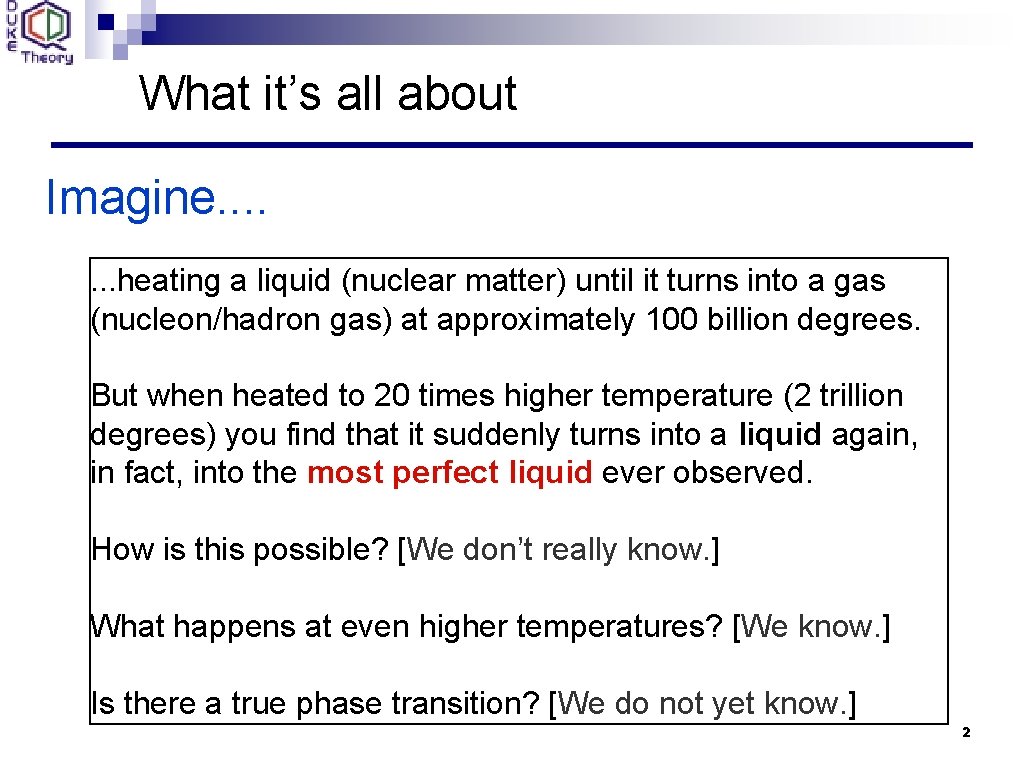
What it’s all about Imagine. . . . heating a liquid (nuclear matter) until it turns into a gas (nucleon/hadron gas) at approximately 100 billion degrees. But when heated to 20 times higher temperature (2 trillion degrees) you find that it suddenly turns into a liquid again, in fact, into the most perfect liquid ever observed. How is this possible? [We don’t really know. ] What happens at even higher temperatures? [We know. ] Is there a true phase transition? [We do not yet know. ] 2
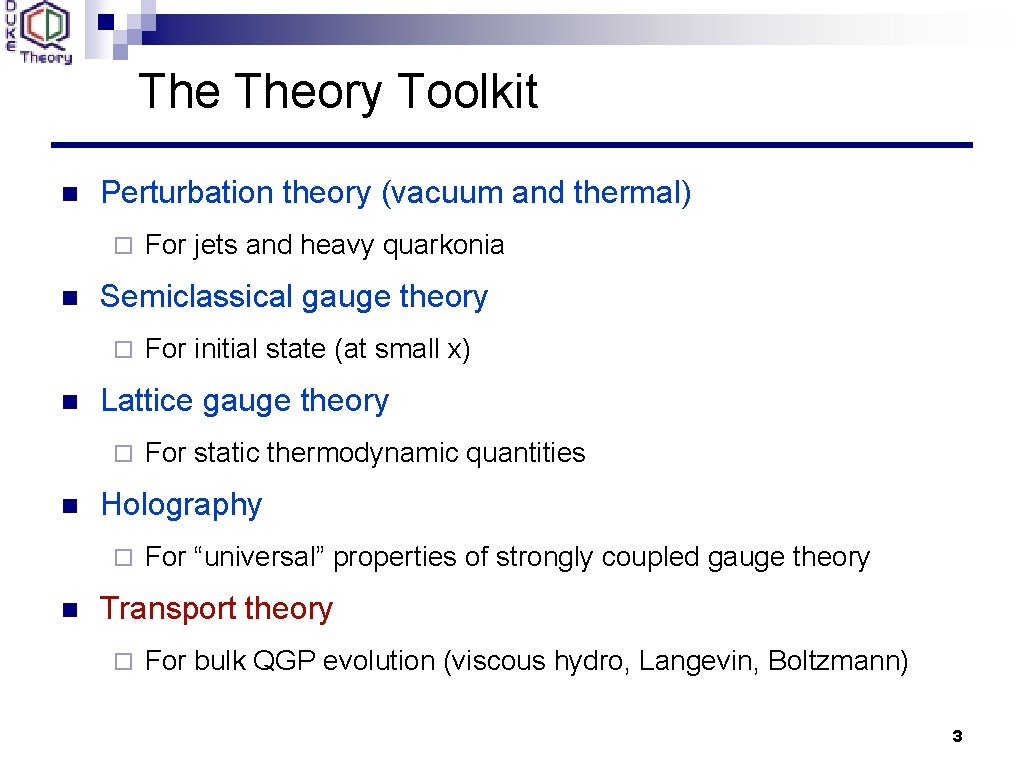
The Theory Toolkit n Perturbation theory (vacuum and thermal) ¨ n Semiclassical gauge theory ¨ n For static thermodynamic quantities Holography ¨ n For initial state (at small x) Lattice gauge theory ¨ n For jets and heavy quarkonia For “universal” properties of strongly coupled gauge theory Transport theory ¨ For bulk QGP evolution (viscous hydro, Langevin, Boltzmann) 3
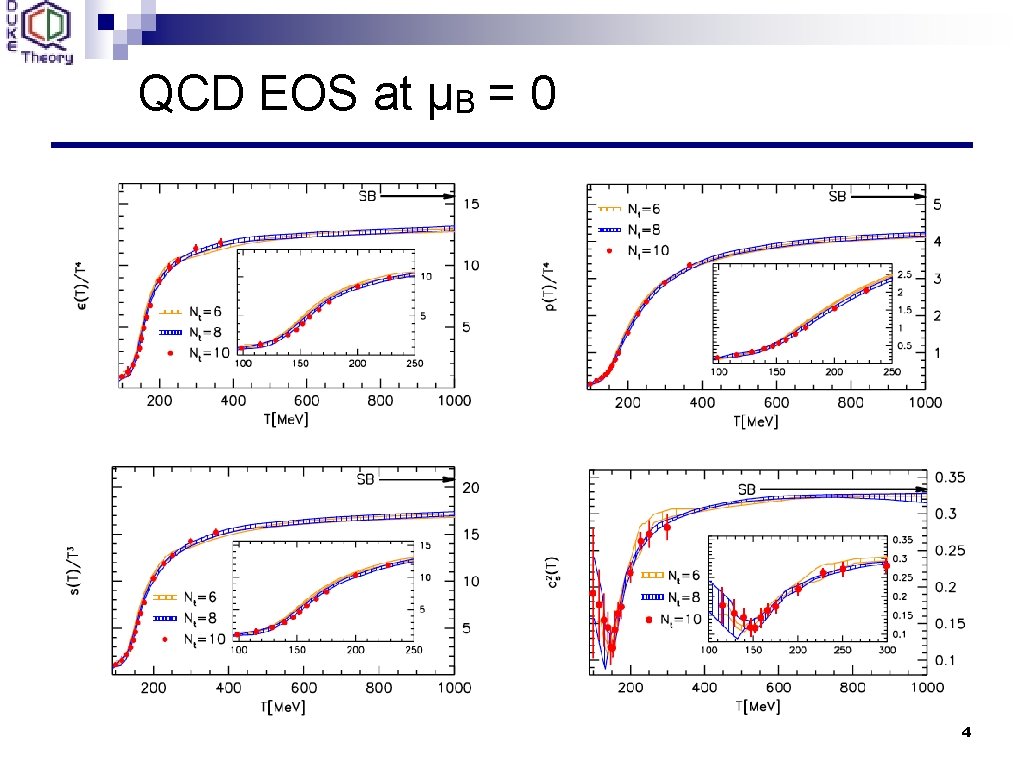
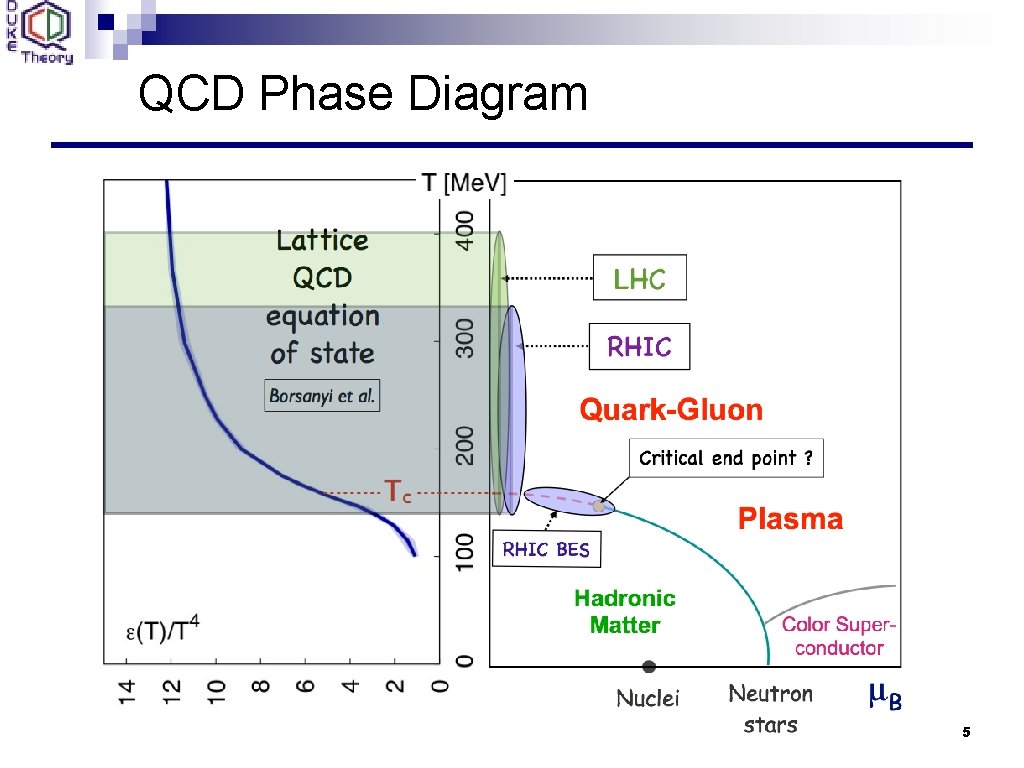
QCD EOS at μB = 0 4
QCD Phase Diagram 5
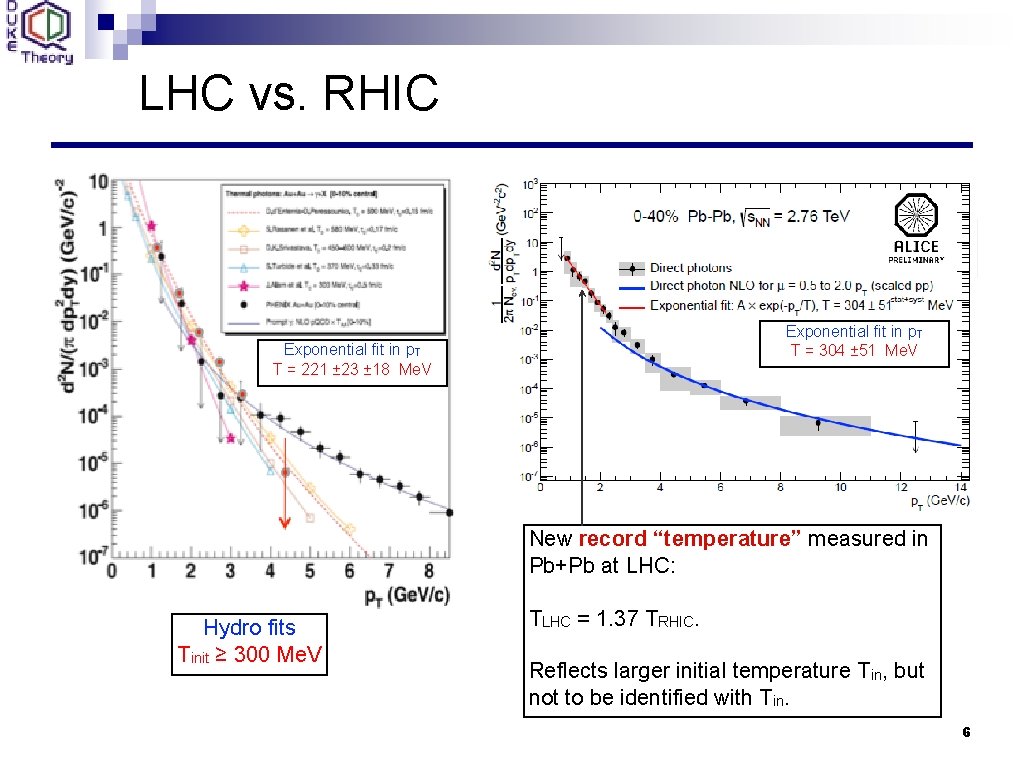
LHC vs. RHIC Exponential fit in p. T T = 304 ± 51 Me. V Exponential fit in p. T T = 221 ± 23 ± 18 Me. V New record “temperature” measured in Pb+Pb at LHC: Hydro fits Tinit ≥ 300 Me. V TLHC = 1. 37 TRHIC. Reflects larger initial temperature Tin, but not to be identified with Tin. 6
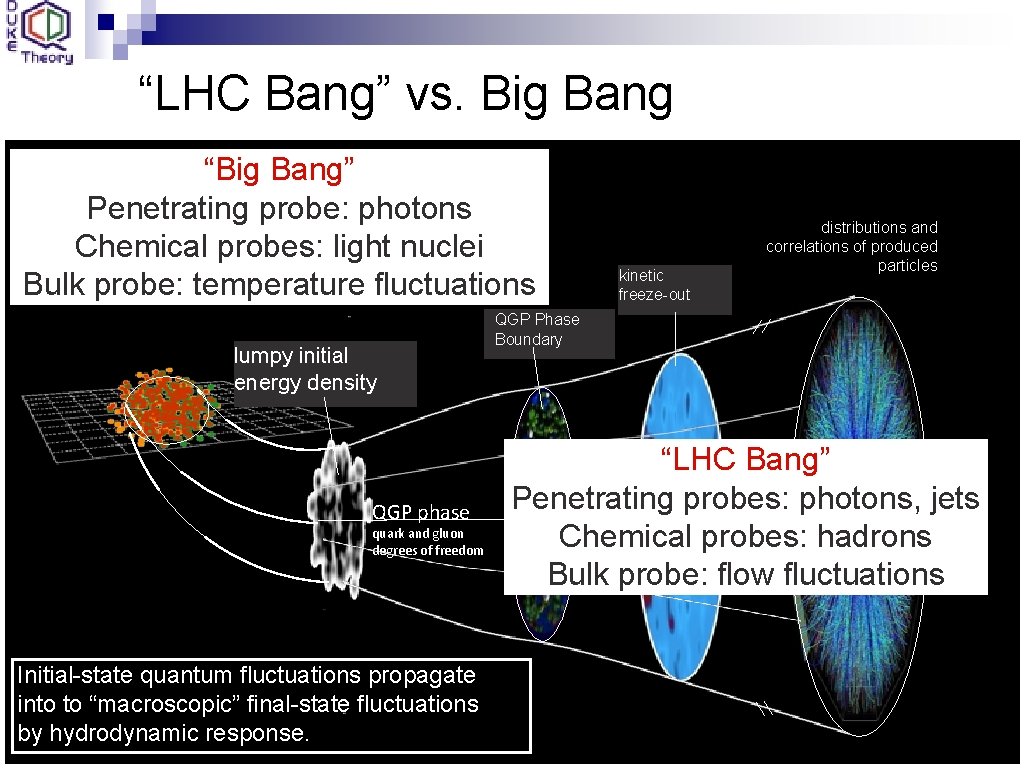
“LHC Bang” vs. Big Bang “Big Bang” Penetrating probe: photons Chemical probes: light nuclei Bulk probe: temperature fluctuations lumpy initial energy density QGP phase quark and gluon degrees of freedom Initial-state quantum fluctuations propagate into to “macroscopic” final-state fluctuations by hydrodynamic response. kinetic freeze-out distributions and correlations of produced particles QGP Phase Boundary “LHC Bang” Penetrating probes: photons, jets Chemical probes: hadrons Bulk probe: flow fluctuations 7
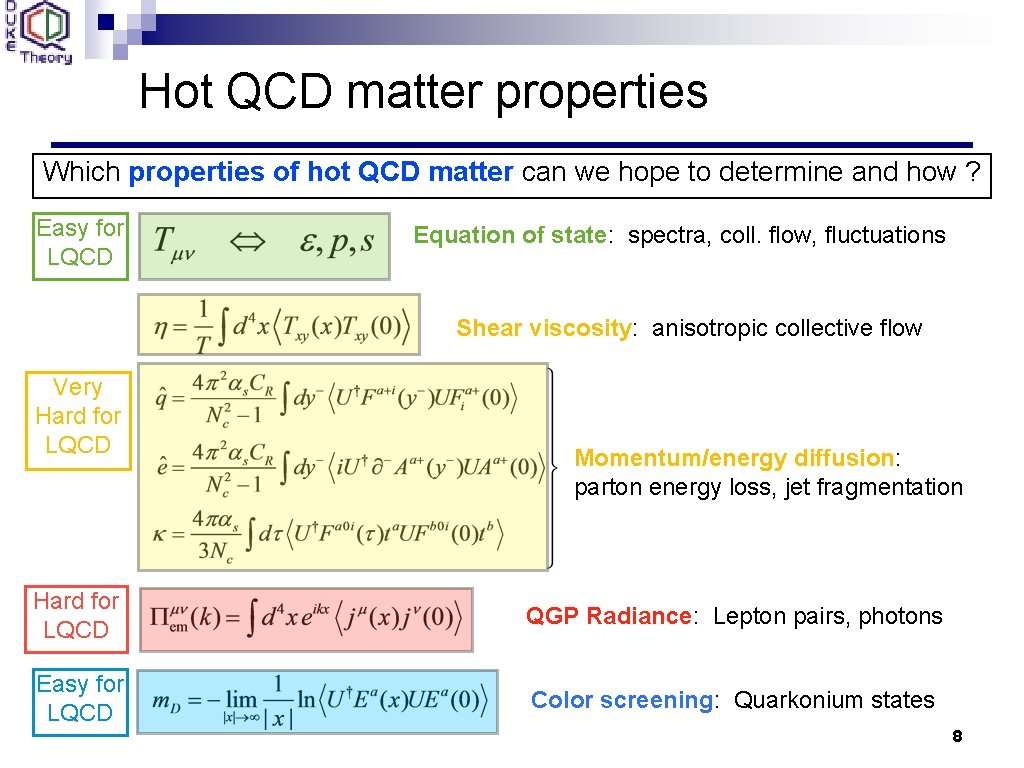
Hot QCD matter properties Which properties of hot QCD matter can we hope to determine and how ? Easy for LQCD Equation of state: spectra, coll. flow, fluctuations Shear viscosity: anisotropic collective flow Very Hard for LQCD Momentum/energy diffusion: parton energy loss, jet fragmentation Hard for LQCD QGP Radiance: Lepton pairs, photons Easy for LQCD Color screening: Quarkonium states 8
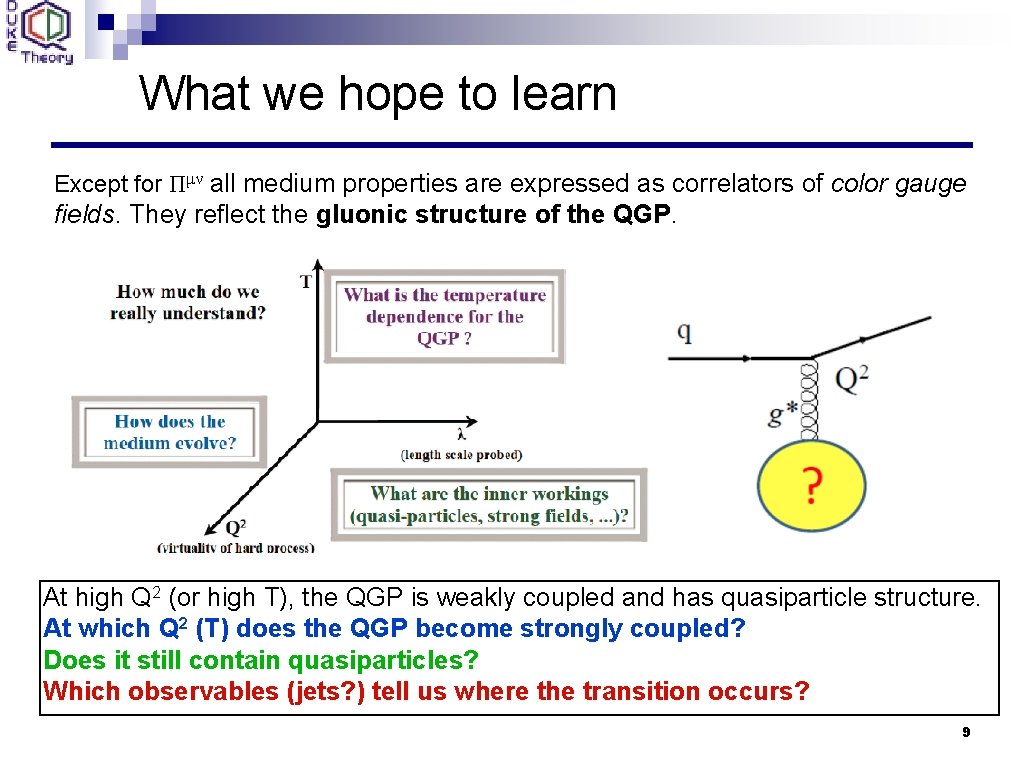
What we hope to learn Except for Πμν all medium properties are expressed as correlators of color gauge fields. They reflect the gluonic structure of the QGP. At high Q 2 (or high T), the QGP is weakly coupled and has quasiparticle structure. At which Q 2 (T) does the QGP become strongly coupled? Does it still contain quasiparticles? Which observables (jets? ) tell us where the transition occurs? 9
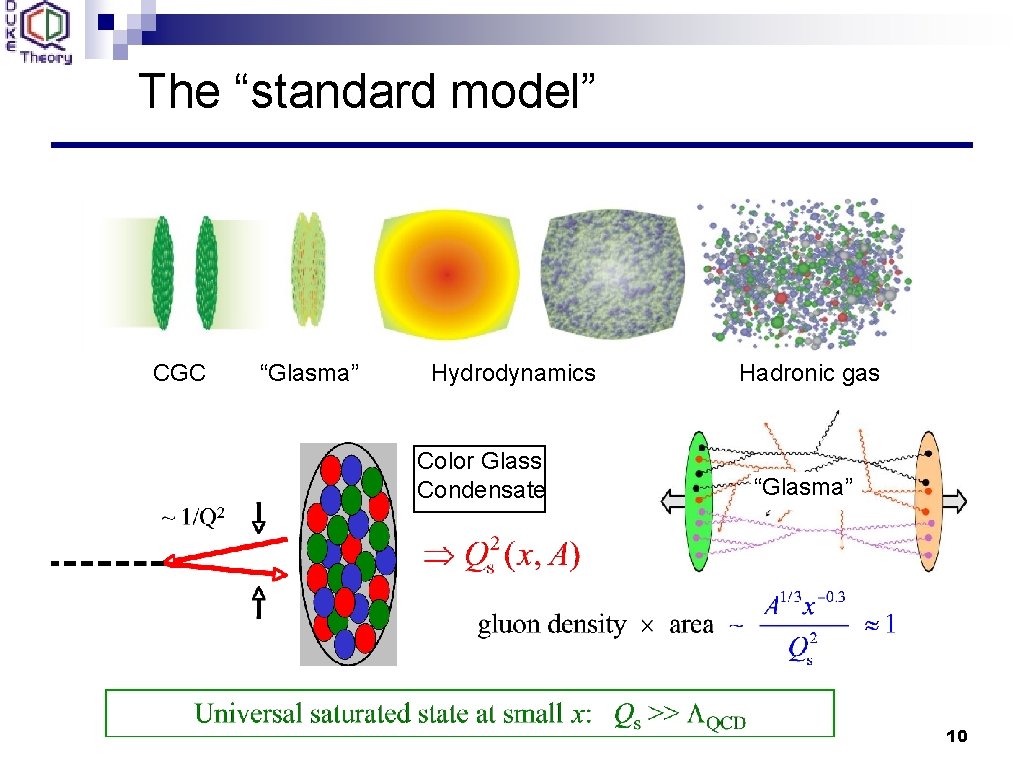
The “standard model” CGC “Glasma” Hydrodynamics Color Glass Condensate Hadronic gas “Glasma” 10
Perfect liquidity 11
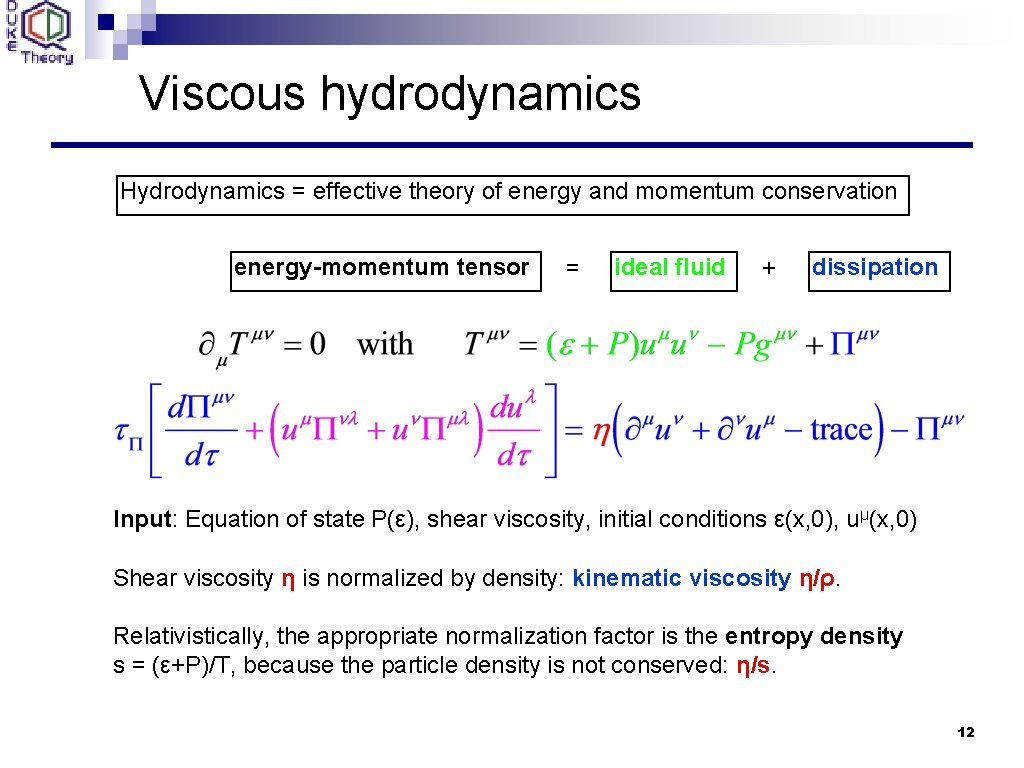
Viscous hydrodynamics Hydrodynamics = effective theory of energy and momentum conservation energy-momentum tensor = ideal fluid + dissipation Input: Equation of state P(ε), shear viscosity, initial conditions ε(x, 0), uμ(x, 0) Shear viscosity η is normalized by density: kinematic viscosity η/ρ. Relativistically, the appropriate normalization factor is the entropy density s = (ε+P)/T, because the particle density is not conserved: η/s. 12
Holographic argument General argument [Kovtun, Son & Starinets, PRL 94 (2005) 111601] based on the holographic duality (Ad. S/CFT) between thermal QFT and string theory in five-dimensional curved space with a “black-hole” metric. (3+1)-D world (t, x) (0, 0) r 0 horizon Dissipation in QFT is dual to the absorption of gravitons by the black hole: 13
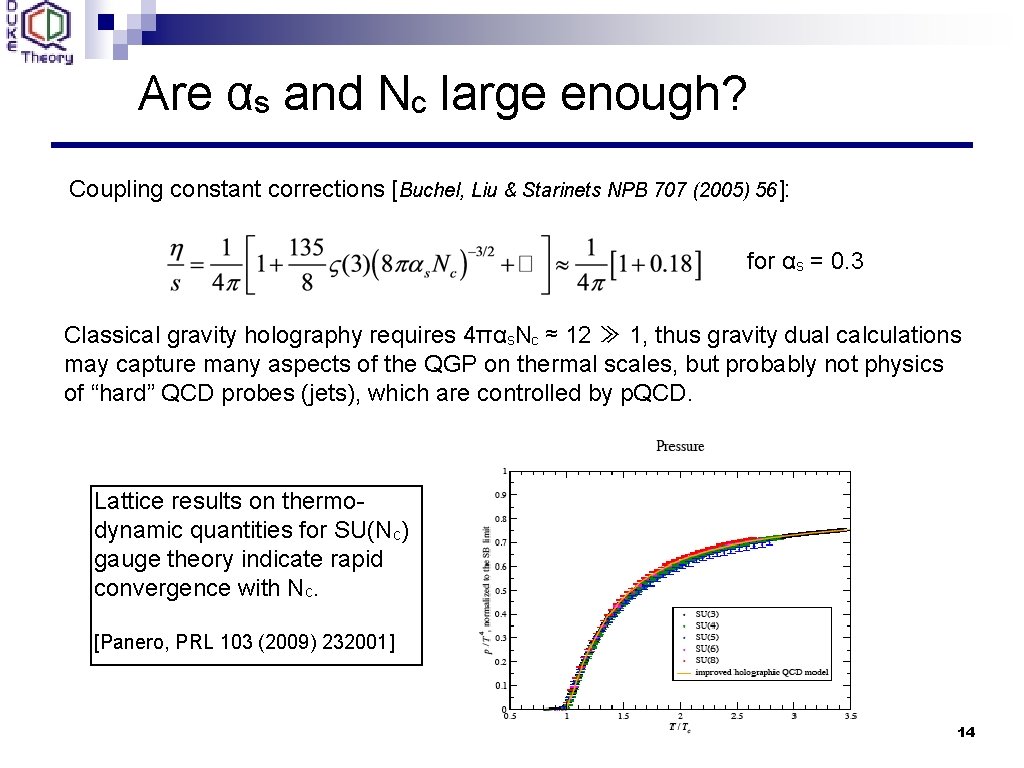
Are αs and Nc large enough? Coupling constant corrections [Buchel, Liu & Starinets NPB 707 (2005) 56]: for αs = 0. 3 Classical gravity holography requires 4παs. Nc ≈ 12 ≫ 1, thus gravity dual calculations may capture many aspects of the QGP on thermal scales, but probably not physics of “hard” QCD probes (jets), which are controlled by p. QCD. Lattice results on thermodynamic quantities for SU(Nc) gauge theory indicate rapid convergence with Nc. [Panero, PRL 103 (2009) 232001] 14
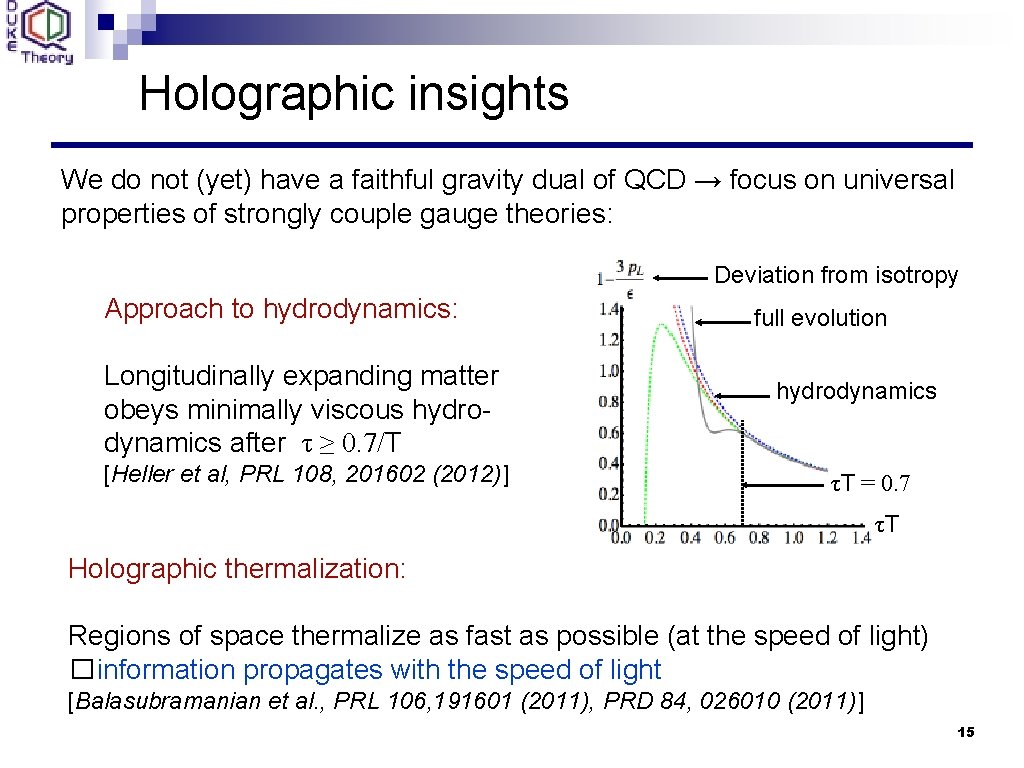
Holographic insights We do not (yet) have a faithful gravity dual of QCD → focus on universal properties of strongly couple gauge theories: Deviation from isotropy Approach to hydrodynamics: Longitudinally expanding matter obeys minimally viscous hydrodynamics after τ ≥ 0. 7/T [Heller et al, PRL 108, 201602 (2012)] full evolution hydrodynamics τT = 0. 7 τT Holographic thermalization: Regions of space thermalize as fast as possible (at the speed of light) �information propagates with the speed of light [Balasubramanian et al. , PRL 106, 191601 (2011), PRD 84, 026010 (2011)] 15
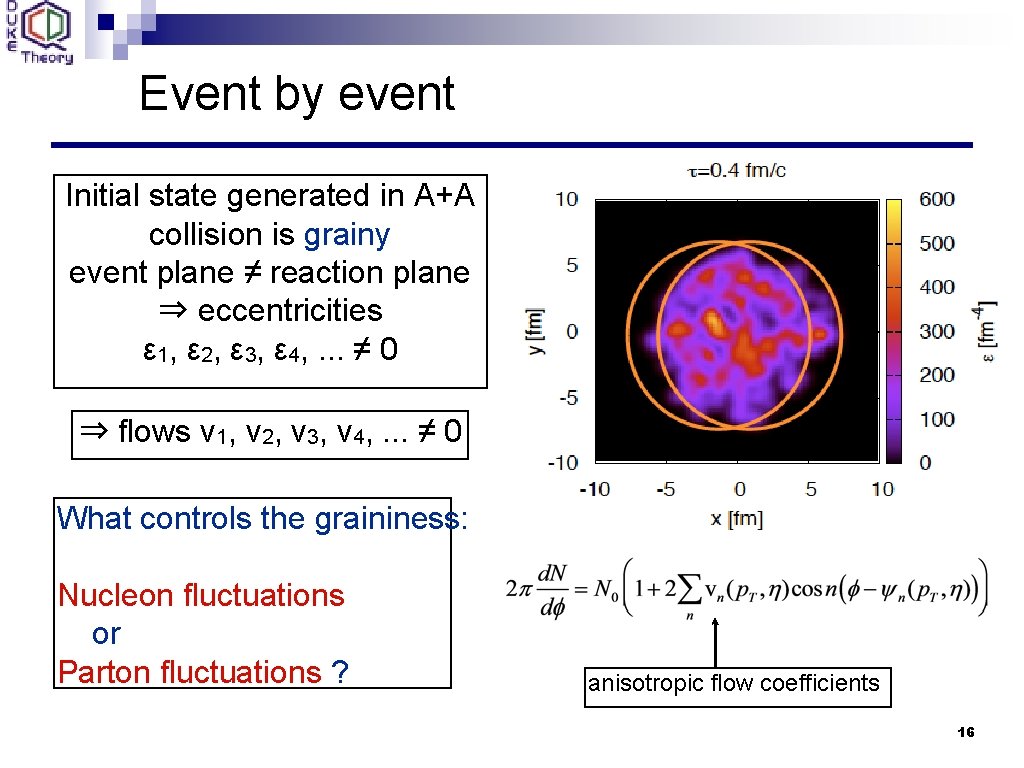
Event by event Initial state generated in A+A collision is grainy event plane ≠ reaction plane ⇒ eccentricities ε 1, ε 2, ε 3, ε 4, . . . ≠ 0 ⇒ flows v 1, v 2, v 3, v 4, . . . ≠ 0 What controls the graininess: Nucleon fluctuations or Parton fluctuations ? anisotropic flow coefficients 16
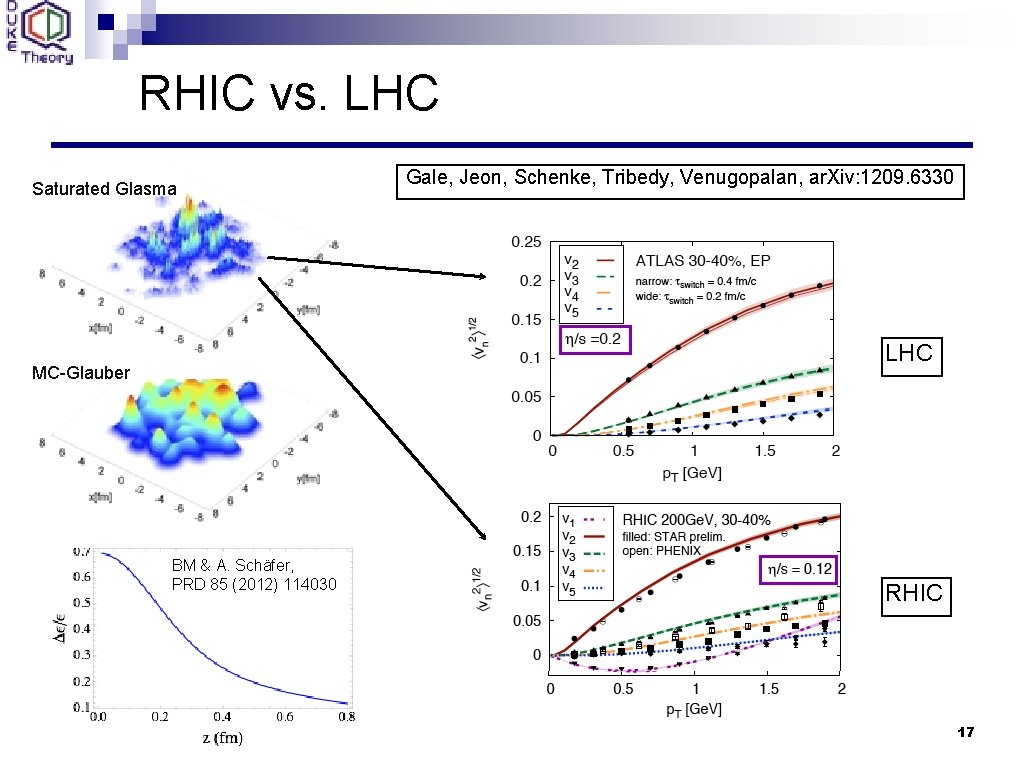
RHIC vs. LHC Saturated Glasma Gale, Jeon, Schenke, Tribedy, Venugopalan, ar. Xiv: 1209. 6330 LHC MC-Glauber BM & A. Schäfer, PRD 85 (2012) 114030 RHIC 17
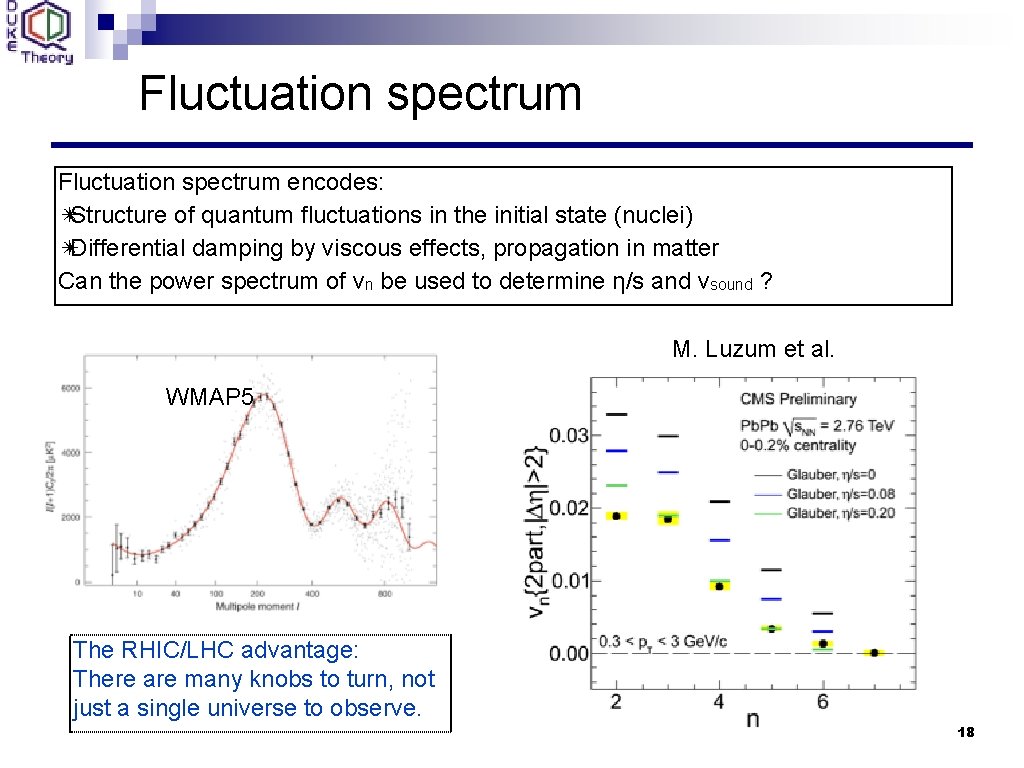
Fluctuation spectrum encodes: ✴ Structure of quantum fluctuations in the initial state (nuclei) ✴ Differential damping by viscous effects, propagation in matter Can the power spectrum of vn be used to determine η/s and vsound ? M. Luzum et al. WMAP 5 The RHIC/LHC advantage: There are many knobs to turn, not just a single universe to observe. 18
Color opacity 19
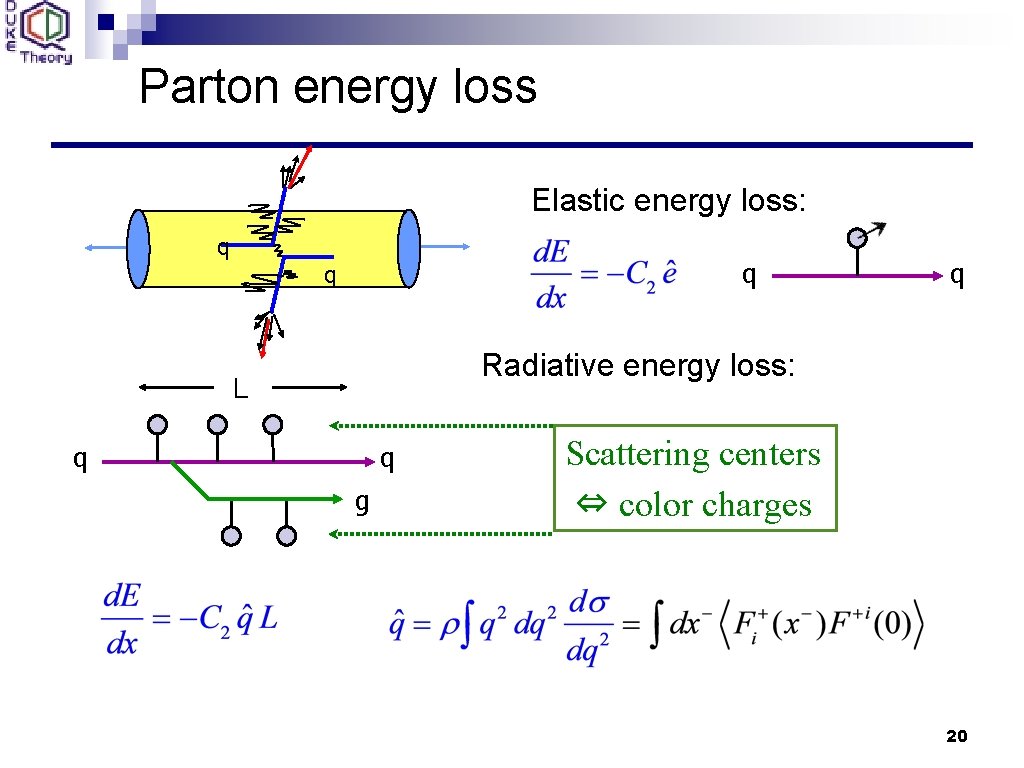
Parton energy loss Elastic energy loss: q q Radiative energy loss: L q q g Scattering centers ⇔ color charges 20
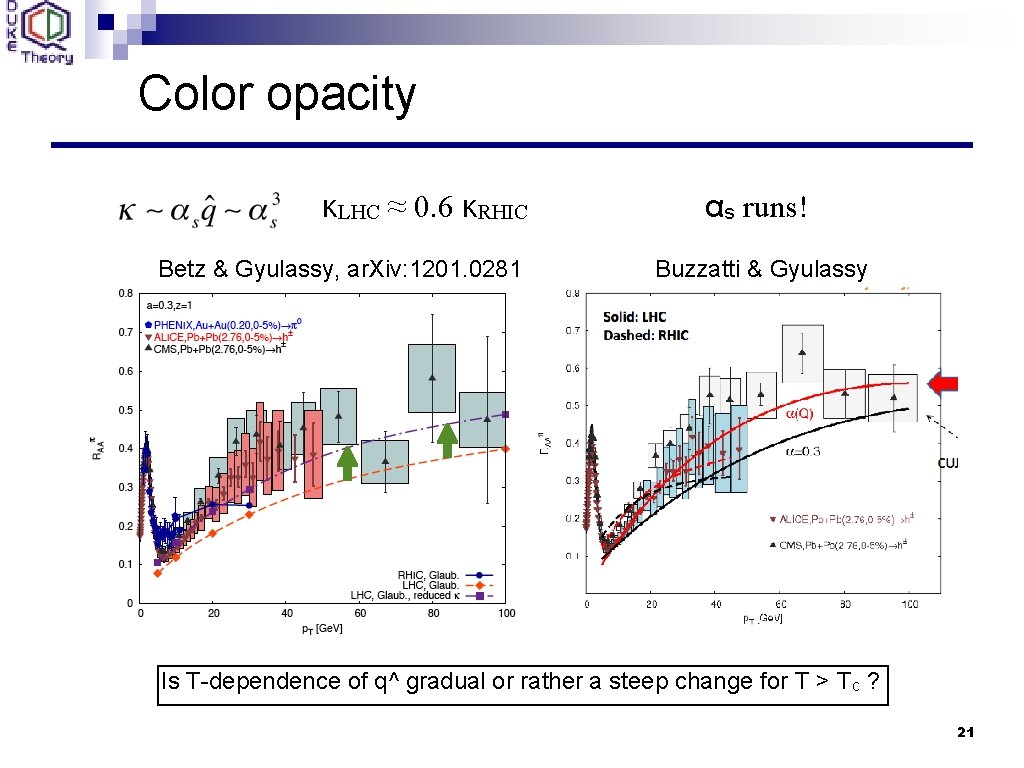
Color opacity κLHC ≈ 0. 6 κRHIC Betz & Gyulassy, ar. Xiv: 1201. 0281 αs runs! Buzzatti & Gyulassy Is T-dependence of q^ gradual or rather a steep change for T > Tc ? 21
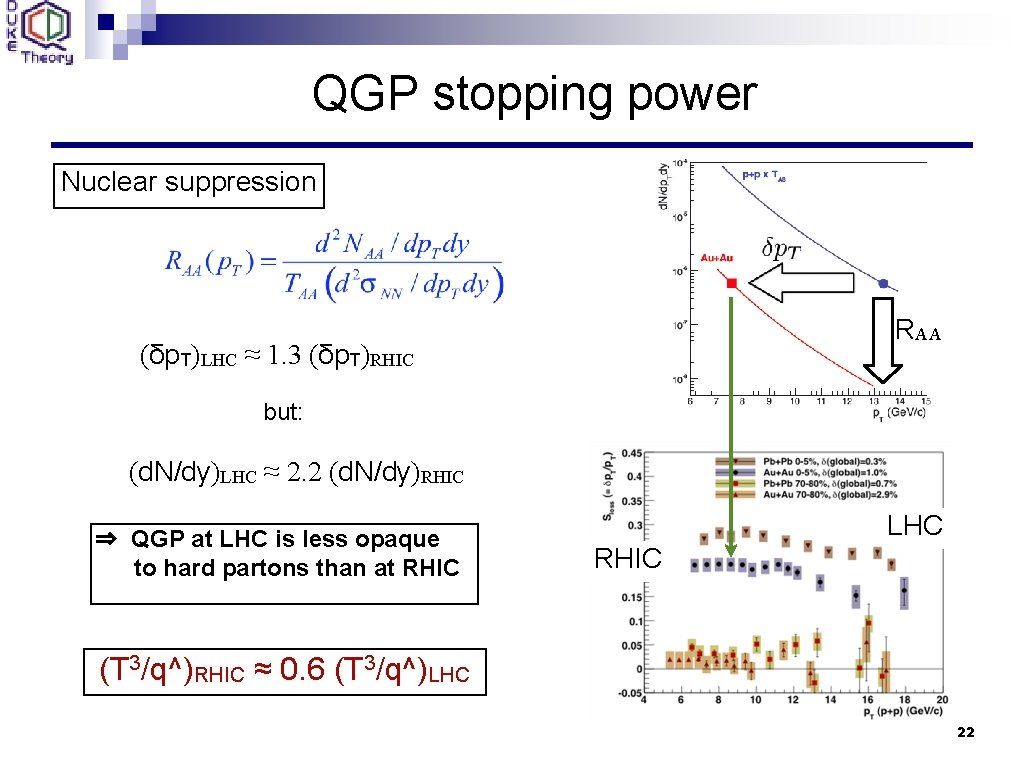
QGP stopping power Nuclear suppression RAA (δp. T)LHC ≈ 1. 3 (δp. T)RHIC but: (d. N/dy)LHC ≈ 2. 2 (d. N/dy)RHIC ⇒ QGP at LHC is less opaque to hard partons than at RHIC LHC RHIC (T 3/q^)RHIC ≈ 0. 6 (T 3/q^)LHC 22
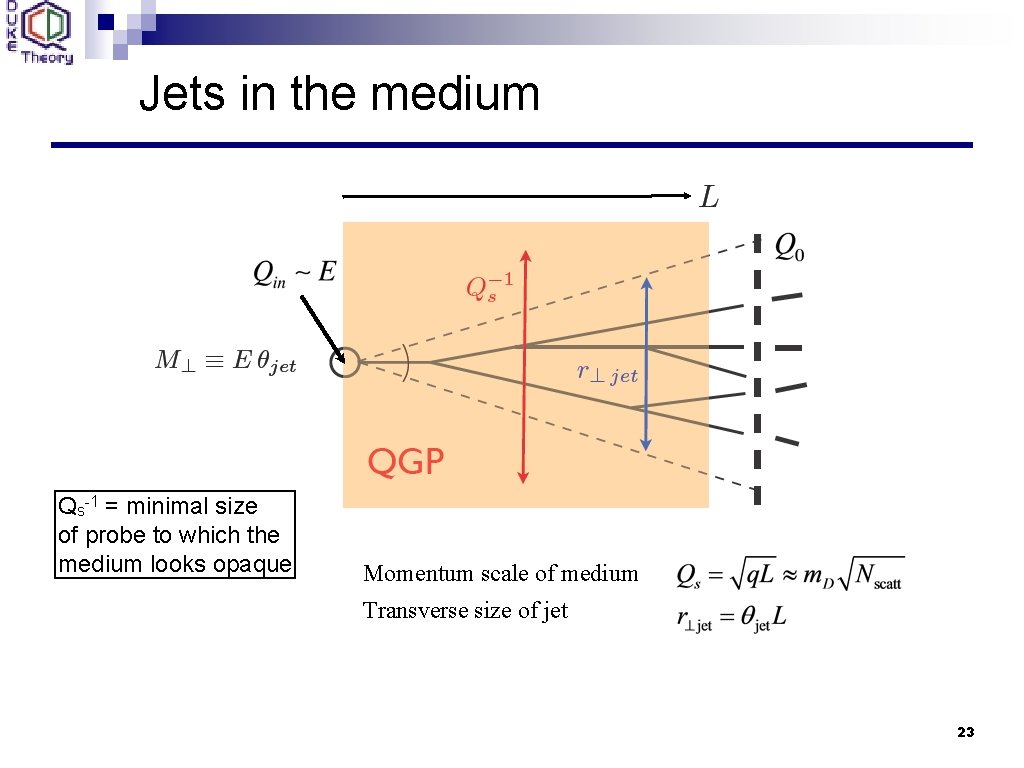
Jets in the medium Qs-1 = minimal size of probe to which the medium looks opaque Momentum scale of medium Transverse size of jet 23
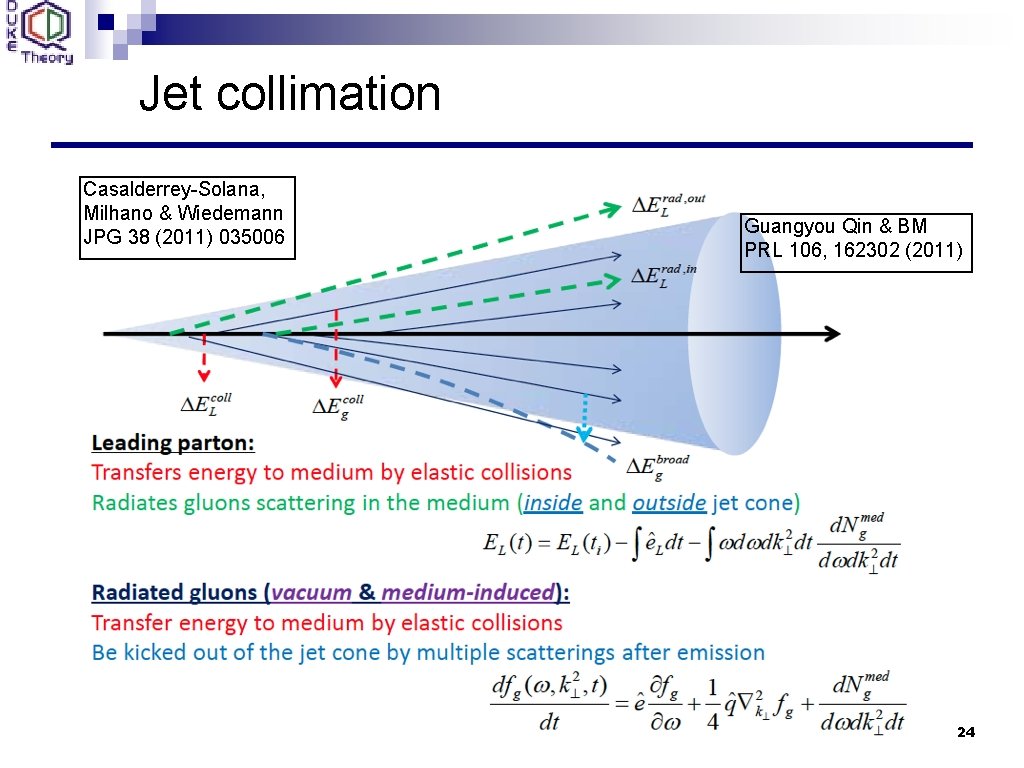
Jet collimation Casalderrey-Solana, Milhano & Wiedemann JPG 38 (2011) 035006 Guangyou Qin & BM PRL 106, 162302 (2011) 24
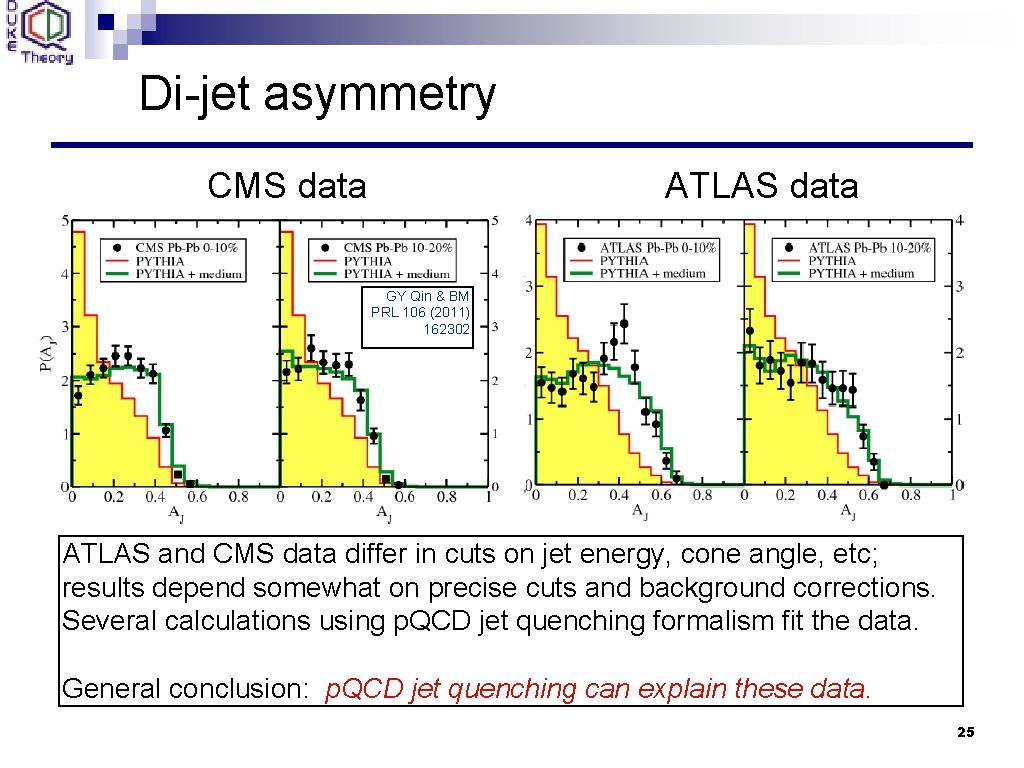
Di-jet asymmetry CMS data ATLAS data GY Qin & BM PRL 106 (2011) 162302 ATLAS and CMS data differ in cuts on jet energy, cone angle, etc; results depend somewhat on precise cuts and background corrections. Several calculations using p. QCD jet quenching formalism fit the data. General conclusion: p. QCD jet quenching can explain these data. 25
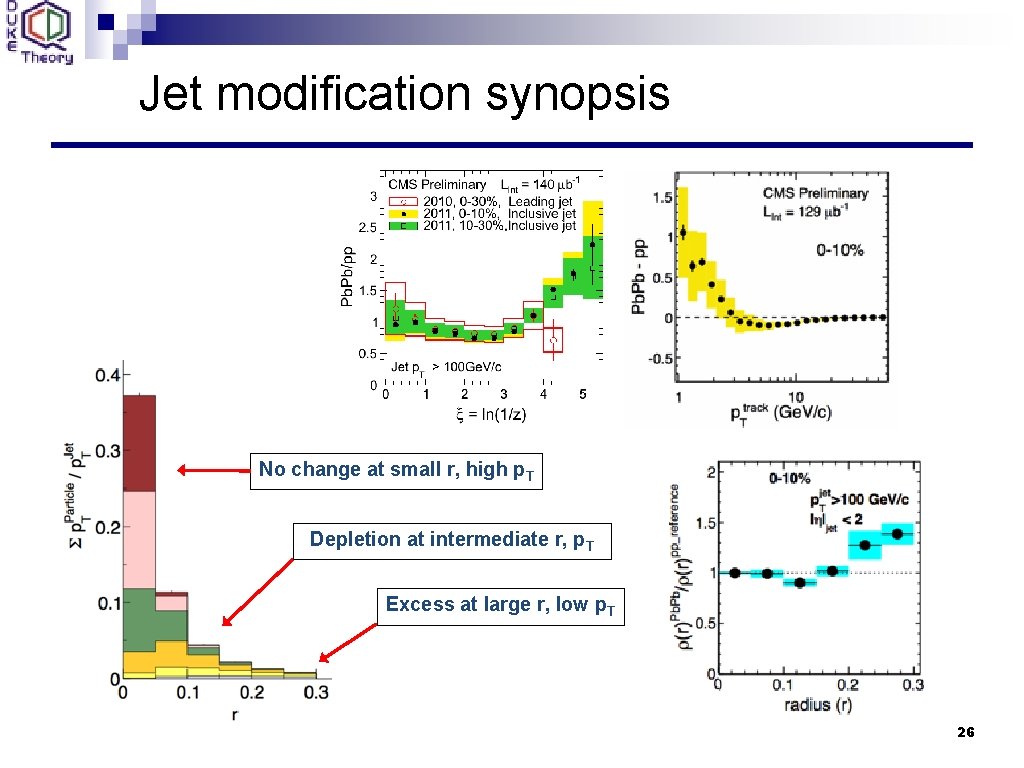
Jet modification synopsis No change at small r, high p. T Depletion at intermediate r, p. T Excess at large r, low p. T 26
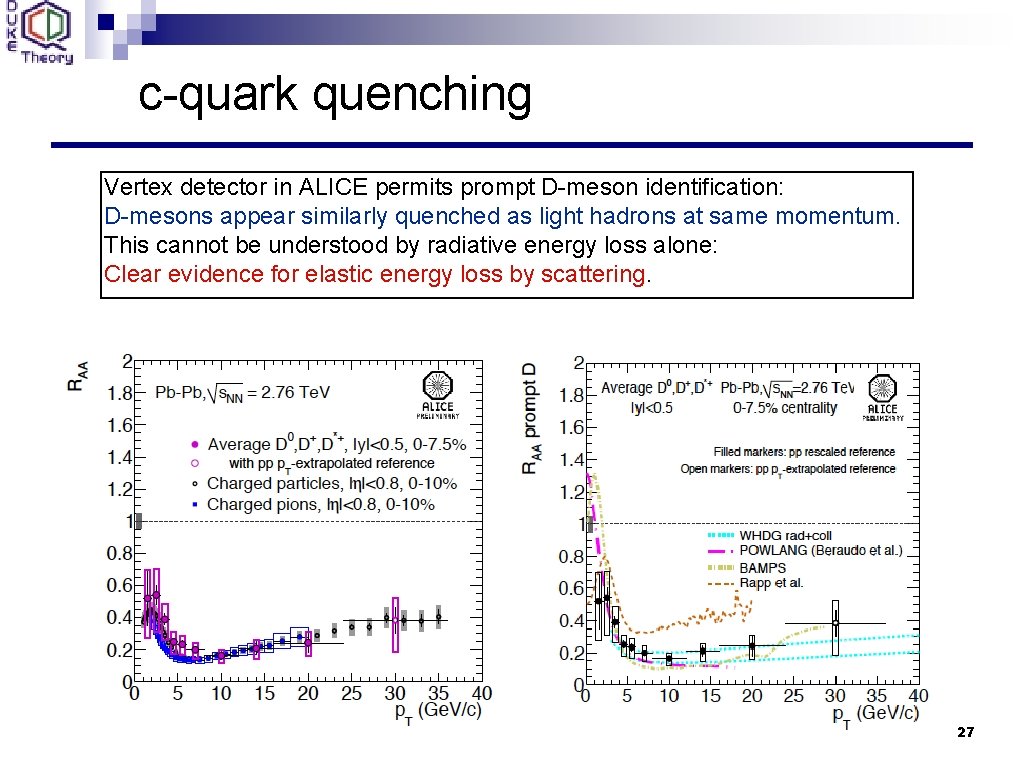
c-quark quenching Vertex detector in ALICE permits prompt D-meson identification: D-mesons appear similarly quenched as light hadrons at same momentum. This cannot be understood by radiative energy loss alone: Clear evidence for elastic energy loss by scattering. 27
Color screening 28
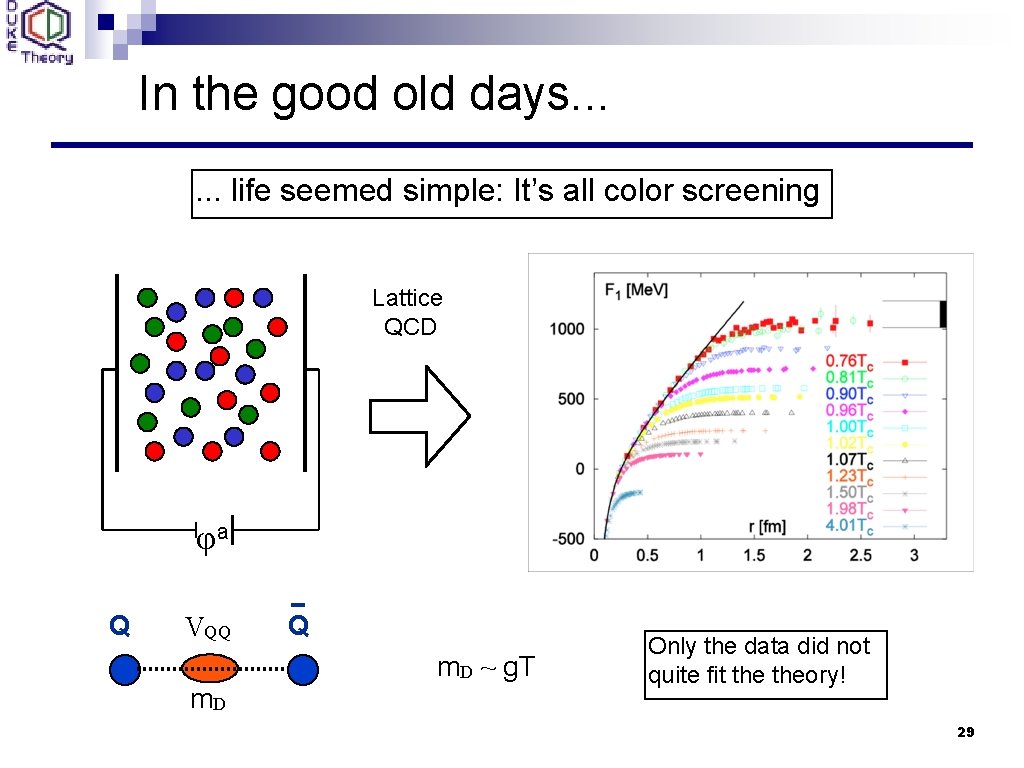
In the good old days. . . life seemed simple: It’s all color screening Lattice QCD φa Q VQQ − Q m. D ~ g. T m. D Only the data did not quite fit theory! 29
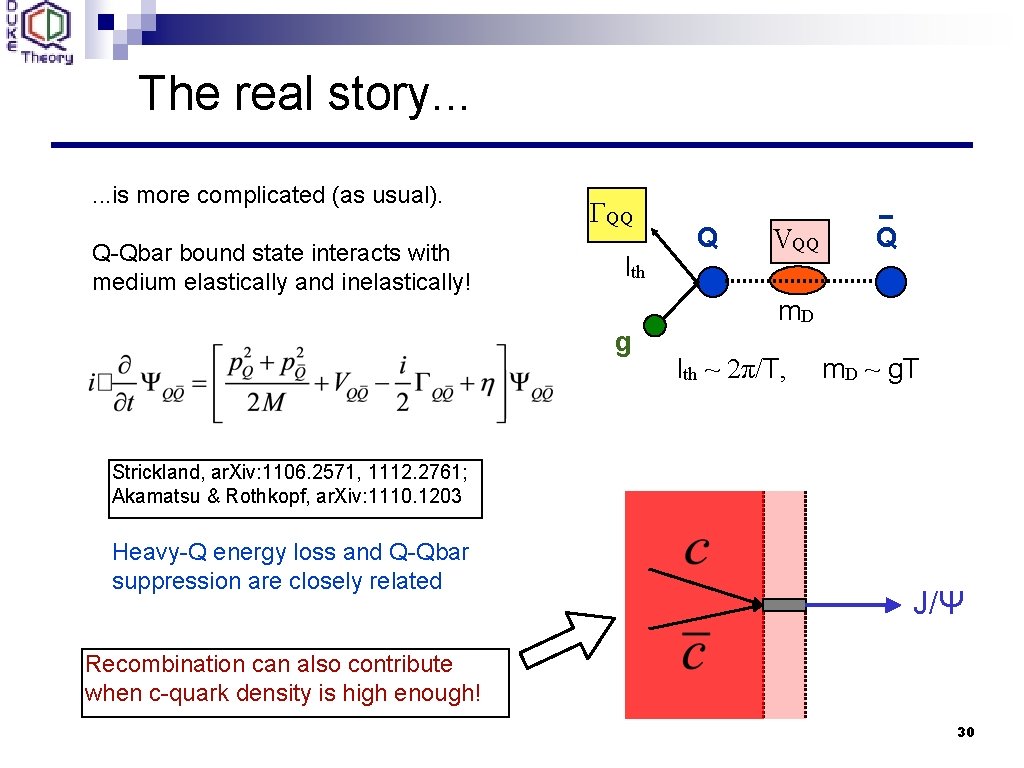
The real story. . . is more complicated (as usual). Q-Qbar bound state interacts with medium elastically and inelastically! ΓQQ lth g Q VQQ − Q m. D lth ~ 2π/T, m. D ~ g. T Strickland, ar. Xiv: 1106. 2571, 1112. 2761; Akamatsu & Rothkopf, ar. Xiv: 1110. 1203 Heavy-Q energy loss and Q-Qbar suppression are closely related J/Ψ Recombination can also contribute when c-quark density is high enough! 30
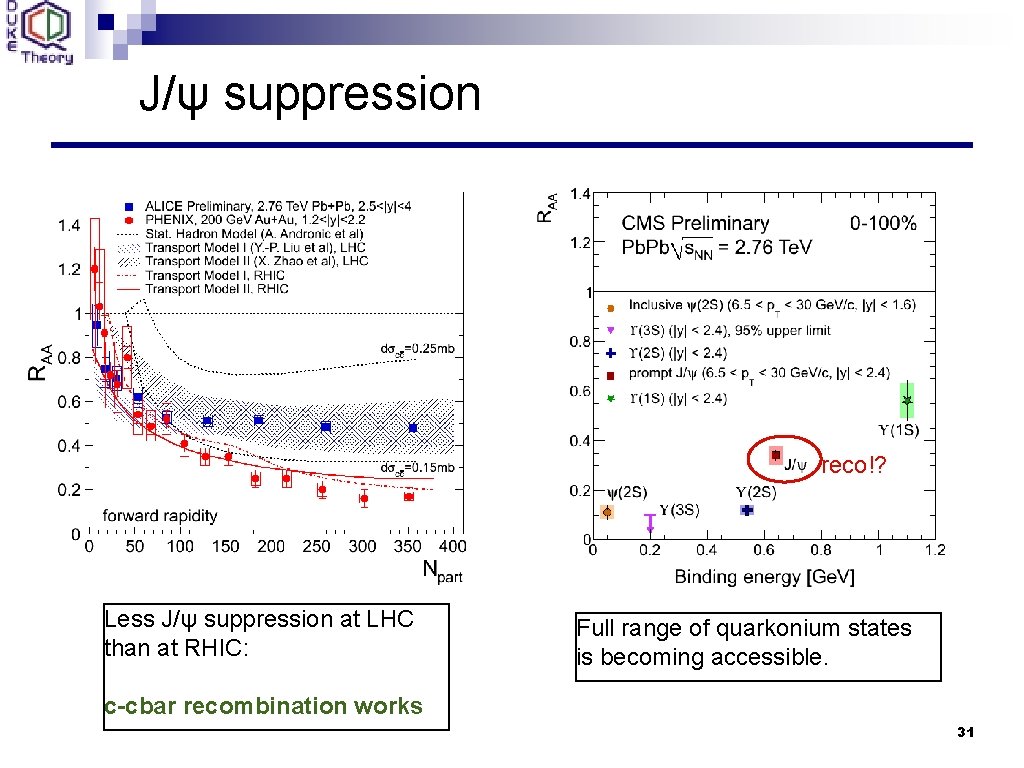
J/ψ suppression reco!? Less J/ψ suppression at LHC than at RHIC: Full range of quarkonium states is becoming accessible. c-cbar recombination works 31
Summary & Questions 32
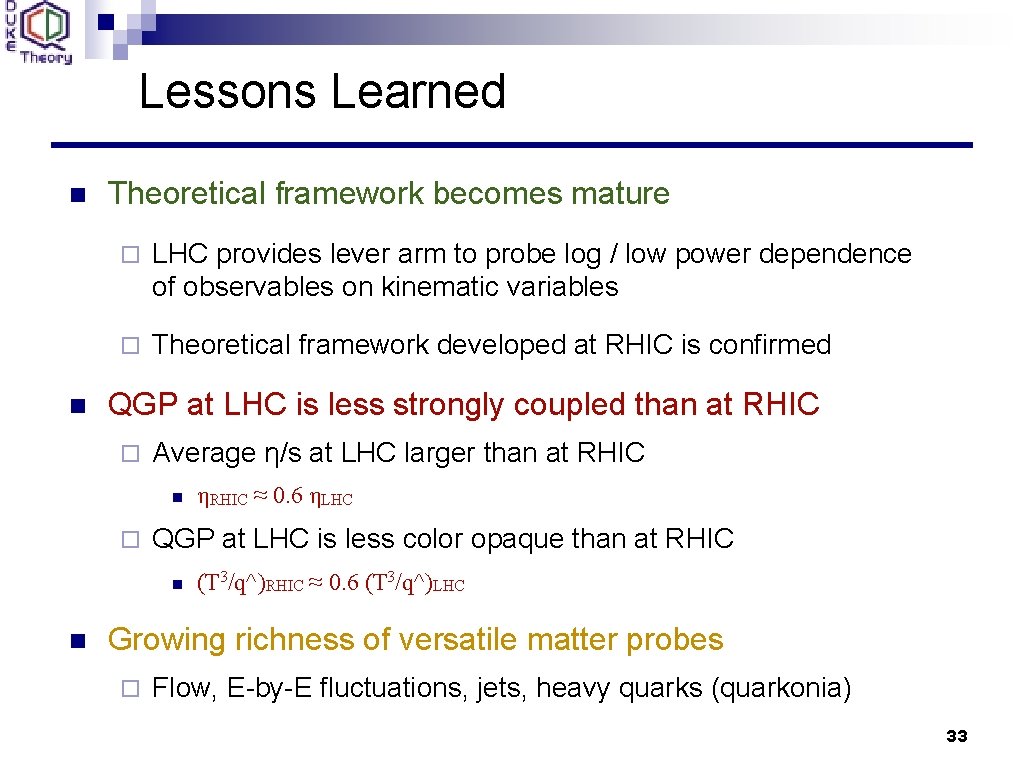
Lessons Learned n n Theoretical framework becomes mature ¨ LHC provides lever arm to probe log / low power dependence of observables on kinematic variables ¨ Theoretical framework developed at RHIC is confirmed QGP at LHC is less strongly coupled than at RHIC ¨ Average η/s at LHC larger than at RHIC n ¨ QGP at LHC is less color opaque than at RHIC n n ηRHIC ≈ 0. 6 ηLHC (T 3/q^)RHIC ≈ 0. 6 (T 3/q^)LHC Growing richness of versatile matter probes ¨ Flow, E-by-E fluctuations, jets, heavy quarks (quarkonia) 33
Experimental limitations n The combination RHIC+LHC has proven to be very powerful, allowing for a meaningful variation of QGP initial conditions n 3 months HI beam time in 5 years severely limit the ability to vary system size and beam energy at LHC for ¨ making baseline p+p and p+A measurements ¨ separating initial state fluctuations from geometric effects ¨ exploring effects of strong transient magnetic fields ¨ filling the gap between 100 Ge. V/A and 1. 37 Te. V/A n RHIC runs 4− 5 months/year, but beam time still limits ability to perform all desirable measurements n Is it time for a reconsideration in the light of other priorities of 34 the LHC physics program?
Achievements and Opportunities n The QGP is a substance like no other: ¨ ¨ ¨ n relativistic, yet strongly coupled a liquid that cools into a gas non-superfluid liquid near the quantum limit of viscosity matter that admits only diffusive transport of particles, yet transports information at the speed of light (how? ) matter that requires a new vacuum state to exist The QGP poses a challenge to theorists: What is the microscopic structure of a relativistic liquid? ¨ How to solve a strongly coupled quantum system for which we do not (yet) have a gravity dual? ¨ n The QGP continues to bring experimental surprises: ¨ E. g. , how small can a thermal QGP be and behave as “matter”? 35
Four Questions n n What is the structure of the initial state, how does it thermalize? ¨ Is the initial state (at small x) a color glass condensate? ¨ Is thermalization governed by strong coupling? How precisely can we measure QGP transport coefficients? ¨ n At what scale does the QGP become strongly coupled? ¨ n What does <25% uncertainty require for η and q^ ? Can jet modification be used to determine the kinematic scale separating quasiparticle and liquid domains in the QGP ? Can we measure color screening in the QGP? ¨ ¨ Can sequential quarkonium melting determine λDebye ? Can (heavy) quark recombination demonstrate deconfinement? 36
Additional slides 37
Jets: core questions n What is the mechanism of energy loss ? “radiative” = into non-thermal gluon modes ¨ “collisional” = directly into thermal plasma modes ¨ n How are radiative and collisional energy loss affected by the structure of the medium (quasiparticles or not)? Quasiparticle masses in weak coupling ¨ Ad. S/CFT inspired models with weak-strong coupling transition? ¨ n What happens to the lost energy and momentum ? If “radiative”, how quickly does it thermalize = what is its longitudinal momentum (z) distribution ? ¨ What is its angular distribution (the jet “shape”) = how much is found in a cone of angular size R ? ¨ n How do the answers depend on the parton flavor ? 38
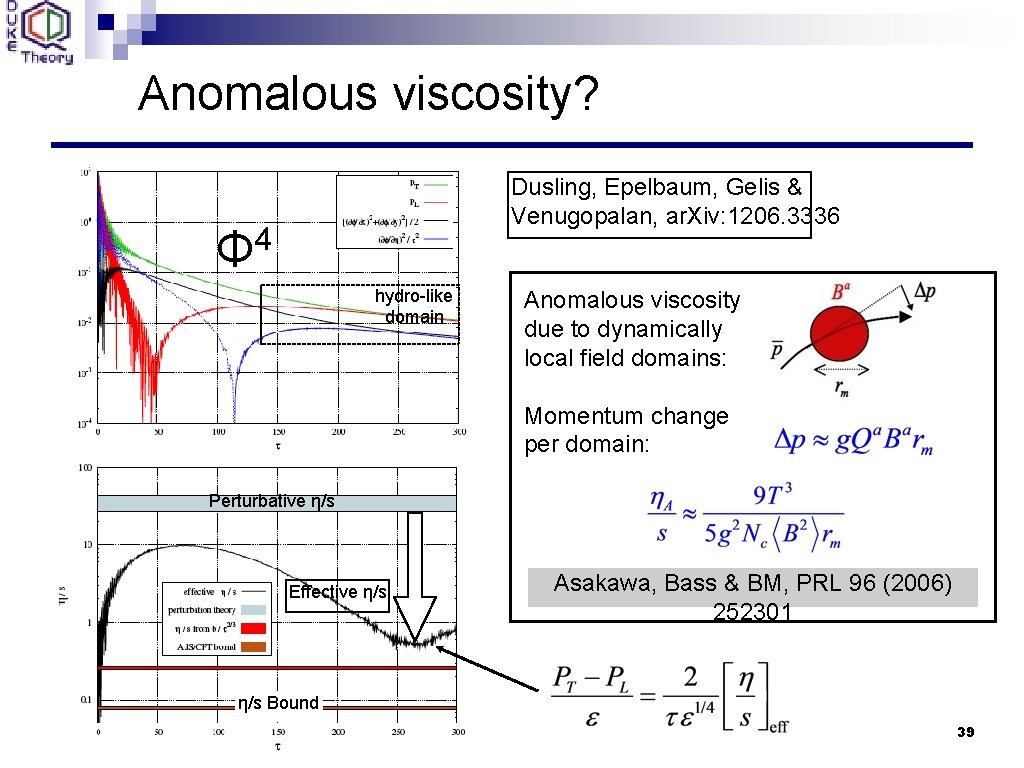
Anomalous viscosity? Dusling, Epelbaum, Gelis & Venugopalan, ar. Xiv: 1206. 3336 4 Φ hydro-like domain Anomalous viscosity due to dynamically local field domains: Momentum change per domain: Perturbative η/s Effective η/s Asakawa, Bass & BM, PRL 96 (2006) 252301 η/s Bound 39
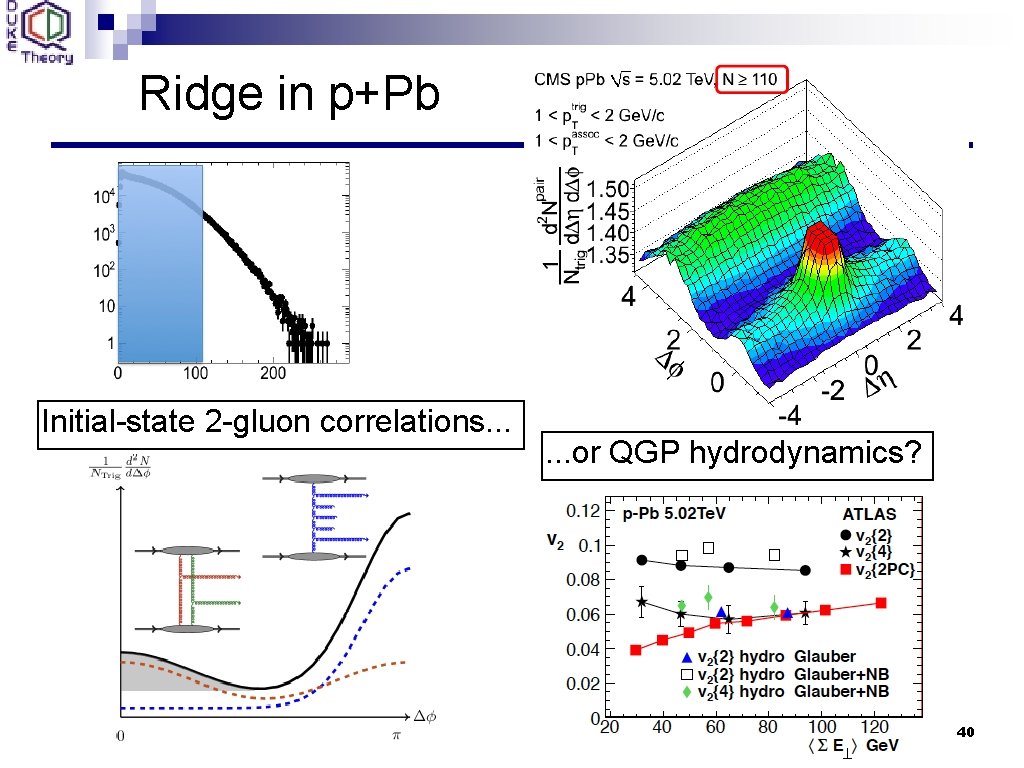
Ridge in p+Pb Initial-state 2 -gluon correlations. . . or QGP hydrodynamics? 40
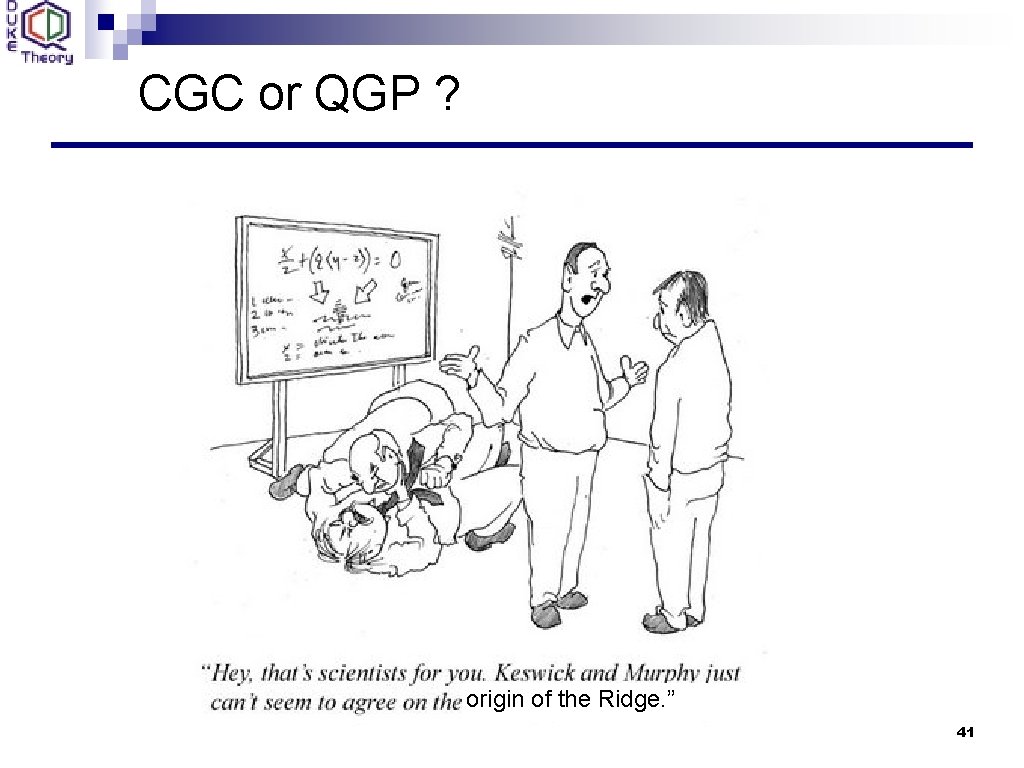
CGC or QGP ? origin of the Ridge. ” 41
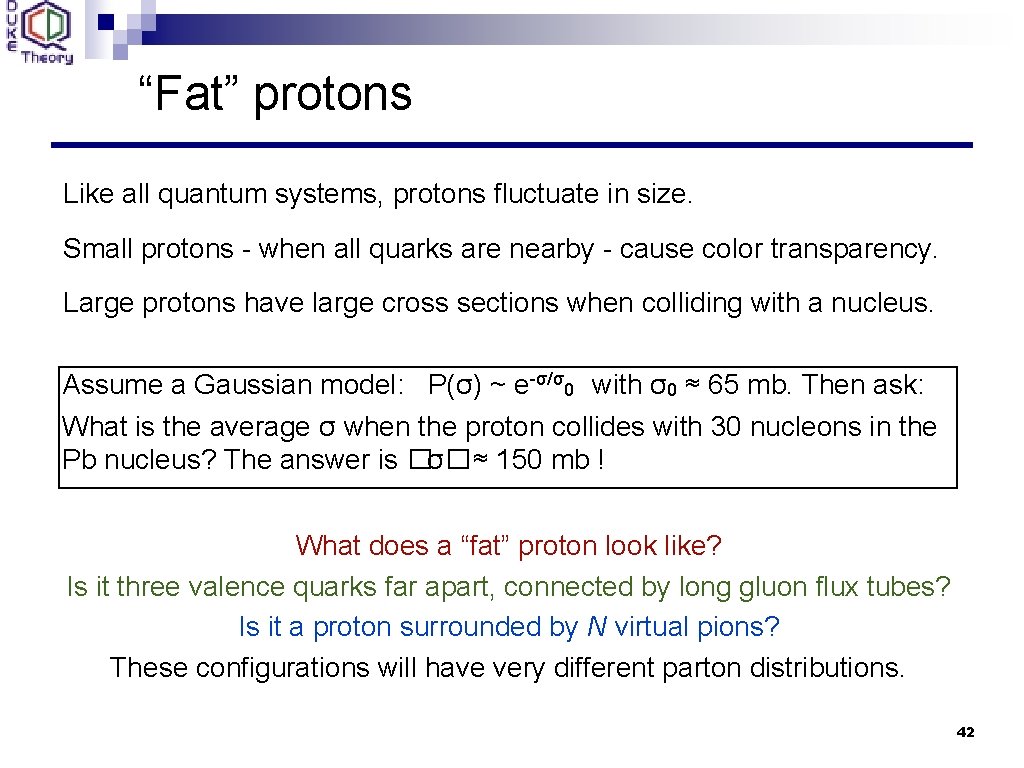
“Fat” protons Like all quantum systems, protons fluctuate in size. Small protons - when all quarks are nearby - cause color transparency. Large protons have large cross sections when colliding with a nucleus. Assume a Gaussian model: P(σ) ~ e-σ/σ0 with σ0 ≈ 65 mb. Then ask: What is the average σ when the proton collides with 30 nucleons in the Pb nucleus? The answer is �σ�≈ 150 mb ! What does a “fat” proton look like? Is it three valence quarks far apart, connected by long gluon flux tubes? Is it a proton surrounded by N virtual pions? These configurations will have very different parton distributions. 42
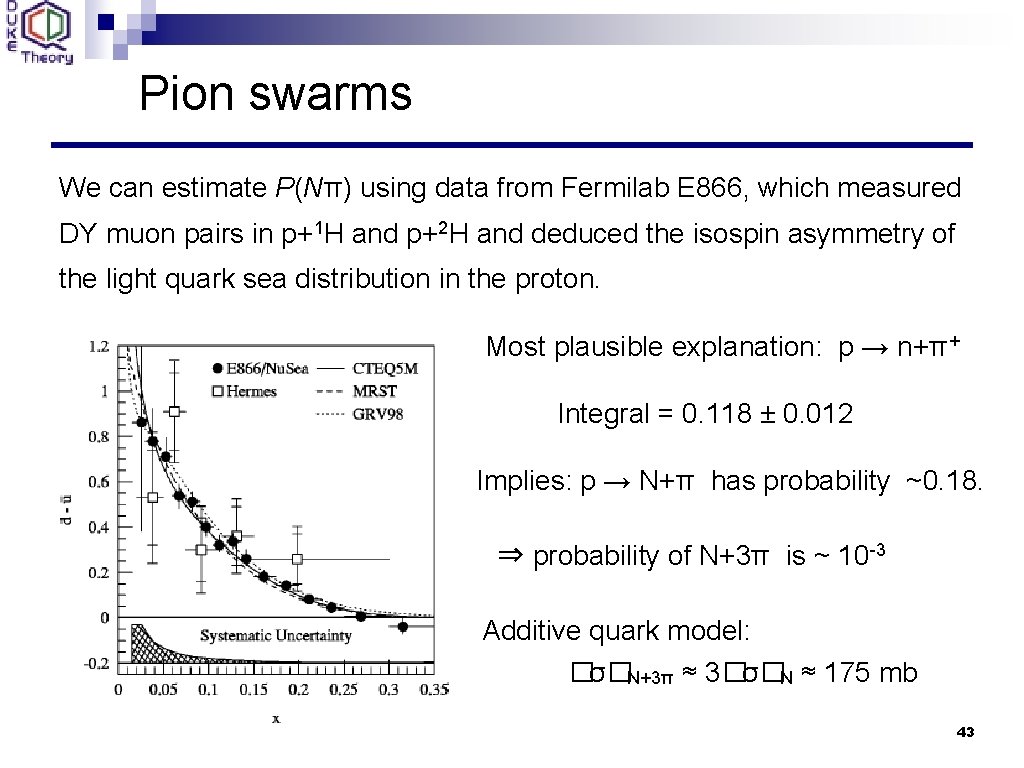
Pion swarms We can estimate P(Nπ) using data from Fermilab E 866, which measured DY muon pairs in p+1 H and p+2 H and deduced the isospin asymmetry of the light quark sea distribution in the proton. Most plausible explanation: p → n+π+ Integral = 0. 118 ± 0. 012 Implies: p → N+π has probability ~0. 18. ⇒ probability of N+3π is ~ 10 -3 Additive quark model: �σ�N+3π ≈ 3�σ�N ≈ 175 mb 43