
Investigation of Geometry Modeling Method for ATLAS Simulation





- Slides: 62
Investigation of Geometry Modeling Method for ATLAS Simulation Niko Tsutskiridze Georgian Technical University European Organization for Nuclear Research CERN SCCTW’ 2016, 06/10/2016
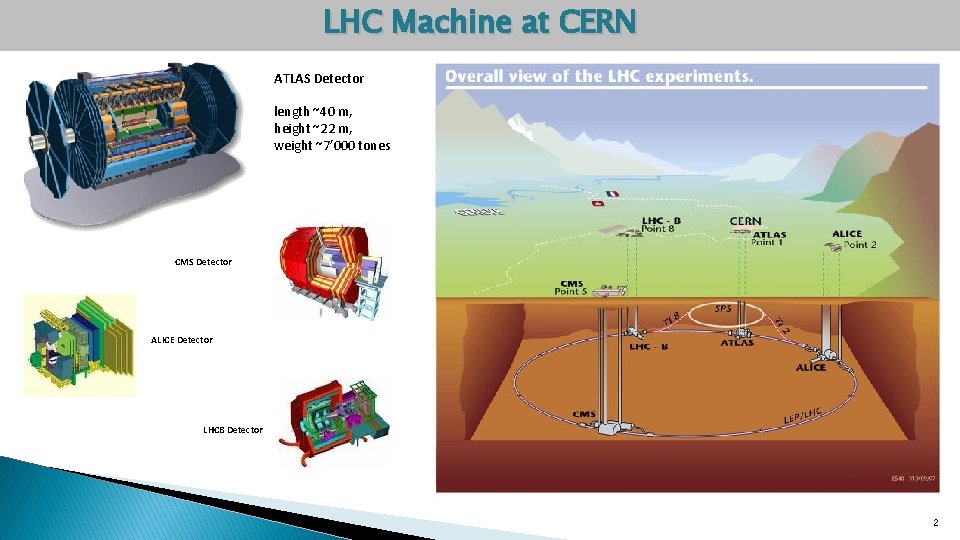
LHC Machine at CERN ATLAS Detector length ~40 m, height ~22 m, weight ~7’ 000 tones CMS Detector ALICE Detector LHCB Detector 2
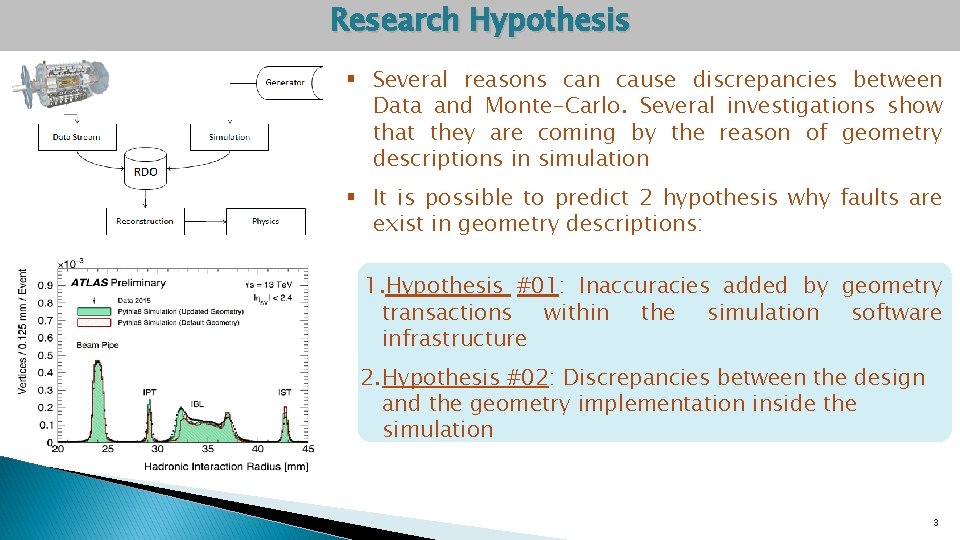
Research Hypothesis § Several reasons can cause discrepancies between Data and Monte-Carlo. Several investigations show that they are coming by the reason of geometry descriptions in simulation § It is possible to predict 2 hypothesis why faults are exist in geometry descriptions: 1. Hypothesis #01: Inaccuracies added by geometry transactions within the simulation software infrastructure 2. Hypothesis #02: Discrepancies between the design and the geometry implementation inside the simulation 3
Geant 4 Toolkit § GEANT 4 is a platform for simulation of facilities and physical events by modelling of the passage of particles through the matter § GEANT 4 implementing in High Energy, nuclear and Accelerator physics as well for studies in medical and in space science BABAR G 4 DNA G 4 EMU GEANT G 4 MED G 4 NAMU 4 BOREXINO LHC 4
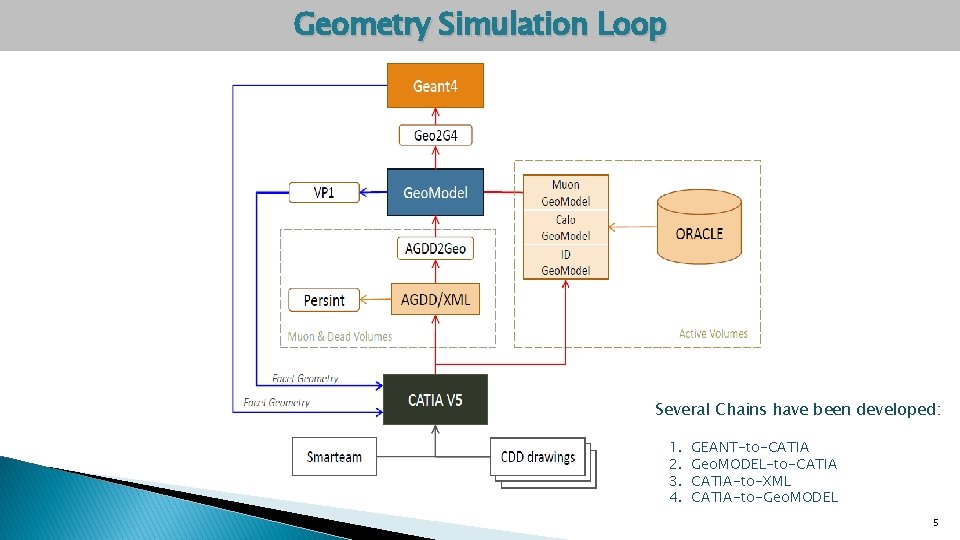
Geometry Simulation Loop Several Chains have been developed: 1. 2. 3. 4. GEANT-to-CATIA Geo. MODEL-to-CATIA-to-XML CATIA-to-Geo. MODEL 5
Checking Hypothesis 01: Investigation of Simulation Infrastructure
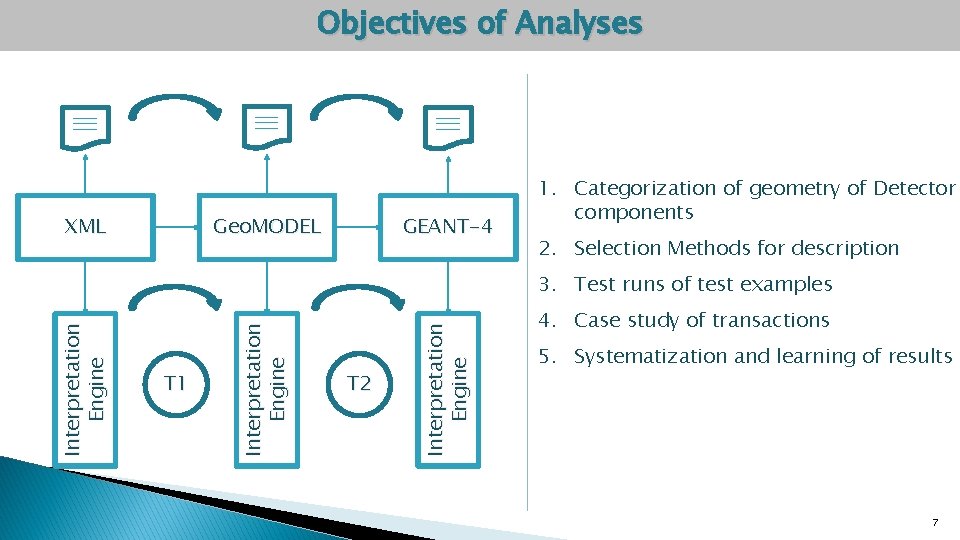
Objectives of Analyses XML Geo. MODEL GEANT-4 1. Categorization of geometry of Detector components 2. Selection Methods for description T 2 Interpretation Engine T 1 Interpretation Engine 3. Test runs of test examples 4. Case study of transactions 5. Systematization and learning of results 7
I. Categorization of Geometry
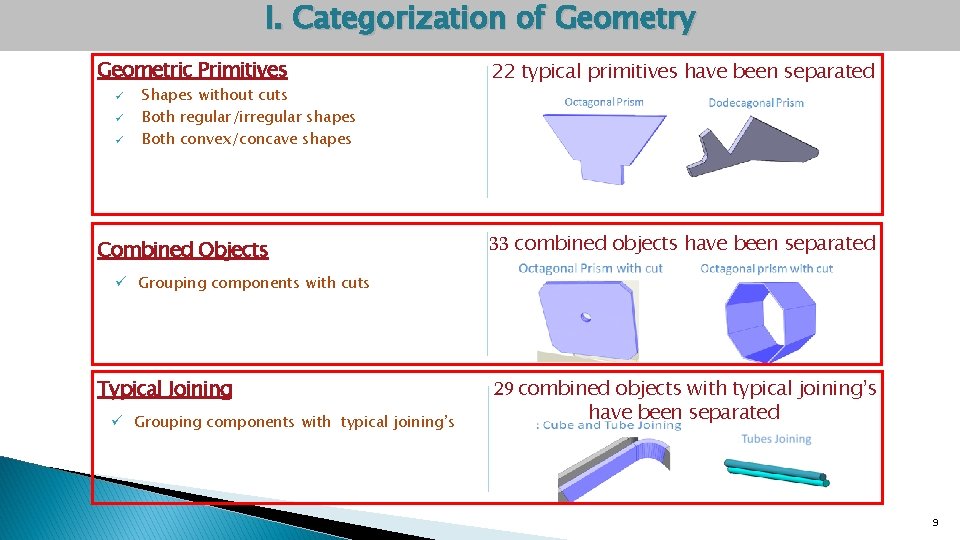
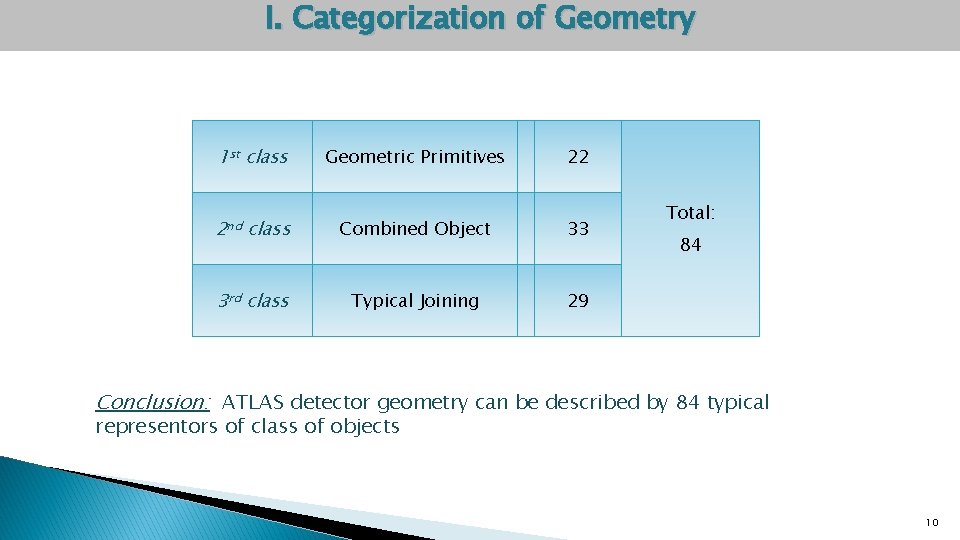
I. Categorization of Geometry Geometric Primitives ü ü ü Shapes without cuts Both regular/irregular shapes Both convex/concave shapes Combined Objects 22 typical primitives have been separated 33 combined objects have been separated ü Grouping components with cuts Typical Joining ü Grouping components with typical joining’s 29 combined objects with typical joining’s have been separated 9
I. Categorization of Geometry 1 st class 2 nd class 3 rd class Geometric Primitives 22 Combined Object 33 Typical Joining 29 Total: 84 Conclusion: ATLAS detector geometry can be described by 84 typical representors of class of objects 10
II. Selection of Methods for Description
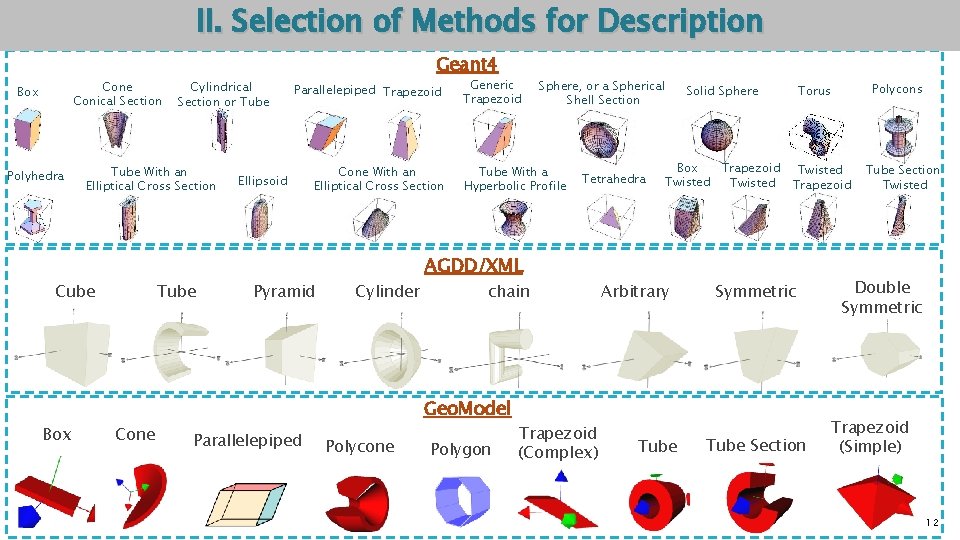
II. Selection of Methods for Description Cone Conical Section Box Polyhedra Cylindrical Section or Tube With an Elliptical Cross Section Geant 4 Parallelepiped Trapezoid Ellipsoid Cone With an Elliptical Cross Section Generic Trapezoid Sphere, or a Spherical Shell Section Tube With a Hyperbolic Profile Tetrahedra Box Trapezoid Twisted Trapezoid AGDD/XML Cube Box Tube Cone Pyramid Cylinder chain Geo. Model Parallelepiped Polycone Polygon Trapezoid (Complex) Arbitrary Tube Polycons Torus Solid Sphere Symmetric Tube Section Twisted Double Symmetric Trapezoid (Simple) 12 12
II. Selection of Methods for Description Method 01 Method 02 13
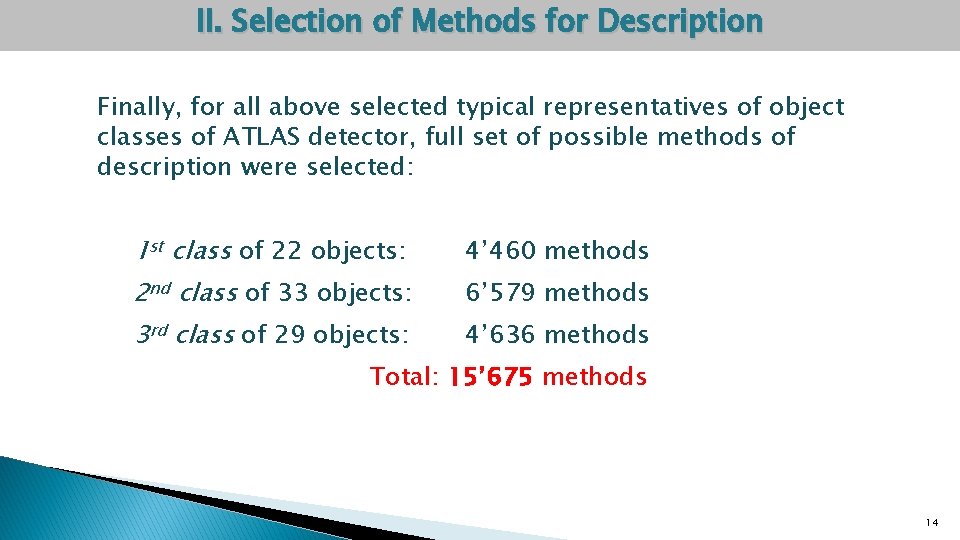
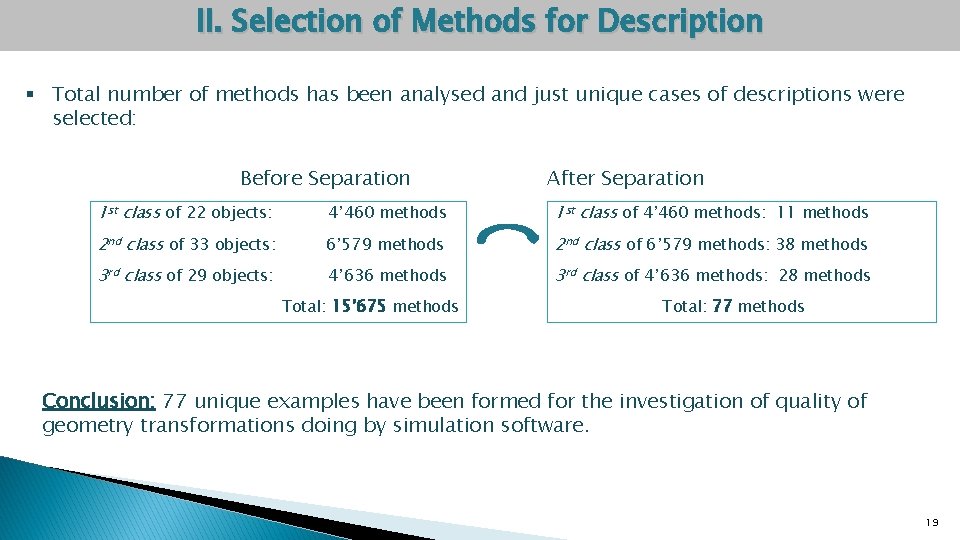
II. Selection of Methods for Description Finally, for all above selected typical representatives of object classes of ATLAS detector, full set of possible methods of description were selected: 1 st class of 22 objects: 4’ 460 methods 2 nd class of 33 objects: 6’ 579 methods 3 rd class of 29 objects: 4’ 636 methods Total: 15’ 675 methods 14
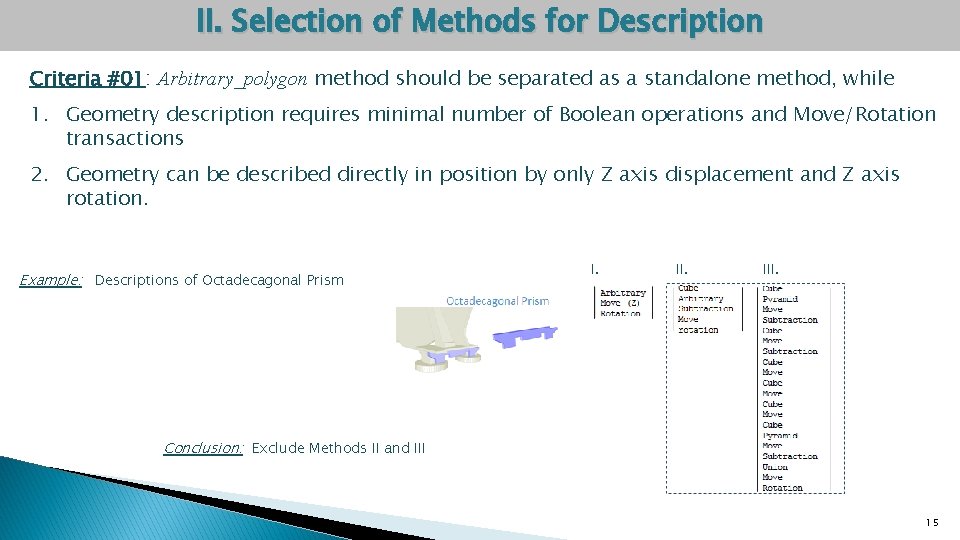
II. Selection of Methods for Description Criteria #01: Arbitrary_polygon method should be separated as a standalone method, while 1. Geometry description requires minimal number of Boolean operations and Move/Rotation transactions 2. Geometry can be described directly in position by only Z axis displacement and Z axis rotation. Example: Descriptions of Octadecagonal Prism I. III. Conclusion: Exclude Methods II and III 15
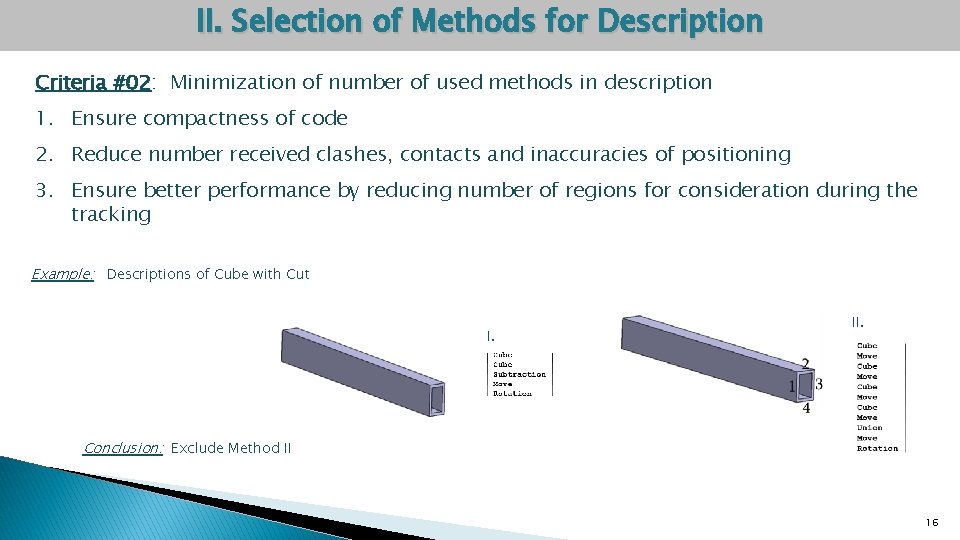
II. Selection of Methods for Description Criteria #02: Minimization of number of used methods in description 1. Ensure compactness of code 2. Reduce number received clashes, contacts and inaccuracies of positioning 3. Ensure better performance by reducing number of regions for consideration during the tracking Example: Descriptions of Cube with Cut I. II. Conclusion: Exclude Method II 16
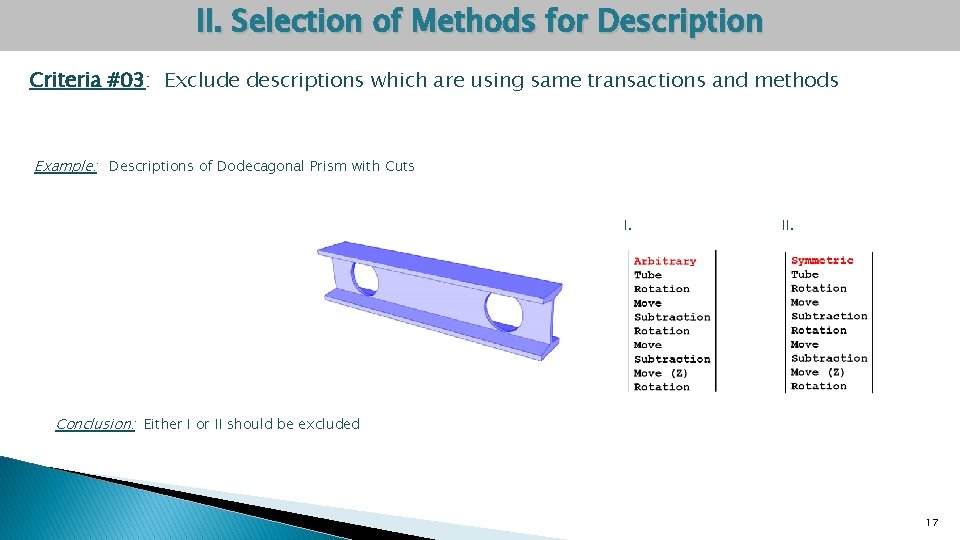
II. Selection of Methods for Description Criteria #03: Exclude descriptions which are using same transactions and methods Example: Descriptions of Dodecagonal Prism with Cuts I. II. Conclusion: Either I or II should be excluded 17
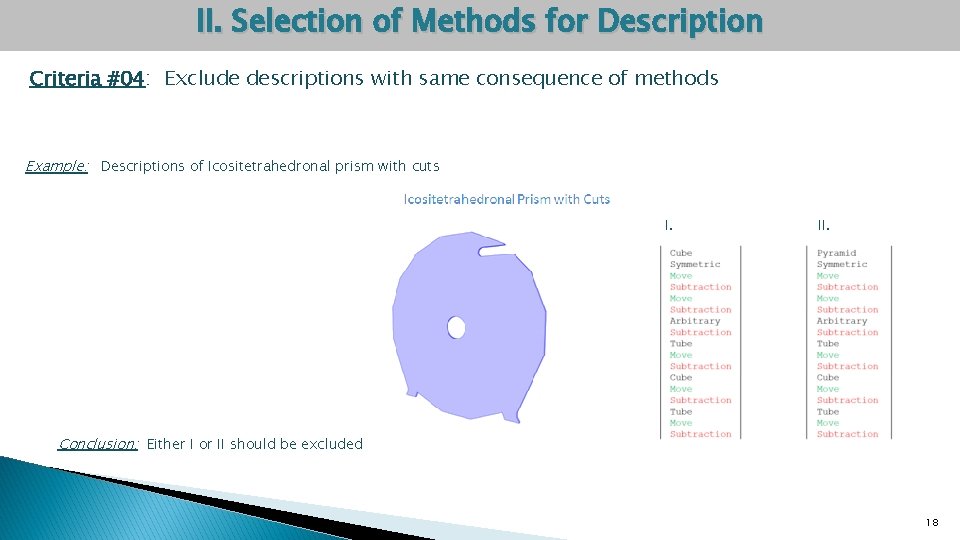
II. Selection of Methods for Description Criteria #04: Exclude descriptions with same consequence of methods Example: Descriptions of Icositetrahedronal prism with cuts I. II. Conclusion: Either I or II should be excluded 18
II. Selection of Methods for Description § Total number of methods has been analysed and just unique cases of descriptions were selected: Before Separation After Separation 1 st class of 22 objects: 4’ 460 methods 1 st class of 4’ 460 methods: 11 methods 2 nd class of 33 objects: 6’ 579 methods 2 nd class of 6’ 579 methods: 38 methods 3 rd class of 29 objects: 4’ 636 methods 3 rd class of 4’ 636 methods: 28 methods Total: 15’ 675 methods Total: 77 methods Conclusion: 77 unique examples have been formed for the investigation of quality of geometry transformations doing by simulation software. 19
III. Test Runs
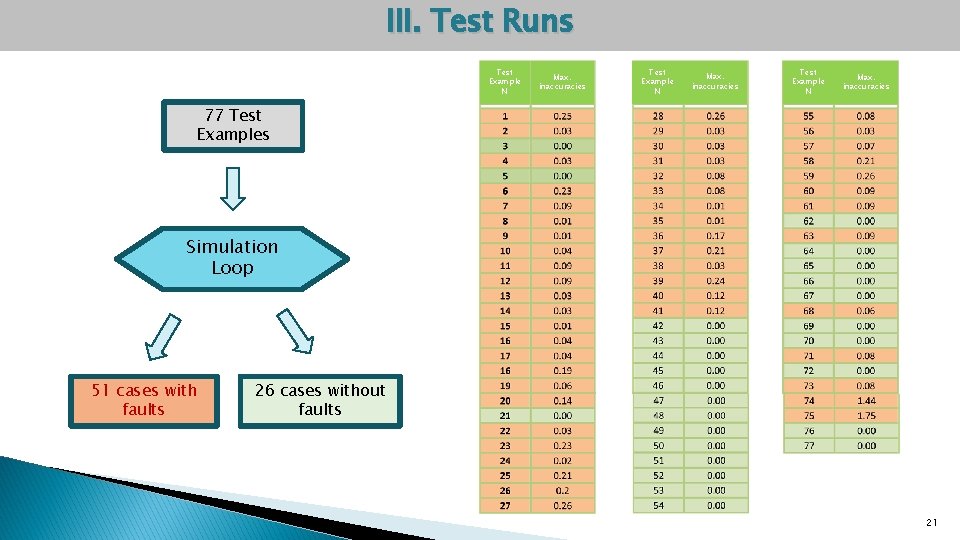
III. Test Runs Test Example N Max. inaccuracies 77 Test Examples Simulation Loop 51 cases with faults 26 cases without faults 21
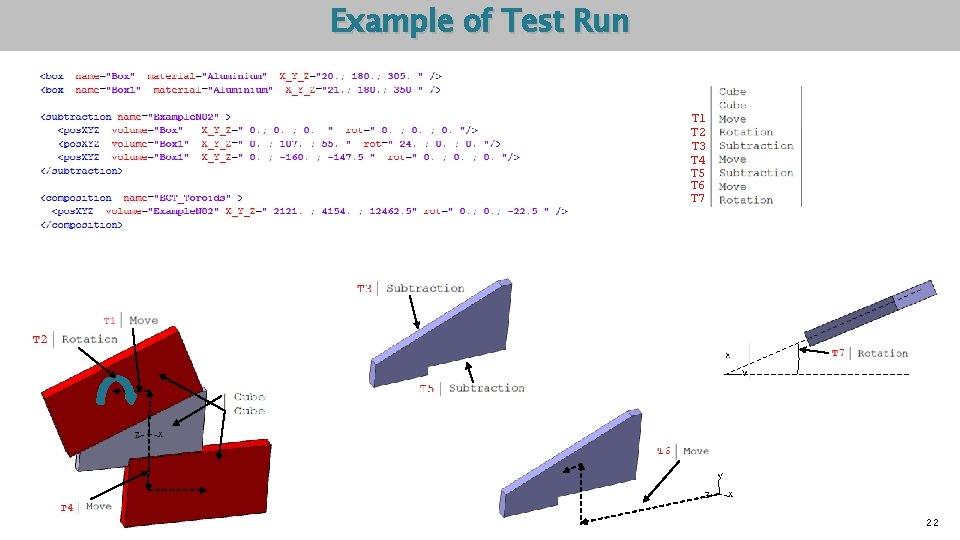
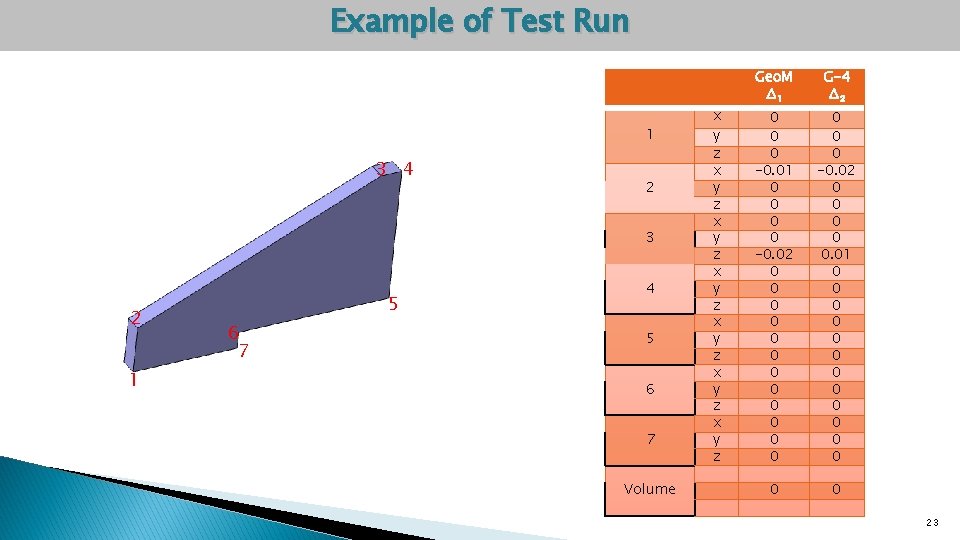
Example of Test Run T 1 T 2 T 3 T 4 T 5 T 6 T 7 22
Example of Test Run 1 3 4 2 3 2 1 5 6 7 4 5 6 7 Volume x y z x y z Geo. M ∆1 G-4 ∆2 0 0 0 -0. 01 0 0 -0. 02 0 0 0 0 -0. 02 0 0 0. 01 0 0 0 0 23
IV. Case Study of Transactions
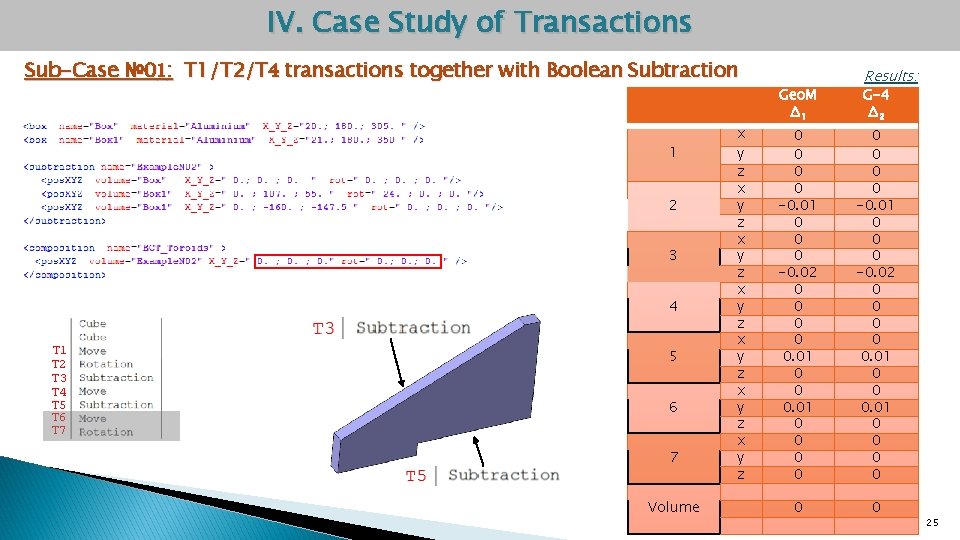
IV. Case Study of Transactions Sub-Case № 01: T 1/T 2/T 4 transactions together with Boolean Subtraction 1 2 3 4 T 1 T 2 T 3 T 4 T 5 T 6 T 7 5 6 7 Volume x y z x y z Results: Geo. M ∆1 G-4 ∆2 0 0 0 0 -0. 01 0 0 0 -0. 02 0 0 0 0 0. 01 0 0 0 25
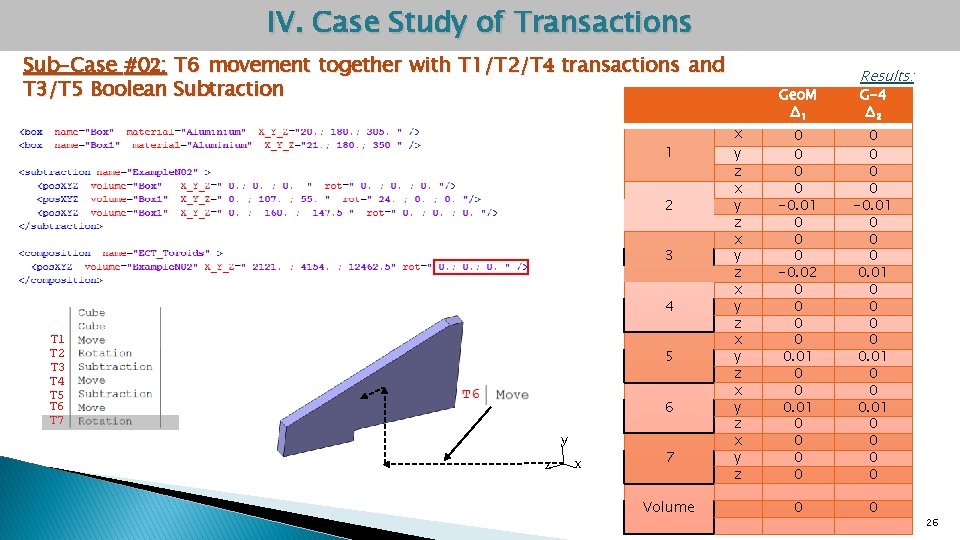
IV. Case Study of Transactions Sub-Case #02: T 6 movement together with T 1/T 2/T 4 transactions and T 3/T 5 Boolean Subtraction 1 2 3 4 T 1 T 2 T 3 T 4 T 5 T 6 T 7 5 6 7 Volume x y z x y z Results: Geo. M ∆1 G-4 ∆2 0 0 -0. 01 0 0 0 -0. 02 0 0 0. 01 0 0 0 0 0 -0. 01 0 0 0 0 26
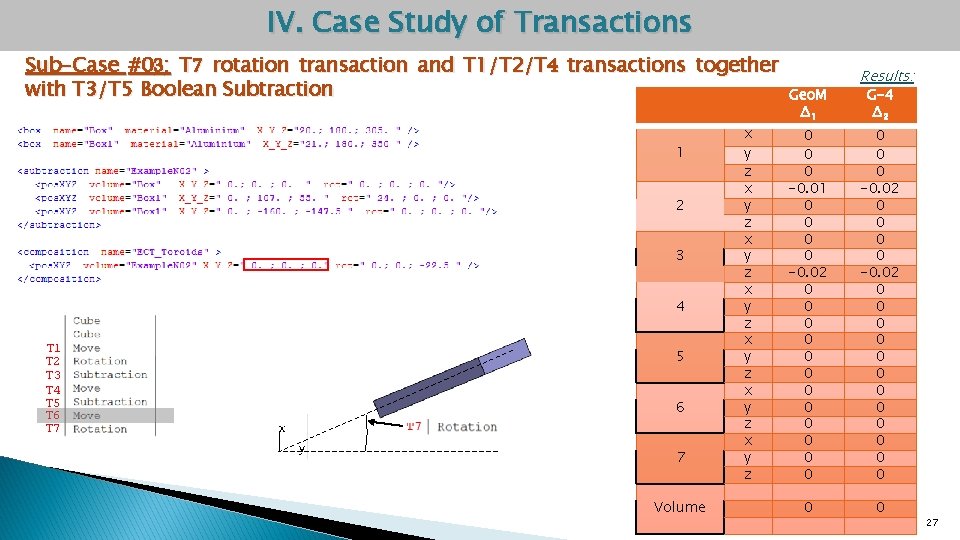
IV. Case Study of Transactions Sub-Case #03: T 7 rotation transaction and T 1/T 2/T 4 transactions together with T 3/T 5 Boolean Subtraction 1 2 3 4 T 1 T 2 T 3 T 4 T 5 T 6 T 7 5 6 7 Volume x y z x y z Geo. M ∆1 Results: G-4 ∆2 0 0 0 -0. 01 0 0 -0. 02 0 0 0 0 0 0 0 0 0 27
V. Systematization and Learning of Results
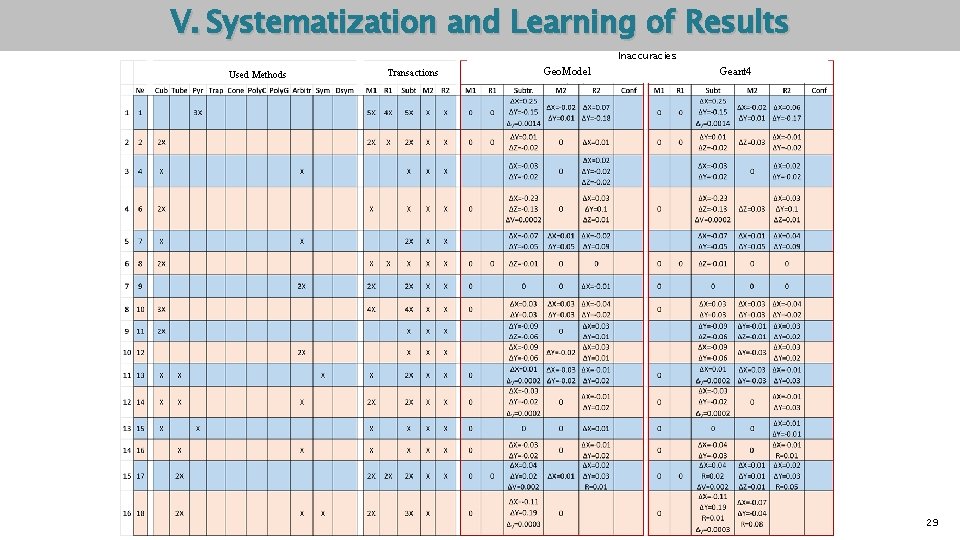
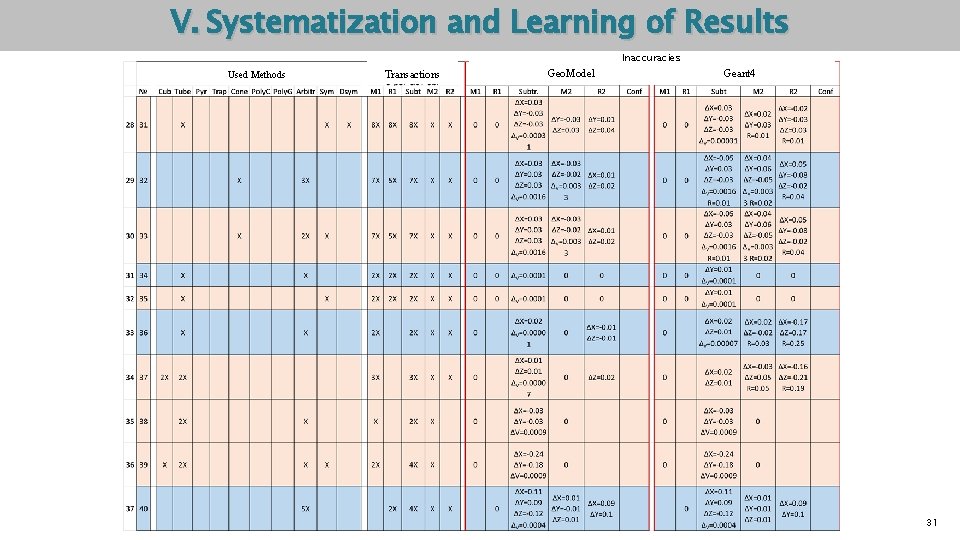
V. Systematization and Learning of Results Inaccuracies Used Methods Transactions Geo. Model Geant 4 29
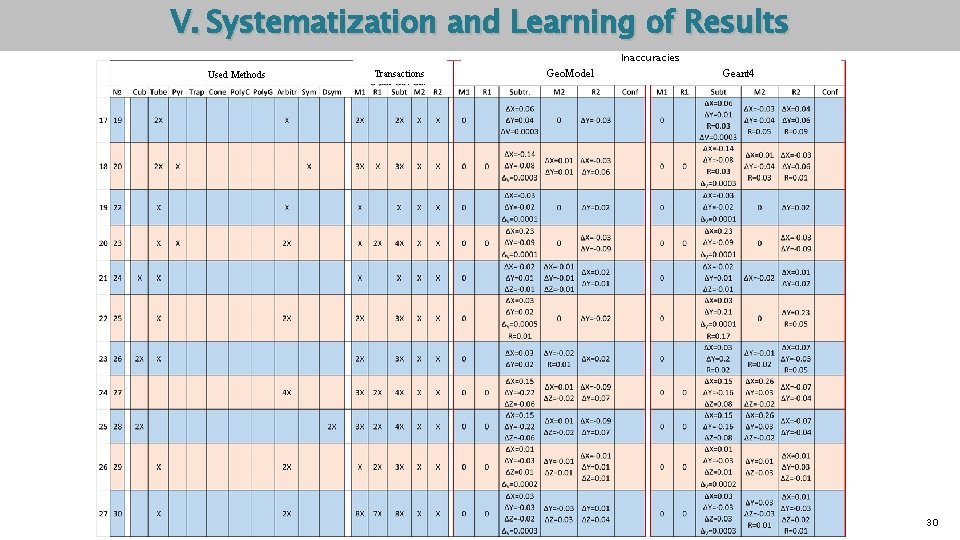
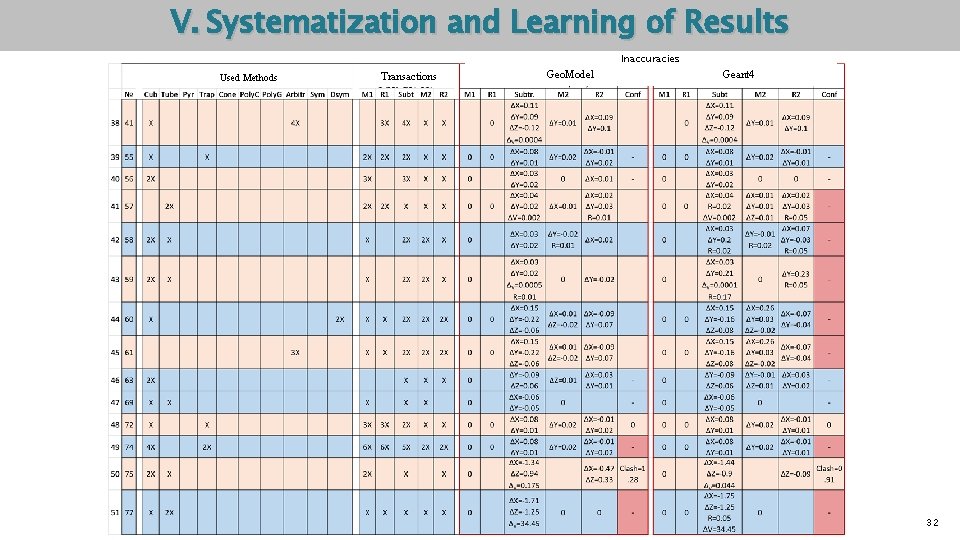
V. Systematization and Learning of Results Inaccuracies Used Methods Transactions Geo. Model Geant 4 30
V. Systematization and Learning of Results Inaccuracies Used Methods Transactions Geo. Model Geant 4 31
V. Systematization and Learning of Results Inaccuracies Used Methods Transactions Geo. Model Geant 4 32
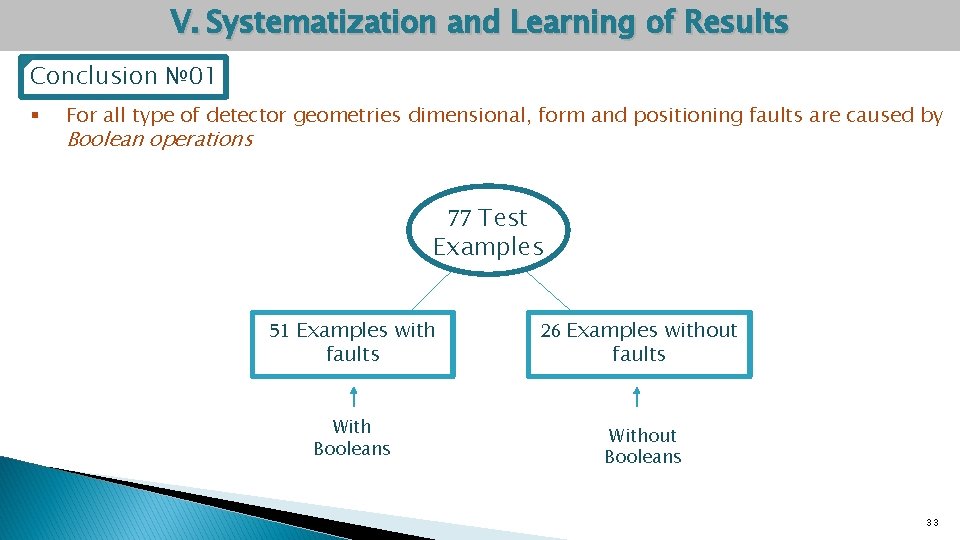
V. Systematization and Learning of Results Conclusion № 01 § For all type of detector geometries dimensional, form and positioning faults are caused by Boolean operations 77 Test Examples 51 Examples with faults 26 Examples without faults With Booleans Without Booleans 33
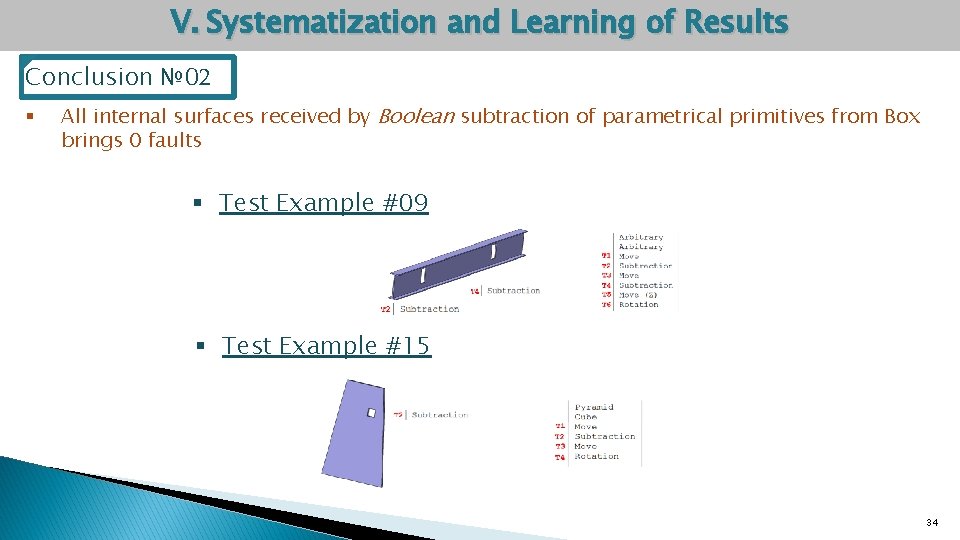
V. Systematization and Learning of Results Conclusion № 02 § All internal surfaces received by Boolean subtraction of parametrical primitives from Box brings 0 faults § Test Example #09 § Test Example #15 34
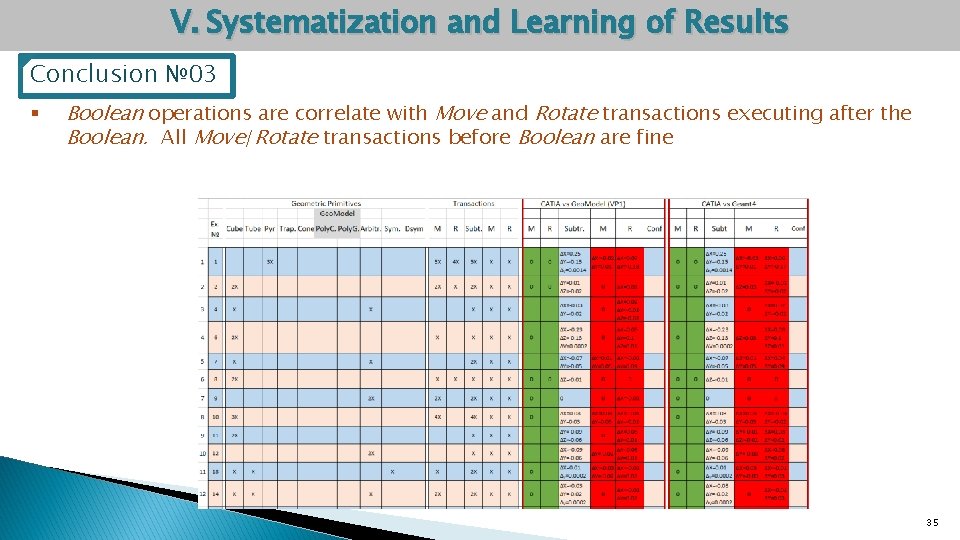
V. Systematization and Learning of Results Conclusion № 03 § Boolean operations are correlate with Move and Rotate transactions executing after the Boolean. All Move/Rotate transactions before Boolean are fine 35
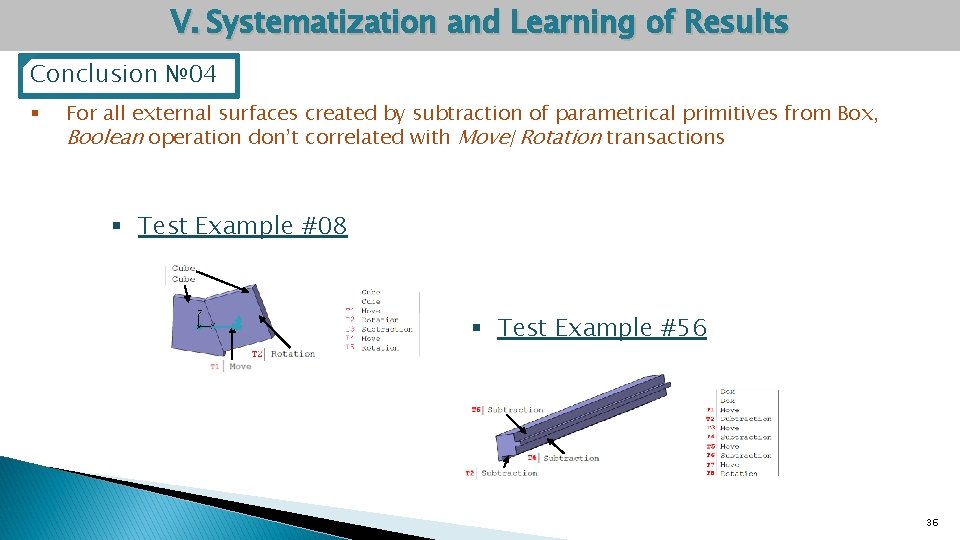
V. Systematization and Learning of Results Conclusion № 04 § For all external surfaces created by subtraction of parametrical primitives from Box, Boolean operation don’t correlated with Move/Rotation transactions § Test Example #08 § Test Example #56 36
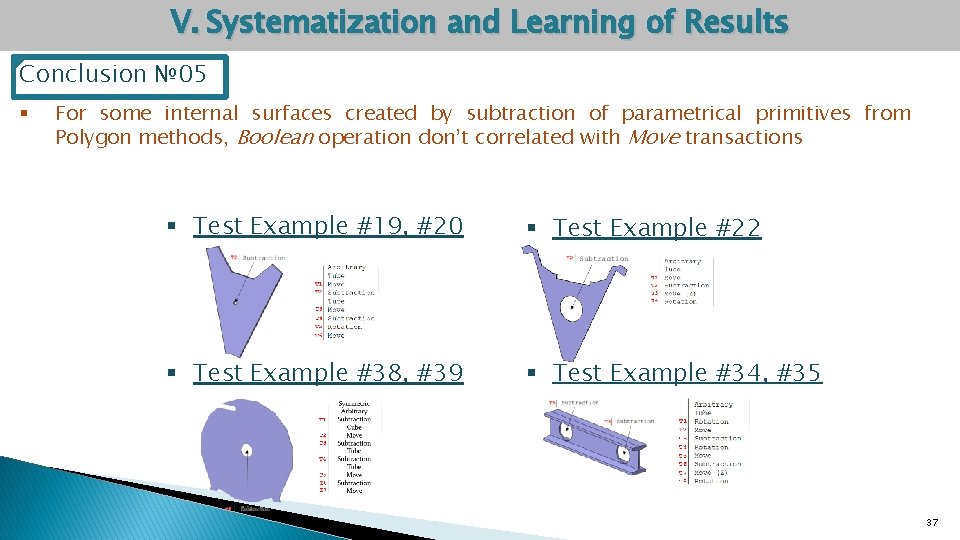
V. Systematization and Learning of Results Conclusion № 05 § For some internal surfaces created by subtraction of parametrical primitives from Polygon methods, Boolean operation don’t correlated with Move transactions § Test Example #19, #20 § Test Example #22 § Test Example #38, #39 § Test Example #34, #35 37
Conclusions of Hypothesis #1 1. Hypothesis #01 has been confirmed: The infrastructure introduces geometrical inaccuracies simulation software 2. For all type of detector geometries the faults in dimension, form and positioning are caused by Boolean operations 3. All internal surfaces received by Boolean subtraction of parametrical primitives from a Box result in zero faults 4. Boolean operation inaccuracies are correlated with Moving/Rotation transactions in GEANT 4 5. For all external surfaces created by the subtraction of parametrical primitives from a Box, Boolean operation Inaccuracies do not correlate with Moving/Rotation transactions 6. For some internal surfaces created by the subtraction of a Polygon methods via Tube method, Boolean operation do not correlate with Moving transactions 38
Checking Hypothesis 02: Investigation of discrepancies between the design and the geometry implementation inside the simulation
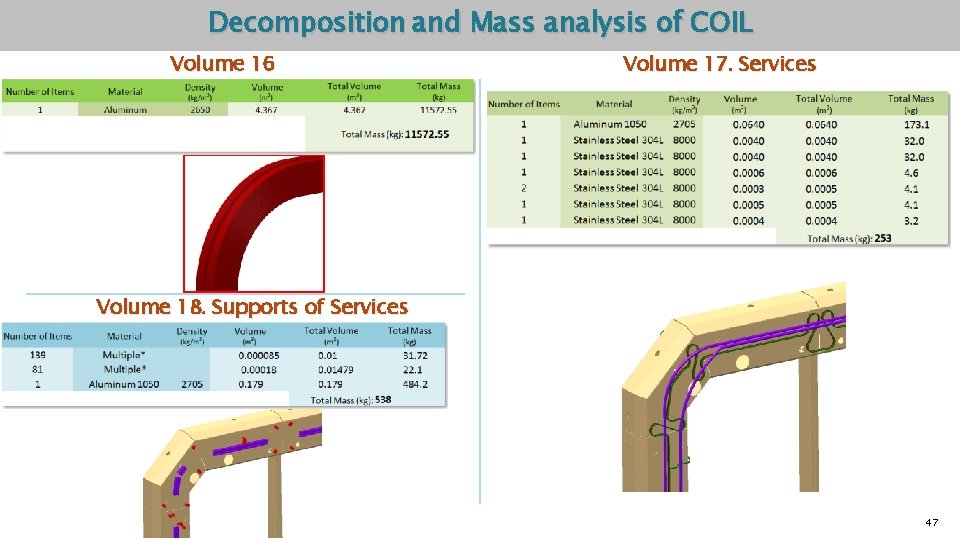
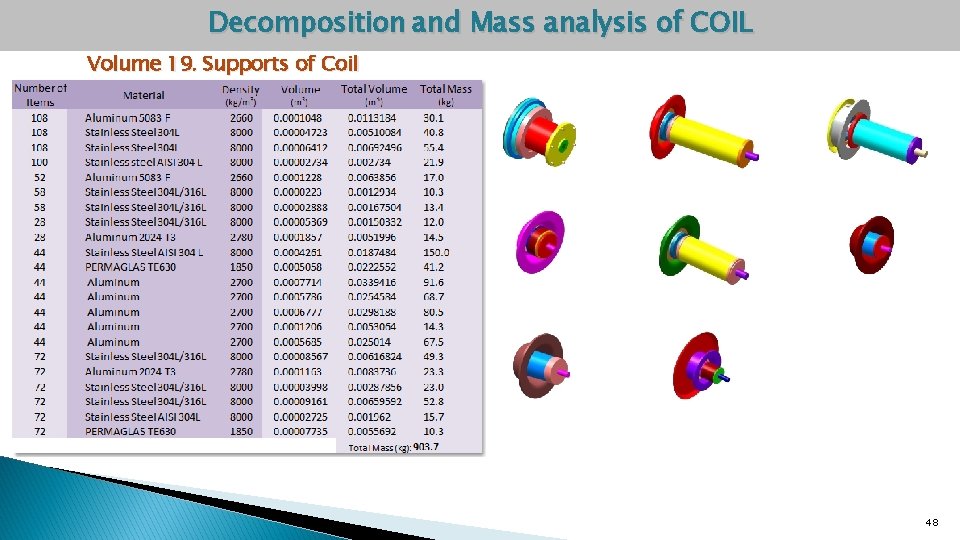
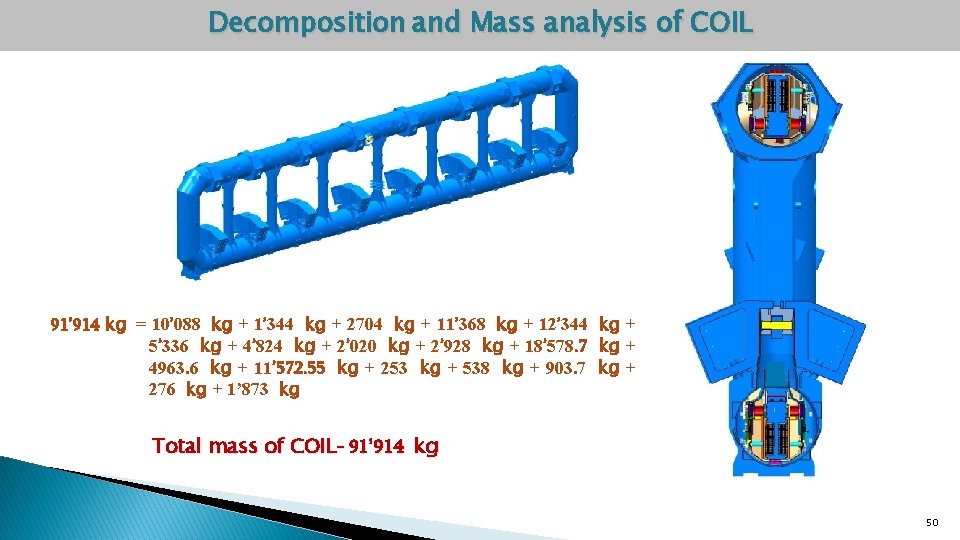
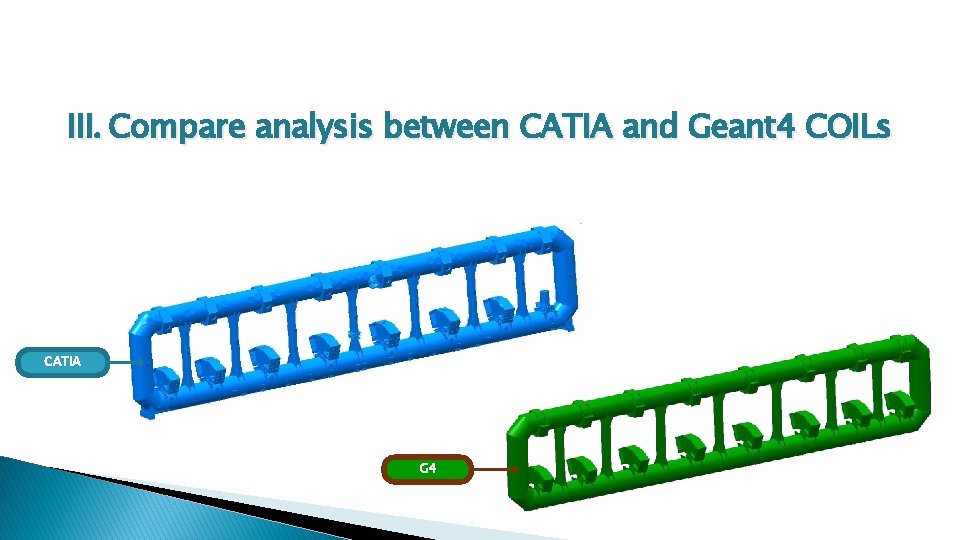
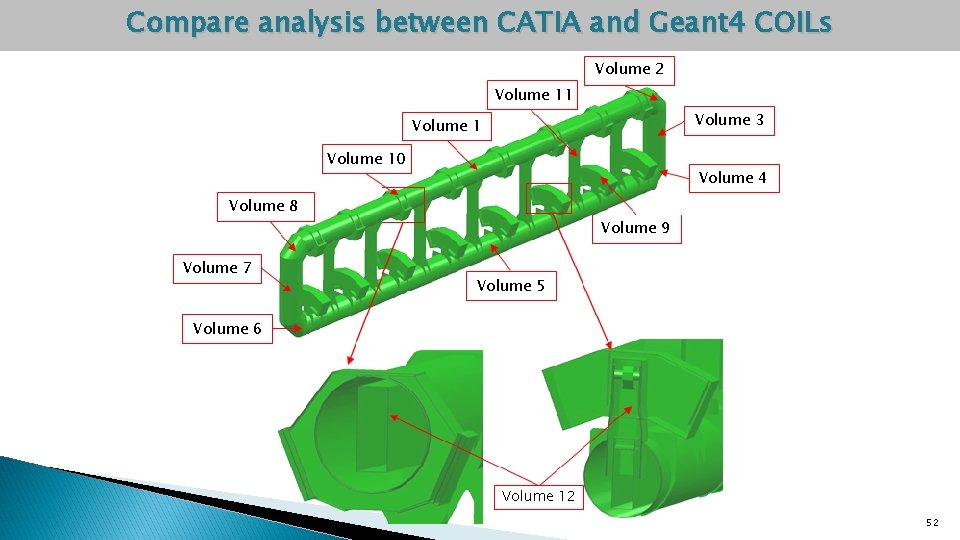
Objectives of Analyses 1. Reproduction of Geometrical Model of COIL in CATIA 2. Decomposition and Mass analysis of COIL 3. Compare analysis between CATIA and Geant 4 COILs 4. Integration conflict checking 40
I. Reproduction of Geometrical Model of COIL in CATIA
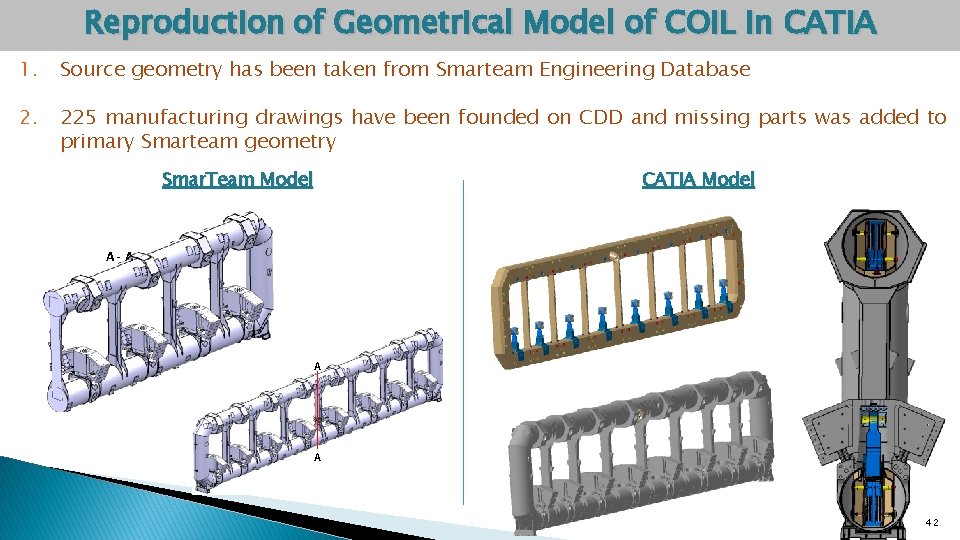
Reproduction of Geometrical Model of COIL in CATIA 1. Source geometry has been taken from Smarteam Engineering Database 2. 225 manufacturing drawings have been founded on CDD and missing parts was added to primary Smarteam geometry Smar. Team Model CATIA Model A-A A A 42
II. Decomposition and Mass analysis of COIL
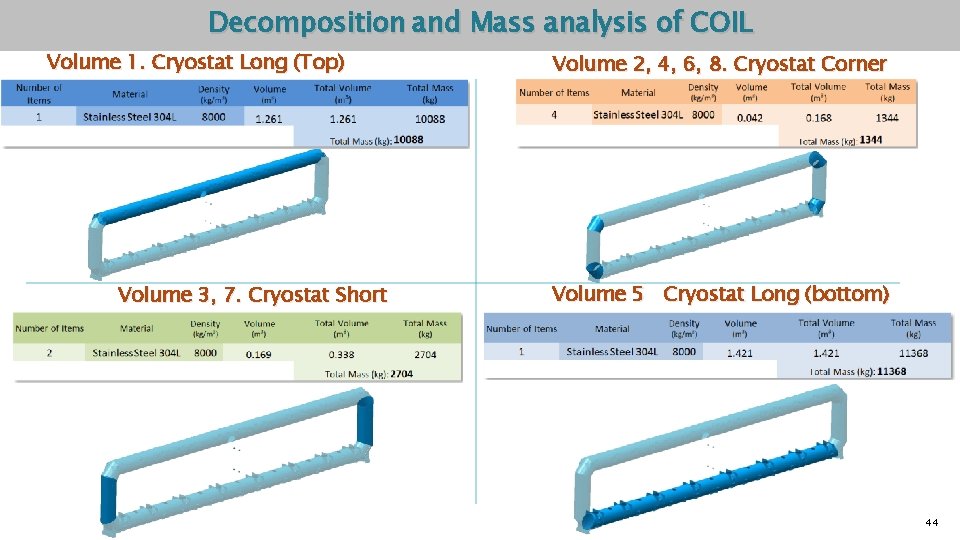
Decomposition and Mass analysis of COIL Volume 1. Cryostat Long (Top) Volume 3, 7. Cryostat Short Volume 2, 4, 6, 8. Cryostat Corner Volume 5 Cryostat Long (bottom) 44
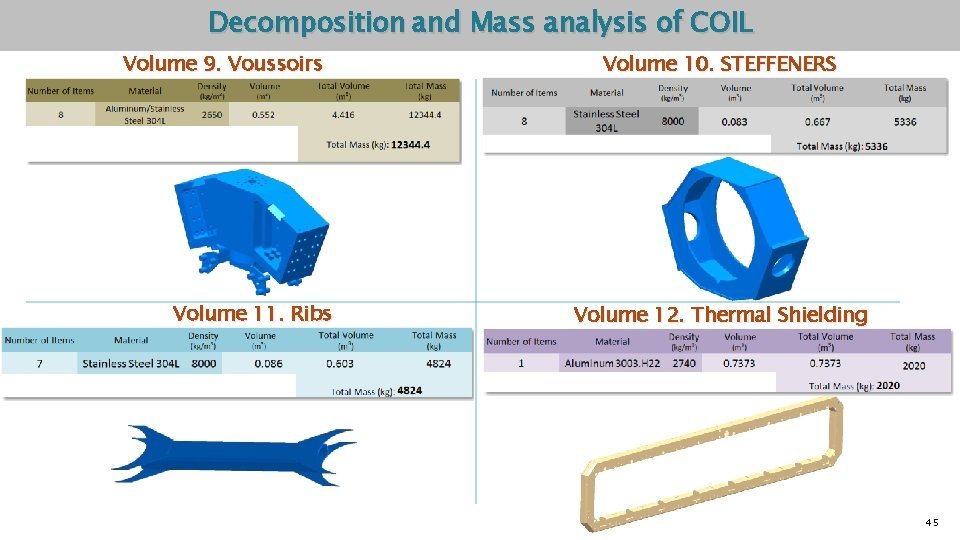
Decomposition and Mass analysis of COIL Volume 9. Voussoirs Volume 11. Ribs Volume 10. STEFFENERS Volume 12. Thermal Shielding 45
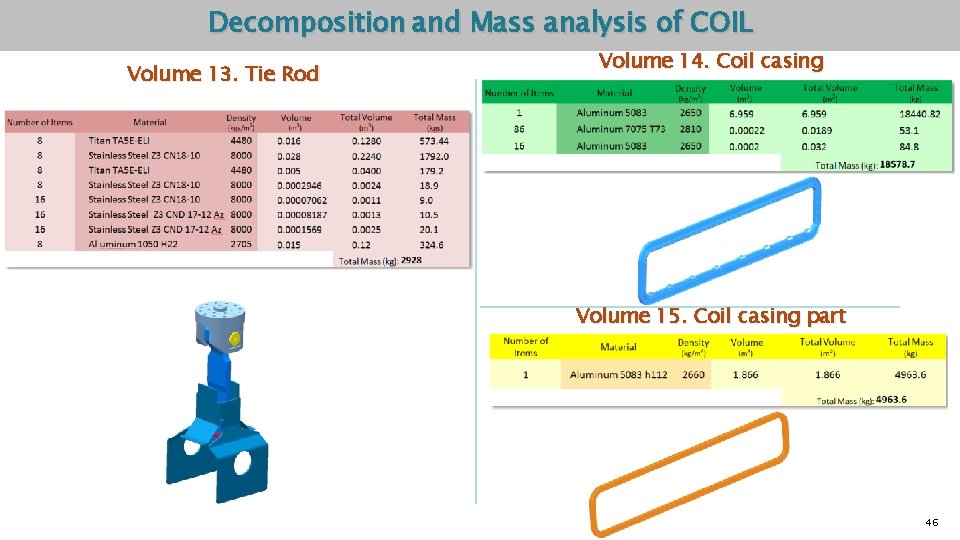
Decomposition and Mass analysis of COIL Volume 13. Tie Rod Volume 14. Coil casing Volume 15. Coil casing part 46
Decomposition and Mass analysis of COIL Volume 16 Volume 17. Services Volume 18. Supports of Services 47
Decomposition and Mass analysis of COIL Volume 19. Supports of Coil 48
Decomposition and Mass analysis of COIL Volume 20. Ribs of Thermal Shielding Volume 21. Ribs of Coil casing 49
Decomposition and Mass analysis of COIL 91’ 914 kg = 10’ 088 kg + 1’ 344 kg + 2704 kg + 11’ 368 kg + 12’ 344 kg + 5’ 336 kg + 4’ 824 kg + 2’ 020 kg + 2’ 928 kg + 18’ 578. 7 kg + 4963. 6 kg + 11’ 572. 55 kg + 253 kg + 538 kg + 903. 7 kg + 276 kg + 1’ 873 kg Total mass of COIL- 91’ 914 kg 50
III. Compare analysis between CATIA and Geant 4 COILs CATIA G 4
Compare analysis between CATIA and Geant 4 COILs Volume 2 Volume 11 Volume 3 Volume 10 Volume 4 Volume 8 Volume 7 Volume 9 Volume 5 Volume 6 Volume 12 52
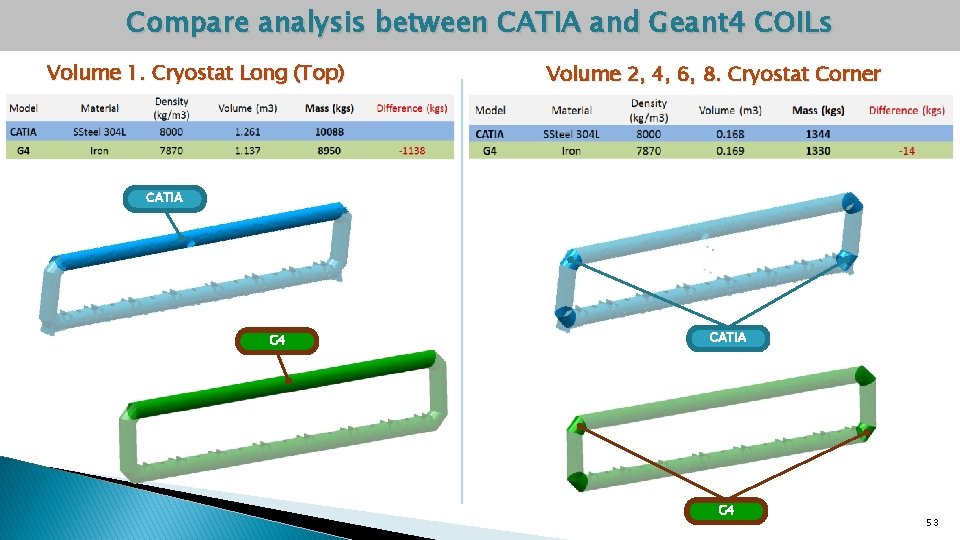
Compare analysis between CATIA and Geant 4 COILs Volume 1. Cryostat Long (Top) Volume 2, 4, 6, 8. Cryostat Corner CATIA G 4 53
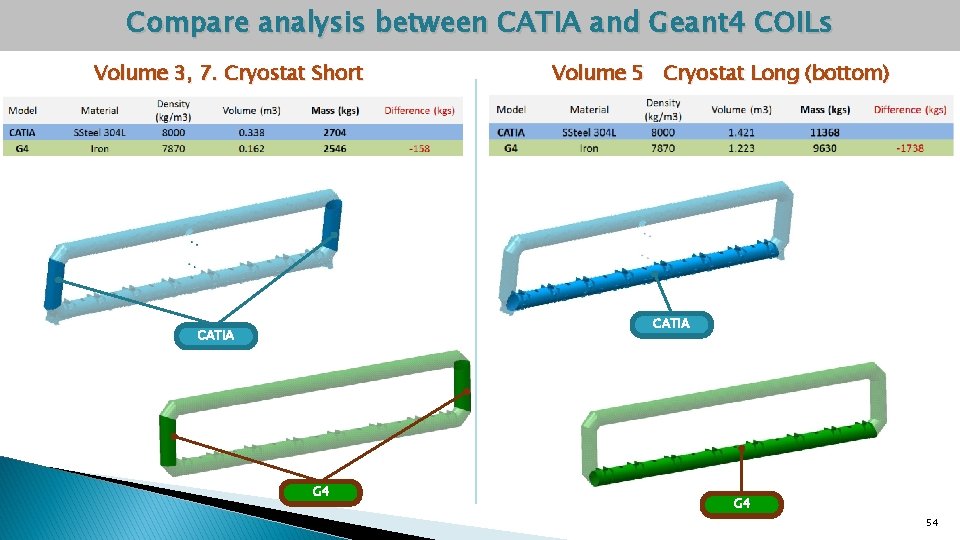
Compare analysis between CATIA and Geant 4 COILs Volume 3, 7. Cryostat Short Volume 5 Cryostat Long (bottom) CATIA G 4 54
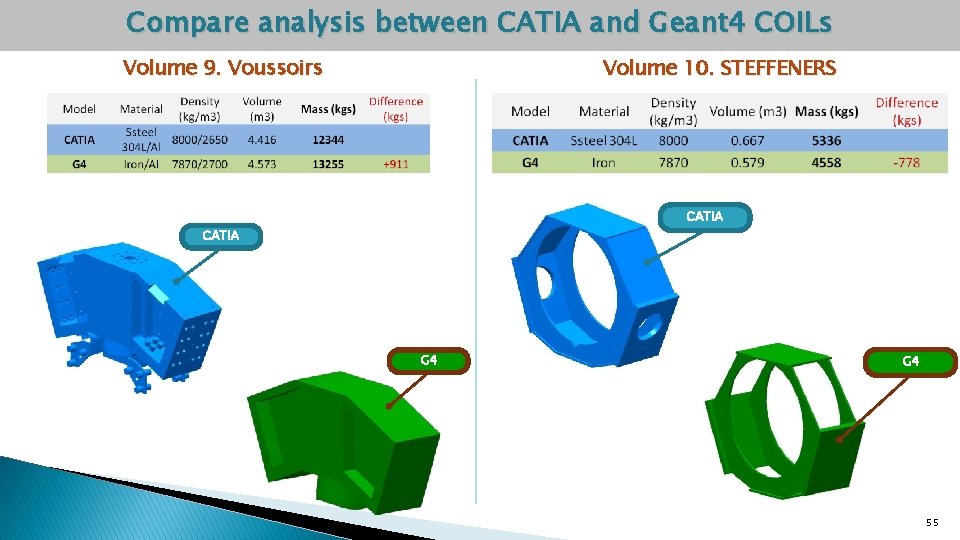
Compare analysis between CATIA and Geant 4 COILs Volume 9. Voussoirs Volume 10. STEFFENERS CATIA G 4 55
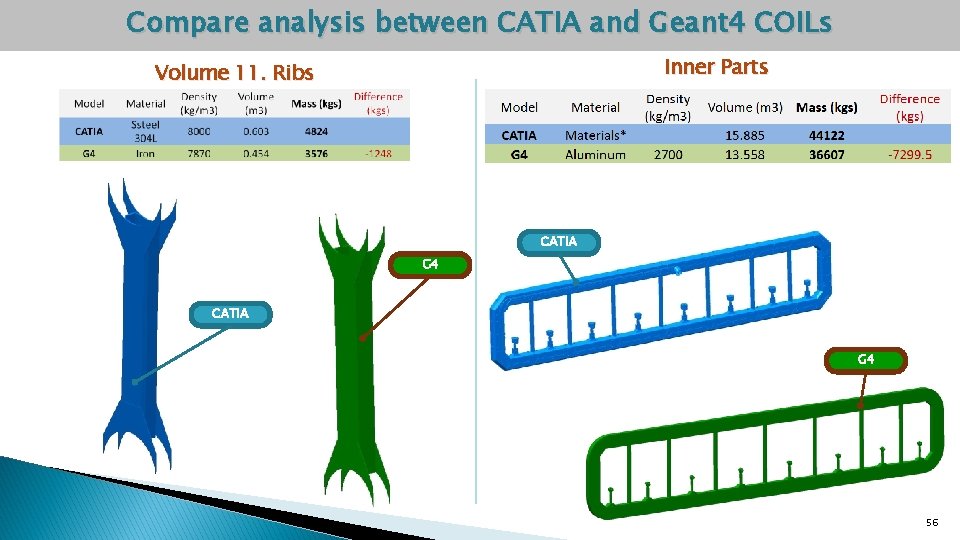
Compare analysis between CATIA and Geant 4 COILs Inner Parts Volume 11. Ribs CATIA G 4 56
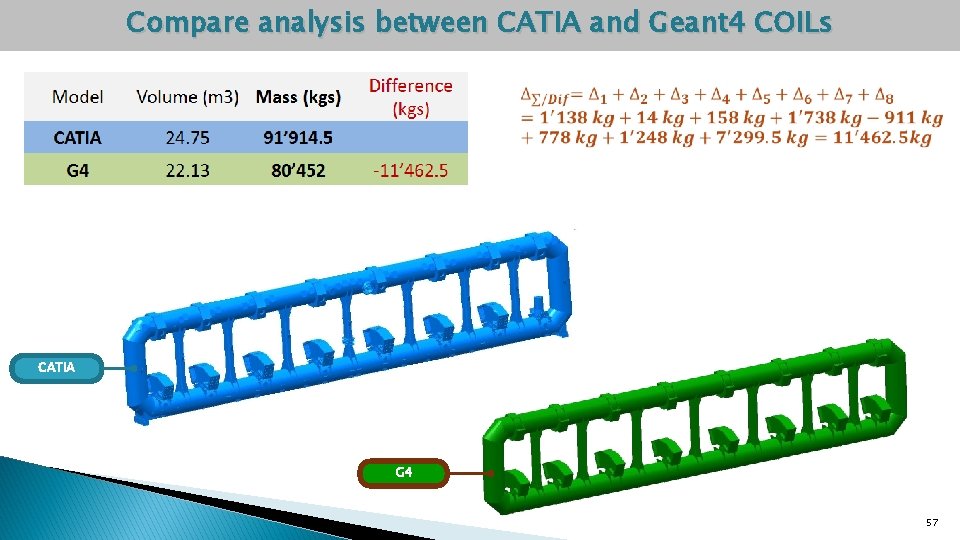
Compare analysis between CATIA and Geant 4 COILs CATIA G 4 57
IV. Integration conflict checking 58
Integration conflict checking 59
Conclusion of Hypothesis II 1. Hypothesis #02 has been confirmed: The geometry descriptions in the simulation are not consistent with design geometry description 2. The COIL was divided into 21 separate volume 3. Volume and Weight analyses of the COIL have been implemented; Comparison of the volume and weight between CATIA and XML descriptions have been implemented 4. Important differences have been discovered for the following volumes: Cryostat Bottom missing 1’ 738 kg. , Rib missing 1’ 248 kg. , Thermal Shielding missing 2’ 020 kg. , Inner parts of the COIL missing 5’ 297. 5 kg 5. It is was found that there was not Thermal Shielding in the Geant 4 description 6. 11. 5 tones missed materials were discovered for Geant 4 geometry 7. 35 mm dispositioning of the COIL has been discovered 60
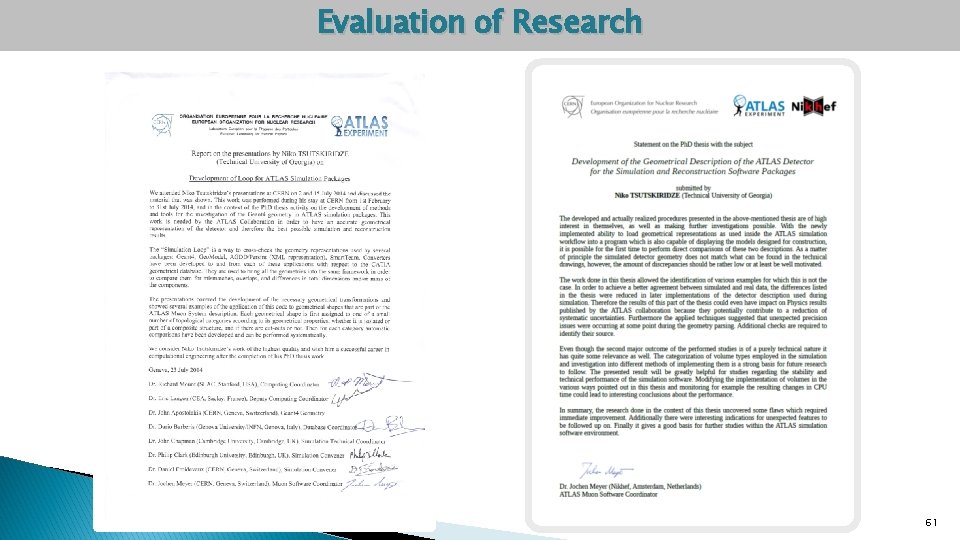
Evaluation of Research 61
Thank you for your attention! Niko Tsutskiridze Georgian Technical University European Organization for Nuclear Research CERN SCCTW’ 2016, 06/10/2016