
INVESTIGATION OF FEATURE RECOGNITION IN CLINICAL CT IMAGES
- Slides: 12
INVESTIGATION OF FEATURE RECOGNITION IN CLINICAL CT IMAGES AS A STEP TOWARDS ADAPTIVE RADIOTHERAPY Louis Jaugey Alix Moawad BSc Research Project
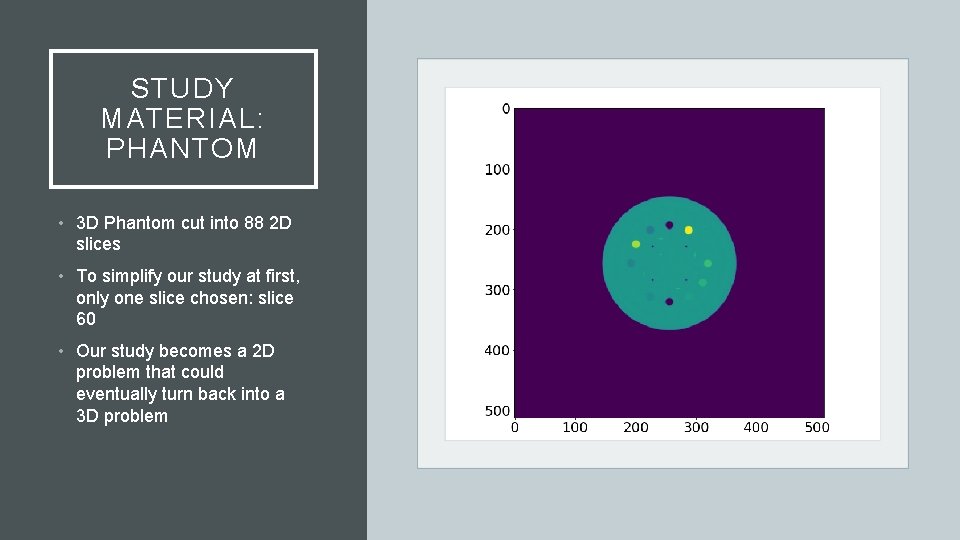
STUDY MATERIAL: PHANTOM • 3 D Phantom cut into 88 2 D slices • To simplify our study at first, only one slice chosen: slice 60 • Our study becomes a 2 D problem that could eventually turn back into a 3 D problem
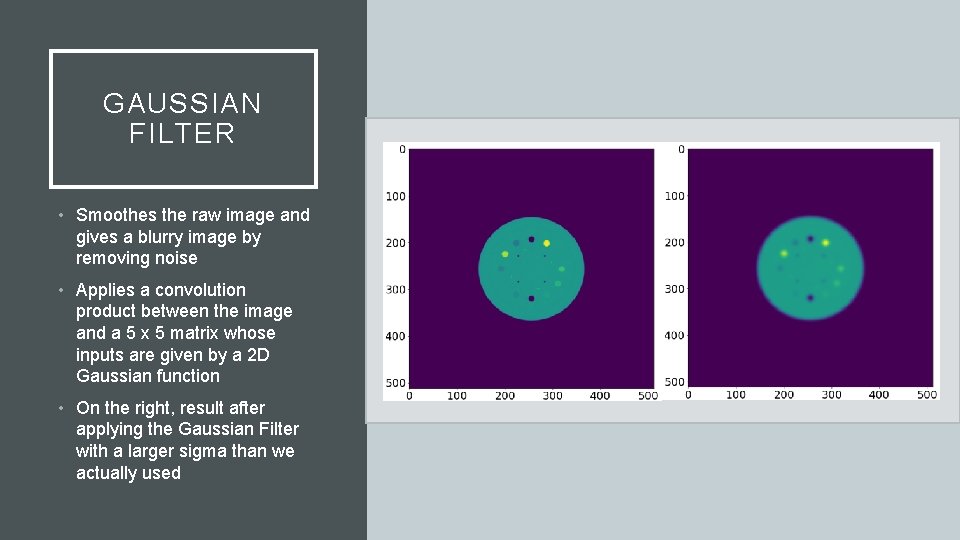
GAUSSIAN FILTER • Smoothes the raw image and gives a blurry image by removing noise • Applies a convolution product between the image and a 5 x 5 matrix whose inputs are given by a 2 D Gaussian function • On the right, result after applying the Gaussian Filter with a larger sigma than we actually used
PLAN OF THE PRESENTATION Directional derivatives Method Laplacian Method Edge Canny Filter Method
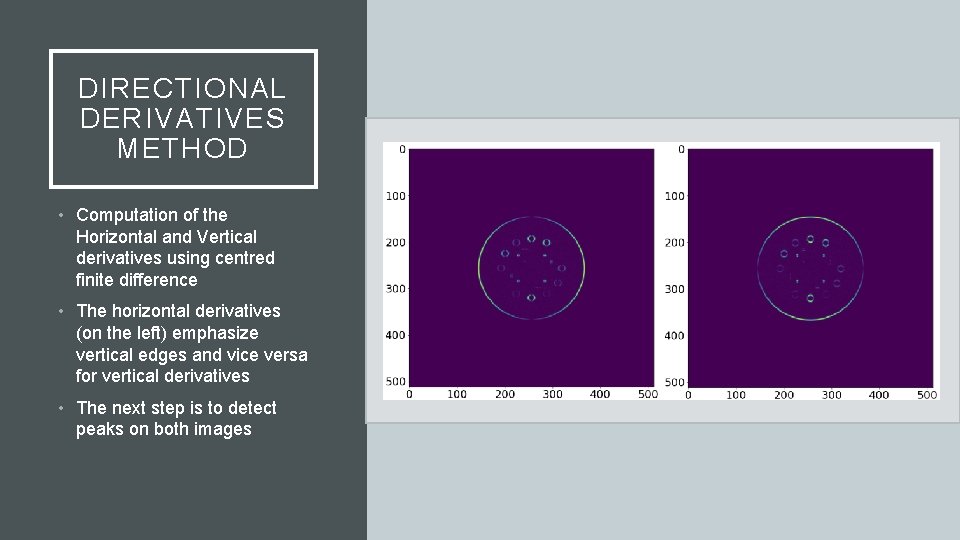
DIRECTIONAL DERIVATIVES METHOD • Computation of the Horizontal and Vertical derivatives using centred finite difference • The horizontal derivatives (on the left) emphasize vertical edges and vice versa for vertical derivatives • The next step is to detect peaks on both images
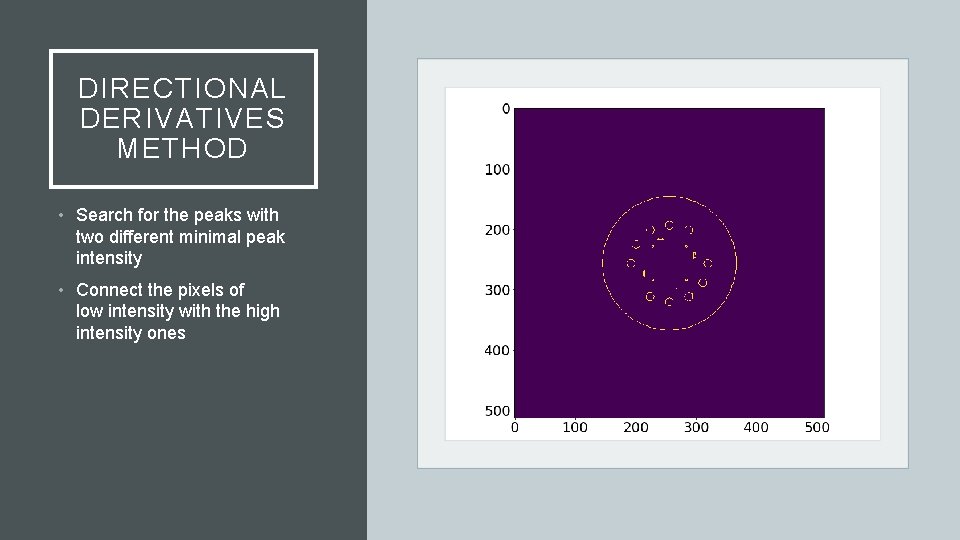
DIRECTIONAL DERIVATIVES METHOD • Search for the peaks with two different minimal peak intensity • Connect the pixels of low intensity with the high intensity ones
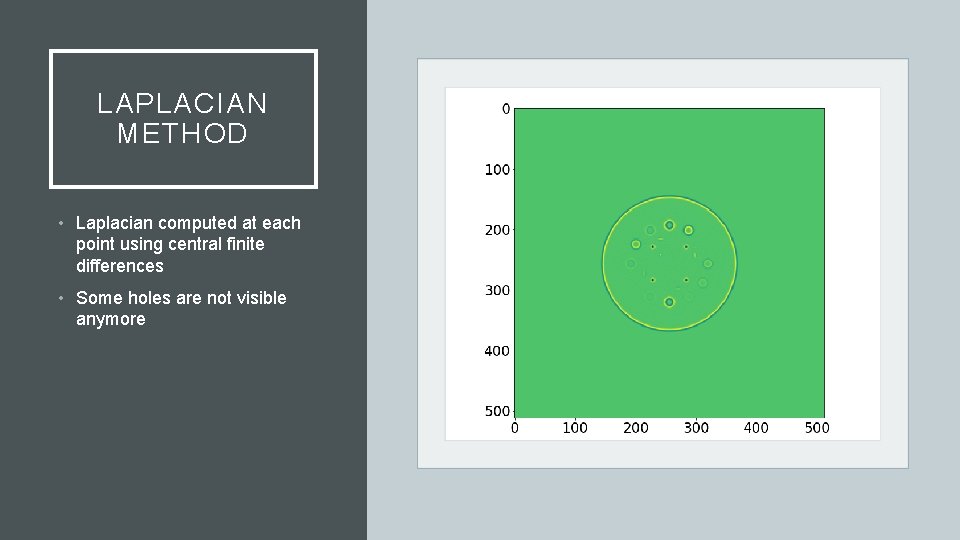
LAPLACIAN METHOD • Laplacian computed at each point using central finite differences • Some holes are not visible anymore
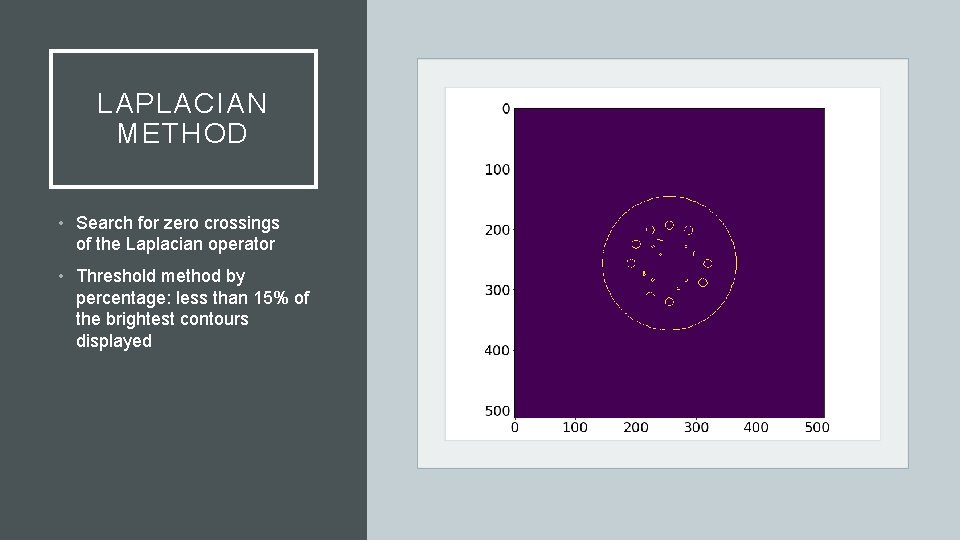
LAPLACIAN METHOD • Search for zero crossings of the Laplacian operator • Threshold method by percentage: less than 15% of the brightest contours displayed
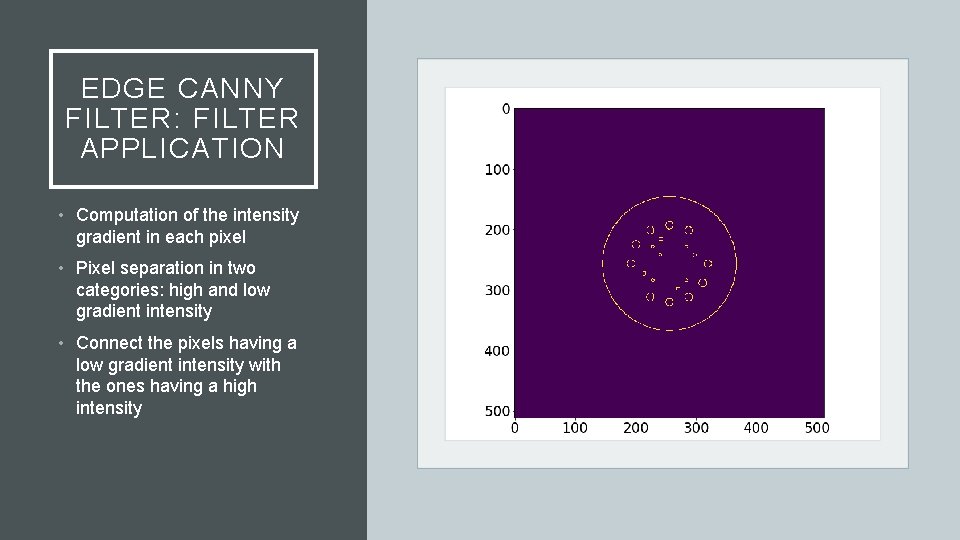
EDGE CANNY FILTER: FILTER APPLICATION • Computation of the intensity gradient in each pixel • Pixel separation in two categories: high and low gradient intensity • Connect the pixels having a low gradient intensity with the ones having a high intensity
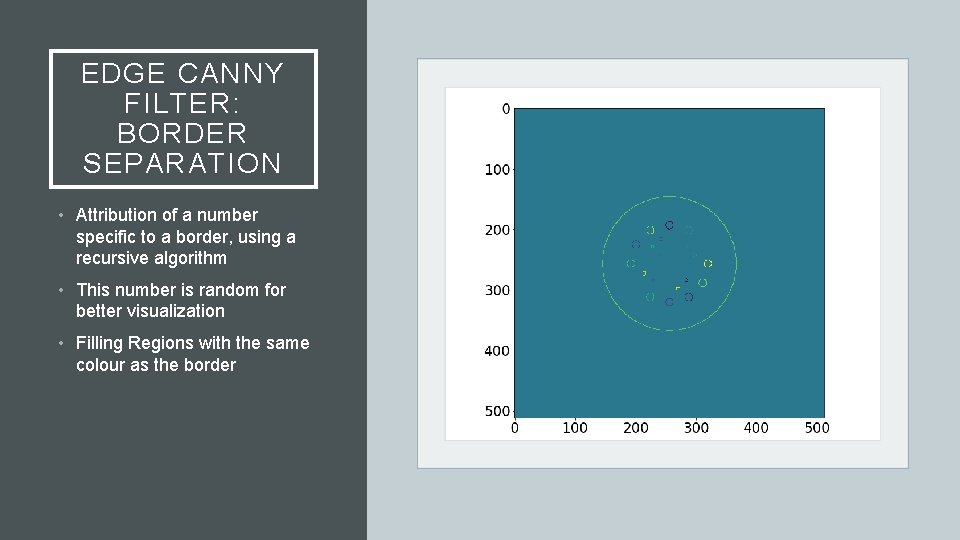
EDGE CANNY FILTER: BORDER SEPARATION • Attribution of a number specific to a border, using a recursive algorithm • This number is random for better visualization • Filling Regions with the same colour as the border
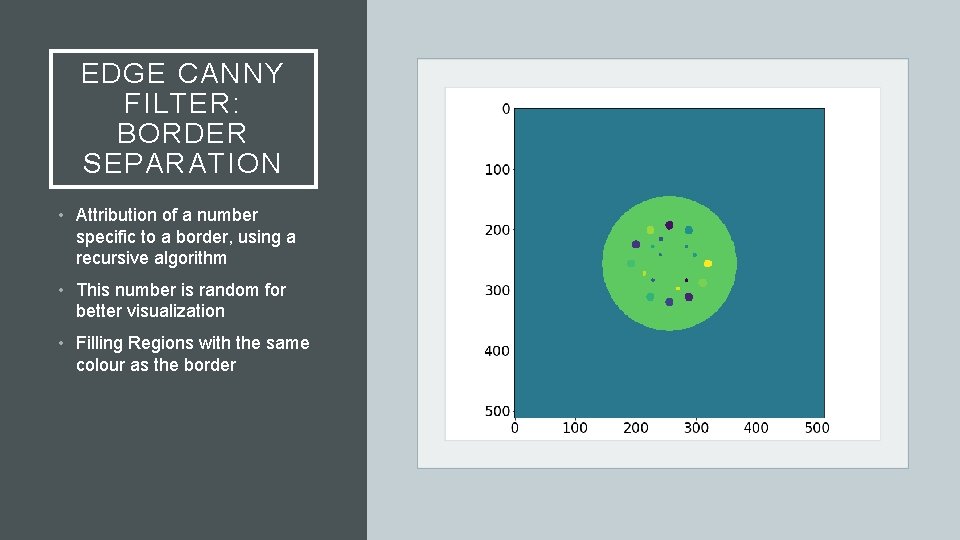
EDGE CANNY FILTER: BORDER SEPARATION • Attribution of a number specific to a border, using a recursive algorithm • This number is random for better visualization • Filling Regions with the same colour as the border
FURTHER WORK AND CONCLUSION • Phantoms have very well-defined regions. Edge detection on real patients' images is a much harder problem. • Application of these methods on 3 D CT-scans. • Latest algorithms used in image treatment rely on Machine Learning techniques. This will be the subject of interest for the second term.