
Investigation of Data Locality in Map Reduce Zhenhua






- Slides: 24
Investigation of Data Locality in Map. Reduce Zhenhua Guo, Geoffrey Fox, Mo Zhou
Outline � Introduction � Analysis of Data Locality � Optimality of Data Locality � Experiments � Conclusions
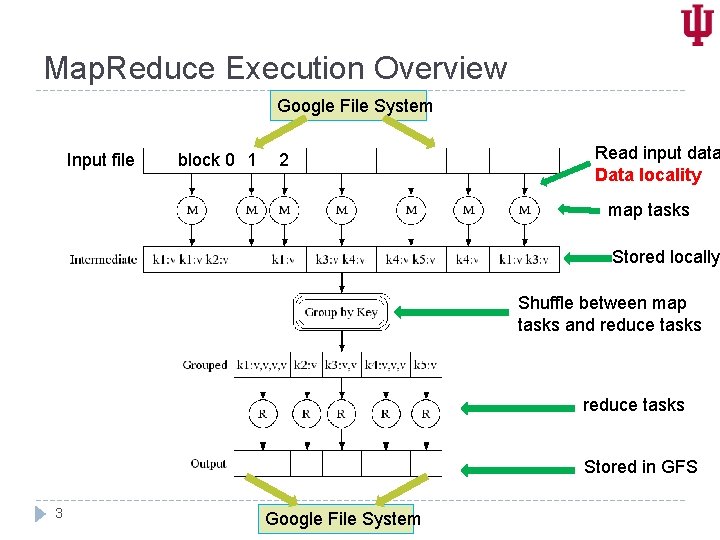
Map. Reduce Execution Overview Google File System Input file block 0 1 2 Read input data Data locality map tasks Stored locally Shuffle between map tasks and reduce tasks Stored in GFS 3 Google File System
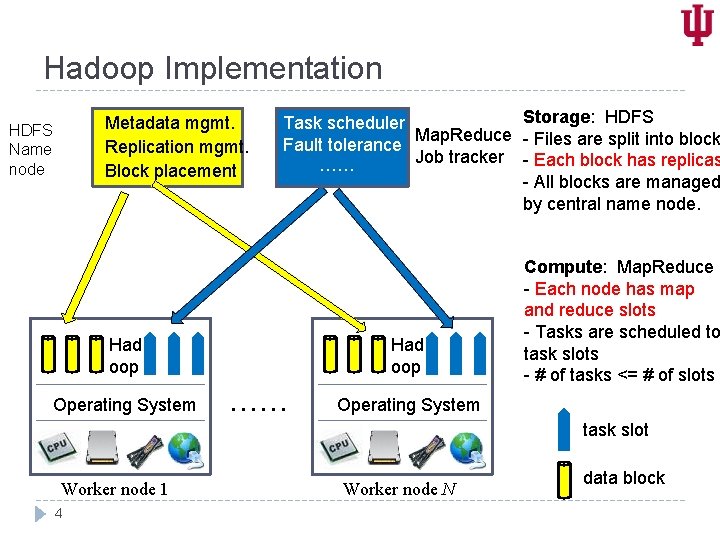
Hadoop Implementation Metadata mgmt. Replication mgmt. Block placement HDFS Name node Storage: HDFS Task scheduler Map. Reduce - Files are split into block Fault tolerance Job tracker - Each block has replicas …… - All blocks are managed by central name node. Had oop Operating System Had oop …… Compute: Map. Reduce - Each node has map and reduce slots - Tasks are scheduled to task slots - # of tasks <= # of slots Operating System task slot Worker node 1 4 Worker node N data block
Data Locality � “Distance” between compute and data � Different levels: node-level, rack-level, etc. � For data-intensive computing, data locality is important � Energy � Network � Research � Evaluate traffic goals how system factors impact data locality and theoretically deduce their relationship � Analyze state-of-the-art scheduling algorithms in Map. Reduce � Propose a scheduling algorithm achieving optimal data locality 5
Outline � Introduction � Analysis of Data Locality � Optimality of Data Locality � Experiments � Conclusions
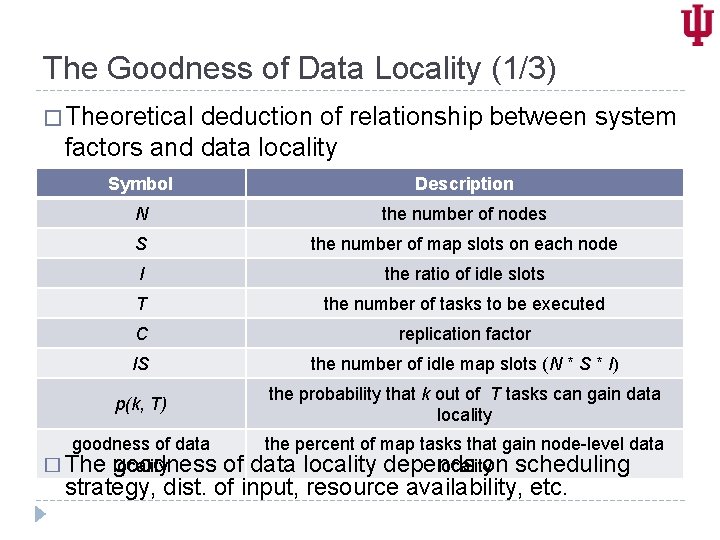
The Goodness of Data Locality (1/3) � Theoretical deduction of relationship between system factors and data locality Symbol Description N the number of nodes S the number of map slots on each node I the ratio of idle slots T the number of tasks to be executed C replication factor IS the number of idle map slots (N * S * I) p(k, T) the probability that k out of T tasks can gain data locality goodness of data locality � The goodness the percent of map tasks that gain node-level data locality depends on scheduling of strategy, dist. of input, resource availability, etc.
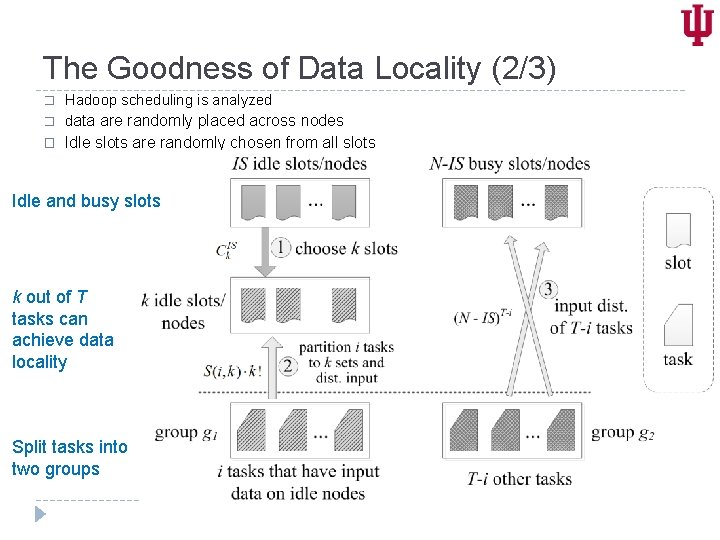
The Goodness of Data Locality (2/3) � Hadoop scheduling is analyzed data are randomly placed across nodes � Idle slots are randomly chosen from all slots � Idle and busy slots k out of T tasks can achieve data locality Split tasks into two groups
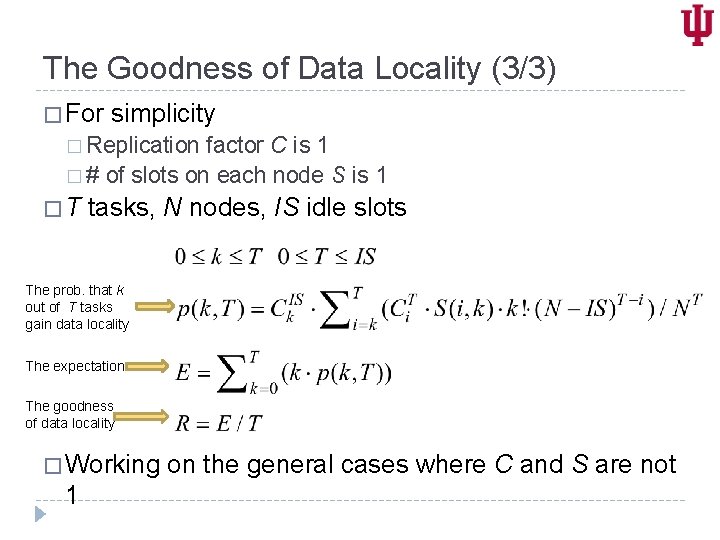
The Goodness of Data Locality (3/3) � For simplicity � Replication factor C is 1 � # of slots on each node S is 1 �T tasks, N nodes, IS idle slots The prob. that k out of T tasks gain data locality The expectation The goodness of data locality � Working 1 on the general cases where C and S are not
Outline � Introduction and Motivation � Analysis of Data Locality � Optimality of Data Locality (Scheduling) � Experiments � Conclusions
Non-optimality of default Hadoop sched. Problem: given a set of tasks and a set of idle slots, assign tasks to idle slots � Hadoop schedules tasks one by one � � Consider one idle slot each time � � Given an idle slot, schedule the task that yields the “best” data locality(from task queue) Achieve local optimum; global optimum is not guaranteed � Each task is scheduled without considering its impact on other tasks
Optimal Data Locality � All idle slots need to be considered at once to achieve global optimum � We propose an algorithm lsap-sched which yields optimal data locality � Reformulate � Use � Find the problem a cost matrix to capture data locality information a similar mathematical problem: Linear Sum Assignment Problem (LSAP) � Convert the scheduling problem to LSAP (not directly mapped) � Prove the optimality
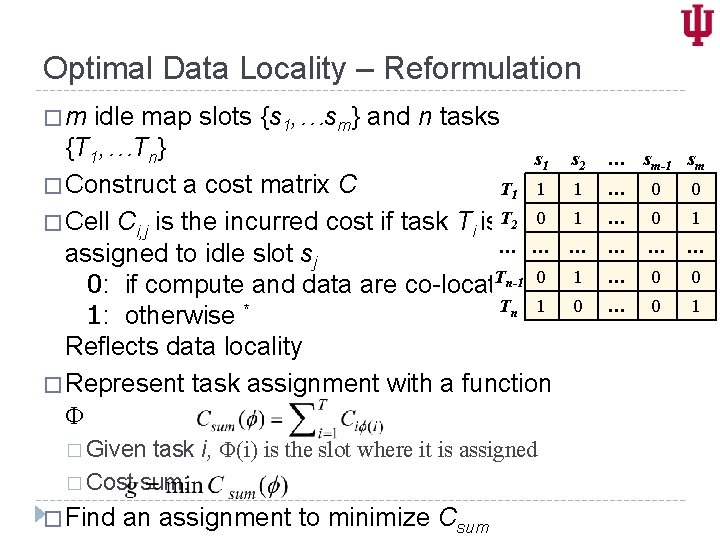
Optimal Data Locality – Reformulation �m idle map slots {s 1, …sm} and n tasks {T 1, …Tn} s 1 � Construct a cost matrix C T 1 1 � Cell Ci, j is the incurred cost if task Ti is. T 2 0 … … assigned to idle slot sj Tn-1 0 0: if compute and data are co-located Tn 1 1: otherwise * Reflects data locality � Represent task assignment with a function Φ � Given task i, Φ(i) is the slot where it is assigned � Cost sum: � Find an assignment to minimize Csum s 2 … sm-1 sm 1 … 0 0 1 … … … … 1 … 0 0 0 … 0 1
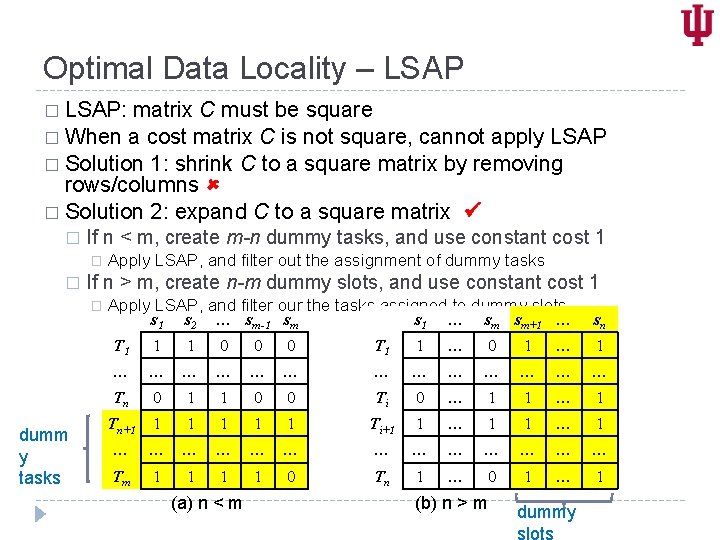
Optimal Data Locality – LSAP � LSAP: matrix C must be square � When a cost matrix C is not square, cannot apply LSAP � Solution 1: shrink C to a square matrix by removing rows/columns û � Solution 2: expand C to a square matrix ü � If n < m, create m-n dummy tasks, and use constant cost 1 � � If n > m, create n-m dummy slots, and use constant cost 1 � dumm y tasks Apply LSAP, and filter out the assignment of dummy tasks Apply LSAP, and filter our the tasks assigned to dummy slots s 1 s 2 … sm-1 sm s 1 … sm sm+1 … 1 T 1 1 0 T 1 1 … 0 1 … … … … Tn 0 1 1 0 0 Ti 0 … 1 1 … 1 Tn+1 1 1 Ti+1 1 … 1 … … … … Tm 1 Tn 1 … 0 1 … 1 1 0 1 (a) n < m 0 sn 1 0 (b) n > m dummy slots
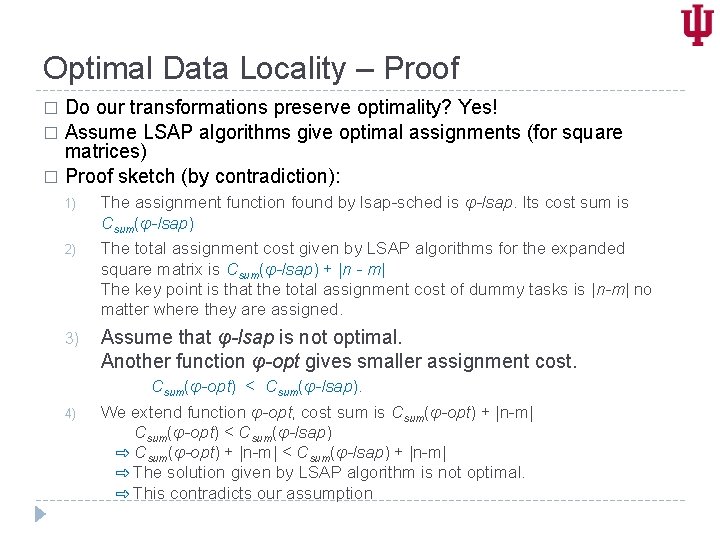
Optimal Data Locality – Proof Do our transformations preserve optimality? Yes! � Assume LSAP algorithms give optimal assignments (for square matrices) � Proof sketch (by contradiction): � 1) 2) 3) The assignment function found by lsap-sched is φ-lsap. Its cost sum is Csum(φ-lsap) The total assignment cost given by LSAP algorithms for the expanded square matrix is Csum(φ-lsap) + |n - m| The key point is that the total assignment cost of dummy tasks is |n-m| no matter where they are assigned. Assume that φ-lsap is not optimal. Another function φ-opt gives smaller assignment cost. Csum(φ-opt) < Csum(φ-lsap). 4) We extend function φ-opt, cost sum is Csum(φ-opt) + |n-m| Csum(φ-opt) < Csum(φ-lsap) ⇨ Csum(φ-opt) + |n-m| < Csum(φ-lsap) + |n-m| ⇨ The solution given by LSAP algorithm is not optimal. ⇨ This contradicts our assumption
Outline � Introduction � Analysis of Data Locality � Optimality of Data Locality � Experiments � Conclusions
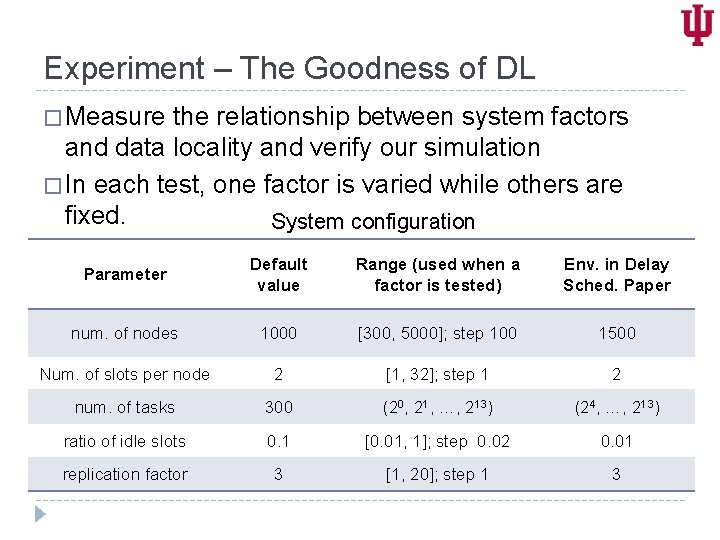
Experiment – The Goodness of DL � Measure the relationship between system factors and data locality and verify our simulation � In each test, one factor is varied while others are fixed. System configuration Parameter Default value Range (used when a factor is tested) Env. in Delay Sched. Paper num. of nodes 1000 [300, 5000]; step 100 1500 Num. of slots per node 2 [1, 32]; step 1 2 num. of tasks 300 (20, 21, …, 213) (24, …, 213) ratio of idle slots 0. 1 [0. 01, 1]; step 0. 02 0. 01 replication factor 3 [1, 20]; step 1 3
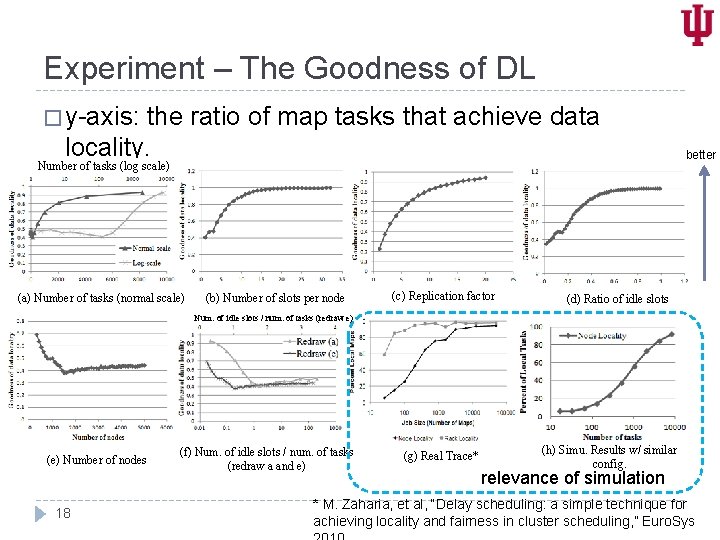
Experiment – The Goodness of DL � y-axis: the ratio of map tasks that achieve data locality. Number of tasks (log scale) (a) Number of tasks (normal scale) (b) Number of slots per node (c) Replication factor better (d) Ratio of idle slots Num. of idle slots / num. of tasks (redraw e) (e) Number of nodes 18 (f) Num. of idle slots / num. of tasks (redraw a and e) (g) Real Trace* (h) Simu. Results w/ similar config. relevance of simulation * M. Zaharia, et al, “Delay scheduling: a simple technique for achieving locality and fairness in cluster scheduling, ” Euro. Sys
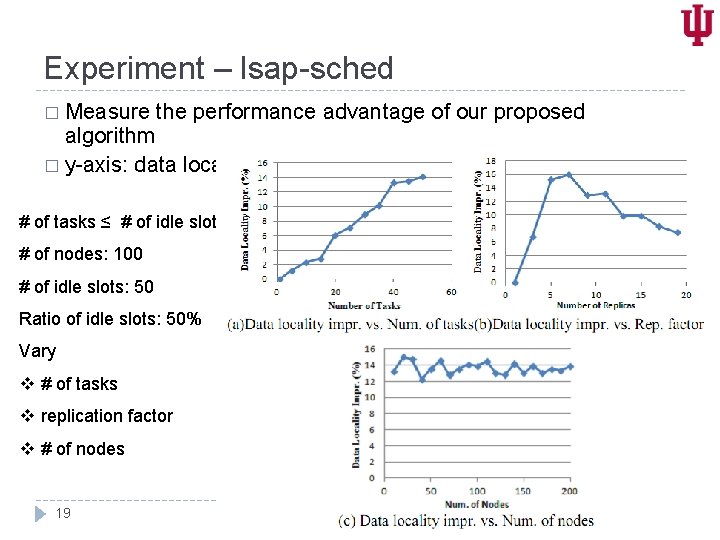
Experiment – lsap-sched � Measure the performance advantage of our proposed algorithm � y-axis: data locality improvement (%) over native Hadoop # of tasks ≤ # of idle slot* # of nodes: 100 # of idle slots: 50 Ratio of idle slots: 50% Vary v # of tasks v replication factor v # of nodes 19
Experiment – Measurement on Future. Grid � � Measure the impact of DL on job exec. Dev. a random scheduler. Parameter randomness � Cross-cluster performance 0: degenerates to default sched. � 1: randomly schedule all tasks � 0. 5: half random, half default sched. Compare efficiency on Future. Grid clusters � � � Single-cluster performance 1 -10 Gbps (a) with high-speed cross-cluster net 1 -10 Mbps (b) with drastically heterogeneous net
Conclusions � Hadoop scheduling favors data locality � Deduced closed-formulas to depict the relationship between system factors and data locality � Hadoop scheduling is not optimal � We propose a new algorithm yielding optimal data locality � Conducted experiments to demonstrate the effectiveness. � More practical evaluation is part of future work
Questions?
Backup slides
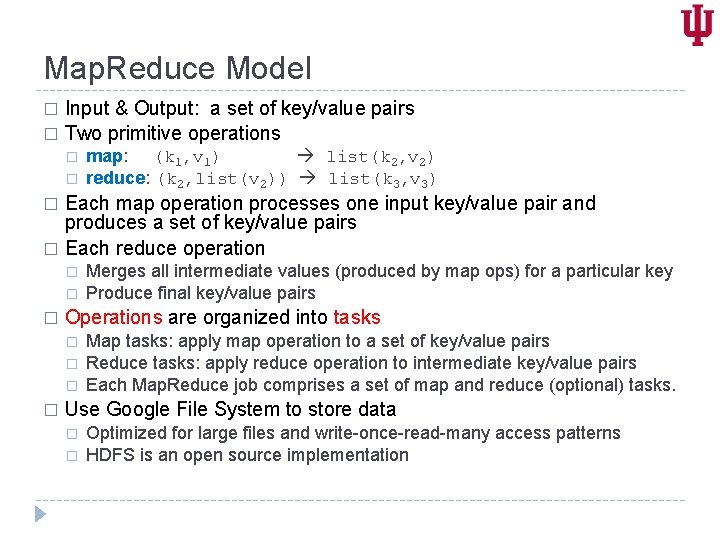
Map. Reduce Model Input & Output: a set of key/value pairs � Two primitive operations � � � map: (k 1, v 1) list(k 2, v 2) reduce: (k 2, list(v 2)) list(k 3, v 3) Each map operation processes one input key/value pair and produces a set of key/value pairs � Each reduce operation � � Operations are organized into tasks � � Merges all intermediate values (produced by map ops) for a particular key Produce final key/value pairs Map tasks: apply map operation to a set of key/value pairs Reduce tasks: apply reduce operation to intermediate key/value pairs Each Map. Reduce job comprises a set of map and reduce (optional) tasks. Use Google File System to store data � � Optimized for large files and write-once-read-many access patterns HDFS is an open source implementation