
Investigating Vertical Alignment and Math Practices 7 8






- Slides: 25
Investigating Vertical Alignment and Math Practices 7 & 8 in Geometry
Objectives • To deepen our understanding of the alignment of geometry concepts and how the CA Math Content Standards provide focus, coherence, and rigor in the Geometry (G) domain. • Strengthen understanding of Standards for Mathematical Practice 7 and 8 by identifying and describing these practices in rich mathematics tasks.
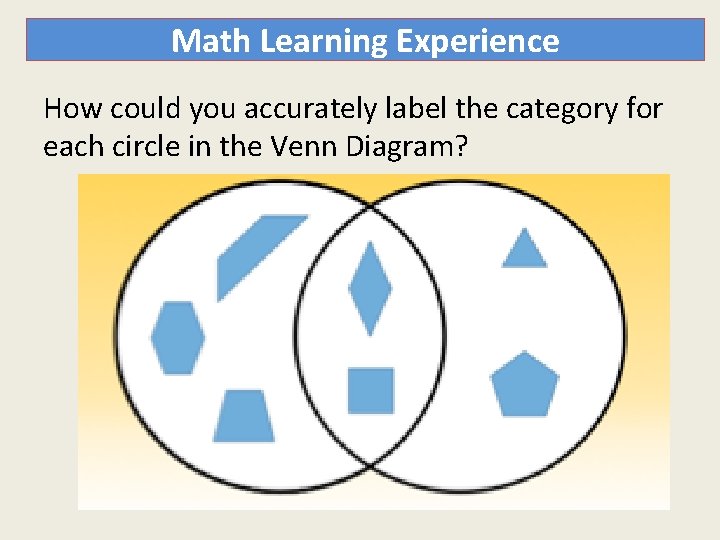
Math Learning Experience How could you accurately label the category for each circle in the Venn Diagram?
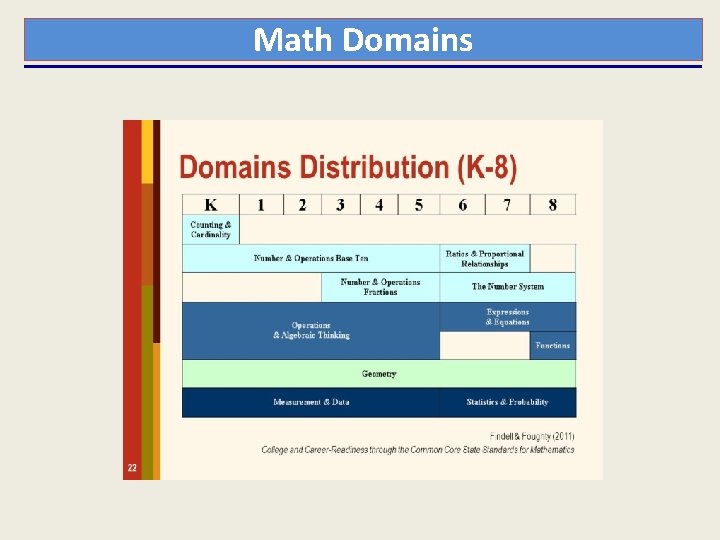
Math Domains
Big Idea: Identify and categorize shapes based on their properties
Big Idea: Identify and categorize shapes based on their properties
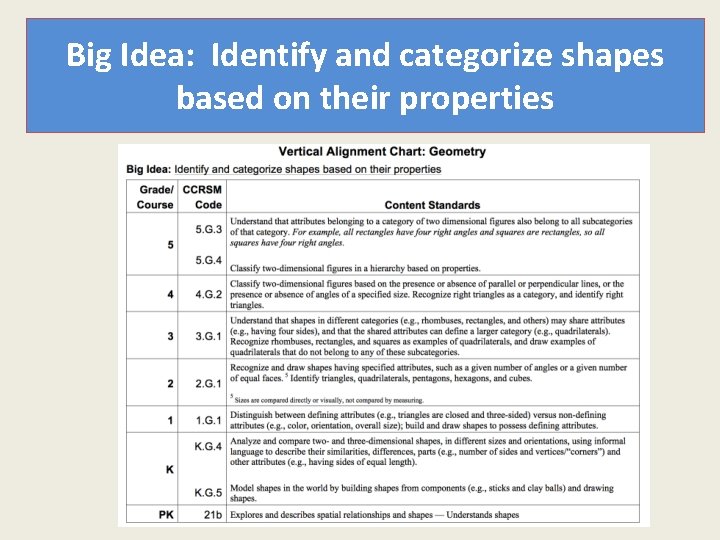
Big Idea: Identify and categorize shapes based on their properties
Investigating Vertical Alignment As a group, analyze the trajectory, considering the following questions: • What changes occur from grade to grade? • Where are concepts introduced, developed, and finalized? • Does an idea or skill get more complex, and if so, how? 8
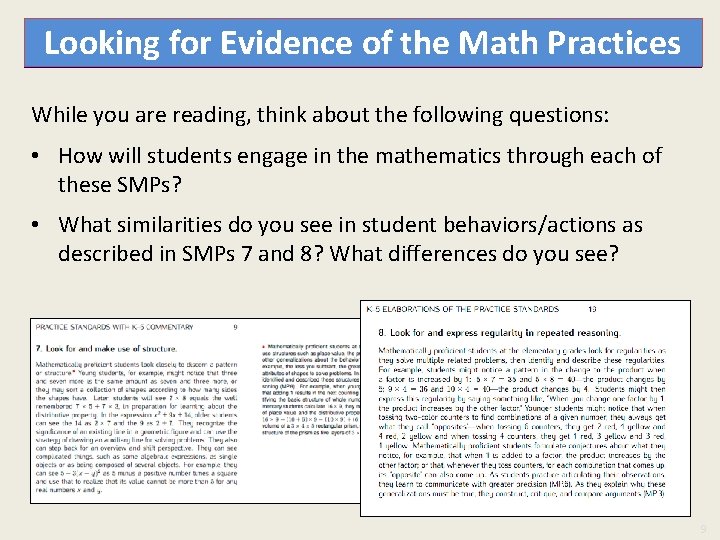
Looking for Evidence of the Math Practices While you are reading, think about the following questions: • How will students engage in the mathematics through each of these SMPs? • What similarities do you see in student behaviors/actions as described in SMPs 7 and 8? What differences do you see? 9
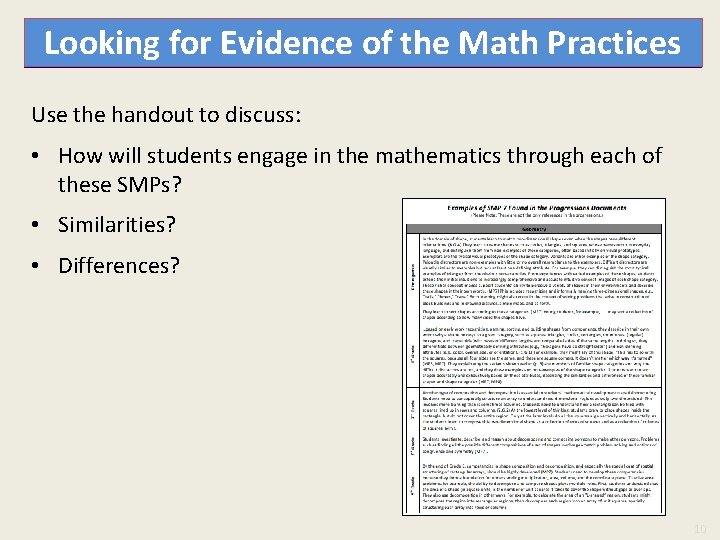
Looking for Evidence of the Math Practices Use the handout to discuss: • How will students engage in the mathematics through each of these SMPs? • Similarities? • Differences? 10
Looking for Evidence of the Math Practices Use this handout to: • Check off actions during task • Record observations during task 11
Math Learning Experience: Tangrams A tangram is an ancient geometric puzzle with 7 shapes: • 2 large triangles • 1 medium triangle • 2 small triangles • 1 square • 1 parallelogram 12
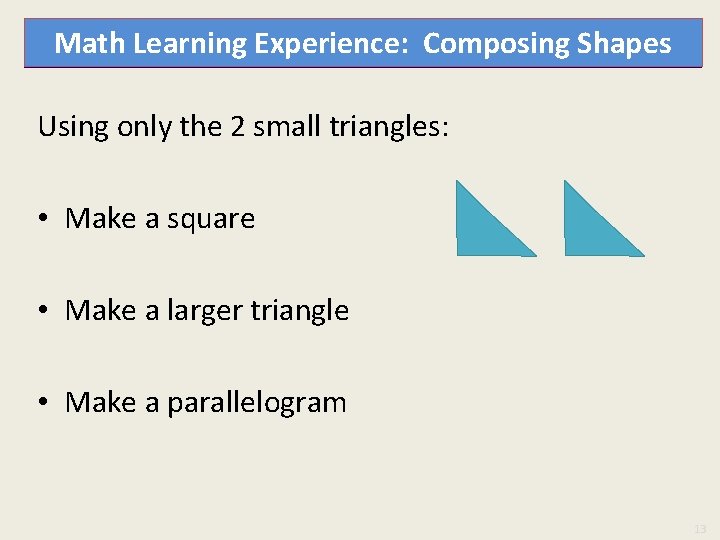
Math Learning Experience: Composing Shapes Using only the 2 small triangles: • Make a square • Make a larger triangle • Make a parallelogram 13
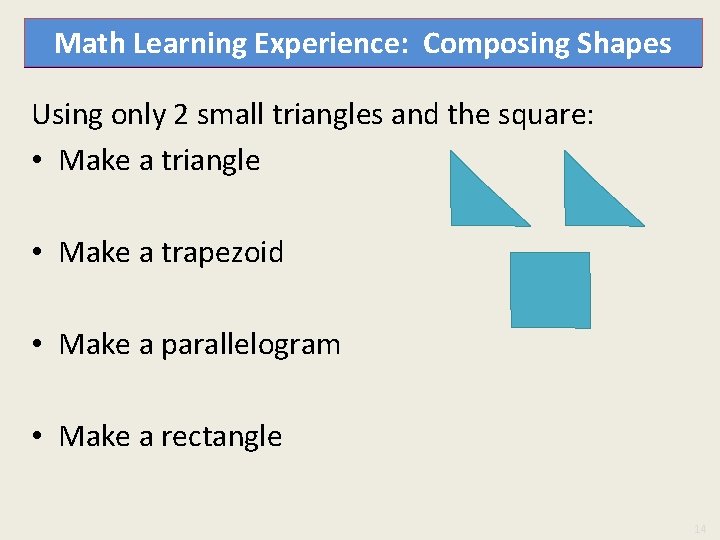
Math Learning Experience: Composing Shapes Using only 2 small triangles and the square: • Make a triangle • Make a trapezoid • Make a parallelogram • Make a rectangle 14
Math Learning Experience: Composing Shapes Using only 2 small triangles and the medium triangle: • Make a triangle • Make a trapezoid • Make a parallelogram • Make a rectangle 15
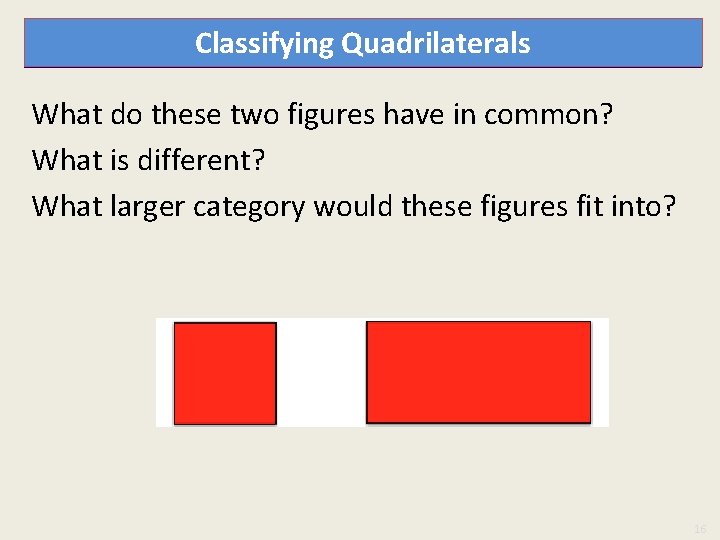
Classifying Quadrilaterals What do these two figures have in common? What is different? What larger category would these figures fit into? 16
Classifying Quadrilaterals What do these two figures have in common? What is different? What larger category would these figures fit into? 17
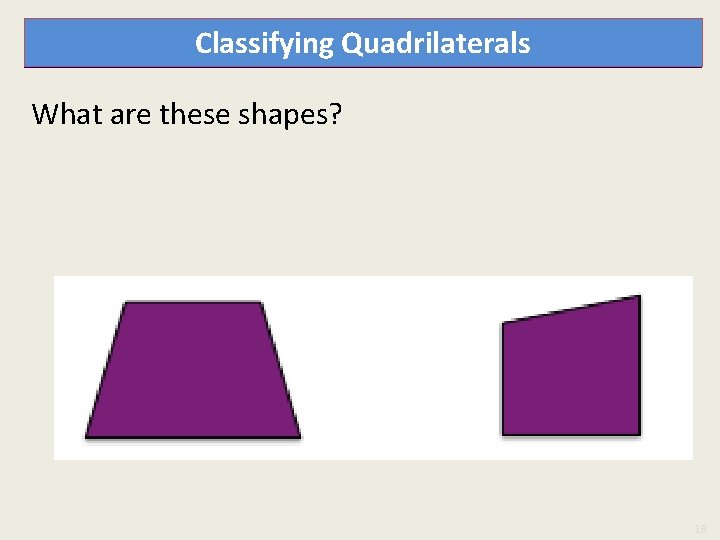
Classifying Quadrilaterals What are these shapes? 18
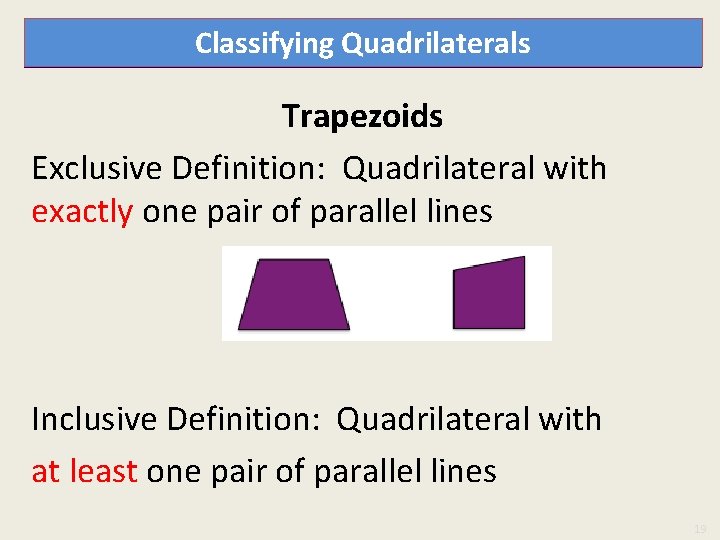
Classifying Quadrilaterals Trapezoids Exclusive Definition: Quadrilateral with exactly one pair of parallel lines Inclusive Definition: Quadrilateral with at least one pair of parallel lines 19
Classifying Quadrilaterals On chart paper, build a hierarchy of quadrilaterals that includes the following terms: • Square • Rectangle • Parallelogram • Rhombus • Trapezoid • Quadrilateral Document the properties that you used to create the hierarchy, and draw an example of each shape. 20
CA Math Framework Here is the hierarchy included in the Grade 5 California Math Framework, Grade 5, page 266: 21
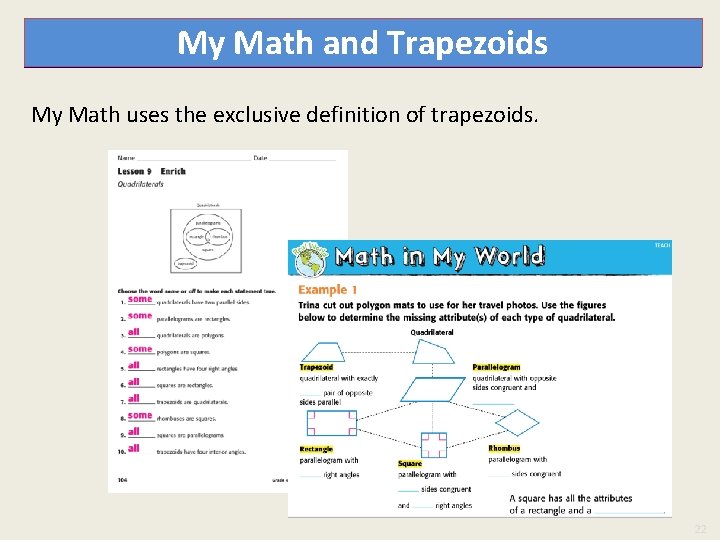
My Math and Trapezoids My Math uses the exclusive definition of trapezoids. 22
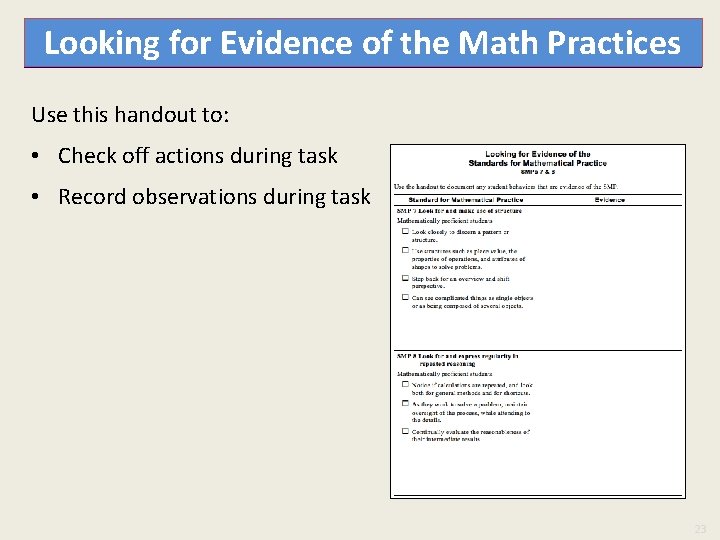
Looking for Evidence of the Math Practices Use this handout to: • Check off actions during task • Record observations during task 23
Teaching and Learning Framework • Standard 1 a 1: Knowledge of Content and the Structure of the Discipline • Standard 3 a 4: Use of Academic Language 24
Reflection 1. How does studying standards across grade levels influence what I do in my classroom? 2. How does studying the standards in this way support my understanding of the key shifts of coherence, focus, and rigor? 25