
Investigating Thermal Lag in Slocum Glider CTD Data
- Slides: 1
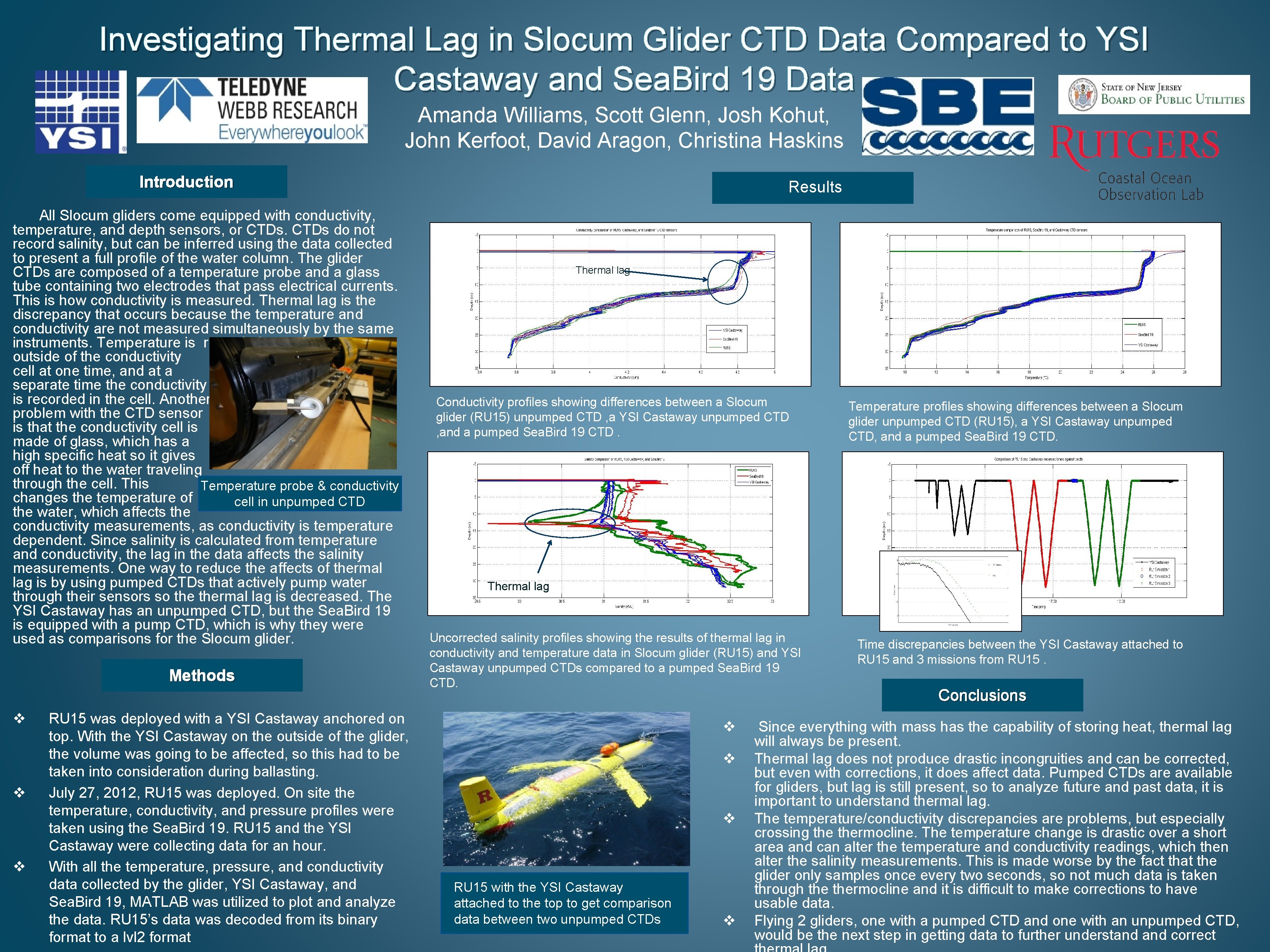
Investigating Thermal Lag in Slocum Glider CTD Data Compared to YSI Castaway and Sea. Bird 19 Data Amanda Williams, Scott Glenn, Josh Kohut, John Kerfoot, David Aragon, Christina Haskins Introduction All Slocum gliders come equipped with conductivity, temperature, and depth sensors, or CTDs do not record salinity, but can be inferred using the data collected to present a full profile of the water column. The glider CTDs are composed of a temperature probe and a glass tube containing two electrodes that pass electrical currents. This is how conductivity is measured. Thermal lag is the discrepancy that occurs because the temperature and conductivity are not measured simultaneously by the same instruments. Temperature is recorded outside of the conductivity cell at one time, and at a separate time the conductivity is recorded in the cell. Another problem with the CTD sensor is that the conductivity cell is made of glass, which has a high specific heat so it gives off heat to the water traveling through the cell. This Temperature probe & conductivity changes the temperature of cell in unpumped CTD the water, which affects the conductivity measurements, as conductivity is temperature dependent. Since salinity is calculated from temperature and conductivity, the lag in the data affects the salinity measurements. One way to reduce the affects of thermal lag is by using pumped CTDs that actively pump water through their sensors so thermal lag is decreased. The YSI Castaway has an unpumped CTD, but the Sea. Bird 19 is equipped with a pump CTD, which is why they were used as comparisons for the Slocum glider. Methods v v v RU 15 was deployed with a YSI Castaway anchored on top. With the YSI Castaway on the outside of the glider, the volume was going to be affected, so this had to be taken into consideration during ballasting. July 27, 2012, RU 15 was deployed. On site the temperature, conductivity, and pressure profiles were taken using the Sea. Bird 19. RU 15 and the YSI Castaway were collecting data for an hour. With all the temperature, pressure, and conductivity data collected by the glider, YSI Castaway, and Sea. Bird 19, MATLAB was utilized to plot and analyze the data. RU 15’s data was decoded from its binary format to a lvl 2 format Results Thermal lag Conductivity profiles showing differences between a Slocum glider (RU 15) unpumped CTD , a YSI Castaway unpumped CTD , and a pumped Sea. Bird 19 CTD. Temperature profiles showing differences between a Slocum glider unpumped CTD (RU 15), a YSI Castaway unpumped CTD, and a pumped Sea. Bird 19 CTD. Thermal lag Uncorrected salinity profiles showing the results of thermal lag in conductivity and temperature data in Slocum glider (RU 15) and YSI Castaway unpumped CTDs compared to a pumped Sea. Bird 19 CTD. v v v RU 15 with the YSI Castaway attached to the top to get comparison data between two unpumped CTDs v Time discrepancies between the YSI Castaway attached to RU 15 and 3 missions from RU 15. Conclusions Since everything with mass has the capability of storing heat, thermal lag will always be present. Thermal lag does not produce drastic incongruities and can be corrected, but even with corrections, it does affect data. Pumped CTDs are available for gliders, but lag is still present, so to analyze future and past data, it is important to understand thermal lag. The temperature/conductivity discrepancies are problems, but especially crossing thermocline. The temperature change is drastic over a short area and can alter the temperature and conductivity readings, which then alter the salinity measurements. This is made worse by the fact that the glider only samples once every two seconds, so not much data is taken through thermocline and it is difficult to make corrections to have usable data. Flying 2 gliders, one with a pumped CTD and one with an unpumped CTD, would be the next step in getting data to further understand correct