
Investigating the shortterm familiarity backfire effect in the
Investigating the short-term familiarity backfire effect in the context of vaccination Emily Kothe & Mathew Ling Misinformation Lab, School of Psychology, Deakin University @emilyandthelime @lingtax
Vaccination • Vaccination is one of the most important public health advances of the last century. • However, in all Australian states, on-time vaccination in children are below the 95% coverage target. • Worryingly, some previous studies have suggested that messages designed to increase willingness to vaccinate actually entrench hesitancy.
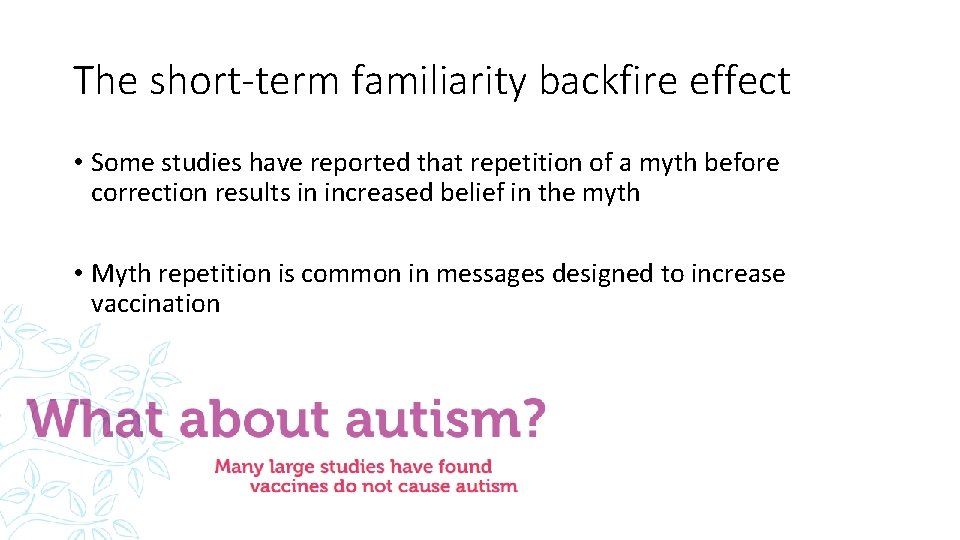
The short-term familiarity backfire effect • Some studies have reported that repetition of a myth before correction results in increased belief in the myth • Myth repetition is common in messages designed to increase vaccination
Hypotheses • The study was pre-registered on the Open Science Framework (OSF) prior to the commencement of data collection (https: //osf. io/32 khq) • H 1: Trust in Science and intervention (vs. control) will have independent negative effects on vaccine hesitancy, increasing willingness to vaccinate. • H 2: Trust in Science will moderate the effect of interventions to reduce vaccine hesitancy, such that those lower in Trust in Science will be less affected by interventions. • H 3: The two intervention frames will be equivalent (+/- d=. 3) in efficacy for increasing vaccination willingness.
Design • Participants completed demographics and a baseline individual difference measure of trust in science, before being randomly allocated to one of three conditions (a non-issue-relevant control and two subtly different informational interventions). The post-intervention questionnaire assessed beliefs, attitudes, and behavioural willingness relevant to vaccination. • Participants (n=270) were recruited through Prolific. Academic. For inclusion, participants needed to • Identify their age as between 18 – 35 years • Answer “No” to the item “Do you have any children? ”, and • Provide a response of >1 and <7 to the item “Please rate on a scale from 1 -7 where 1 is TOTALLY DISAGREEE and 7 is TOTALLY AGREE. I believe that scheduled immunizations are safe for children”.
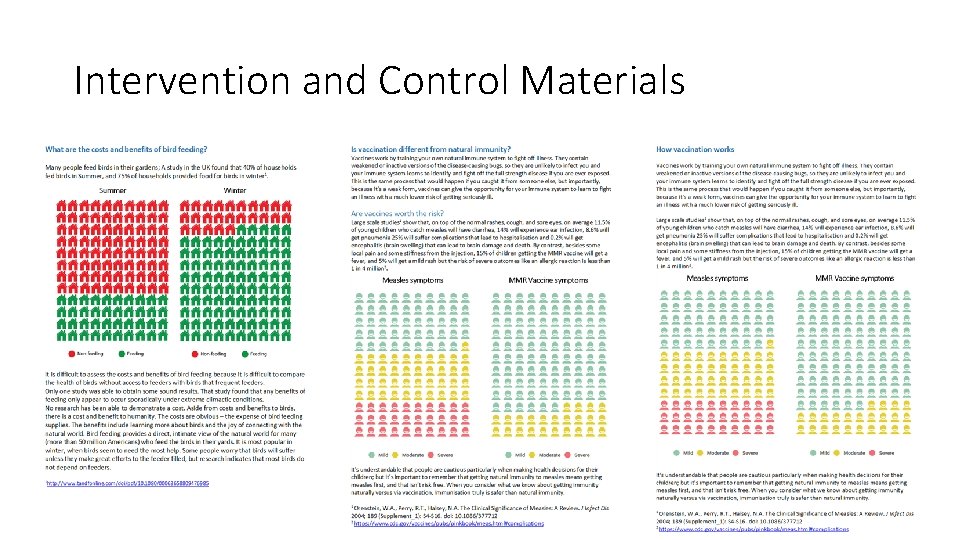
Intervention and Control Materials
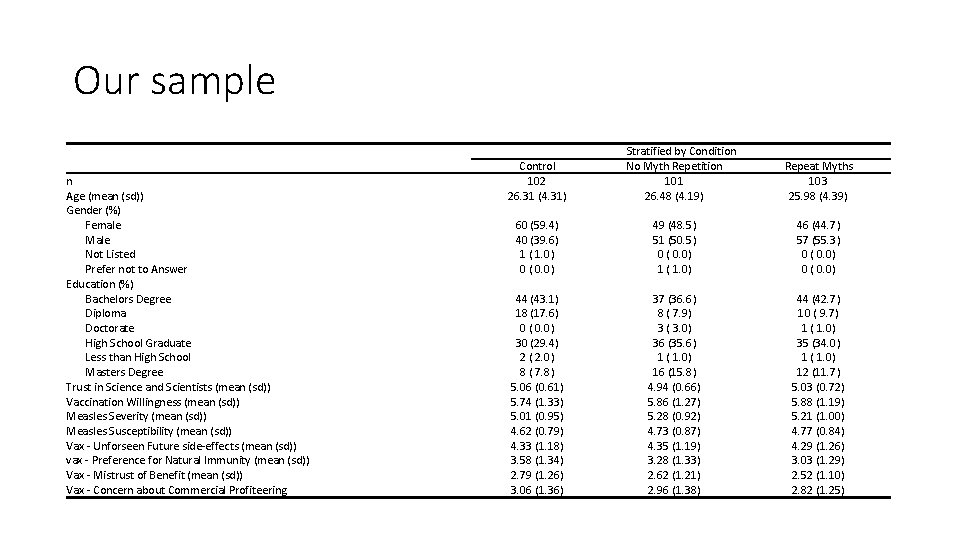
Our sample n Age (mean (sd)) Gender (%) Female Male Not Listed Prefer not to Answer Education (%) Bachelors Degree Diploma Doctorate High School Graduate Less than High School Masters Degree Trust in Science and Scientists (mean (sd)) Vaccination Willingness (mean (sd)) Measles Severity (mean (sd)) Measles Susceptibility (mean (sd)) Vax - Unforseen Future side-effects (mean (sd)) vax - Preference for Natural Immunity (mean (sd)) Vax - Mistrust of Benefit (mean (sd)) Vax - Concern about Commercial Profiteering Control 102 26. 31 (4. 31) Stratified by Condition No Myth Repetition 101 26. 48 (4. 19) Repeat Myths 103 25. 98 (4. 39) 60 (59. 4) 40 (39. 6) 1 ( 1. 0) 0 ( 0. 0) 49 (48. 5) 51 (50. 5) 0 ( 0. 0) 1 ( 1. 0) 46 (44. 7) 57 (55. 3) 0 ( 0. 0) 44 (43. 1) 18 (17. 6) 0 ( 0. 0) 30 (29. 4) 2 ( 2. 0) 8 ( 7. 8) 5. 06 (0. 61) 5. 74 (1. 33) 5. 01 (0. 95) 4. 62 (0. 79) 4. 33 (1. 18) 3. 58 (1. 34) 2. 79 (1. 26) 3. 06 (1. 36) 37 (36. 6) 8 ( 7. 9) 3 ( 3. 0) 36 (35. 6) 1 ( 1. 0) 16 (15. 8) 4. 94 (0. 66) 5. 86 (1. 27) 5. 28 (0. 92) 4. 73 (0. 87) 4. 35 (1. 19) 3. 28 (1. 33) 2. 62 (1. 21) 2. 96 (1. 38) 44 (42. 7) 10 ( 9. 7) 1 ( 1. 0) 35 (34. 0) 1 ( 1. 0) 12 (11. 7) 5. 03 (0. 72) 5. 88 (1. 19) 5. 21 (1. 00) 4. 77 (0. 84) 4. 29 (1. 26) 3. 03 (1. 29) 2. 52 (1. 10) 2. 82 (1. 25)
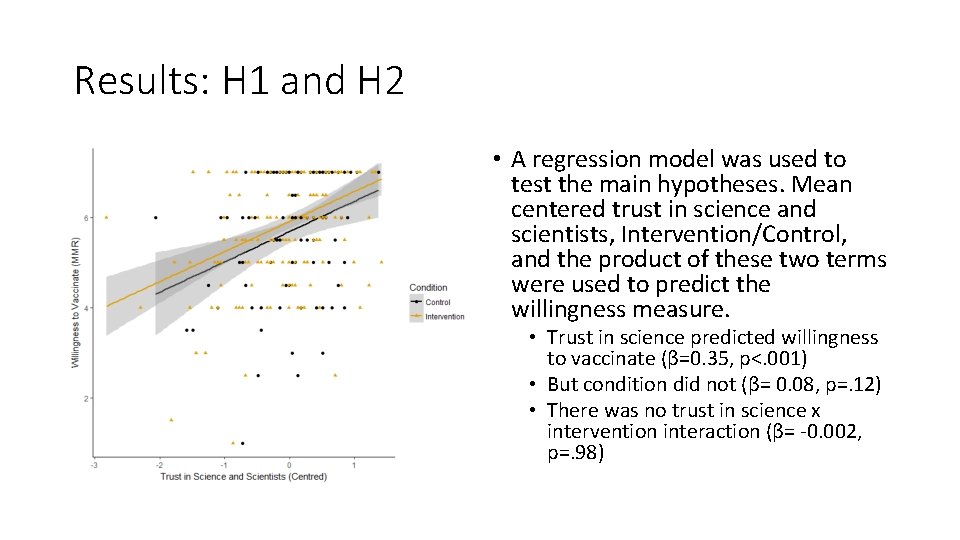
Results: H 1 and H 2 • A regression model was used to test the main hypotheses. Mean centered trust in science and scientists, Intervention/Control, and the product of these two terms were used to predict the willingness measure. • Trust in science predicted willingness to vaccinate (β=0. 35, p<. 001) • But condition did not (β= 0. 08, p=. 12) • There was no trust in science x intervention interaction (β= -0. 002, p=. 98)
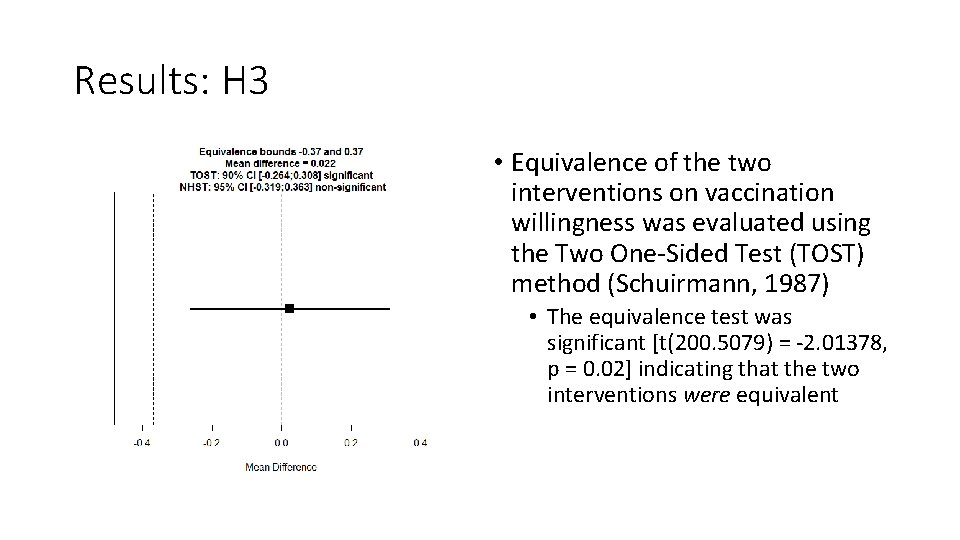
Results: H 3 • Equivalence of the two interventions on vaccination willingness was evaluated using the Two One-Sided Test (TOST) method (Schuirmann, 1987) • The equivalence test was significant [t(200. 5079) = -2. 01378, p = 0. 02] indicating that the two interventions were equivalent
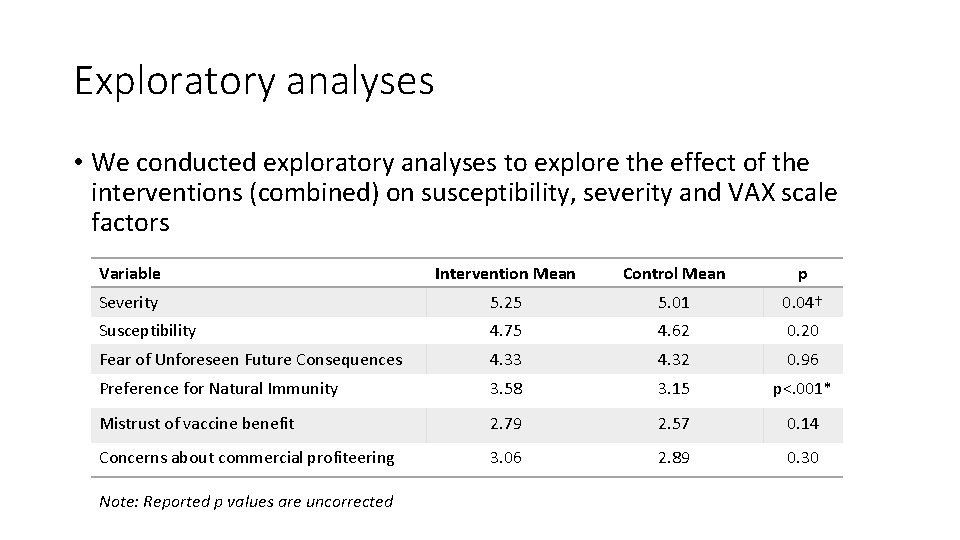
Exploratory analyses • We conducted exploratory analyses to explore the effect of the interventions (combined) on susceptibility, severity and VAX scale factors Variable Intervention Mean Control Mean p Severity 5. 25 5. 01 0. 04† Susceptibility 4. 75 4. 62 0. 20 Fear of Unforeseen Future Consequences 4. 33 4. 32 0. 96 Preference for Natural Immunity 3. 58 3. 15 p<. 001* Mistrust of vaccine benefit 2. 79 2. 57 0. 14 Concerns about commercial profiteering 3. 06 2. 89 0. 30 Note: Reported p values are uncorrected
Discussion • Short-term familiarity backfire effects were not observed in this study. • However, the messages were also not effective in influencing individuals’ beliefs about vaccination. • The trust in science → vaccination willingness relationship is consistent with other studies. Unclear whether this will act as a limiting factor for more effective science based messages • More understanding the factors that underlie willingness to vaccinate is required in order to aid in the development of more effective persuasive messages.
Investigating the short-term familiarity backfire effect in the context of vaccination Emily Kothe & Mathew Ling Misinformation Lab, School of Psychology, Deakin University @emilyandthelime @lingtax
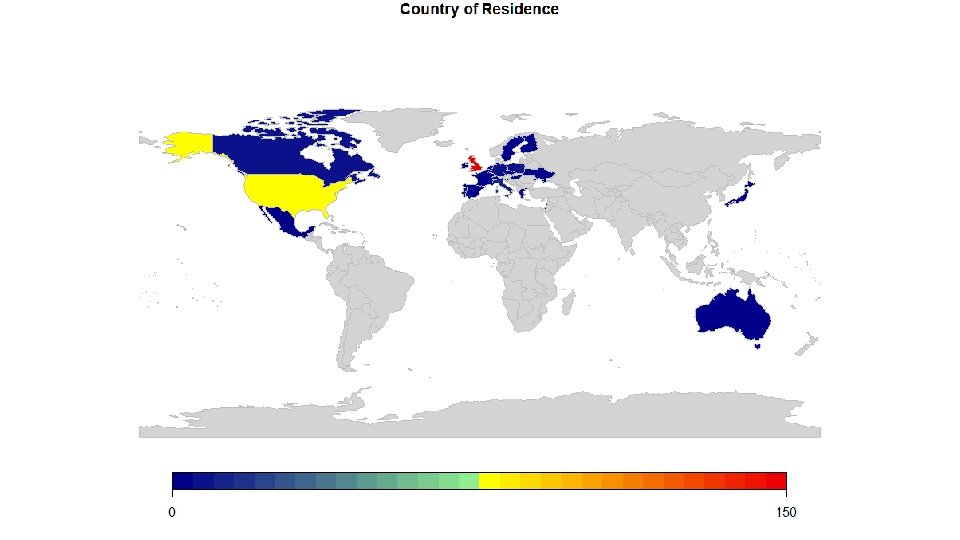
Measures • In addition to age, educational attainment, country of residence, and gender, the following measures were taken: • Pre-intervention • Trust in Science and Scientists Scale (Nadelson et al. , 2014) • Post Intervention • • Vaccine Attitudes e. Xamination (VAX; Martin & Petrie, 2017) Novel measure of Perceived Severity of measles Novel measure of Perceived Susceptibility to measles Novel measure of Willingness to vaccinate (future) child
- Slides: 14