
INVESTIGATING THE POWER SECTOR BY THEOPHILUS ABBAH What
INVESTIGATING THE POWER SECTOR BY THEOPHILUS ABBAH
What is Investigative Reporting? O Investigative Reporting is newspaper or broadcast journalism with focus on longterm efforts to uncover corruption or misconduct, especially by public institutions and government.
Investigative Reporting O Investigative reporters uncover facts and write articles that expose waste, wrongdoing, mismanagement, fraud, conflict of interest and abuse of authority. The stories promote change and reform.
Investigative Reporting O Uncovering something somebody wants to keep secret. O Investigative journalists are prepared to look beyond what is conventionally acceptable, behind the interpretations of events provided for us by authority and the authoritative
Public Interest O It’s a crucial duty of journalists to serve public interest by acting as a watchdog on government, business, education, health, environment, safety and other institutions.
Public Interest O The public expects journalists to expose rot and corruption. Government, business organizations, lawmakers, traditional institutions are waiting for journalists to expose corruption. Publicity is the antidote to corruption
Story Ideas? O Your own experience O Experience of friends and family O Roadside radio – gossips and anecdotes of O O street traders, taxi drivers and passengers Whistleblowers; complainants Local newspaper reports Follow-up stories Reading and surfing the web: what similar stories to the ones who have read can you do?
Story Ideas? O Checking public information: When there is a press release about events, persons, policies, is it possible to dig deeper into the background of the people/issues? O A tip off – ‘leak journalism’ O Government documents: budgets, gazettes, annual reports, investigative panel reports, , etc
It’s scientific An investigative story must be scientific. How? There is the story idea (from documents, radio, beer parlour, parliamentary debate, etc. ) You form your hypothesis of what you need to find out and how You study what others have written about the story you’re working on (like Literature Review) Talk to Experts Go There: Enter the field to find out things for yourself. What did you uncover? What is new? What is the evidence of what you claimed to have discovered?
What is Solutions Journalism? O Solutions Journalism Network (SJN), defines it as: “rigorous, compelling coverage of responses to social problems — reporting done with the highest of journalistic standards”
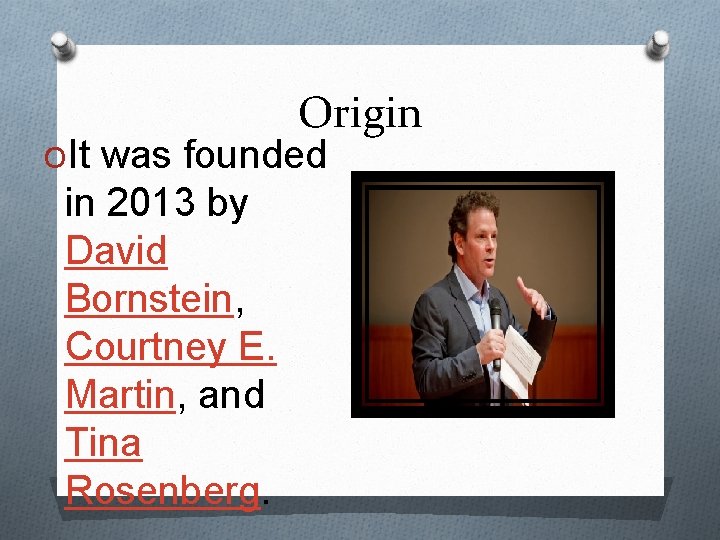
Origin OIt was founded in 2013 by David Bornstein, Courtney E. Martin, and Tina Rosenberg.
Solutions Journalism O It’s central focus is solving social problems, using models and insight from experts. Checklist q Does the story explain the causes of a social problem? q Does the story present an associated response to that problem? q Does the story get into the problem solving and how-to details of implementation?
Solutions Journalism q Is the problem-solving process central to the narrative q Does the story present evidence of results linked to the response? q Does the story explain the limitations of the response? q Does the story convey an insight or teachable lesson? q Does the story avoid reading like a puff piece? : Solutions journalism is expressly not about advocating for particular models, organizations, and ideas. Journalists pursuing solutions stories are bringing their discernment to explore ideas and methods, not to advance an agenda or make people feel good.
Solutions Journalism q Does the story draw on sources who have a ground-level understanding, not just 30, 000 -foot expertise? q Does the story give greater attention to the response than to a leader/innovator/dogooder? q It’s not a complaint; hero worship; favour for a friend; think tank; a afterthought attempt to write an answer which was not an element of the story
7 Steps to Writing a Solutionsbased story
1. Identify a social problem 1. Identifying social problems that require solutions. E. g How to solve latecoming to schools
2. How does it affect the people? Anecdotes, interviews, observations, and other ways of proving that it is a social problem
3. Gather relevant data Look for data to support the level of seriousness of problems. Government, CSOs, academia, etc. Analytical reporting of the effects of the social problem on the people. Is it leading to closure of businesses? Is it cause health crisis? Is it creating conflicts in families?
4. Identify efforts already made to solve the problem Identify efforts made by various actors to solve the problem: those involved in dealing with it. Find out how they have failed in solving the problem. You don’t just criticize, but acknowledge efforts.
5. Who has ever solved a similar problem? Who has solved the problem? Find out how. Most times there are peoples who have solved the problem in the country or outside the country. To what extent did they do it, and under what climate?
6. Talk to Experts Talk to experts in the sector to find out other approaches to solving the problem
7. State the way forward O A solutions story is emphatic about what next steps must be taken by who and how, in order to get rid of the social problem. You don’t just present the diverse views and leave a jigsaw to the reader to solve.
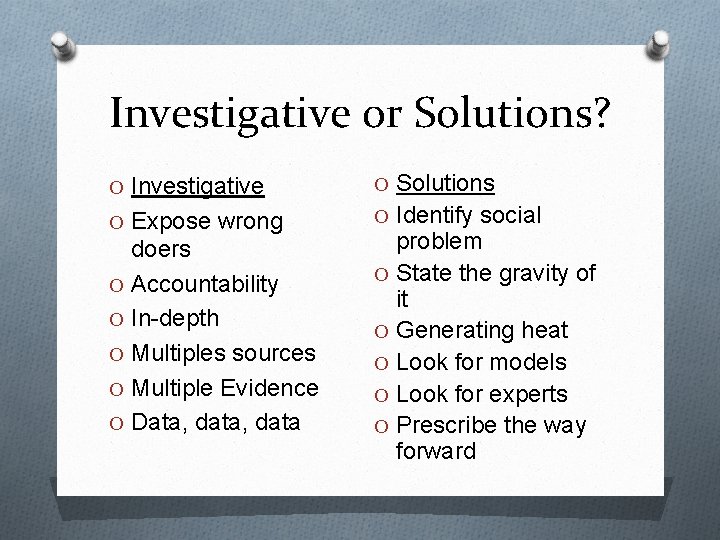
Investigative or Solutions? O Investigative O Solutions O Expose wrong O Identify social doers O Accountability O In-depth O Multiples sources O Multiple Evidence O Data, data problem O State the gravity of it O Generating heat O Look for models O Look for experts O Prescribe the way forward
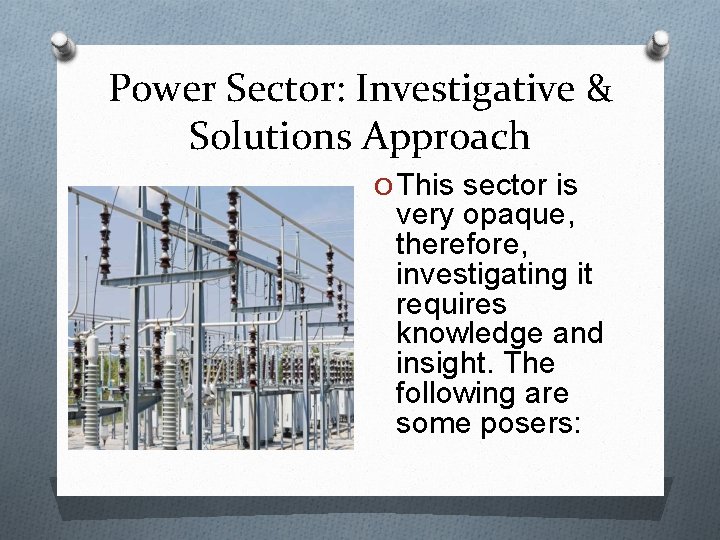
Power Sector: Investigative & Solutions Approach O This sector is very opaque, therefore, investigating it requires knowledge and insight. The following are some posers:
Power Sector O How much has government pumped into it? O Metering: Why is it difficult? How could be done better? O Are Nigerians getting value for the tariff they pay? How can they? O Rural Electrification Project: Is it working? O Who is destroying gas pipelines? Are they being punished? How can the pipelines be better protected? O Who are behind ‘estimated electricity bills, ’ and how can victims seek redress? O In what state are the hydroelectric power stations: Kainji, Jebba, Shiroro, Zamfara, etc
Power Sector O Does NERC have the capacity to monitor Discos and Gencos? O Are the completed ‘electricity-related constituency projects’ working? O How reliable are the solutions to power problems: solar especially? O How are power outages affecting specific sectors? : data story O Why have we abandoned coal? How could they be revived? O How can government ensure that water sources to our hydroelectric power stations don’t dry up?
- Slides: 26