
Investigating the effects of online and flipped classroom
- Slides: 12
Investigating the effects of online and flipped classroom approach during COVID-19 pandemic Natasa Koceska*, Saso Koceski*, Bore Pucovski**, Vera K. Mitkovska ** and Aleksandar Lazovski*** * Faculty of Computer Science, University Goce Delcev-Stip, R. North Macedonia ** UNICEF Country Office, Skopje, R. North Macedonia *** Smart. Up - Social Innovation Lab, Skopje, R. North Macedonia
INTRODUCTION • The COVID-19 pandemic has created the largest disruption of education systems in history, affecting nearly 1. 6 billion learners in more than 190 countries on all continents. All educational institutions in Republic of North Macedonia were also closed on March 10, 2020. • To ensure learning continuity during this disruption to the traditional (face-toface) teaching, most schools and universities were constrained to adopt the online teaching and learning models in a relatively short period of time. • This need for rapid shift to online learning revealed many problems in the education systems all over the globe but, it also revealed a deep gap in our overall approach to education. • COVID-19 pandemic has stimulated innovation within the education sector: from radio and television to take-home packages.
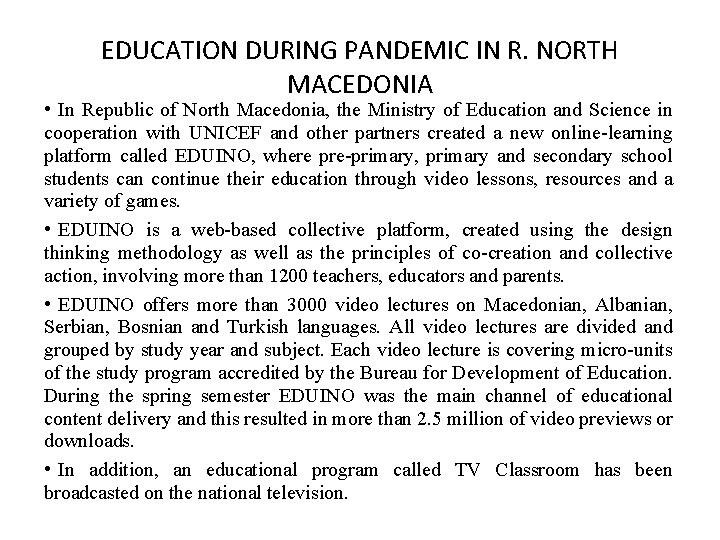
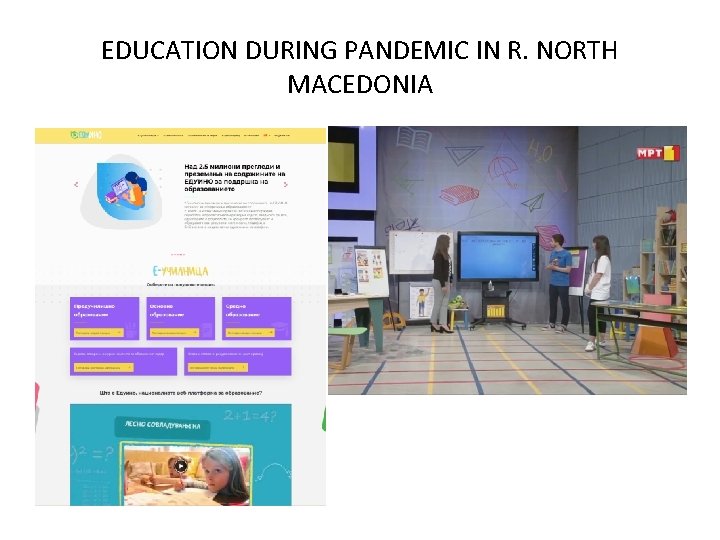
EDUCATION DURING PANDEMIC IN R. NORTH MACEDONIA • In Republic of North Macedonia, the Ministry of Education and Science in cooperation with UNICEF and other partners created a new online-learning platform called EDUINO, where pre-primary, primary and secondary school students can continue their education through video lessons, resources and a variety of games. • EDUINO is a web-based collective platform, created using the design thinking methodology as well as the principles of co-creation and collective action, involving more than 1200 teachers, educators and parents. • EDUINO offers more than 3000 video lectures on Macedonian, Albanian, Serbian, Bosnian and Turkish languages. All video lectures are divided and grouped by study year and subject. Each video lecture is covering micro-units of the study program accredited by the Bureau for Development of Education. During the spring semester EDUINO was the main channel of educational content delivery and this resulted in more than 2. 5 million of video previews or downloads. • In addition, an educational program called TV Classroom has been broadcasted on the national television.
EDUCATION DURING PANDEMIC IN R. NORTH MACEDONIA
RESEARCH OBJETIVES • This research work investigates the effects of online and flipped classroom approach under COVID-19 pandemic. • The retrospective survey was used to determine students’ motivation, attitudes, engagement, interaction/collaboration and satisfaction of two groups of students. • One group was taught by synchronous online model, while the other attended flipped classroom. • The research questions that we’ll try to answer here are: – RQ 1: What are students’ perceptions about online teaching/learning during Covid-19? – RQ 2: What are students’ perceptions about flipped classroom approach during Covid-19? – RQ 3: Are there any differences between the two groups of students regarding their motivation, attitudes, engagement, interaction/collaboration and satisfaction?
ONLINE AND FLIPPED CLASSROOM MODELS • Online education is electronically supported learning that relies on the Internet for teacher-student and student-student interaction, as well as the distribution of class materials. • Its primarily aim is to foster students to be independent at certain times and take responsibility for their learning. • Flipped classroom is an alternative pedagogical approach focusing on studentcentered instruction that reverses the traditional classroom environment. • In the flipped classroom model, the delivery of content is usually obtained through online videos prepared by the teacher or a third party. • Students’ watch the assigned short instructional videos at their own time and pace prior to attending classes in which they participate in group activities or the teachers answer their questions
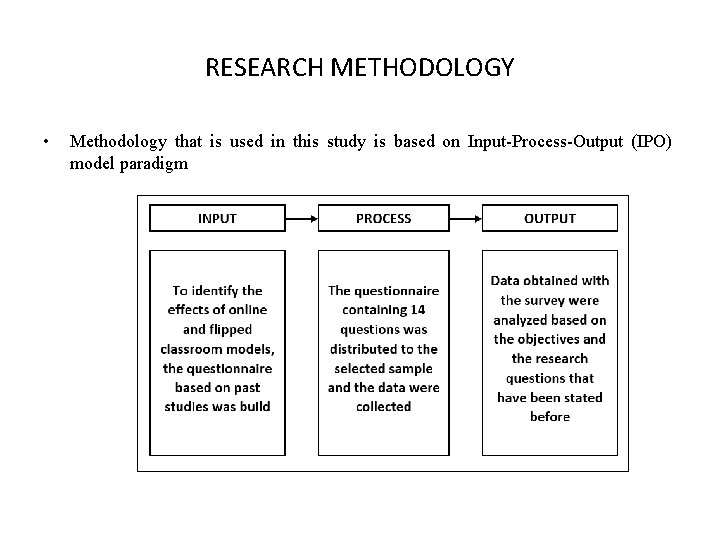
RESEARCH METHODOLOGY • Methodology that is used in this study is based on Input-Process-Output (IPO) model paradigm
PARTICIPANTS AND STUDY • Students from three elementary schools located in three different regions in Republic of North Macedonia (East, South-west and North), form 7 th grade, were included in the study in the period from 1 st of April till 1 st of June • The total number of participants was 167 students of which 89 were female (53%) and 78 were male (47%). • Two classes from each school were involved. • One class was taught by synchronous online model, while the other attended flipped classroom. • All students attended the “Math” course.
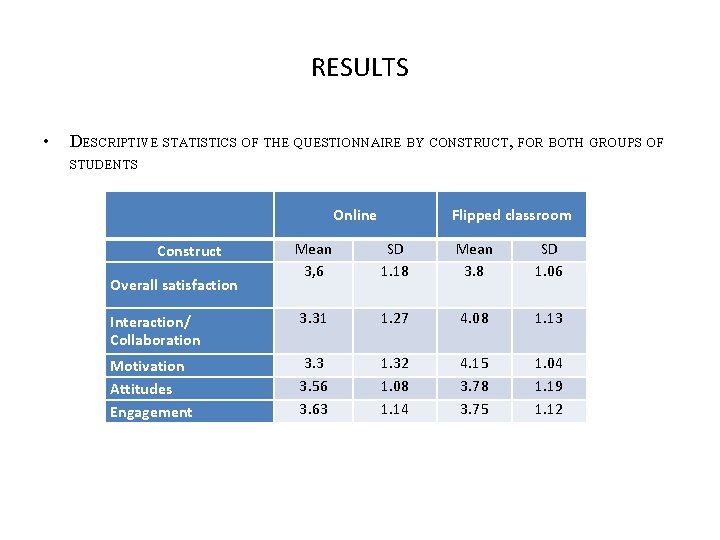
RESULTS • DESCRIPTIVE STATISTICS OF THE QUESTIONNAIRE BY CONSTRUCT, FOR BOTH GROUPS OF STUDENTS Online Flipped classroom Mean 3, 6 SD 1. 18 Mean 3. 8 SD 1. 06 Interaction/ Collaboration 3. 31 1. 27 4. 08 1. 13 Motivation Attitudes Engagement 3. 3 3. 56 3. 63 1. 32 1. 08 1. 14 4. 15 3. 78 3. 75 1. 04 1. 19 1. 12 Construct Overall satisfaction
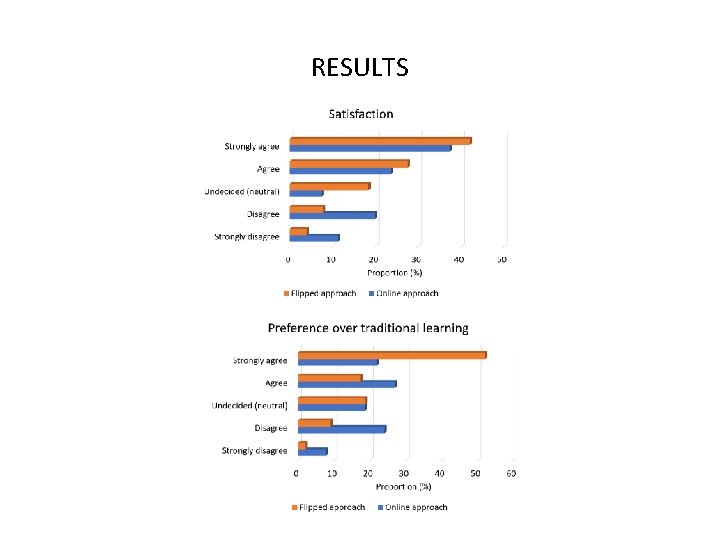
RESULTS
CONCLUSION • This study aimed to examine the effects of online and flipped classroom approach on elementary school students, using the questionnaire. Analyzing the responses, it was concluded that both methods have positive impact on students’ motivation, attitude, engagement, interaction/collaboration and general satisfaction. • However, when it comes to students’ motivation and interaction/collaboration, as well as their general satisfaction, the flipped classroom was preferred by most of the students. • As a general conclusion, we can say that the aforementioned teaching methods can facilitate the delivery of theoretical knowledge not only during emergencies (such as Covid-19 pandemic), but also during normal educational process. Therefore, we can strongly recommend the teachers to continue with these teaching methods even after the pandemic whenever and wherever possible.
Thank you for your attention!