
Investigating student understanding of entropy and second law
- Slides: 20
Investigating student understanding of entropy and second law of thermodynamics* Warren Christensen and David E. Meltzer Iowa State University PERG *Supported in part by NSF grants #DUE-9981140 and #PHY-0406724.
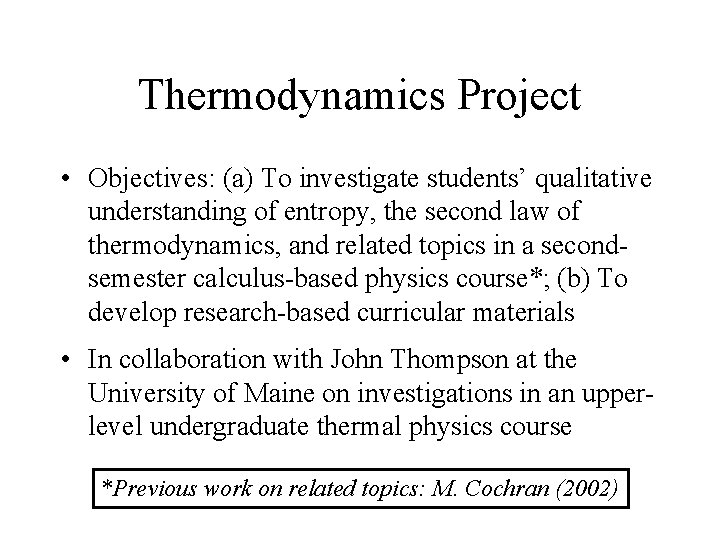
Thermodynamics Project • Objectives: (a) To investigate students’ qualitative understanding of entropy, the second law of thermodynamics, and related topics in a secondsemester calculus-based physics course*; (b) To develop research-based curricular materials • In collaboration with John Thompson at the University of Maine on investigations in an upperlevel undergraduate thermal physics course *Previous work on related topics: M. Cochran (2002)
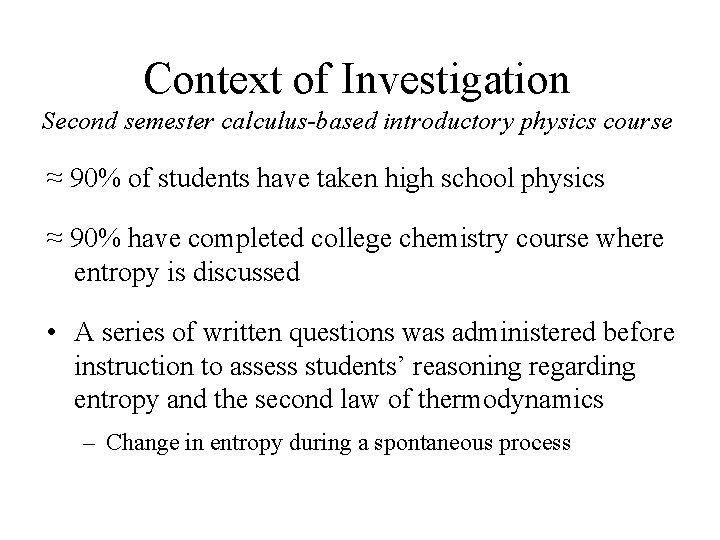
Context of Investigation Second semester calculus-based introductory physics course ≈ 90% of students have taken high school physics ≈ 90% have completed college chemistry course where entropy is discussed • A series of written questions was administered before instruction to assess students’ reasoning regarding entropy and the second law of thermodynamics – Change in entropy during a spontaneous process
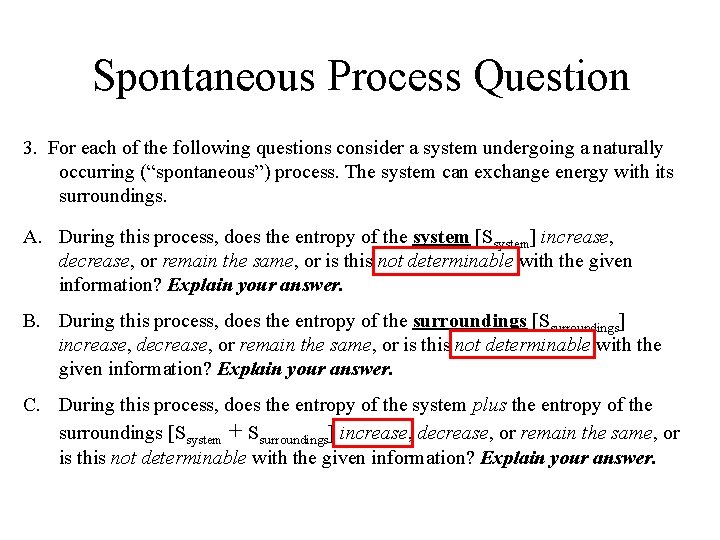
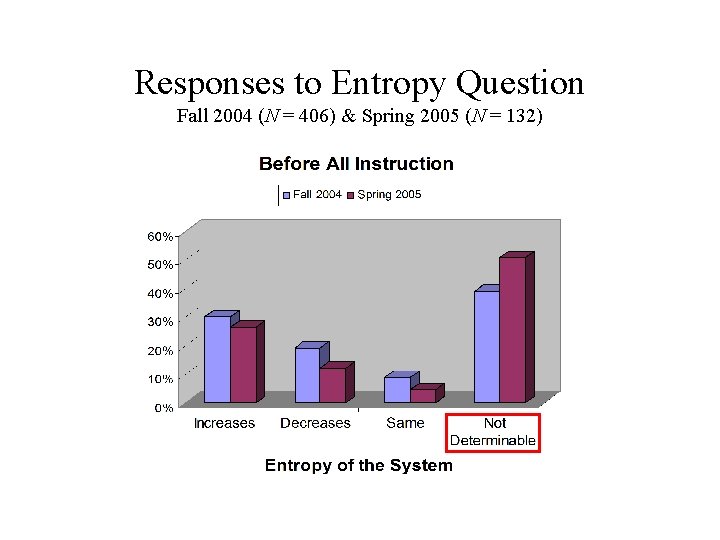
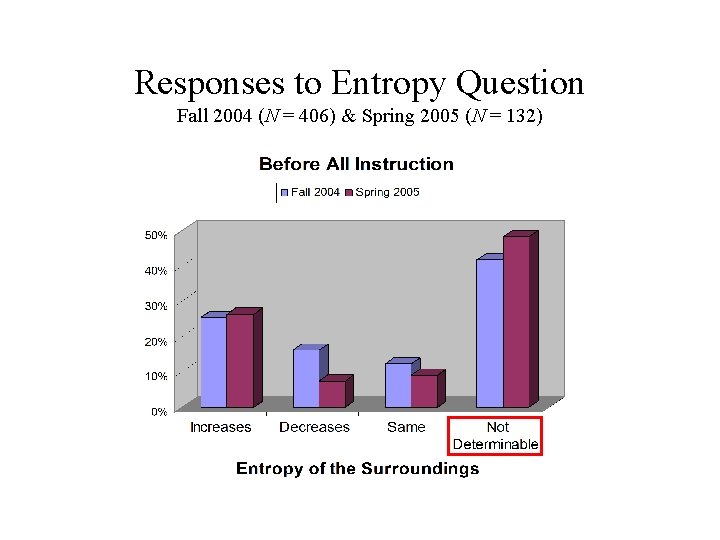
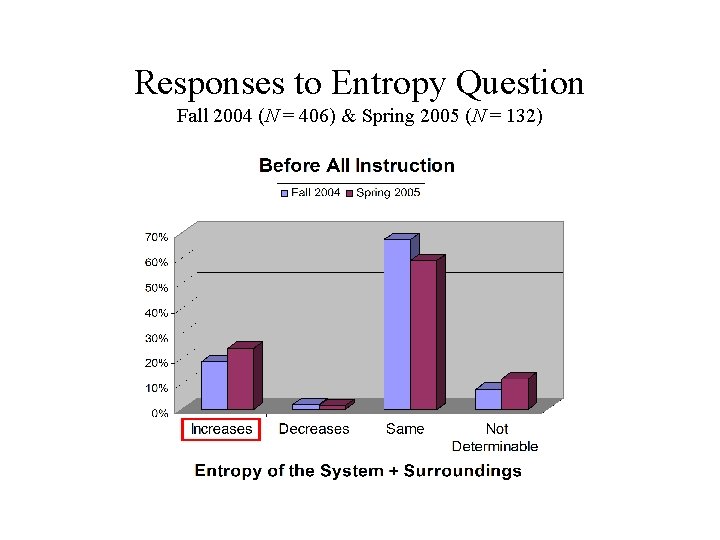
Spontaneous Process Question 3. For each of the following questions consider a system undergoing a naturally occurring (“spontaneous”) process. The system can exchange energy with its surroundings. A. During this process, does the entropy of the system [Ssystem] increase, decrease, or remain the same, or is this not determinable with the given information? Explain your answer. B. During this process, does the entropy of the surroundings [Ssurroundings] increase, decrease, or remain the same, or is this not determinable with the given information? Explain your answer. C. During this process, does the entropy of the system plus the entropy of the surroundings [Ssystem + Ssurroundings] increase, decrease, or remain the same, or is this not determinable with the given information? Explain your answer.
Responses to Entropy Question Fall 2004 (N = 406) & Spring 2005 (N = 132)
Responses to Entropy Question Fall 2004 (N = 406) & Spring 2005 (N = 132)
Responses to Entropy Question Fall 2004 (N = 406) & Spring 2005 (N = 132)
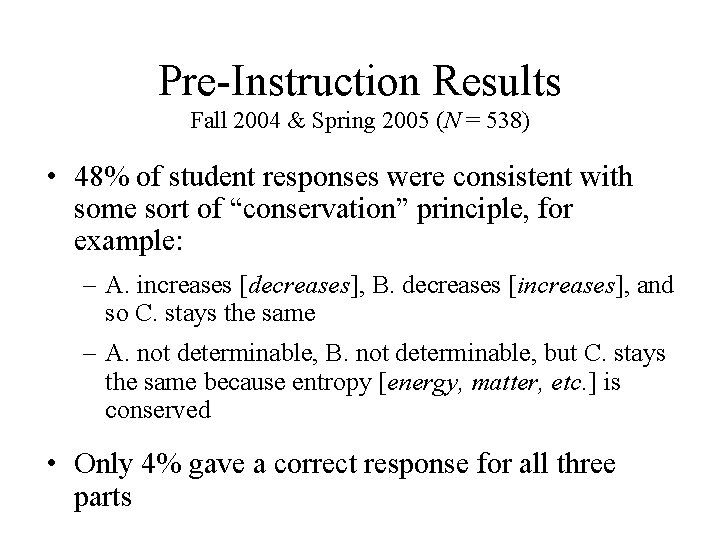
Pre-Instruction Results Fall 2004 & Spring 2005 (N = 538) • 48% of student responses were consistent with some sort of “conservation” principle, for example: – A. increases [decreases], B. decreases [increases], and so C. stays the same – A. not determinable, B. not determinable, but C. stays the same because entropy [energy, matter, etc. ] is conserved • Only 4% gave a correct response for all three parts
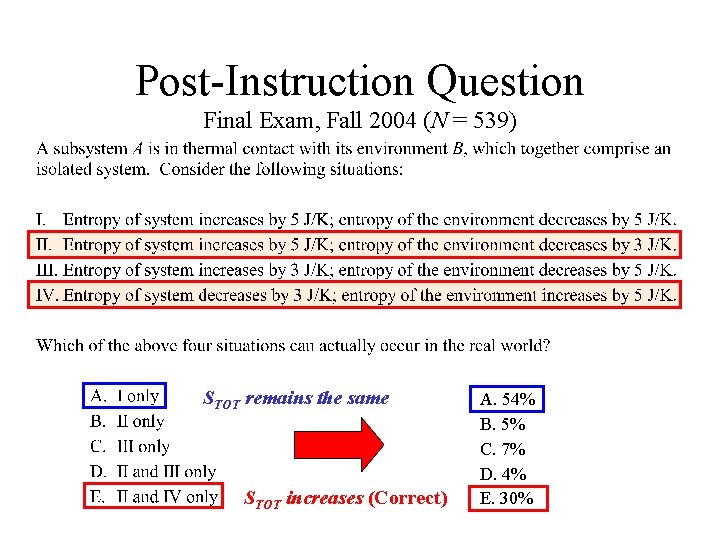
Post-Instruction Question Final Exam, Fall 2004 (N = 539) STOT remains the same STOT increases (Correct) A. 54% B. 5% C. 7% D. 4% E. 30%
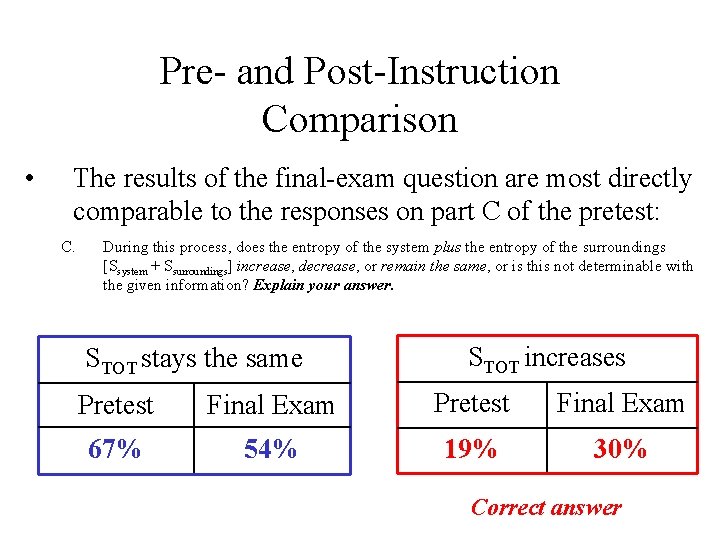
Pre- and Post-Instruction Comparison • The results of the final-exam question are most directly comparable to the responses on part C of the pretest: C. During this process, does the entropy of the system plus the entropy of the surroundings [Ssystem + Ssurroundings] increase, decrease, or remain the same, or is this not determinable with the given information? Explain your answer. STOT stays the same STOT increases Pretest Final Exam 67% 54% 19% 30% Correct answer
Interview Data Fall 2004 & Spring 2005 (N = 16) • Hour-long interviews with student volunteers – conducted after instruction on all relevant material was completed • Students asked to respond to several questions regarding entropy and the second law
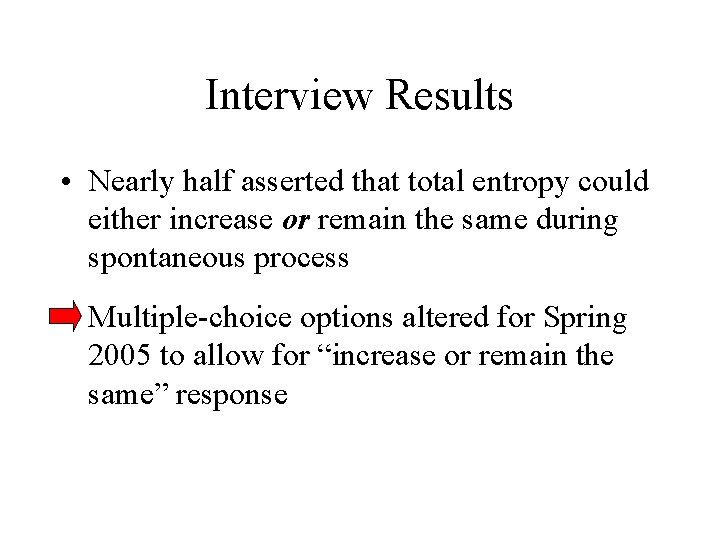
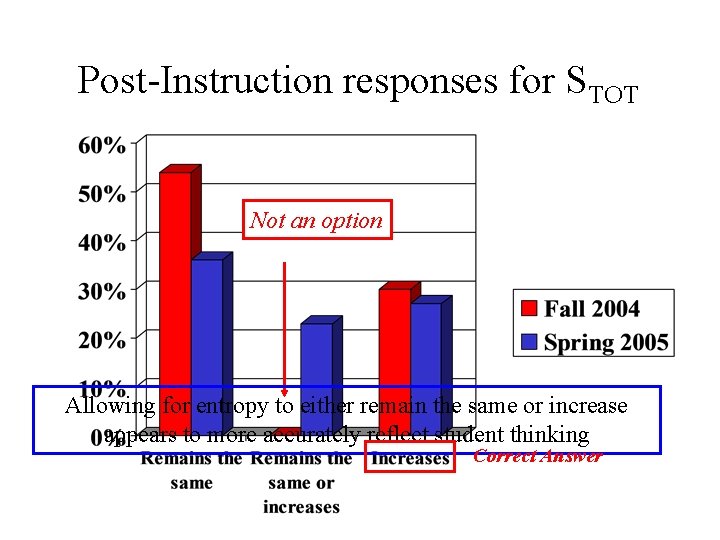
Interview Results • Nearly half asserted that total entropy could either increase or remain the same during spontaneous process Multiple-choice options altered for Spring 2005 to allow for “increase or remain the same” response
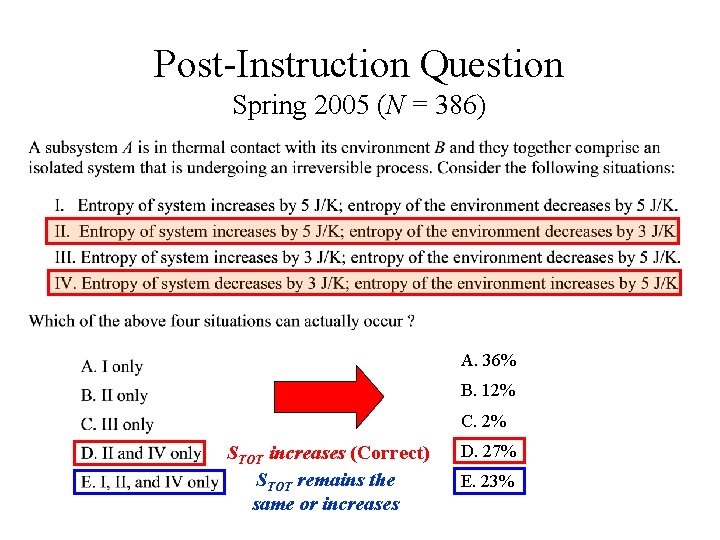
Post-Instruction Question Spring 2005 (N = 386) A. 36% B. 12% C. 2% STOT increases (Correct) STOT remains the same or increases D. 27% E. 23%
Post-Instruction responses for STOT Not an option Allowing for entropy to either remain the same or increase appears to more accurately reflect student thinking Correct Answer
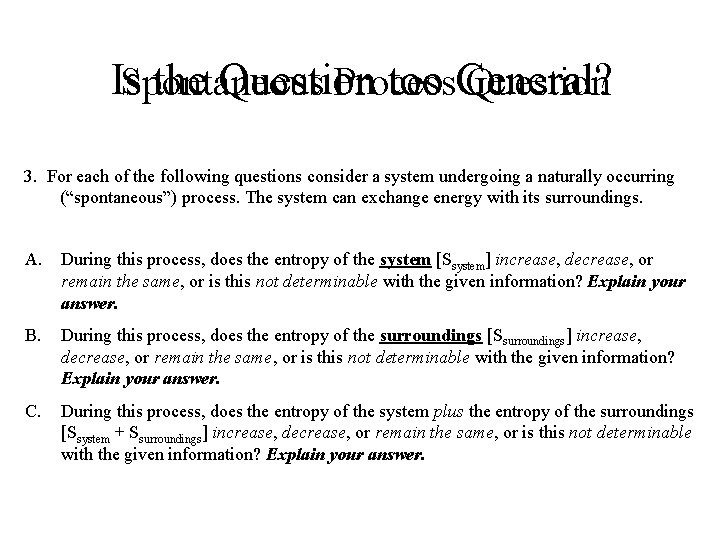
Is the Question too General? Spontaneous Process Question 3. For each of the following questions consider a system undergoing a naturally occurring (“spontaneous”) process. The system can exchange energy with its surroundings. A. During this process, does the entropy of the system [Ssystem] increase, decrease, or remain the same, or is this not determinable with the given information? Explain your answer. B. During this process, does the entropy of the surroundings [Ssurroundings] increase, decrease, or remain the same, or is this not determinable with the given information? Explain your answer. C. During this process, does the entropy of the system plus the entropy of the surroundings [Ssystem + Ssurroundings] increase, decrease, or remain the same, or is this not determinable with the given information? Explain your answer.
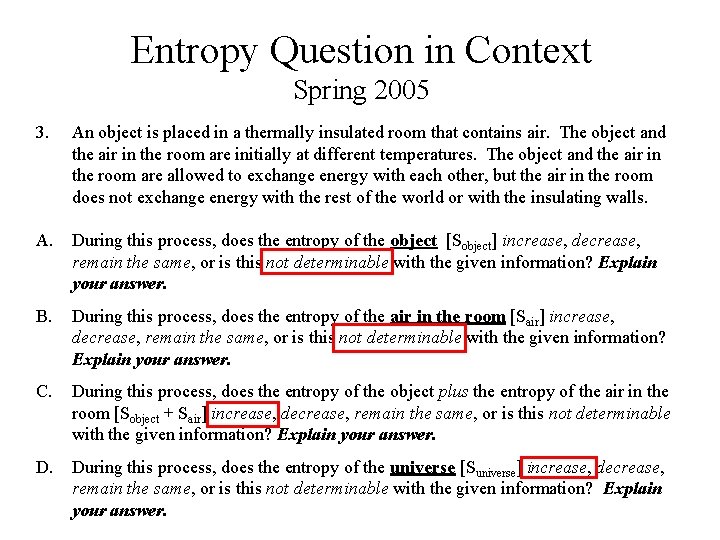
Entropy Question in Context Spring 2005 3. An object is placed in a thermally insulated room that contains air. The object and the air in the room are initially at different temperatures. The object and the air in the room are allowed to exchange energy with each other, but the air in the room does not exchange energy with the rest of the world or with the insulating walls. A. During this process, does the entropy of the object [Sobject] increase, decrease, remain the same, or is this not determinable with the given information? Explain your answer. B. During this process, does the entropy of the air in the room [Sair] increase, decrease, remain the same, or is this not determinable with the given information? Explain your answer. C. During this process, does the entropy of the object plus the entropy of the air in the room [Sobject + Sair] increase, decrease, remain the same, or is this not determinable with the given information? Explain your answer. D. During this process, does the entropy of the universe [Suniverse] increase, decrease, remain the same, or is this not determinable with the given information? Explain your answer.
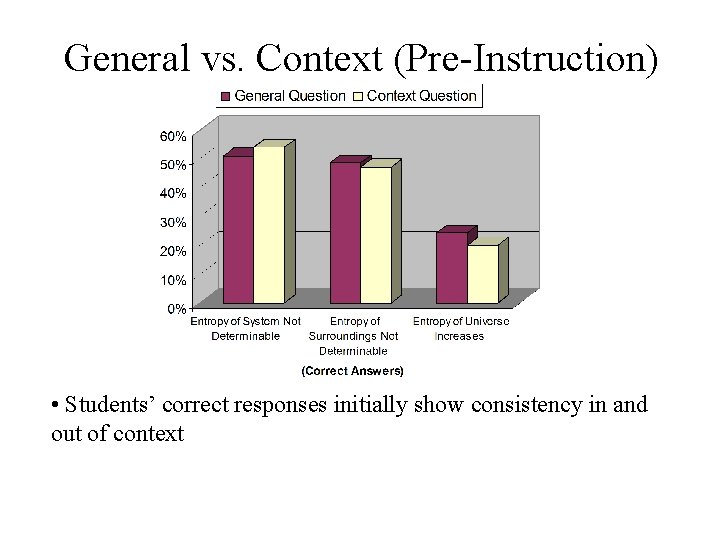
General vs. Context (Pre-Instruction) • Students’ correct responses initially show consistency in and out of context
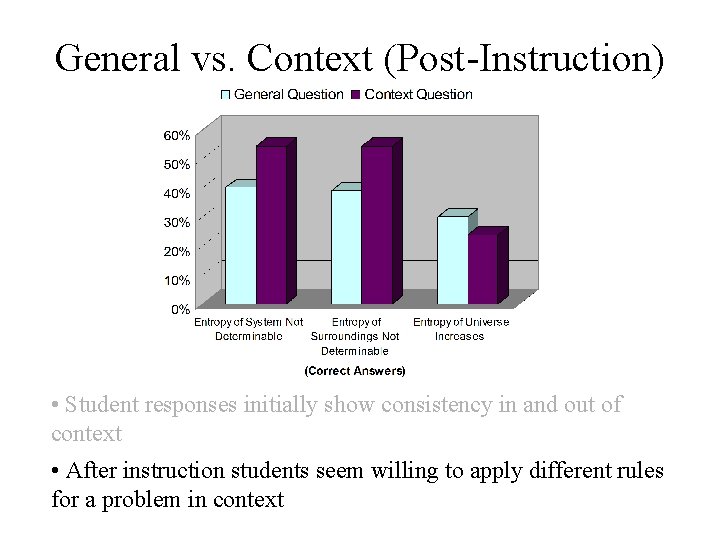
General vs. Context (Post-Instruction) • Student responses initially show consistency in and out of context • After instruction students seem willing to apply different rules for a problem in context
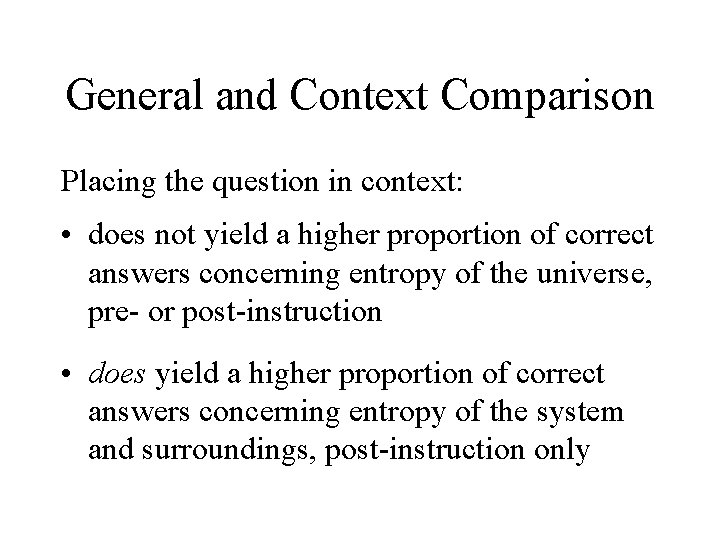
General and Context Comparison Placing the question in context: • does not yield a higher proportion of correct answers concerning entropy of the universe, pre- or post-instruction • does yield a higher proportion of correct answers concerning entropy of the system and surroundings, post-instruction only
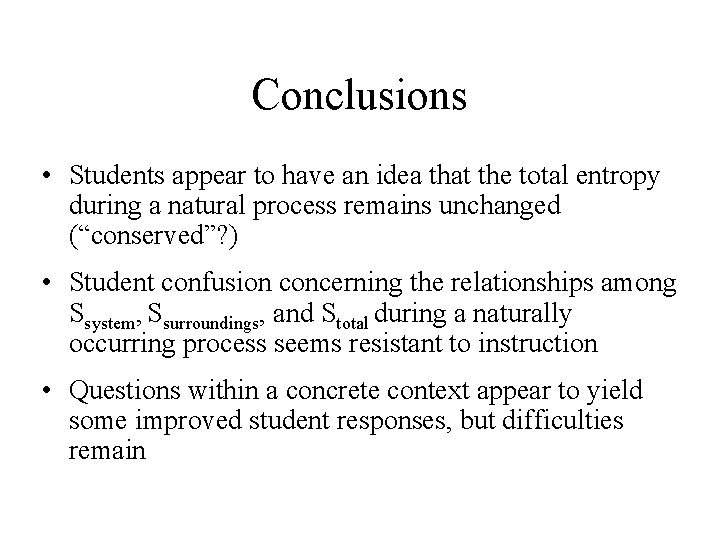
Conclusions • Students appear to have an idea that the total entropy during a natural process remains unchanged (“conserved”? ) • Student confusion concerning the relationships among Ssystem, Ssurroundings, and Stotal during a naturally occurring process seems resistant to instruction • Questions within a concrete context appear to yield some improved student responses, but difficulties remain