
Investigating SLT in Cleft Care Lorraine Britton Sam
Investigating SLT in Cleft Care Lorraine Britton, Sam Calladine, Helen Extence & Marie Pinkstone On Behalf of Lead SLT Group March 2016
Background Concerns raised about NHS SLT provision in cleft care by • CLAPA • Clinical Directors • NHS England Clinical Reference Group Gap between CCG & specialised commissioning
Aims to investigate: • The variability in local and regional SLT provision for children with cleft? • Local service characteristics & dosage of SLT currently being offered? • Waiting times for SLT? • What currently supports and constrains SLT service delivery to children with cleft? • The interface between local & specialist SLT services?
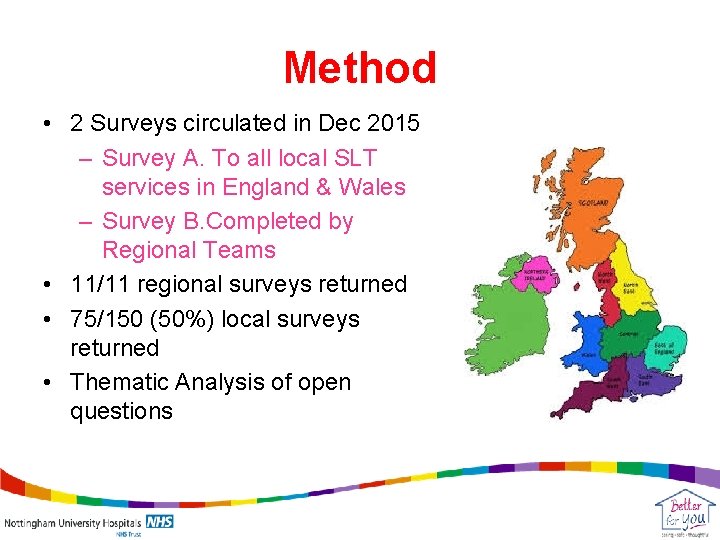
Method • 2 Surveys circulated in Dec 2015 – Survey A. To all local SLT services in England & Wales – Survey B. Completed by Regional Teams • 11/11 regional surveys returned • 75/150 (50%) local surveys returned • Thematic Analysis of open questions
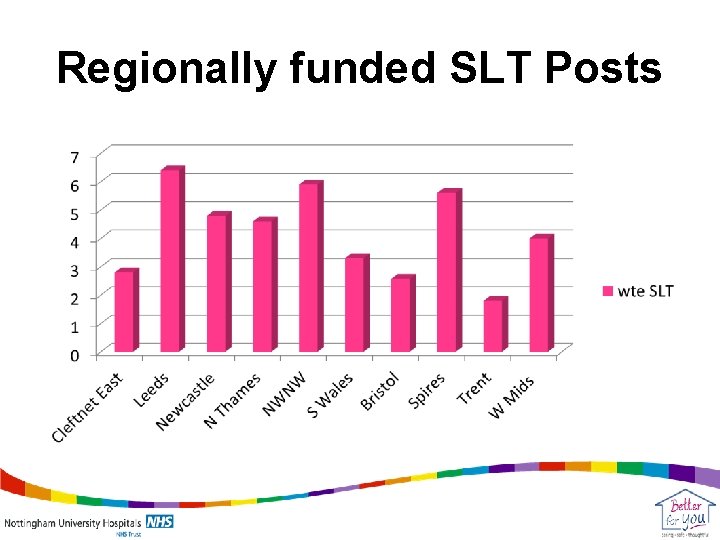
Regionally funded SLT Posts
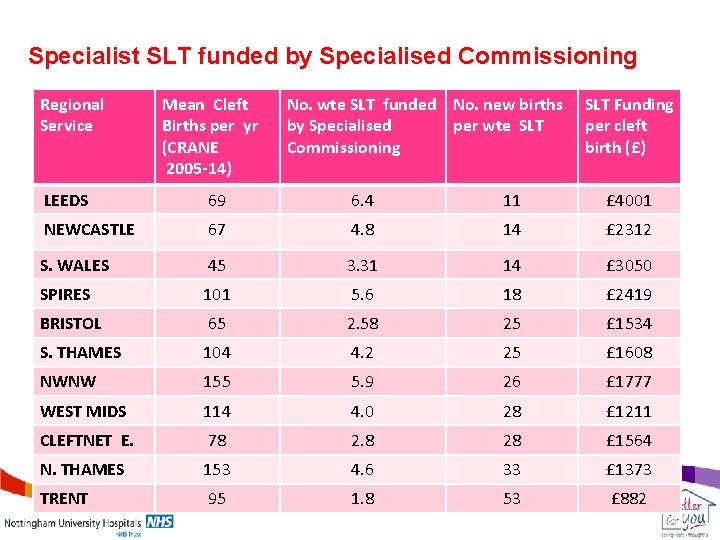
Specialist SLT funded by Specialised Commissioning Regional Service Mean Cleft Births per yr (CRANE 2005 -14) No. wte SLT funded No. new births by Specialised per wte SLT Commissioning SLT Funding per cleft birth (£) LEEDS 69 6. 4 11 £ 4001 NEWCASTLE 67 4. 8 14 £ 2312 S. WALES 45 3. 31 14 £ 3050 SPIRES 101 5. 6 18 £ 2419 BRISTOL 65 2. 58 25 £ 1534 S. THAMES 104 4. 2 25 £ 1608 NWNW 155 5. 9 26 £ 1777 WEST MIDS 114 4. 0 28 £ 1211 CLEFTNET E. 78 2. 8 28 £ 1564 N. THAMES 153 4. 6 33 £ 1373 TRENT 95 1. 8 53 £ 882
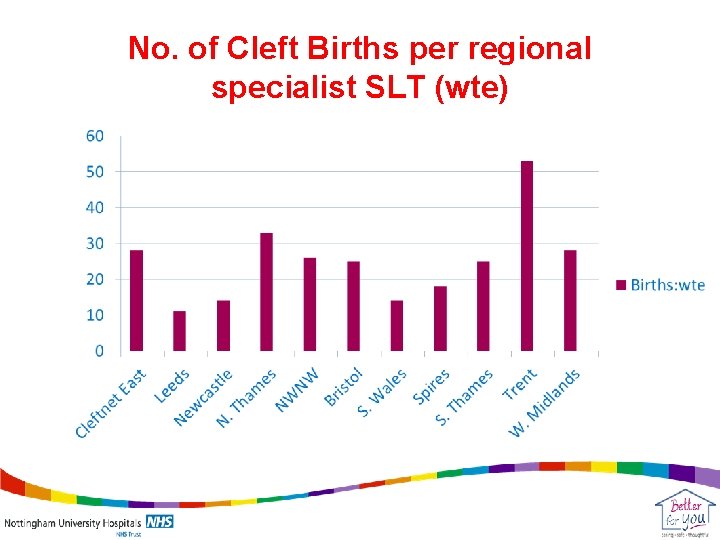
No. of Cleft Births per regional specialist SLT (wte)
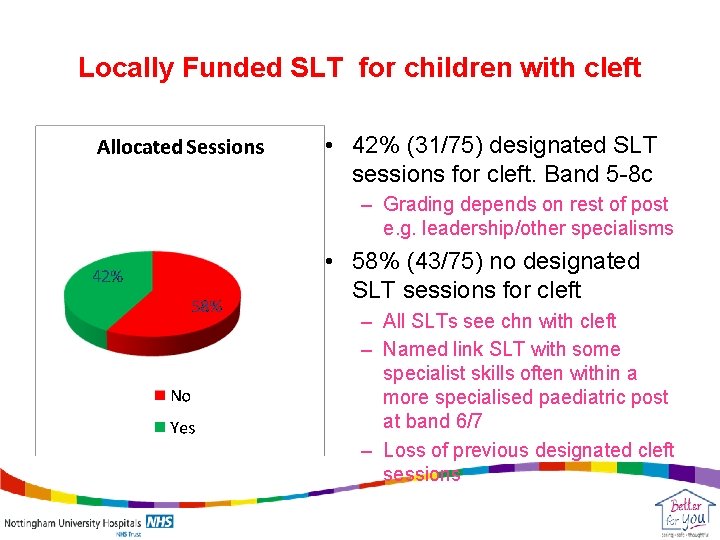
Locally Funded SLT for children with cleft • 42% (31/75) designated SLT sessions for cleft. Band 5 -8 c – Grading depends on rest of post e. g. leadership/other specialisms • 58% (43/75) no designated SLT sessions for cleft – All SLTs see chn with cleft – Named link SLT with some specialist skills often within a more specialised paediatric post at band 6/7 – Loss of previous designated cleft sessions
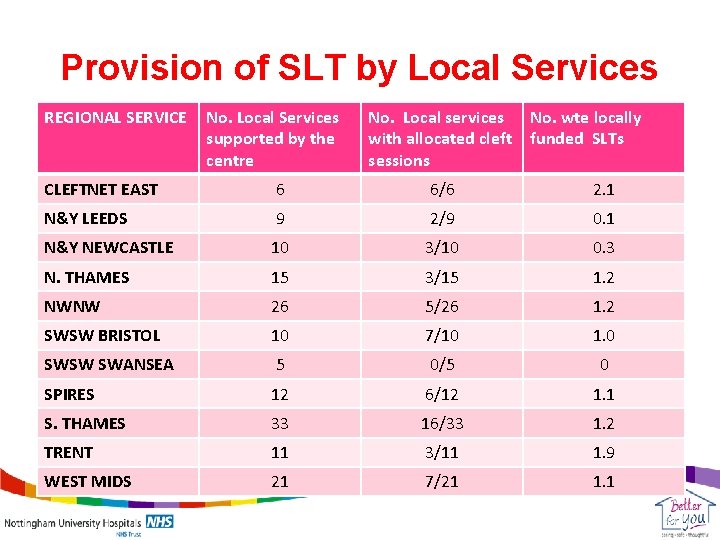
Provision of SLT by Local Services REGIONAL SERVICE No. Local Services supported by the centre No. Local services with allocated cleft sessions No. wte locally funded SLTs CLEFTNET EAST 6 6/6 2. 1 N&Y LEEDS 9 2/9 0. 1 N&Y NEWCASTLE 10 3/10 0. 3 N. THAMES 15 3/15 1. 2 NWNW 26 5/26 1. 2 SWSW BRISTOL 10 7/10 1. 0 SWSW SWANSEA 5 0/5 0 SPIRES 12 6/12 1. 1 S. THAMES 33 16/33 1. 2 TRENT 11 3/11 1. 9 WEST MIDS 21 7/21 1. 1
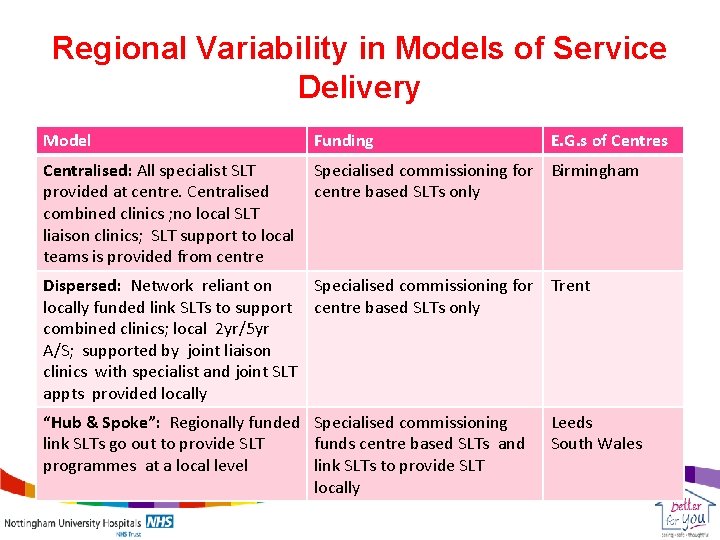
Regional Variability in Models of Service Delivery Model Funding E. G. s of Centres Centralised: All specialist SLT provided at centre. Centralised combined clinics ; no local SLT liaison clinics; SLT support to local teams is provided from centre Specialised commissioning for Birmingham centre based SLTs only Dispersed: Network reliant on Specialised commissioning for Trent locally funded link SLTs to support centre based SLTs only combined clinics; local 2 yr/5 yr A/S; supported by joint liaison clinics with specialist and joint SLT appts provided locally “Hub & Spoke”: Regionally funded Specialised commissioning link SLTs go out to provide SLT funds centre based SLTs and programmes at a local level link SLTs to provide SLT locally Leeds South Wales
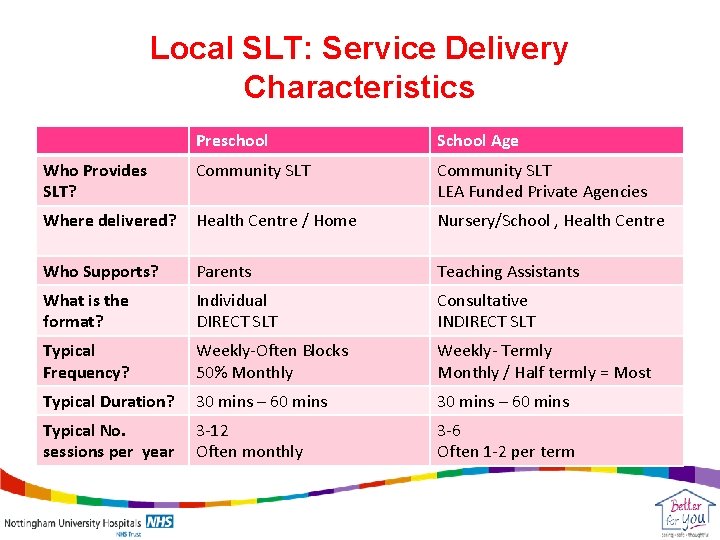
Local SLT: Service Delivery Characteristics Preschool School Age Who Provides SLT? Community SLT LEA Funded Private Agencies Where delivered? Health Centre / Home Nursery/School , Health Centre Who Supports? Parents Teaching Assistants What is the format? Individual DIRECT SLT Consultative INDIRECT SLT Typical Frequency? Weekly-Often Blocks 50% Monthly Weekly- Termly Monthly / Half termly = Most Typical Duration? 30 mins – 60 mins Typical No. sessions per year 3 -12 Often monthly 3 -6 Often 1 -2 per term
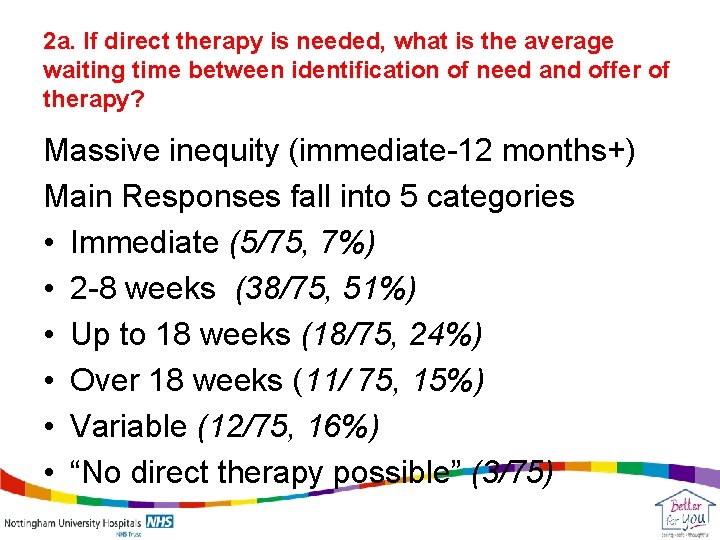
2 a. If direct therapy is needed, what is the average waiting time between identification of need and offer of therapy? Massive inequity (immediate-12 months+) Main Responses fall into 5 categories • Immediate (5/75, 7%) • 2 -8 weeks (38/75, 51%) • Up to 18 weeks (18/75, 24%) • Over 18 weeks (11/ 75, 15%) • Variable (12/75, 16%) • “No direct therapy possible” (3/75)
2 b. Is there any prioritisation system for children waiting for therapy? • 33% (25/75) local SLT services operate a formal prioritisation system for therapy • All Client groups • Weighting severity of problem & impact on child • 15% (11/75) of local SLT services rate children with cleft as a higher priority • 48% (36/75) no formal prioritisation system • Some SLT services are commissioned to see children in strict order of date of referral rather than clinical need
3 a. What currently enables & supports your local SLT service to deliver therapy to children with cleft in your area? • Free Training for link SLTs / Local SLTS (79%) • Joint Sessions & liaison clinics to plan therapy (at regional centre / locally) (65%) • Easy access to specialist advice & support from regional centre (60%) • Designated local SLT sessions for children with cleft (41%) • Local Link SLTs with specialist expertise and ideally designated cleft sessions (30%) • Specialist provision of individual and group therapy from regional centre (22%) • CPD opportunities in cleft (19%) • Local support from more experienced SLTs (16%) • Clinical resources and leaflets provided by regional centre (12%) • “The regional team are understanding & supportive about local pressures”
4. What are the current constraints / limitations to delivering therapy to children with cleft in your area? • CASELOAD DEMANDS (73%) • Lack of designated / local specialist sessions for cleft (37%) – Down grading of posts, – Retirements not replaced, – Loss of previously designated sessions • Commissioning arrangements reducing flexibility for SLTs and reducing provision of direct & regular therapy by SLTs (19%) • Funding issues (16%) • Lack of skills & expertise for cleft (9%) • Large geographical areas and distances from regional centre reducing options for access to specialist care (9%)
5. Does your service have any protocols or guidelines that influence service delivery in any way • DNA policy (60%) • Age limited packages of care – No direct therapy before 4 yrs (2) – No SLT after 5 yrs unless additional needs (2) – No SLT after 11 yrs (11/64, 17%) • • 6 -8 week on/off blocks of therapy (12/75, 16%) Limitation on annual no. sessions (4/75, 5%) Consultative only services (3/75) Tightly commissioned service provision
Comments from SLTs “Cleft are the only children to get direct therapy with an SLT. The rest are seen in groups of by an SLTA” “We have no capacity to offer regular therapy” “current POC focus on skilling parents & TAS & not delivering direct therapy”,
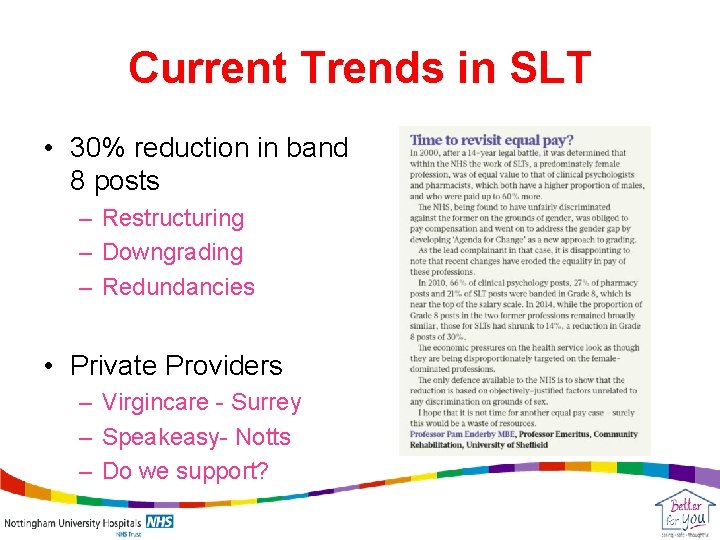
Current Trends in SLT • 30% reduction in band 8 posts – Restructuring – Downgrading – Redundancies • Private Providers – Virgincare - Surrey – Speakeasy- Notts – Do we support?
Commissioning based on EBP…. Or not? Evidence supports therapy for chn with SSD Baker & Mc. Leod (2011) Narrative Review of 134 studies Research on SLT in cleft care is limited but shows the beneficial effects of therapy Bessell et al (2011) Systematic Review-16 studies NHS SLT Provision very different from effective SLT research • Effective: 2 -3 sessions of therapy per week for 3 -46 months , conducted by a skilled SLT (Baker & Mc. Leod, 2011) • Ineffective: 6 hours SLT annually (Glogowska et al, 2000) Typical Dose in Cleft Care – Not Evidence Based • 3 -12 hours with an SLT per year (Britton, 2012; Britton et al 2016) • No evidence: 6 week blocks or consultative models of SLT
CLAPA: How do you think not getting SLT has affected your child? We waited 6 mnths for an appt and now we are finally getting seen it’s a different lady every time and there are sometimes 12 week gaps between sessions We saw our old therapist once every few months, and this has impacted hugely on his learning We have had 5 different SLTs. There is no continuity and each SLT has a different way of teaching…. My son was getting 6 sessions then going back on a waiting list which made SLT more difficult… Speech Therapy provision is not standard across the country, timing of intervention and resources available differ according to local practice
Leanne’s Story • SLT from 2 -6 yrs • Severe glottal pattern & VPI • Weekly specialist SLT at centre meant missing half a day at school, travel, bringing siblings, rearranging work, tired • Intensive groups meant not booking hols • Local SLT less tiring but frequent change of SLT, no support for unskilled TA, staffing issues, gaps between sessions, little progress, • Now a 10 yr old with clear articulate speech
Summary: The Bad News • Inequity in SLT provision locally& regionally • SLT services are commissioned & provided based on cost & demand rather than EBP • Systematic dilution of SLT services & down grading of posts • Many children seen by generalist SLTs often without local specialist clinical leadership • Lack of DIRECT, REGULAR, INTENSIVE therapy • Loss of SPECIALIST SLT • Children’s Speech Outcomes are at risk
Summary: The Good News • Cobweb of Goodwill in cleft SLT • Regional specialists work closely with local SLTs to provide integrated care • Local SLT services appreciate regional support, expertise & training • “Hub & Spoke” Model for future
A model for the Future? • Specialised commissioning to fund “link” SLT sessions in ALL centres • “Links” to provide therapy within local SLT services to children with cleft • Local SLT support to continue • Ensures more equity of therapy proivision • Less at mercy of local SLT services
Discussion • How can we ensure all Regional Centres have a similar level of specialist SLT funding? • How do we ensure equal access to SLT for a nationally commissioned locally delivered service? • Given the limitations of our influence, should we continue to try and influence / ring fence local SLT provision or to provide more from the centres instead? • What are the advantages & disadvantages of different models of service provision? • How do we work with private agencies?

“Knowledge is power” Thank you Lorraine. britton@nuh. nhs. uk
- Slides: 26