
Investigating Radioactivity Gamma Spectroscopy Using a Sodium Iodide
- Slides: 1
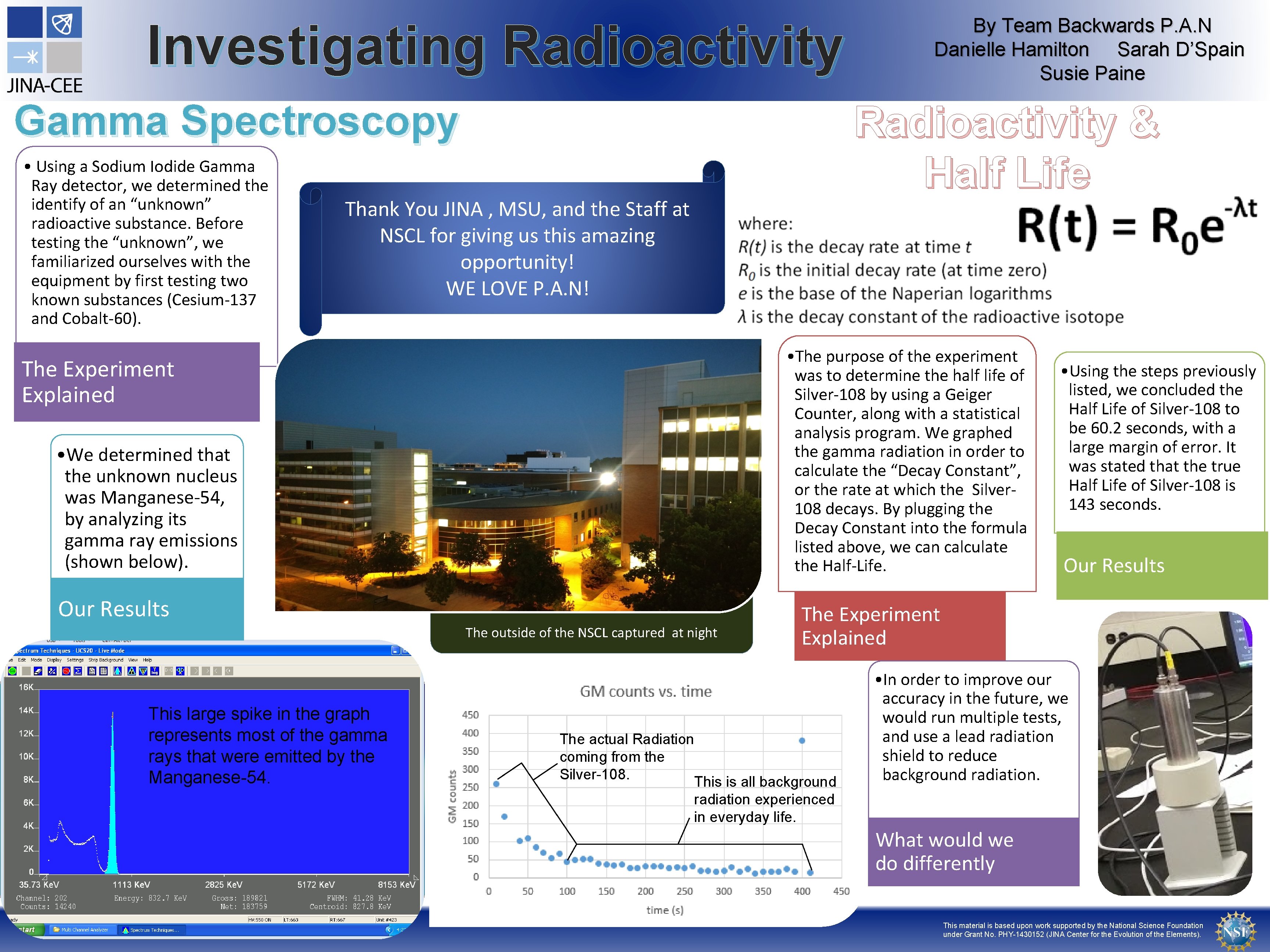
Investigating Radioactivity Gamma Spectroscopy • Using a Sodium Iodide Gamma Ray detector, we determined the identify of an “unknown” radioactive substance. Before testing the “unknown”, we familiarized ourselves with the equipment by first testing two known substances (Cesium-137 and Cobalt-60). Radioactivity & Half Life Thank You JINA , MSU, and the Staff at NSCL for giving us this amazing opportunity! WE LOVE P. A. N! • The purpose of the experiment was to determine the half life of Silver-108 by using a Geiger Counter, along with a statistical analysis program. We graphed the gamma radiation in order to calculate the “Decay Constant”, or the rate at which the Silver 108 decays. By plugging the Decay Constant into the formula listed above, we can calculate the Half-Life. The Experiment Explained • We determined that the unknown nucleus was Manganese-54, by analyzing its gamma ray emissions (shown below). Our Results The outside of the NSCL captured at night This large spike in the graph represents most of the gamma rays that were emitted by the Manganese-54. By Team Backwards P. A. N Danielle Hamilton Sarah D’Spain Susie Paine • Using the steps previously listed, we concluded the Half Life of Silver-108 to be 60. 2 seconds, with a large margin of error. It was stated that the true Half Life of Silver-108 is 143 seconds. Our Results The Experiment Explained The actual Radiation coming from the Silver-108. This is all background • In order to improve our accuracy in the future, we would run multiple tests, and use a lead radiation shield to reduce background radiation experienced in everyday life. What would we do differently This material is based upon work supported by the National Science Foundation under Grant No. PHY-1430152 (JINA Center for the Evolution of the Elements).