
Investigating Earth Systems 1 Workshop Goals n n
- Slides: 18
Investigating Earth Systems 1
Workshop Goals n n n Engage in IES by doing an activity; Explore the curriculum design, pedagogy, and assessment “as we go”; Explain key program features, including the teacher’s guide, materials kits, web sites, and professional development; Elaborate on questions that you may have; Evaluate the workshop. 2
IES Oceans Investigation 3 Sampler page 8 – Key Question n Answer the Key Question: What causes ocean currents? Individually in your Journal 2. Discuss with the person next to you 3. Discuss as a group 1. n Class Discussion and Recording of Ideas 3
IES Oceans Investigation 3 Sampler pages 8 -10: Investigate Part A – Surface Currents 1. 2. Complete steps 1 and 2 in your group Discuss step 3 as a “class” ¨ ¨ ¨ What patterns do you see between surface currents and wind direction? What new questions do you have? Form a hypothesis to explain the relationship between wind direction and surface currents. Give reasons based on evidence. 4
IES Oceans Investigation 3 n Sampler Pages 10 -11 – Investigate Part B: Deep Ocean Currents Complete step 1 in your group 2. Watch a demonstration of steps 2 and 3 3. Discuss step 4 as a class 4. Complete steps 5 -7 in your group 1. 5
IES Oceans Investigation 3 Reviewing the Rest of the Investigation n Digging Deeper and As Your Read Using the IES Web Site to support inquiry Review and Reflect 1. 2. 3. 4. Review Reflect Thinking about the Earth System Thinking about Scientific Inquiry 6
Investigating Earth Systems n Modular, inquiry-based Earth science curriculum n Driven by the National Standards and Benchmarks for Science Literacy n Developed by Earth science experts and classroom teachers through the AGI n Published by It’s About Time n Materials kits, teacher guides, web sites, and professional development to support teachers. 7
Your Students Will: n n n Learn the principles and practices of Earth science. Hypothesize, experiment, reflect, and analyze. Develop an understanding of how the Earth works as a set of systems. Appreciate the relevance of Earth science to their lives and the environment. Work collaboratively with other students to solve problems. 8
The Big Picture 1. 2. 3. 4. 5. Earth is a set of closely linked systems. Earth's processes are powered by two sources; the Sun and Earth's own inner heat. The geology of Earth is dynamic, and has evolved over 4. 5 billion years. The geological evolution of Earth has left a record of its history that geoscientists interpret. We depend upon Earth's resources-both mined and grown. 9
Module Structure Pre-Assessment of Key Concepts in the Module n Six to Seven Inquiry-based Investigations n Final Product and Presentation Summative Assessment n Back to the Beginning – Post Assessment of Key Concepts in the Module n 10
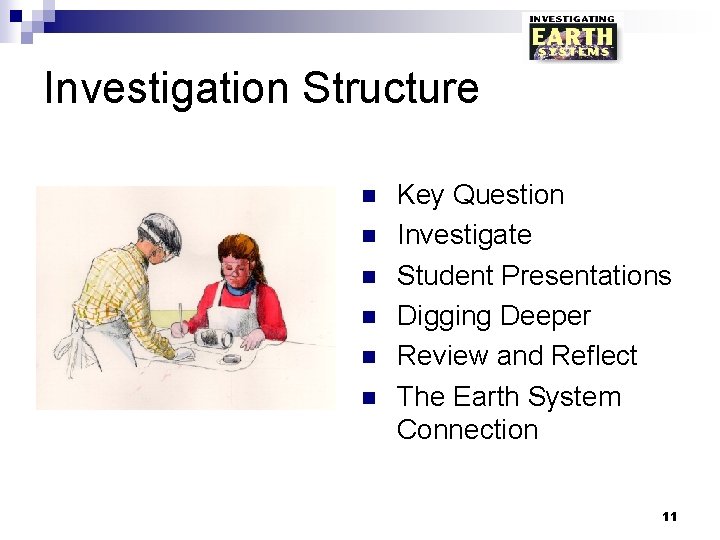
Investigation Structure n n n Key Question Investigate Student Presentations Digging Deeper Review and Reflect The Earth System Connection 11
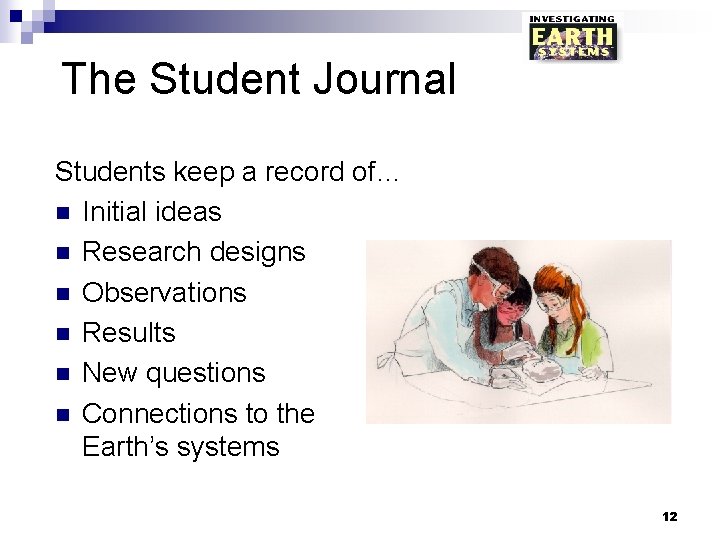
The Student Journal Students keep a record of… n Initial ideas n Research designs n Observations n Results n New questions n Connections to the Earth’s systems 12
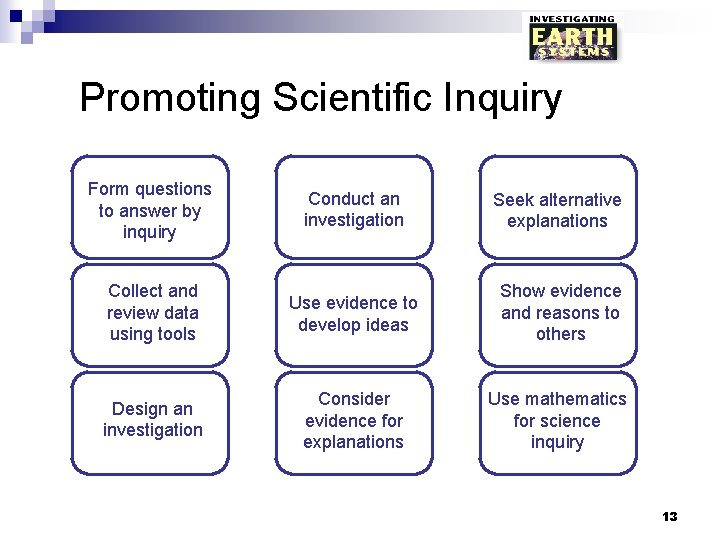
Promoting Scientific Inquiry Form questions to answer by inquiry Conduct an investigation Seek alternative explanations Collect and review data using tools Use evidence to develop ideas Show evidence and reasons to others Design an investigation Consider evidence for explanations Use mathematics for science inquiry 13
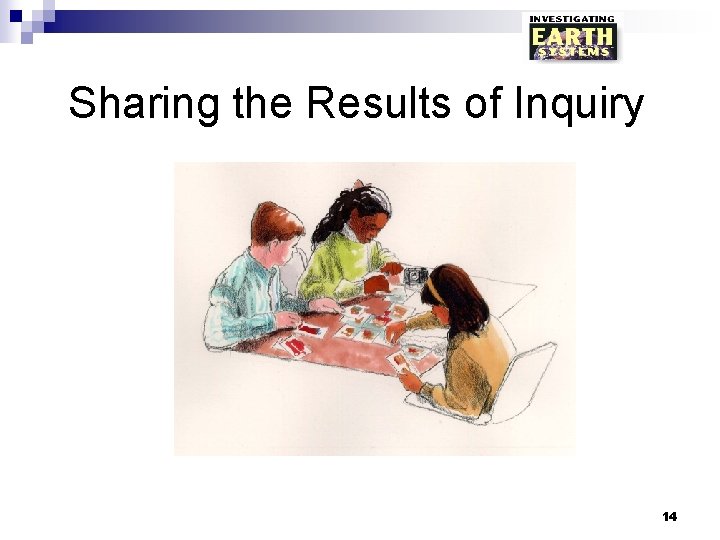
Sharing the Results of Inquiry 14
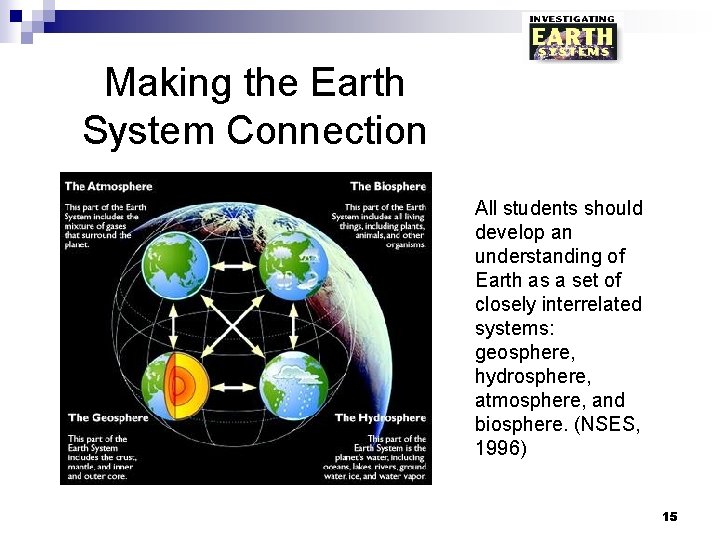
Making the Earth System Connection All students should develop an understanding of Earth as a set of closely interrelated systems: geosphere, hydrosphere, atmosphere, and biosphere. (NSES, 1996) 15
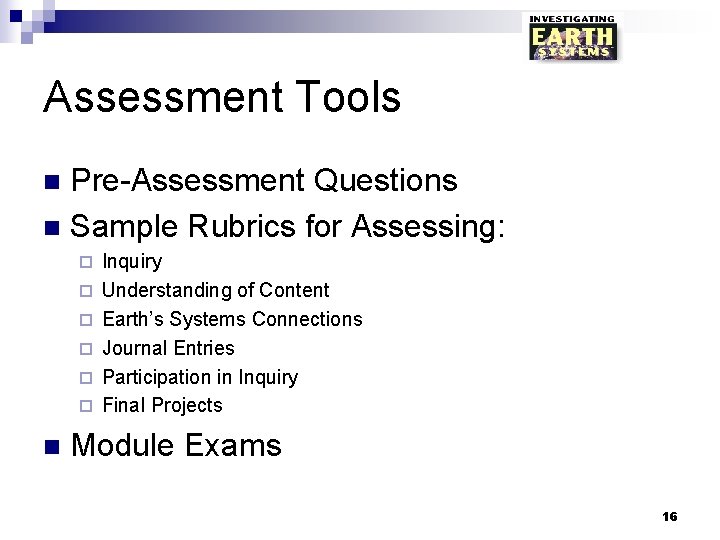
Assessment Tools Pre-Assessment Questions n Sample Rubrics for Assessing: n ¨ ¨ ¨ n Inquiry Understanding of Content Earth’s Systems Connections Journal Entries Participation in Inquiry Final Projects Module Exams 16
Comprehensive Teacher Guide Module flow, goals and objectives n Background information n Correlation to National Standards n Preparation and materials needed n Detailed teaching and assessment tips n Blackline masters of key diagrams n Assessment rubrics and exams n 17
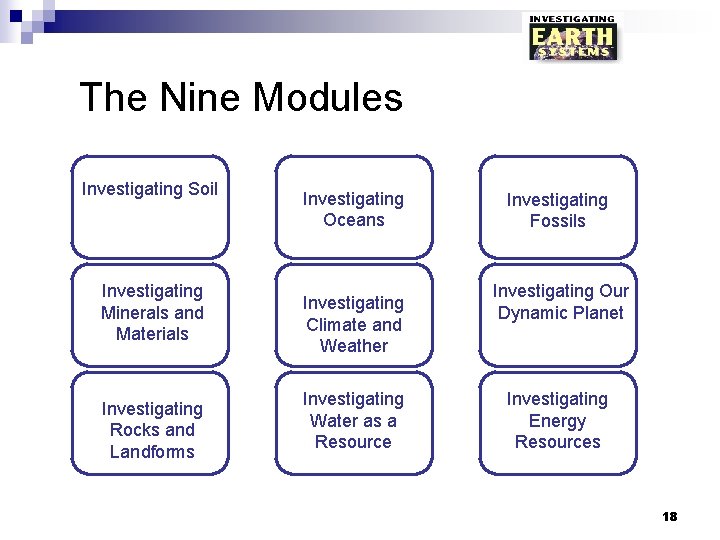
The Nine Modules Investigating Soil Investigating Minerals and Materials Investigating Rocks and Landforms Investigating Oceans Investigating Climate and Weather Investigating Water as a Resource Investigating Fossils Investigating Our Dynamic Planet Investigating Energy Resources 18