
Investigating circles Did you know that it is
- Slides: 72
Investigating circles Did you know that it is possible to make a pyramid from a paper circle? 1
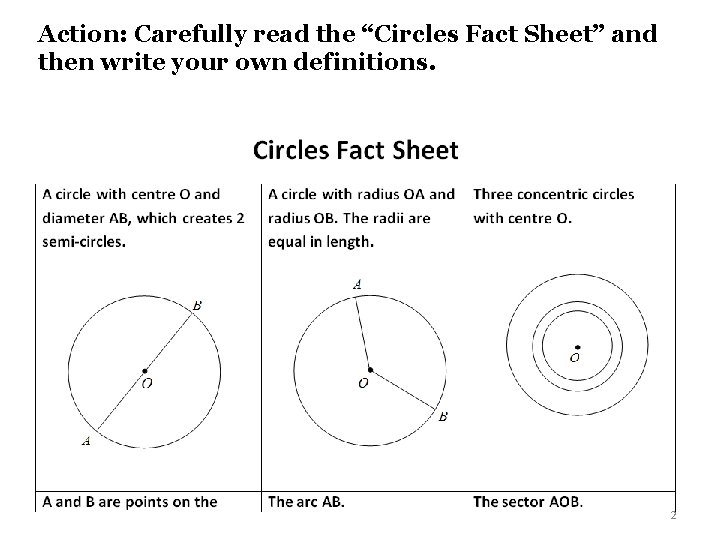
Action: Carefully read the “Circles Fact Sheet” and then write your own definitions. 2
Action: Place your circle with the coloured side up and the white side down. 3
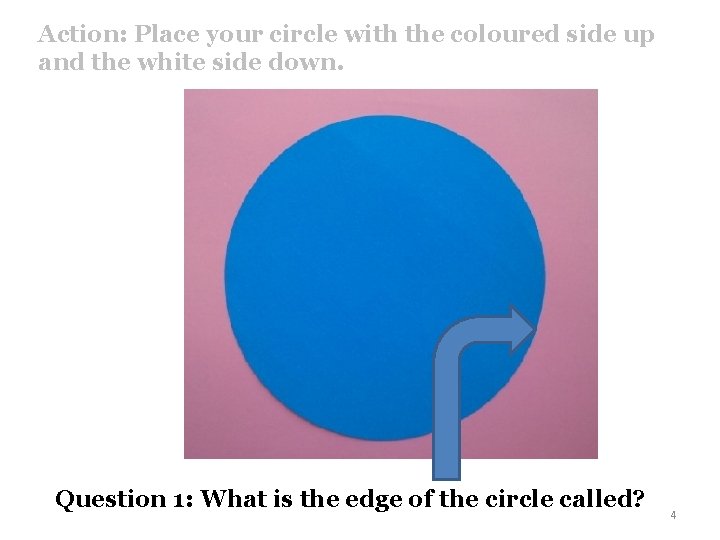
Action: Place your circle with the coloured side up and the white side down. Question 1: What is the edge of the circle called? 4
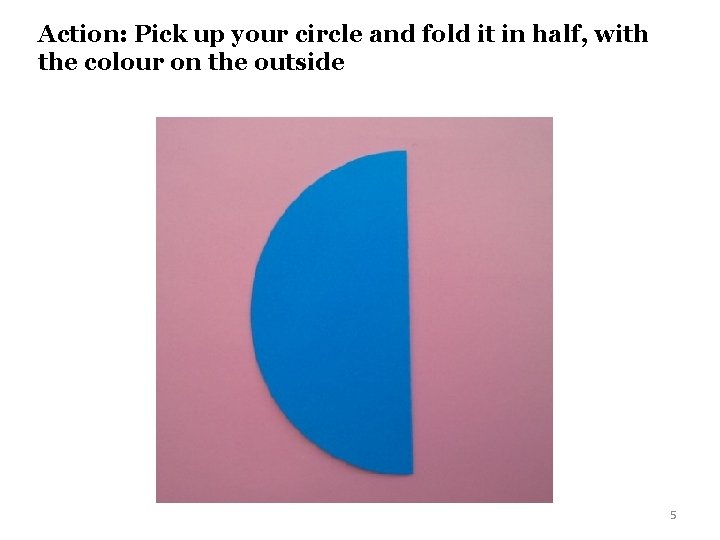
Action: Pick up your circle and fold it in half, with the colour on the outside 5
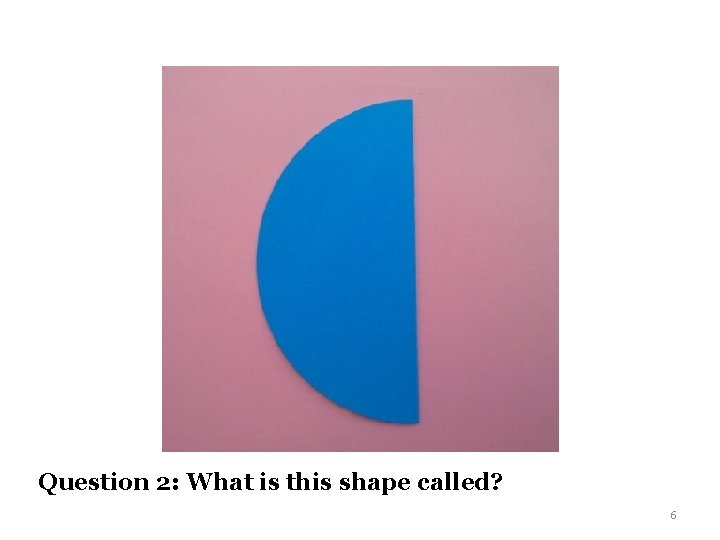
Question 2: What is this shape called? 6
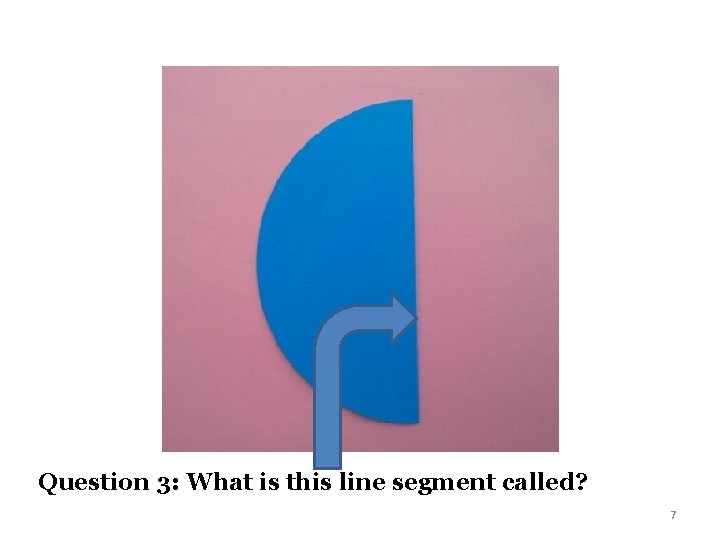
Question 3: What is this line segment called? 7
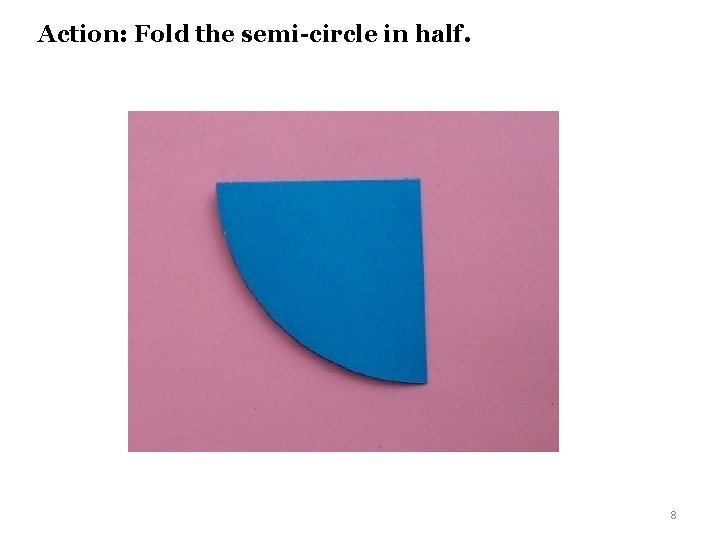
Action: Fold the semi-circle in half. 8
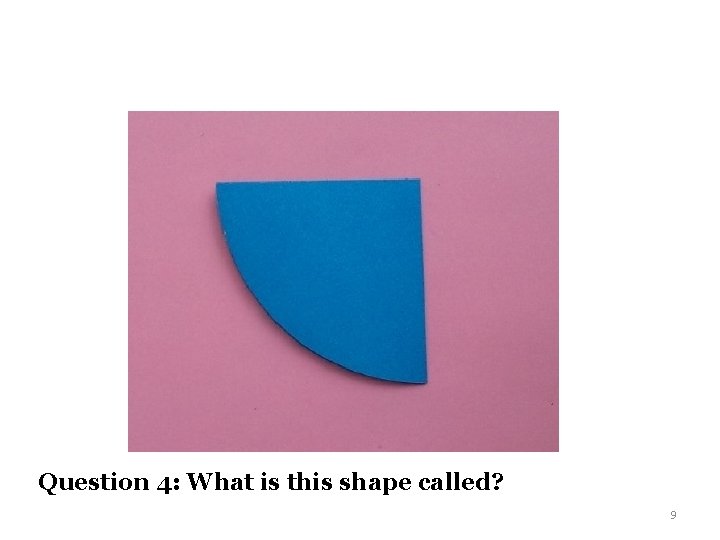
Question 4: What is this shape called? 9
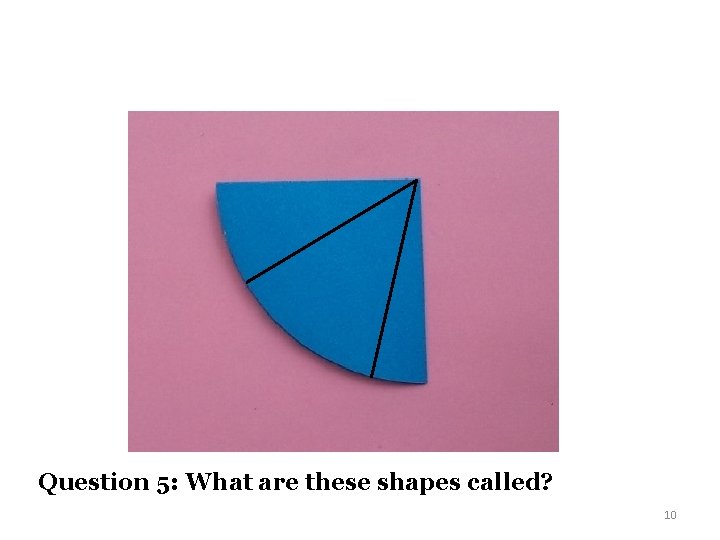
Question 5: What are these shapes called? 10
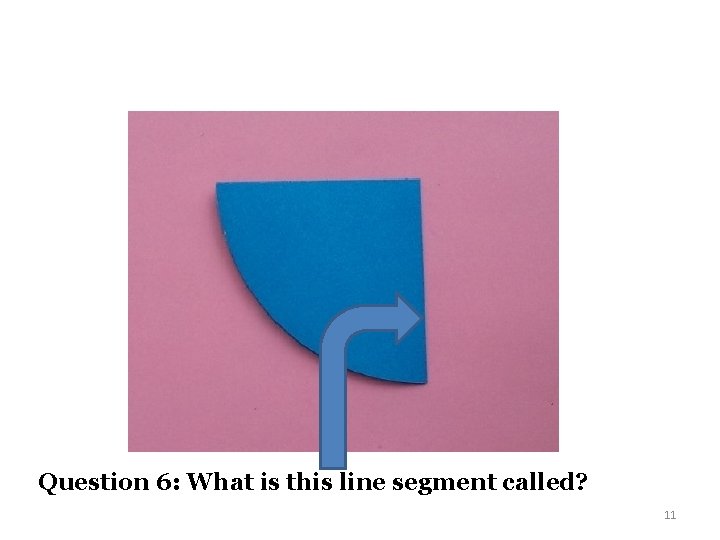
Question 6: What is this line segment called? 11
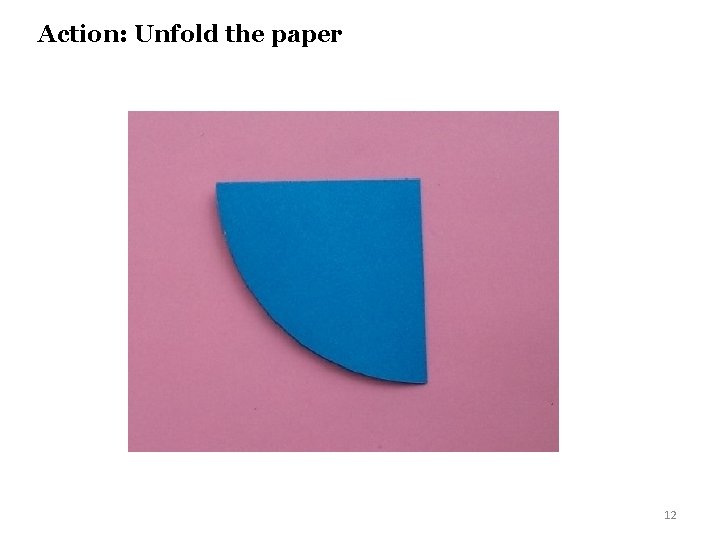
Action: Unfold the paper 12
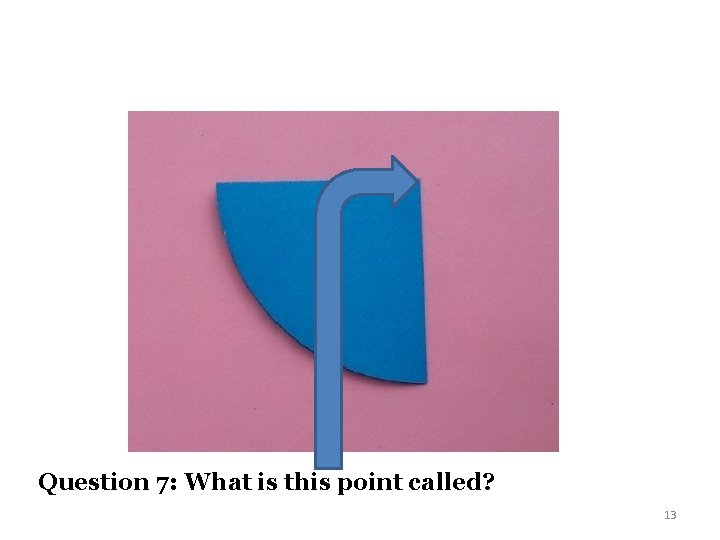
Question 7: What is this point called? 13
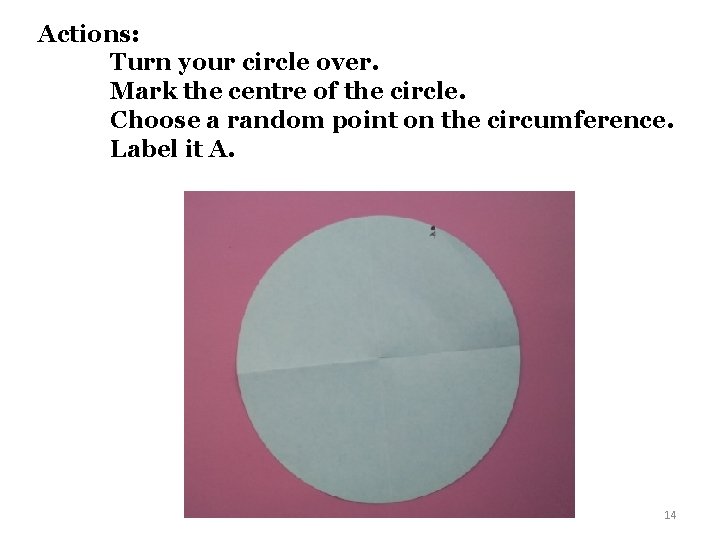
Actions: Turn your circle over. Mark the centre of the circle. Choose a random point on the circumference. Label it A. 14
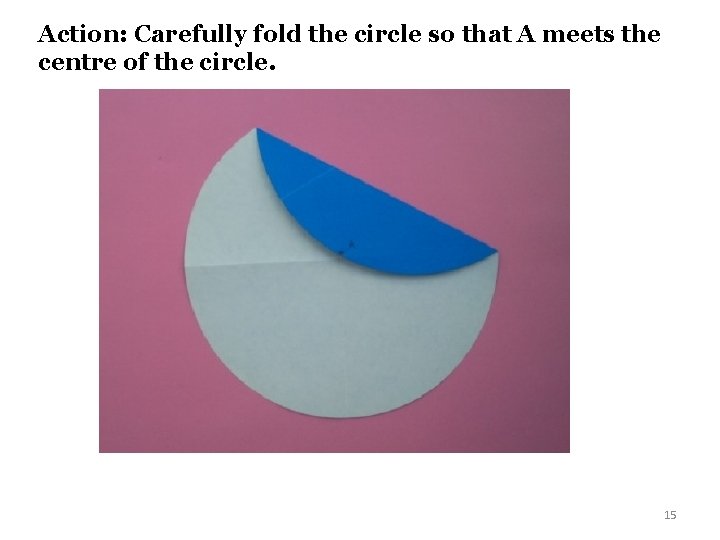
Action: Carefully fold the circle so that A meets the centre of the circle. 15
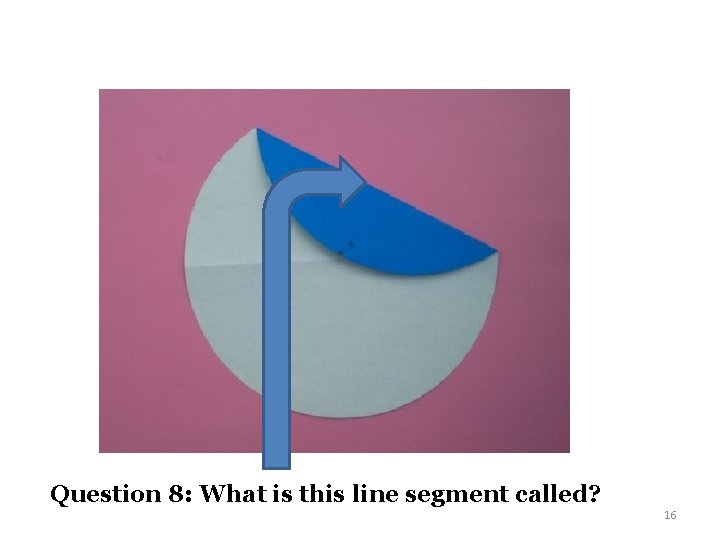
Question 8: What is this line segment called? 16
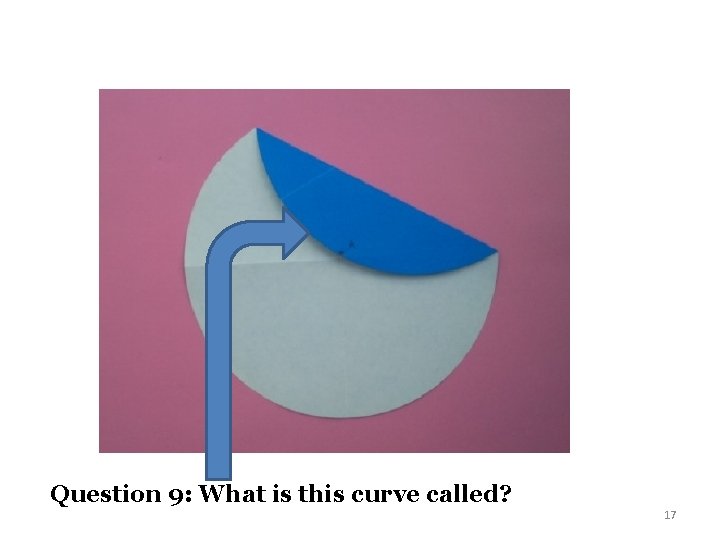
Question 9: What is this curve called? 17
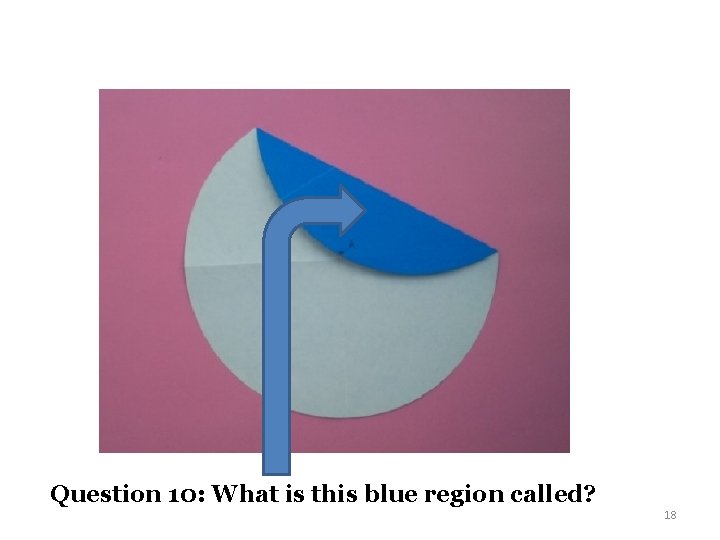
Question 10: What is this blue region called? 18
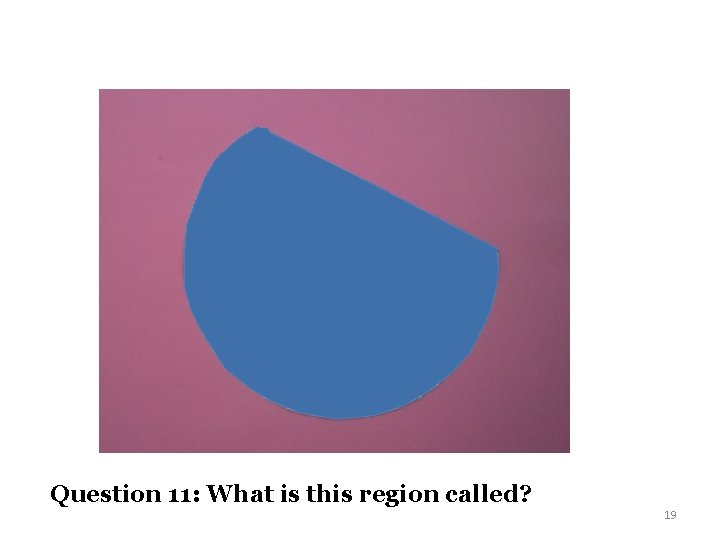
Question 11: What is this region called? 19
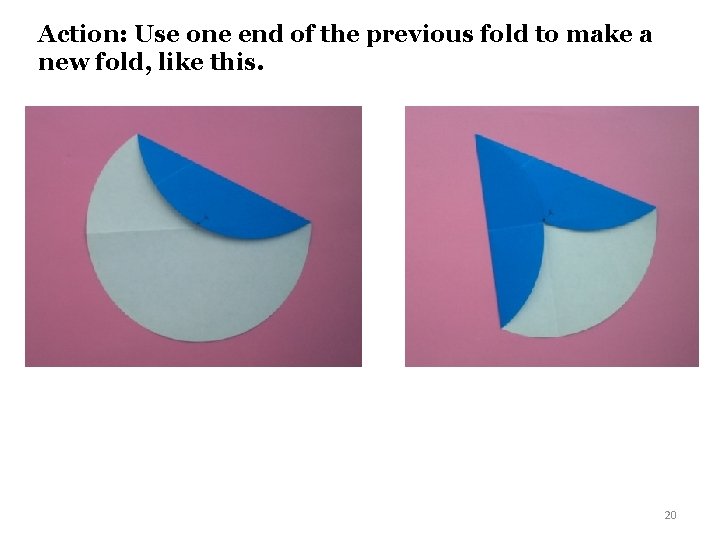
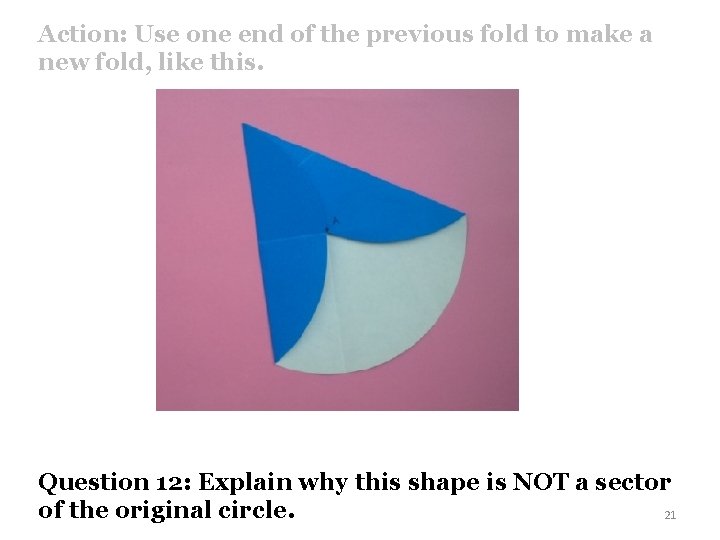
Action: Use one end of the previous fold to make a new fold, like this. 20
Action: Use one end of the previous fold to make a new fold, like this. Question 12: Explain why this shape is NOT a sector of the original circle. 21
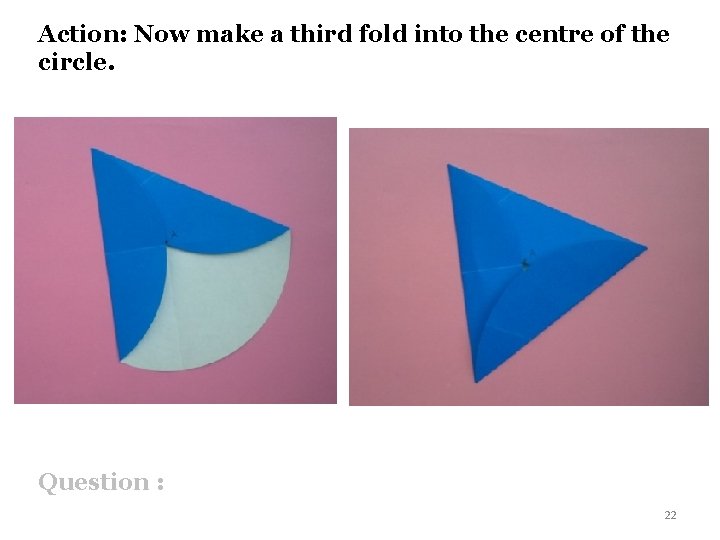
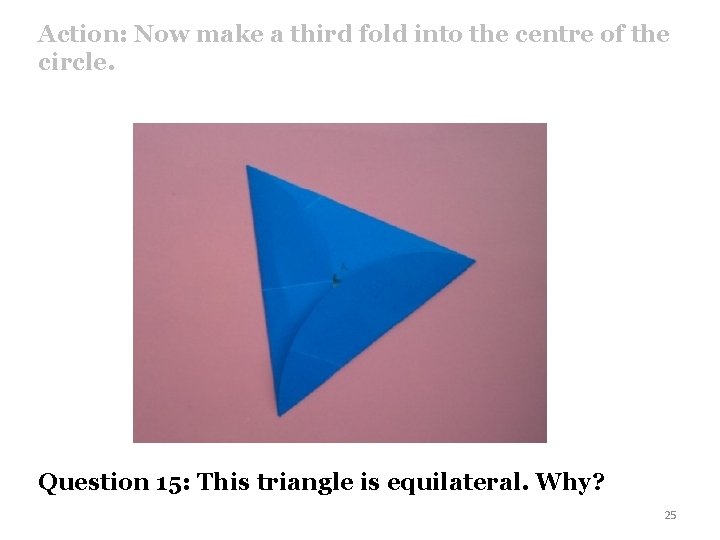
Action: Now make a third fold into the centre of the circle. Question : 22
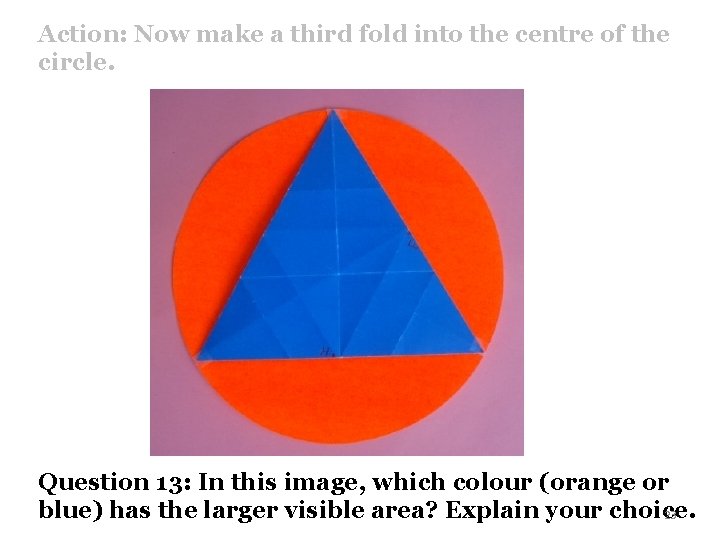
Action: Now make a third fold into the centre of the circle. Question 13: In this image, which colour (orange or blue) has the larger visible area? Explain your choice. 23
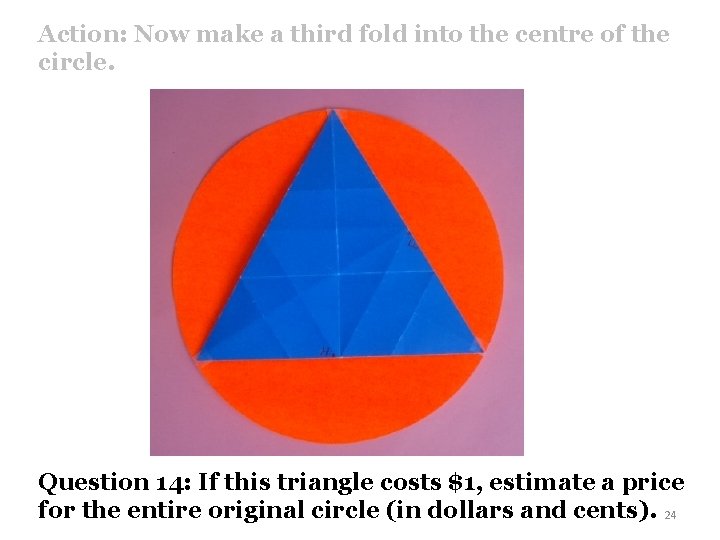
Action: Now make a third fold into the centre of the circle. Question 14: If this triangle costs $1, estimate a price for the entire original circle (in dollars and cents). 24
Action: Now make a third fold into the centre of the circle. Question 15: This triangle is equilateral. Why? 25
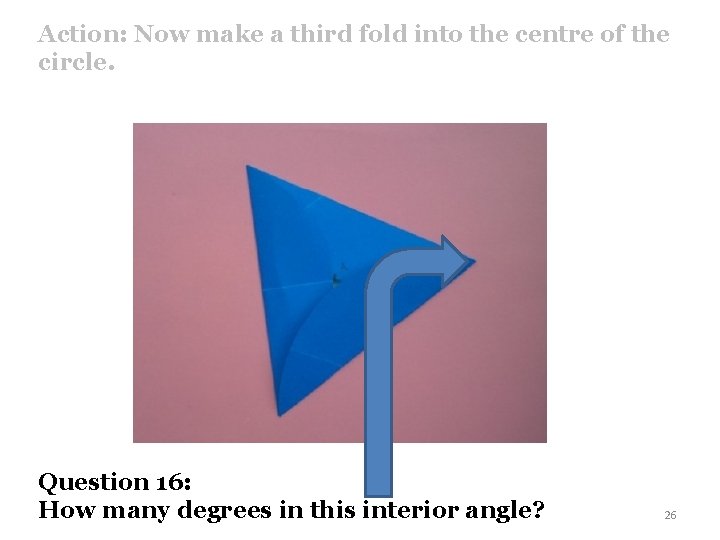
Action: Now make a third fold into the centre of the circle. Question 16: How many degrees in this interior angle? 26
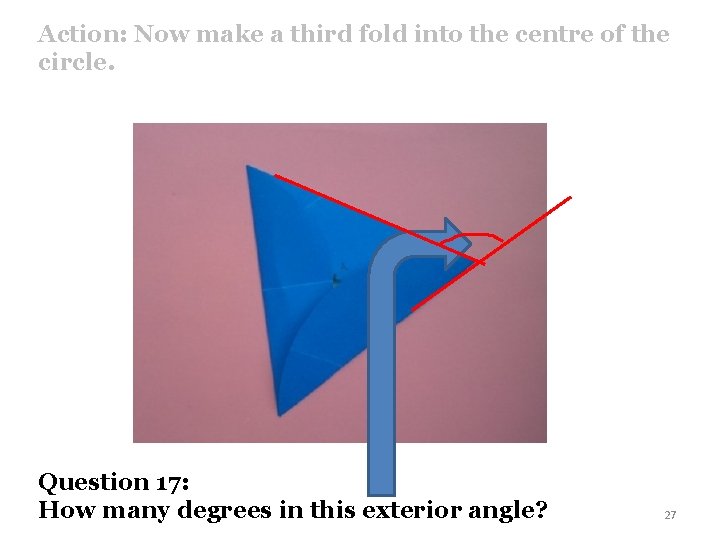
Action: Now make a third fold into the centre of the circle. Question 17: How many degrees in this exterior angle? 27
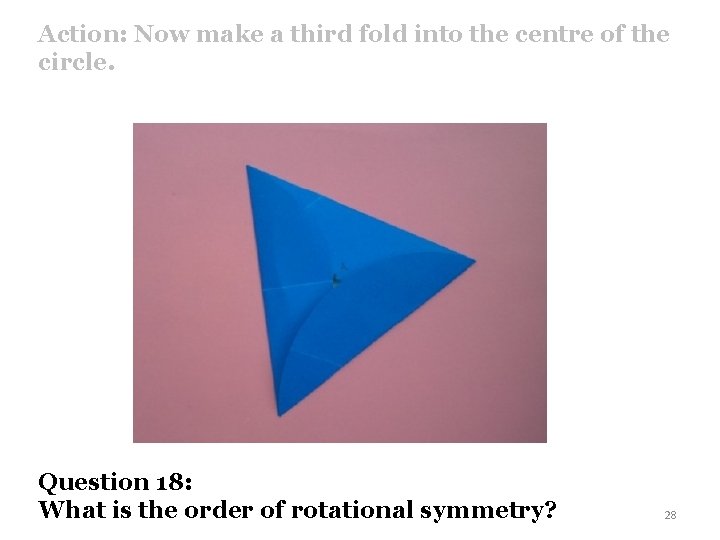
Action: Now make a third fold into the centre of the circle. Question 18: What is the order of rotational symmetry? 28
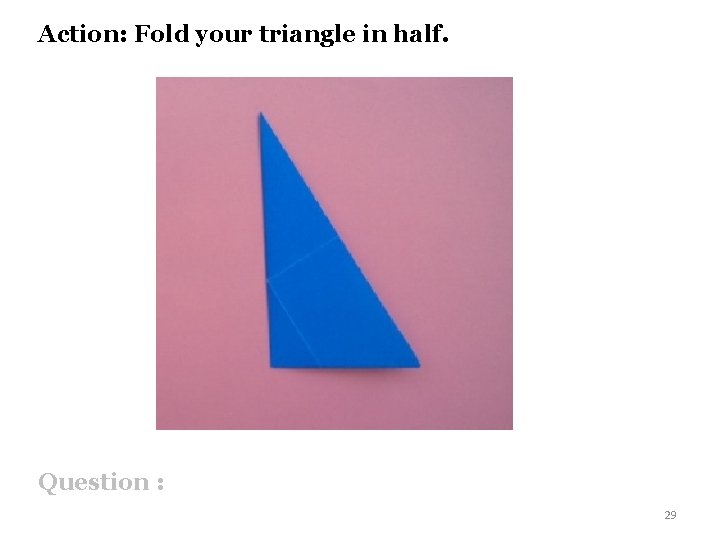
Action: Fold your triangle in half. Question : 29
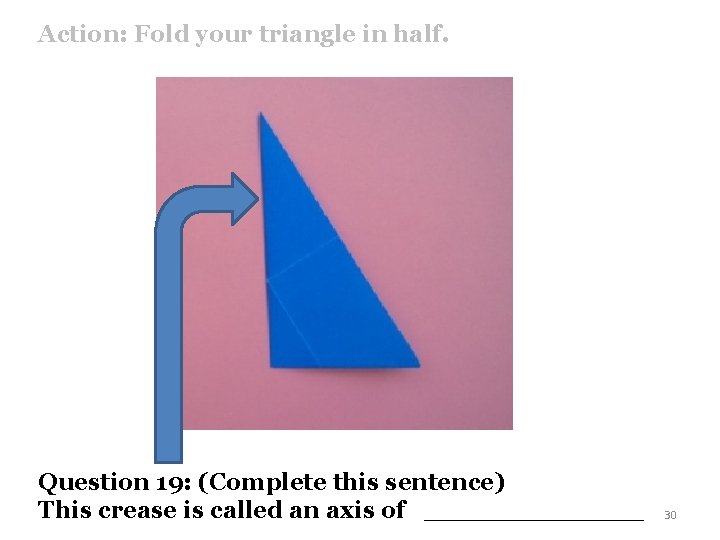
Action: Fold your triangle in half. Question 19: (Complete this sentence) This crease is called an axis of _______ 30
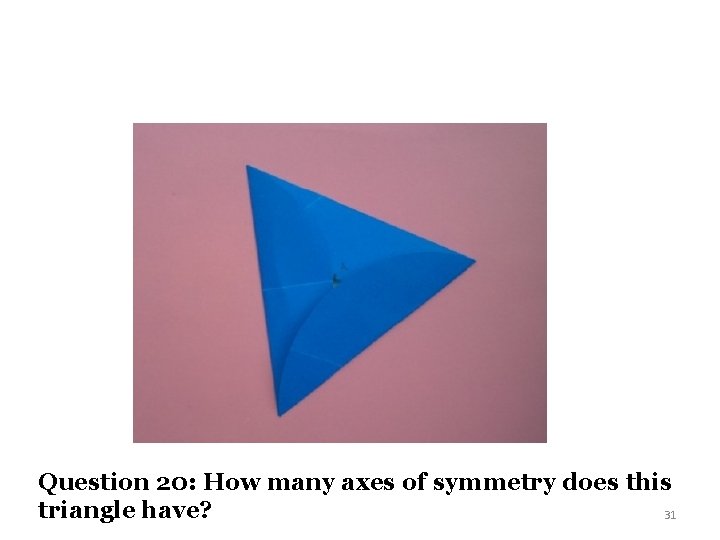
Question 20: How many axes of symmetry does this triangle have? 31
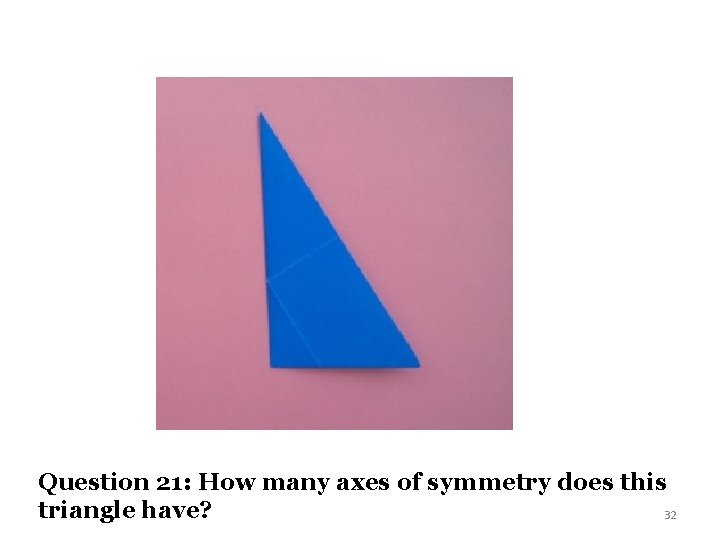
Question 21: How many axes of symmetry does this triangle have? 32
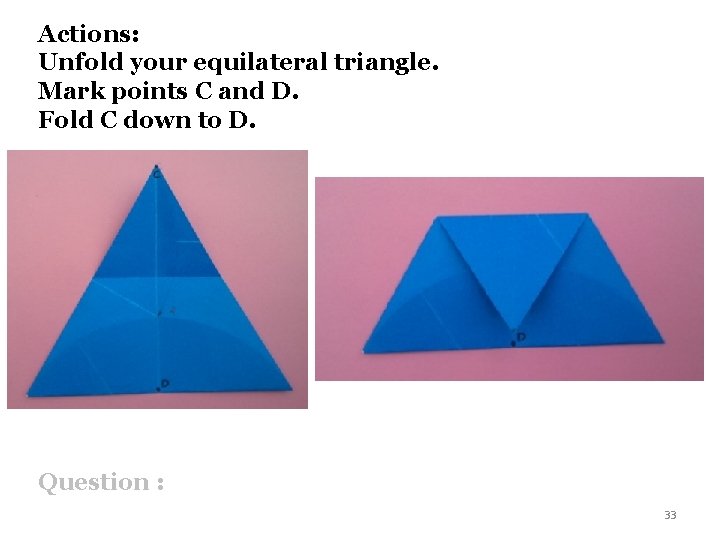
Actions: Unfold your equilateral triangle. Mark points C and D. Fold C down to D. Question : 33
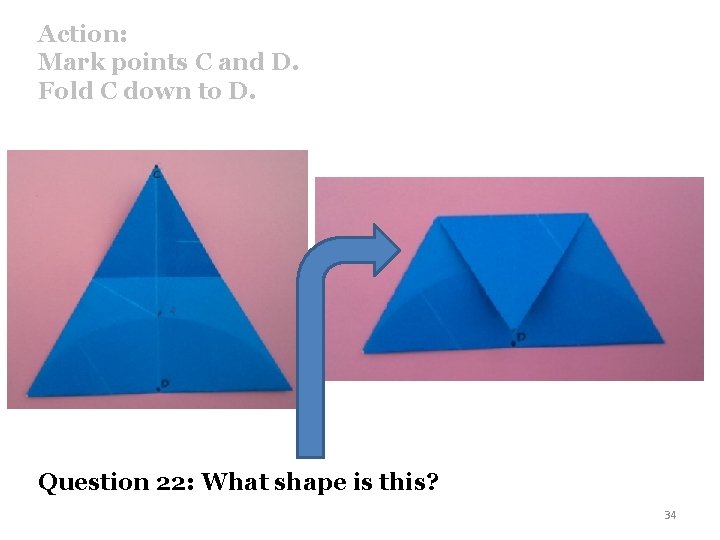
Action: Mark points C and D. Fold C down to D. Question 22: What shape is this? 34
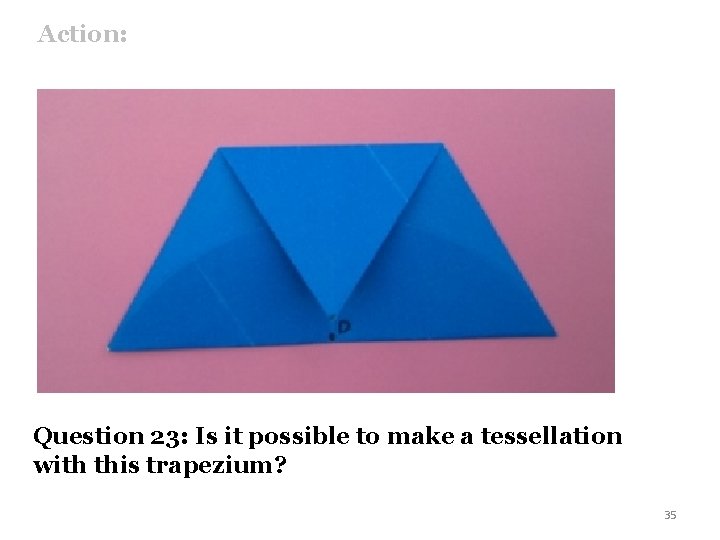
Action: Question 23: Is it possible to make a tessellation with this trapezium? 35
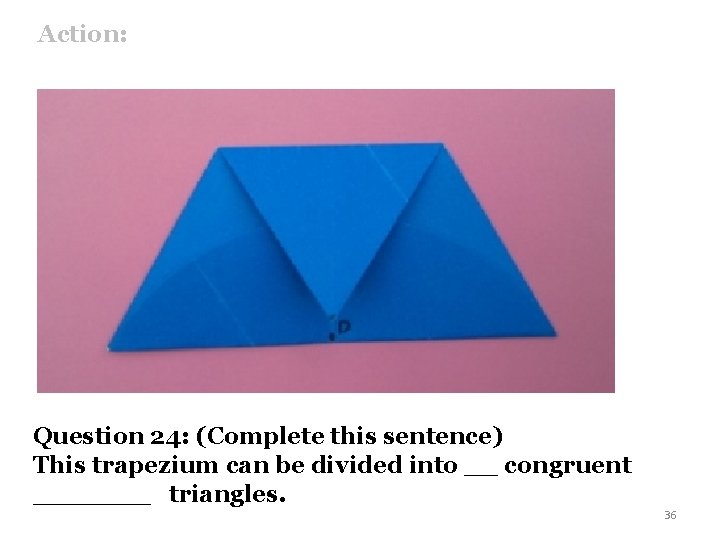
Action: Question 24: (Complete this sentence) This trapezium can be divided into __ congruent _______ triangles. 36
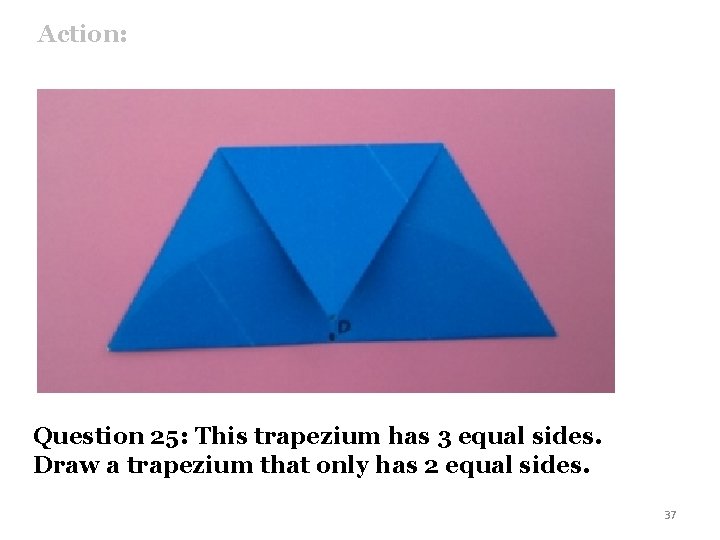
Action: Question 25: This trapezium has 3 equal sides. Draw a trapezium that only has 2 equal sides. 37
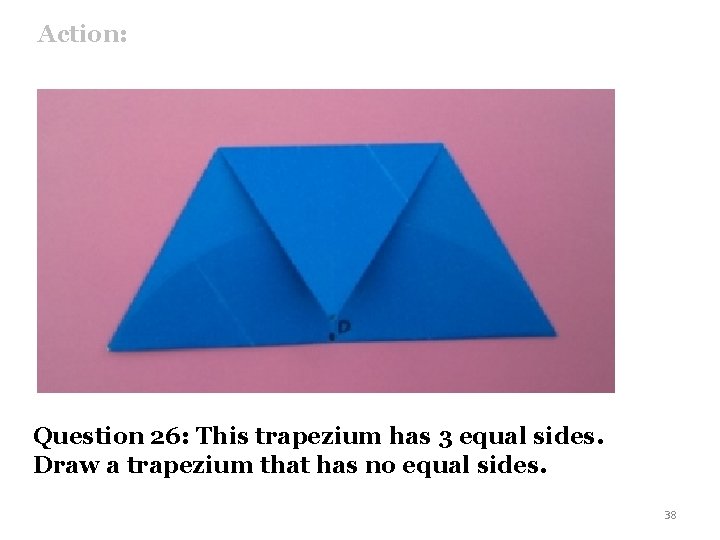
Action: Question 26: This trapezium has 3 equal sides. Draw a trapezium that has no equal sides. 38
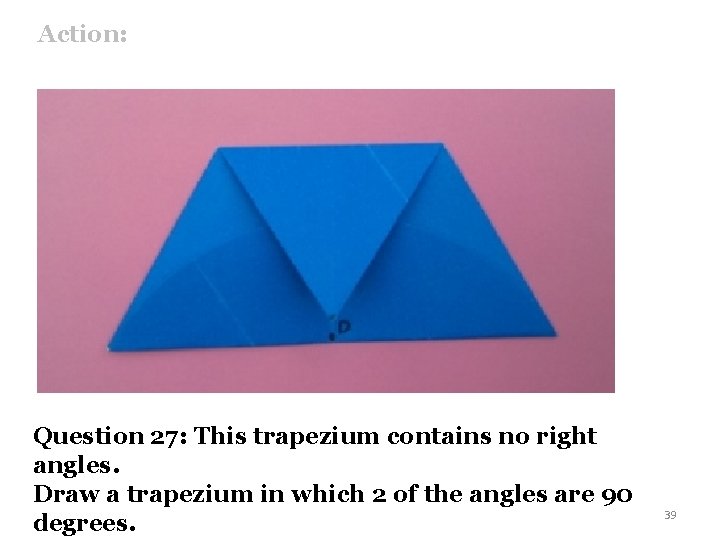
Action: Question 27: This trapezium contains no right angles. Draw a trapezium in which 2 of the angles are 90 degrees. 39
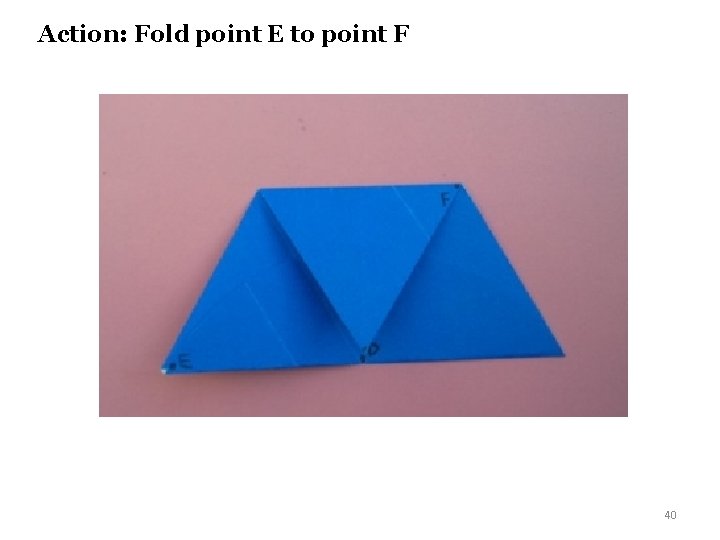
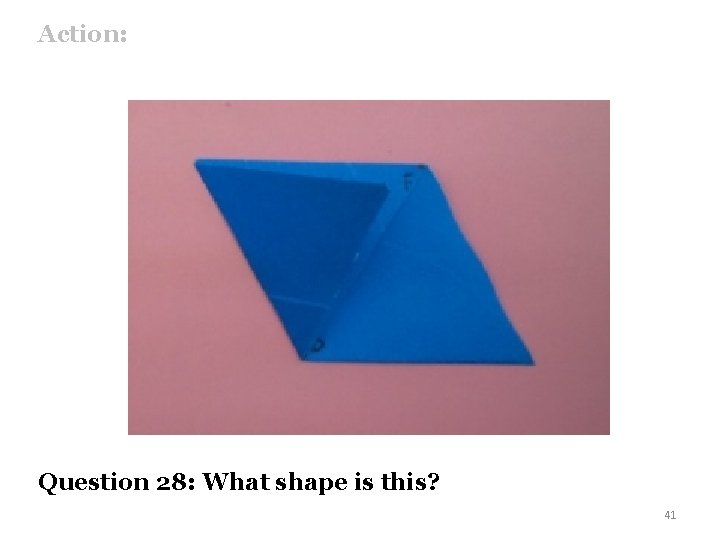
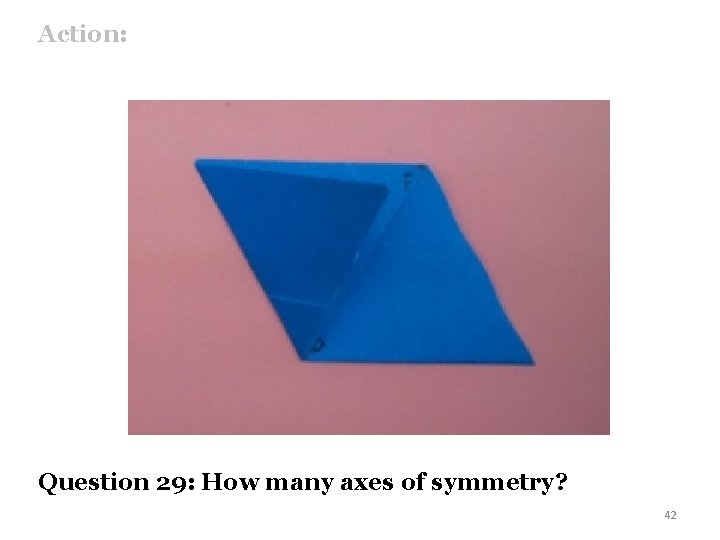
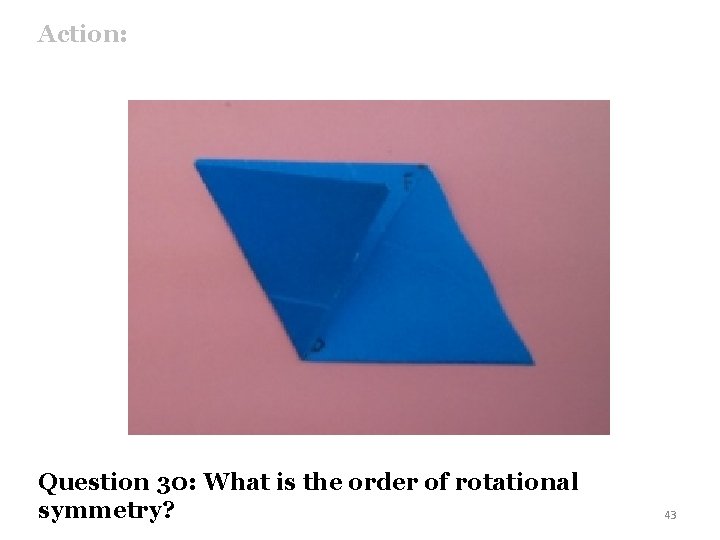
Action: Fold point E to point F 40
Action: Question 28: What shape is this? 41
Action: Question 29: How many axes of symmetry? 42
Action: Question 30: What is the order of rotational symmetry? 43
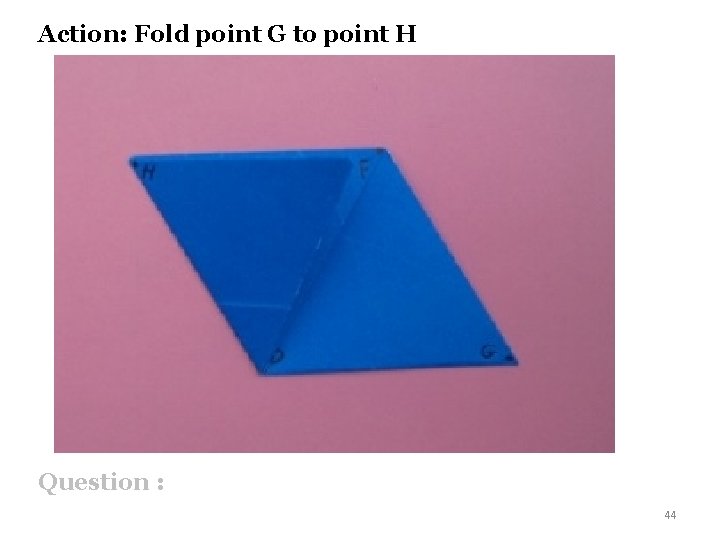
Action: Fold point G to point H Question : 44
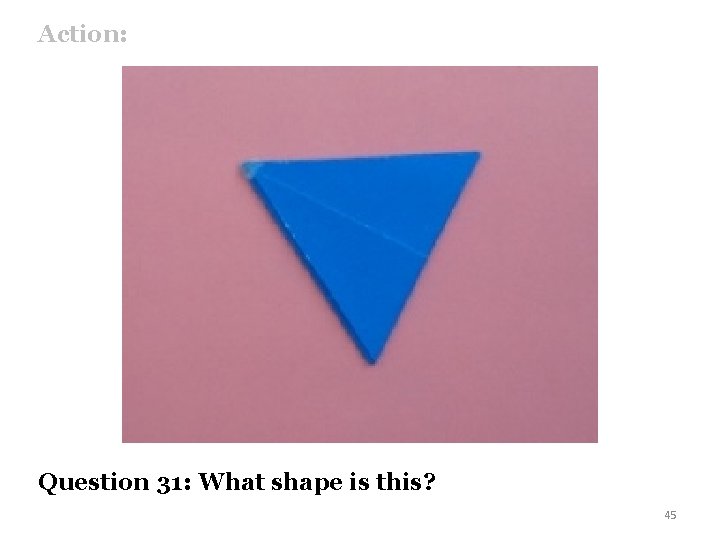
Action: Question 31: What shape is this? 45
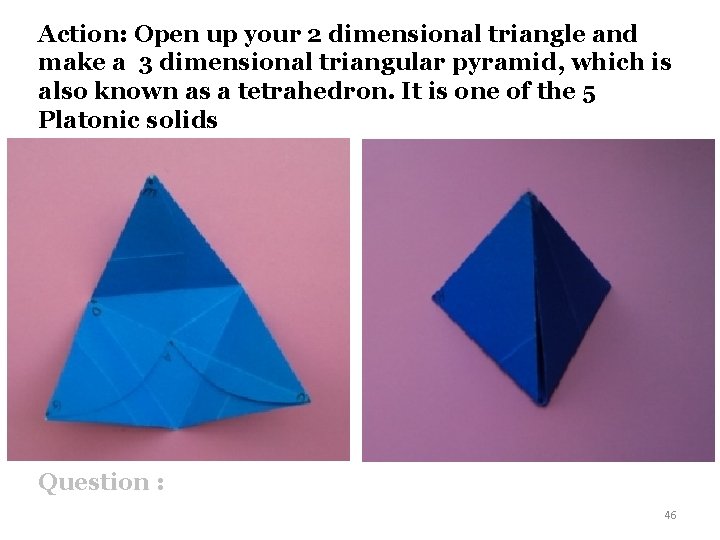
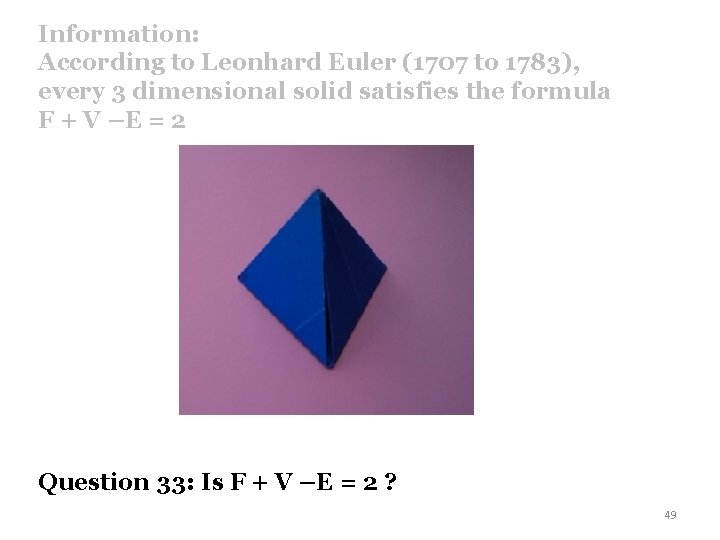
Action: Open up your 2 dimensional triangle and make a 3 dimensional triangular pyramid, which is also known as a tetrahedron. It is one of the 5 Platonic solids Question : 46
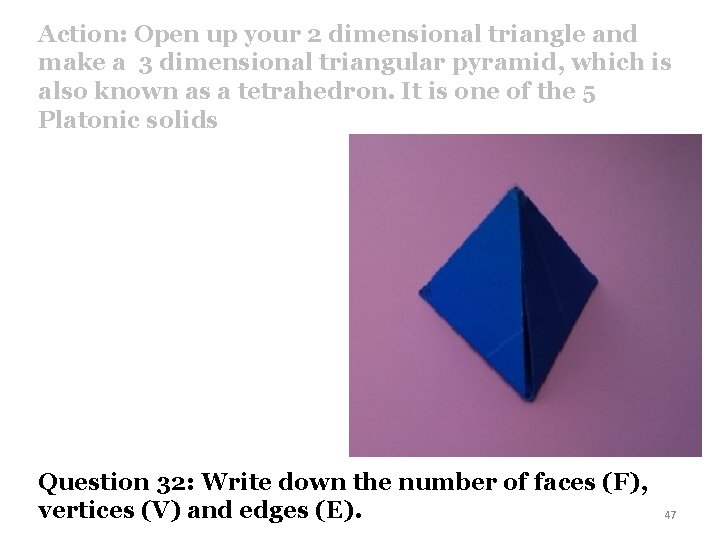
Action: Open up your 2 dimensional triangle and make a 3 dimensional triangular pyramid, which is also known as a tetrahedron. It is one of the 5 Platonic solids Question 32: Write down the number of faces (F), vertices (V) and edges (E). 47
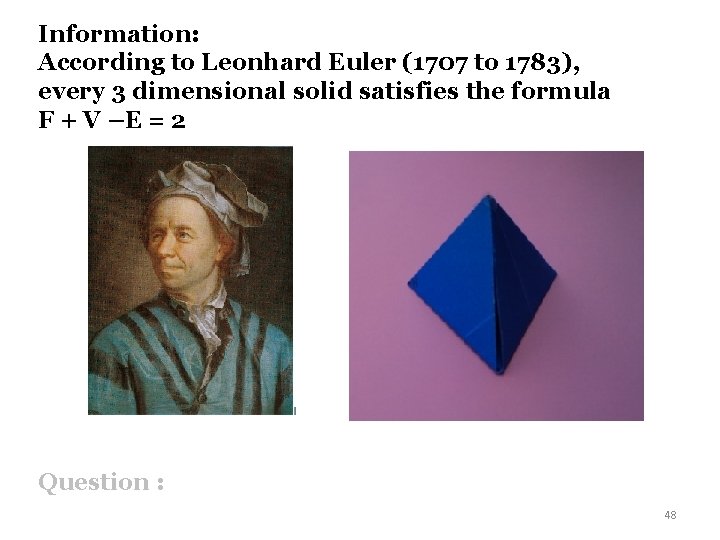
Information: According to Leonhard Euler (1707 to 1783), every 3 dimensional solid satisfies the formula F + V –E = 2 Question : 48
Information: According to Leonhard Euler (1707 to 1783), every 3 dimensional solid satisfies the formula F + V –E = 2 Question 33: Is F + V –E = 2 ? 49
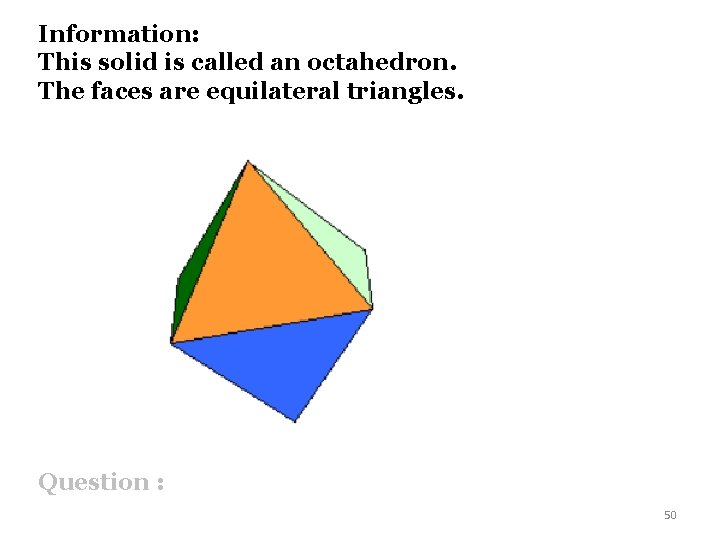
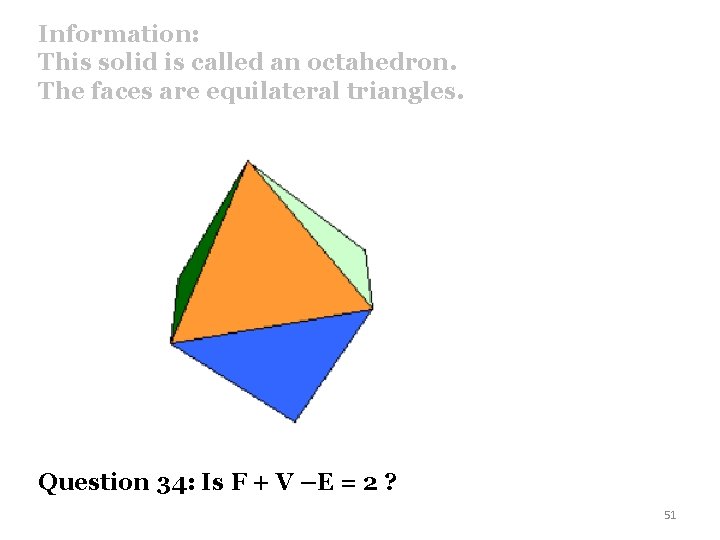
Information: This solid is called an octahedron. The faces are equilateral triangles. Question : 50
Information: This solid is called an octahedron. The faces are equilateral triangles. Question 34: Is F + V –E = 2 ? 51
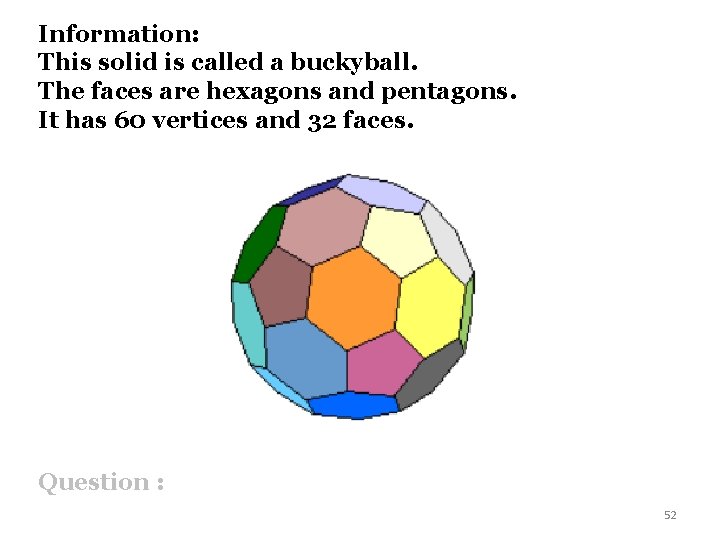
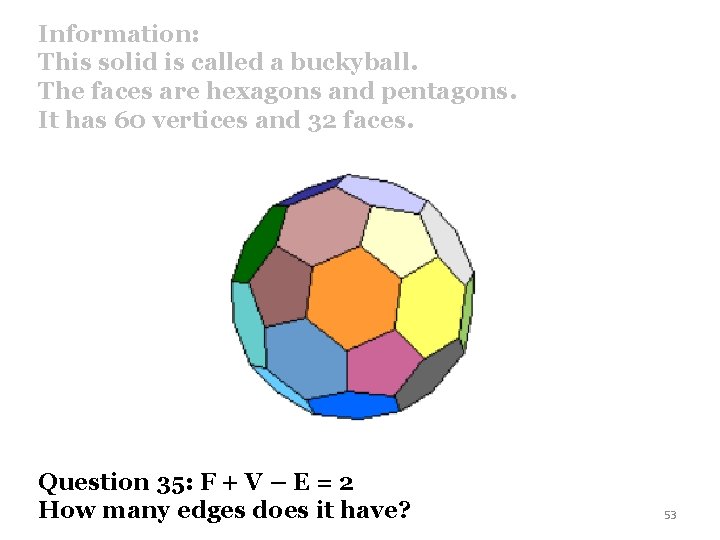
Information: This solid is called a buckyball. The faces are hexagons and pentagons. It has 60 vertices and 32 faces. Question : 52
Information: This solid is called a buckyball. The faces are hexagons and pentagons. It has 60 vertices and 32 faces. Question 35: F + V – E = 2 How many edges does it have? 53
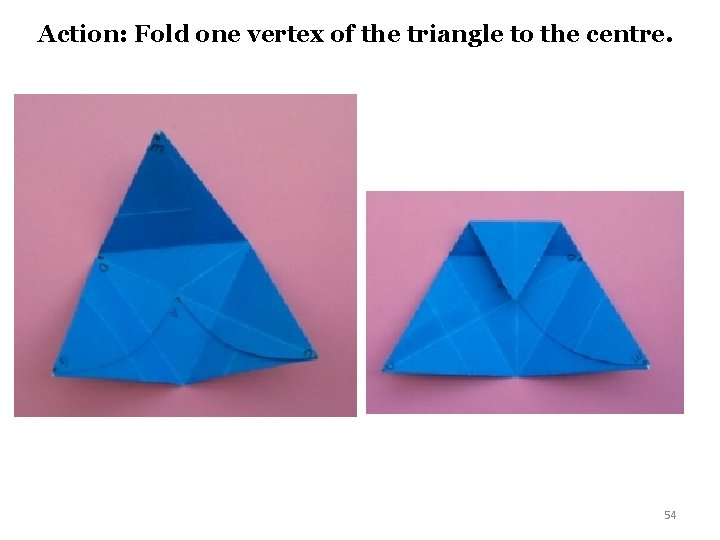
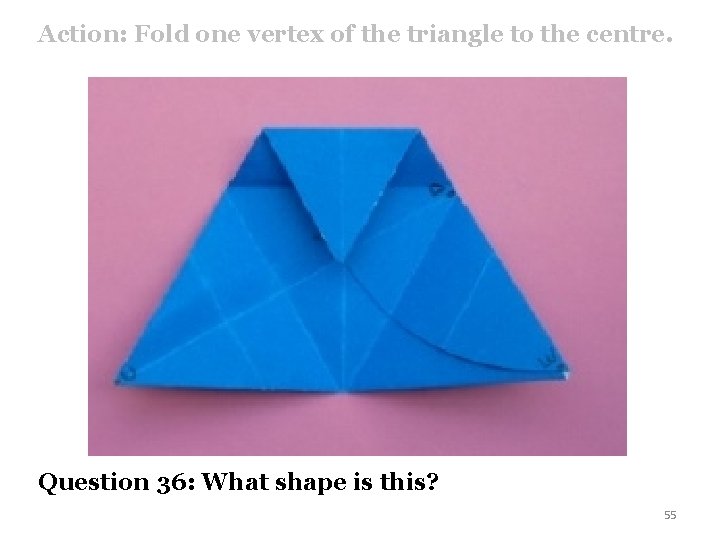
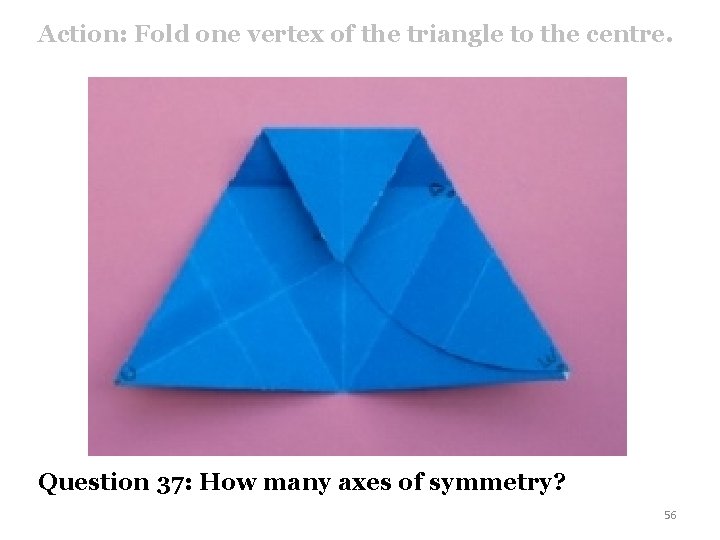
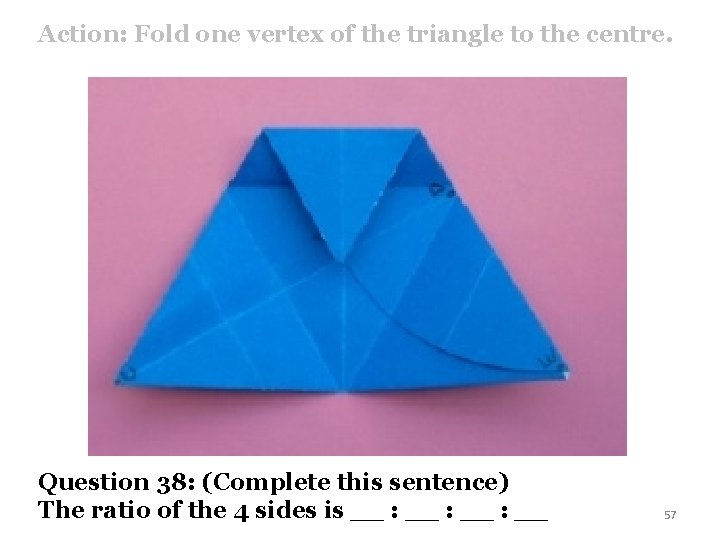
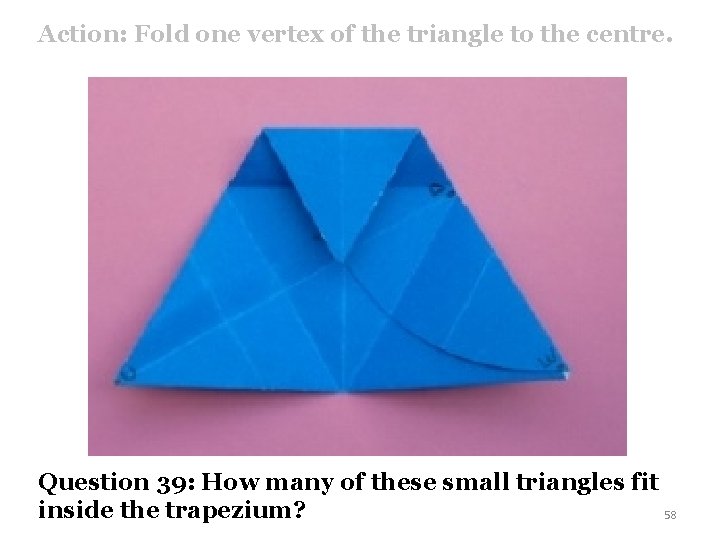
Action: Fold one vertex of the triangle to the centre. 54
Action: Fold one vertex of the triangle to the centre. Question 36: What shape is this? 55
Action: Fold one vertex of the triangle to the centre. Question 37: How many axes of symmetry? 56
Action: Fold one vertex of the triangle to the centre. Question 38: (Complete this sentence) The ratio of the 4 sides is __ : __ 57
Action: Fold one vertex of the triangle to the centre. Question 39: How many of these small triangles fit inside the trapezium? 58
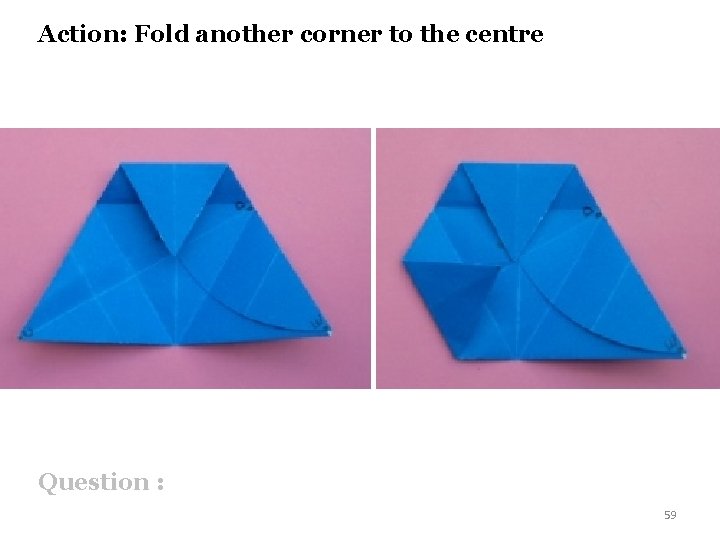
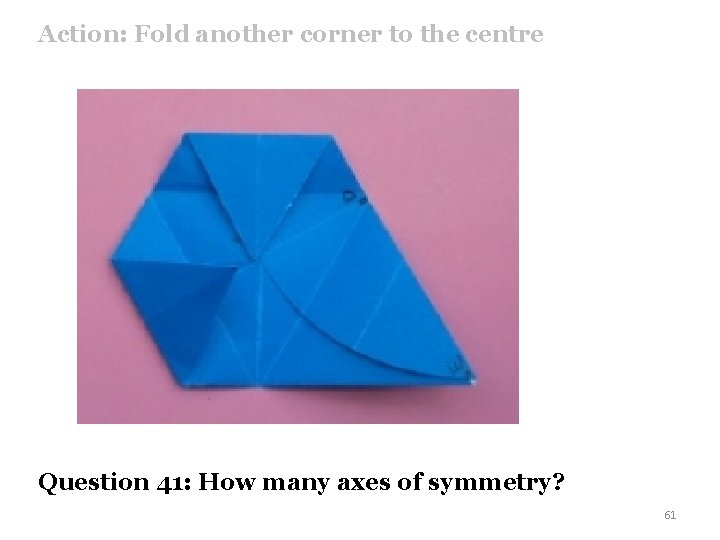
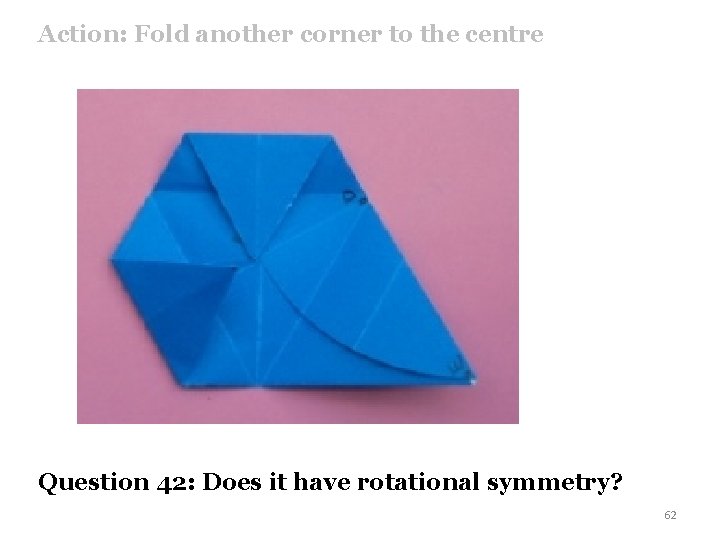
Action: Fold another corner to the centre Question : 59
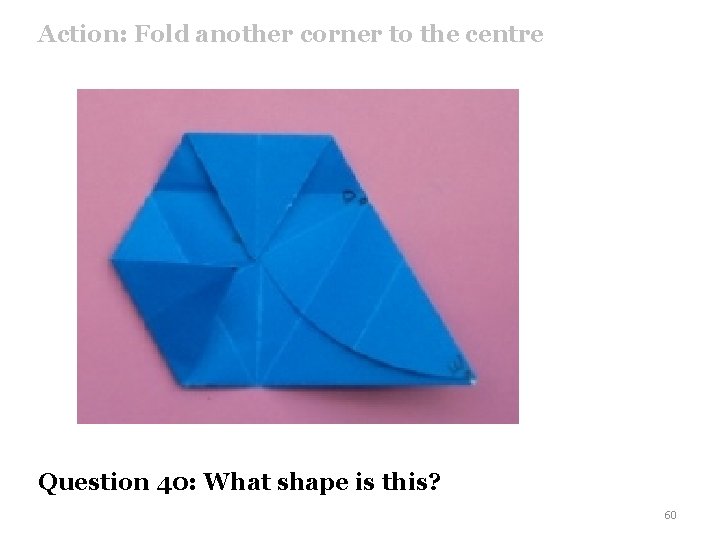
Action: Fold another corner to the centre Question 40: What shape is this? 60
Action: Fold another corner to the centre Question 41: How many axes of symmetry? 61
Action: Fold another corner to the centre Question 42: Does it have rotational symmetry? 62
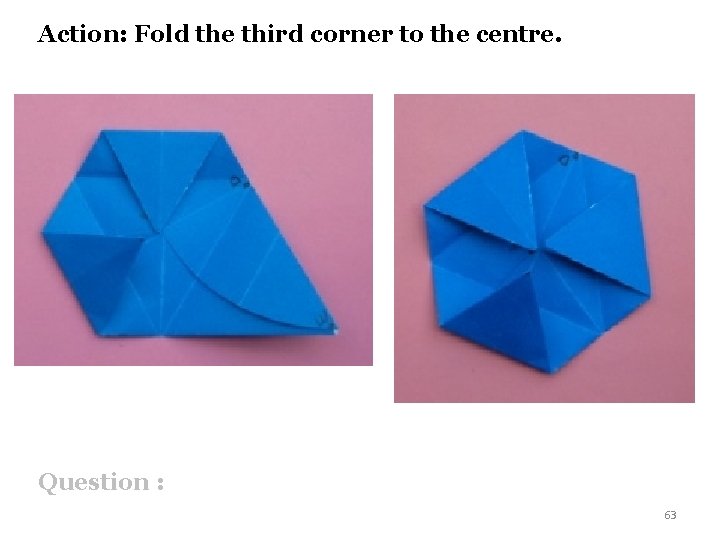
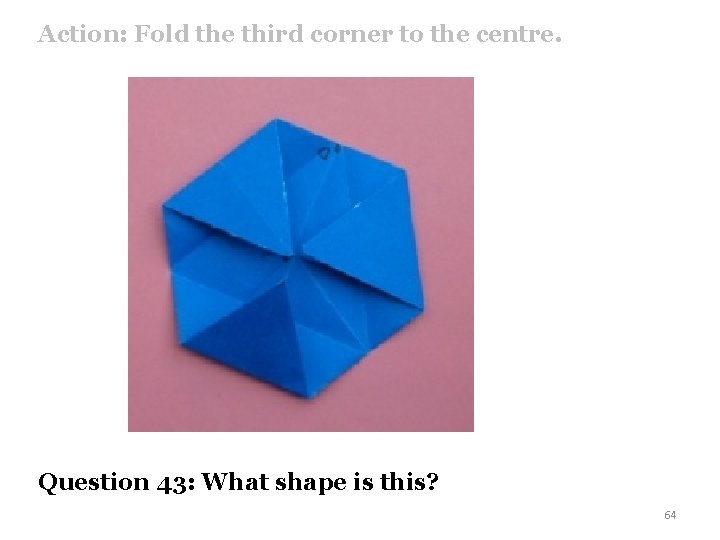
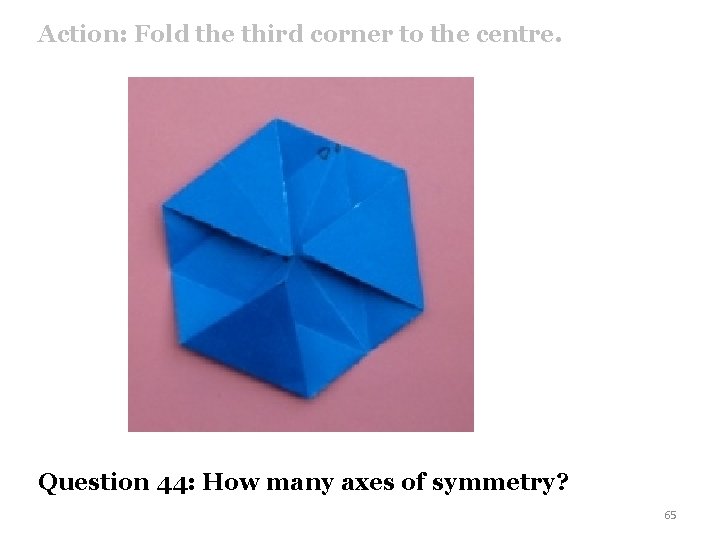
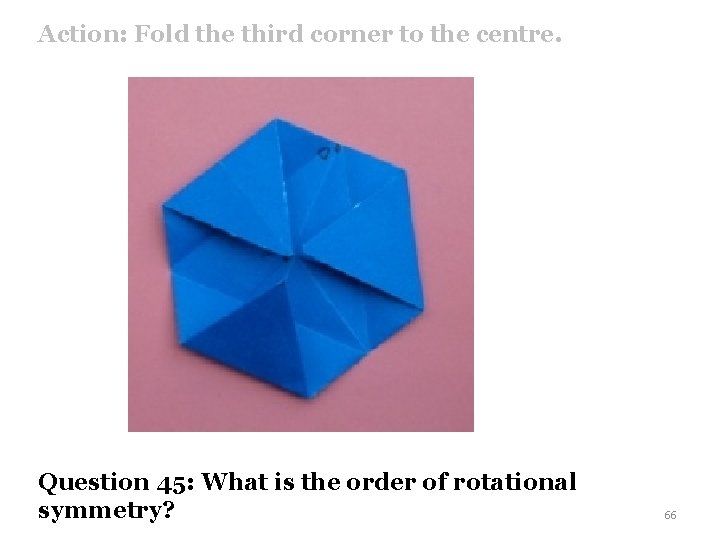
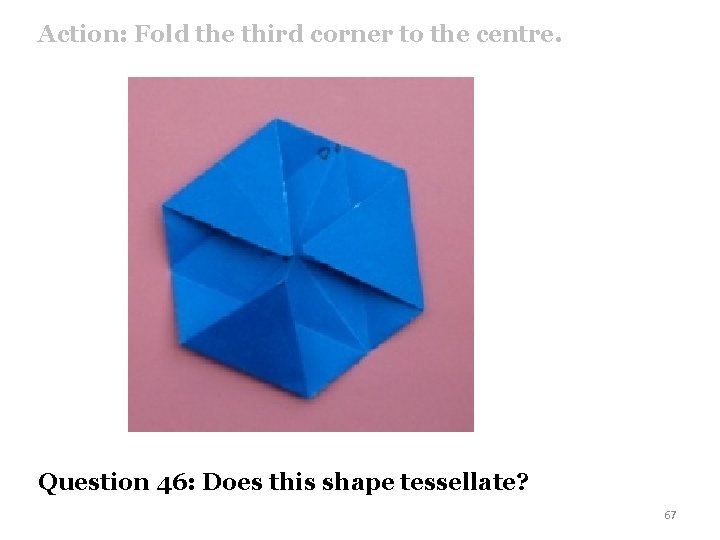
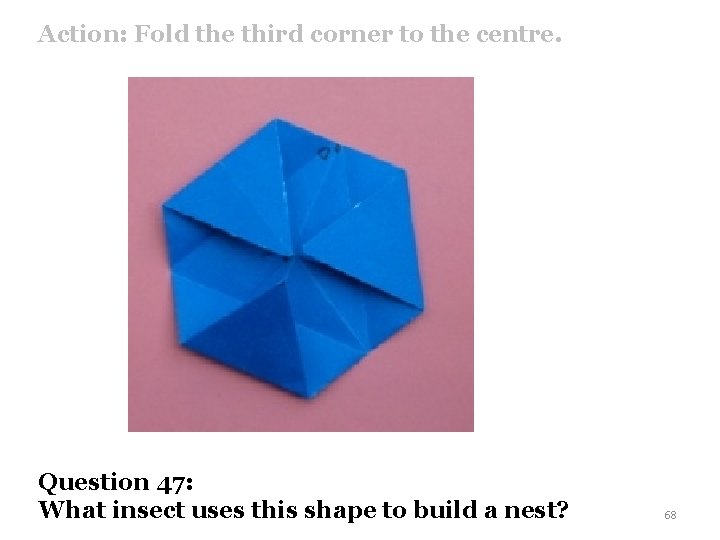
Action: Fold the third corner to the centre. Question : 63
Action: Fold the third corner to the centre. Question 43: What shape is this? 64
Action: Fold the third corner to the centre. Question 44: How many axes of symmetry? 65
Action: Fold the third corner to the centre. Question 45: What is the order of rotational symmetry? 66
Action: Fold the third corner to the centre. Question 46: Does this shape tessellate? 67
Action: Fold the third corner to the centre. Question 47: What insect uses this shape to build a nest? 68
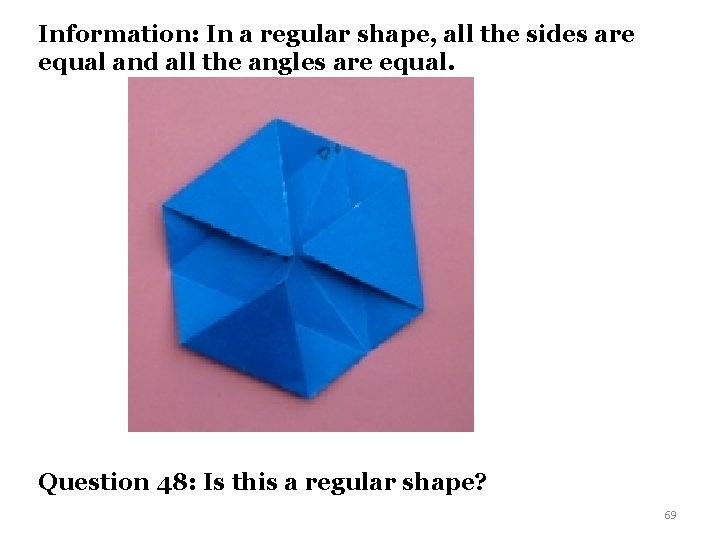
Information: In a regular shape, all the sides are equal and all the angles are equal. Question 48: Is this a regular shape? 69
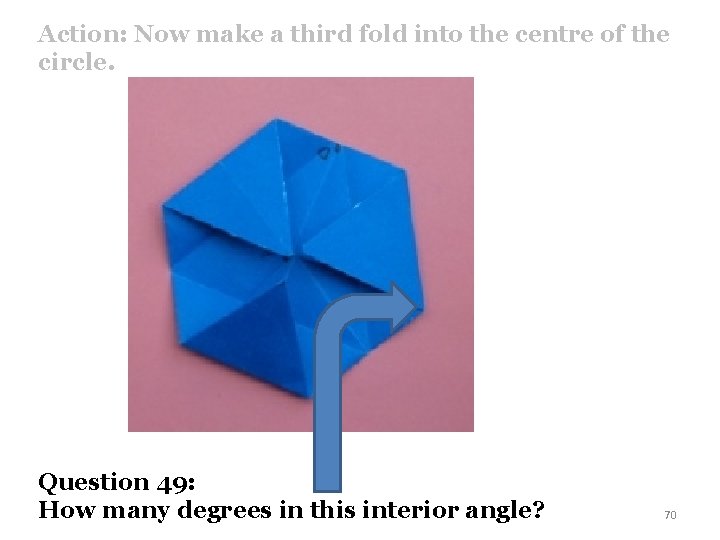
Action: Now make a third fold into the centre of the circle. Question 49: How many degrees in this interior angle? 70
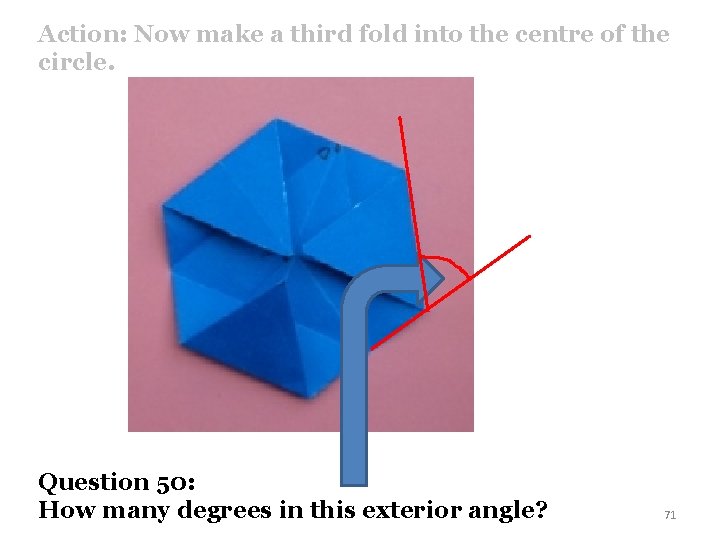
Action: Now make a third fold into the centre of the circle. Question 50: How many degrees in this exterior angle? 71
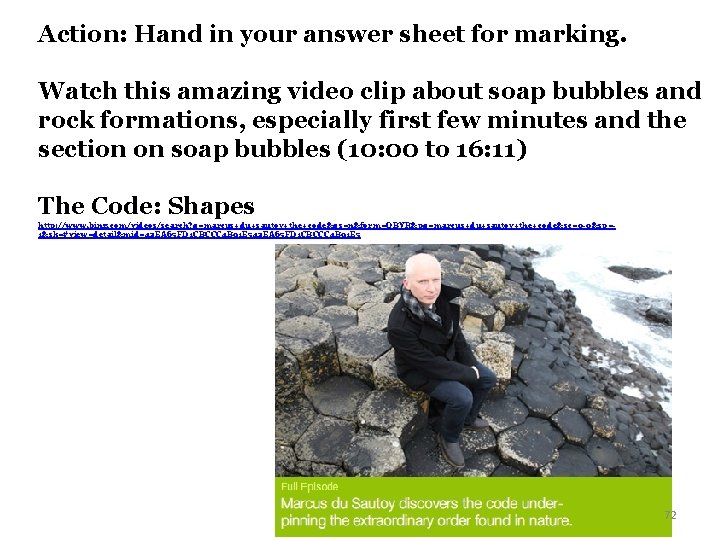
Action: Hand in your answer sheet for marking. Watch this amazing video clip about soap bubbles and rock formations, especially first few minutes and the section on soap bubbles (10: 00 to 16: 11) The Code: Shapes http: //www. bing. com/videos/search? q=marcus+du+sautoy+the+code&qs=n&form=QBVR&pq=marcus+du+sautoy+the+code&sc=0 -0&sp=1&sk=#view=detail&mid=42 EA 65 FD 1 CBCCC 4 B 91 E 5 72