
Investigating blue light illumination on human retinal pigment
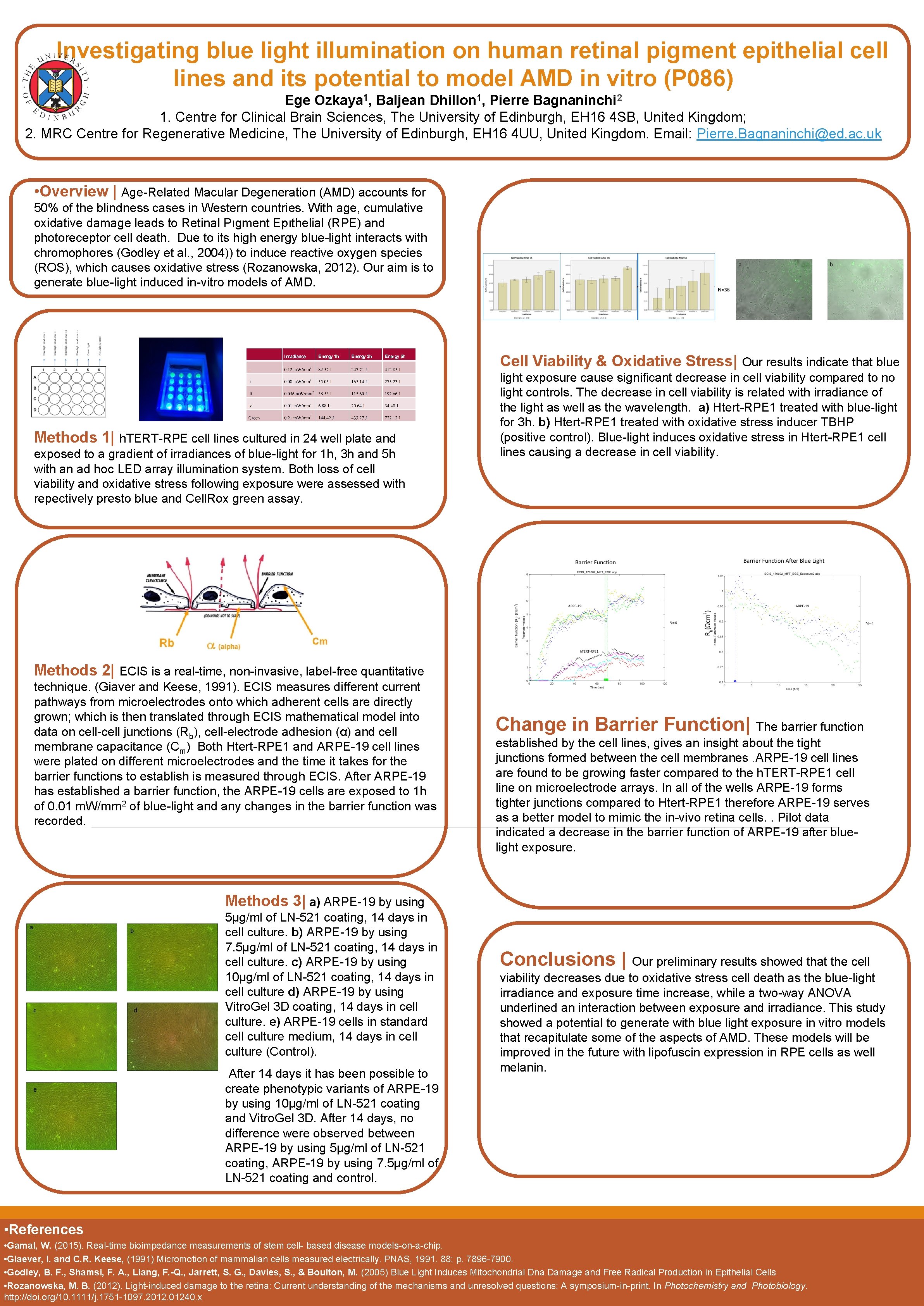
Investigating blue light illumination on human retinal pigment epithelial cell lines and its potential to model AMD in vitro (P 086) Ege Ozkaya 1, Baljean Dhillon 1, Pierre Bagnaninchi 2 1. Centre for Clinical Brain Sciences, The University of Edinburgh, EH 16 4 SB, United Kingdom; 2. MRC Centre for Regenerative Medicine, The University of Edinburgh, EH 16 4 UU, United Kingdom. Email: Pierre. Bagnaninchi@ed. ac. uk • Overview | Age-Related Macular Degeneration (AMD) accounts for 50% of the blindness cases in Western countries. With age, cumulative oxidative damage leads to Retinal Pıgment Epıthelial (RPE) and photoreceptor cell death. Due to its high energy blue-light interacts with chromophores (Godley et al. , 2004)) to induce reactive oxygen species (ROS), which causes oxidative stress (Rozanowska, 2012). Our aim is to generate blue-light induced in-vitro models of AMD. Cell Viability & Oxidative Stress| Our results indicate that blue Methods 1| h. TERT-RPE cell lines cultured in 24 well plate and exposed to a gradient of irradiances of blue-light for 1 h, 3 h and 5 h with an ad hoc LED array illumination system. Both loss of cell viability and oxidative stress following exposure were assessed with repectively presto blue and Cell. Rox green assay. light exposure cause significant decrease in cell viability compared to no light controls. The decrease in cell viability is related with irradiance of the light as well as the wavelength. a) Htert-RPE 1 treated with blue-light for 3 h. b) Htert-RPE 1 treated with oxidative stress inducer TBHP (positive control). Blue-light induces oxidative stress in Htert-RPE 1 cell lines causing a decrease in cell viability. Methods 2| ECIS is a real-time, non-invasive, label-free quantitative technique. (Giaver and Keese, 1991). ECIS measures different current pathways from microelectrodes onto which adherent cells are directly grown; which is then translated through ECIS mathematical model into data on cell-cell junctions (Rb), cell-electrode adhesion (α) and cell membrane capacitance (Cm) Both Htert-RPE 1 and ARPE-19 cell lines were plated on different microelectrodes and the time it takes for the barrier functions to establish is measured through ECIS. After ARPE-19 has established a barrier function, the ARPE-19 cells are exposed to 1 h of 0. 01 m. W/mm 2 of blue-light and any changes in the barrier function was recorded. Change in Barrier Function| The barrier function established by the cell lines, gives an insight about the tight junctions formed between the cell membranes. ARPE-19 cell lines are found to be growing faster compared to the h. TERT-RPE 1 cell line on microelectrode arrays. In all of the wells ARPE-19 forms tighter junctions compared to Htert-RPE 1 therefore ARPE-19 serves as a better model to mimic the in-vivo retina cells. . Pilot data indicated a decrease in the barrier function of ARPE-19 after bluelight exposure. Methods 3| a) ARPE-19 by using 5µg/ml of LN-521 coating, 14 days in cell culture. b) ARPE-19 by using 7. 5µg/ml of LN-521 coating, 14 days in cell culture. c) ARPE-19 by using 10µg/ml of LN-521 coating, 14 days in cell culture d) ARPE-19 by using Vitro. Gel 3 D coating, 14 days in cell culture. e) ARPE-19 cells in standard cell culture medium, 14 days in cell culture (Control). After 14 days it has been possible to create phenotypic variants of ARPE-19 by using 10µg/ml of LN-521 coating and Vitro. Gel 3 D. After 14 days, no difference were observed between ARPE-19 by using 5µg/ml of LN-521 coating, ARPE-19 by using 7. 5µg/ml of LN-521 coating and control. Conclusions | Our preliminary results showed that the cell viability decreases due to oxidative stress cell death as the blue-light irradiance and exposure time increase, while a two-way ANOVA underlined an interaction between exposure and irradiance. This study showed a potential to generate with blue light exposure in vitro models that recapitulate some of the aspects of AMD. These models will be improved in the future with lipofuscin expression in RPE cells as well melanin. • References • Gamal, W. (2015). Real-time bioimpedance measurements of stem cell- based disease models-on-a-chip. • Giaever, I. and C. R. Keese, (1991) Micromotion of mammalian cells measured electrically. PNAS, 1991. 88: p. 7896 -7900. • Godley, B. F. , Shamsi, F. A. , Liang, F. -Q. , Jarrett, S. G. , Davies, S. , & Boulton, M. (2005) Blue Light Induces Mitochondrial Dna Damage and Free Radical Production in Epithelial Cells • Rozanowska, M. B. (2012). Light-induced damage to the retina: Current understanding of the mechanisms and unresolved questions: A symposium-in-print. In Photochemistry and Photobiology. http: //doi. org/10. 1111/j. 1751 -1097. 2012. 01240. x
- Slides: 1